University of the Punjab
Department of English Language & Literature
Lahore, Pakistan
Semantics
• Learning a language includes:
– learning the meaning of individual elements
– how to combine these to make further meaningful
phrases and sentences
• The study of meaning that can be determined from:
–A sentence
– Phrase
–Word
Principle of Compositionality
• The meaning of a sentence is determined:
– by the meaning of its component parts
– the manner in which they are arranged in syntactic
structure
• So, the meaning of a sentence is:
– just the word meanings
– Interface of syntax and semantics - syntax
influences meaning
“Keelin killed John”
vs
“John killed Keelin”: huge difference
Types of Meaning
Referential:
thing, event, state of the world
Social:
word choice tells us about
someone's social class
Affective:
word choice conveys feelings and
attitudes
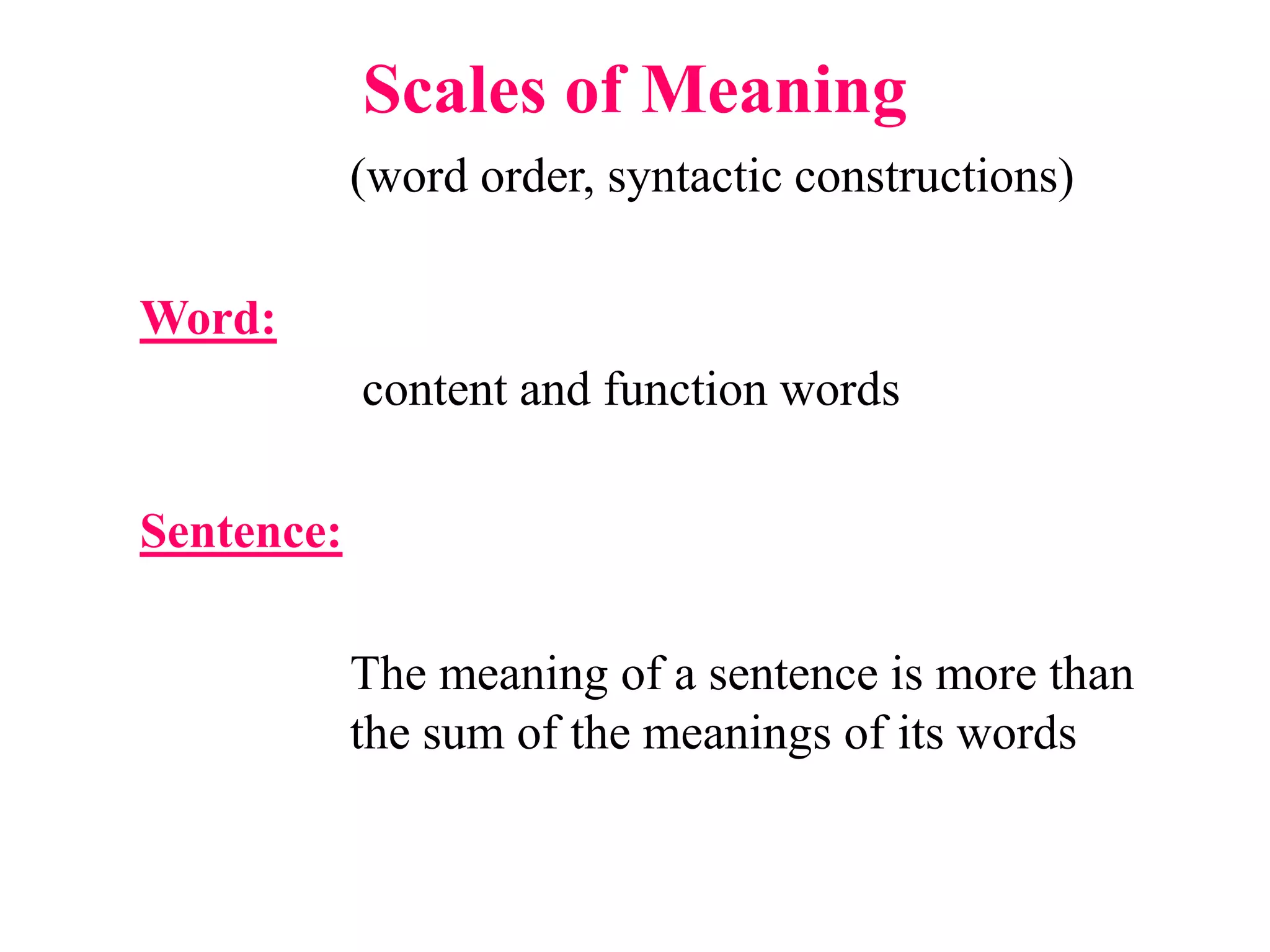
Scales of Meaning
(word order, syntactic constructions)
Word:
content and function words
Sentence:
The meaning of a sentence is more than
the sum of the meanings of its words
Lexical Semantics
• Semantic Properties:
– The components of meaning of a word
– and the meaningful relationship between words
• Semantic feature:
– A device for expressing the presence or absence of
semantic properties by pluses and minuses.
baby is [+ young], [+ human], [– abstract]
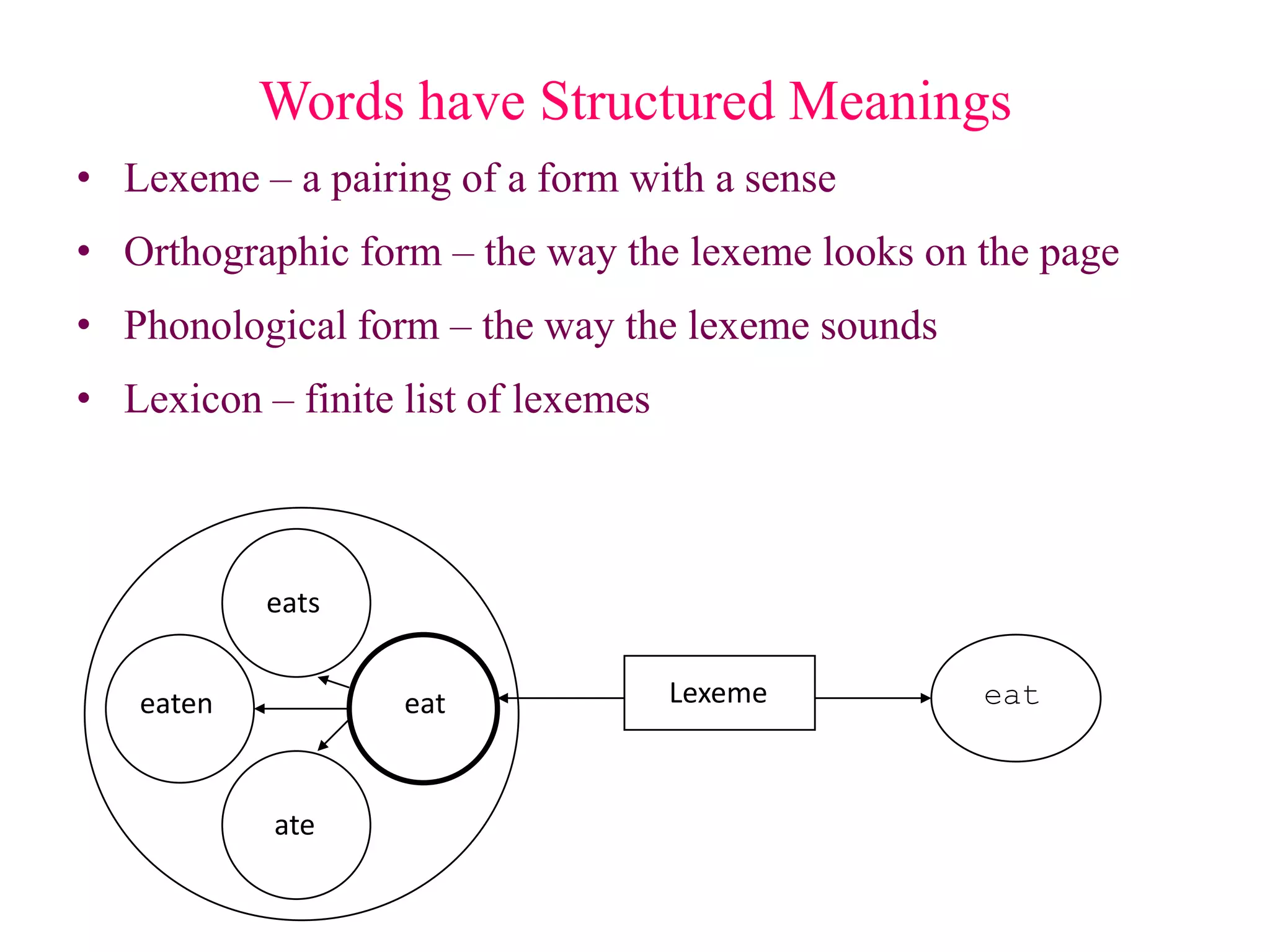
Words have Structured Meanings
• Lexeme – a pairing of a form with a sense
• Orthographic form – the way the lexeme looks on the page
• Phonological form – the way the lexeme sounds
• Lexicon – finite list of lexemes
eaten eat
eats
ate
Lexeme eat
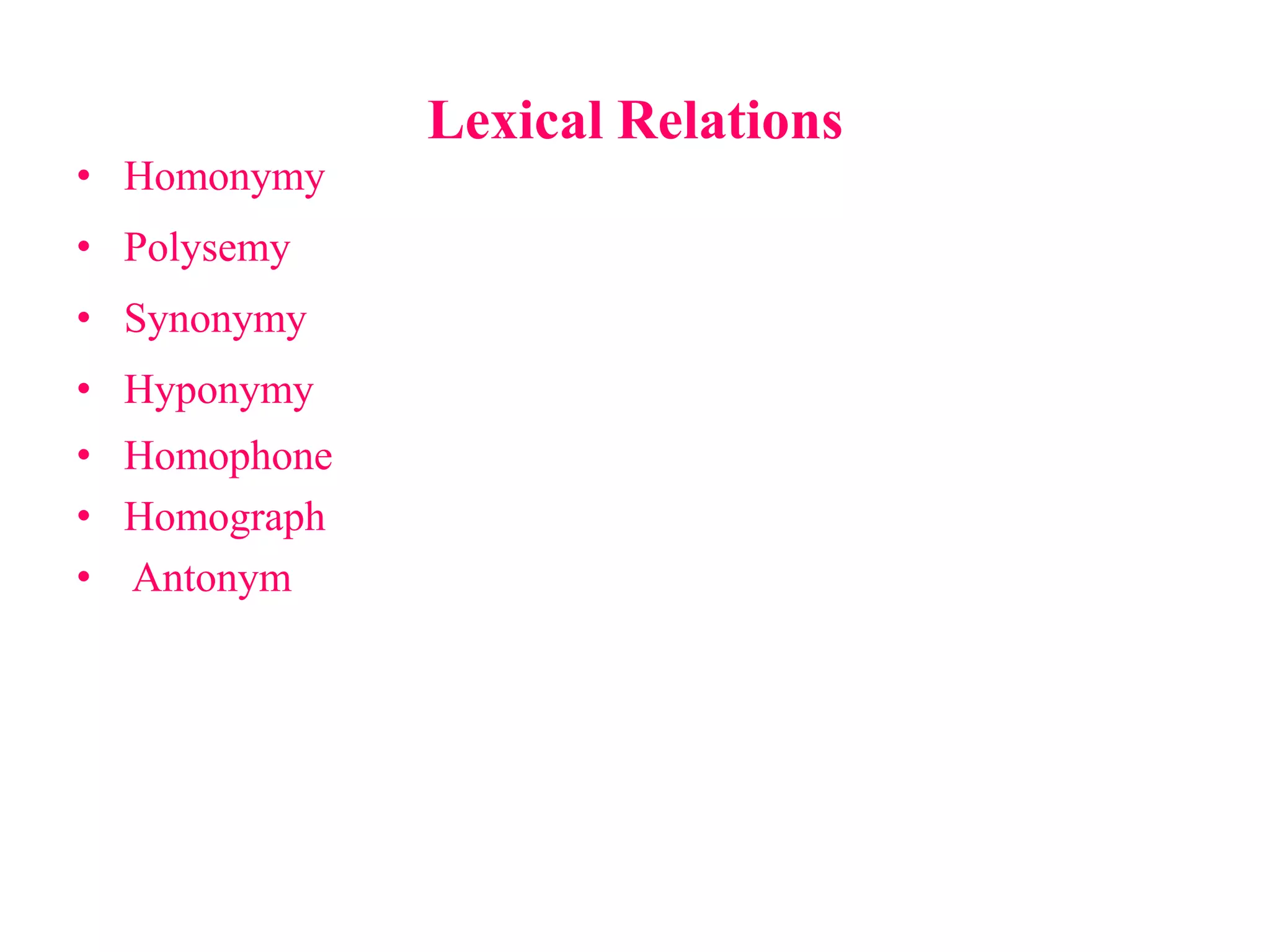
Lexical Relations
• Homonymy
• Polysemy
• Synonymy
• Hyponymy
• Homophone
• Homograph
• Antonym
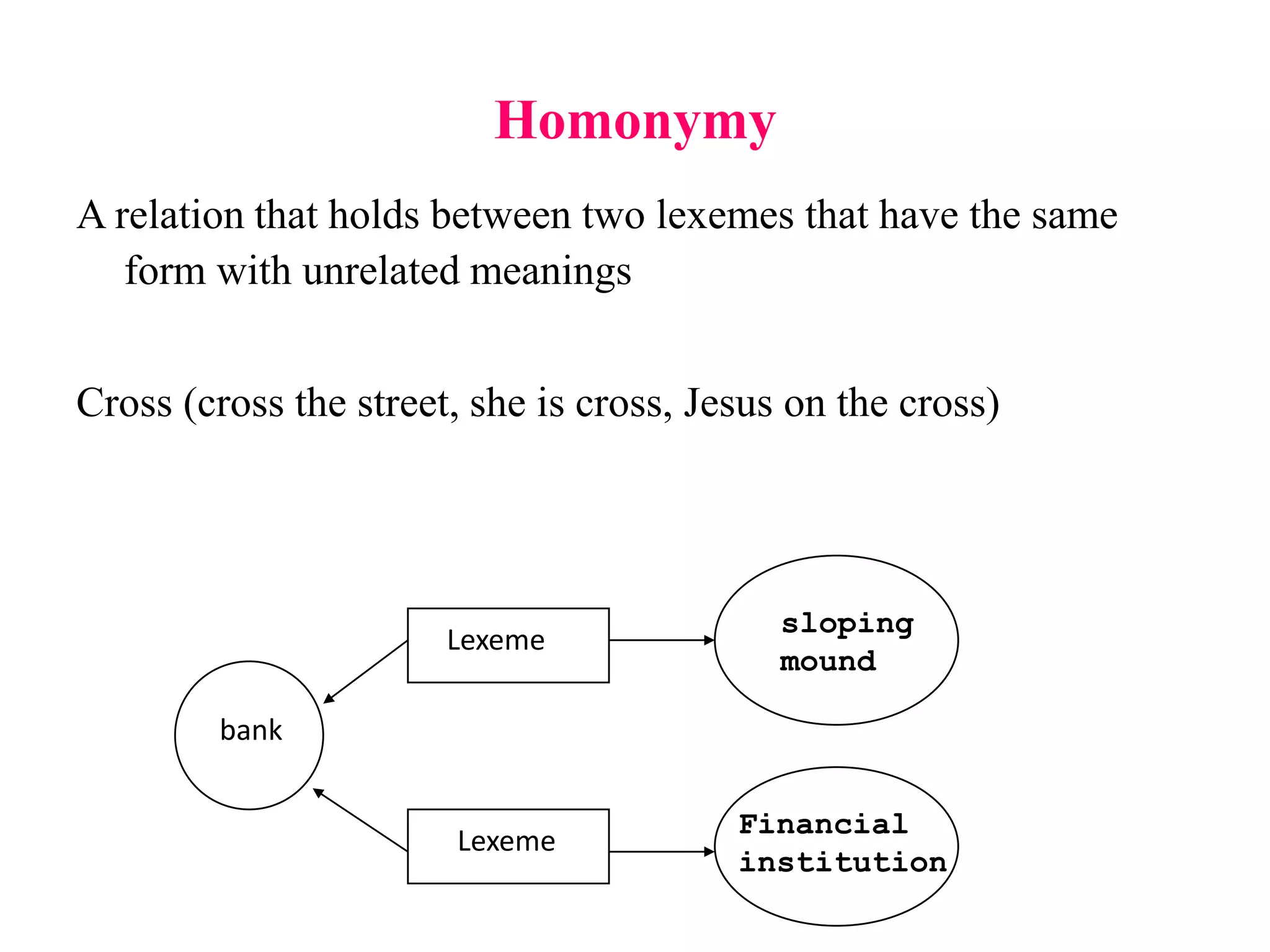
Homonymy
A relation that holds between two lexemes that have the same
form with unrelated meanings
Cross (cross the street, she is cross, Jesus on the cross)
bank
sloping
mound
Financial
institution
Lexeme
Lexeme
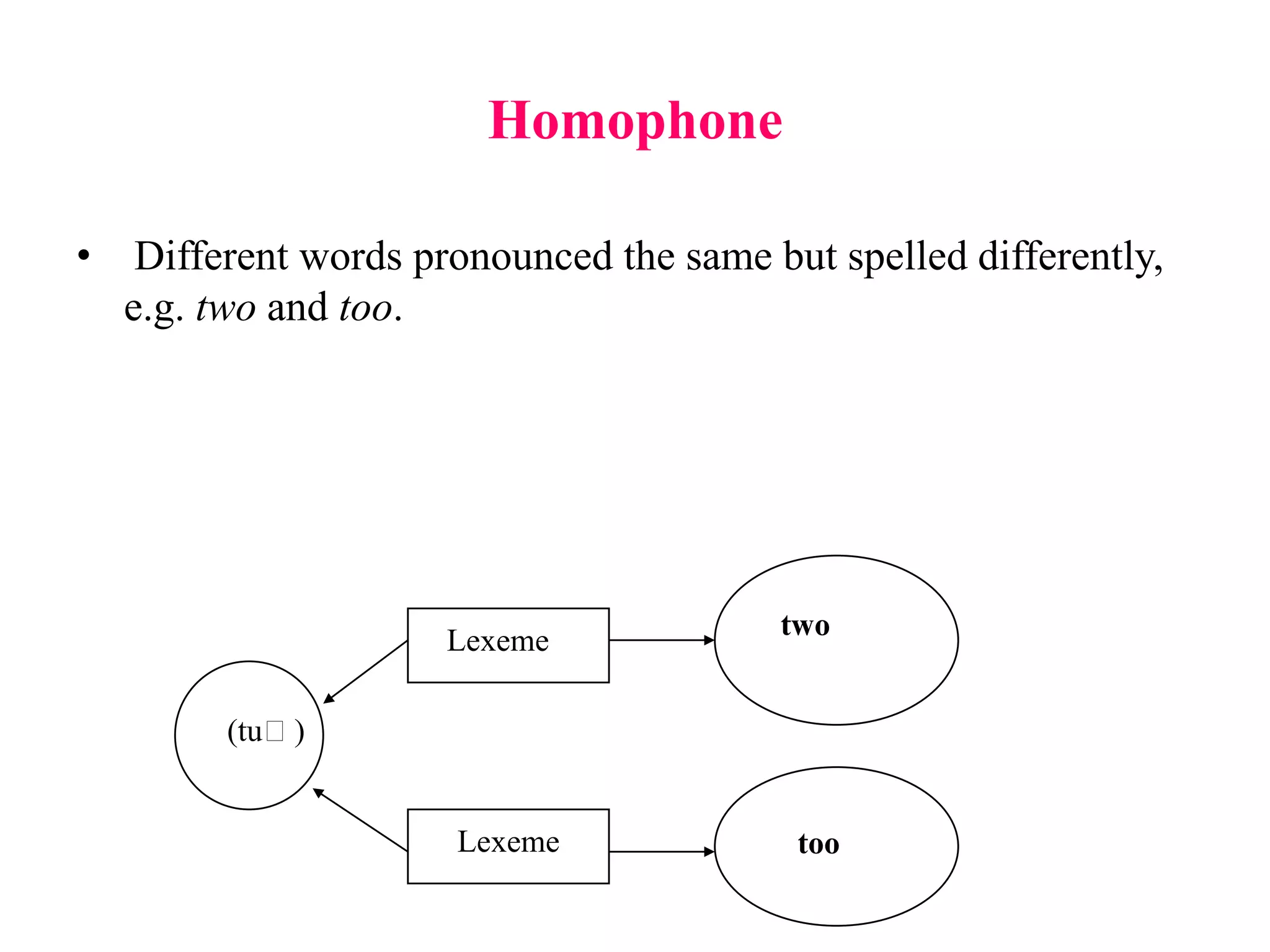
Homophone
• Different words pronounced the same but spelled differently,
e.g. two and too.
(tuː)
two
too
Lexeme
Lexeme
Homograph
• Different words spelled the same but pronounced differently, e.g.
• “advocate” can be pronounced:
– /'ædvəkeɪt/ (v)
– /'ædvəkət/ (N)
advocate
advocate
lexeme
lexeme
/'ædvəkeɪt/ (v)
/'ædvəkət/ (N)
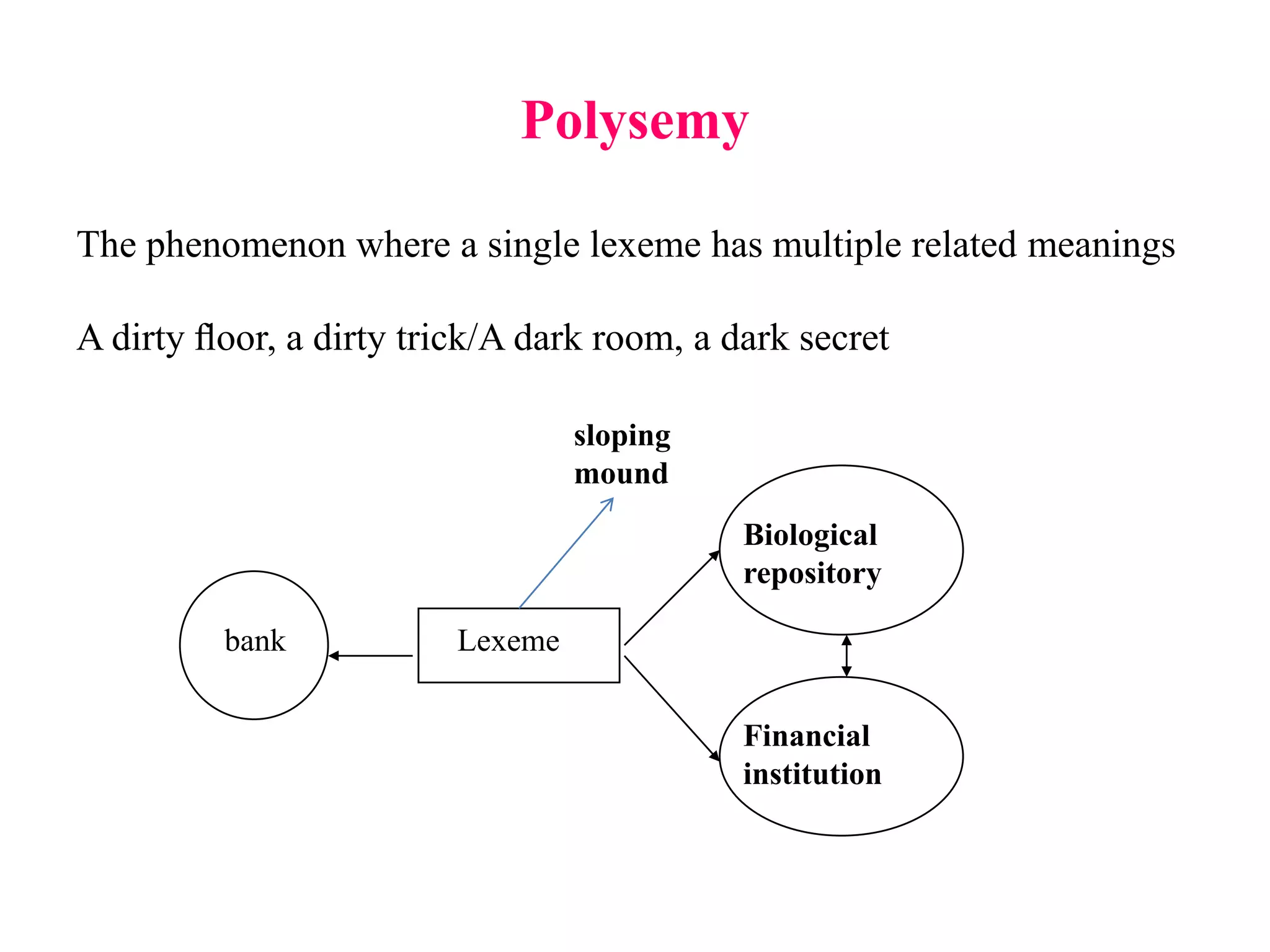
Polysemy
The phenomenon where a single lexeme has multiple related meanings
A dirty floor, a dirty trick/A dark room, a dark secret
bank
Biological
repository
Financial
institution
Lexeme
sloping
mound
Synonymy
A relation that holds between two lexemes with the
same sense
big
large
Positive
size
older
lexeme
lexeme
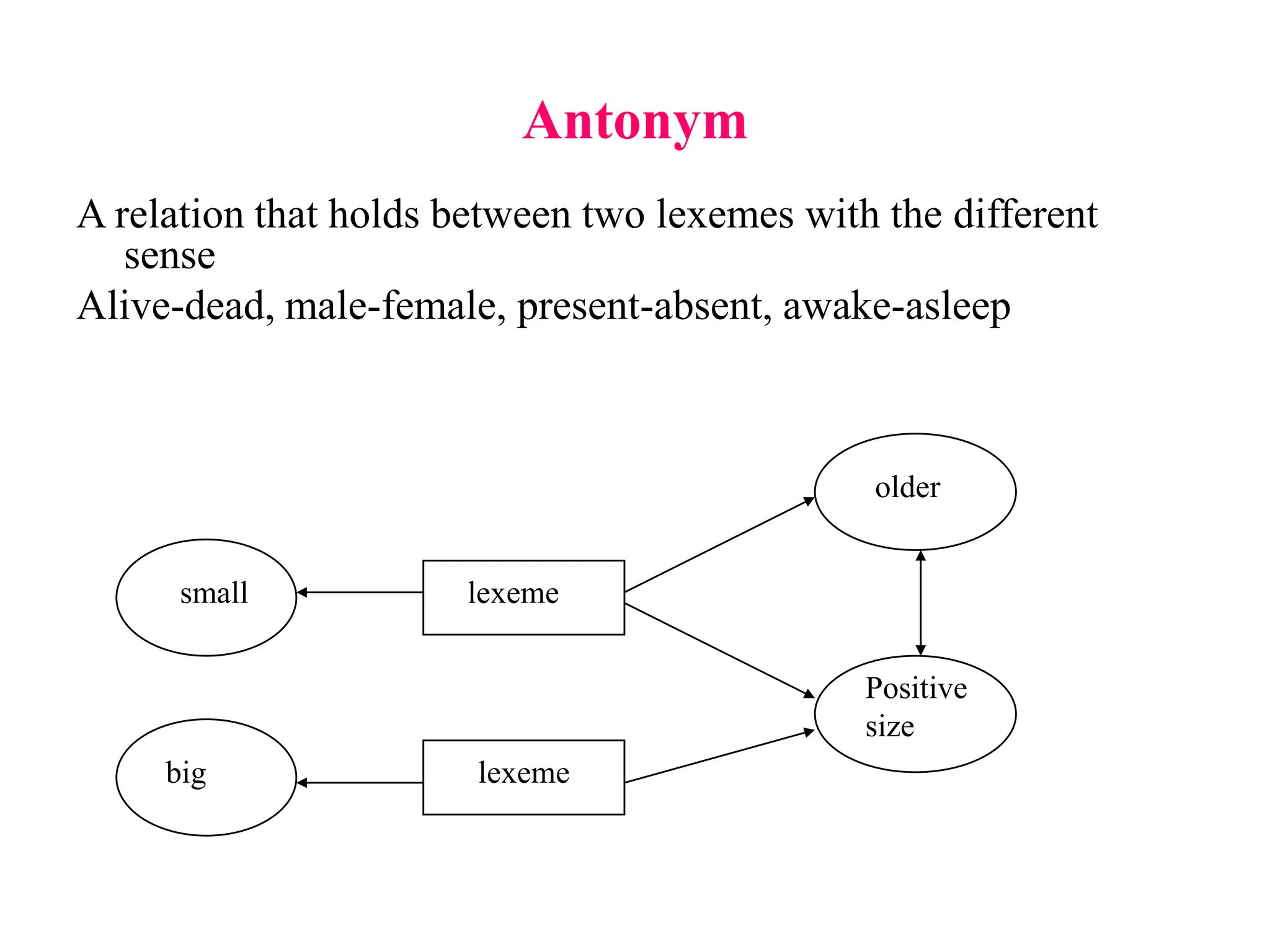
Antonym
A relation that holds between two lexemes with the different
sense
Alive-dead, male-female, present-absent, awake-asleep
small
big
Positive
size
older
lexeme
lexeme
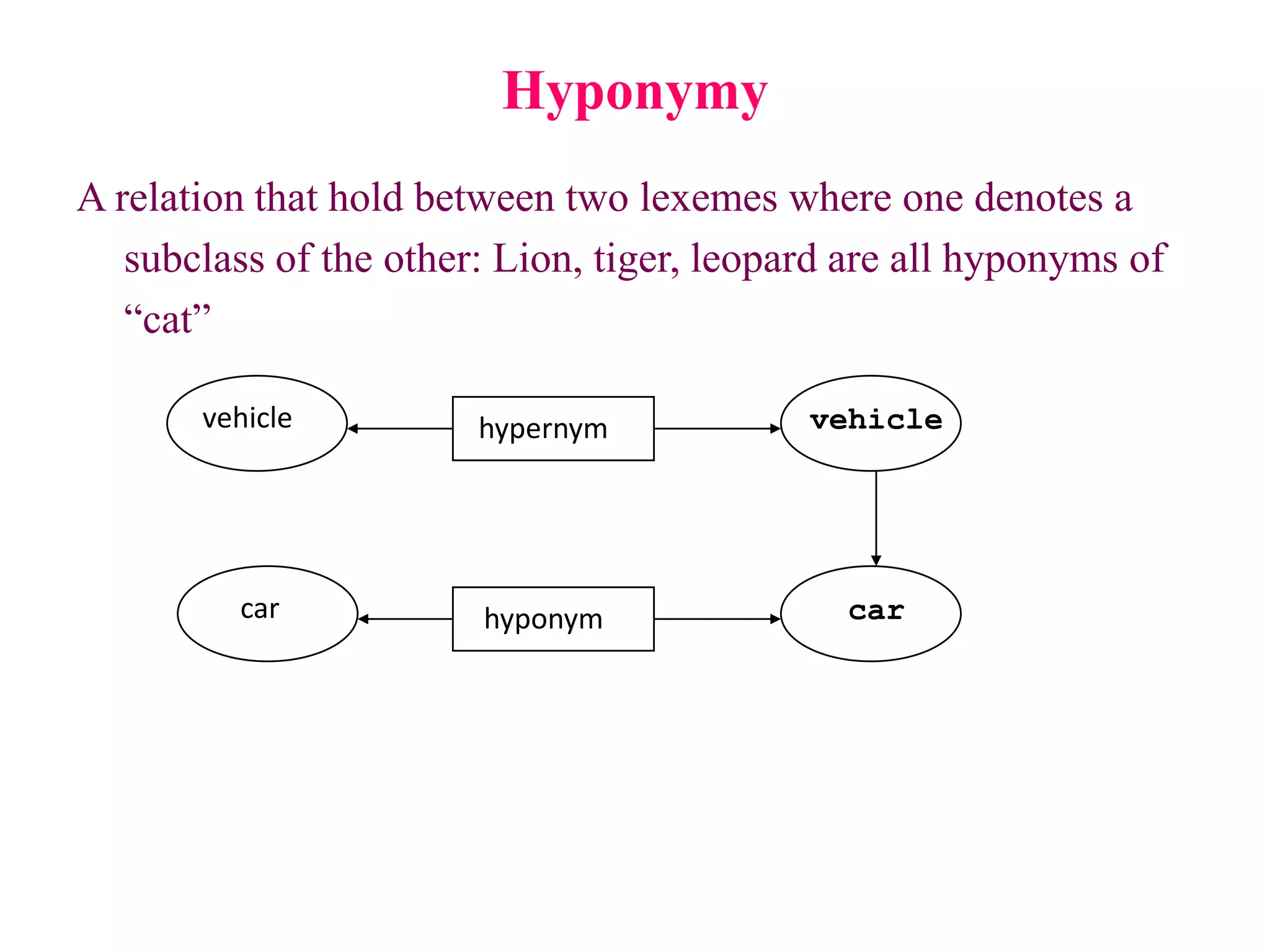
Hyponymy
A relation that hold between two lexemes where one denotes a
subclass of the other: Lion, tiger, leopard are all hyponyms of
“cat”
vehicle
car
hypernym
hyponym
vehicle
car
Semantic Ambiguity
• An utterance
which has more
than one meaning
Ambiguity is Pervasive
• I cooked waterfowl belonging to her.
– Lexical Category: “her” can be a possessive (“of
her”) or dative (“for her”) pronoun
• I made the (plaster) duck statue she owns
– Lexical Semantics: “make” can mean “create” or
“cook”
Ambiguity is Pervasive
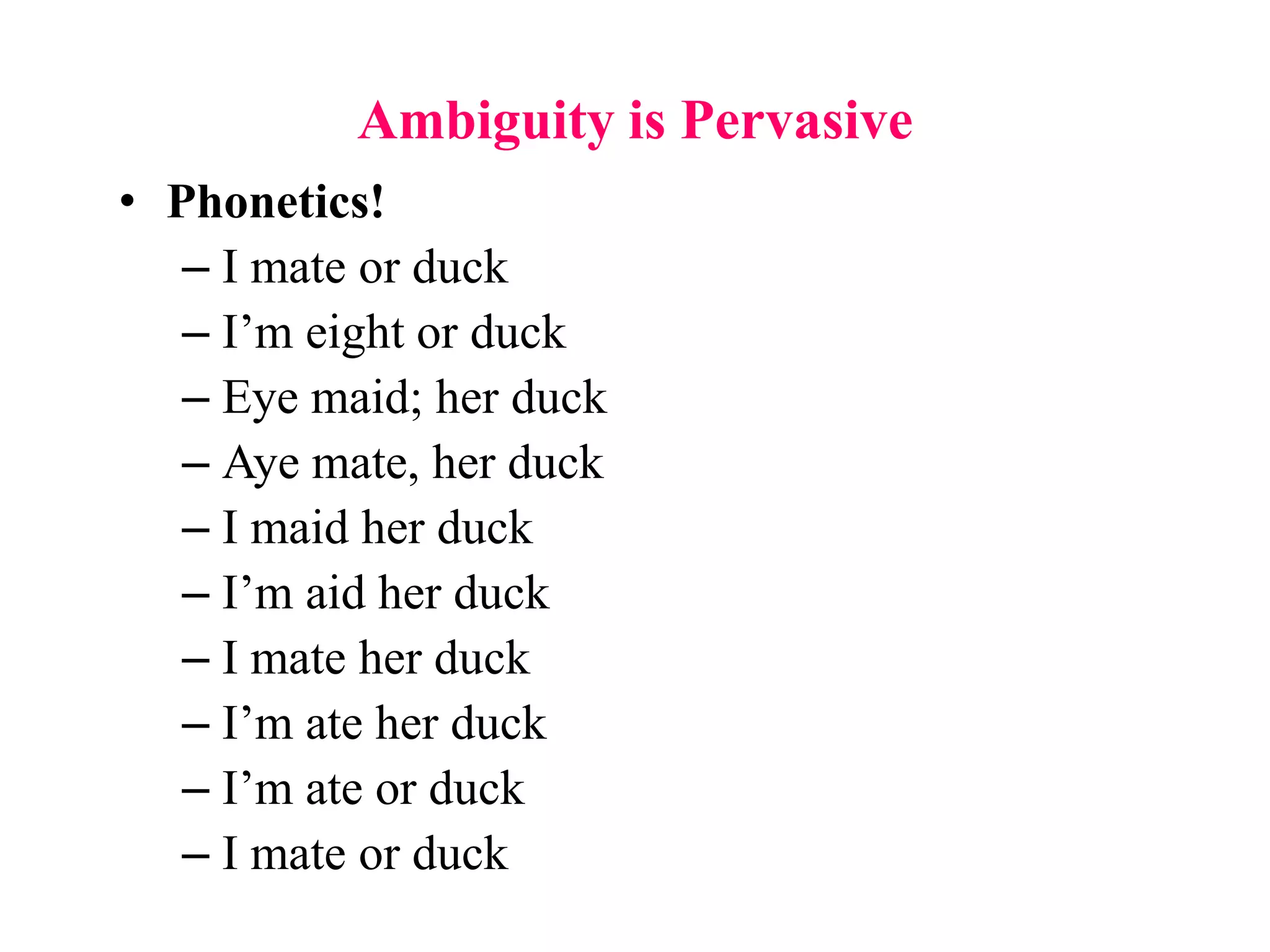
• Phonetics!
– I mate or duck
– I’m eight or duck
– Eye maid; her duck
– Aye mate, her duck
– I maid her duck
– I’m aid her duck
– I mate her duck
– I’m ate her duck
– I’m ate or duck
– I mate or duck
Semantic change/shift
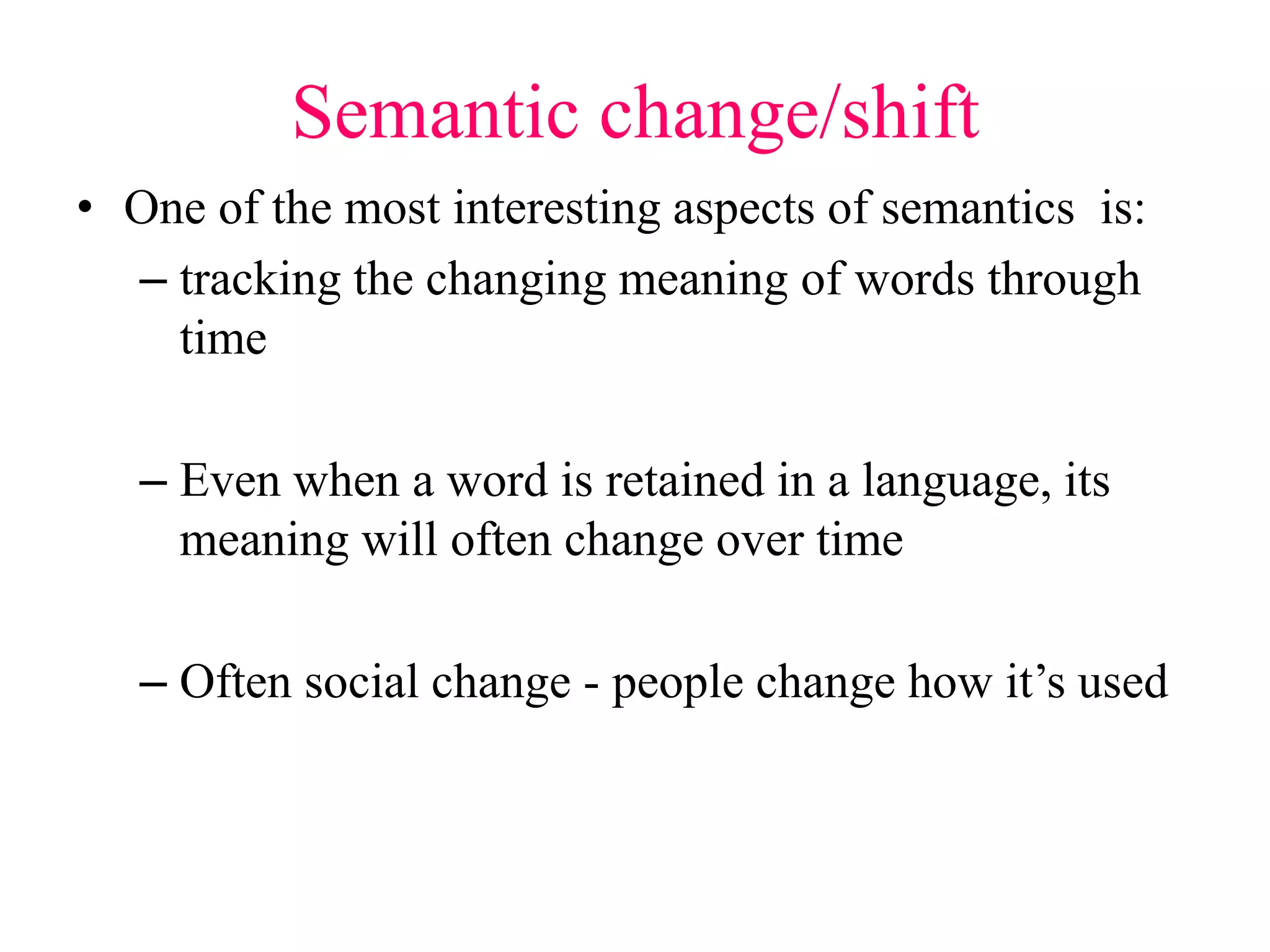
• One of the most interesting aspects of semantics is:
– tracking the changing meaning of words through
time
– Even when a word is retained in a language, its
meaning will often change over time
– Often social change - people change how it’s used
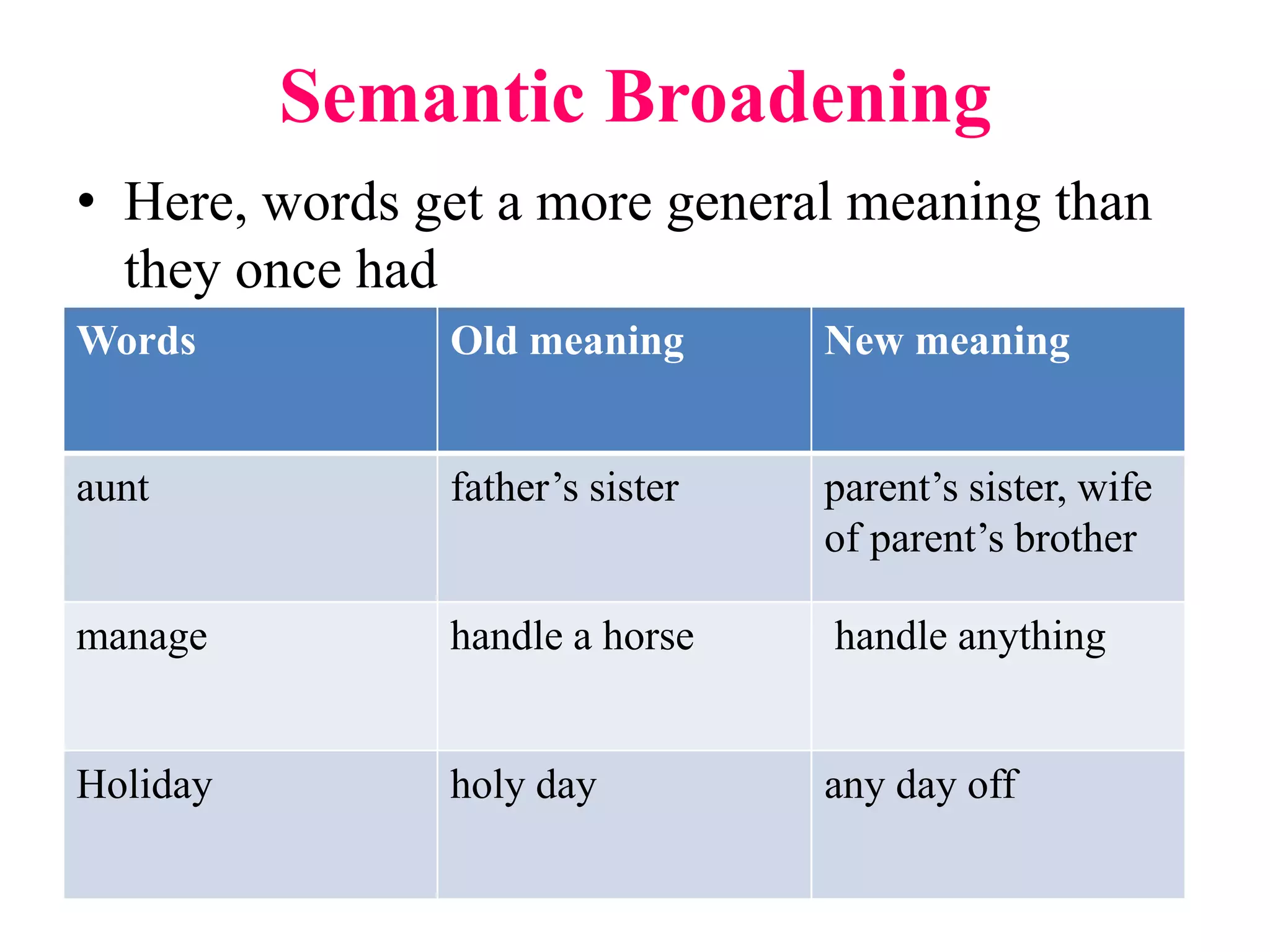
Semantic Broadening
• Here, words get a more general meaning than
they once had
Words Old meaning New meaning
aunt father’s sister parent’s sister, wife
of parent’s brother
manage handle a horse handle anything
Holiday holy day any day off
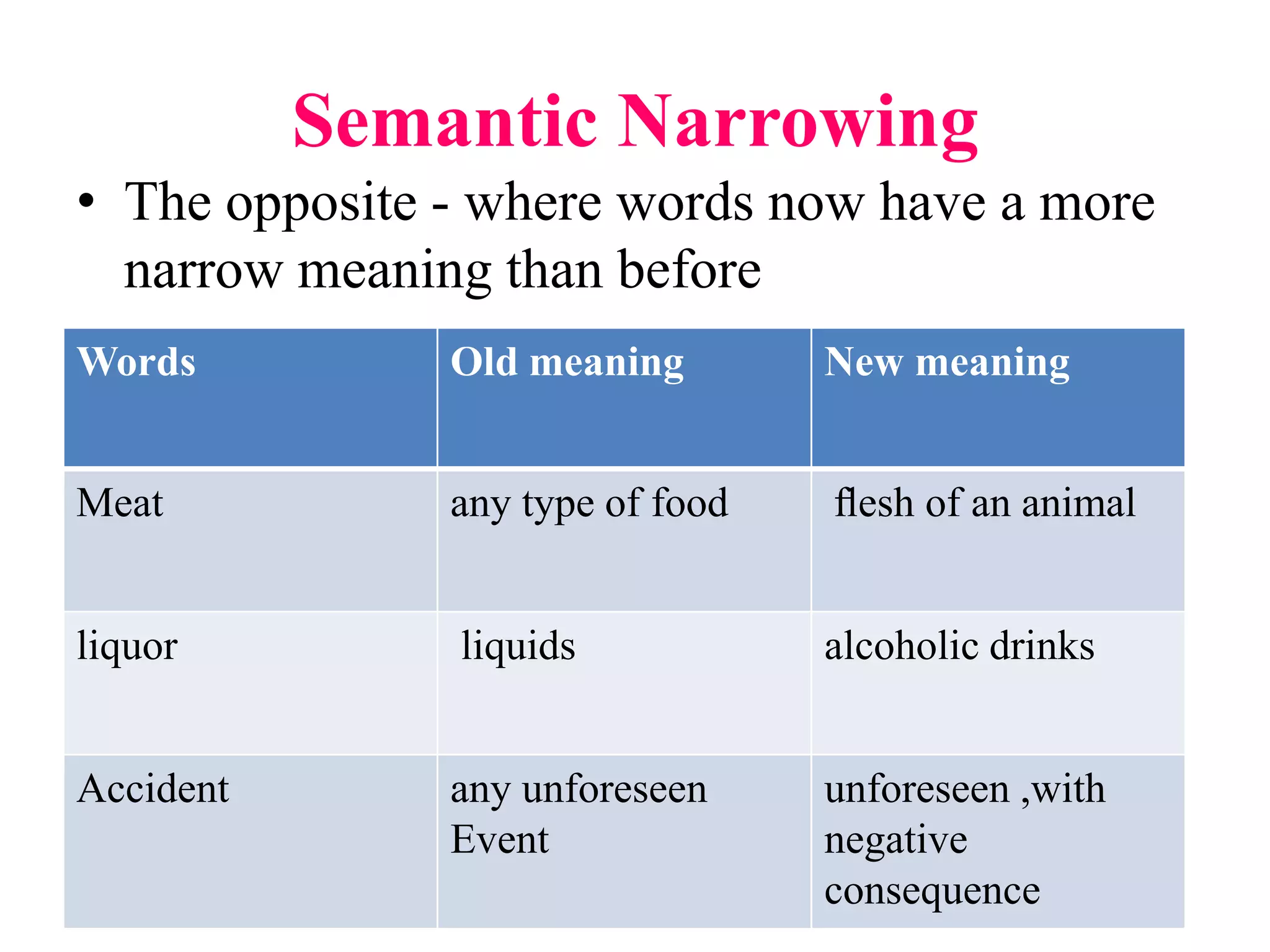
Semantic Narrowing
• The opposite - where words now have a more
narrow meaning than before
Words Old meaning New meaning
Meat any type of food flesh of an animal
liquor liquids alcoholic drinks
Accident any unforeseen
Event
unforeseen ,with
negative
consequence
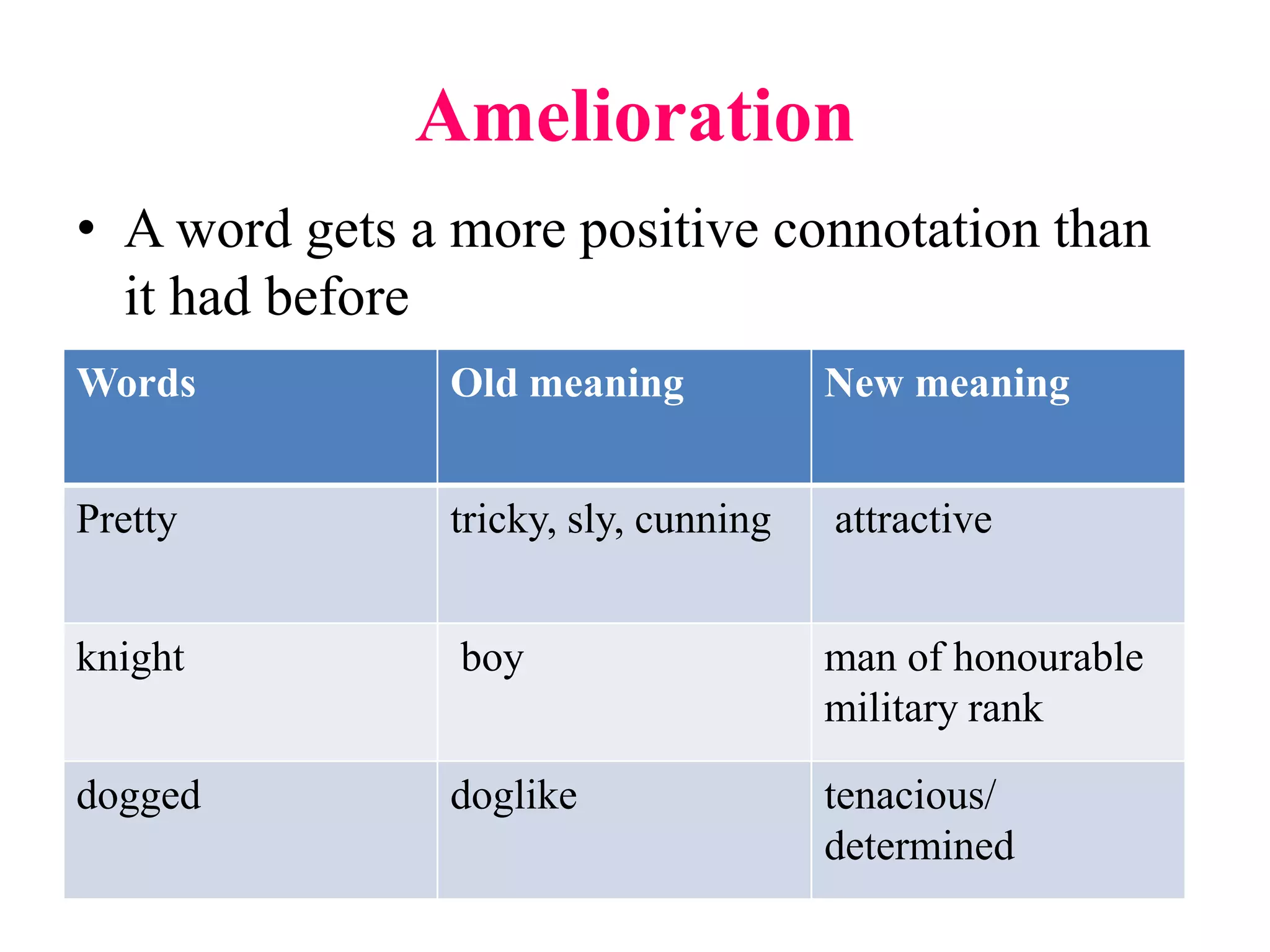
Amelioration
• A word gets a more positive connotation than
it had before
Words Old meaning New meaning
Pretty tricky, sly, cunning attractive
knight boy man of honourable
military rank
dogged doglike tenacious/
determined
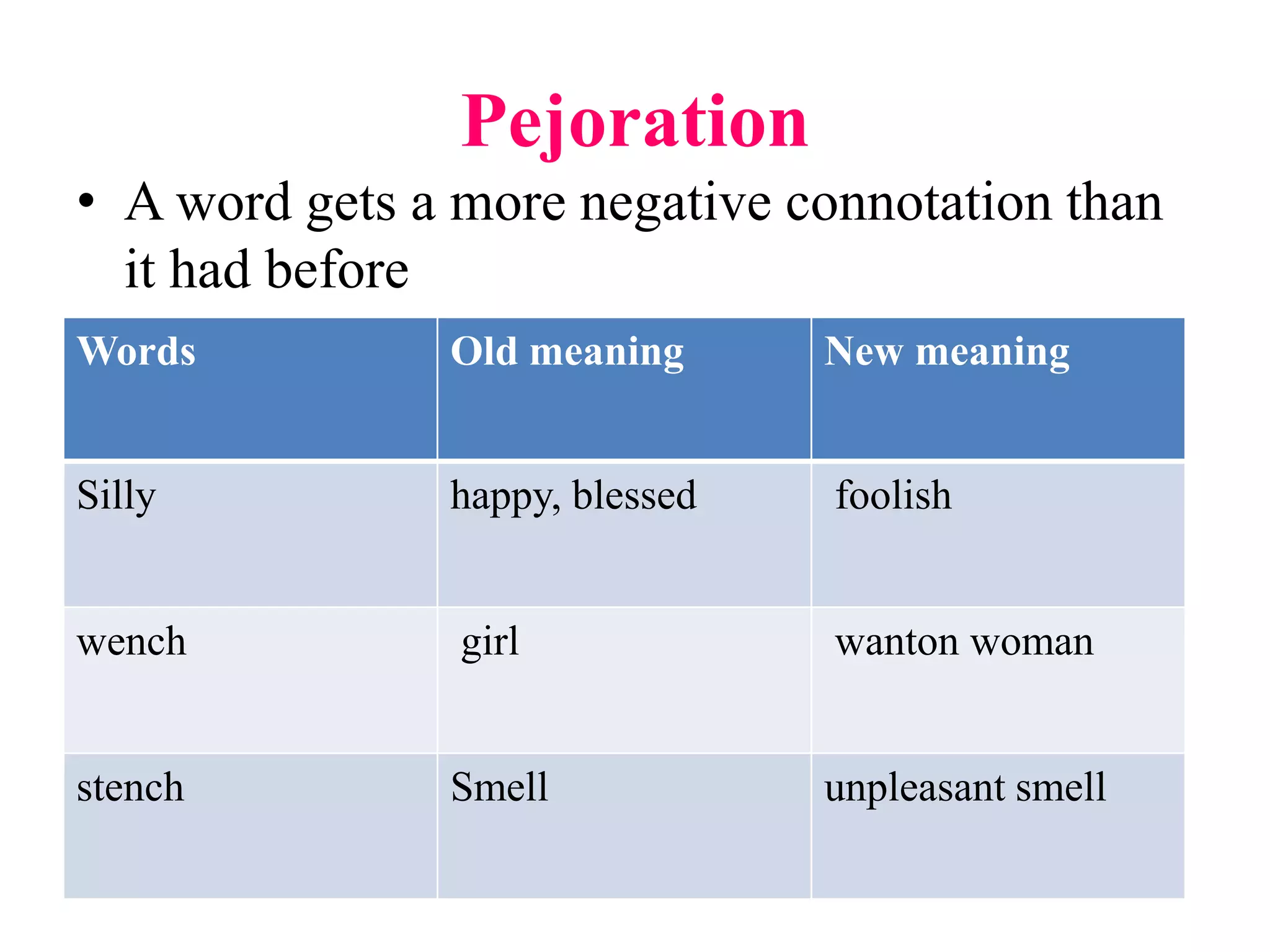
Pejoration
• A word gets a more negative connotation than
it had before
Words Old meaning New meaning
Silly happy, blessed foolish
wench girl wanton woman
stench Smell unpleasant smell
Summary
• Semantics aims:
– to look at meaning in language
• This involves looking at:
– word meanings
– sentence meanings
– how meanings can and do change over time
Semantics

Semantics

  • 1.
    University of thePunjab Department of English Language & Literature Lahore, Pakistan
  • 2.
    Semantics • Learning alanguage includes: – learning the meaning of individual elements – how to combine these to make further meaningful phrases and sentences • The study of meaning that can be determined from: –A sentence – Phrase –Word
  • 3.
    Principle of Compositionality •The meaning of a sentence is determined: – by the meaning of its component parts – the manner in which they are arranged in syntactic structure • So, the meaning of a sentence is: – just the word meanings – Interface of syntax and semantics - syntax influences meaning “Keelin killed John” vs “John killed Keelin”: huge difference
  • 4.
    Types of Meaning Referential: thing,event, state of the world Social: word choice tells us about someone's social class Affective: word choice conveys feelings and attitudes
  • 5.
    Scales of Meaning (wordorder, syntactic constructions) Word: content and function words Sentence: The meaning of a sentence is more than the sum of the meanings of its words
  • 6.
    Lexical Semantics • SemanticProperties: – The components of meaning of a word – and the meaningful relationship between words • Semantic feature: – A device for expressing the presence or absence of semantic properties by pluses and minuses. baby is [+ young], [+ human], [– abstract]
  • 7.
    Words have StructuredMeanings • Lexeme – a pairing of a form with a sense • Orthographic form – the way the lexeme looks on the page • Phonological form – the way the lexeme sounds • Lexicon – finite list of lexemes eaten eat eats ate Lexeme eat
  • 8.
    Lexical Relations • Homonymy •Polysemy • Synonymy • Hyponymy • Homophone • Homograph • Antonym
  • 9.
    Homonymy A relation thatholds between two lexemes that have the same form with unrelated meanings Cross (cross the street, she is cross, Jesus on the cross) bank sloping mound Financial institution Lexeme Lexeme
  • 10.
    Homophone • Different wordspronounced the same but spelled differently, e.g. two and too. (tuː) two too Lexeme Lexeme
  • 11.
    Homograph • Different wordsspelled the same but pronounced differently, e.g. • “advocate” can be pronounced: – /'ædvəkeɪt/ (v) – /'ædvəkət/ (N) advocate advocate lexeme lexeme /'ædvəkeɪt/ (v) /'ædvəkət/ (N)
  • 12.
    Polysemy The phenomenon wherea single lexeme has multiple related meanings A dirty floor, a dirty trick/A dark room, a dark secret bank Biological repository Financial institution Lexeme sloping mound
  • 13.
    Synonymy A relation thatholds between two lexemes with the same sense big large Positive size older lexeme lexeme
  • 14.
    Antonym A relation thatholds between two lexemes with the different sense Alive-dead, male-female, present-absent, awake-asleep small big Positive size older lexeme lexeme
  • 15.
    Hyponymy A relation thathold between two lexemes where one denotes a subclass of the other: Lion, tiger, leopard are all hyponyms of “cat” vehicle car hypernym hyponym vehicle car
  • 16.
    Semantic Ambiguity • Anutterance which has more than one meaning
  • 17.
    Ambiguity is Pervasive •I cooked waterfowl belonging to her. – Lexical Category: “her” can be a possessive (“of her”) or dative (“for her”) pronoun • I made the (plaster) duck statue she owns – Lexical Semantics: “make” can mean “create” or “cook”
  • 18.
    Ambiguity is Pervasive •Phonetics! – I mate or duck – I’m eight or duck – Eye maid; her duck – Aye mate, her duck – I maid her duck – I’m aid her duck – I mate her duck – I’m ate her duck – I’m ate or duck – I mate or duck
  • 19.
    Semantic change/shift • Oneof the most interesting aspects of semantics is: – tracking the changing meaning of words through time – Even when a word is retained in a language, its meaning will often change over time – Often social change - people change how it’s used
  • 20.
    Semantic Broadening • Here,words get a more general meaning than they once had Words Old meaning New meaning aunt father’s sister parent’s sister, wife of parent’s brother manage handle a horse handle anything Holiday holy day any day off
  • 21.
    Semantic Narrowing • Theopposite - where words now have a more narrow meaning than before Words Old meaning New meaning Meat any type of food flesh of an animal liquor liquids alcoholic drinks Accident any unforeseen Event unforeseen ,with negative consequence
  • 22.
    Amelioration • A wordgets a more positive connotation than it had before Words Old meaning New meaning Pretty tricky, sly, cunning attractive knight boy man of honourable military rank dogged doglike tenacious/ determined
  • 23.
    Pejoration • A wordgets a more negative connotation than it had before Words Old meaning New meaning Silly happy, blessed foolish wench girl wanton woman stench Smell unpleasant smell
  • 24.
    Summary • Semantics aims: –to look at meaning in language • This involves looking at: – word meanings – sentence meanings – how meanings can and do change over time