Structure of Programming Languages SYNTAX ANALYSIS VSRivera
Syntax “ The arrangement of words as elements in a sentence to show their relationship” describes the sequence of symbols that make up valid programs. Form of expressions, statements and program units.
The General Problem of Describing Syntax:  Terminology A  sentence  is a string of characters over some alphabet A  language  is a set of sentences A  lexeme  is the lowest level syntactic unit of a language (e.g .,  * ,  sum, begin ) A  token  is a category of lexemes (e.g., identifier)
Syntactic elements of the Language Character set – ASCII, Unicode Identifiers –restrictions on length reduces readability Operator symbols - + and – represents two basic arithmetic operations.
Syntactic elements of the Language Keywords and reserved words – is an identifier used as a fixed part of the syntax of a statement. It is a reserved word if it may not be used as a programmer-chosen identifier. Noise words – optional words that are inserted in a statements to improved readability.
Syntactic elements of the Language Comments – important part of the documentation. REM, /* */, or // Blank (spaces) Delimiters – a syntactic element used simply to mark the beginning or end of some syntactic unit such as a statement or expression. “begin”…”end”, or { }.
Syntactic elements of the Language Expressions – functions that access data objects in a program and return some value. Statements
Syntactic Analysis (parsing) 2 nd  stage in translation Determines if the program being compiled is a valid sentence in the syntactic model programming language.
Role of the Parser Where lexical analysis splits the input into tokens, the purpose of syntax analysis (also known as parsing) is to recombine these tokens to reflect the data structure of the text.  The parse must also reject invalid texts by reporting syntax errors, and recover from commonly occurring errors so that it can continue processing the remainder of its input.
Role of the Parser Lexical  Analyzer Source program Get next  token token Parser Rest of  front end Parser Parse tree Intermediate representation
Formal Methods of Describing Syntax Grammars  Parse Trees Syntax Diagrams
Grammars Formal definition of the syntax of a programming language. Collection of rules that define, mathematically, which strings of symbols are valid sentences.
Parts of Grammar Set of tokens/terminal symbols symbols that are atomic / non-divisible can be combined to form valid constructs in the language Set of non-terminal symbols symbols used to represent intermediate definitions within the language defined by productions syntactic classes or categories
Parts of Grammar Set of rules called productions a definition of a non-terminal symbol has the form x ::= y where  x  is a non-terminal symbol and  y  is a sequence of symbols (non-terminal or terminal)
Parts of Grammar LHS: abstraction being defined RHS: tokens, lexemes, references to other abstractions Goal symbol one of the set of non-terminal symbols also referred to as the start symbol
Rules to form Grammar Every non-terminal symbol must appear to the left of the  ::=  at least one production The goal symbol must not appear to the right of the  ::=  of any production A rule is recursive if its LHS appears in its RHS
Context Free Grammar (CFG) Backus-Naur Form (BNF) Grammar originally presented by John Backus (to describe ALGOL 58)and later modified by Peter Naur Composed of finite set of grammar rules which define a programming language.
Examples <conditional stmt> ::=  if <boolean expr> then  <stmt>  else <stmt> |  if <boolean expr> then <stmt>
Examples <unsigned int> ::= <digit> | <unsigned int> <digit> A rule is recursive if its LHS appears in its RHS
Examples <assign> ::= <id> := <expr> <id> ::= A | B | C <expr> ::= <id> + <expr> |  <id> * <expr> |  ( <expr> ) |  <id>
Examples <program> ::=   begin  <stmt_list> end <stmt_list> ::=<stmt> | <stmt>    <stmt_list> <stmt> ::= <var>  :=  <expression> <var> ::= A | B | C <expression> ::= <var>  +  <var>
Grammar Derivation BNF is a generative device for defining language. The sentences of the language are generated through a sequence of applications of the rules, beginning with a special non-terminal (start symbol) of the grammar.
Example <program> ::= begin    <stmt_list>    end begin <stmt> end begin <var> := <expression> end begin <var> := <var> + <var>  end begin A := B + C end
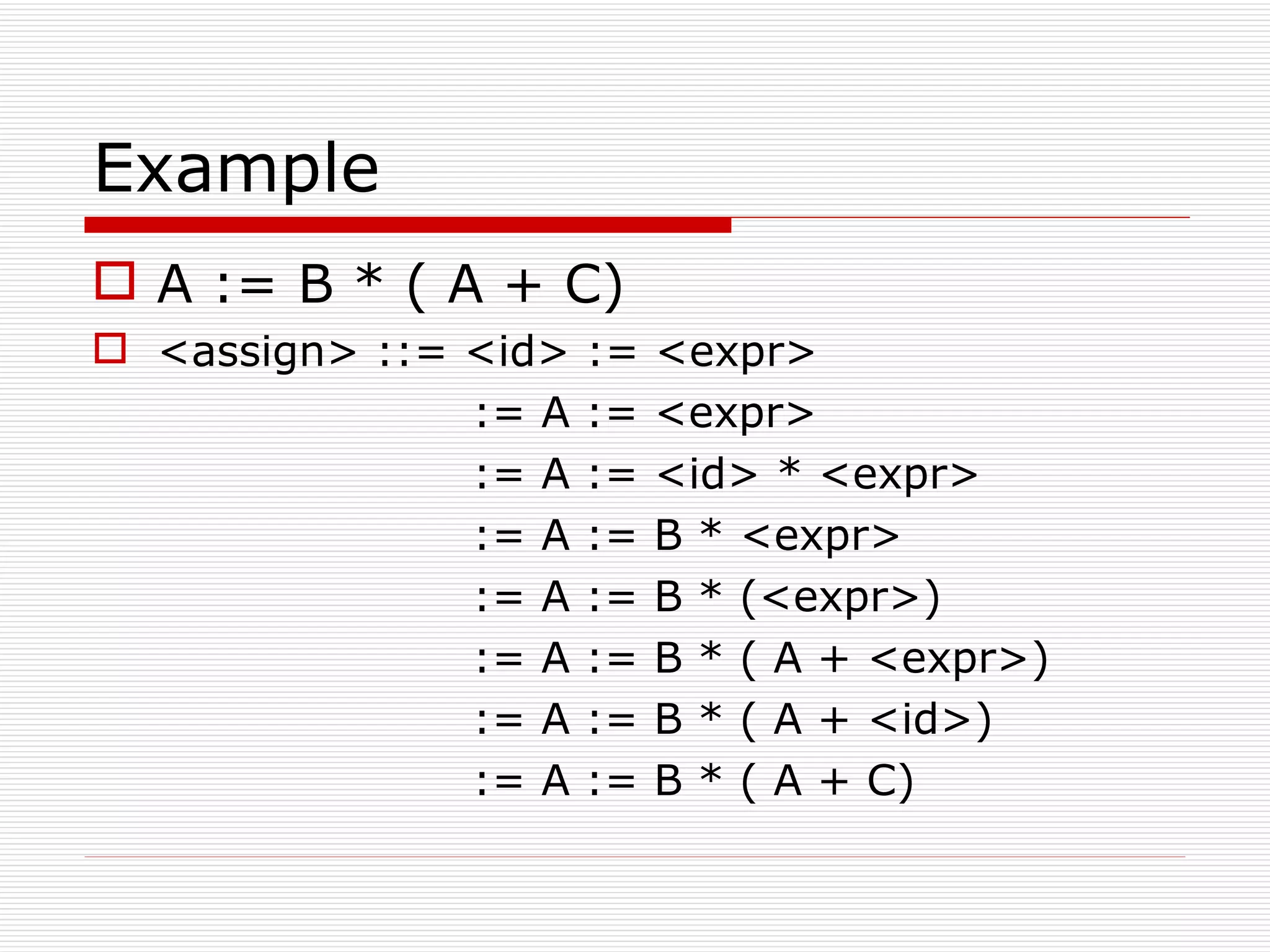
Example A := B * ( A + C) <assign> ::= <id> := <expr> := A := <expr> := A := <id> * <expr> := A := B * <expr> := A := B * (<expr>) := A := B * ( A + <expr>) := A := B * ( A + <id>) := A := B * ( A + C)
When does derivation stop? By exhaustingly choosing all combinations of choices, the entire language  can generate.
Exercise BNF of signed integer?  begin A := B + C; B := C; end
Extended BNF (EBNF) Enhance the descriptive power of BNF Increases the readability and writability of BNF
Extended BNF (EBNF) Notational Extensions An optional element may be indicated by enclosing the element in square brackets, [ … ]. A choice of alternative may use the symbol | within the single rule, optionally enclosed by parenthesis ( [ , ] ) if needed. An arbitrary sequence of instances of element may be indicated by enclosing the element in braces followed by an asterisk, { … } + .
Example BNF <expr> ::= <expr> + <term> | <expr> - <term> | <term> <term> ::= <term> * <factor> | <term> / <factor> | <factor>
Example EBNF <expr> ::= <term> { (+|-) <term> } <term> ::= <factor> { (*|/) <factor>}
Example BNF <program> ::= begin    <stmt_list>    end
Example EBNF <program> ::= begin    <stmt> {<stmt>}   end <program> ::= begin    {<stmt>} +   end
Example BNF <signed int> ::= + <int> | - <int> <int> ::= <digit> | <int> <digit> EBNF <signed int> ::= [+|-] <digit>    {<digit>} +
Exercise EBNF of identifier?
Solution EBNF of identifier <identifier> ::= <letter> {<letter> |   <digit> } +
Get ½ sheet of yellow pad. Prepare for a quiz. Open Notes.
Midterm Quiz #1 Using the following English Grammar: <sentence> ::= <noun phrase> <verb phrase>  . <noun phrase> ::= <determiner> <noun>| <determiner> <noun> <prepositional phrase> <verb phrase> ::= <verb> | <verb> <noun phrase> | <verb> <noun phrase> <prepositional phrase> <prepositional phrase> ::= <preposition> <noun phrase> <noun> ::=  boy  |  girl  |  cat  |  telescope  |  song  |  feather <determiner> ::=  a  |  the <verb> ::=  saw  |  touched  |  surprised  |  sang <preposition> ::=  by  |  with Write the Left Side Derivation of the sentence “ the girl touched the cat with a feather ”

Syntax analysis

  • 1.
    Structure of ProgrammingLanguages SYNTAX ANALYSIS VSRivera
  • 2.
    Syntax “ Thearrangement of words as elements in a sentence to show their relationship” describes the sequence of symbols that make up valid programs. Form of expressions, statements and program units.
  • 3.
    The General Problemof Describing Syntax: Terminology A sentence is a string of characters over some alphabet A language is a set of sentences A lexeme is the lowest level syntactic unit of a language (e.g ., * , sum, begin ) A token is a category of lexemes (e.g., identifier)
  • 4.
    Syntactic elements ofthe Language Character set – ASCII, Unicode Identifiers –restrictions on length reduces readability Operator symbols - + and – represents two basic arithmetic operations.
  • 5.
    Syntactic elements ofthe Language Keywords and reserved words – is an identifier used as a fixed part of the syntax of a statement. It is a reserved word if it may not be used as a programmer-chosen identifier. Noise words – optional words that are inserted in a statements to improved readability.
  • 6.
    Syntactic elements ofthe Language Comments – important part of the documentation. REM, /* */, or // Blank (spaces) Delimiters – a syntactic element used simply to mark the beginning or end of some syntactic unit such as a statement or expression. “begin”…”end”, or { }.
  • 7.
    Syntactic elements ofthe Language Expressions – functions that access data objects in a program and return some value. Statements
  • 8.
    Syntactic Analysis (parsing)2 nd stage in translation Determines if the program being compiled is a valid sentence in the syntactic model programming language.
  • 9.
    Role of theParser Where lexical analysis splits the input into tokens, the purpose of syntax analysis (also known as parsing) is to recombine these tokens to reflect the data structure of the text. The parse must also reject invalid texts by reporting syntax errors, and recover from commonly occurring errors so that it can continue processing the remainder of its input.
  • 10.
    Role of theParser Lexical Analyzer Source program Get next token token Parser Rest of front end Parser Parse tree Intermediate representation
  • 11.
    Formal Methods ofDescribing Syntax Grammars Parse Trees Syntax Diagrams
  • 12.
    Grammars Formal definitionof the syntax of a programming language. Collection of rules that define, mathematically, which strings of symbols are valid sentences.
  • 13.
    Parts of GrammarSet of tokens/terminal symbols symbols that are atomic / non-divisible can be combined to form valid constructs in the language Set of non-terminal symbols symbols used to represent intermediate definitions within the language defined by productions syntactic classes or categories
  • 14.
    Parts of GrammarSet of rules called productions a definition of a non-terminal symbol has the form x ::= y where x is a non-terminal symbol and y is a sequence of symbols (non-terminal or terminal)
  • 15.
    Parts of GrammarLHS: abstraction being defined RHS: tokens, lexemes, references to other abstractions Goal symbol one of the set of non-terminal symbols also referred to as the start symbol
  • 16.
    Rules to formGrammar Every non-terminal symbol must appear to the left of the ::= at least one production The goal symbol must not appear to the right of the ::= of any production A rule is recursive if its LHS appears in its RHS
  • 17.
    Context Free Grammar(CFG) Backus-Naur Form (BNF) Grammar originally presented by John Backus (to describe ALGOL 58)and later modified by Peter Naur Composed of finite set of grammar rules which define a programming language.
  • 18.
    Examples <conditional stmt>::= if <boolean expr> then <stmt> else <stmt> | if <boolean expr> then <stmt>
  • 19.
    Examples <unsigned int>::= <digit> | <unsigned int> <digit> A rule is recursive if its LHS appears in its RHS
  • 20.
    Examples <assign> ::=<id> := <expr> <id> ::= A | B | C <expr> ::= <id> + <expr> | <id> * <expr> | ( <expr> ) | <id>
  • 21.
    Examples <program> ::= begin <stmt_list> end <stmt_list> ::=<stmt> | <stmt> <stmt_list> <stmt> ::= <var> := <expression> <var> ::= A | B | C <expression> ::= <var> + <var>
  • 22.
    Grammar Derivation BNFis a generative device for defining language. The sentences of the language are generated through a sequence of applications of the rules, beginning with a special non-terminal (start symbol) of the grammar.
  • 23.
    Example <program> ::=begin <stmt_list> end begin <stmt> end begin <var> := <expression> end begin <var> := <var> + <var> end begin A := B + C end
  • 24.
    Example A :=B * ( A + C) <assign> ::= <id> := <expr> := A := <expr> := A := <id> * <expr> := A := B * <expr> := A := B * (<expr>) := A := B * ( A + <expr>) := A := B * ( A + <id>) := A := B * ( A + C)
  • 25.
    When does derivationstop? By exhaustingly choosing all combinations of choices, the entire language can generate.
  • 26.
    Exercise BNF ofsigned integer? begin A := B + C; B := C; end
  • 27.
    Extended BNF (EBNF)Enhance the descriptive power of BNF Increases the readability and writability of BNF
  • 28.
    Extended BNF (EBNF)Notational Extensions An optional element may be indicated by enclosing the element in square brackets, [ … ]. A choice of alternative may use the symbol | within the single rule, optionally enclosed by parenthesis ( [ , ] ) if needed. An arbitrary sequence of instances of element may be indicated by enclosing the element in braces followed by an asterisk, { … } + .
  • 29.
    Example BNF <expr>::= <expr> + <term> | <expr> - <term> | <term> <term> ::= <term> * <factor> | <term> / <factor> | <factor>
  • 30.
    Example EBNF <expr>::= <term> { (+|-) <term> } <term> ::= <factor> { (*|/) <factor>}
  • 31.
    Example BNF <program>::= begin <stmt_list> end
  • 32.
    Example EBNF <program>::= begin <stmt> {<stmt>} end <program> ::= begin {<stmt>} + end
  • 33.
    Example BNF <signedint> ::= + <int> | - <int> <int> ::= <digit> | <int> <digit> EBNF <signed int> ::= [+|-] <digit> {<digit>} +
  • 34.
    Exercise EBNF ofidentifier?
  • 35.
    Solution EBNF ofidentifier <identifier> ::= <letter> {<letter> | <digit> } +
  • 36.
    Get ½ sheetof yellow pad. Prepare for a quiz. Open Notes.
  • 37.
    Midterm Quiz #1Using the following English Grammar: <sentence> ::= <noun phrase> <verb phrase> . <noun phrase> ::= <determiner> <noun>| <determiner> <noun> <prepositional phrase> <verb phrase> ::= <verb> | <verb> <noun phrase> | <verb> <noun phrase> <prepositional phrase> <prepositional phrase> ::= <preposition> <noun phrase> <noun> ::= boy | girl | cat | telescope | song | feather <determiner> ::= a | the <verb> ::= saw | touched | surprised | sang <preposition> ::= by | with Write the Left Side Derivation of the sentence “ the girl touched the cat with a feather ”