Formal and contextual links
two .way to approach language as:
1. contextual, referring to facts outside language
knowledge stored in the mind about the real world,
1. formal, referring to facts inside language.
writing, speech sounds,
 Text: Stretches of language treated only formally
 Formal links between sentences and between clauses are
known as cohesive devices:
1. Verb form
2. Parallelism
3. Referring expressions
4. Repetition and lexical chains
5. Substitution
6. Ellipsis
7. Conjunction
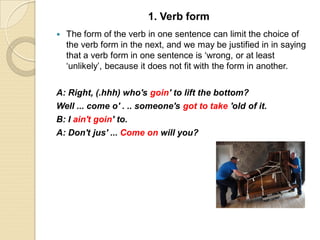
 The form of the verb in one sentence can limit the choice of
the verb form in the next, and we may be justified in in saying
that a verb form in one sentence is ‘wrong, or at least
‘unlikely’, because it does not fit with the form in another.
A: Right, (.hhh) who's goin' to lift the bottom?
Well ... come o' . .. someone's got to take 'old of it.
B: I ain't goin' to.
A: Don't jus' ... Come on will you?
1. Verb form
 Parallelism is a device which suggests a connection, simply
because the form of one sentence or clause repeats the form
of another.
TASK 5
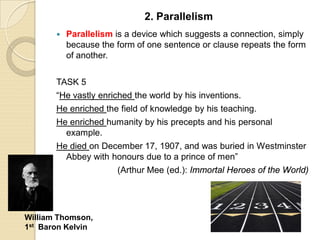
“He vastly enriched the world by his inventions.
He enriched the field of knowledge by his teaching.
He enriched humanity by his precepts and his personal
example.
He died on December 17, 1907, and was buried in Westminster
Abbey with honours due to a prince of men”
(Arthur Mee (ed.): Immortal Heroes of the World)
2. Parallelism
 Parallelism is a device which suggests a connection, simply
because the form of one sentence or clause repeats the form
of another.
TASK 5
“He vastly enriched the world by his inventions.
He enriched the field of knowledge by his teaching.
He enriched humanity by his precepts and his personal
example.
He died on December 17, 1907, and was buried in Westminster
Abbey with honours due to a prince of men”
(Arthur Mee (ed.): Immortal Heroes of the World)
2. Parallelism
William Thomson,
1st Baron Kelvin
2. Parallelism
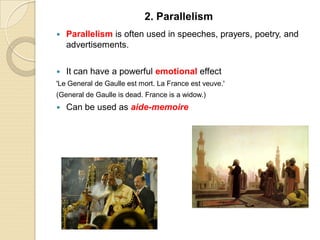
 Parallelism is often used in speeches, prayers, poetry, and
advertisements.
 It can have a powerful emotional effect
'Le General de Gaulle est mort. La France est veuve.'
(General de Gaulle is dead. France is a widow.)
 Can be used as aide-memoire
2. Parallelism
 We may have also a sound parallelism: as in the rhyme,
rhythm, and other sound effects of verse.
"...and that government of the people, by the people, for the people, shall not
perish from the earth."
-- Abraham Lincoln
 One might even extend the idea and talk of semantic
parallelism where two sentences are linked because they
mean the same thing.
 Comic duos often exploit this for humorous effect. The first
comedian says something in a high-flown style, and the other
repeats the same information in a colloquial one:
o A: The Good Lord, in his wisdom, has taken her away from us.
o B: You mean the old girl's snuffed it.
2. Parallelism
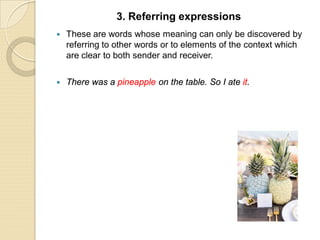
 These are words whose meaning can only be discovered by
referring to other words or to elements of the context which
are clear to both sender and receiver.
 There was a pineapple on the table. So I ate it.
3. Referring expressions
 Anaphora
 the identity of someone or something to be given once at the
beginning, and thereafter referred to as she or he or it.
 This makes a kind of chain, running through the discourse, in
which each expression is linked to another:
o a pineapple ... it ... it ... it . ..
 Foreign language teachers, assuming that comprehension
difficulties arise from new vocabulary, can overlook the
difficulties students can have in interpreting the meaning of
referring expressions within discourse.
3. Referring expressions
 Anaphora
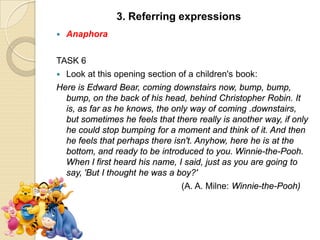
TASK 6
 Look at this opening section of a children's book:
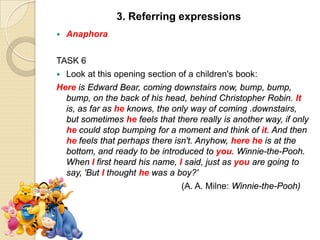
Here is Edward Bear, coming downstairs now, bump, bump,
bump, on the back of his head, behind Christopher Robin. It
is, as far as he knows, the only way of coming .downstairs,
but sometimes he feels that there really is another way, if only
he could stop bumping for a moment and think of it. And then
he feels that perhaps there isn't. Anyhow, here he is at the
bottom, and ready to be introduced to you. Winnie-the-Pooh.
When I first heard his name, I said, just as you are going to
say, 'But I thought he was a boy?'
(A. A. Milne: Winnie-the-Pooh)
3. Referring expressions
 Anaphora
TASK 6
 Look at this opening section of a children's book:
Here is Edward Bear, coming downstairs now, bump, bump,
bump, on the back of his head, behind Christopher Robin. It
is, as far as he knows, the only way of coming .downstairs,
but sometimes he feels that there really is another way, if only
he could stop bumping for a moment and think of it. And then
he feels that perhaps there isn't. Anyhow, here he is at the
bottom, and ready to be introduced to you. Winnie-the-Pooh.
When I first heard his name, I said, just as you are going to
say, 'But I thought he was a boy?'
(A. A. Milne: Winnie-the-Pooh)
3. Referring expressions
 This story is written to be read out loud, and in many
contemporary cultures, reading out loud is something done
mostly for children.
 That, together with the subject matter, accounts for our feeling
at this point that the story is being sent to a child, the you.
 So we can see how complicated this network of referring
expressions is, and how skilled even quite young children are
at understanding it.
 Yet if, as teachers, we concentrate our attention on formal
links within sentences, we are taking all these skills for
granted, and may leave our students completely at sea.
3. Referring expressions
 Cataphora
 When we are given the pronoun first, and then kept in
suspense as to its identity, which is revealed later.
TASK 7
 Here is another chapter opening from the same children's
book. What is different about the use of the pronouns?
 Nobody seemed to know where they came from, but there
they were in the Forest: Kanga and Baby Roo.
(A. A. Milne: Winnie-the-Pooh, Chapter 7)
3. Referring expressions
 Referring expressions fulfil a dual purpose of unifying the text
(they depend upon some of the subject matter remaining the
same) and of economy, because they save us from having to
repeat the identity of what we are talking about again and
again.
3. Referring expressions
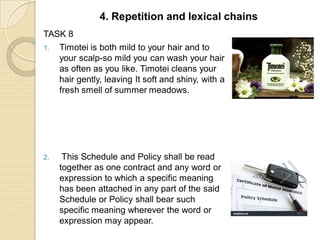
TASK 8
1. Timotei is both mild to your hair and to
your scalp-so mild you can wash your hair
as often as you like. Timotei cleans your
hair gently, leaving It soft and shiny, with a
fresh smell of summer meadows.
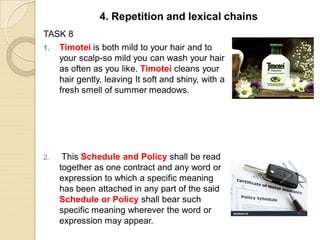
2. This Schedule and Policy shall be read
together as one contract and any word or
expression to which a specific meaning
has been attached in any part of the said
Schedule or Policy shall bear such
specific meaning wherever the word or
expression may appear.
4. Repetition and lexical chains
TASK 8
1. Timotei is both mild to your hair and to
your scalp-so mild you can wash your hair
as often as you like. Timotei cleans your
hair gently, leaving It soft and shiny, with a
fresh smell of summer meadows.
2. This Schedule and Policy shall be read
together as one contract and any word or
expression to which a specific meaning
has been attached in any part of the said
Schedule or Policy shall bear such
specific meaning wherever the word or
expression may appear.
4. Repetition and lexical chains
elegant repetition, a device where synonymous or more
general words or phrases are used.
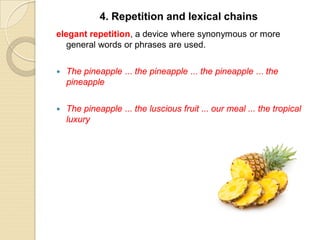
 The pineapple ... the pineapple ... the pineapple ... the
pineapple
 The pineapple ... the luscious fruit ... our meal ... the tropical
luxury
4. Repetition and lexical chains
TASK 9
 ln the following, is it possible or desirable to
1. replace repetitions with referring expressions
2. replace referring expressions by repetitions
3. replace either by elegant repetition
 and, if so, could this affect the meaning, the style, or both?
What does all this refer to in the third sentence?
4. Repetition and lexical chains
TASK 9
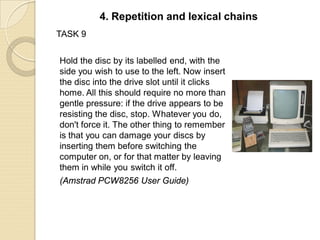
Hold the disc by its labelled end, with the
side you wish to use to the left. Now insert
the disc into the drive slot until it clicks
home. All this should require no more than
gentle pressure: if the drive appears to be
resisting the disc, stop. Whatever you do,
don't force it. The other thing to remember
is that you can damage your discs by
inserting them before switching the
computer on, or for that matter by leaving
them in while you switch it off.
(Amstrad PCW8256 User Guide)
4. Repetition and lexical chains
TASK 9
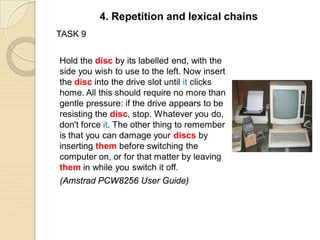
Hold the disc by its labelled end, with the
side you wish to use to the left. Now insert
the disc into the drive slot until it clicks
home. All this should require no more than
gentle pressure: if the drive appears to be
resisting the disc, stop. Whatever you do,
don't force it. The other thing to remember
is that you can damage your discs by
inserting them before switching the
computer on, or for that matter by leaving
them in while you switch it off.
(Amstrad PCW8256 User Guide)
4. Repetition and lexical chains
TASK 9
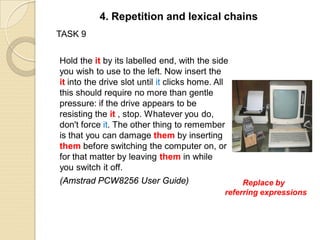
Hold the it by its labelled end, with the side
you wish to use to the left. Now insert the
it into the drive slot until it clicks home. All
this should require no more than gentle
pressure: if the drive appears to be
resisting the it , stop. Whatever you do,
don't force it. The other thing to remember
is that you can damage them by inserting
them before switching the computer on, or
for that matter by leaving them in while
you switch it off.
(Amstrad PCW8256 User Guide)
4. Repetition and lexical chains
Replace by
referring expressions
TASK 9
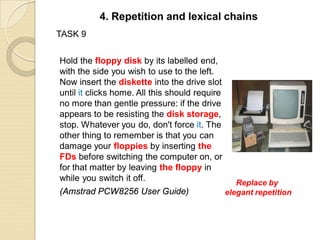
Hold the floppy disk by its labelled end,
with the side you wish to use to the left.
Now insert the diskette into the drive slot
until it clicks home. All this should require
no more than gentle pressure: if the drive
appears to be resisting the disk storage,
stop. Whatever you do, don't force it. The
other thing to remember is that you can
damage your floppies by inserting the
FDs before switching the computer on, or
for that matter by leaving the floppy in
while you switch it off.
(Amstrad PCW8256 User Guide)
4. Repetition and lexical chains
Replace by
elegant repetition
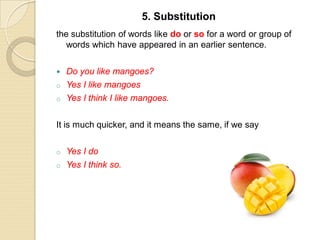
the substitution of words like do or so for a word or group of
words which have appeared in an earlier sentence.
 Do you like mangoes?
o Yes I like mangoes
o Yes I think I like mangoes.
It is much quicker, and it means the same, if we say
o Yes I do
o Yes I think so.
5. Substitution
o Q: Would you like a cup of coffee?
o A1: Yes I would.
And that is understood as:
o A2: Yes I would like a cup of coffee.
o Q: What are you doing?
o A2: Eating a mango
And that is understood as:
o A1: I am eating a mango.
6. Ellipsis
 the type of relationship which exists between one sentence or
clause and another.
These words may simply:
 add more information to what has already been said (and,
furthermore, add to that)
 elaborate or exemplify it (for instance, thus, in other words}.
 contrast new information with old information, or put another
side to the argument (or, on the other hand, however,
conversely).
 relate new information to what has already been given in
terms of
◦ causes (so, consequently, because, for this reason) or
◦ time (formerly, then, in the end, next) or they may indicate a new
depanure
 summary (by the way, well, to sum up, anyway).
7. Conjunction
 the formal links presence does not automatically make a
passage coherent, and their absence does not automatically
make it meaningless.
 As teachers, we should notice that a clear understanding of
the formal connections between sentences may help to
explain one of the ways in which foreign language students
sometimes write supposedly connected sentences, each of
which is well-formed in itself, but which somehow add up to
very strange discourse.
 It should be clear that the correctness and the effect of some
expressions cannot only be judged within the sentence, but
must be judged in connection with other sentences in the
discourse as well.
Conclusion
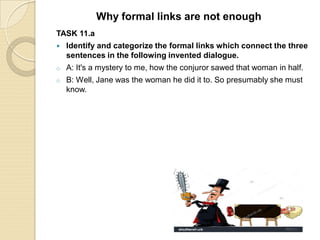
TASK 11.a
 Identify and categorize the formal links which connect the three
sentences in the following invented dialogue.
o A: It's a mystery to me, how the conjuror sawed that woman in half.
o B: Well, Jane was the woman he did it to. So presumably she must
know.
Why formal links are not enough
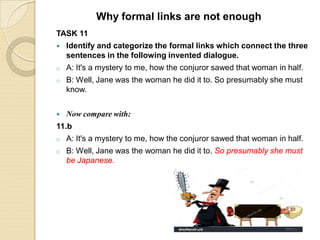
TASK 11
 Identify and categorize the formal links which connect the three
sentences in the following invented dialogue.
o A: It's a mystery to me, how the conjuror sawed that woman in half.
o B: Well, Jane was the woman he did it to. So presumably she must
know.
 Now compare with:
11.b
o A: It's a mystery to me, how the conjuror sawed that woman in half.
o B: Well, Jane was the woman he did it to. So presumably she must
be Japanese.
Why formal links are not enough
 The sentences in Task 11.a are packed with cohesive
devices, but it would be a mistake to suppose that it is this,
and nothing else, which creates the unity between them.
 The sentences in Task 11.b might form part of a discourse,
and if we stretch our imaginations we could come up with a
situation in which they do; but this will not be by virtue of the
words so and she, but because of some other information
about the context.
 Formal links between sentences, then, are not enough to
account for our feeling that a stretch of language is discourse.
 Formal links are neither necessary nor sufficient, and in brief
spoken exchanges, it is quite common to encounter
sequences of sentences that are almost entirely bare of them.
Why formal links are not enough
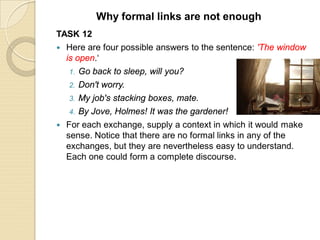
TASK 12
 Here are four possible answers to the sentence: 'The window
is open.‘
1. Go back to sleep, will you?
2. Don't worry.
3. My job's stacking boxes, mate.
4. By Jove, Holmes! It was the gardener!
 For each exchange, supply a context in which it would make
sense. Notice that there are no formal links in any of the
exchanges, but they are nevertheless easy to understand.
Each one could form a complete discourse.
Why formal links are not enough
 to explain interpretation such those we had in 11.b and 12 we
will need more than our list of cohesive devices.
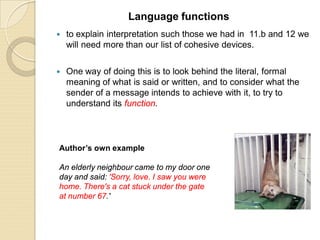
 One way of doing this is to look behind the literal, formal
meaning of what is said or written, and to consider what the
sender of a message intends to achieve with it, to try to
understand its function.
Language functions
Author’s own example
An elderly neighbour came to my door one
day and said: 'Sorry, love. I saw you were
home. There's a cat stuck under the gate
at number 67.'
 In order to discover how such inferences are made, we will
need
1. to examine the range of possible functions of language,
2. to try to ' understand how people correctly interpret them.
 We cannot assume that such interpretations will be made in
the same way in all cultures and in all languages,
 so understanding how interpretation proceeds in the culture
of the language we are teaching is crucial if we are to help
foreign learners to make their words function in the way that
they intend.
Language functions
utterance vs. sentence
 utterance for a unit of language used by somebody in context
to do something-to communicate.
 sentence for grammatically complete units regarded purely
formally, in isolation from their context and their function.
Language functions
Functions of language
 'to send information'
 'to tell other people your thoughts'.
The classification of macro-functions
Functions of language
 'to send information'
 'to tell other people your thoughts'.
The classification of macro-functions
referential function
Functions of language
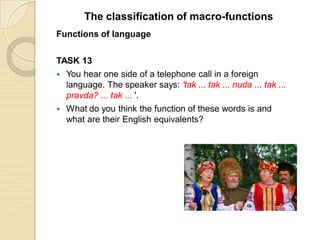
TASK 13
 You hear one side of a telephone call in a foreign
language. The speaker says: 'tak ... tak ... nuda ... tak ...
pravda? ... tak ... '.
 What do you think the function of these words is and
what are their English equivalents?
The classification of macro-functions
Functions of language
TASK 13
 You hear one side of a telephone call in a foreign
language. The speaker says: 'tak ... tak ... nuda ... tak ...
pravda? ... tak ... '.
 What do you think the function of these words is and
what are their English equivalents?
The classification of macro-functions
macro-functions
the elements of communication
 The addresser: the person who originates the message. This is
usually the same as the person who is sending the message, but not
always, as in the case of messengers, spokespeople, and town
criers.
 The addressee: the person to whom 'the message is addressed.
This is usually the person who receives the message, but not
necessarily so, as in the case of intercepted letters, bugged
telephone calls, and eavesdropping.
 The channel: the medium through which the message travels:
sound waves, marks on paper, telephone wires, word processor
screens.
 The message form: the particular grammatical and lexical choices
of the message.
 The topic: the information carried in the message.
 The code: the language or dialect, for example, Swedish, Yorkshire
English, Semaphore, British Sign Language, Japanese.
 The setting: the social or physical context.
The classification of macro-functions
macro-functions
Macro-functions are then established, each focusing
attention upon one element:
 The emotive function: communicating the inner stares and
emotions of the addresser ('Oh no!', 'Fantastic!', 'Ugh!', and swear
words used as exclamations).
 The directive function: seeking to affect the behaviour of the
addressee ('Please help me!', 'Shut up!', 'I'm warning you!').
 The phatic function: opening the channel or checking that It is
working, either for social reasons ('Hello', 'Lovely weather', 'Do you
come here often?') or for practical ones ('Can you hear me?', 'Are
you still there?‘, 'Can you see the blackboard from the back of the
room?', 'Can you read my writing?'). . .
The classification of macro-functions
macro-functions
Macro-functions are then established, each focusing
attention upon one element:
 The poetic function: in which the particular form chosen is the
essence of the message. (The advertising slogan BEANZ MEANZ
HEINZ would lose its point if it were paraphrased as 'If you are
buying beans, you will naturally buy Heinz.')
 The referential function: carrying information. .
 The metalinguistic function: focusing attention upon the code
itself, to clarify it or renegotiate it ('What does this word here mean?',
'This bone is known as the "femur"', '"Will" and "shall" mean the
same thing nowadays'). This book has a largely metalinguistic
function.
 The contextual function: creating a particular kind of
communication ('Right, let's start the lecture', 'It's just a game').
The classification of macro-functions
TASK 14
 What do you consider to be the most likely functions of the
following?
1. Dear Sir or Madam ...
2. Fred Astaire's dead.
3. Workers of the World, Unite!
4. You make me sick.
5. The court is now in session.
6. What do you mean by this?
7. Well, I'll be damned!
8. Here's Miss Julie.
 Is it possible to assign one function to each, or are some of
mixed function? How might the function of each utterance
vary according to context?
The classification of macro-functions

formal-and-contextual-links.pdf

  • 1.
  • 2.
    two .way toapproach language as: 1. contextual, referring to facts outside language knowledge stored in the mind about the real world, 1. formal, referring to facts inside language. writing, speech sounds,  Text: Stretches of language treated only formally
  • 3.
     Formal linksbetween sentences and between clauses are known as cohesive devices: 1. Verb form 2. Parallelism 3. Referring expressions 4. Repetition and lexical chains 5. Substitution 6. Ellipsis 7. Conjunction
  • 4.
     The formof the verb in one sentence can limit the choice of the verb form in the next, and we may be justified in in saying that a verb form in one sentence is ‘wrong, or at least ‘unlikely’, because it does not fit with the form in another. A: Right, (.hhh) who's goin' to lift the bottom? Well ... come o' . .. someone's got to take 'old of it. B: I ain't goin' to. A: Don't jus' ... Come on will you? 1. Verb form
  • 5.
     Parallelism isa device which suggests a connection, simply because the form of one sentence or clause repeats the form of another. TASK 5 “He vastly enriched the world by his inventions. He enriched the field of knowledge by his teaching. He enriched humanity by his precepts and his personal example. He died on December 17, 1907, and was buried in Westminster Abbey with honours due to a prince of men” (Arthur Mee (ed.): Immortal Heroes of the World) 2. Parallelism
  • 6.
     Parallelism isa device which suggests a connection, simply because the form of one sentence or clause repeats the form of another. TASK 5 “He vastly enriched the world by his inventions. He enriched the field of knowledge by his teaching. He enriched humanity by his precepts and his personal example. He died on December 17, 1907, and was buried in Westminster Abbey with honours due to a prince of men” (Arthur Mee (ed.): Immortal Heroes of the World) 2. Parallelism William Thomson, 1st Baron Kelvin
  • 7.
  • 8.
     Parallelism isoften used in speeches, prayers, poetry, and advertisements.  It can have a powerful emotional effect 'Le General de Gaulle est mort. La France est veuve.' (General de Gaulle is dead. France is a widow.)  Can be used as aide-memoire 2. Parallelism
  • 9.
     We mayhave also a sound parallelism: as in the rhyme, rhythm, and other sound effects of verse. "...and that government of the people, by the people, for the people, shall not perish from the earth." -- Abraham Lincoln  One might even extend the idea and talk of semantic parallelism where two sentences are linked because they mean the same thing.  Comic duos often exploit this for humorous effect. The first comedian says something in a high-flown style, and the other repeats the same information in a colloquial one: o A: The Good Lord, in his wisdom, has taken her away from us. o B: You mean the old girl's snuffed it. 2. Parallelism
  • 10.
     These arewords whose meaning can only be discovered by referring to other words or to elements of the context which are clear to both sender and receiver.  There was a pineapple on the table. So I ate it. 3. Referring expressions
  • 11.
     Anaphora  theidentity of someone or something to be given once at the beginning, and thereafter referred to as she or he or it.  This makes a kind of chain, running through the discourse, in which each expression is linked to another: o a pineapple ... it ... it ... it . ..  Foreign language teachers, assuming that comprehension difficulties arise from new vocabulary, can overlook the difficulties students can have in interpreting the meaning of referring expressions within discourse. 3. Referring expressions
  • 12.
     Anaphora TASK 6 Look at this opening section of a children's book: Here is Edward Bear, coming downstairs now, bump, bump, bump, on the back of his head, behind Christopher Robin. It is, as far as he knows, the only way of coming .downstairs, but sometimes he feels that there really is another way, if only he could stop bumping for a moment and think of it. And then he feels that perhaps there isn't. Anyhow, here he is at the bottom, and ready to be introduced to you. Winnie-the-Pooh. When I first heard his name, I said, just as you are going to say, 'But I thought he was a boy?' (A. A. Milne: Winnie-the-Pooh) 3. Referring expressions
  • 13.
     Anaphora TASK 6 Look at this opening section of a children's book: Here is Edward Bear, coming downstairs now, bump, bump, bump, on the back of his head, behind Christopher Robin. It is, as far as he knows, the only way of coming .downstairs, but sometimes he feels that there really is another way, if only he could stop bumping for a moment and think of it. And then he feels that perhaps there isn't. Anyhow, here he is at the bottom, and ready to be introduced to you. Winnie-the-Pooh. When I first heard his name, I said, just as you are going to say, 'But I thought he was a boy?' (A. A. Milne: Winnie-the-Pooh) 3. Referring expressions
  • 14.
     This storyis written to be read out loud, and in many contemporary cultures, reading out loud is something done mostly for children.  That, together with the subject matter, accounts for our feeling at this point that the story is being sent to a child, the you.  So we can see how complicated this network of referring expressions is, and how skilled even quite young children are at understanding it.  Yet if, as teachers, we concentrate our attention on formal links within sentences, we are taking all these skills for granted, and may leave our students completely at sea. 3. Referring expressions
  • 15.
     Cataphora  Whenwe are given the pronoun first, and then kept in suspense as to its identity, which is revealed later. TASK 7  Here is another chapter opening from the same children's book. What is different about the use of the pronouns?  Nobody seemed to know where they came from, but there they were in the Forest: Kanga and Baby Roo. (A. A. Milne: Winnie-the-Pooh, Chapter 7) 3. Referring expressions
  • 16.
     Referring expressionsfulfil a dual purpose of unifying the text (they depend upon some of the subject matter remaining the same) and of economy, because they save us from having to repeat the identity of what we are talking about again and again. 3. Referring expressions
  • 17.
    TASK 8 1. Timoteiis both mild to your hair and to your scalp-so mild you can wash your hair as often as you like. Timotei cleans your hair gently, leaving It soft and shiny, with a fresh smell of summer meadows. 2. This Schedule and Policy shall be read together as one contract and any word or expression to which a specific meaning has been attached in any part of the said Schedule or Policy shall bear such specific meaning wherever the word or expression may appear. 4. Repetition and lexical chains
  • 18.
    TASK 8 1. Timoteiis both mild to your hair and to your scalp-so mild you can wash your hair as often as you like. Timotei cleans your hair gently, leaving It soft and shiny, with a fresh smell of summer meadows. 2. This Schedule and Policy shall be read together as one contract and any word or expression to which a specific meaning has been attached in any part of the said Schedule or Policy shall bear such specific meaning wherever the word or expression may appear. 4. Repetition and lexical chains
  • 19.
    elegant repetition, adevice where synonymous or more general words or phrases are used.  The pineapple ... the pineapple ... the pineapple ... the pineapple  The pineapple ... the luscious fruit ... our meal ... the tropical luxury 4. Repetition and lexical chains
  • 20.
    TASK 9  lnthe following, is it possible or desirable to 1. replace repetitions with referring expressions 2. replace referring expressions by repetitions 3. replace either by elegant repetition  and, if so, could this affect the meaning, the style, or both? What does all this refer to in the third sentence? 4. Repetition and lexical chains
  • 21.
    TASK 9 Hold thedisc by its labelled end, with the side you wish to use to the left. Now insert the disc into the drive slot until it clicks home. All this should require no more than gentle pressure: if the drive appears to be resisting the disc, stop. Whatever you do, don't force it. The other thing to remember is that you can damage your discs by inserting them before switching the computer on, or for that matter by leaving them in while you switch it off. (Amstrad PCW8256 User Guide) 4. Repetition and lexical chains
  • 22.
    TASK 9 Hold thedisc by its labelled end, with the side you wish to use to the left. Now insert the disc into the drive slot until it clicks home. All this should require no more than gentle pressure: if the drive appears to be resisting the disc, stop. Whatever you do, don't force it. The other thing to remember is that you can damage your discs by inserting them before switching the computer on, or for that matter by leaving them in while you switch it off. (Amstrad PCW8256 User Guide) 4. Repetition and lexical chains
  • 23.
    TASK 9 Hold theit by its labelled end, with the side you wish to use to the left. Now insert the it into the drive slot until it clicks home. All this should require no more than gentle pressure: if the drive appears to be resisting the it , stop. Whatever you do, don't force it. The other thing to remember is that you can damage them by inserting them before switching the computer on, or for that matter by leaving them in while you switch it off. (Amstrad PCW8256 User Guide) 4. Repetition and lexical chains Replace by referring expressions
  • 24.
    TASK 9 Hold thefloppy disk by its labelled end, with the side you wish to use to the left. Now insert the diskette into the drive slot until it clicks home. All this should require no more than gentle pressure: if the drive appears to be resisting the disk storage, stop. Whatever you do, don't force it. The other thing to remember is that you can damage your floppies by inserting the FDs before switching the computer on, or for that matter by leaving the floppy in while you switch it off. (Amstrad PCW8256 User Guide) 4. Repetition and lexical chains Replace by elegant repetition
  • 25.
    the substitution ofwords like do or so for a word or group of words which have appeared in an earlier sentence.  Do you like mangoes? o Yes I like mangoes o Yes I think I like mangoes. It is much quicker, and it means the same, if we say o Yes I do o Yes I think so. 5. Substitution
  • 26.
    o Q: Wouldyou like a cup of coffee? o A1: Yes I would. And that is understood as: o A2: Yes I would like a cup of coffee. o Q: What are you doing? o A2: Eating a mango And that is understood as: o A1: I am eating a mango. 6. Ellipsis
  • 27.
     the typeof relationship which exists between one sentence or clause and another. These words may simply:  add more information to what has already been said (and, furthermore, add to that)  elaborate or exemplify it (for instance, thus, in other words}.  contrast new information with old information, or put another side to the argument (or, on the other hand, however, conversely).  relate new information to what has already been given in terms of ◦ causes (so, consequently, because, for this reason) or ◦ time (formerly, then, in the end, next) or they may indicate a new depanure  summary (by the way, well, to sum up, anyway). 7. Conjunction
  • 28.
     the formallinks presence does not automatically make a passage coherent, and their absence does not automatically make it meaningless.  As teachers, we should notice that a clear understanding of the formal connections between sentences may help to explain one of the ways in which foreign language students sometimes write supposedly connected sentences, each of which is well-formed in itself, but which somehow add up to very strange discourse.  It should be clear that the correctness and the effect of some expressions cannot only be judged within the sentence, but must be judged in connection with other sentences in the discourse as well. Conclusion
  • 29.
    TASK 11.a  Identifyand categorize the formal links which connect the three sentences in the following invented dialogue. o A: It's a mystery to me, how the conjuror sawed that woman in half. o B: Well, Jane was the woman he did it to. So presumably she must know. Why formal links are not enough
  • 30.
    TASK 11  Identifyand categorize the formal links which connect the three sentences in the following invented dialogue. o A: It's a mystery to me, how the conjuror sawed that woman in half. o B: Well, Jane was the woman he did it to. So presumably she must know.  Now compare with: 11.b o A: It's a mystery to me, how the conjuror sawed that woman in half. o B: Well, Jane was the woman he did it to. So presumably she must be Japanese. Why formal links are not enough
  • 31.
     The sentencesin Task 11.a are packed with cohesive devices, but it would be a mistake to suppose that it is this, and nothing else, which creates the unity between them.  The sentences in Task 11.b might form part of a discourse, and if we stretch our imaginations we could come up with a situation in which they do; but this will not be by virtue of the words so and she, but because of some other information about the context.  Formal links between sentences, then, are not enough to account for our feeling that a stretch of language is discourse.  Formal links are neither necessary nor sufficient, and in brief spoken exchanges, it is quite common to encounter sequences of sentences that are almost entirely bare of them. Why formal links are not enough
  • 32.
    TASK 12  Hereare four possible answers to the sentence: 'The window is open.‘ 1. Go back to sleep, will you? 2. Don't worry. 3. My job's stacking boxes, mate. 4. By Jove, Holmes! It was the gardener!  For each exchange, supply a context in which it would make sense. Notice that there are no formal links in any of the exchanges, but they are nevertheless easy to understand. Each one could form a complete discourse. Why formal links are not enough
  • 33.
     to explaininterpretation such those we had in 11.b and 12 we will need more than our list of cohesive devices.  One way of doing this is to look behind the literal, formal meaning of what is said or written, and to consider what the sender of a message intends to achieve with it, to try to understand its function. Language functions Author’s own example An elderly neighbour came to my door one day and said: 'Sorry, love. I saw you were home. There's a cat stuck under the gate at number 67.'
  • 34.
     In orderto discover how such inferences are made, we will need 1. to examine the range of possible functions of language, 2. to try to ' understand how people correctly interpret them.  We cannot assume that such interpretations will be made in the same way in all cultures and in all languages,  so understanding how interpretation proceeds in the culture of the language we are teaching is crucial if we are to help foreign learners to make their words function in the way that they intend. Language functions
  • 35.
    utterance vs. sentence utterance for a unit of language used by somebody in context to do something-to communicate.  sentence for grammatically complete units regarded purely formally, in isolation from their context and their function. Language functions
  • 36.
    Functions of language 'to send information'  'to tell other people your thoughts'. The classification of macro-functions
  • 37.
    Functions of language 'to send information'  'to tell other people your thoughts'. The classification of macro-functions referential function
  • 38.
    Functions of language TASK13  You hear one side of a telephone call in a foreign language. The speaker says: 'tak ... tak ... nuda ... tak ... pravda? ... tak ... '.  What do you think the function of these words is and what are their English equivalents? The classification of macro-functions
  • 39.
    Functions of language TASK13  You hear one side of a telephone call in a foreign language. The speaker says: 'tak ... tak ... nuda ... tak ... pravda? ... tak ... '.  What do you think the function of these words is and what are their English equivalents? The classification of macro-functions
  • 40.
    macro-functions the elements ofcommunication  The addresser: the person who originates the message. This is usually the same as the person who is sending the message, but not always, as in the case of messengers, spokespeople, and town criers.  The addressee: the person to whom 'the message is addressed. This is usually the person who receives the message, but not necessarily so, as in the case of intercepted letters, bugged telephone calls, and eavesdropping.  The channel: the medium through which the message travels: sound waves, marks on paper, telephone wires, word processor screens.  The message form: the particular grammatical and lexical choices of the message.  The topic: the information carried in the message.  The code: the language or dialect, for example, Swedish, Yorkshire English, Semaphore, British Sign Language, Japanese.  The setting: the social or physical context. The classification of macro-functions
  • 41.
    macro-functions Macro-functions are thenestablished, each focusing attention upon one element:  The emotive function: communicating the inner stares and emotions of the addresser ('Oh no!', 'Fantastic!', 'Ugh!', and swear words used as exclamations).  The directive function: seeking to affect the behaviour of the addressee ('Please help me!', 'Shut up!', 'I'm warning you!').  The phatic function: opening the channel or checking that It is working, either for social reasons ('Hello', 'Lovely weather', 'Do you come here often?') or for practical ones ('Can you hear me?', 'Are you still there?‘, 'Can you see the blackboard from the back of the room?', 'Can you read my writing?'). . . The classification of macro-functions
  • 42.
    macro-functions Macro-functions are thenestablished, each focusing attention upon one element:  The poetic function: in which the particular form chosen is the essence of the message. (The advertising slogan BEANZ MEANZ HEINZ would lose its point if it were paraphrased as 'If you are buying beans, you will naturally buy Heinz.')  The referential function: carrying information. .  The metalinguistic function: focusing attention upon the code itself, to clarify it or renegotiate it ('What does this word here mean?', 'This bone is known as the "femur"', '"Will" and "shall" mean the same thing nowadays'). This book has a largely metalinguistic function.  The contextual function: creating a particular kind of communication ('Right, let's start the lecture', 'It's just a game'). The classification of macro-functions
  • 43.
    TASK 14  Whatdo you consider to be the most likely functions of the following? 1. Dear Sir or Madam ... 2. Fred Astaire's dead. 3. Workers of the World, Unite! 4. You make me sick. 5. The court is now in session. 6. What do you mean by this? 7. Well, I'll be damned! 8. Here's Miss Julie.  Is it possible to assign one function to each, or are some of mixed function? How might the function of each utterance vary according to context? The classification of macro-functions