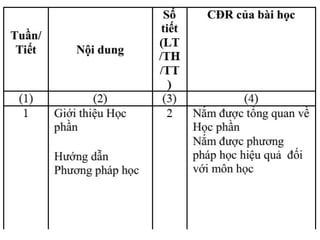
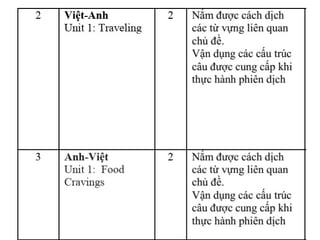
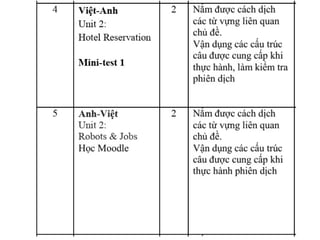
INTRODUCTION
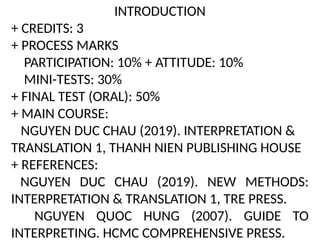
+ CREDITS: 3
+PROCESS MARKS
PARTICIPATION: 10% + ATTITUDE: 10%
MINI-TESTS: 30%
+ FINAL TEST (ORAL): 50%
+ MAIN COURSE:
NGUYEN DUC CHAU (2019). INTERPRETATION &
TRANSLATION 1, THANH NIEN PUBLISHING HOUSE
+ REFERENCES:
NGUYEN DUC CHAU (2019). NEW METHODS:
INTERPRETATION & TRANSLATION 1, TRE PRESS.
NGUYEN QUOC HUNG (2007). GUIDE TO
INTERPRETING. HCMC COMPREHENSIVE PRESS.
10.
INTERPRETATION CRITERIA
1/ Goodpronunciation
2/ Good intonation
3/ Fluency
4/ Proper use of vocabulary and structures
5/ Simultaneity (Reflex)
6/ Memory
7/ Confidence
8/ Concentration
9/ Flexibility
11.
PRACTICING INTERPRETIVE SKILLS
Havingwell prepared the knowledge and skills of
translation, the learners then may begin practicing
interpretive skills which are considered so
challenging to all Vietnamese learners.
There are some particular skills involved to the
skill of code switching required in the translation
and the interpretation of one language to another:
listening, memory, note-taking, summarizing and
paraphrasing.
Interpretation involves in variety of complex
tasks in terms of general knowledge, cultural
knowledge and interpretive skills.
12.
A good translator/interpreterhas to be a veritable
mind of information no matter what subject he is
dealing with. If you are interpreting a lecture on
genetics and you don’t know what a chromosome is,
you are in deep trouble!
13.
DIFFERENCES BETWEEN TRANSLATION
ANDINTERPRETATION
Most people think that translation and interpretation
are the same thing and that the mere knowledge of a
language implies the ability to go from one language
to another. Translation implies carefully analyzing
the message given within the context of a particular
linguistic code and transferring this message into
another written linguistic code. Interpretation, on the
other hand, means doing the same but orally and
simultaneously.
14.
According to GailRobinson there are 2 basic kinds
of interpretation: Consecutive and Simultaneous.
‘Consecutive interpretation is the process of listening
to a speech or lecture in one language and then at a
certain moment, transcribing and summarizing it
orally, in another language. The time lapse between
the speech and your interpretation varies.’
Simultaneous interpretation is somewhat more
complicated and challenging.
15.
THE NECESSARY QUALIFICATIONSFOR A
CONSECUTIVE INTERPRETER
a) Proficiency in two languages and two cultures
involved.
b) Acute speech and mind
c) Good techniques and memorizing verbal
utterances and converting them
rapidly, accurately and completely into another
language.
d) Power of concentration
e) Confidence
f) High moral standards
g) High level of education
16.
h) Master anumber of specific terms in the specific
situation, familiarize with the field, e.g. health,
education, environment, etc.
i) Responsibility
j) Remaining impartial and not taking sides.
k) Ability of taking notes of the discourse segments,
if required
l) Be able to work under stressful conditions
m) High order note-taking skills
17.
The followings areexcerpted from the International
Association of Conference Interpreters (AIIC) :
ability to analyze and construe facts; intuition;
speed of reaction and ability to adapt without
delay to speakers, situations and subjects;
powers of concentration;
above average physical and nervous staying-
power;
pleasant voice and public-speaking skills;
high degree of intellectual curiosity;
intellectual integrity;
tact and diplomacy.
18.
What professional liaisoninterpreters do
a) Familiarize themselves in advance with the likely
content of the interview.
b) Evaluate whether the complexity of the
conversation is within their competence.
c) Obtain correct information on location, time,
relevant topics, and participants.
d) Make contact with the party requesting the talks in
order to make introductions between all participants
and, if possible, arrange pre-interview consultation.
e) Provide advice to the relative persons on specific
cultural implications/background of L1 or L2, if any.
f) Explain the interpreter’s role to all participants.
19.
g) Select appropriateinterpreting mode (in almost all
liaison interpreting situations, the dialogue-
interpreting mode is chosen)
h) Check appropriate devices, e.g. tables, chairs,
sound system, etc. to facilitate communication.
i) Render TL messages into SL and vice versa.
j) Seek classification, when necessary, of terminology
used to ensure accuracy and clarity.
k) Clarify specific role and responsibilities where
more than one interpreter is present (usually one for
SL to TL, one for TL to SL).
l) Arrange de-briefing, where possible, to clarify
questions of cultural difference, or failure to establish
intended level of communication.
20.
m) Control thelength of questions and answers to
maintain adequate time constraints and ensure the
best understanding by both parties.
n) Consult with individuals for additional
information, e.g. cultural background, religious
aspects, etc.
PROBLEMS IN INTERPRETATION
Listening
Distraction
Lexical elements (ambiguity, homonymy, metaphor,
idiom)