Sentence
Structure
and
Punctuation.
Analysis
 Sentence structure and punctuation comeunder analysis questions.
 This means you must identify the techniqueAND explain the effect.
 You must beable to recognisedifferent types of sentences and also
whyparticular punctuation is used.
Sentence Structure
Remember:
An answer to this kind of analysisquestionshould always
describe the main features of the sentence structure
AND
Explainthe EFFECT this is meant to have.
Sentence Lengths
Long Sentences–if the sentence is long, the paceof the sentence
will beslow, creating a relaxed,flowing effect to the writing,
e.g.
‘Shewalkeddownthesideofthehillasthesummersunblazedin
theskyaboveher,causinghertoshieldhereyes,suchwasthe
brightness ofthat beautiful afternoon’
Sentence Lengths
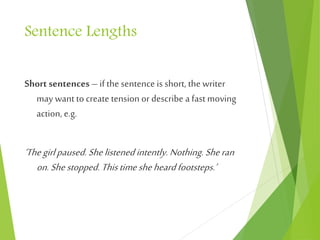
Short sentences – if the sentence is short, the writer
may want to create tension or describe a fast moving
action, e.g.
‘Thegirlpaused.Shelistenedintently.Nothing.Sheran
on.Shestopped. Thistimesheheardfootsteps.’
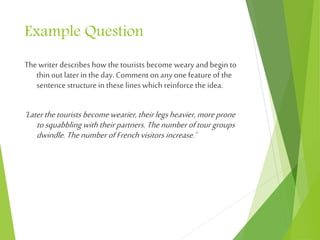
Example Question
Thewriter describes how the tourists become weary and begin to
thin out later in the day. Comment on any one feature of the
sentence structure in these lines which reinforce the idea.
‘Laterthetourists becomewearier,theirlegsheavier,moreprone
tosquabbling withtheirpartners.Thenumberoftourgroups
dwindle. ThenumberofFrenchvisitors increase.’
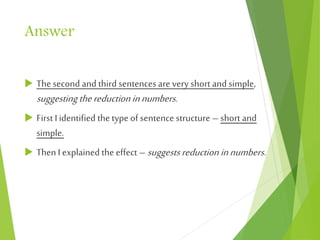
Answer
 The second and third sentences are very short and simple,
suggestingthereductioninnumbers.
 First I identified the type of sentence structure – short and
simple.
 Then I explained the effect – suggestsreduction innumbers.
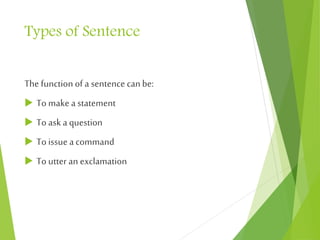
Types of Sentence
The function of a sentence canbe:
 To make a statement
 To aska question
 To issue acommand
 To utter an exclamation
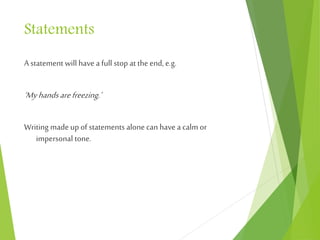
Statements
A statement will have a full stop at the end, e.g.
‘Myhandsarefreezing.’
Writing made up of statements alone can have a calm or
impersonal tone.
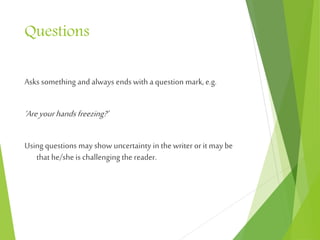
Questions
Asks something and always ends with a question mark, e.g.
‘Areyourhandsfreezing?’
Using questions may show uncertainty in the writer orit may be
that he/she is challenging the reader.
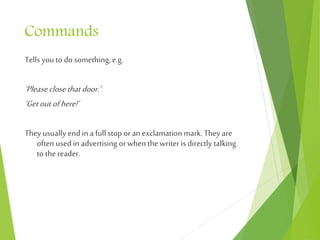
Commands
Tells you to do something, e.g.
‘Pleaseclosethatdoor.’
‘Getoutofhere!’
Theyusually end in a full stop oran exclamation mark.They are
often used in advertising orwhen the writer is directly talking
to the reader.
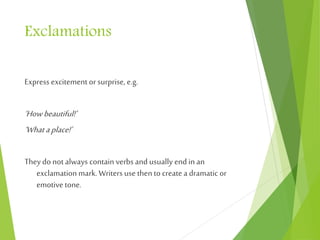
Exclamations
Express excitementor surprise, e.g.
‘Howbeautiful!’
‘Whataplace!’
Theydo not always contain verbs and usually end in an
exclamation mark. Writers use then to createa dramatic or
emotive tone.
Minor Sentences
Do notcontain a verb, They are abbreviations of othertypes of
sentences, so may end in a full stop orquestion mark, e.g.
‘What now?’
These sentences can bevery short and maycreate a tense or
dramatic mood. Theyare typical of informal language and can
beused in direct speech. Writing without verbs can also be
called note form.
Recap
Decide whether sentences are long andcomplex orshort and
simple.
Short and simple sentences aredirect and for quick
communication.
Long and complex sentences are usually usedin more formal
serious language.
Patterns in Sentences
Look for these particular patterns in sentences:
INVERSION –is when the orderof words is notas you would
expect. This can be useful in creating suspense when the
subject is only understood at the endof the sentence, e.g.
‘Eerily,fromthemistonthemoor,camealowwhistle.’
It also emphasises the word orphrase at the beginning of the
sentence, e.g.
‘Downswepttheaxe’.
Patterns
LISTS –emphasise how many examples there are of a certain
thing, or emphasise a point that may have been in the
sentence before, e.g.
‘Scotland isanunhealthy country,Ithasproblemswithheart
disease,strokes,cancer,obesity anddrugoverdoes.’
This list emphasises how many serious health problems Scotland
has, and backs upthe point made in the previous sentence.
Patterns
REPETITION –in a sentence, certain words may be used more
than once,. This draws attention to that particular word to
stress its significance or makea point, e.g.
‘They,andtheyalone’
Thesentence construction may also berepeated. This is often
used by politicians in public speeches because itdrives home a
point effectively, e.g.
‘Wewillnotbedictatedtobythegovernment.Wewillnotbe
satisfied withanycompromises,Wewillnotbesatisfied until
ourdemandsaremet.
Patterns
RHETORICAL QUESTIONS –are also used frequently in
public speaking and consists if a question to which no answer
is called for because the speaker assumes that all are agreed
on theanswer. They areused by writers who want to arguea
point, e.g.
‘Whodotheythink theyare?’
‘Wouldyoulikeapunishment exercise?’
Punctuation
What is the point of punctuation?
 Punctuation creates andclarifies meaning.
Really?
Yes really!
Whatever …
Example
Read the following text and describe how the woman feels
about the man she is writing to.
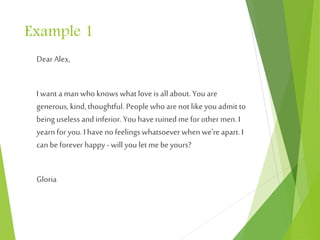
Example 1
Dear Alex,
I want a man who knows what love is all about. You are
generous, kind, thoughtful. People who arenot like you admit to
being useless and inferior. You haveruined me for othermen.I
yearn for you. I haveno feelings whatsoever when we're apart. I
can be forever happy - will you let me be yours?
Gloria
Now the exact same piece of text and explain how the woman
feels about Alex.
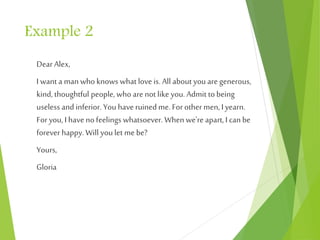
Example 2
Dear Alex,
I want a man who knows what love is. All about you aregenerous,
kind, thoughtful people, who arenot like you. Admit to being
useless and inferior. You haveruined me. Forothermen, I yearn.
Foryou, I haveno feelings whatsoever. When we're apart, I can be
foreverhappy. Will you let me be?
Yours,
Gloria
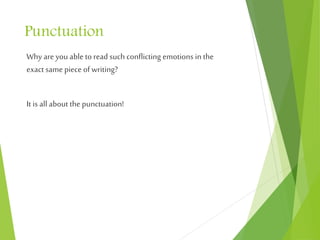
Punctuation
Why are you able to read such conflicting emotions in the
exact same piece of writing?
It is all about the punctuation!
Punctuation
These types of question come under sentence structure and
you have to ANALYSE the effect of different types of
punctuation. This means you need to beable to identify the
punctuation and explain why it has been used.
Exclamation Marks
Create the effect that the writer is shouting, or that they are
making a joke. It also gives the effect that the writer us
shocked or surprised.
Commas
Commas are separating marks.They may separate items in a
list, orseparate clauses of phrases form the rest of the
sentence. They can also slow down the pace.
Colon
Introduces a quotation ora list; an explanation orelaboration;
ora summing up. It always points you forward to complete an
idea.
Semi-Colon
May finish a sentence that is followed by another closely
connected orcontrasted with it. Semi-colons may also
separate items ins a list.
Dash
Emphasises the word which comes after it. It canalso act like a
colon and introduce a list oran additional idea in a sentence.
Inverted Commas
Theymark quotations, exact words spoken,direct speech,
foreign words orwords used in an unusual way. Also used to
suggest ‘so-called’ expressions. Forexample:He was a ‘hero’,
suggests that hewasn't a hero at all. Theword is being used
ironically orsarcastically.
Parenthesis
Is an extra piece of information inserted into a sentence and
enclosed bya pair or commas,brackets or dashes etc.
e.g.‘John Wilson (who is in class 2x) won the prize of best
pupil’
‘TheCN Tower –the highest man-made structure in the world
–is Toronto’s most visited tourist attraction’
Capital Letters
Emphasises something important orsuggests the ay
something is said. It gives the impression that the writer is
shouting oris very surprised.
Italics
Emphasises something important orsuggests the way
something is said. It puts emphasis on a particular word or
phrase.

Sentence structure-and-punctuation revised

  • 1.
  • 2.
    Analysis  Sentence structureand punctuation comeunder analysis questions.  This means you must identify the techniqueAND explain the effect.  You must beable to recognisedifferent types of sentences and also whyparticular punctuation is used.
  • 3.
    Sentence Structure Remember: An answerto this kind of analysisquestionshould always describe the main features of the sentence structure AND Explainthe EFFECT this is meant to have.
  • 4.
    Sentence Lengths Long Sentences–ifthe sentence is long, the paceof the sentence will beslow, creating a relaxed,flowing effect to the writing, e.g. ‘Shewalkeddownthesideofthehillasthesummersunblazedin theskyaboveher,causinghertoshieldhereyes,suchwasthe brightness ofthat beautiful afternoon’
  • 5.
    Sentence Lengths Short sentences– if the sentence is short, the writer may want to create tension or describe a fast moving action, e.g. ‘Thegirlpaused.Shelistenedintently.Nothing.Sheran on.Shestopped. Thistimesheheardfootsteps.’
  • 6.
    Example Question Thewriter describeshow the tourists become weary and begin to thin out later in the day. Comment on any one feature of the sentence structure in these lines which reinforce the idea. ‘Laterthetourists becomewearier,theirlegsheavier,moreprone tosquabbling withtheirpartners.Thenumberoftourgroups dwindle. ThenumberofFrenchvisitors increase.’
  • 7.
    Answer  The secondand third sentences are very short and simple, suggestingthereductioninnumbers.  First I identified the type of sentence structure – short and simple.  Then I explained the effect – suggestsreduction innumbers.
  • 8.
    Types of Sentence Thefunction of a sentence canbe:  To make a statement  To aska question  To issue acommand  To utter an exclamation
  • 9.
    Statements A statement willhave a full stop at the end, e.g. ‘Myhandsarefreezing.’ Writing made up of statements alone can have a calm or impersonal tone.
  • 10.
    Questions Asks something andalways ends with a question mark, e.g. ‘Areyourhandsfreezing?’ Using questions may show uncertainty in the writer orit may be that he/she is challenging the reader.
  • 11.
    Commands Tells you todo something, e.g. ‘Pleaseclosethatdoor.’ ‘Getoutofhere!’ Theyusually end in a full stop oran exclamation mark.They are often used in advertising orwhen the writer is directly talking to the reader.
  • 12.
    Exclamations Express excitementor surprise,e.g. ‘Howbeautiful!’ ‘Whataplace!’ Theydo not always contain verbs and usually end in an exclamation mark. Writers use then to createa dramatic or emotive tone.
  • 13.
    Minor Sentences Do notcontaina verb, They are abbreviations of othertypes of sentences, so may end in a full stop orquestion mark, e.g. ‘What now?’ These sentences can bevery short and maycreate a tense or dramatic mood. Theyare typical of informal language and can beused in direct speech. Writing without verbs can also be called note form.
  • 14.
    Recap Decide whether sentencesare long andcomplex orshort and simple. Short and simple sentences aredirect and for quick communication. Long and complex sentences are usually usedin more formal serious language.
  • 15.
    Patterns in Sentences Lookfor these particular patterns in sentences: INVERSION –is when the orderof words is notas you would expect. This can be useful in creating suspense when the subject is only understood at the endof the sentence, e.g. ‘Eerily,fromthemistonthemoor,camealowwhistle.’ It also emphasises the word orphrase at the beginning of the sentence, e.g. ‘Downswepttheaxe’.
  • 16.
    Patterns LISTS –emphasise howmany examples there are of a certain thing, or emphasise a point that may have been in the sentence before, e.g. ‘Scotland isanunhealthy country,Ithasproblemswithheart disease,strokes,cancer,obesity anddrugoverdoes.’ This list emphasises how many serious health problems Scotland has, and backs upthe point made in the previous sentence.
  • 17.
    Patterns REPETITION –in asentence, certain words may be used more than once,. This draws attention to that particular word to stress its significance or makea point, e.g. ‘They,andtheyalone’ Thesentence construction may also berepeated. This is often used by politicians in public speeches because itdrives home a point effectively, e.g. ‘Wewillnotbedictatedtobythegovernment.Wewillnotbe satisfied withanycompromises,Wewillnotbesatisfied until ourdemandsaremet.
  • 18.
    Patterns RHETORICAL QUESTIONS –arealso used frequently in public speaking and consists if a question to which no answer is called for because the speaker assumes that all are agreed on theanswer. They areused by writers who want to arguea point, e.g. ‘Whodotheythink theyare?’ ‘Wouldyoulikeapunishment exercise?’
  • 19.
    Punctuation What is thepoint of punctuation?  Punctuation creates andclarifies meaning. Really? Yes really! Whatever …
  • 20.
    Example Read the followingtext and describe how the woman feels about the man she is writing to.
  • 21.
    Example 1 Dear Alex, Iwant a man who knows what love is all about. You are generous, kind, thoughtful. People who arenot like you admit to being useless and inferior. You haveruined me for othermen.I yearn for you. I haveno feelings whatsoever when we're apart. I can be forever happy - will you let me be yours? Gloria
  • 22.
    Now the exactsame piece of text and explain how the woman feels about Alex.
  • 23.
    Example 2 Dear Alex, Iwant a man who knows what love is. All about you aregenerous, kind, thoughtful people, who arenot like you. Admit to being useless and inferior. You haveruined me. Forothermen, I yearn. Foryou, I haveno feelings whatsoever. When we're apart, I can be foreverhappy. Will you let me be? Yours, Gloria
  • 24.
    Punctuation Why are youable to read such conflicting emotions in the exact same piece of writing? It is all about the punctuation!
  • 25.
    Punctuation These types ofquestion come under sentence structure and you have to ANALYSE the effect of different types of punctuation. This means you need to beable to identify the punctuation and explain why it has been used.
  • 26.
    Exclamation Marks Create theeffect that the writer is shouting, or that they are making a joke. It also gives the effect that the writer us shocked or surprised.
  • 27.
    Commas Commas are separatingmarks.They may separate items in a list, orseparate clauses of phrases form the rest of the sentence. They can also slow down the pace.
  • 28.
    Colon Introduces a quotationora list; an explanation orelaboration; ora summing up. It always points you forward to complete an idea.
  • 29.
    Semi-Colon May finish asentence that is followed by another closely connected orcontrasted with it. Semi-colons may also separate items ins a list.
  • 30.
    Dash Emphasises the wordwhich comes after it. It canalso act like a colon and introduce a list oran additional idea in a sentence.
  • 31.
    Inverted Commas Theymark quotations,exact words spoken,direct speech, foreign words orwords used in an unusual way. Also used to suggest ‘so-called’ expressions. Forexample:He was a ‘hero’, suggests that hewasn't a hero at all. Theword is being used ironically orsarcastically.
  • 32.
    Parenthesis Is an extrapiece of information inserted into a sentence and enclosed bya pair or commas,brackets or dashes etc. e.g.‘John Wilson (who is in class 2x) won the prize of best pupil’ ‘TheCN Tower –the highest man-made structure in the world –is Toronto’s most visited tourist attraction’
  • 33.
    Capital Letters Emphasises somethingimportant orsuggests the ay something is said. It gives the impression that the writer is shouting oris very surprised.
  • 34.
    Italics Emphasises something importantorsuggests the way something is said. It puts emphasis on a particular word or phrase.