

An oral translation of a written
text.
TJ Patricia Villacorta- Melendreras
Loyola 2016
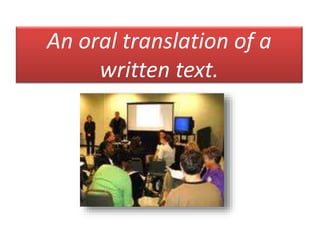
An oral translation of a
written text.
5
Determining the Differences
• 1. What is the difference between
sight and written translation?
–As opposed to written translation,
which is the written rendering of a
document from one language into
another, sight translation is the
oral rendering of a document from
one language into another.
6
Elements
1. Reading Comprehension: Interpreters must be adept at
grasping the meaning of written texts and
understanding the material explicitly and implicitly
(interrelationships of ideas)
2. Prediction: Interpreters should be able to predict the
outcome of an incomplete message and also be versed
in the various writing styles—legal documents, personal
and business correspondence, technical reports so they
can be alert to common constructions that may pose
translation problems.
7
Process of Sight Translation
1. Scan the document to determine the subject
matter, context, style, and country of origin.
2. Make a mental note of common pitfalls
unique to the source language.
3. Skim the passages quickly and identify key
features, commas, parentheses, etc.
4. Translate sentence by sentence, focusing on
one unit of meaning at a time.
5. Maintain a steady pace, translating as
smoothly as possible.
Excellent Reading comprehension is an
important skill a translator/interpreter
must possess. In order to accurately
render sight translation, an
interpreter/translator must also possess
the ability to:
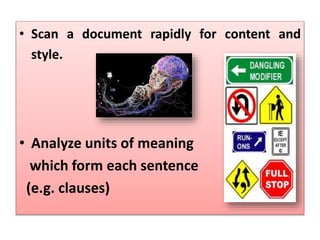
• Scan a document rapidly for content and
style.
• Analyze units of meaning
which form each sentence
(e.g. clauses)
• Render sight translation in Target Language while
reading ahead and preparing to render next units of
meaning.
• Render sight translation with accuracy and fidelity to
the text.
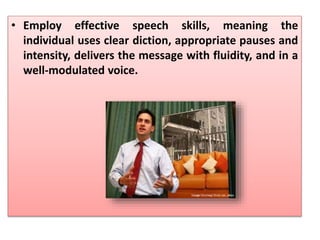
• Employ effective speech skills, meaning the
individual uses clear diction, appropriate pauses and
intensity, delivers the message with fluidity, and in a
well-modulated voice.
• Handwritten Text
• Ungrammatical sentence structures and poor
punctuation.
(For ex. text written by non-native-speakers who are
unfamiliar with the rules of grammar and
punctuation)
Incoherent or poor thought organization.
• Text may involve graphs, tables, pictures or diagrams.
• Lengthy text.
• Last night I could not girop, I tossed and turned all
pritoor but could not fall agirop. I finally got up and
turned on the yiopl. I channel surfed for a while
until I found a rietz about humpback whales I
watched the entire thing and finally at 4:30 am I fell
agirop, but 30 tivgs later my alarm bopsa went off
and I had to prepare to go to necop.
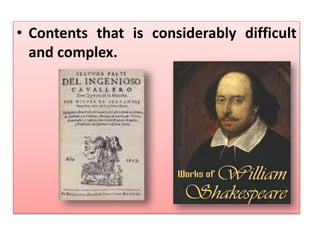
• Contents that is considerably difficult
and complex.
18
Exercises for Sight Translation
• 1. Reading Aloud: Stand in front of a
mirror and read passages aloud from any
book, newspaper, or magazine. A legal
textbook, code book, or other legal text
is useful for familiarizing yourself with
legal language. Record or videotape
yourself and analyze the outcome
critically. Pay attention to your voice,
pitch, tone, hesitations, signs, projection,
enunciation, and posture.
19
Exercises
• 2. Extensive Reading: Build up your reading
speed and your vocabulary by reading as
much as possible in many different fields.
• 3. Deciphering Handwriting: Obtain texts
written by hand (e.g., personal letters) and
practice deciphering the handwriting on the
first oral reading.
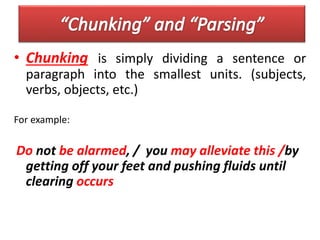
• Chunking is simply dividing a sentence or
paragraph into the smallest units. (subjects,
verbs, objects, etc.)
For example:
Do not be alarmed, / you may alleviate this /by
getting off your feet and pushing fluids until
clearing occurs
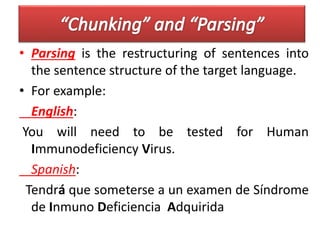
• Parsing is the restructuring of sentences into
the sentence structure of the target language.
• For example:
English:
You will need to be tested for Human
Immunodeficiency Virus.
Spanish:
Tendrá que someterse a un examen de Síndrome
de Inmuno Deficiencia Adquirida
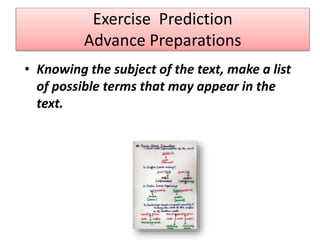
Exercise Prediction
Advance Preparations
• Knowing the subject of the text, make a list
of possible terms that may appear in the
text.
The time may come when you cannot speak for yourself. By completing this form,
you can give directions about your medical treatment at such a time. This
document can be used by non-English-speakers if a qualified interpreter/translator
reads it to the person in the person’s own language and a signed Statement of
Interpreter/Translator is attached.
TO MY FAMILY, FRIENDS AND HEALTH-CARE PROVIDERS
I, ____________________________[Print your full name ]
of ___________________________[Print your street address]
State: _______________________________Zip Code:_________________ ,
born on _________________________[Print your date of birth]
being over the age of eighteen years, make this directive after careful
consideration
and of my own free will. If at any time I am unable to take part in decisions about
my medical care, let this document stand as evidence of my views, wishes and
beliefs about my quality of life and the medical treatment I require.
This directive should never be used if I have the capacity to speak competently for
myself or if there is evidence that it has been revoked.
I sign this document in the full knowledge that my health care may be limited as a
result, but only as specified below. I request that all who are responsible for my
care respect the directions given in this document.
1. Re-express the text, write it in your own words you may change the
register the only rule is to not to change the meaning.
2. Answer the following questions about the text:
A. What is the purpose of this document?
B. When are Cesarean Sections generally done?
C. When will the patient be contacted?
D. Who will contact the patient?
E. What may cause delays in the getting to the patients surgery?
3. Chunk or divide the text into the smallest
semantic units.
4. Parse or restructure the sentences into the
sentence structure of the target.
5. Sight Translate it out loud!
TT Sight Translation

TT Sight Translation

  • 1.
    An oral translationof a written text. TJ Patricia Villacorta- Melendreras Loyola 2016
  • 2.
    An oral translationof a written text.
  • 5.
    5 Determining the Differences •1. What is the difference between sight and written translation? –As opposed to written translation, which is the written rendering of a document from one language into another, sight translation is the oral rendering of a document from one language into another.
  • 6.
    6 Elements 1. Reading Comprehension:Interpreters must be adept at grasping the meaning of written texts and understanding the material explicitly and implicitly (interrelationships of ideas) 2. Prediction: Interpreters should be able to predict the outcome of an incomplete message and also be versed in the various writing styles—legal documents, personal and business correspondence, technical reports so they can be alert to common constructions that may pose translation problems.
  • 7.
    7 Process of SightTranslation 1. Scan the document to determine the subject matter, context, style, and country of origin. 2. Make a mental note of common pitfalls unique to the source language. 3. Skim the passages quickly and identify key features, commas, parentheses, etc. 4. Translate sentence by sentence, focusing on one unit of meaning at a time. 5. Maintain a steady pace, translating as smoothly as possible.
  • 9.
    Excellent Reading comprehensionis an important skill a translator/interpreter must possess. In order to accurately render sight translation, an interpreter/translator must also possess the ability to:
  • 10.
    • Scan adocument rapidly for content and style. • Analyze units of meaning which form each sentence (e.g. clauses)
  • 11.
    • Render sighttranslation in Target Language while reading ahead and preparing to render next units of meaning. • Render sight translation with accuracy and fidelity to the text.
  • 12.
    • Employ effectivespeech skills, meaning the individual uses clear diction, appropriate pauses and intensity, delivers the message with fluidity, and in a well-modulated voice.
  • 13.
    • Handwritten Text •Ungrammatical sentence structures and poor punctuation. (For ex. text written by non-native-speakers who are unfamiliar with the rules of grammar and punctuation)
  • 14.
    Incoherent or poorthought organization. • Text may involve graphs, tables, pictures or diagrams. • Lengthy text.
  • 15.
    • Last nightI could not girop, I tossed and turned all pritoor but could not fall agirop. I finally got up and turned on the yiopl. I channel surfed for a while until I found a rietz about humpback whales I watched the entire thing and finally at 4:30 am I fell agirop, but 30 tivgs later my alarm bopsa went off and I had to prepare to go to necop.
  • 16.
    • Contents thatis considerably difficult and complex.
  • 18.
    18 Exercises for SightTranslation • 1. Reading Aloud: Stand in front of a mirror and read passages aloud from any book, newspaper, or magazine. A legal textbook, code book, or other legal text is useful for familiarizing yourself with legal language. Record or videotape yourself and analyze the outcome critically. Pay attention to your voice, pitch, tone, hesitations, signs, projection, enunciation, and posture.
  • 19.
    19 Exercises • 2. ExtensiveReading: Build up your reading speed and your vocabulary by reading as much as possible in many different fields. • 3. Deciphering Handwriting: Obtain texts written by hand (e.g., personal letters) and practice deciphering the handwriting on the first oral reading.
  • 20.
    • Chunking issimply dividing a sentence or paragraph into the smallest units. (subjects, verbs, objects, etc.) For example: Do not be alarmed, / you may alleviate this /by getting off your feet and pushing fluids until clearing occurs
  • 21.
    • Parsing isthe restructuring of sentences into the sentence structure of the target language. • For example: English: You will need to be tested for Human Immunodeficiency Virus. Spanish: Tendrá que someterse a un examen de Síndrome de Inmuno Deficiencia Adquirida
  • 22.
    Exercise Prediction Advance Preparations •Knowing the subject of the text, make a list of possible terms that may appear in the text.
  • 23.
    The time maycome when you cannot speak for yourself. By completing this form, you can give directions about your medical treatment at such a time. This document can be used by non-English-speakers if a qualified interpreter/translator reads it to the person in the person’s own language and a signed Statement of Interpreter/Translator is attached. TO MY FAMILY, FRIENDS AND HEALTH-CARE PROVIDERS I, ____________________________[Print your full name ] of ___________________________[Print your street address] State: _______________________________Zip Code:_________________ , born on _________________________[Print your date of birth] being over the age of eighteen years, make this directive after careful consideration and of my own free will. If at any time I am unable to take part in decisions about my medical care, let this document stand as evidence of my views, wishes and beliefs about my quality of life and the medical treatment I require. This directive should never be used if I have the capacity to speak competently for myself or if there is evidence that it has been revoked. I sign this document in the full knowledge that my health care may be limited as a result, but only as specified below. I request that all who are responsible for my care respect the directions given in this document.
  • 25.
    1. Re-express thetext, write it in your own words you may change the register the only rule is to not to change the meaning. 2. Answer the following questions about the text: A. What is the purpose of this document? B. When are Cesarean Sections generally done? C. When will the patient be contacted? D. Who will contact the patient? E. What may cause delays in the getting to the patients surgery?
  • 26.
    3. Chunk ordivide the text into the smallest semantic units. 4. Parse or restructure the sentences into the sentence structure of the target. 5. Sight Translate it out loud!