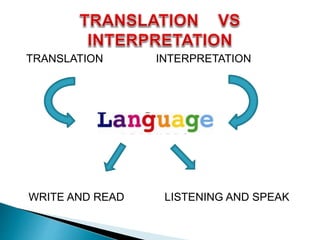
TRANSLATION INTERPRETATION
WRITE AND READ LISTENING AND SPEAK
TRANSLATION
Translation deals
with written
communication.
INTERPRETATION
While interpreting is
all about the spoken
word.
 They work on written documents such as:
 Books
 Essays,
 Legal documents,
 Medical records,
 Websites, or any other form of information in
written form.
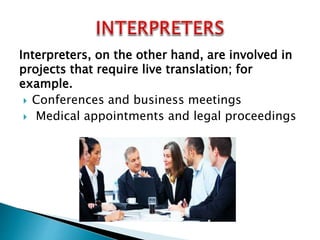
Interpreters, on the other hand, are involved in
projects that require live translation; for
example.
 Conferences and business meetings
 Medical appointments and legal proceedings
INTERPRETER
 Carried out in real
time or very close to
it.
 No time to refer to
the written
resources.
TRANSLATOR
 Time to refer to the
written resources.
 Preparation before
each assignment.
INTERPRETER
 Keep up with around
150 words a minute.
 Has to receive,
understand, manage,
and reconstruct
information
TRANSLATOR
 Translate 2000-3000
words a day.
 In interpretation communication is immediate,
involving an interaction between speakers,
listeners, and interpreters.
 interpreters, often working in a team, are faced
with people speaking and communicating right
now.
 In translation there is always a gap between
the writing of a text by an author and its
reception by the readers.
 Translators often spend a long time working
on one text.
Both translators and interpreters have a deep
linguistic and cultural knowledge of their
working languages, as well as the ability to
communicate clearly.
The use of particular linguistic resources: the
original speaker's ideas are transmitted as
spoken words, with a particular rhythm and
intonation, and gestures.

Translation

  • 3.
    TRANSLATION INTERPRETATION WRITE ANDREAD LISTENING AND SPEAK
  • 4.
  • 5.
     They workon written documents such as:  Books  Essays,  Legal documents,  Medical records,  Websites, or any other form of information in written form.
  • 6.
    Interpreters, on theother hand, are involved in projects that require live translation; for example.  Conferences and business meetings  Medical appointments and legal proceedings
  • 8.
    INTERPRETER  Carried outin real time or very close to it.  No time to refer to the written resources. TRANSLATOR  Time to refer to the written resources.  Preparation before each assignment.
  • 9.
    INTERPRETER  Keep upwith around 150 words a minute.  Has to receive, understand, manage, and reconstruct information TRANSLATOR  Translate 2000-3000 words a day.
  • 10.
     In interpretationcommunication is immediate, involving an interaction between speakers, listeners, and interpreters.  interpreters, often working in a team, are faced with people speaking and communicating right now.
  • 11.
     In translationthere is always a gap between the writing of a text by an author and its reception by the readers.  Translators often spend a long time working on one text.
  • 12.
    Both translators andinterpreters have a deep linguistic and cultural knowledge of their working languages, as well as the ability to communicate clearly.
  • 13.
    The use ofparticular linguistic resources: the original speaker's ideas are transmitted as spoken words, with a particular rhythm and intonation, and gestures.