INTERPERSONAL SKILLS
2
Interpersonal Skills/
Facilitation Skills
listening
questioning
language &
communication
using
feedback
conflict handling
3
ESSENTIAL IP COMPETENCIES
 Self awareness
 Control
 Motivation
 Acknowledging the interests of
subordinates
 Communication skills
4
DEVELOPING IP Skills
 Developing Assertiveness
 Accepting Responsibility
 Managing Conflicts
Avoiding
Accommodating
Competing/Forcing
Collaborating
Compromising
5
Life Positions
I’m OK — I’m OK —
You’re not OK You’re OK
I’m not OK — I’m not OK —
You’re not OK You’re OK
AttitudetowardOneself
Attitude toward Others
Negative Positive
Positive
Negative
6
Management Conflict Styles
Assertive
behavior
Aggressive
behavior
Accommodating
style
Collaborating
style
Compromising
style
Avoiding
style
Forcing
style
Passive
behavior
High concern
for others’
needs
Low concern
for others’
needs
High concern
for own
needs
I’m
not OK —
You’re OK
I’m OK —
You’re OK
I’m
not OK —
You’re not OK
I’m OK —
You’re not OK
7
Factors Hampering Interpersonal
Interactions
 Poor Listening
 Emotional Arousal
 Lack of Time
 Differences in objective
Eric Berne and Transactional Analysis
Transactional Analysis
A unified system of individual and
social psychiatry
Focuses on the individual but also
one s relationship to others
A model for explaining why and how:
People think like they do
People act like they do
People interact/communicate with
others
9
Eric Berne and Transactional Analysis
Transactional Analysis
 People have three ego states: parent, adult, child
 Parent: when a person thinks, feels & behaves
in ways copied from his/her parents
 Child: thinking, feeling, behaving as one did as
a child
 Adult: thoughts, feelings, or behaviors that are
a direct result of current happenings
Key point: people shift in & out of these states
10
The Three Ego States
Parent- Do as I do
Child- What shall I do?
Adult- I will be frank with you
 Biological conditions are irrelevant to these ego
states.
• We shift from one ego state to another in
transactions.
Parent- Why don t you prepare a time-table?
Child- What is the point when one cannot
follow it? – Becomes an Adult.
11
Ego Portraits
People have favorite, preferred ego state, depicted by
larger circle in a diagram
Parent Adult Child
P
A
C
P
A
C
P
A
C
12
Eric Berne and Transactional Analysis
Transactional Analysis – further development
 Parent & child ego states subdivided
 Parent state: controlling or nurturing
 Child state: free child (FC) or adapted
child (AC)
• AC – a person conforms & adapts to
demands of others
 FC – a person acts & feels like an
uninhibited & unsocialized child
 Adult state: current self
13
Transactional Analysis
Transactional analysis (TA): a method of understanding
behavior in interpersonal dynamics.
The three ego states
Parent
Critical parent
Sympathetic/nurturing parent
Child
Natural child (affectionate playful)
Adapted child
Adult
The three types of transactions
Complementary
Crossed
Ulterior
14
Types of Transactions
Complementary Transactions: Appropriate and
Expected Transactions indicating healthy human
relationships.
Communication takes place when transactions are
complementary. A stimulus invites a response; this
response becomes a stimulus inviting further
response and so on.
15
Transactional Analysis Types (I)
Complementary transaction
Supervisor Employee
P
C
A
P
C
A
16
Eric Berne and Transactional Analysis
Transactional Analysis occurs when the ego states
of 2 people interacting is assessed
 Complimentary interaction:
 one person in a nurturing parent ego state
 other person in their adaptive child ego
state
17
Eric Berne and Transactional Analysis
For a leader-follower, the following complementary
transactions could occur:
18
Transactional Analysis Types (II)
Crossed transaction
Supervisor Employee
P
C
A
P
C
A
19
Types of Transactions
Crossed Transaction: This causes most difficulties in
social situations.
May be, you should improve your study habits .
You always find fault with me whatever I do Parent-
Child interaction.
20
Eric Berne and Transactional Analysis
Transactional Analysis occurs when the ego states of 2
people interacting is assessed, cont d.
 Crossed transaction:
 A leader in the adult ego state deals with
 A subordinate who responds from their free child
ego state with somewhat negative, rejecting input
from the leader
21
Eric Berne and Transactional Analysis
For a leader-follower, there are a number of possible
crossed transactions:
22
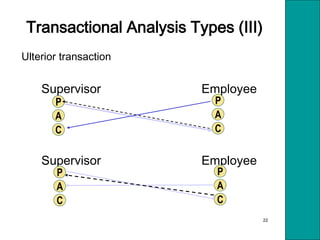
Transactional Analysis Types (III)
Ulterior transaction
Supervisor Employee
Supervisor Employee
P
C
A
P
C
A
P
C
A
P
C
A
23
STROKES
 Positive
 Negative
 Neutral
24
UTILITY
 Communication
 Motivation
 Leadership
Interpersonal Skills
- BC
26
Building Positive Relationship
 Use of I
 Focus on problem solving
 Don t Deceive
 Empathy
 Listen
Use of Praise
 Be specific
 Praise progress
 Sincere
 Don t overdo
 Timing
27
Dealing with Criticism
 Understand the Reason behind
 Empathy
 Don t personalize criticism
 Do not be Judgmental
 Do not overload
NEGOTIATIONS
29
Steps Involved
 Planning
 Impersonal Relationship Building
 Exchanging Task-Related Information
 Persuasion
 Agreement
30
Negotiation Tactics & Behavior
 Location
 Time
 Buyer-Seller Relation
 Extreme Behavior
 Promises/Threats
 Using Silence

Interpersonal skills

  • 1.
  • 2.
  • 3.
    3 ESSENTIAL IP COMPETENCIES Self awareness  Control  Motivation  Acknowledging the interests of subordinates  Communication skills
  • 4.
    4 DEVELOPING IP Skills Developing Assertiveness  Accepting Responsibility  Managing Conflicts Avoiding Accommodating Competing/Forcing Collaborating Compromising
  • 5.
    5 Life Positions I’m OK— I’m OK — You’re not OK You’re OK I’m not OK — I’m not OK — You’re not OK You’re OK AttitudetowardOneself Attitude toward Others Negative Positive Positive Negative
  • 6.
    6 Management Conflict Styles Assertive behavior Aggressive behavior Accommodating style Collaborating style Compromising style Avoiding style Forcing style Passive behavior Highconcern for others’ needs Low concern for others’ needs High concern for own needs I’m not OK — You’re OK I’m OK — You’re OK I’m not OK — You’re not OK I’m OK — You’re not OK
  • 7.
    7 Factors Hampering Interpersonal Interactions Poor Listening  Emotional Arousal  Lack of Time  Differences in objective
  • 8.
    Eric Berne andTransactional Analysis Transactional Analysis A unified system of individual and social psychiatry Focuses on the individual but also one s relationship to others A model for explaining why and how: People think like they do People act like they do People interact/communicate with others
  • 9.
    9 Eric Berne andTransactional Analysis Transactional Analysis  People have three ego states: parent, adult, child  Parent: when a person thinks, feels & behaves in ways copied from his/her parents  Child: thinking, feeling, behaving as one did as a child  Adult: thoughts, feelings, or behaviors that are a direct result of current happenings Key point: people shift in & out of these states
  • 10.
    10 The Three EgoStates Parent- Do as I do Child- What shall I do? Adult- I will be frank with you  Biological conditions are irrelevant to these ego states. • We shift from one ego state to another in transactions. Parent- Why don t you prepare a time-table? Child- What is the point when one cannot follow it? – Becomes an Adult.
  • 11.
    11 Ego Portraits People havefavorite, preferred ego state, depicted by larger circle in a diagram Parent Adult Child P A C P A C P A C
  • 12.
    12 Eric Berne andTransactional Analysis Transactional Analysis – further development  Parent & child ego states subdivided  Parent state: controlling or nurturing  Child state: free child (FC) or adapted child (AC) • AC – a person conforms & adapts to demands of others  FC – a person acts & feels like an uninhibited & unsocialized child  Adult state: current self
  • 13.
    13 Transactional Analysis Transactional analysis(TA): a method of understanding behavior in interpersonal dynamics. The three ego states Parent Critical parent Sympathetic/nurturing parent Child Natural child (affectionate playful) Adapted child Adult The three types of transactions Complementary Crossed Ulterior
  • 14.
    14 Types of Transactions ComplementaryTransactions: Appropriate and Expected Transactions indicating healthy human relationships. Communication takes place when transactions are complementary. A stimulus invites a response; this response becomes a stimulus inviting further response and so on.
  • 15.
    15 Transactional Analysis Types(I) Complementary transaction Supervisor Employee P C A P C A
  • 16.
    16 Eric Berne andTransactional Analysis Transactional Analysis occurs when the ego states of 2 people interacting is assessed  Complimentary interaction:  one person in a nurturing parent ego state  other person in their adaptive child ego state
  • 17.
    17 Eric Berne andTransactional Analysis For a leader-follower, the following complementary transactions could occur:
  • 18.
    18 Transactional Analysis Types(II) Crossed transaction Supervisor Employee P C A P C A
  • 19.
    19 Types of Transactions CrossedTransaction: This causes most difficulties in social situations. May be, you should improve your study habits . You always find fault with me whatever I do Parent- Child interaction.
  • 20.
    20 Eric Berne andTransactional Analysis Transactional Analysis occurs when the ego states of 2 people interacting is assessed, cont d.  Crossed transaction:  A leader in the adult ego state deals with  A subordinate who responds from their free child ego state with somewhat negative, rejecting input from the leader
  • 21.
    21 Eric Berne andTransactional Analysis For a leader-follower, there are a number of possible crossed transactions:
  • 22.
    22 Transactional Analysis Types(III) Ulterior transaction Supervisor Employee Supervisor Employee P C A P C A P C A P C A
  • 23.
  • 24.
  • 25.
  • 26.
    26 Building Positive Relationship Use of I  Focus on problem solving  Don t Deceive  Empathy  Listen Use of Praise  Be specific  Praise progress  Sincere  Don t overdo  Timing
  • 27.
    27 Dealing with Criticism Understand the Reason behind  Empathy  Don t personalize criticism  Do not be Judgmental  Do not overload
  • 28.
  • 29.
    29 Steps Involved  Planning Impersonal Relationship Building  Exchanging Task-Related Information  Persuasion  Agreement
  • 30.
    30 Negotiation Tactics &Behavior  Location  Time  Buyer-Seller Relation  Extreme Behavior  Promises/Threats  Using Silence