EFFECTIVE
COMMUNICAT
ION
EdM 408 – Advance English
Communication
Reporter: Chinly Ruth T. Alberto
“Communicati
on is the
sister of
leadership.”
In the new global and diverse
workplace, it requires
excellent communication skills!
“it is simply saying what you

mean and meaning what you
say”
SIMPLE?
misunderstood with simple message
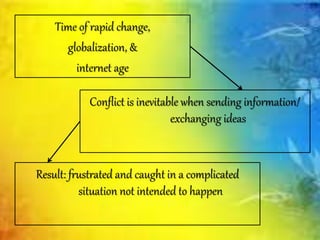
Time of rapid change,
globalization, &
internet age
Conflict is inevitable when sending information/
exchanging ideas
Result: frustrated and caught in a complicated
situation not intended to happen
MISCOMMUNICATION
Skills on how to effectively
connect with others to
build trust
gain respect
to be understood
How can we communicate
effectively?
What can we do to
maintain and improve
our relationship with
others without being
misunderstood?
COMMUNICATION
• not just exchanging ideas or
information
• an understanding of the
emotions and the intention of
the speaker in his message
It would be helpful to consider
not just the verbal signs sent
WAYS ON HOW TO
BECOME AN
EFFECTIVE
COMMUNICATOR
"People sense how you feel
about them. If you want to
change their attitudes
toward you, change the
negative attitudes you
have toward them."
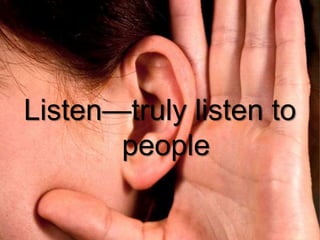
Listen—truly listen to
people
Listening is hearing with understanding.
Do not only be good in sending
information or sharing your ideas, but
also in paying attention to the
information the sender has provided you
to appreciate the emotion that goes with
his or her message.
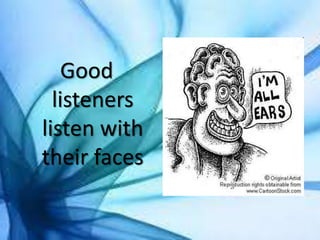
Good
listeners
listen with
their faces
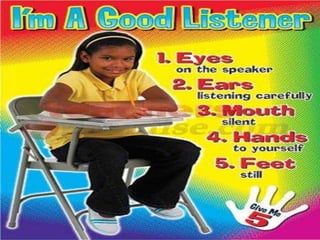
How to Listen
Face the speaker
Maintain eye contact
Minimize external
distractions
Respond appropriately
Focus solely on what
the speaker is saying
Minimize internal
distractions
Keep an open mind
Avoid letting the
speaker know how
you handled a similar
situation
Even if the speaker is
launching a complaint
against you, wait until
they finish to defend
yourself
Engage yourself
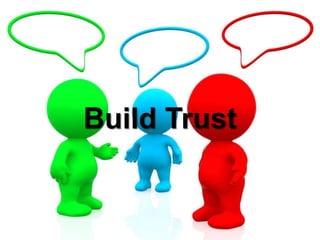
Build Trust
Mutual trust is a shared belief that you
can depend on each other to achieve a
common purpose.
You cannot establish trust if you cannot
listen. A conversation is a relationship.
Both speaker and listener play a part,
each influencing the other. Instead of
being a passive recipient, the listener has
as much to do in shaping the
conversation as the speaker.
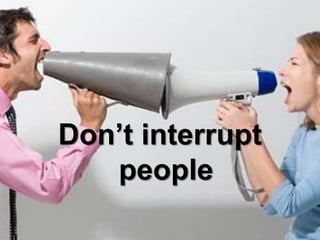
Don’t interrupt
people
Interrupting a speaker is disruptive.
This may cause the speaker to forget
or get lost in his/her speech.
You will not get the chance to hear
everything he/she has to say and miss
important information/ ideas that might
be useful to you and that you might be
very interested about.
Show interest
Nod occasionally, smile, make eye
contact.
Encourage the speaker to continue by
saying “yes” and show interest by other
verbal comments like “ah-huh,” and
“oh,” but not conversation fillers like
“ahms” or “ahs” because they do not
contribute any in making conversation
better.
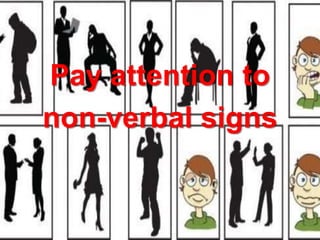
Pay attention to
non-verbal signs
Nonverbal cues reveal more than
what a speaker says.
Be reminded to consider all nonverbal
signals you receive or observe and not
just focus on one. Consider all of it as a
whole to get a better “read” of the
person.
Provide Feedback
Give genuine
recognition and
praise
Providing feedback is important
because you let the other person
know that you are paying attention to
his/ her message.
One form of feedback is paraphrasing what
the speaker has said to remind him/her
to where to continue in case he/she
forgets or has been interrupted by other
factors.
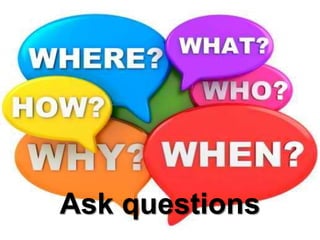
Ask questions
By asking questions, you are able to
clarify what you think/ feel about the
topic and the speaker will know that
you are genuinely paying attention
and not just merely pretending.
This will aid in making the speaker
comfortable, thus eliminating a possible
barrier that may cause the
communication to fail.
Get rid of
distractions
There are many distractions that are
causing communication to fail and
topping the list nowadays is the cell
phone followed by other gadgets that
are using modern technology.
How would you feel if the person you are
talking to does not even bother to look at
you? When talking to someone, give
him/her your full attention and get rid of
distractions.
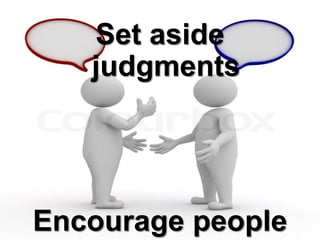
Set aside
judgments
Encourage people
Listening to what another person is
saying does not mean that you have
to believe or be convinced in what
he/she believes.
Give others a chance to send their
message. Be fair. For sure, you would not
want to be judged by another who is a
better communicator or speaker than
you.
Use people’s name
First name basis
Be fully present when
you are with people
Smile
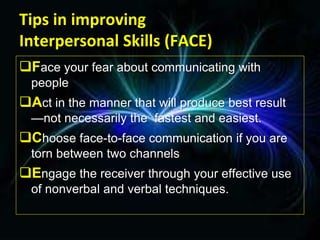
Tips in improving
Interpersonal Skills (FACE)
Face your fear about communicating with
people
Act in the manner that will produce best result
—not necessarily the fastest and easiest.
Choose face-to-face communication if you are
torn between two channels
Engage the receiver through your effective use
of nonverbal and verbal techniques.
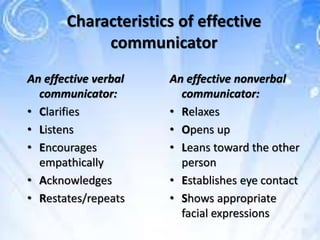
Characteristics of effective
communicator
An effective verbal
communicator:
• Clarifies
• Listens
• Encourages
empathically
• Acknowledges
• Restates/repeats
An effective nonverbal
communicator:
• Relaxes
• Opens up
• Leans toward the other
person
• Establishes eye contact
• Shows appropriate
facial expressions
References
http://www.iamnext.com/people/listen.html
http://changingminds.org/techniques/body/
submissive_body.htm
http://www.axzopress.com/downloads/pdf/
1560526998pv.pdf
http://en.wikipedia.org/wiki/Nonverbal
Antonino, M.T., et. al. Oral Communication
in Context for Senior High School
• For group 1: Create a set of conversations
regarding your stand in Child Protection Policy.
Is it an advantage or a disadvantage? Be able
to show the process of communication in your
dialogue together with its elements.
• For group 2: You are a subject teacher and a
parent is filing a case against you regarding on
how you treat her child in the classroom
saying it has something to do with Child
Protection Policy. How are you going to
communicate effectively to the parent and
your school administrator to settle the issue?
Present it through a simulation.
• For group 3: Demonstrate some scenarios
regarding Child Protection Policy that occur in
the field of education through verbal and
nonverbal communication.

Effective communication

  • 1.
    EFFECTIVE COMMUNICAT ION EdM 408 –Advance English Communication Reporter: Chinly Ruth T. Alberto
  • 2.
  • 3.
    In the newglobal and diverse workplace, it requires excellent communication skills!
  • 8.
    “it is simplysaying what you mean and meaning what you say” SIMPLE? misunderstood with simple message
  • 9.
    Time of rapidchange, globalization, & internet age Conflict is inevitable when sending information/ exchanging ideas Result: frustrated and caught in a complicated situation not intended to happen
  • 10.
    MISCOMMUNICATION Skills on howto effectively connect with others to build trust gain respect to be understood
  • 11.
    How can wecommunicate effectively? What can we do to maintain and improve our relationship with others without being misunderstood?
  • 12.
    COMMUNICATION • not justexchanging ideas or information • an understanding of the emotions and the intention of the speaker in his message It would be helpful to consider not just the verbal signs sent
  • 13.
    WAYS ON HOWTO BECOME AN EFFECTIVE COMMUNICATOR
  • 14.
    "People sense howyou feel about them. If you want to change their attitudes toward you, change the negative attitudes you have toward them."
  • 15.
  • 16.
    Listening is hearingwith understanding. Do not only be good in sending information or sharing your ideas, but also in paying attention to the information the sender has provided you to appreciate the emotion that goes with his or her message.
  • 17.
  • 18.
    How to Listen Facethe speaker Maintain eye contact Minimize external distractions Respond appropriately Focus solely on what the speaker is saying Minimize internal distractions Keep an open mind Avoid letting the speaker know how you handled a similar situation Even if the speaker is launching a complaint against you, wait until they finish to defend yourself Engage yourself
  • 20.
  • 21.
    Mutual trust isa shared belief that you can depend on each other to achieve a common purpose. You cannot establish trust if you cannot listen. A conversation is a relationship. Both speaker and listener play a part, each influencing the other. Instead of being a passive recipient, the listener has as much to do in shaping the conversation as the speaker.
  • 22.
  • 23.
    Interrupting a speakeris disruptive. This may cause the speaker to forget or get lost in his/her speech. You will not get the chance to hear everything he/she has to say and miss important information/ ideas that might be useful to you and that you might be very interested about.
  • 24.
  • 25.
    Nod occasionally, smile,make eye contact. Encourage the speaker to continue by saying “yes” and show interest by other verbal comments like “ah-huh,” and “oh,” but not conversation fillers like “ahms” or “ahs” because they do not contribute any in making conversation better.
  • 26.
  • 27.
    Nonverbal cues revealmore than what a speaker says. Be reminded to consider all nonverbal signals you receive or observe and not just focus on one. Consider all of it as a whole to get a better “read” of the person.
  • 28.
  • 29.
    Providing feedback isimportant because you let the other person know that you are paying attention to his/ her message. One form of feedback is paraphrasing what the speaker has said to remind him/her to where to continue in case he/she forgets or has been interrupted by other factors.
  • 30.
  • 31.
    By asking questions,you are able to clarify what you think/ feel about the topic and the speaker will know that you are genuinely paying attention and not just merely pretending. This will aid in making the speaker comfortable, thus eliminating a possible barrier that may cause the communication to fail.
  • 32.
  • 34.
    There are manydistractions that are causing communication to fail and topping the list nowadays is the cell phone followed by other gadgets that are using modern technology. How would you feel if the person you are talking to does not even bother to look at you? When talking to someone, give him/her your full attention and get rid of distractions.
  • 35.
  • 36.
    Listening to whatanother person is saying does not mean that you have to believe or be convinced in what he/she believes. Give others a chance to send their message. Be fair. For sure, you would not want to be judged by another who is a better communicator or speaker than you.
  • 37.
  • 38.
    Be fully presentwhen you are with people
  • 39.
  • 40.
    Tips in improving InterpersonalSkills (FACE) Face your fear about communicating with people Act in the manner that will produce best result —not necessarily the fastest and easiest. Choose face-to-face communication if you are torn between two channels Engage the receiver through your effective use of nonverbal and verbal techniques.
  • 41.
    Characteristics of effective communicator Aneffective verbal communicator: • Clarifies • Listens • Encourages empathically • Acknowledges • Restates/repeats An effective nonverbal communicator: • Relaxes • Opens up • Leans toward the other person • Establishes eye contact • Shows appropriate facial expressions
  • 42.
  • 43.
    • For group1: Create a set of conversations regarding your stand in Child Protection Policy. Is it an advantage or a disadvantage? Be able to show the process of communication in your dialogue together with its elements.
  • 44.
    • For group2: You are a subject teacher and a parent is filing a case against you regarding on how you treat her child in the classroom saying it has something to do with Child Protection Policy. How are you going to communicate effectively to the parent and your school administrator to settle the issue? Present it through a simulation.
  • 45.
    • For group3: Demonstrate some scenarios regarding Child Protection Policy that occur in the field of education through verbal and nonverbal communication.