Introduction
 The study of human behavior is very complex and
complicated concept.
 It is affected by the psychological factors such as
perception, learning, personality and motivation.
 In addition to these factors, individual behavior
affects and affected by the behavior of others.
 One of the major problems in the study of
organizational behavior is to analyze and improve,
the interpersonal relationships.
 One basic approach to study interpersonal relations
in an organizational system is transactional analysis.
 This analysis deals with understanding, predicting
and controlling interpersonal relationships.
 It was introduced by Eric Berne.
Transactional analysis is a technique used
to help people better understand their own
and other’s behavior, especially in
interpersonal relationships.
 It is a good method for understanding
interpersonal behavior.
 It offers a model of personality and the
dynamics of self and its relationship to
others that makes possible a clear and
meaningful discussion of behavior.
 When two people interact with each
other, they engage in social
transactions, in which one person
responds to the other
 Study of such ”Social Transactions” is
called ’Transactional Analysis
What is a Transaction?
 A Transaction is an exchange of two
strokes between two people. The first
stroke is called ’Stimulus’, the second is
called the ’Response’.
 Transactional Analysis
 Transactions are psychological in nature
and relate to how people behave and
how other people behave with them in
response to their behavior.
 Transactional analysis is primarily
concerned with following:
 Analysis of self awareness
 Analysis of ego states
 Analysis of transactions
 Script analysis
 Games analysis
 Analysis of life positions
 Stroking
ANALYSIS OF SELF
AWARENESS
 The interpersonal relationships are composed of
interself.
 Self is the core of personality pattern which provides
integration.
 Self awareness is an important concept, it describes
the self in terms of image, both conscious and
unconscious.
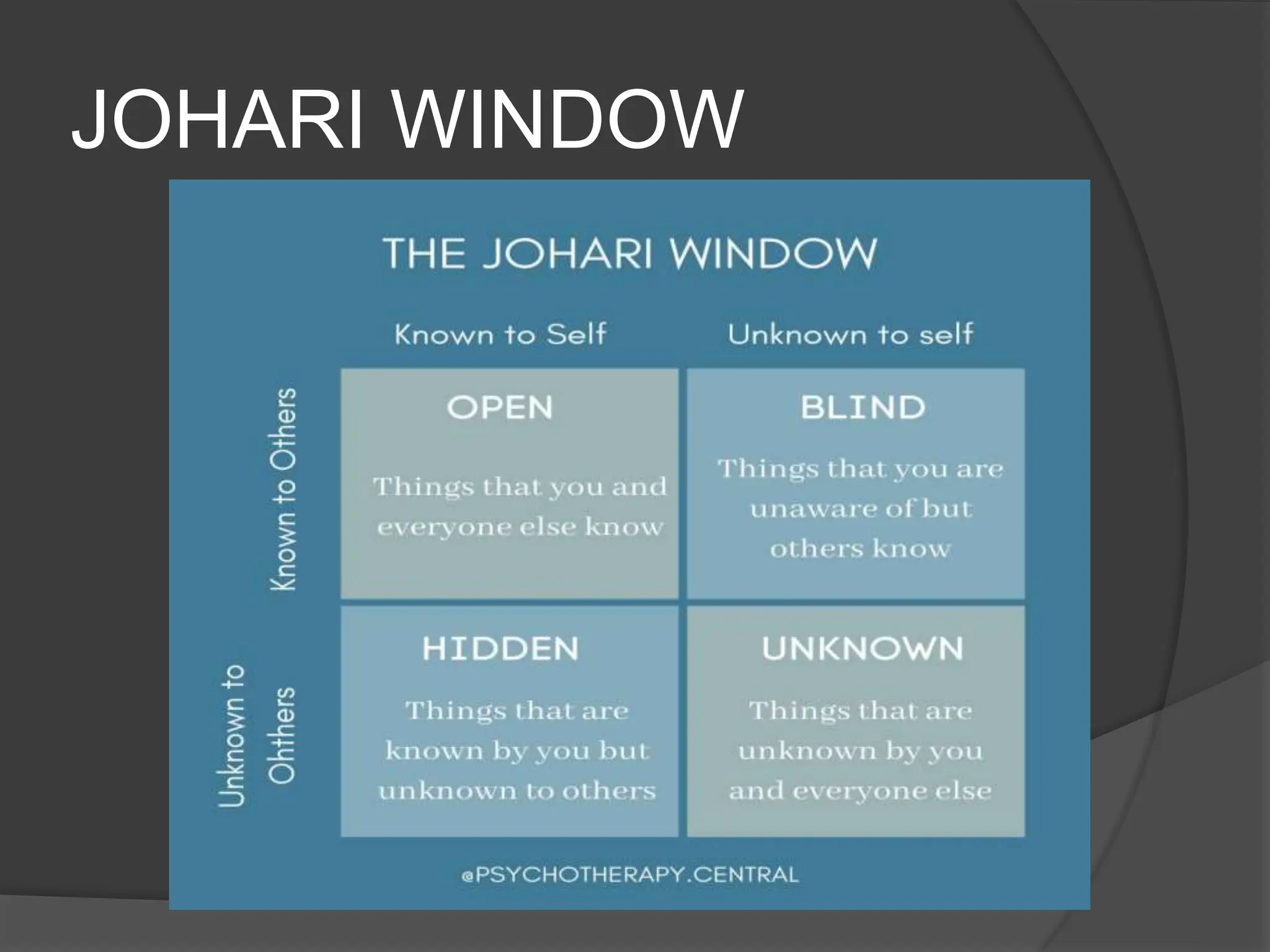
 Joseph Luft and Harrington have developed a
diagram to look at one’s personality including
behaviours and attitudes that can be known and
unknown to self and known and unknown to others.
 This diagram is known as the JOHARI WINDOW.• It
comprising of 4 parts.
JOHARI WINDOW
 To understand Transactional Analysis
we must first understand EGO STATES:
 EGO STATES:
 Within each human being, several
human beings are existing at the same
time, depending upon how the person is
behaving at any given time.
ANALYSIS OF EGO
STATES
 The ego plays an important role in human behaviour.
 People interact with each other in terms of
psycological positions or behavioural patterns known
as ego states.
 Ego states are person’s way of thinking, feeling and
behaving at any time.
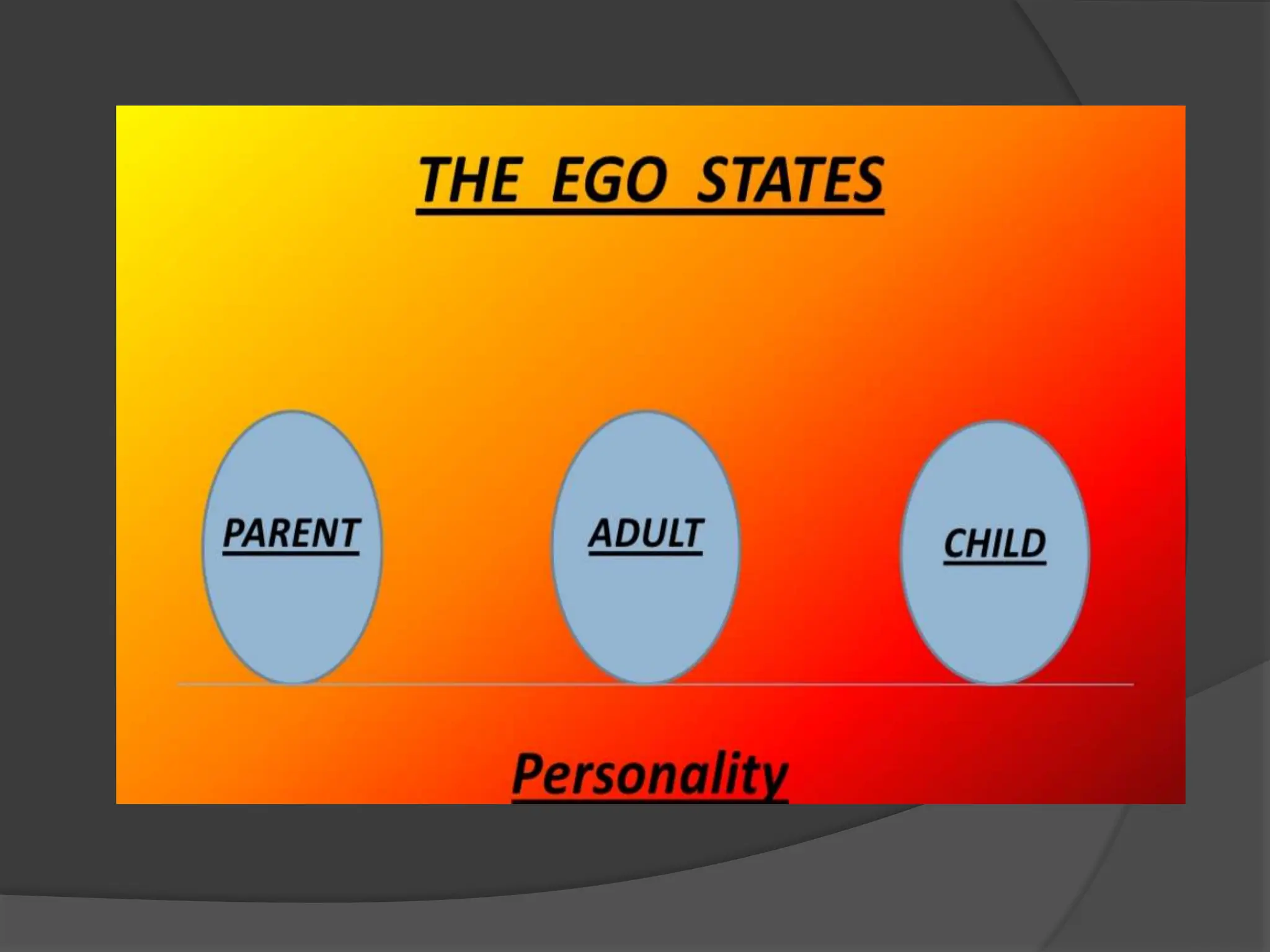
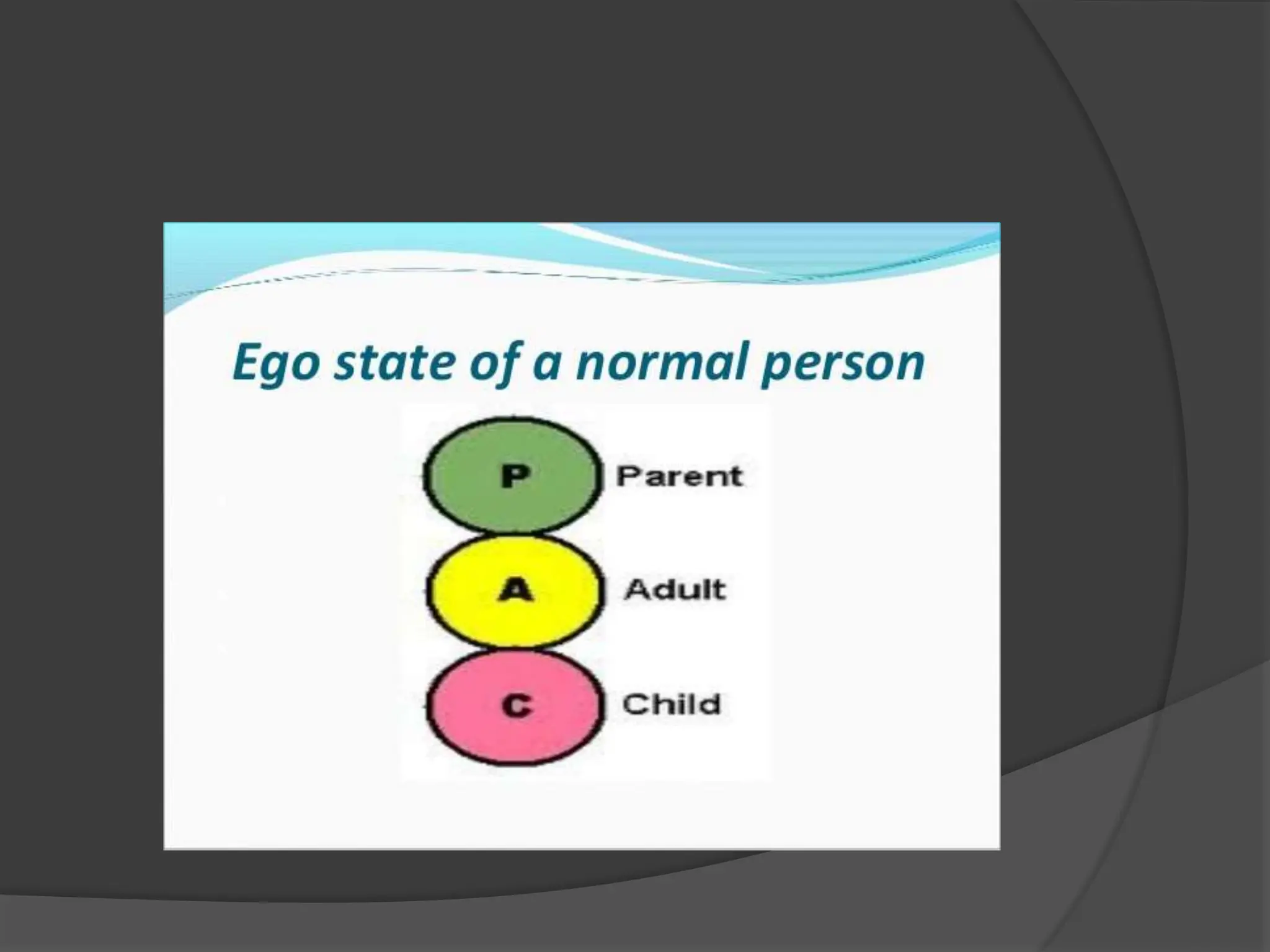
 There are 3 important ego states.
 Ego states: child, adult and parent.
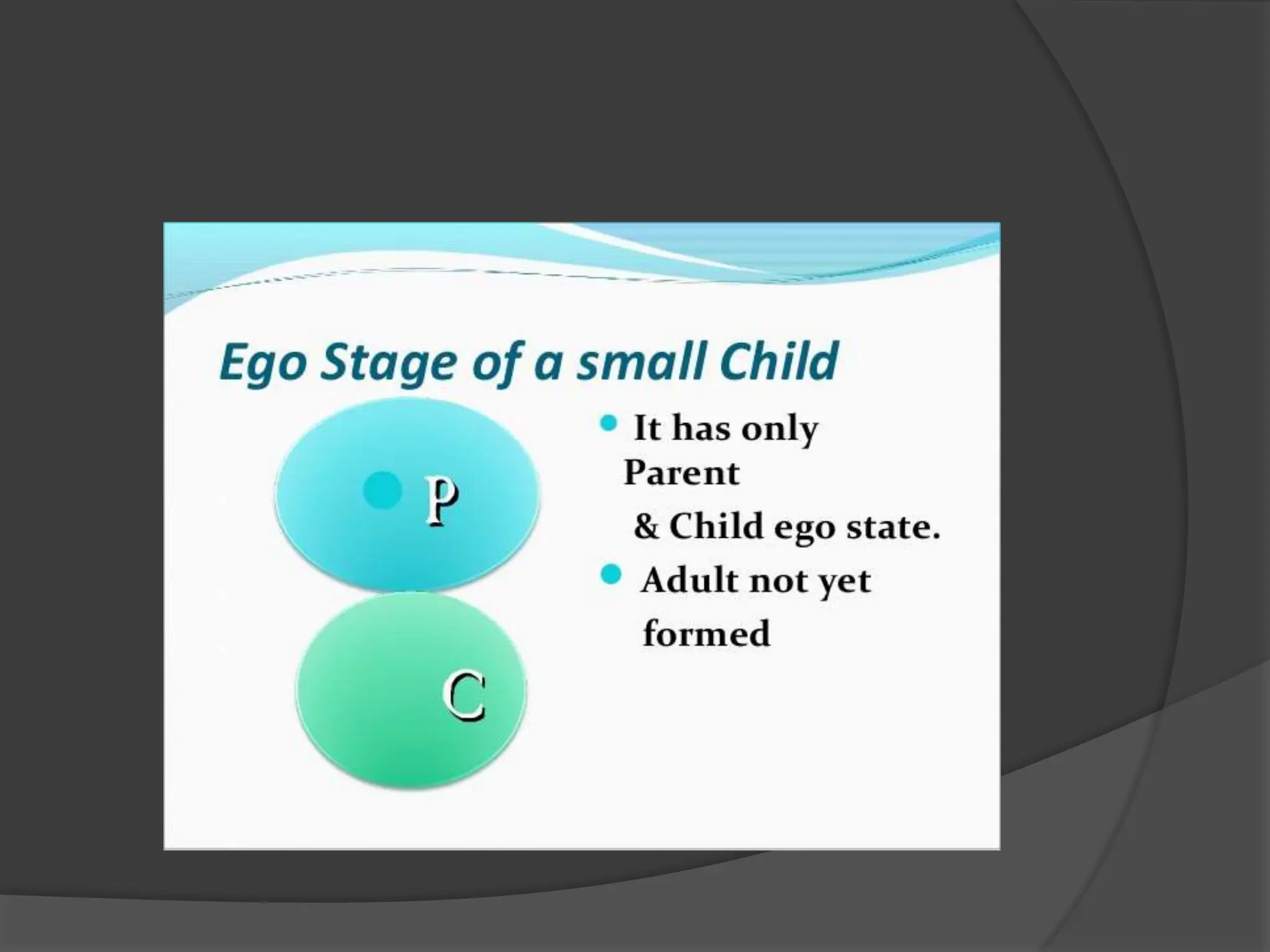
 A person of any age have these ego states in varying
degree.
 A healthy person is able to move from one ego state
to another
THE EGO STATES PARENT
ADULT CHILD Personality
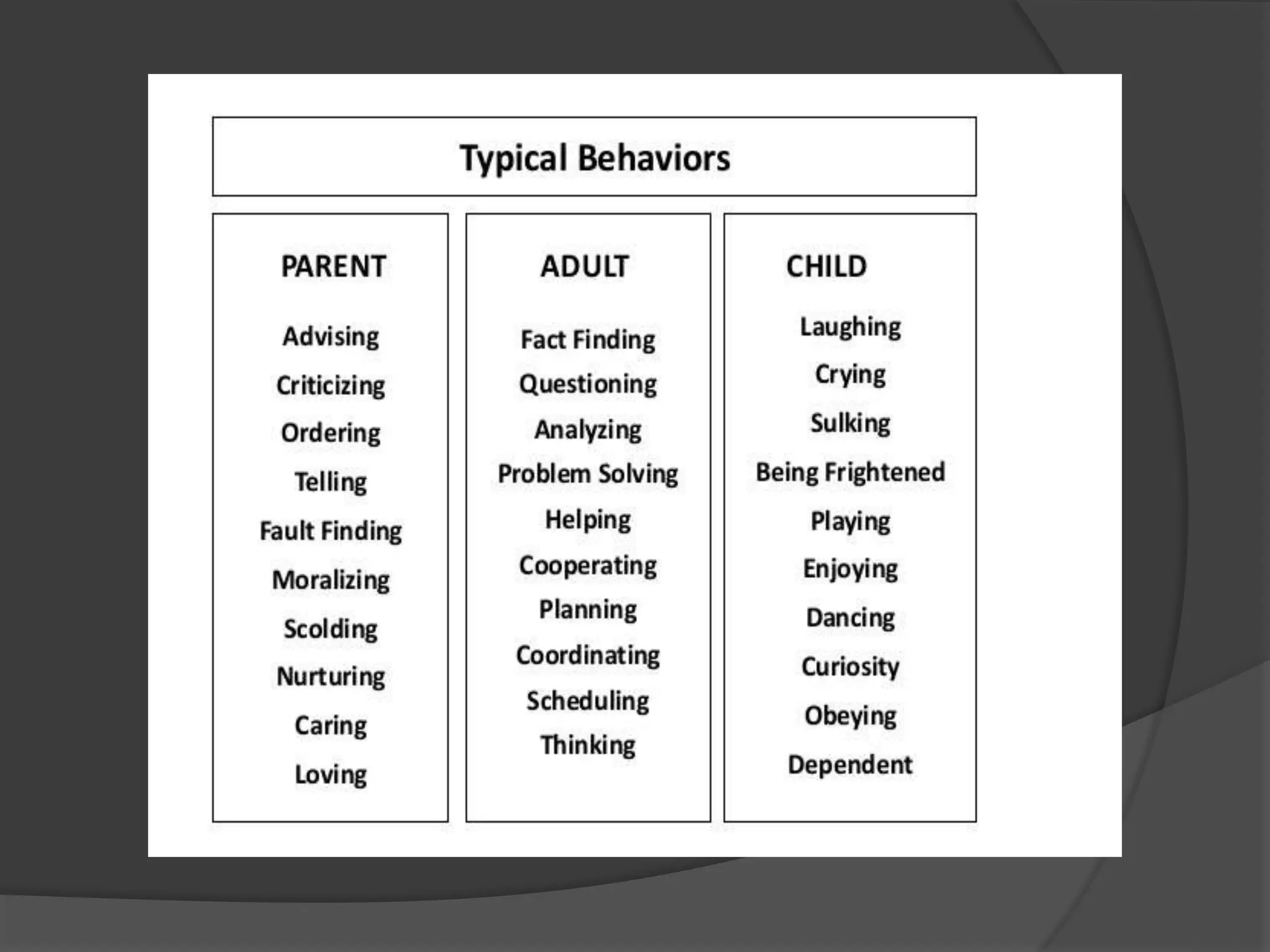
1.Parent ego state:
 The parent ego state means that the values,
attitudes and behaviours of parents an integral
part of the personality of an individual.
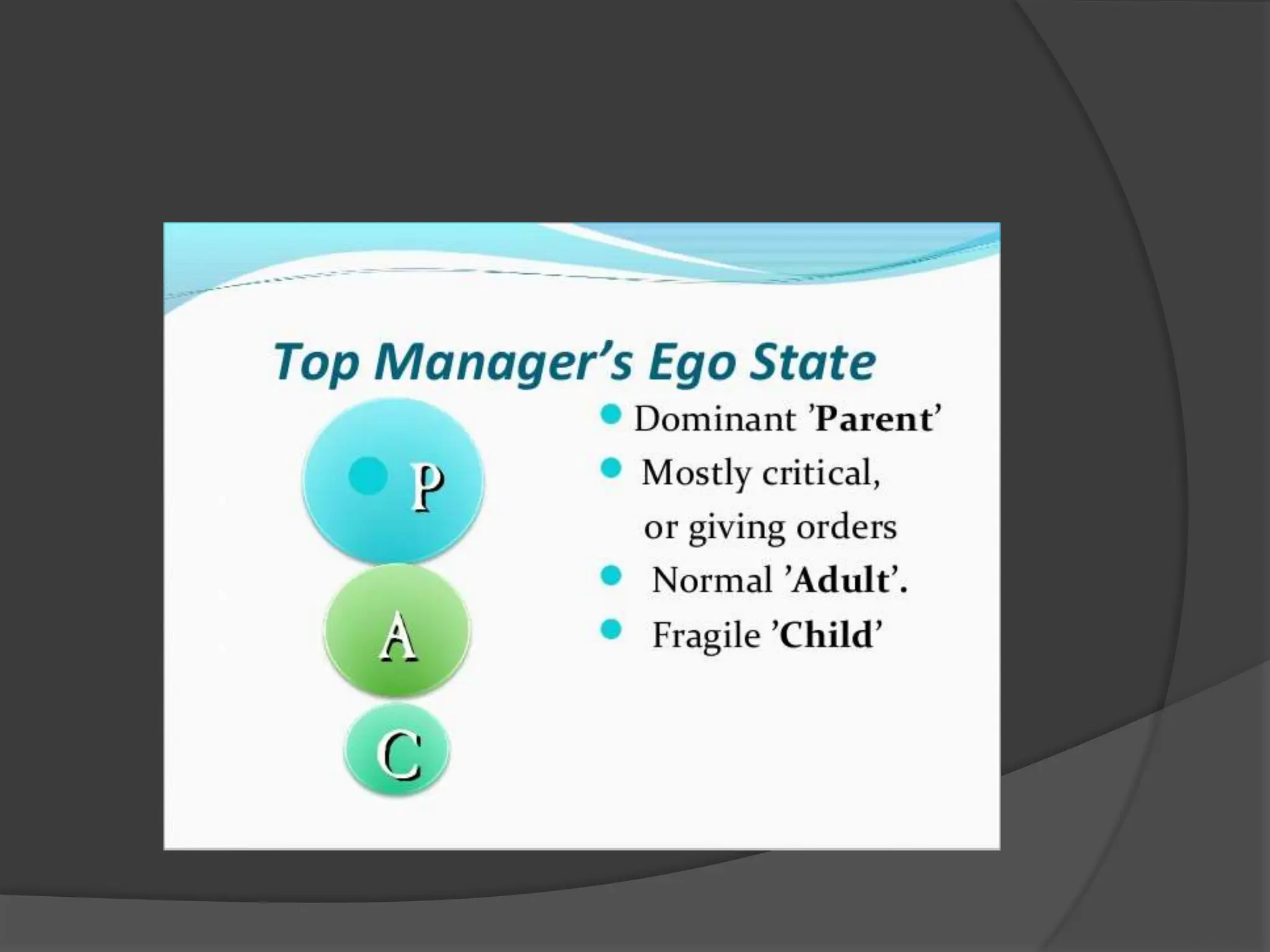
 These people tend to talk to people and treat
others like children.
 The characteristics of a person with parent ego
state are:
 Judgmental,
 Rule maker,
 Moralizing,
 Over protective,
 indispensable.
2. Adult ego state:
 The adult ego state is authentic, direct, reality
based, fact seeking and problem solving.
 They assume that human beings as equal,
worthy and responsible.
 The process of adult ego state formation goes
through one’s own experiences and continuously
updating attitudes left over from childhood.
 People with adult ego state, gather relevant
information, carefully analyse it, generate
alternatives and make logical choices.
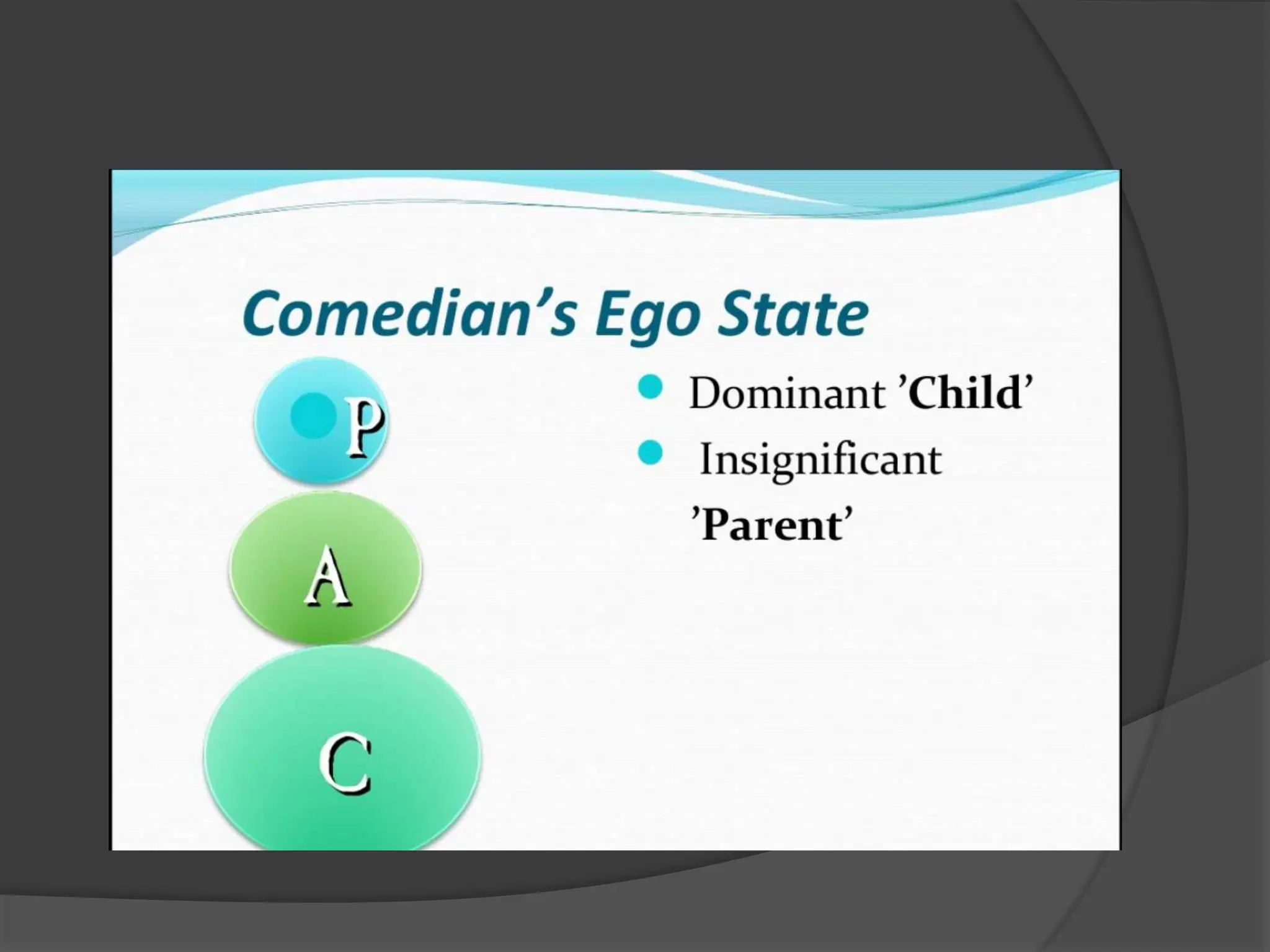
3.Child ego state:
 The important features of child ego state are
creativity, anxiety, depression, dependence, fear,
joy, emotional sentimental etc.
ANALYSIS OF
TRANSACTIONS
 A transaction is a basic unit of social
interaction.
 The heart of transactional analysis is the study
and diagramming of the exchanges between
two persons.
 Thus where a verbal or non verbal stimulus
from one person is being responded by
another person a transaction occurs.
 Transactional analysis can help us to
determine which ego state is most heavily
influencing our behaviour and the behaviour of
the other people with whom we interact.
 Depending on the ego states of the
persons involved in transactions, there
may be three types of transactions:
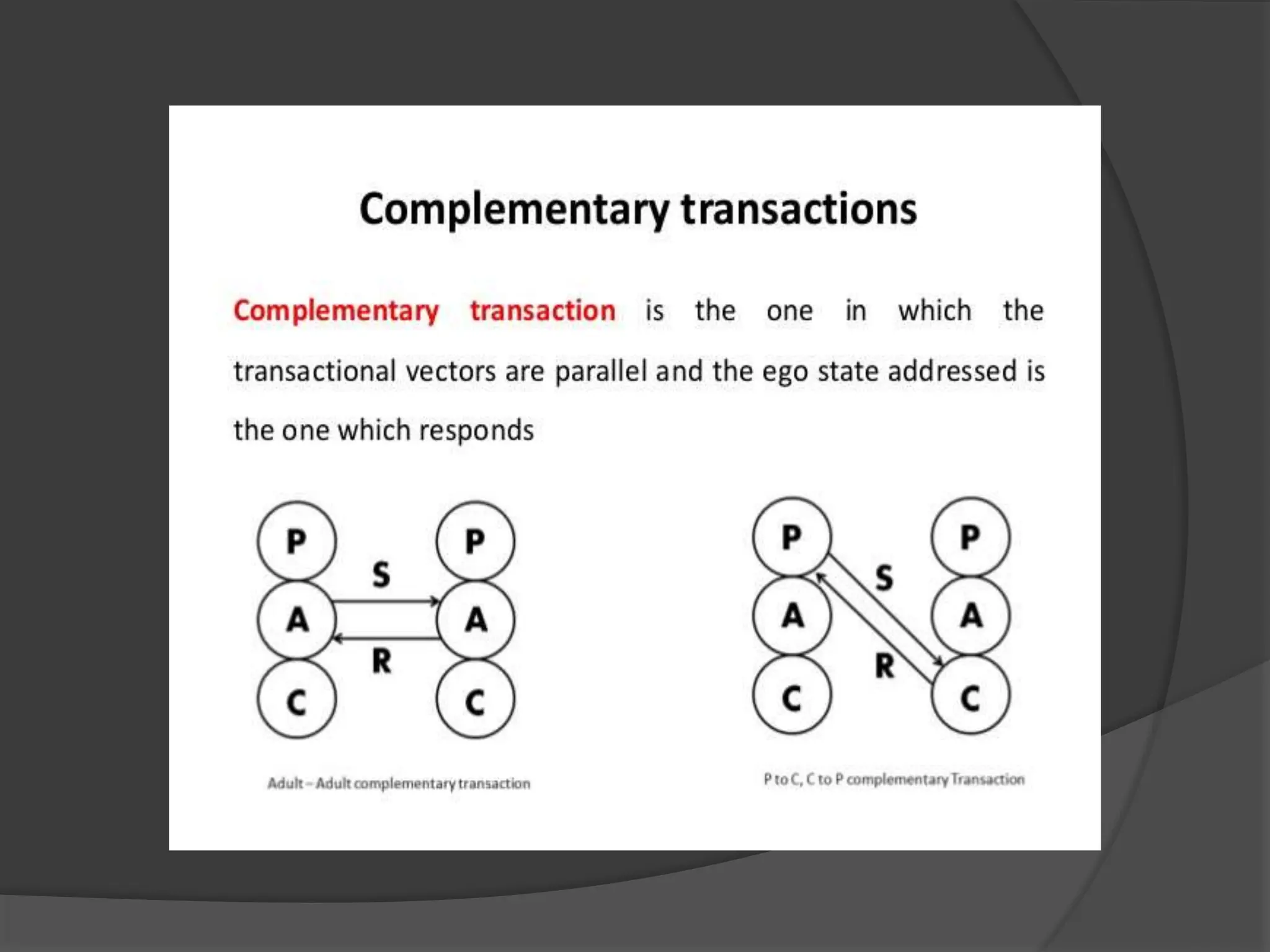
 1.Complementary transactions: Both
people are operating from the same ego
state. There can be nine complementary
transactions. They are given below
 Adult-Adult transactions
 Adult-Parent transactions
 Adult-Child transactions
 Parent-Parent transactions
 Parent-Adult transactions
 Parent-Child transactions
 Child-Parent transactions
 Child-Adult transactions
 Child-Child transactions
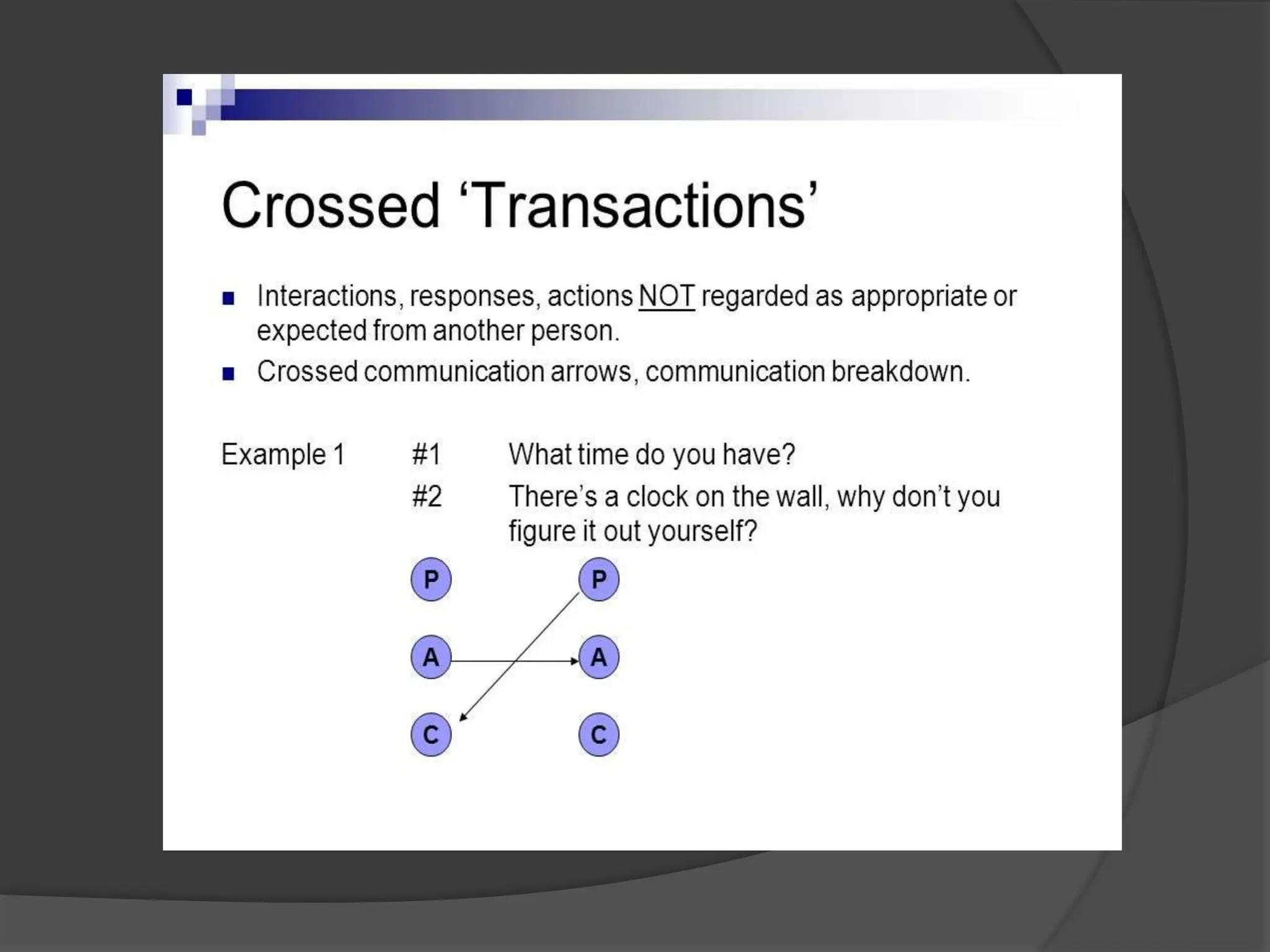
 2. Crossed transactions: a crossed transaction
is one in which the sender sends message a
behaviour on the basis of his ego state, but
this message is reacted to by an unexpected
ego state on the part of the receiver. Crossed
communication should be avoided as far as
possible. Whenever such transactions occur,
communication tends to be blocked and a
satisfactory transaction is not accomplished.
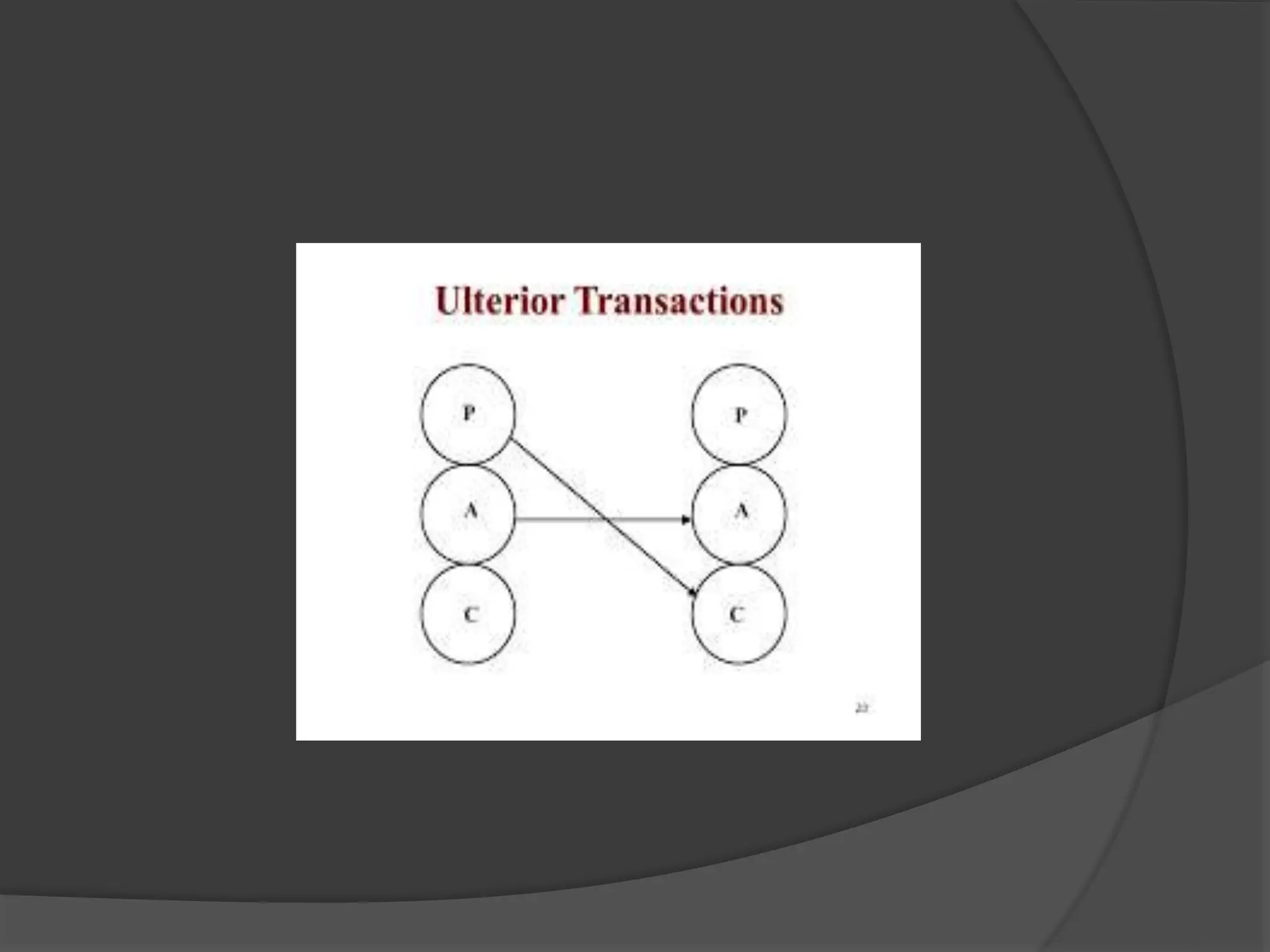
 3.Ulterior transactions: two ego states within
the same person but one disguises the other
one.
SCRIPT ANALYSIS
 In a layman’s view ,a script is the text of play,
motion picture, or a radio or TV programme.
 In transactional analysis a person’s life is
compared to a play and the script is the text of
the play.
 According to Eric Berne,” a script is an
ongoing programme, developed in early
childhood under parental influence which
directs the individual behaviour in the most
important aspects of his life.
 A script is a complete plan of living, offering
prescriptions, permissions and structure which
makes one winner or loser in life
Cont.
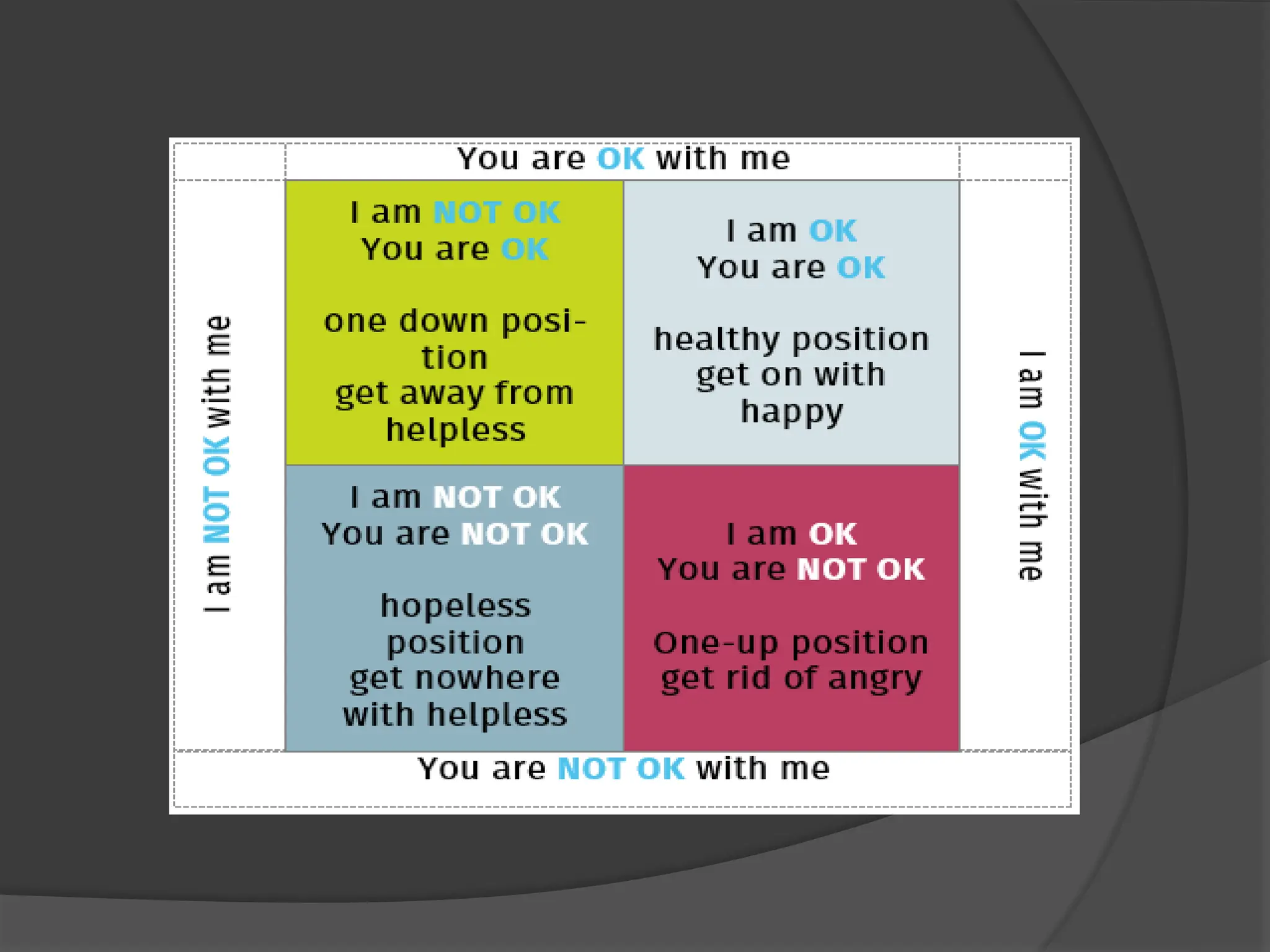
 ANALYSIS OF LIFE POSITIONS• In the
process of growing up people make basic
assumptions about their own self worth as
well as about the worth of significant
people in their environment.
 The combination of assumptions about self
and the other person called as life
position.• Transactional analysis constructs
the following classifications of the four
possible life positions or psychological
positions
Cont.
 I am OK, you are OK: It appears to be an ideal life
position. People with this type of life position have
confidence in themselves as well as trust and
confidence in others.
 I am OK, you are not OK: This is a distrustful
psychological positions. This is the attitude of those
people, who think that whatever they do is correct.
 I am not OK, you are OK This is a common position
for those people who feel power less when they
compare themselves to others.
 I am not OK,, you are not OK: people in this position
tend to feel bad about themselves and see the whole
world as miserable. They do not trust others and
have no confidence in themselves.
STROKING
 Stroking is an important aspects of the
transactional analysis.
 The term stroke refers to “giving some kind
of recognition to others.”
 People need strokes for their sense of
survival and well being on the job. Lack of
stroking can have negative consequences
both on physiological and psychological
well being of a person.
 There are three types of strokes:
Cont.
1. Positive strokes: the stroke one feel good,
is a positive stroke. Recognition, approval
are some of the examples.
2. Negative strokes: a stroke one feel bad or
not good is a negative stroke. negative
strokes hurt physically or psychologically.
3. Mixed strokes: a stroke may be of a mixed
type also. Example :the boss comment to a
worker “you did an excellent job inspite of
your limited experience.
GAMES ANALYSIS
 When people fail to get enough strokes at
work they try a variety of things.
 One of the most important thing is that they
play psychological games.
 A psychological game is a set of
transaction with three characteristics:
1.The transaction tend to be repeated.
2.They make sense on superficial or social
level.
3.One or more transactions is ulterior.
Cont.
 Types of games:
 A first degree game is one which is
socially acceptable in the agent’s circle.
 A second degree game is one which is
more intimate end up with bad feelings.
 A third degree game is one which
usually involve physical injury.
BENEFITS AND UTILITY OF
TRANSACATIONAL ANALYSIS
 Improved interpersonal communication.
 Source of positive energy.
 Understanding ego state.
 Motivation.
 Organisational development
Cont.
 Transactional Analysis applies to different
levels:-
1. The clinical side of therapy.
2. The analysis of personality.
3. The interpersonal communication.
4. The group dynamics.
5. The organization analysis (organizational
theory of Eric Berne).
6. Used in the domains of education,
consulting, training, coaching, recruitment,
skills assessment and organization.
Cont.
 Transactional Analysis Provides Simple
Yet Powerful Ways To:
1. Increase understanding in
communication with others
2. Deal with stress and change healthily
3. Handle and resolve conflict
4. Understand human behaviour
5. Gain autonomy and build self-esteem
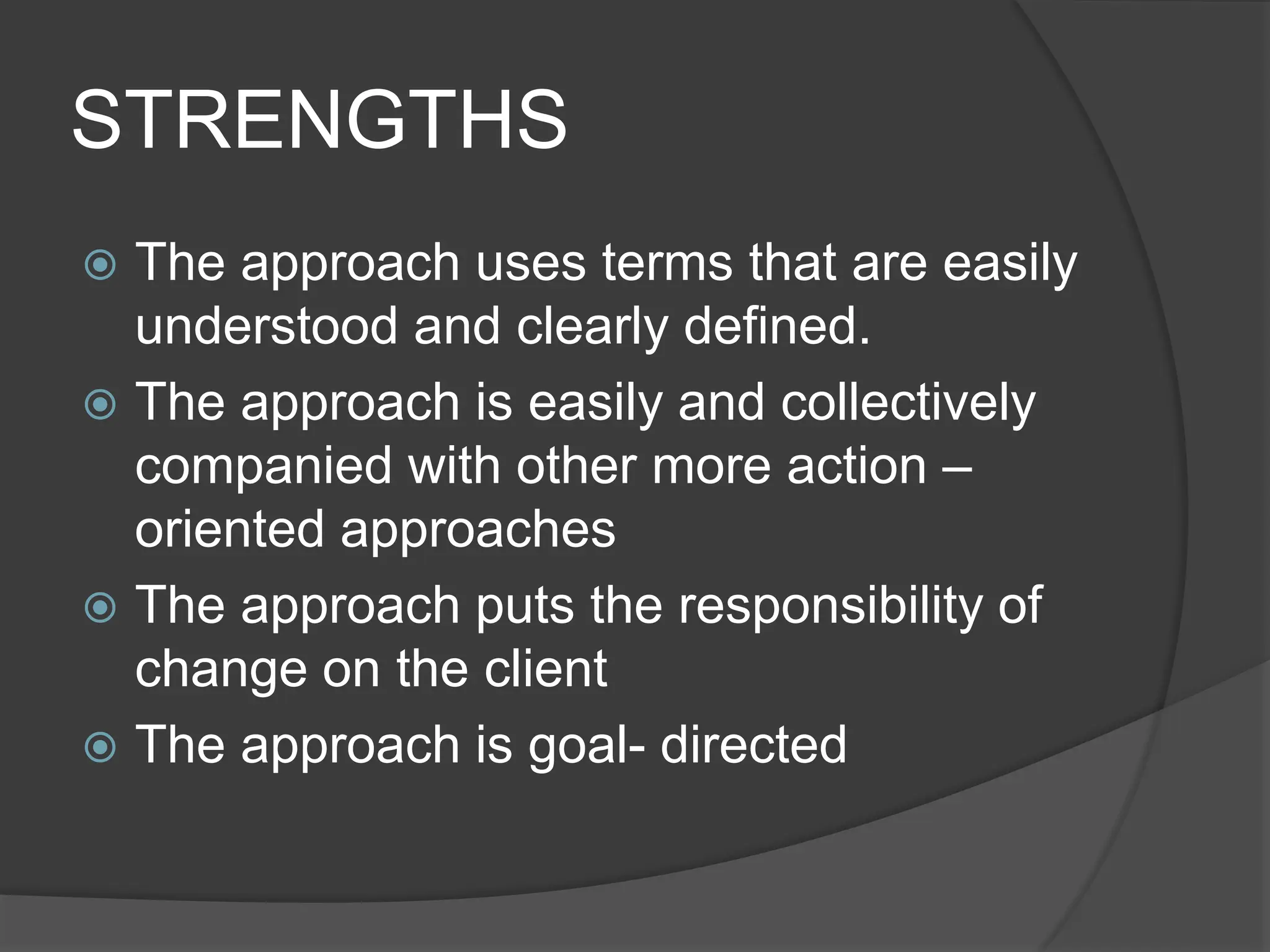
STRENGTHS
 The approach uses terms that are easily
understood and clearly defined.
 The approach is easily and collectively
companied with other more action –
oriented approaches
 The approach puts the responsibility of
change on the client
 The approach is goal- directed
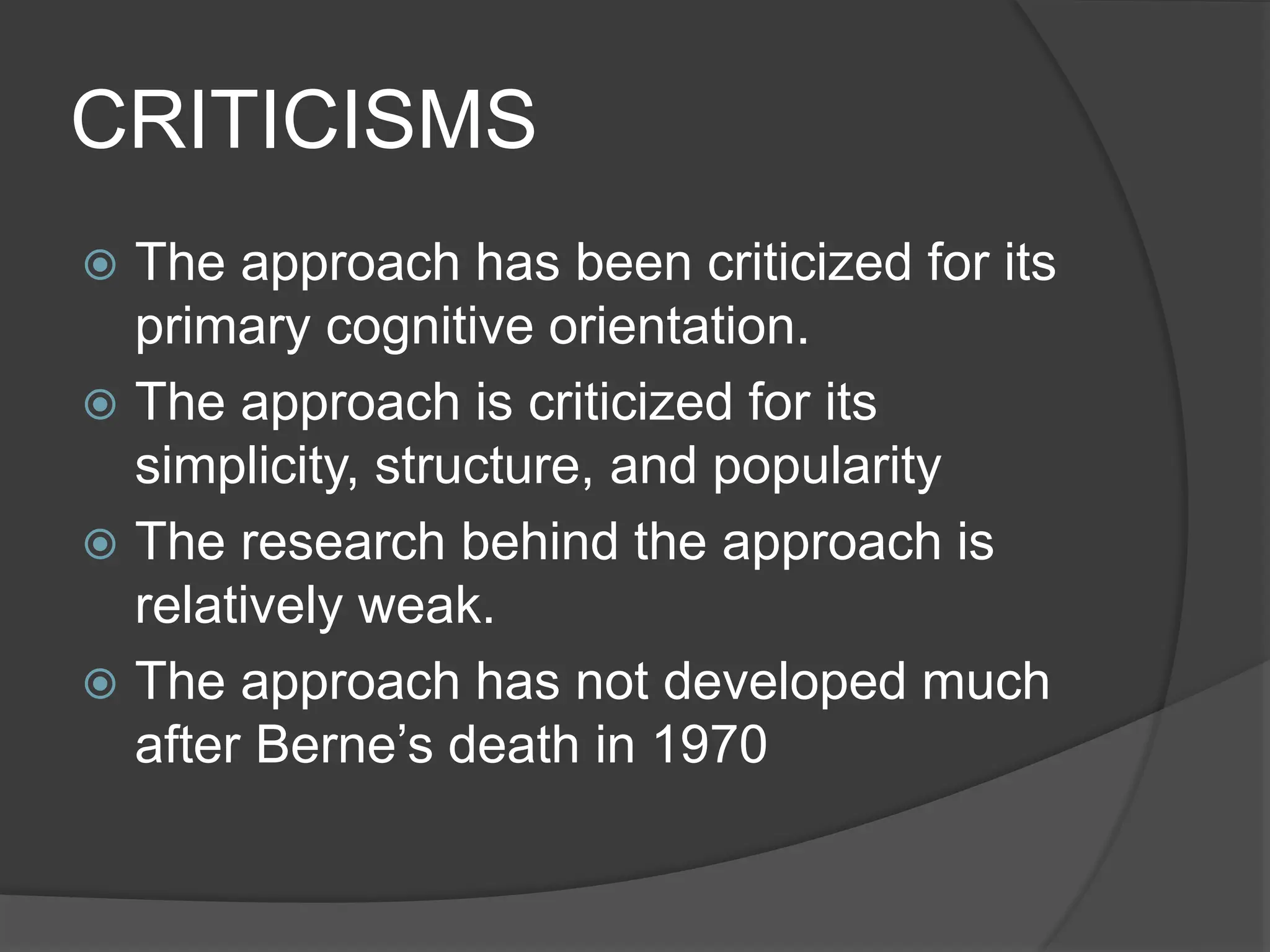
CRITICISMS
 The approach has been criticized for its
primary cognitive orientation.
 The approach is criticized for its
simplicity, structure, and popularity
 The research behind the approach is
relatively weak.
 The approach has not developed much
after Berne’s death in 1970

Transactional Analysis(Unit VI).ppt MBAx

  • 2.
    Introduction  The studyof human behavior is very complex and complicated concept.  It is affected by the psychological factors such as perception, learning, personality and motivation.  In addition to these factors, individual behavior affects and affected by the behavior of others.  One of the major problems in the study of organizational behavior is to analyze and improve, the interpersonal relationships.  One basic approach to study interpersonal relations in an organizational system is transactional analysis.  This analysis deals with understanding, predicting and controlling interpersonal relationships.
  • 3.
     It wasintroduced by Eric Berne. Transactional analysis is a technique used to help people better understand their own and other’s behavior, especially in interpersonal relationships.  It is a good method for understanding interpersonal behavior.  It offers a model of personality and the dynamics of self and its relationship to others that makes possible a clear and meaningful discussion of behavior.
  • 4.
     When twopeople interact with each other, they engage in social transactions, in which one person responds to the other  Study of such ”Social Transactions” is called ’Transactional Analysis
  • 5.
    What is aTransaction?  A Transaction is an exchange of two strokes between two people. The first stroke is called ’Stimulus’, the second is called the ’Response’.  Transactional Analysis  Transactions are psychological in nature and relate to how people behave and how other people behave with them in response to their behavior.
  • 6.
     Transactional analysisis primarily concerned with following:  Analysis of self awareness  Analysis of ego states  Analysis of transactions  Script analysis  Games analysis  Analysis of life positions  Stroking
  • 7.
    ANALYSIS OF SELF AWARENESS The interpersonal relationships are composed of interself.  Self is the core of personality pattern which provides integration.  Self awareness is an important concept, it describes the self in terms of image, both conscious and unconscious.  Joseph Luft and Harrington have developed a diagram to look at one’s personality including behaviours and attitudes that can be known and unknown to self and known and unknown to others.  This diagram is known as the JOHARI WINDOW.• It comprising of 4 parts.
  • 8.
  • 9.
     To understandTransactional Analysis we must first understand EGO STATES:  EGO STATES:  Within each human being, several human beings are existing at the same time, depending upon how the person is behaving at any given time.
  • 10.
    ANALYSIS OF EGO STATES The ego plays an important role in human behaviour.  People interact with each other in terms of psycological positions or behavioural patterns known as ego states.  Ego states are person’s way of thinking, feeling and behaving at any time.  There are 3 important ego states.  Ego states: child, adult and parent.  A person of any age have these ego states in varying degree.  A healthy person is able to move from one ego state to another
  • 17.
    THE EGO STATESPARENT ADULT CHILD Personality 1.Parent ego state:  The parent ego state means that the values, attitudes and behaviours of parents an integral part of the personality of an individual.  These people tend to talk to people and treat others like children.  The characteristics of a person with parent ego state are:  Judgmental,  Rule maker,  Moralizing,  Over protective,  indispensable.
  • 18.
    2. Adult egostate:  The adult ego state is authentic, direct, reality based, fact seeking and problem solving.  They assume that human beings as equal, worthy and responsible.  The process of adult ego state formation goes through one’s own experiences and continuously updating attitudes left over from childhood.  People with adult ego state, gather relevant information, carefully analyse it, generate alternatives and make logical choices.
  • 19.
    3.Child ego state: The important features of child ego state are creativity, anxiety, depression, dependence, fear, joy, emotional sentimental etc.
  • 20.
    ANALYSIS OF TRANSACTIONS  Atransaction is a basic unit of social interaction.  The heart of transactional analysis is the study and diagramming of the exchanges between two persons.  Thus where a verbal or non verbal stimulus from one person is being responded by another person a transaction occurs.  Transactional analysis can help us to determine which ego state is most heavily influencing our behaviour and the behaviour of the other people with whom we interact.
  • 21.
     Depending onthe ego states of the persons involved in transactions, there may be three types of transactions:  1.Complementary transactions: Both people are operating from the same ego state. There can be nine complementary transactions. They are given below
  • 23.
     Adult-Adult transactions Adult-Parent transactions  Adult-Child transactions  Parent-Parent transactions  Parent-Adult transactions  Parent-Child transactions  Child-Parent transactions  Child-Adult transactions  Child-Child transactions
  • 24.
     2. Crossedtransactions: a crossed transaction is one in which the sender sends message a behaviour on the basis of his ego state, but this message is reacted to by an unexpected ego state on the part of the receiver. Crossed communication should be avoided as far as possible. Whenever such transactions occur, communication tends to be blocked and a satisfactory transaction is not accomplished.  3.Ulterior transactions: two ego states within the same person but one disguises the other one.
  • 27.
    SCRIPT ANALYSIS  Ina layman’s view ,a script is the text of play, motion picture, or a radio or TV programme.  In transactional analysis a person’s life is compared to a play and the script is the text of the play.  According to Eric Berne,” a script is an ongoing programme, developed in early childhood under parental influence which directs the individual behaviour in the most important aspects of his life.  A script is a complete plan of living, offering prescriptions, permissions and structure which makes one winner or loser in life
  • 28.
    Cont.  ANALYSIS OFLIFE POSITIONS• In the process of growing up people make basic assumptions about their own self worth as well as about the worth of significant people in their environment.  The combination of assumptions about self and the other person called as life position.• Transactional analysis constructs the following classifications of the four possible life positions or psychological positions
  • 30.
    Cont.  I amOK, you are OK: It appears to be an ideal life position. People with this type of life position have confidence in themselves as well as trust and confidence in others.  I am OK, you are not OK: This is a distrustful psychological positions. This is the attitude of those people, who think that whatever they do is correct.  I am not OK, you are OK This is a common position for those people who feel power less when they compare themselves to others.  I am not OK,, you are not OK: people in this position tend to feel bad about themselves and see the whole world as miserable. They do not trust others and have no confidence in themselves.
  • 31.
    STROKING  Stroking isan important aspects of the transactional analysis.  The term stroke refers to “giving some kind of recognition to others.”  People need strokes for their sense of survival and well being on the job. Lack of stroking can have negative consequences both on physiological and psychological well being of a person.  There are three types of strokes:
  • 32.
    Cont. 1. Positive strokes:the stroke one feel good, is a positive stroke. Recognition, approval are some of the examples. 2. Negative strokes: a stroke one feel bad or not good is a negative stroke. negative strokes hurt physically or psychologically. 3. Mixed strokes: a stroke may be of a mixed type also. Example :the boss comment to a worker “you did an excellent job inspite of your limited experience.
  • 33.
    GAMES ANALYSIS  Whenpeople fail to get enough strokes at work they try a variety of things.  One of the most important thing is that they play psychological games.  A psychological game is a set of transaction with three characteristics: 1.The transaction tend to be repeated. 2.They make sense on superficial or social level. 3.One or more transactions is ulterior.
  • 34.
    Cont.  Types ofgames:  A first degree game is one which is socially acceptable in the agent’s circle.  A second degree game is one which is more intimate end up with bad feelings.  A third degree game is one which usually involve physical injury.
  • 35.
    BENEFITS AND UTILITYOF TRANSACATIONAL ANALYSIS  Improved interpersonal communication.  Source of positive energy.  Understanding ego state.  Motivation.  Organisational development
  • 36.
    Cont.  Transactional Analysisapplies to different levels:- 1. The clinical side of therapy. 2. The analysis of personality. 3. The interpersonal communication. 4. The group dynamics. 5. The organization analysis (organizational theory of Eric Berne). 6. Used in the domains of education, consulting, training, coaching, recruitment, skills assessment and organization.
  • 37.
    Cont.  Transactional AnalysisProvides Simple Yet Powerful Ways To: 1. Increase understanding in communication with others 2. Deal with stress and change healthily 3. Handle and resolve conflict 4. Understand human behaviour 5. Gain autonomy and build self-esteem
  • 38.
    STRENGTHS  The approachuses terms that are easily understood and clearly defined.  The approach is easily and collectively companied with other more action – oriented approaches  The approach puts the responsibility of change on the client  The approach is goal- directed
  • 39.
    CRITICISMS  The approachhas been criticized for its primary cognitive orientation.  The approach is criticized for its simplicity, structure, and popularity  The research behind the approach is relatively weak.  The approach has not developed much after Berne’s death in 1970