TRANSACTIONAL ANALYSIS
INTRODUCTION
• Transaction Analysis: A theory for analyzing
human behavior and communication.
• Developed by Eric Berne.
• A category of feelings and thoughts that lead to
attitudes or states of mind.
TRANSACTIONAL ANALYSIS
 A model for explaining why and how:
 People think like they do
 People act like they do
 People interact/communicate with others
EGO STATES: PAC MODEL
 Everyone has three ego states based on their
childhood experiences and role models.
1) Parent Ego State
2) Adult Ego State
3) Child Ego State
 The three ego states are Parent Ego state or “The
Should Ego state , the Adult Ego state that “
Computes Sober Part of Personality “ and the Child
Ego state that “ Makes you feel like you did when you
were a child”.
UNDERSTANDING EGO STATES
 Body Language
 Tone of voice and
 Verbal statements.
• Thoughts , feeling , attitudes and behavioral
patterns based on lessons learned from parents
and other ‘parental’ sources.
• Parent ego state can be broadly divided into 2
types:
• Nurturing Parent ego state and
• Critical parent Ego state
• The Nurturing Parent ego state includes the
nurturing side and can be soft , loving , and
permission giving whereas Critical State includes
fault finding, judgmental views.
• Adult ego state is data processing center.
• Part of our personality that can process data
accurately, that sees, hears, thinks , and can come
up with solutions to problems based on the facts
and not solely on our prejudged thoughts or
childlike emotions.
•Can evaluate parental and child programming
and decide on what is all right and what needs to
be changed.
•Make decisions based on logic, computations,
probabilities, etc. (not emotion)
• Thoughts , feeling , attitudes and behavioral
patterns based on child like emotions
• Divided into two parts :
•Free child ego state(known as natural child) and
•Adaptive child ego state( includes Rebellious
Child ego state)
HUMAN INTERACTION ANALYSIS
Types of communication and interactions:
1) Complementary Transactions
2) Crossed Transactions
3) Ulterior Transactions
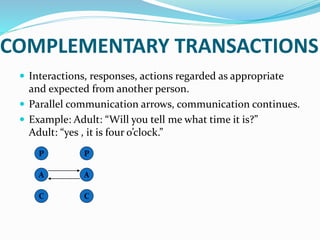
COMPLEMENTARY TRANSACTIONS
 Interactions, responses, actions regarded as appropriate
and expected from another person.
 Parallel communication arrows, communication continues.
 Example: Adult: “Will you tell me what time it is?”
Adult: “yes , it is four o’clock.”
P
A
C
P
A
C
CROSSED TRANSACTIONS
 In the case of inconsistent or non-complementary
transactions, communication takes place between different
ego states,.
 Sender addresses an ego state and receives the answer from
another ego state.
 Example: He: "There's a concert this evening I'd like to go
to. What do you think?"
She: "Wouldn't it be better to study for your exams?"
P
A
C
P
A
C
ULTERIOR TRANSACTIONS
 It plays a significant role in intercultural communication because
contact with direct or indirect messages is handled so differently.
 The transactions takes place on two different levels, one in the
foreground and one in the background.
 Example: "Would you like to see my butterfly collection?“
"no, thank you, dead butterflies depress me“ or reacting to "oh,
yes, I love butterfly collections“. The implied message is then left
up to the other.
P
A
C
P
A
C
• We all have three ego states programmed
with different kinds of behavior.
• Awareness of ego states gives more choices
in your communication patterns.
THANK YOU

Transaction Analysis.

  • 1.
  • 2.
    INTRODUCTION • Transaction Analysis:A theory for analyzing human behavior and communication. • Developed by Eric Berne. • A category of feelings and thoughts that lead to attitudes or states of mind.
  • 3.
    TRANSACTIONAL ANALYSIS  Amodel for explaining why and how:  People think like they do  People act like they do  People interact/communicate with others
  • 4.
    EGO STATES: PACMODEL  Everyone has three ego states based on their childhood experiences and role models. 1) Parent Ego State 2) Adult Ego State 3) Child Ego State  The three ego states are Parent Ego state or “The Should Ego state , the Adult Ego state that “ Computes Sober Part of Personality “ and the Child Ego state that “ Makes you feel like you did when you were a child”.
  • 5.
    UNDERSTANDING EGO STATES Body Language  Tone of voice and  Verbal statements.
  • 6.
    • Thoughts ,feeling , attitudes and behavioral patterns based on lessons learned from parents and other ‘parental’ sources. • Parent ego state can be broadly divided into 2 types: • Nurturing Parent ego state and • Critical parent Ego state • The Nurturing Parent ego state includes the nurturing side and can be soft , loving , and permission giving whereas Critical State includes fault finding, judgmental views.
  • 7.
    • Adult egostate is data processing center. • Part of our personality that can process data accurately, that sees, hears, thinks , and can come up with solutions to problems based on the facts and not solely on our prejudged thoughts or childlike emotions. •Can evaluate parental and child programming and decide on what is all right and what needs to be changed. •Make decisions based on logic, computations, probabilities, etc. (not emotion)
  • 8.
    • Thoughts ,feeling , attitudes and behavioral patterns based on child like emotions • Divided into two parts : •Free child ego state(known as natural child) and •Adaptive child ego state( includes Rebellious Child ego state)
  • 9.
    HUMAN INTERACTION ANALYSIS Typesof communication and interactions: 1) Complementary Transactions 2) Crossed Transactions 3) Ulterior Transactions
  • 10.
    COMPLEMENTARY TRANSACTIONS  Interactions,responses, actions regarded as appropriate and expected from another person.  Parallel communication arrows, communication continues.  Example: Adult: “Will you tell me what time it is?” Adult: “yes , it is four o’clock.” P A C P A C
  • 11.
    CROSSED TRANSACTIONS  Inthe case of inconsistent or non-complementary transactions, communication takes place between different ego states,.  Sender addresses an ego state and receives the answer from another ego state.  Example: He: "There's a concert this evening I'd like to go to. What do you think?" She: "Wouldn't it be better to study for your exams?" P A C P A C
  • 12.
    ULTERIOR TRANSACTIONS  Itplays a significant role in intercultural communication because contact with direct or indirect messages is handled so differently.  The transactions takes place on two different levels, one in the foreground and one in the background.  Example: "Would you like to see my butterfly collection?“ "no, thank you, dead butterflies depress me“ or reacting to "oh, yes, I love butterfly collections“. The implied message is then left up to the other. P A C P A C
  • 13.
    • We allhave three ego states programmed with different kinds of behavior. • Awareness of ego states gives more choices in your communication patterns.
  • 14.