ERICBERNE
BY
SABITHACK
Assistant professor
Cutec,nattika
 Proposed by the Canadian psychologist Eric
Berne (1910-70) in his 1964 book 'Games
People Play
 Berne's theory was based on the ideas
of Freud but was distinctly different.
 Dr. Berne defined Transactional Analysis is
the method for studying interactions
between individuals
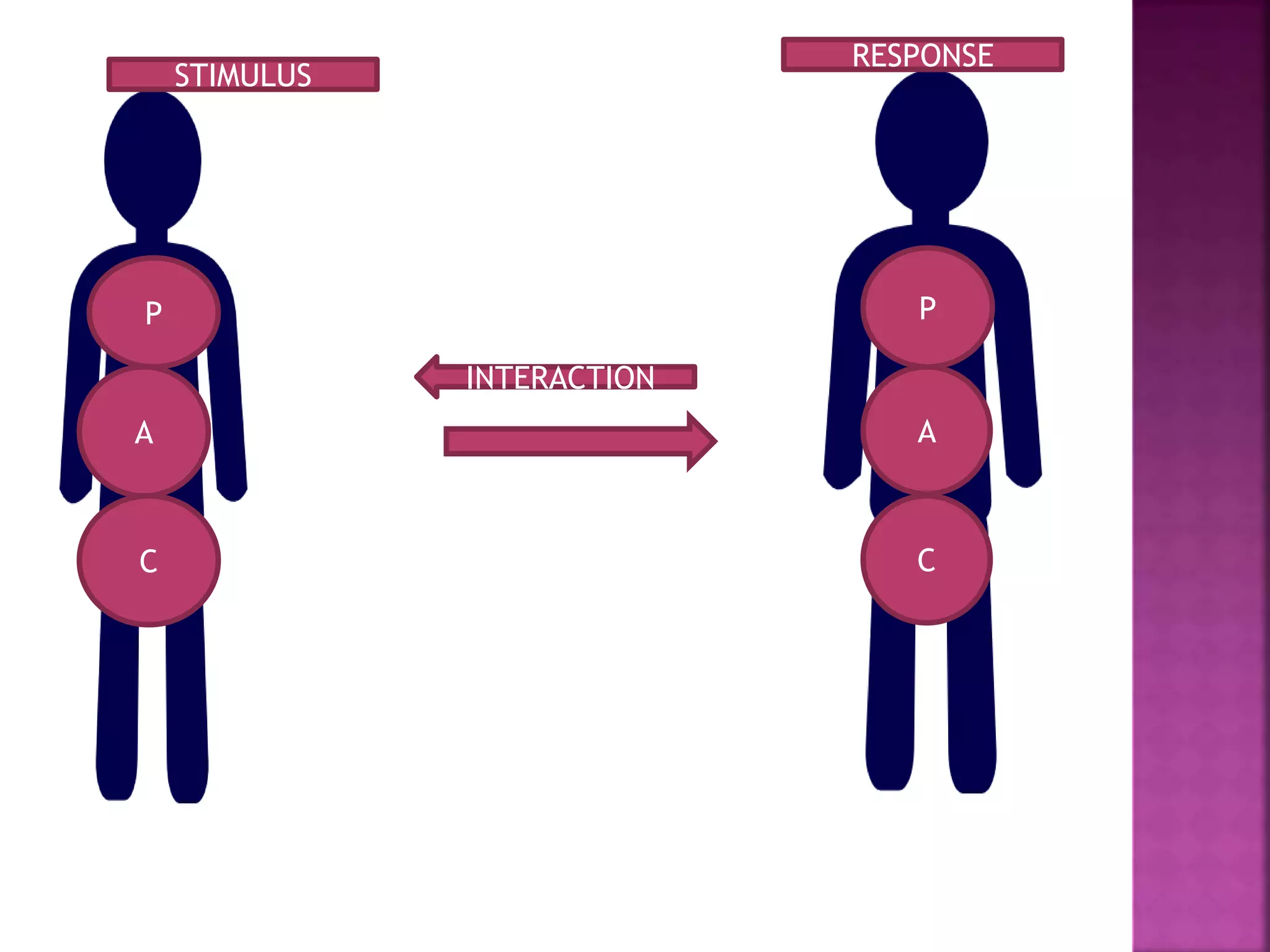
 According to TA, a transaction is a stimulus
plus a response.
 For example, if you say to one of your
student, "You really did a good job on that
project" that is stimulus: and he says,
"Thanks", that is a response. Thus,
transactions take place between people.
 The theory outlines how we have developed
and treat ourselves, how we relate and
communicate with others, and offers
suggestions and interventions which will
enable us to change and grow
 In addition to the analysis of the interactions
between individuals, Transactional Analysis
also involves the identification of the ego
states behind each and every transaction.
Berne defined an ego state as “a consistent
pattern of feeling and experience directly
related to a corresponding consistent
pattern of behavior.”4
 Transactional analysis involves four types of
analysis namely
 Structural analysis
 Transactional analysis
 Game analysis
 script
 Structural analysis speak of the psychological
structure of personality which comprises of a
group of ego states namely
 1. the parent ego state,
 2.adult ego state and
 3.child ego state
 The personality of a person is the collection
of behaviour patterns developed over a
period of time.
 these behaviour patterns are evolved in
differing degrees from three ego states -
Parent, Adult and Child.
 a parent (mother or father) has parent, adult
and child ego states; and a child (son or
daughter) also has parent, adult and child
ego states.
 The parent ego state is a result of the "messages"
(conditioning) people receive from their parents,
elder sisters and brothers, school teachers and others
during their childhood
 the majority of the external events experienced by a
child are actions of the parent, the ego state was
appropriately called Parent.
 events perceived by the child from individuals that
are NOT parents (but who are often in parent-like
roles) are also recorded in the Parent.
 Examples of recordings in the Parent include:
 “Never talk to strangers”
 “Always chew with your mouth closed”
 “Look both ways before you cross the street”
 There are two kinds of Parent ego states :
 (i) Nurturing Parent and
 (ii) Critical parent.
 The Nurturing parent is that part of a person
which is understanding and caring about
other people. Behaviour coming from the
nurturing parent may set limits on and
provide direction for people behaviour. It will
not put the people down and make then feel
not OK as individual.
 Critical parent behaviour attacks people's
personalities as well as their behaviour.
 Critical parent makes people feel that they
are not OK.
 When people are in their critical parent ego
state they are very evaluative and
judgmental.
 They are always ready to respond with a
'should' or 'ought' to almost anything people
tell them.
 The Adult ego state evokes behaviour that
could be described simply as logical,
reasonable, rationale and unemotional.
 Behaviour from the adult ego state is
characterized by problem solving analysis
and rationale decision-making.
 .
 People operating from the adult ego state
are taking emotional content of their child
ego state, the value-laden content of their
parent ego state and checking them out in
the reality of the external world.
 These people are examining alternatives,
probabilities and values prior to engaging in
behaviour
 The child ego state is associated with
behaviours that appear when a person is
responding emotionally.
 A person's child contains the 'natural'
impulses and attitudes learned from child
experiences.
 the Child represents the recordings in the
brain of internal events associated with
external events the child perceives.
 , recordings in the Child occur from
childbirth all the way up to the age of
approximately 5 years old.
 “There are several forms of the child ego
state. However, two kinds of ego states viz.
happy child and destructive child are
commonly relevant in behaviour
 People behaving from their happy child are
doing things they want to do it but it is not
destructive to others.
 people in their destructive child are also
doing things but their behaviour is either
destructive to others or to themselves, or to
their environment
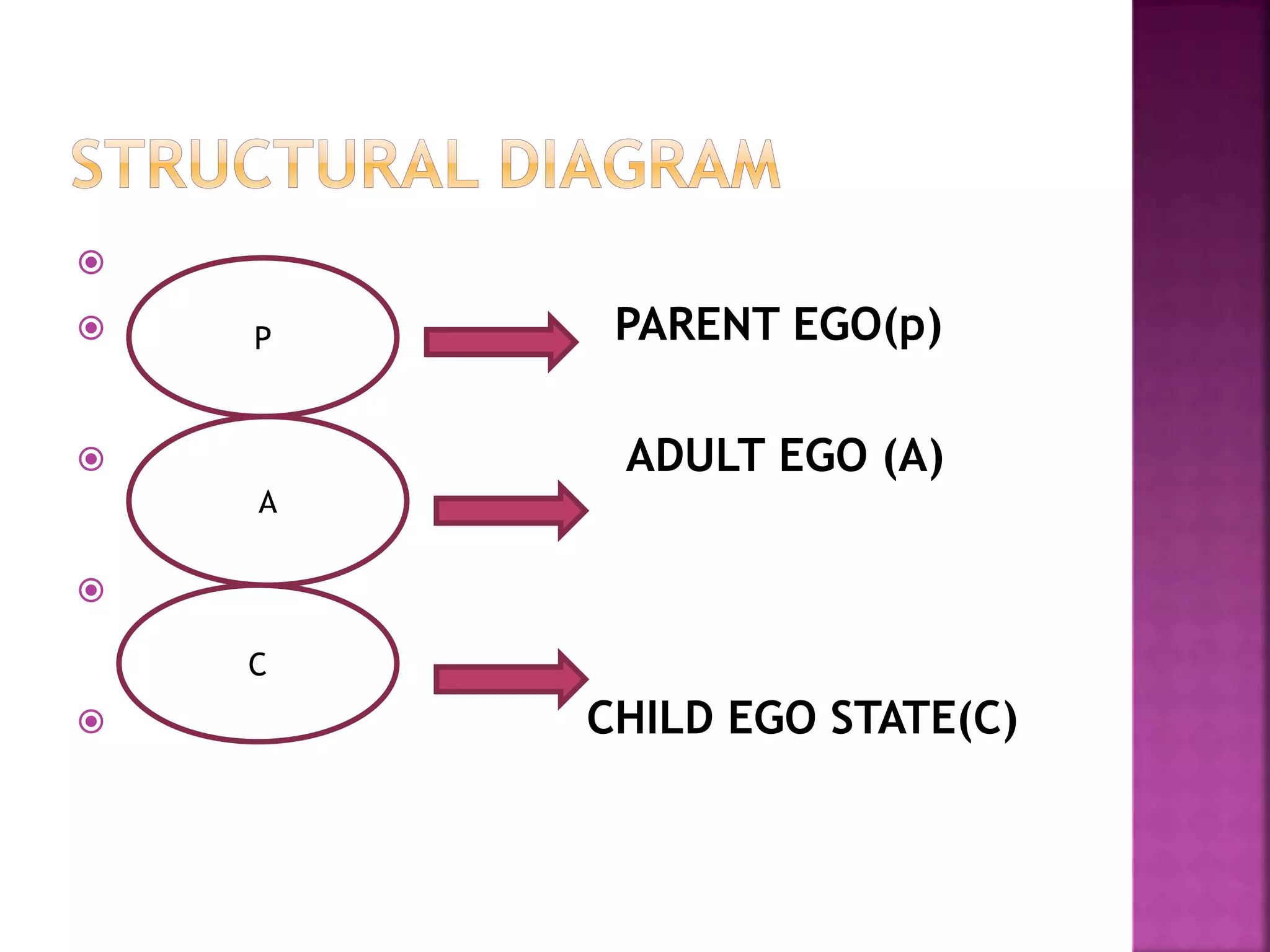
 The three ego states are usually diagrammed
as shown in figure below:.

 PARENT EGO(p)
 ADULT EGO (A)

 CHILD EGO STATE(C)
P
A
C
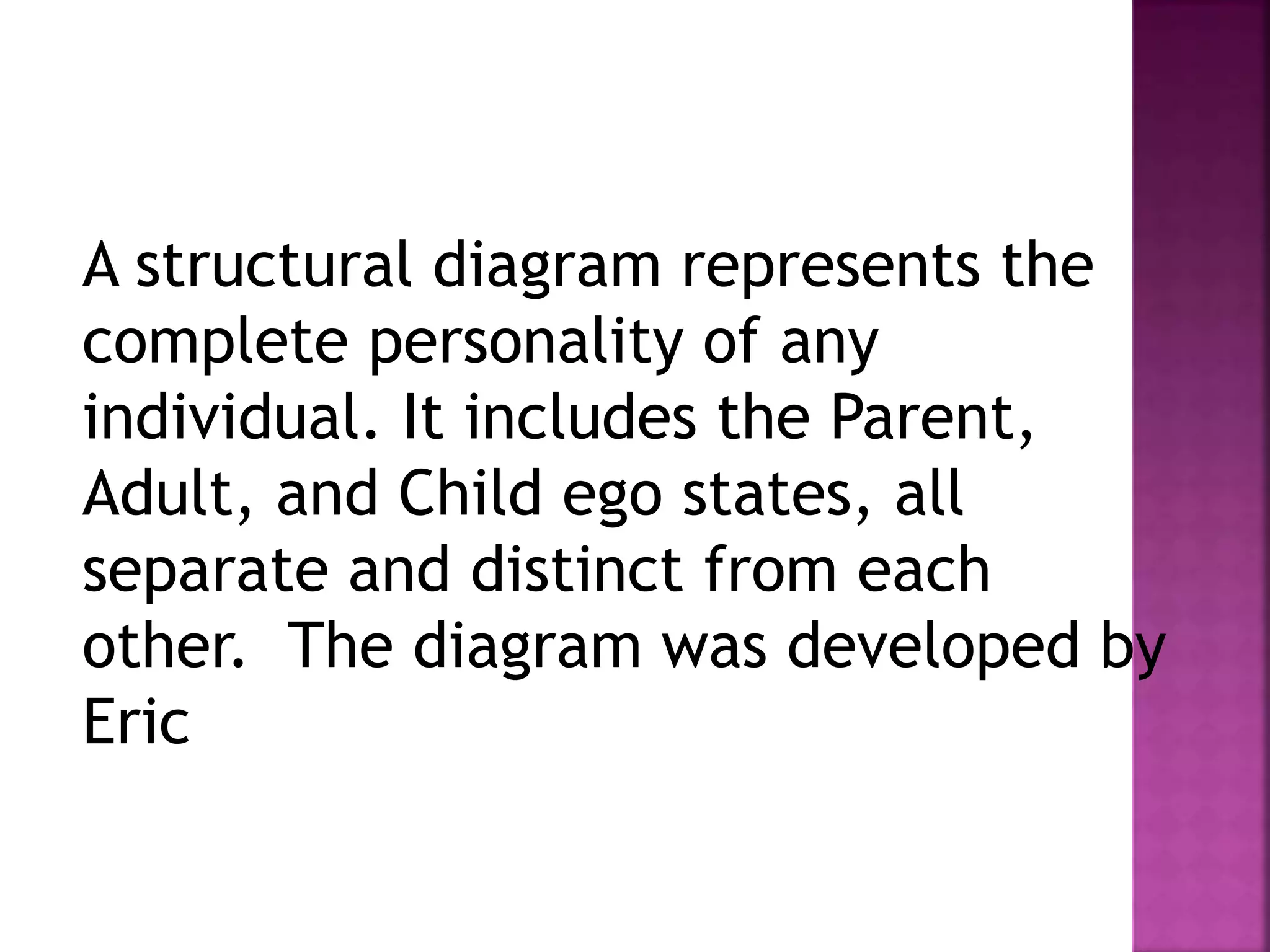
A structural diagram represents the
complete personality of any
individual. It includes the Parent,
Adult, and Child ego states, all
separate and distinct from each
other. The diagram was developed by
Eric
 The application of ego state model to
analyze sequence of transaction is called
transactional analysis.
 is attempted to determine correctly is the
ego state in which each individual is at that
moment.
 When two individual confront each other, the
number of ego state involved in transactional
situation will be three plus three ie,six
 Ego state of one may act as transactional
stimulus and ego state of other person may
be act as transactional response.
 Transaction consist of two or more
component of behaviour known as strokes
eg:-hellow,hi
P
A
C
P
A
C
INTERACTION
STIMULUS
RESPONSE
 Berne identifies three types of transactions:
 1. Complementary Transactions
 2.Crossed transaction
 3.Ulterior transaction
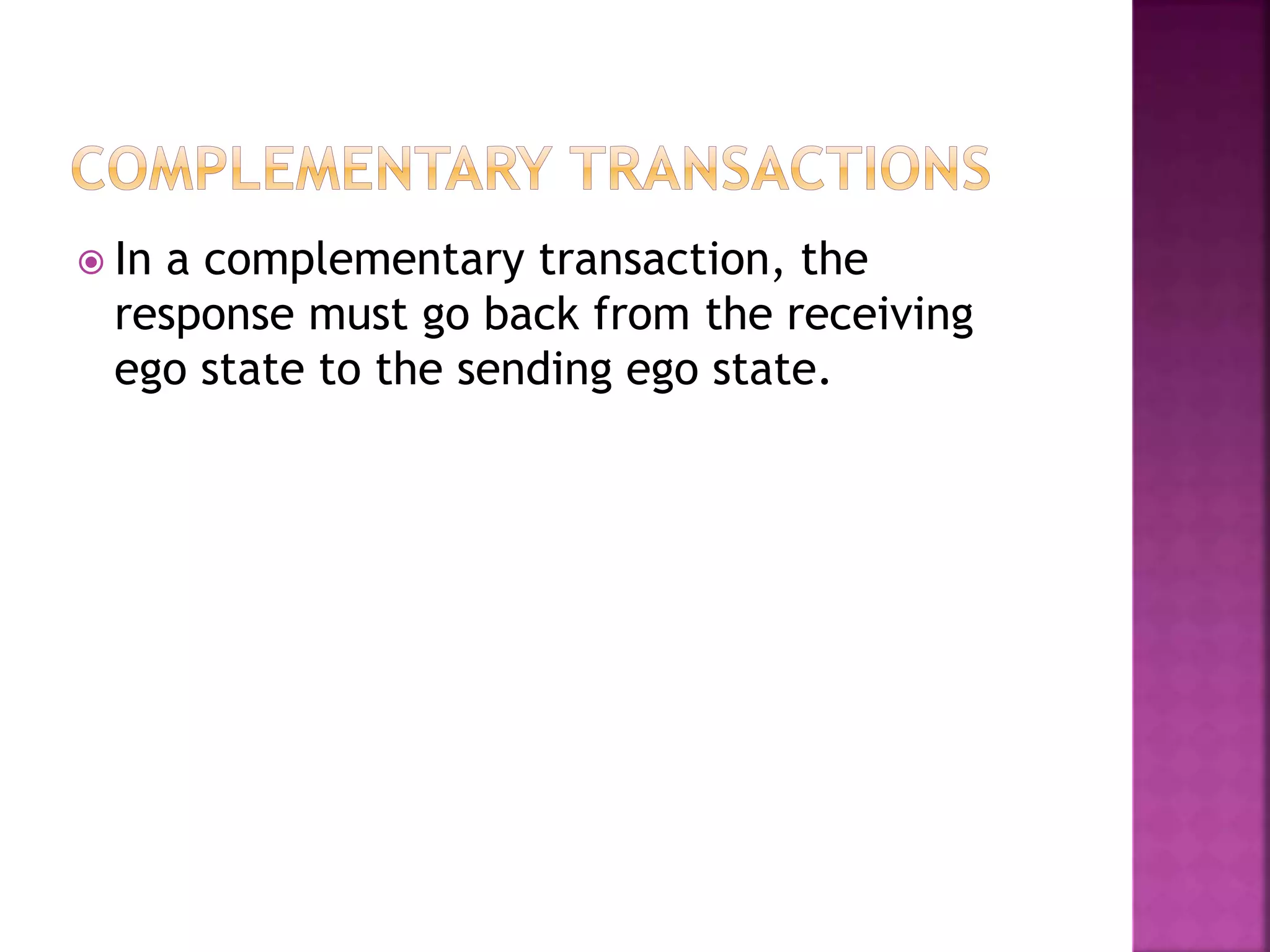
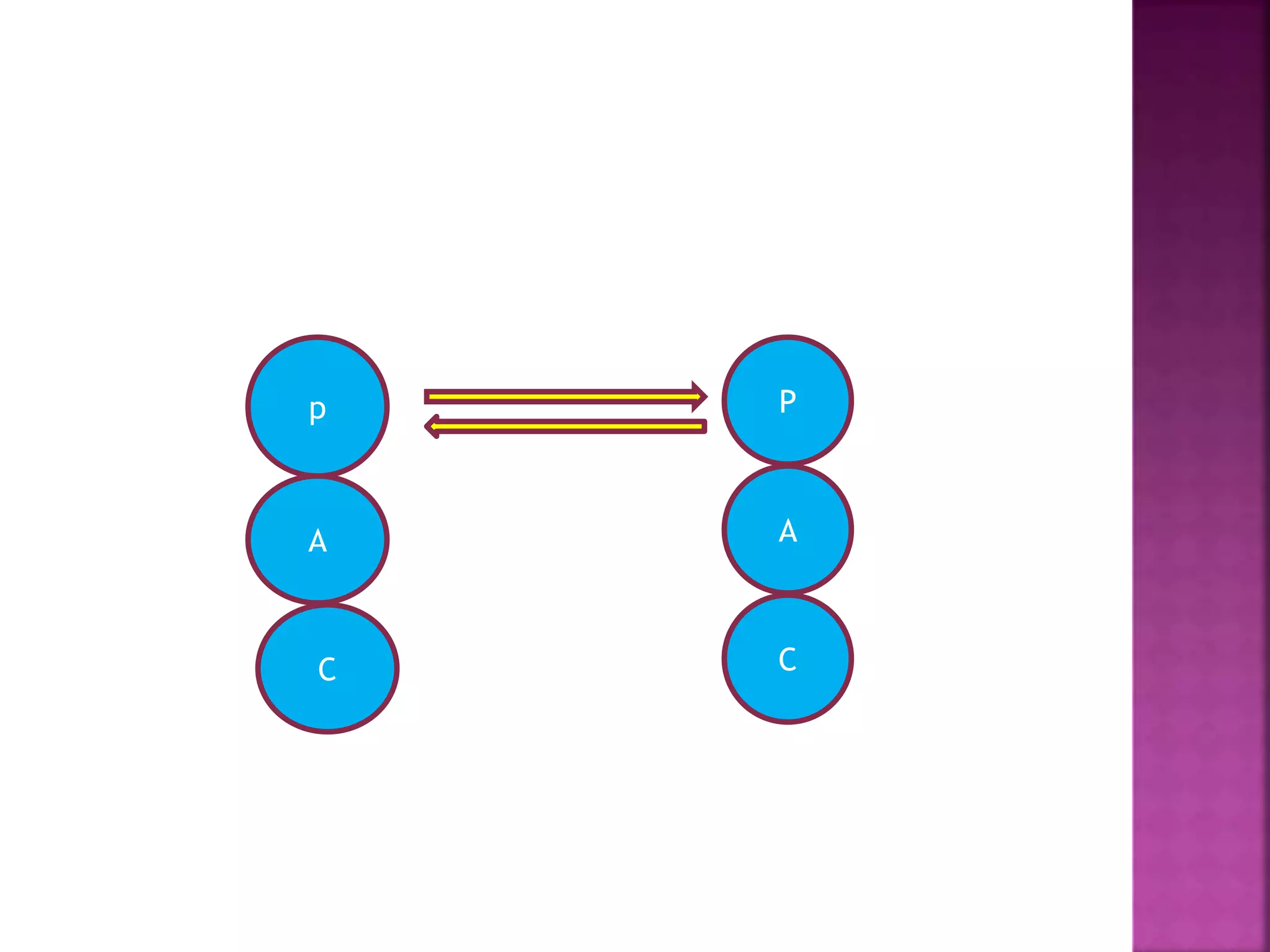
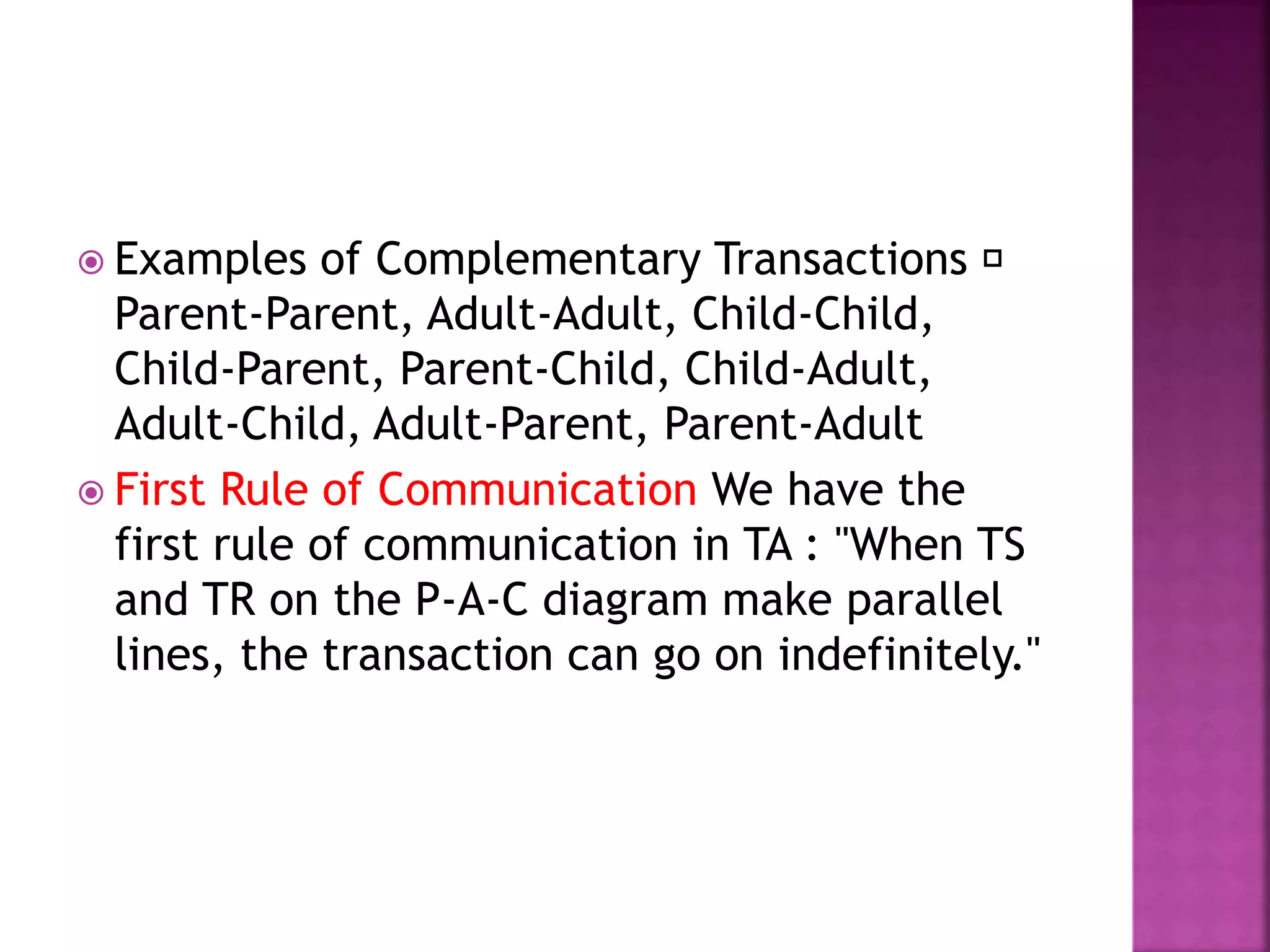
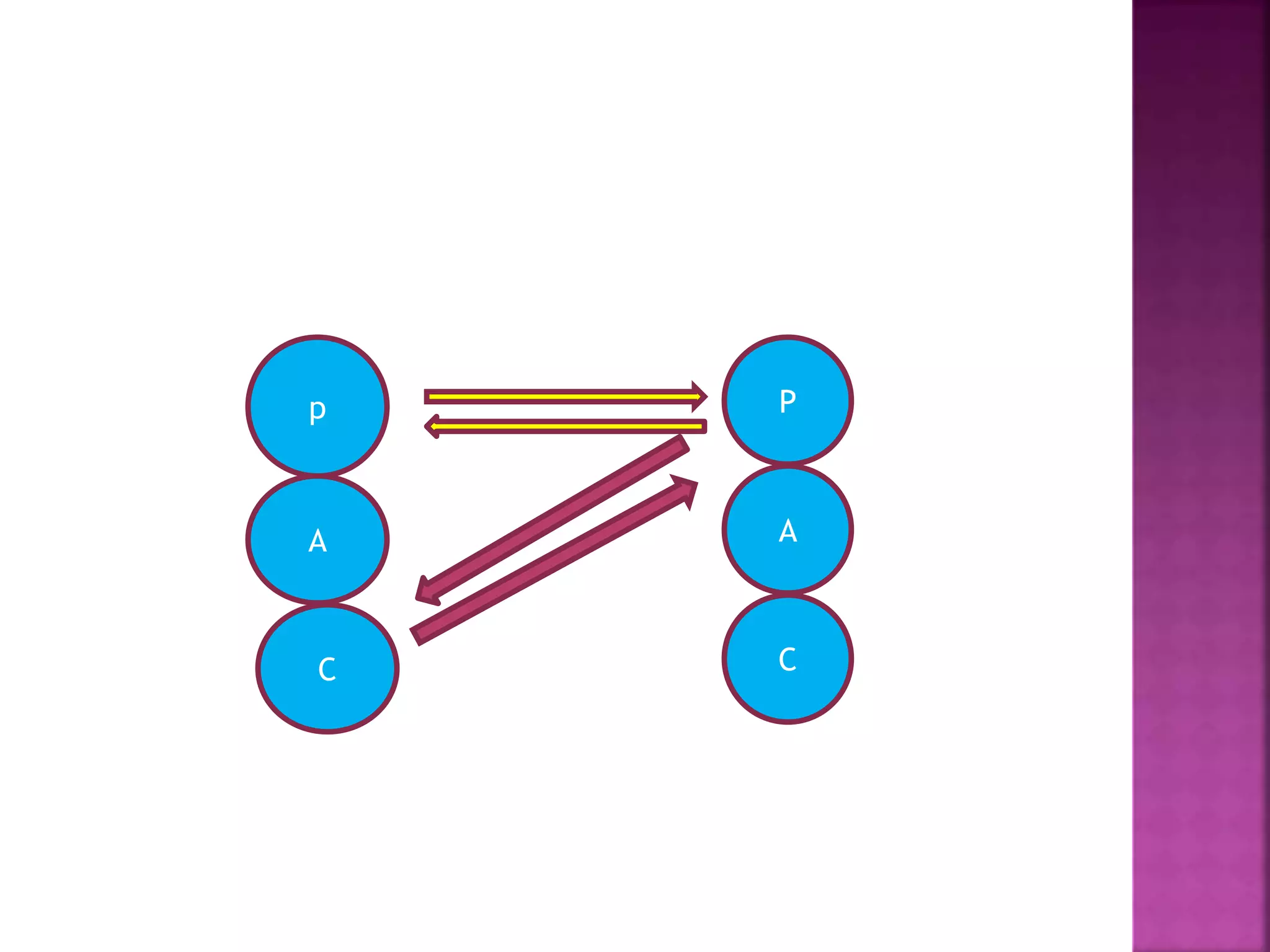
 In a complementary transaction, the
response must go back from the receiving
ego state to the sending ego state.
p
C
P
A
C
A
 According to Dr. Berne, these transactions
are healthy and represent normal human
interactions.
 As Berne says in Games People
Play “communication will proceed as long as
transactions are complementary.”9
 Examples of Complementary Transactions
Parent-Parent, Adult-Adult, Child-Child,
Child-Parent, Parent-Child, Child-Adult,
Adult-Child, Adult-Parent, Parent-Adult
 First Rule of Communication We have the
first rule of communication in TA : "When TS
and TR on the P-A-C diagram make parallel
lines, the transaction can go on indefinitely."
p
C
P
A
C
A
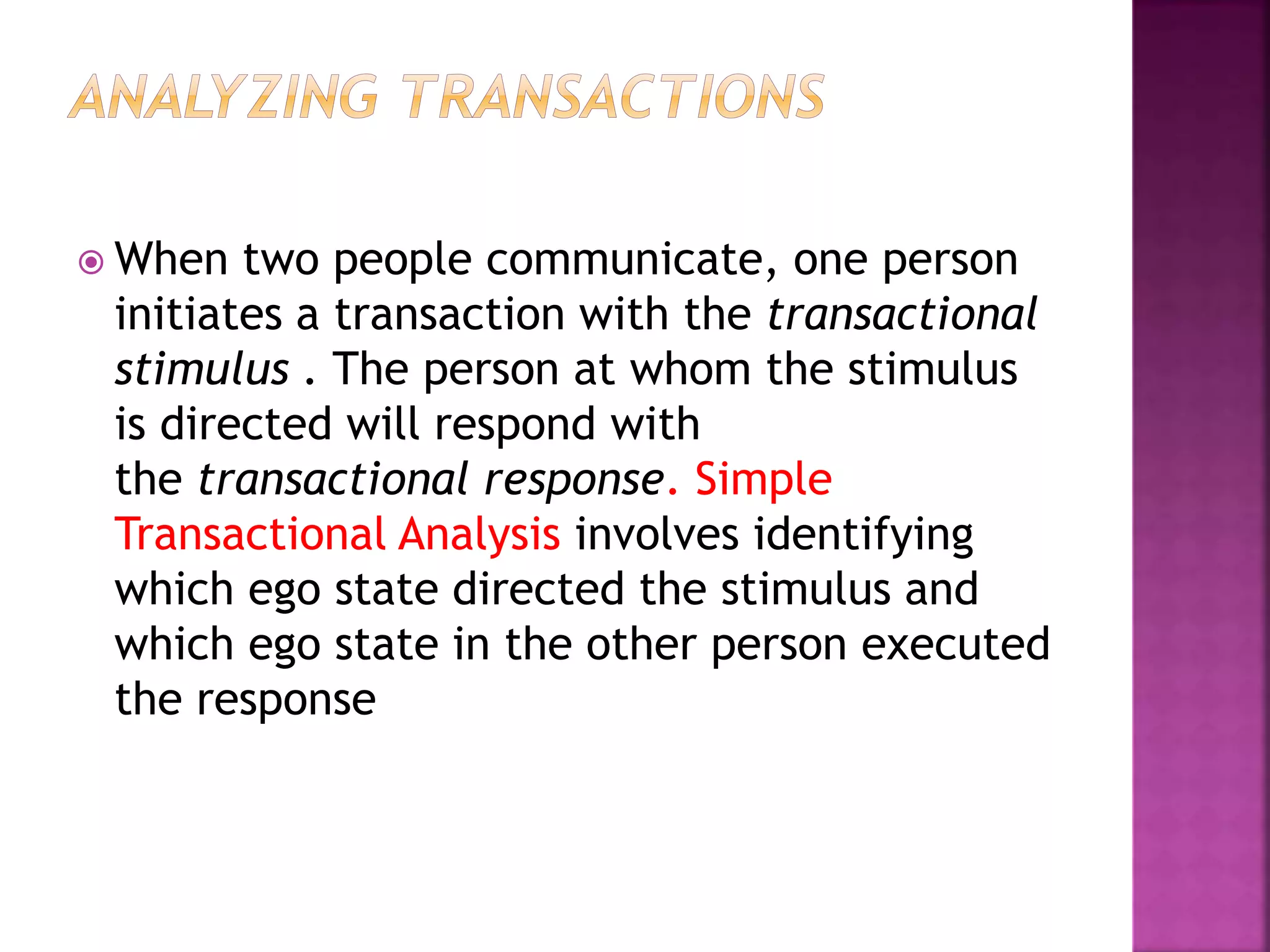
 When two people communicate, one person
initiates a transaction with the transactional
stimulus . The person at whom the stimulus
is directed will respond with
the transactional response. Simple
Transactional Analysis involves identifying
which ego state directed the stimulus and
which ego state in the other person executed
the response
 According to Dr. Berne, the simplest
transactions are between Adults ego states.
 healthy person has a personality that
maintains a balance among all three –
according to Abewagner, "Nurturing Parent,
Adult and Happy Child". This means that
these people are able to lead the adult ego
state take over and think very rationally and
engage in problem solving
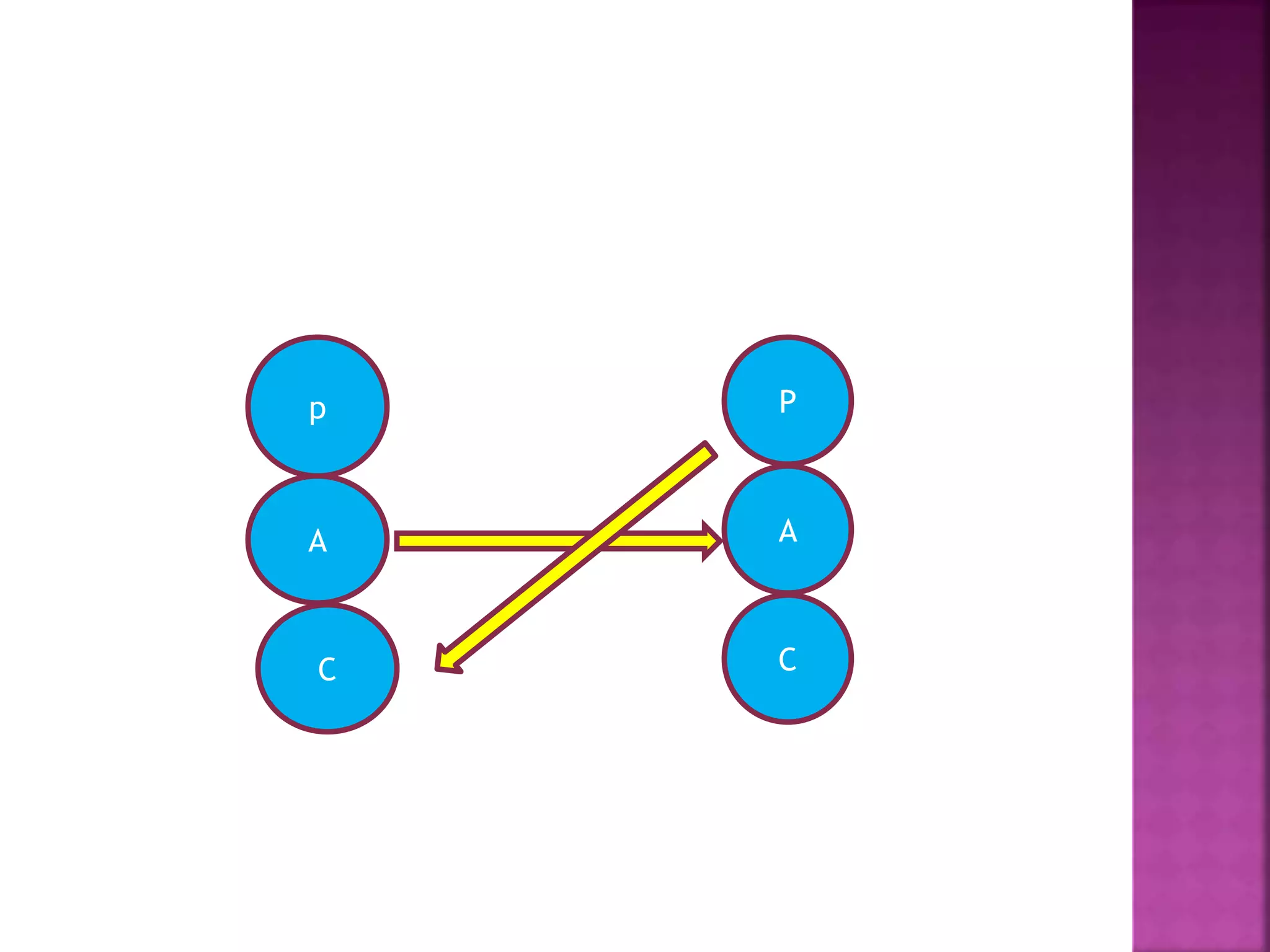
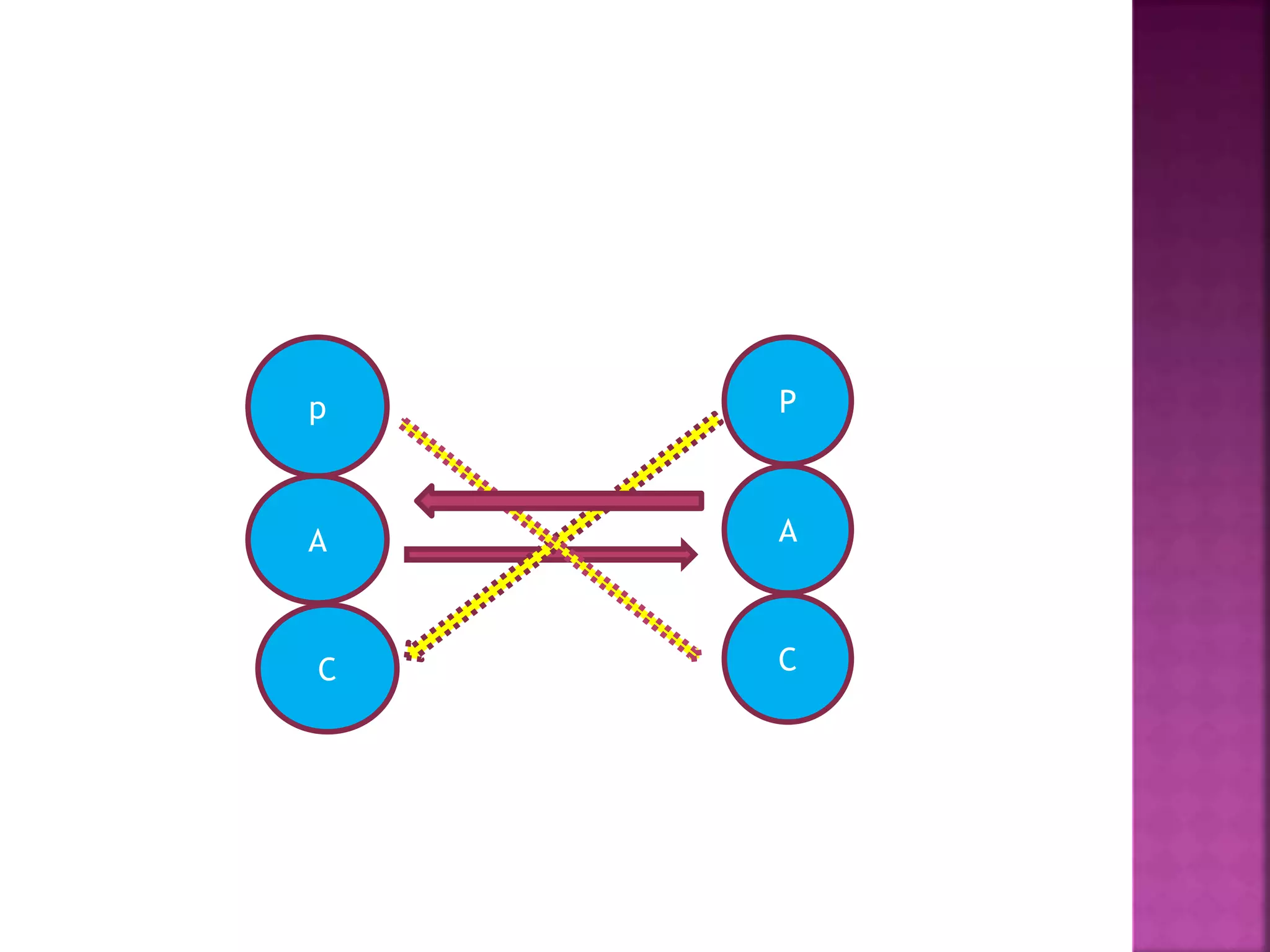
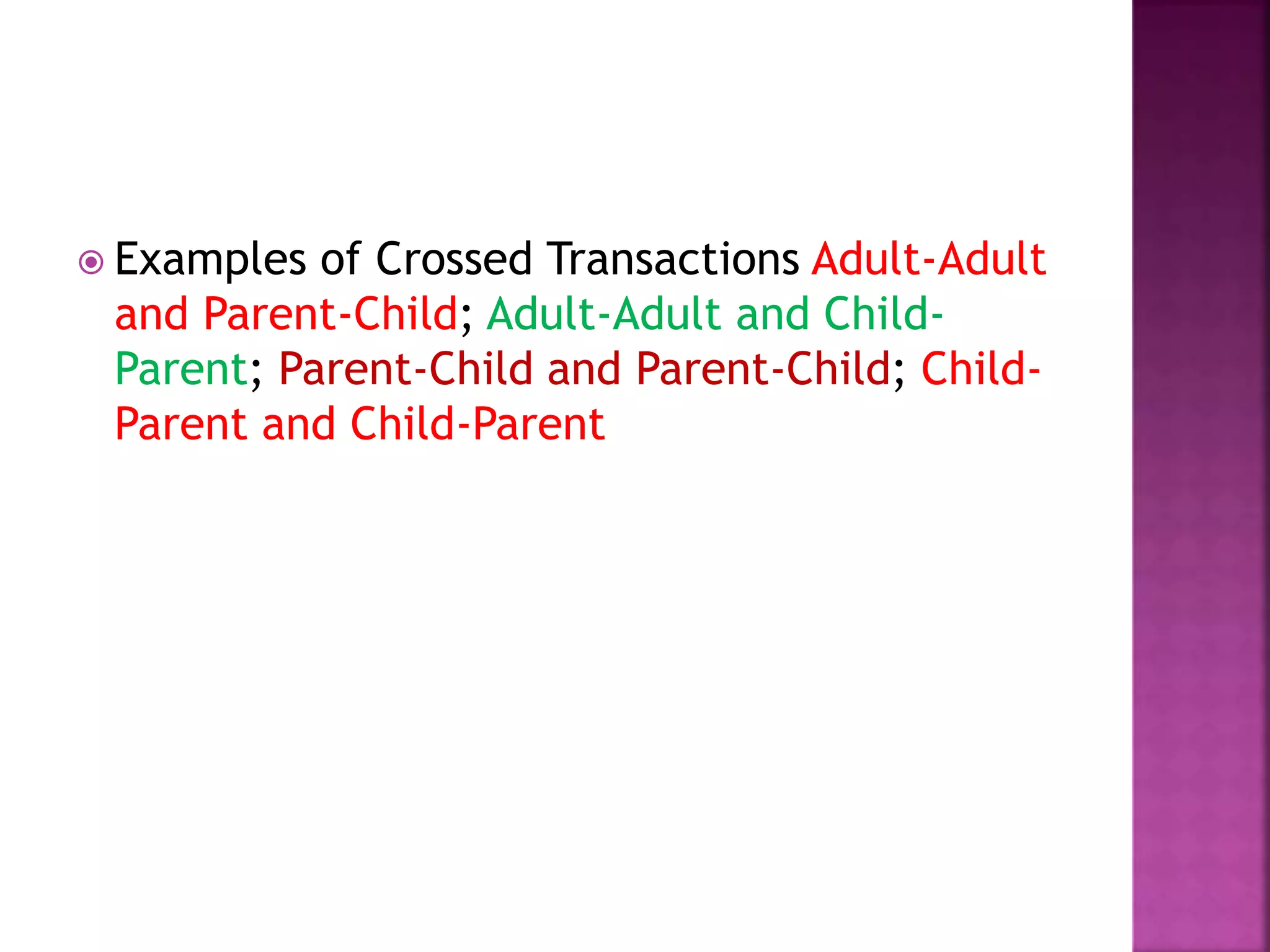
 A crossed transaction is one in which the
sender sends a message, a behaviour, on the
basis of his ego state but the response is
from the unexpected ego state of the
respondent.
p
C
P
A
C
A
 Examples of Crossed Transactions Adult-Adult
and Parent-Child; Adult-Adult and Child-
Parent; Parent-Child and Parent-Child; Child-
Parent and Child-Parent
 Here we have the second rule of
communication in TA: "When TS and TR in the
P-A-C diagram cross each other,
communication stops."
 There is a social and an ulterior level
transaction. The social level is a socially
acceptable stimulus, for example, do you
know what time it is? Ulterior transactions
are by definition out of the person’s
awareness... it is an unconscious process.
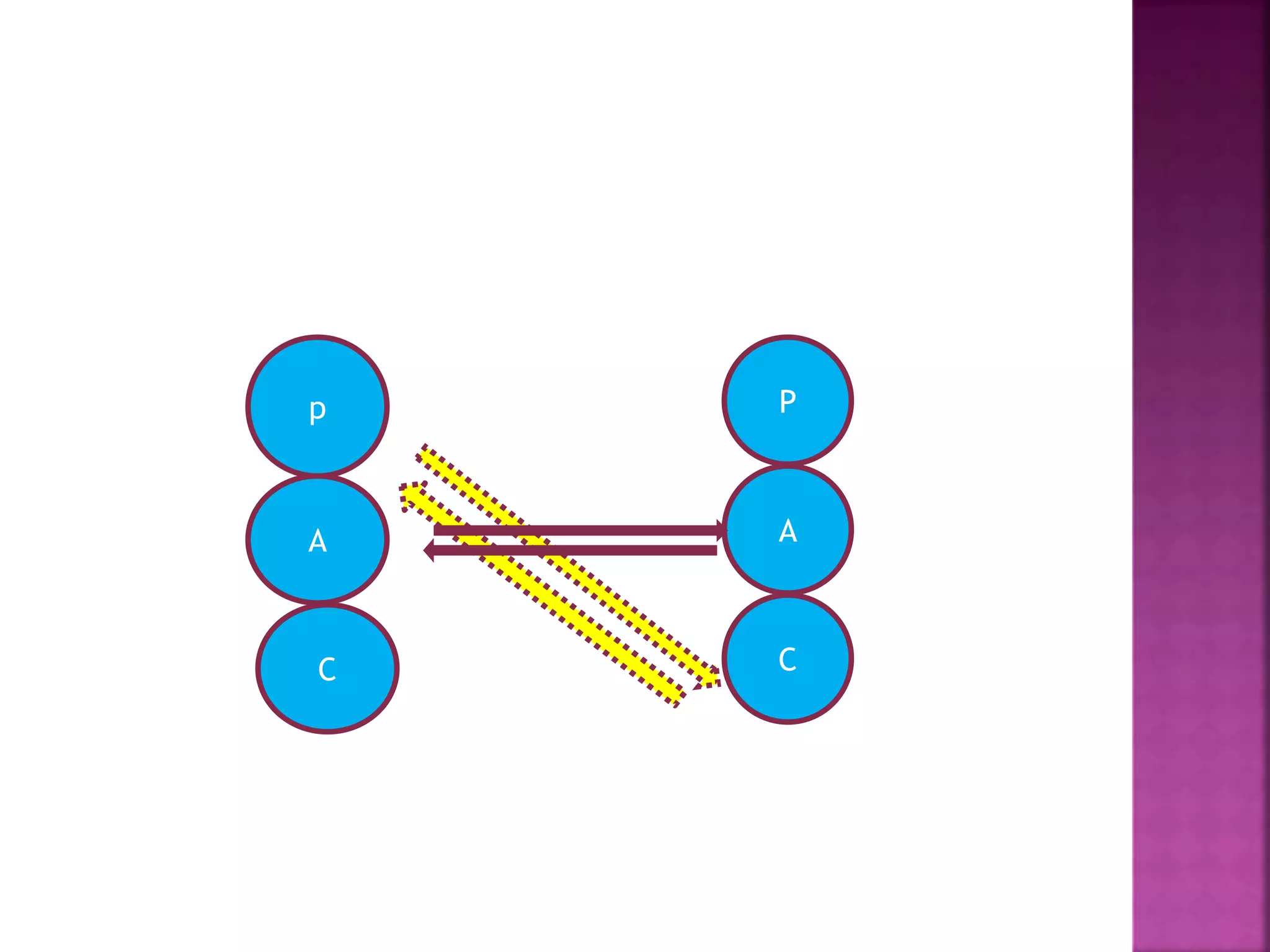
 In an ulterior transaction, two messages are
conveyed at the same time. One of these is
an overt or social level message. The other is
a covert or psychological level message. •
Most often, the social level content is Adult-
Adult. The psychological level messages are
usually either Parent –Child or Child –Parent.
p
C
P
A
C
A
 The ulterior transaction is shown as a broken
line in the transactional diagram and the
meaning will be made clear to the receiver
by the use of non-verbal language clues... a
wagging finger for example along with a
stern look will usually mean a Parent > Child
ulterior.
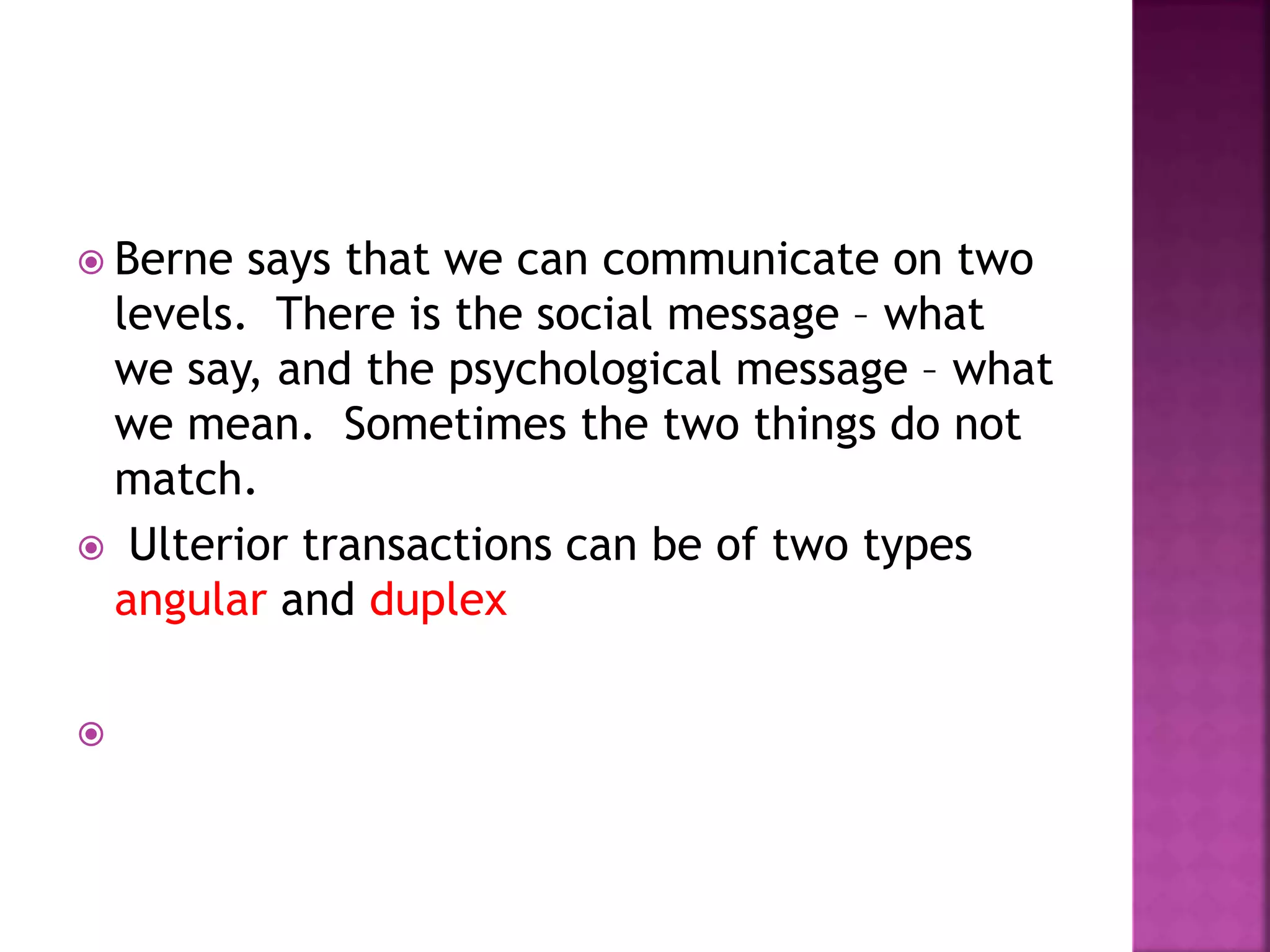
 Berne says that we can communicate on two
levels. There is the social message – what
we say, and the psychological message – what
we mean. Sometimes the two things do not
match.
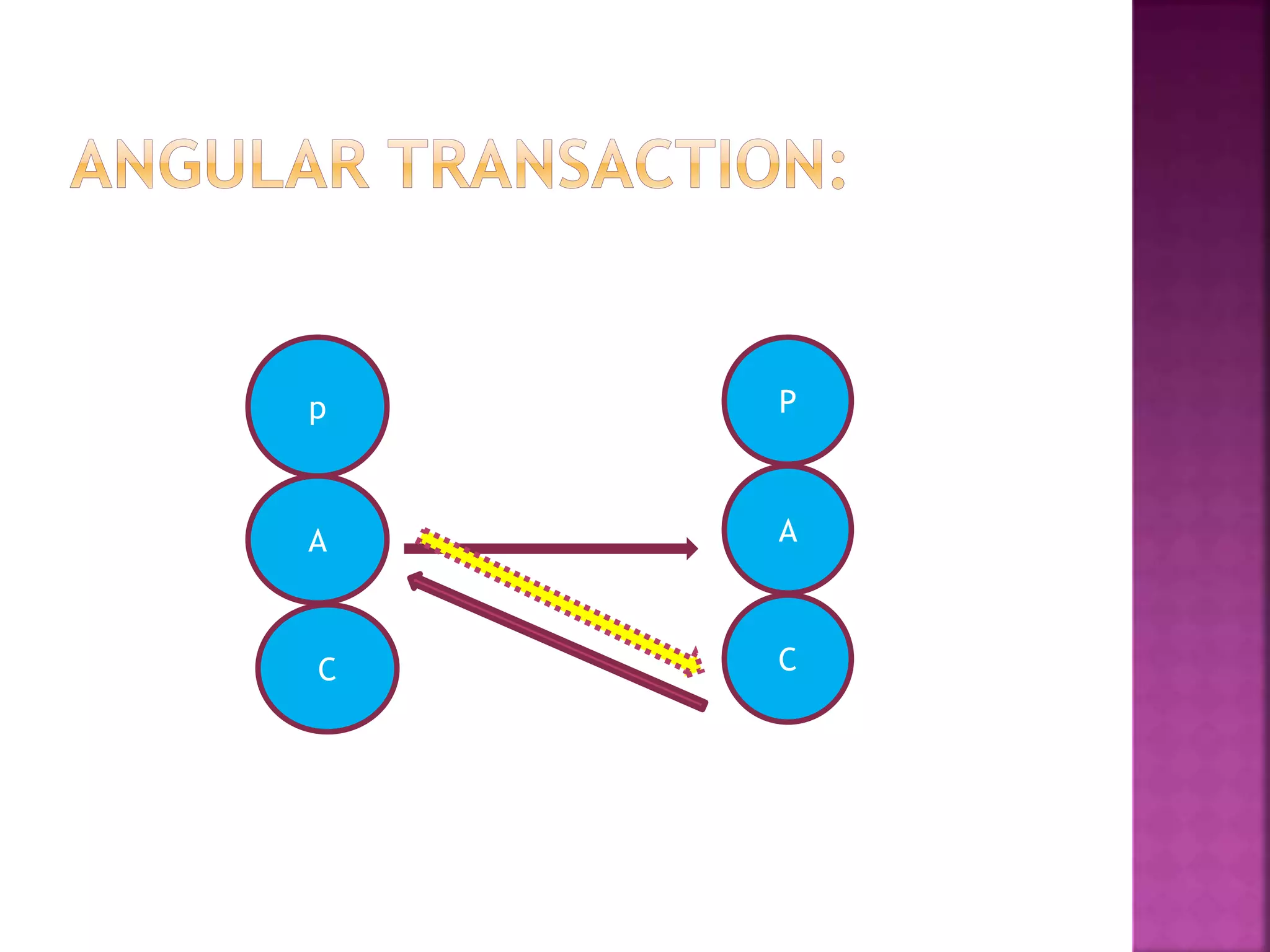
 Ulterior transactions can be of two types
angular and duplex

 Angular transaction involves three ego
states. Salesmen are particularly adapt this
kind of transaction. They convey their
message in social level as Adult ego-state,
but it contains a hidden psychological
message intending the Child ego-state of the
customer.
p
C
P
A
C
A
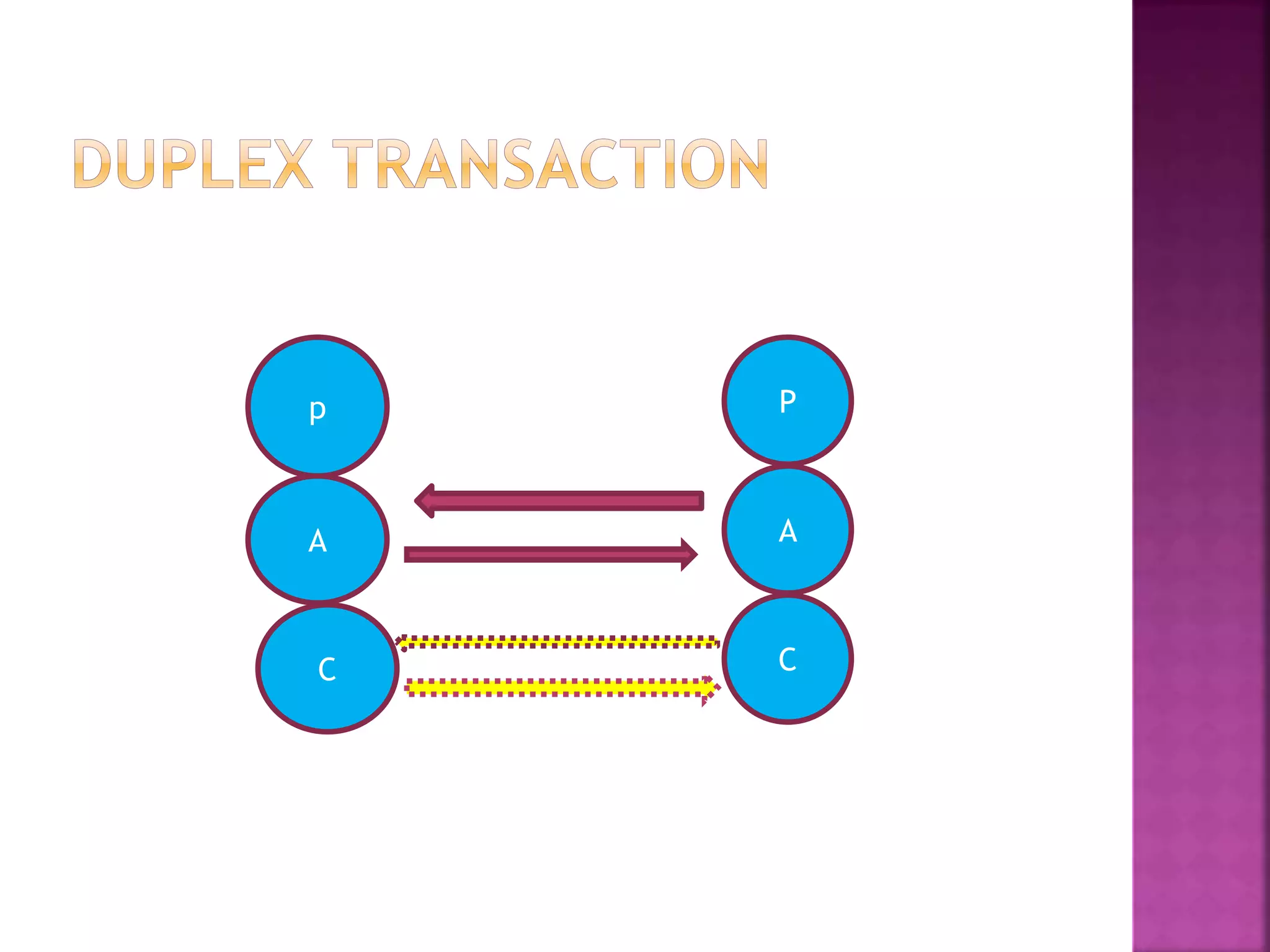
 This is a two level transaction in which beyond
the obvious transaction, there is a hidden
transaction between the two ego states of the
persons concerned. A duplex transaction
involves four ego states and is commonly seen
among college students. (the hidden or
psychological transactions are always
represented by doted arrows.)
p
C
P
A
C
A
 : The meaning of the communication will
always be at the ulterior level.
 Keep transactions complementary
 Avoid crossed transactions
 Beware of ulterior transactions
 An ongoing series of complementary ulterior
transactions progressing to a well defined
,predictable outcome can be conceived as a
game
 A game involves a recurring set of
transactions
 – repeating sequences of transactions that
lead to a result subconsciously agreed to by
the parties involved in the game
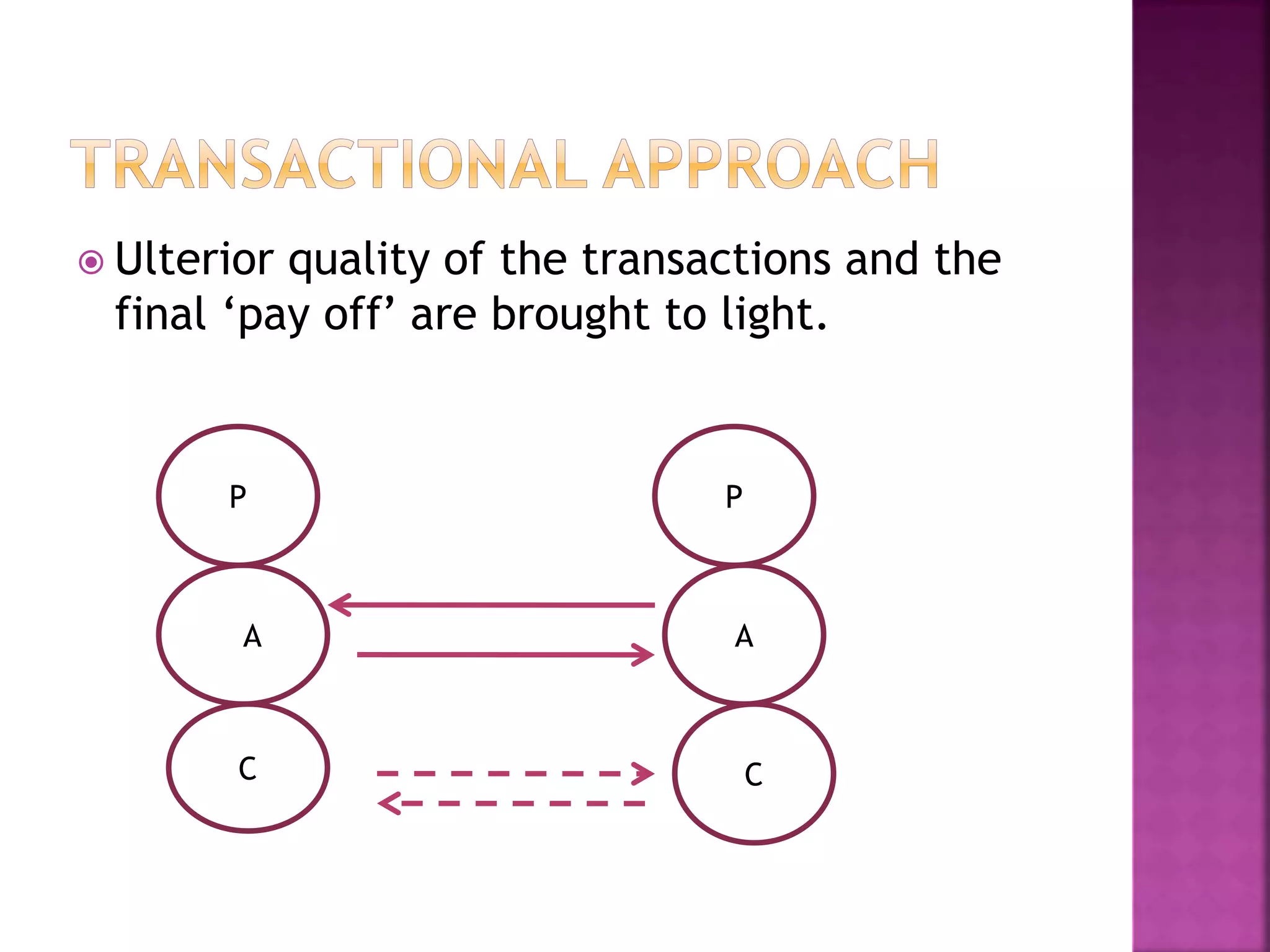
 This transaction may involve a concealed
motive or gimmick.
 Eric Bern speaks of three ways of analyzing
such games
 1.transactional approach
 2.formula G
 3.karpman triangle
 Ulterior quality of the transactions and the
final ‘pay off’ are brought to light.
P
AA
C
P
A
C
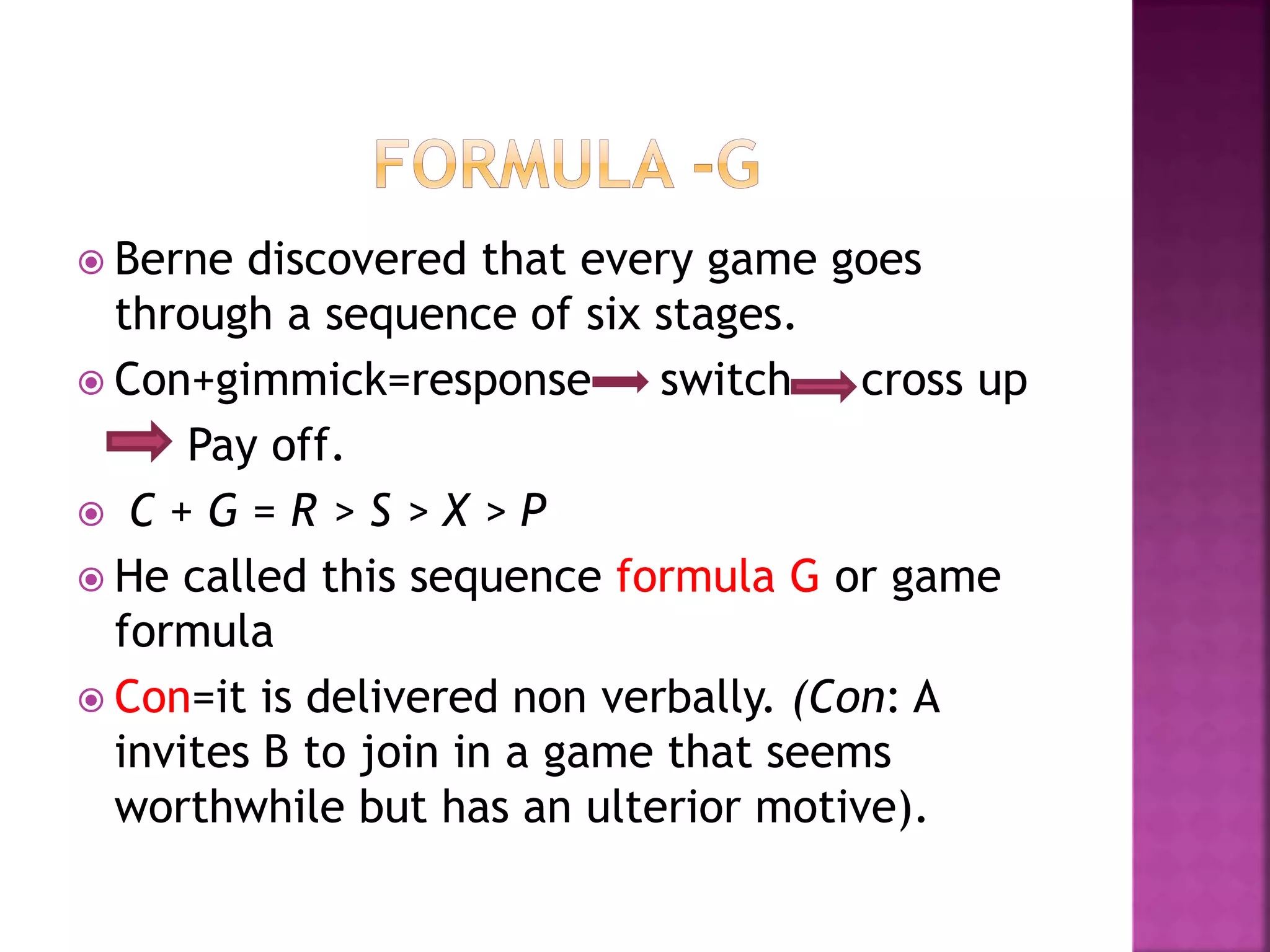
 Berne discovered that every game goes
through a sequence of six stages.
 Con+gimmick=response switch cross up
Pay off.
 C + G = R > S > X > P
 He called this sequence formula G or game
formula
 Con=it is delivered non verbally. (Con: A
invites B to join in a game that seems
worthwhile but has an ulterior motive).
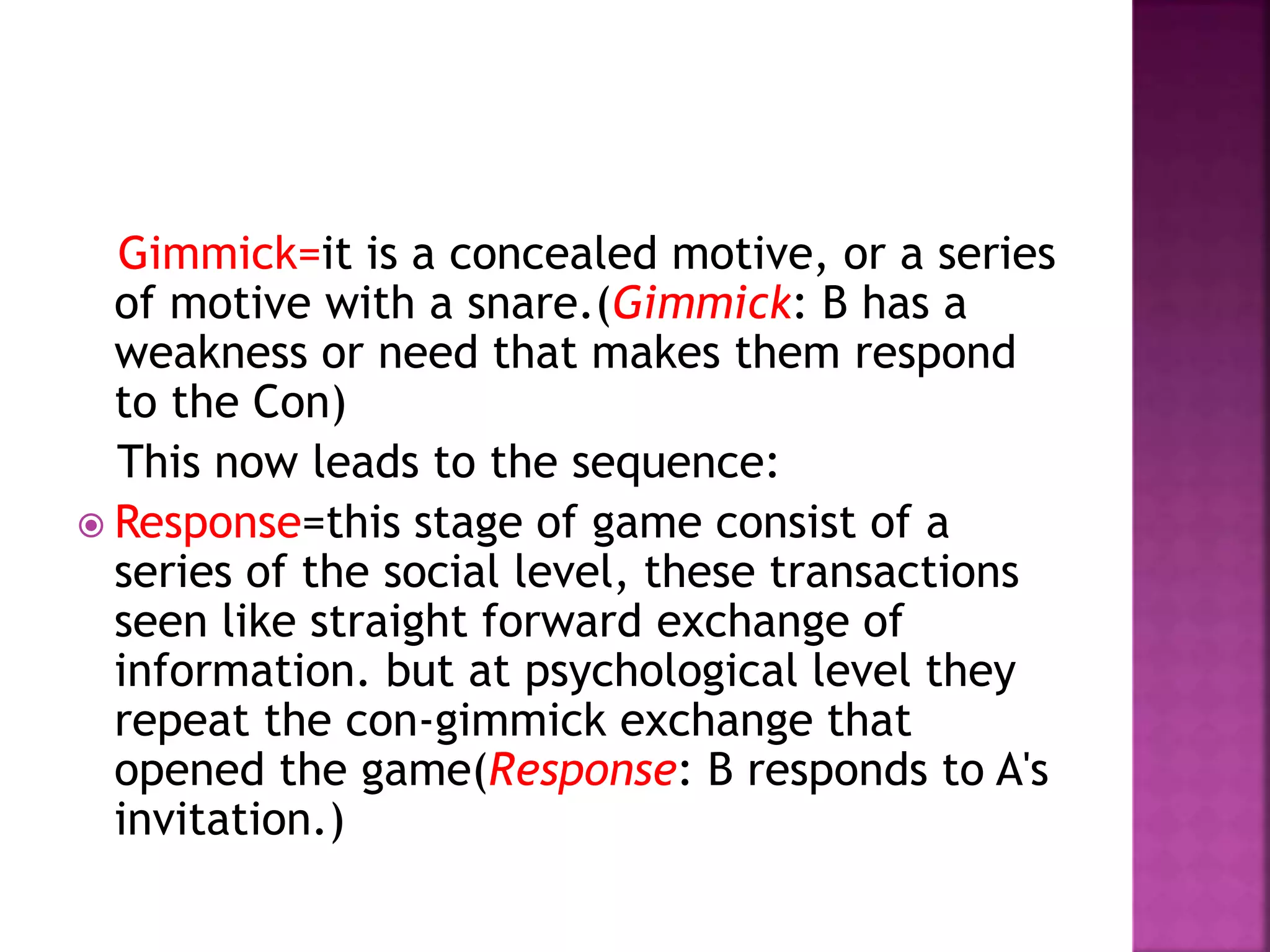
Gimmick=it is a concealed motive, or a series
of motive with a snare.(Gimmick: B has a
weakness or need that makes them respond
to the Con)
This now leads to the sequence:
 Response=this stage of game consist of a
series of the social level, these transactions
seen like straight forward exchange of
information. but at psychological level they
repeat the con-gimmick exchange that
opened the game(Response: B responds to A's
invitation.)
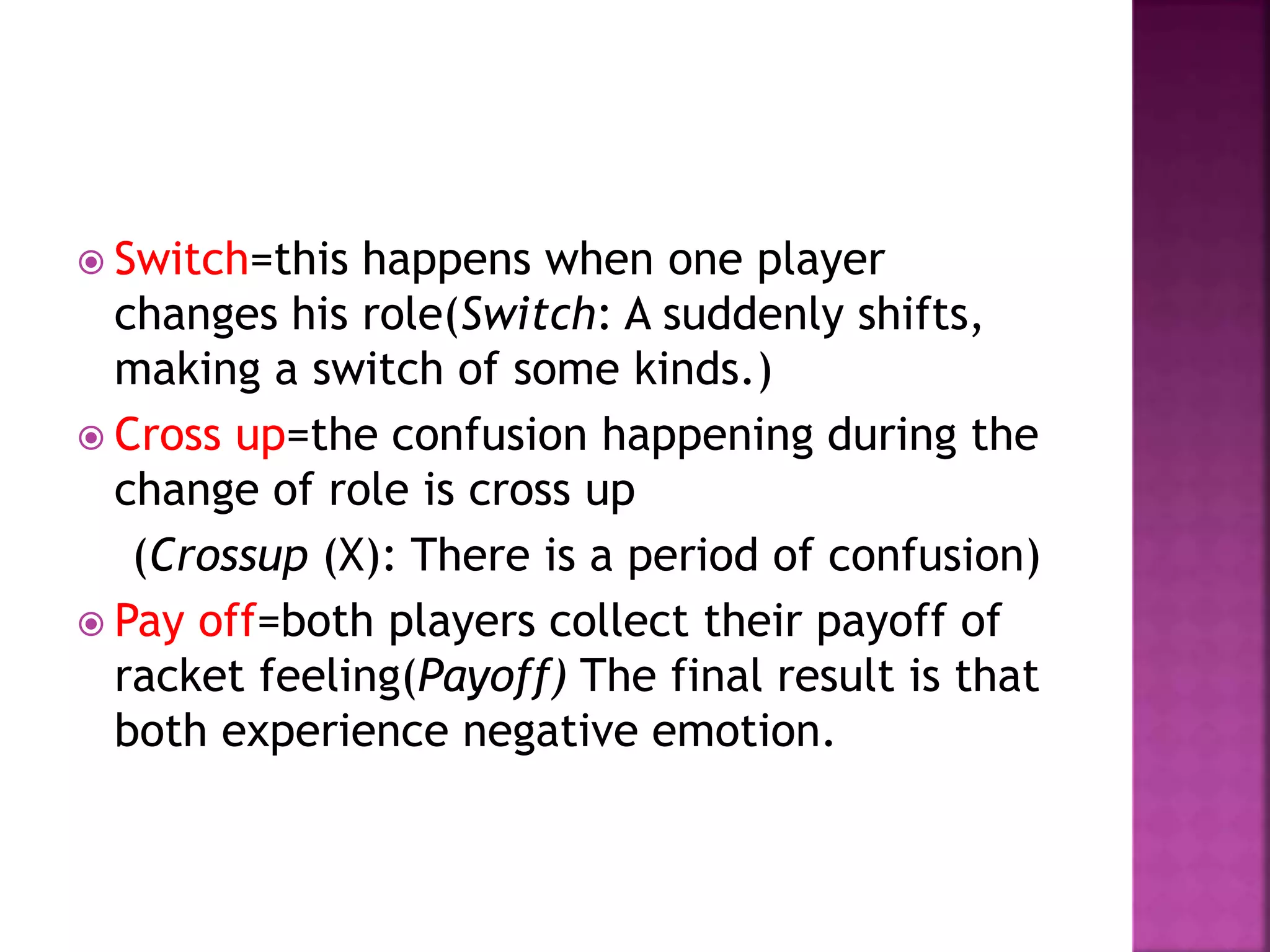
 Switch=this happens when one player
changes his role(Switch: A suddenly shifts,
making a switch of some kinds.)
 Cross up=the confusion happening during the
change of role is cross up
(Crossup (X): There is a period of confusion)
 Pay off=both players collect their payoff of
racket feeling(Payoff) The final result is that
both experience negative emotion.
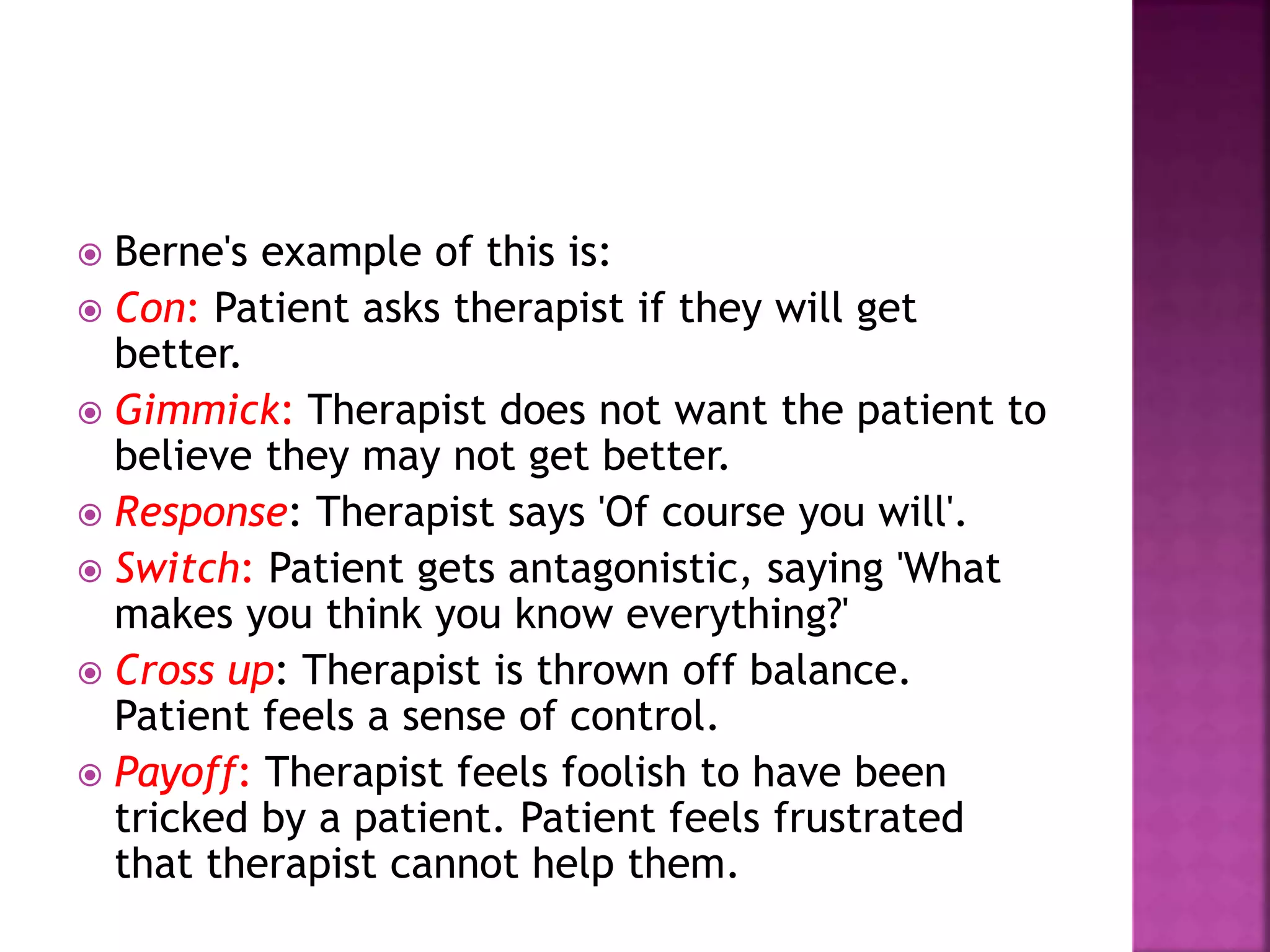
 Berne's example of this is:
 Con: Patient asks therapist if they will get
better.
 Gimmick: Therapist does not want the patient to
believe they may not get better.
 Response: Therapist says 'Of course you will'.
 Switch: Patient gets antagonistic, saying 'What
makes you think you know everything?'
 Cross up: Therapist is thrown off balance.
Patient feels a sense of control.
 Payoff: Therapist feels foolish to have been
tricked by a patient. Patient feels frustrated
that therapist cannot help them.
p
C
P
A
C
A
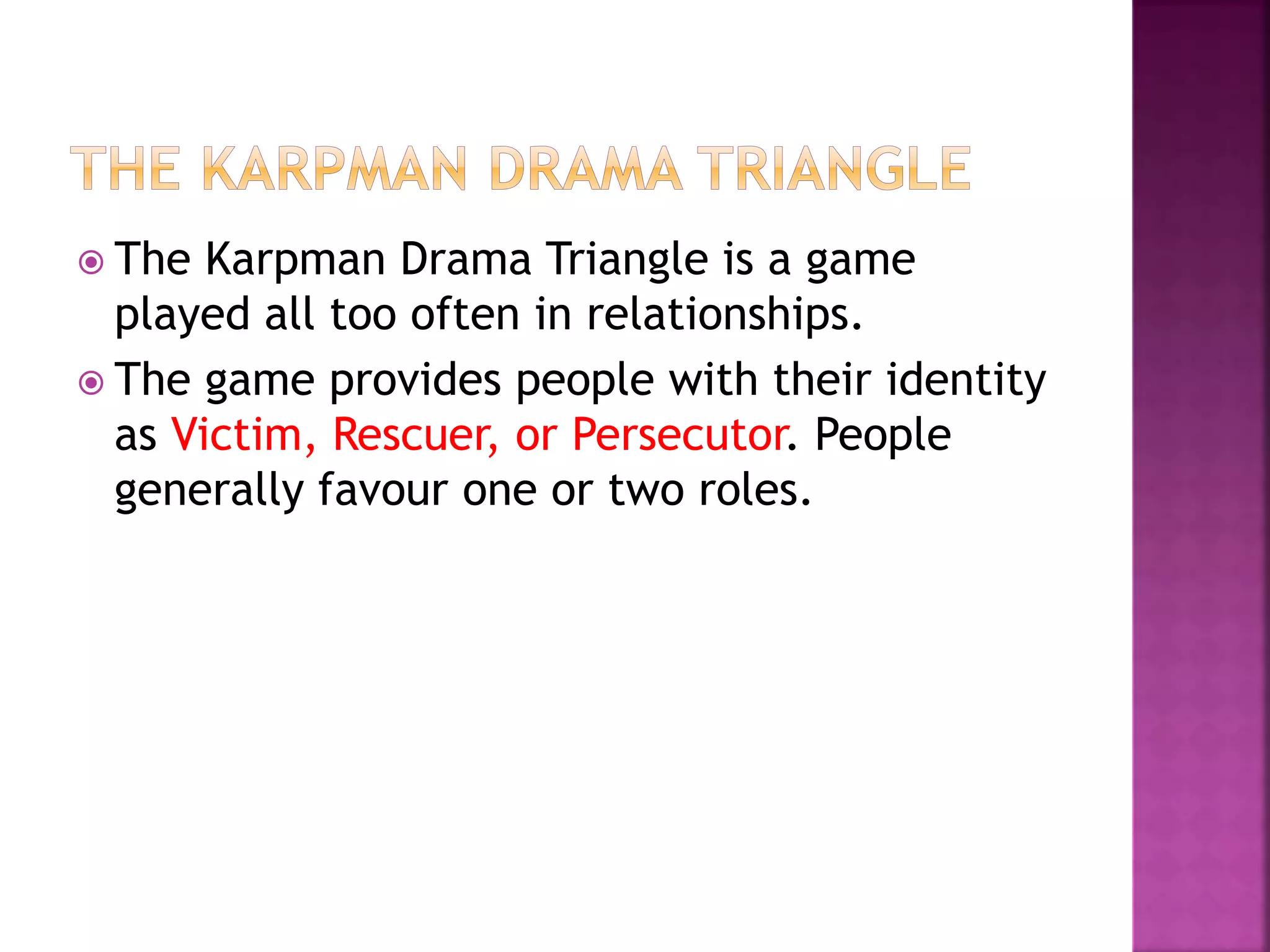
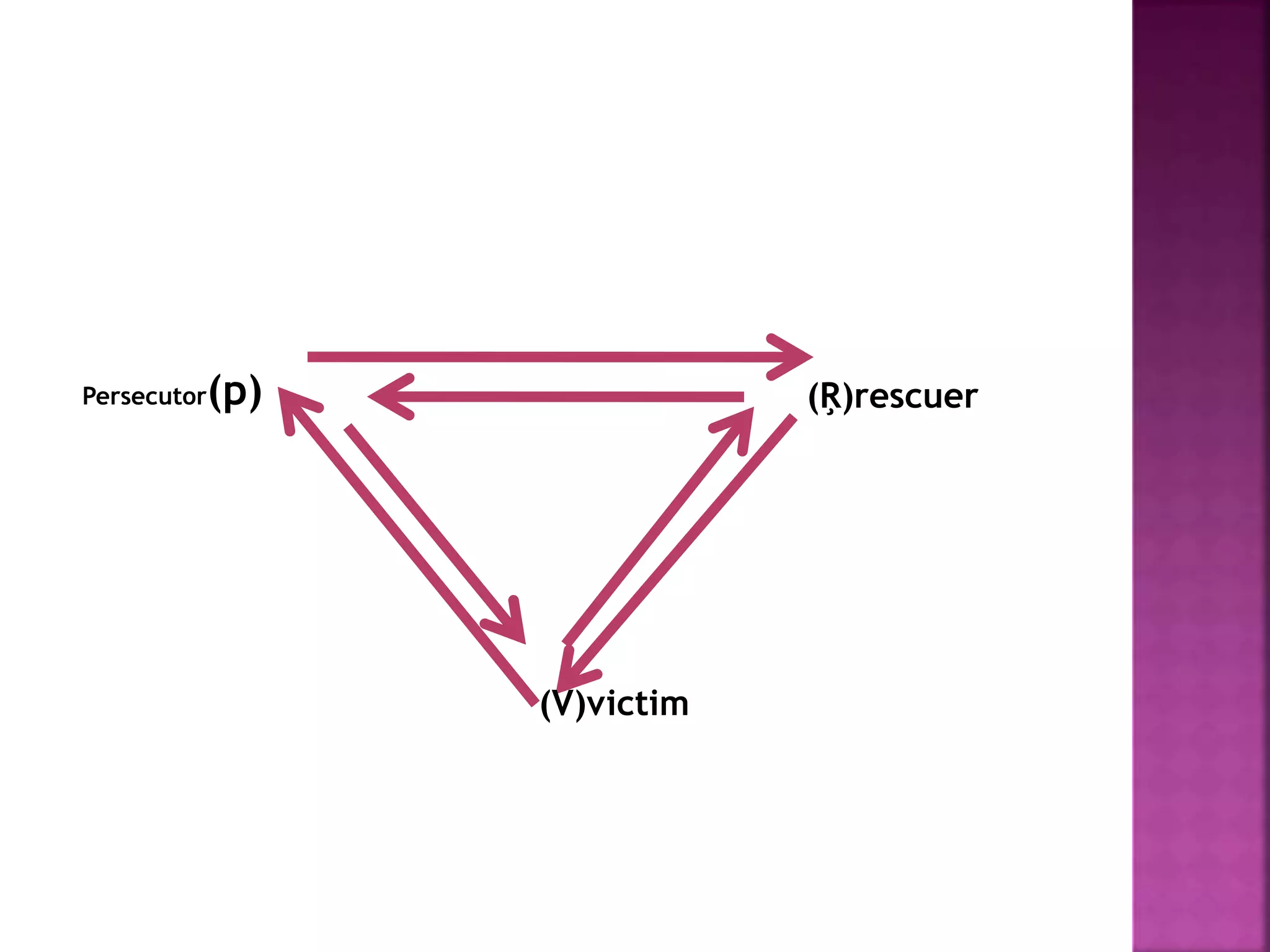
 The Karpman Drama Triangle is a game
played all too often in relationships.
 The game provides people with their identity
as Victim, Rescuer, or Persecutor. People
generally favour one or two roles.
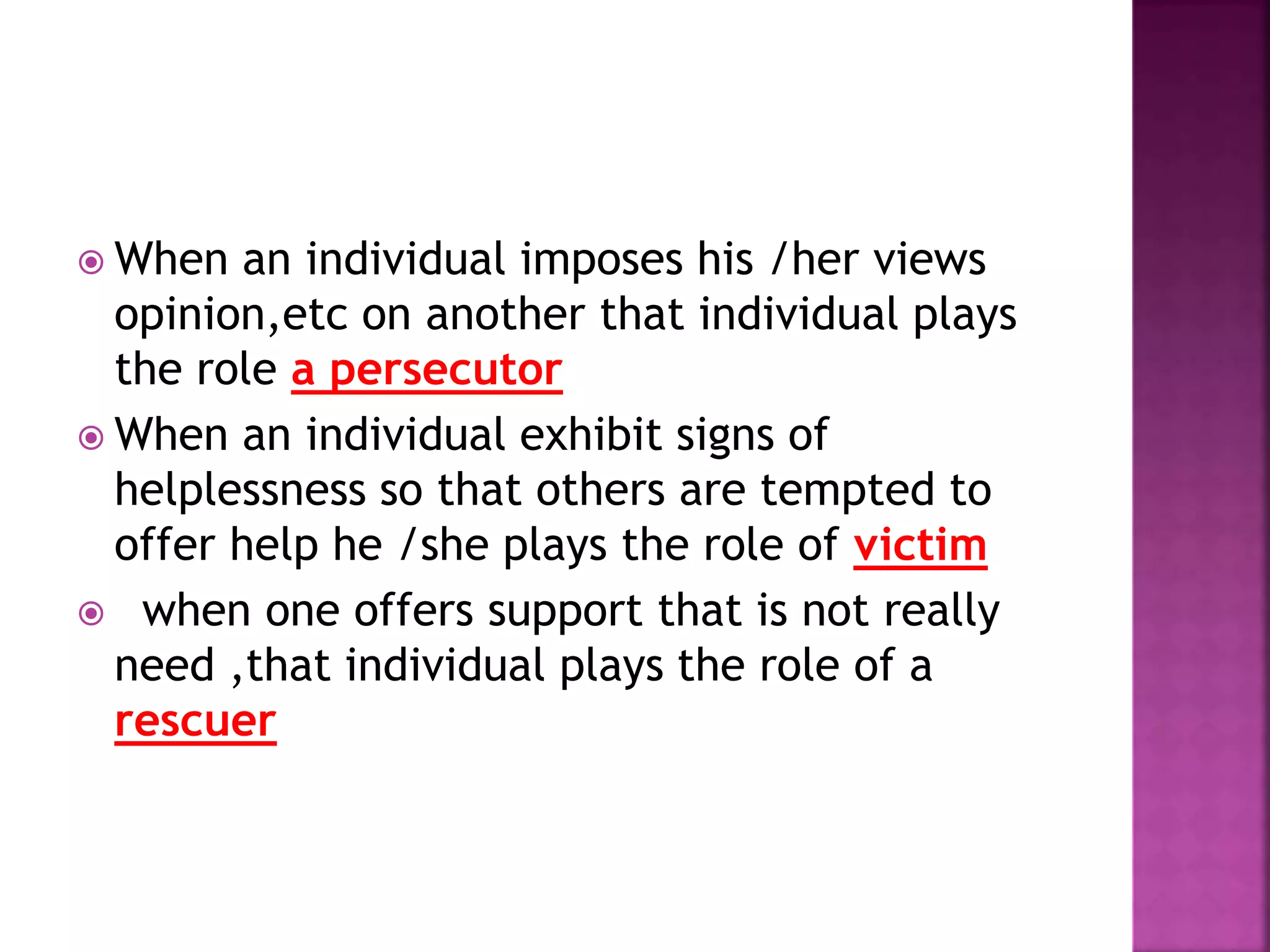
 When an individual imposes his /her views
opinion,etc on another that individual plays
the role a persecutor
 When an individual exhibit signs of
helplessness so that others are tempted to
offer help he /she plays the role of victim
 when one offers support that is not really
need ,that individual plays the role of a
rescuer
(V)victim
(Ŗ)rescuerPersecutor(р)
 Script is a central part of Transactional
analysis theory.
 Script can be seen as a well defined course
of action that we decide on as a child.

 The theory states that we experience the
world and make decisions about how we
need to be in order to survive in it.
 Script analysis is the method of uncovering
the 'early decisions, made unconsciously, as
to how life shall be lived'.[
 A central belief of transactional analysis is
that we made the decision in the first place
so we have the power to change it. There is
always hope that we can do things
differently once our script is brought into
awareness.
 So there it is, the very basics of transactional
analysis theory.
 The purpose of script analysis is to aid the
client (individual or organizational) to
achieve autonomy by recognising the script's
influence on values, decisions, behaviors and
thereby allowing them to decide against the
script.
 . Berne describes someone who is
autonomous as being 'script free‘ and as a
"real person“.
 , scripts can be changed, since they are not
inborn, but learned‘.
 a life plan that may involve long-term
involvement in particular games in order to
reach the life pay-off of the individual
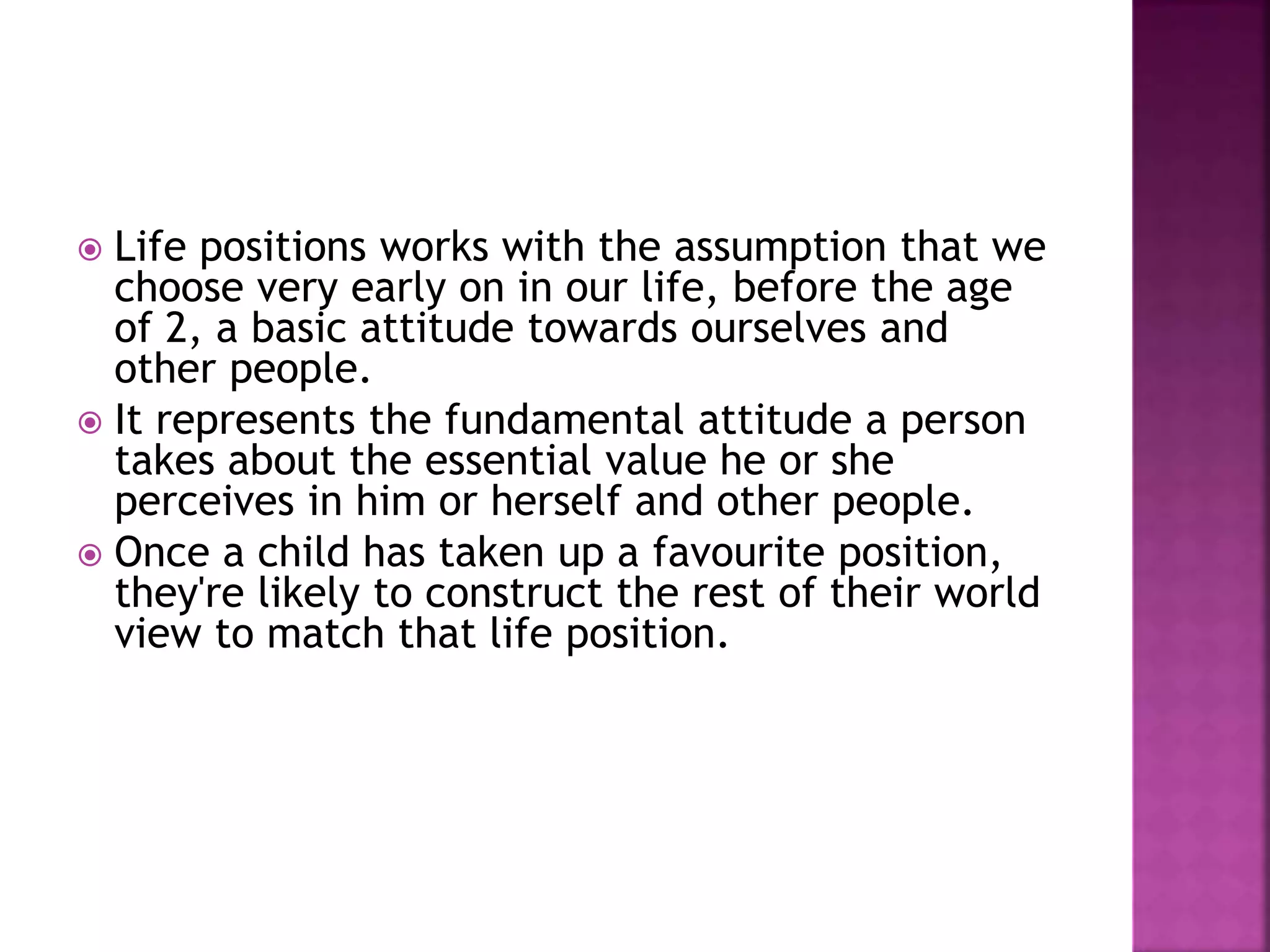
 Transactional Analysis constructs four possible
life position held with respect to oneself and
others. There are four fundamental life
positions. They are:

I am not OK - You are OK
I am not OK - You are not OK
I am OK - You are not OK
I am OK - You are Ok
 Life positions works with the assumption that we
choose very early on in our life, before the age
of 2, a basic attitude towards ourselves and
other people.
 It represents the fundamental attitude a person
takes about the essential value he or she
perceives in him or herself and other people.
 Once a child has taken up a favourite position,
they're likely to construct the rest of their world
view to match that life position.
 Our life position is like a set of glasses
through which we see the world. If we end
up with gray tinted glasses the whole
world will look gray to us. If they are
clear, we can see ourselves and the world
as things are good and bad, but mostly all
sorts of colours and shapes.
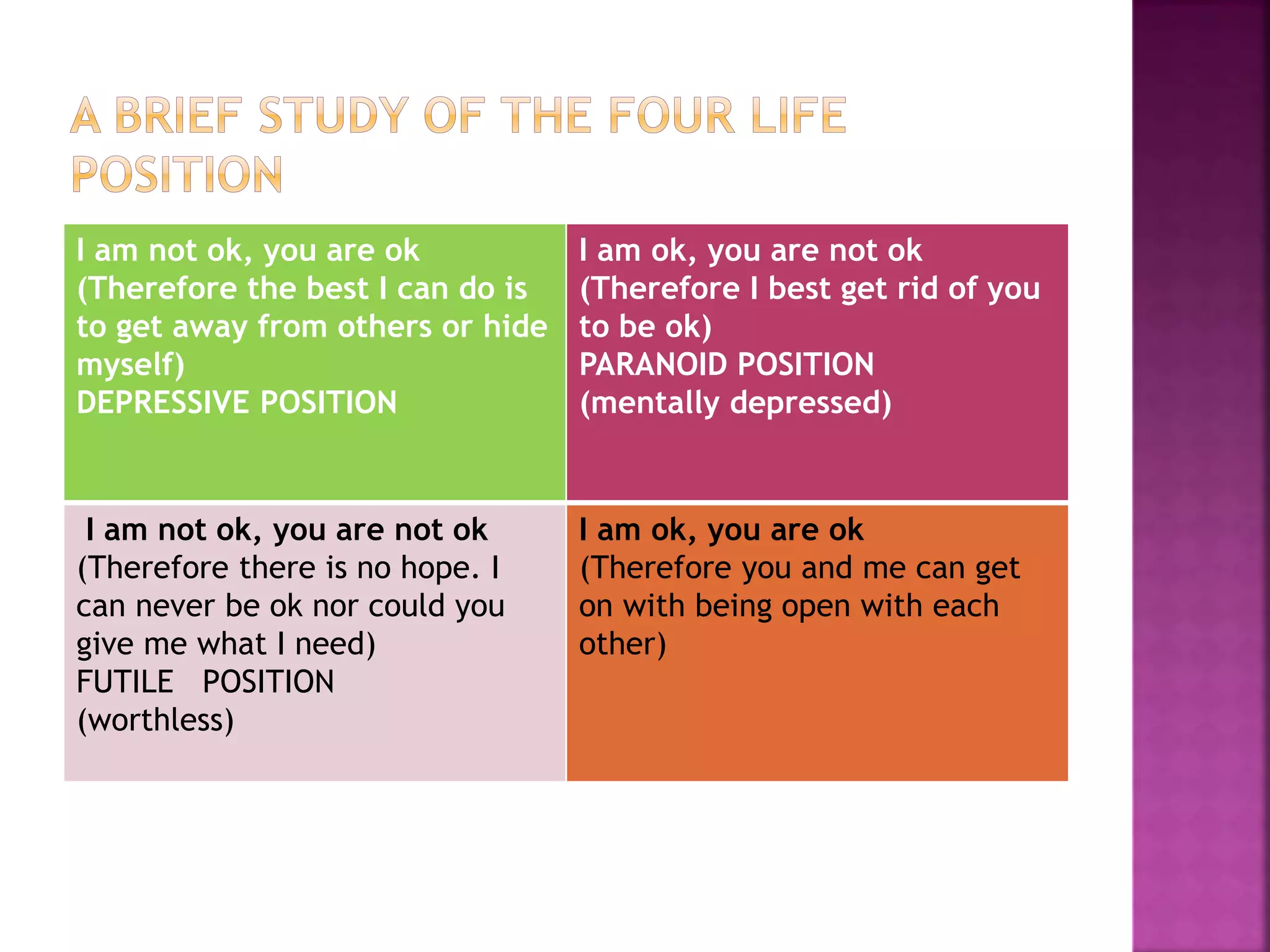
It shows the four basic life positions we can
assume:
 1. "I am not ok, you are ok," short for "There is
something fundamentally wrong with me, but
everybody else is ok.".
 This is the universal position of early childhood
in social transaction when the child arrives at
the logical conclusion that “I am not OK’.
 This NOT OK-ness arises from the helplessness of
the child. Such people feel inferior when they
compare themselves with others.
 These people are depressed and withdraw from
others.
 "I am not ok, you are not ok," short for
"There is something fundamentally wrong
with me and other people are unreliable,
untrustworthy, wrong in some way too."
 Such people become deeply sick and lose
interest in living. They might end up in
mental hospitals or kill themselves or others.
 3. "I am ok, you are not ok," short for "I am ok,
but I can't rely on or trust you. I feel there is
something wrong with other people around me."
A child who is brutalized by the parents will
switch over the third life position, that is : I AM
OK – YOU ARE NOT OK.
 this as a criminal position as there is every
chance for such a child to develop a criminal
personality type. Such people feel victimized,
and they blame others for their miseries. These
people may turn persecutors.
 4. "'I am ok, you are ok," which is short for "I am ok
with myself and with you too."
 Such people are mentally healthy. This OK position is
experienced by children who have received an
exposure situation in early life in which they can
prove, to themselves, their own worth and the worth
of others. In this position, a person recognize that
both you and I have worth, value and dignity as
people have. People in this position are happy and
have intimate relationships.
 It's easy to see that the best place to come from is "'I
am ok, you are ok!"
I am not ok, you are ok
(Therefore the best I can do is
to get away from others or hide
myself)
DEPRESSIVE POSITION
I am ok, you are not ok
(Therefore I best get rid of you
to be ok)
PARANOID POSITION
(mentally depressed)
I am not ok, you are not ok
(Therefore there is no hope. I
can never be ok nor could you
give me what I need)
FUTILE POSITION
(worthless)
I am ok, you are ok
(Therefore you and me can get
on with being open with each
other)
 GOOD LIFE POSITION
It is important that you find a way to
relate from an "I am ok you are ok" position
as much as possible to your partner. And that
he or she relates in the same way to you.
Only then you are in a place where you can
trust and respect yourself and the other
person and you can be secure in knowing
that you both are committed to working
things out together when things get tough.
Thank you

Transactional analysis

  • 1.
  • 2.
     Proposed bythe Canadian psychologist Eric Berne (1910-70) in his 1964 book 'Games People Play  Berne's theory was based on the ideas of Freud but was distinctly different.  Dr. Berne defined Transactional Analysis is the method for studying interactions between individuals
  • 3.
     According toTA, a transaction is a stimulus plus a response.  For example, if you say to one of your student, "You really did a good job on that project" that is stimulus: and he says, "Thanks", that is a response. Thus, transactions take place between people.
  • 4.
     The theoryoutlines how we have developed and treat ourselves, how we relate and communicate with others, and offers suggestions and interventions which will enable us to change and grow
  • 5.
     In additionto the analysis of the interactions between individuals, Transactional Analysis also involves the identification of the ego states behind each and every transaction. Berne defined an ego state as “a consistent pattern of feeling and experience directly related to a corresponding consistent pattern of behavior.”4
  • 6.
     Transactional analysisinvolves four types of analysis namely  Structural analysis  Transactional analysis  Game analysis  script
  • 7.
     Structural analysisspeak of the psychological structure of personality which comprises of a group of ego states namely  1. the parent ego state,  2.adult ego state and  3.child ego state
  • 8.
     The personalityof a person is the collection of behaviour patterns developed over a period of time.  these behaviour patterns are evolved in differing degrees from three ego states - Parent, Adult and Child.  a parent (mother or father) has parent, adult and child ego states; and a child (son or daughter) also has parent, adult and child ego states.
  • 9.
     The parentego state is a result of the "messages" (conditioning) people receive from their parents, elder sisters and brothers, school teachers and others during their childhood  the majority of the external events experienced by a child are actions of the parent, the ego state was appropriately called Parent.  events perceived by the child from individuals that are NOT parents (but who are often in parent-like roles) are also recorded in the Parent.  Examples of recordings in the Parent include:  “Never talk to strangers”  “Always chew with your mouth closed”  “Look both ways before you cross the street”
  • 10.
     There aretwo kinds of Parent ego states :  (i) Nurturing Parent and  (ii) Critical parent.  The Nurturing parent is that part of a person which is understanding and caring about other people. Behaviour coming from the nurturing parent may set limits on and provide direction for people behaviour. It will not put the people down and make then feel not OK as individual.
  • 11.
     Critical parentbehaviour attacks people's personalities as well as their behaviour.  Critical parent makes people feel that they are not OK.  When people are in their critical parent ego state they are very evaluative and judgmental.  They are always ready to respond with a 'should' or 'ought' to almost anything people tell them.
  • 12.
     The Adultego state evokes behaviour that could be described simply as logical, reasonable, rationale and unemotional.  Behaviour from the adult ego state is characterized by problem solving analysis and rationale decision-making.  .
  • 13.
     People operatingfrom the adult ego state are taking emotional content of their child ego state, the value-laden content of their parent ego state and checking them out in the reality of the external world.  These people are examining alternatives, probabilities and values prior to engaging in behaviour
  • 14.
     The childego state is associated with behaviours that appear when a person is responding emotionally.  A person's child contains the 'natural' impulses and attitudes learned from child experiences.  the Child represents the recordings in the brain of internal events associated with external events the child perceives.
  • 15.
     , recordingsin the Child occur from childbirth all the way up to the age of approximately 5 years old.  “There are several forms of the child ego state. However, two kinds of ego states viz. happy child and destructive child are commonly relevant in behaviour
  • 16.
     People behavingfrom their happy child are doing things they want to do it but it is not destructive to others.  people in their destructive child are also doing things but their behaviour is either destructive to others or to themselves, or to their environment
  • 17.
     The threeego states are usually diagrammed as shown in figure below:.
  • 18.
      PARENT EGO(p) ADULT EGO (A)   CHILD EGO STATE(C) P A C
  • 19.
    A structural diagramrepresents the complete personality of any individual. It includes the Parent, Adult, and Child ego states, all separate and distinct from each other. The diagram was developed by Eric
  • 20.
     The applicationof ego state model to analyze sequence of transaction is called transactional analysis.  is attempted to determine correctly is the ego state in which each individual is at that moment.  When two individual confront each other, the number of ego state involved in transactional situation will be three plus three ie,six
  • 21.
     Ego stateof one may act as transactional stimulus and ego state of other person may be act as transactional response.  Transaction consist of two or more component of behaviour known as strokes eg:-hellow,hi
  • 22.
  • 23.
     Berne identifiesthree types of transactions:  1. Complementary Transactions  2.Crossed transaction  3.Ulterior transaction
  • 24.
     In acomplementary transaction, the response must go back from the receiving ego state to the sending ego state.
  • 25.
  • 26.
     According toDr. Berne, these transactions are healthy and represent normal human interactions.  As Berne says in Games People Play “communication will proceed as long as transactions are complementary.”9
  • 27.
     Examples ofComplementary Transactions Parent-Parent, Adult-Adult, Child-Child, Child-Parent, Parent-Child, Child-Adult, Adult-Child, Adult-Parent, Parent-Adult  First Rule of Communication We have the first rule of communication in TA : "When TS and TR on the P-A-C diagram make parallel lines, the transaction can go on indefinitely."
  • 28.
  • 29.
     When twopeople communicate, one person initiates a transaction with the transactional stimulus . The person at whom the stimulus is directed will respond with the transactional response. Simple Transactional Analysis involves identifying which ego state directed the stimulus and which ego state in the other person executed the response
  • 30.
     According toDr. Berne, the simplest transactions are between Adults ego states.
  • 31.
     healthy personhas a personality that maintains a balance among all three – according to Abewagner, "Nurturing Parent, Adult and Happy Child". This means that these people are able to lead the adult ego state take over and think very rationally and engage in problem solving
  • 32.
     A crossedtransaction is one in which the sender sends a message, a behaviour, on the basis of his ego state but the response is from the unexpected ego state of the respondent.
  • 33.
  • 34.
     Examples ofCrossed Transactions Adult-Adult and Parent-Child; Adult-Adult and Child- Parent; Parent-Child and Parent-Child; Child- Parent and Child-Parent
  • 35.
     Here wehave the second rule of communication in TA: "When TS and TR in the P-A-C diagram cross each other, communication stops."
  • 36.
     There isa social and an ulterior level transaction. The social level is a socially acceptable stimulus, for example, do you know what time it is? Ulterior transactions are by definition out of the person’s awareness... it is an unconscious process.
  • 37.
     In anulterior transaction, two messages are conveyed at the same time. One of these is an overt or social level message. The other is a covert or psychological level message. • Most often, the social level content is Adult- Adult. The psychological level messages are usually either Parent –Child or Child –Parent.
  • 38.
  • 39.
     The ulteriortransaction is shown as a broken line in the transactional diagram and the meaning will be made clear to the receiver by the use of non-verbal language clues... a wagging finger for example along with a stern look will usually mean a Parent > Child ulterior.
  • 40.
     Berne saysthat we can communicate on two levels. There is the social message – what we say, and the psychological message – what we mean. Sometimes the two things do not match.  Ulterior transactions can be of two types angular and duplex 
  • 41.
     Angular transactioninvolves three ego states. Salesmen are particularly adapt this kind of transaction. They convey their message in social level as Adult ego-state, but it contains a hidden psychological message intending the Child ego-state of the customer.
  • 42.
  • 43.
     This isa two level transaction in which beyond the obvious transaction, there is a hidden transaction between the two ego states of the persons concerned. A duplex transaction involves four ego states and is commonly seen among college students. (the hidden or psychological transactions are always represented by doted arrows.)
  • 44.
  • 45.
     : Themeaning of the communication will always be at the ulterior level.
  • 46.
     Keep transactionscomplementary  Avoid crossed transactions  Beware of ulterior transactions
  • 47.
     An ongoingseries of complementary ulterior transactions progressing to a well defined ,predictable outcome can be conceived as a game  A game involves a recurring set of transactions  – repeating sequences of transactions that lead to a result subconsciously agreed to by the parties involved in the game
  • 48.
     This transactionmay involve a concealed motive or gimmick.  Eric Bern speaks of three ways of analyzing such games  1.transactional approach  2.formula G  3.karpman triangle
  • 49.
     Ulterior qualityof the transactions and the final ‘pay off’ are brought to light. P AA C P A C
  • 50.
     Berne discoveredthat every game goes through a sequence of six stages.  Con+gimmick=response switch cross up Pay off.  C + G = R > S > X > P  He called this sequence formula G or game formula  Con=it is delivered non verbally. (Con: A invites B to join in a game that seems worthwhile but has an ulterior motive).
  • 51.
    Gimmick=it is aconcealed motive, or a series of motive with a snare.(Gimmick: B has a weakness or need that makes them respond to the Con) This now leads to the sequence:  Response=this stage of game consist of a series of the social level, these transactions seen like straight forward exchange of information. but at psychological level they repeat the con-gimmick exchange that opened the game(Response: B responds to A's invitation.)
  • 52.
     Switch=this happenswhen one player changes his role(Switch: A suddenly shifts, making a switch of some kinds.)  Cross up=the confusion happening during the change of role is cross up (Crossup (X): There is a period of confusion)  Pay off=both players collect their payoff of racket feeling(Payoff) The final result is that both experience negative emotion.
  • 53.
     Berne's exampleof this is:  Con: Patient asks therapist if they will get better.  Gimmick: Therapist does not want the patient to believe they may not get better.  Response: Therapist says 'Of course you will'.  Switch: Patient gets antagonistic, saying 'What makes you think you know everything?'  Cross up: Therapist is thrown off balance. Patient feels a sense of control.  Payoff: Therapist feels foolish to have been tricked by a patient. Patient feels frustrated that therapist cannot help them.
  • 54.
  • 55.
     The KarpmanDrama Triangle is a game played all too often in relationships.  The game provides people with their identity as Victim, Rescuer, or Persecutor. People generally favour one or two roles.
  • 56.
     When anindividual imposes his /her views opinion,etc on another that individual plays the role a persecutor  When an individual exhibit signs of helplessness so that others are tempted to offer help he /she plays the role of victim  when one offers support that is not really need ,that individual plays the role of a rescuer
  • 57.
  • 58.
     Script isa central part of Transactional analysis theory.  Script can be seen as a well defined course of action that we decide on as a child. 
  • 59.
     The theorystates that we experience the world and make decisions about how we need to be in order to survive in it.  Script analysis is the method of uncovering the 'early decisions, made unconsciously, as to how life shall be lived'.[
  • 60.
     A centralbelief of transactional analysis is that we made the decision in the first place so we have the power to change it. There is always hope that we can do things differently once our script is brought into awareness.  So there it is, the very basics of transactional analysis theory.
  • 61.
     The purposeof script analysis is to aid the client (individual or organizational) to achieve autonomy by recognising the script's influence on values, decisions, behaviors and thereby allowing them to decide against the script.  . Berne describes someone who is autonomous as being 'script free‘ and as a "real person“.
  • 62.
     , scriptscan be changed, since they are not inborn, but learned‘.  a life plan that may involve long-term involvement in particular games in order to reach the life pay-off of the individual
  • 63.
     Transactional Analysisconstructs four possible life position held with respect to oneself and others. There are four fundamental life positions. They are:  I am not OK - You are OK I am not OK - You are not OK I am OK - You are not OK I am OK - You are Ok
  • 64.
     Life positionsworks with the assumption that we choose very early on in our life, before the age of 2, a basic attitude towards ourselves and other people.  It represents the fundamental attitude a person takes about the essential value he or she perceives in him or herself and other people.  Once a child has taken up a favourite position, they're likely to construct the rest of their world view to match that life position.
  • 65.
     Our lifeposition is like a set of glasses through which we see the world. If we end up with gray tinted glasses the whole world will look gray to us. If they are clear, we can see ourselves and the world as things are good and bad, but mostly all sorts of colours and shapes.
  • 66.
    It shows thefour basic life positions we can assume:  1. "I am not ok, you are ok," short for "There is something fundamentally wrong with me, but everybody else is ok.".  This is the universal position of early childhood in social transaction when the child arrives at the logical conclusion that “I am not OK’.  This NOT OK-ness arises from the helplessness of the child. Such people feel inferior when they compare themselves with others.  These people are depressed and withdraw from others.
  • 67.
     "I amnot ok, you are not ok," short for "There is something fundamentally wrong with me and other people are unreliable, untrustworthy, wrong in some way too."  Such people become deeply sick and lose interest in living. They might end up in mental hospitals or kill themselves or others.
  • 68.
     3. "Iam ok, you are not ok," short for "I am ok, but I can't rely on or trust you. I feel there is something wrong with other people around me." A child who is brutalized by the parents will switch over the third life position, that is : I AM OK – YOU ARE NOT OK.  this as a criminal position as there is every chance for such a child to develop a criminal personality type. Such people feel victimized, and they blame others for their miseries. These people may turn persecutors.
  • 69.
     4. "'Iam ok, you are ok," which is short for "I am ok with myself and with you too."  Such people are mentally healthy. This OK position is experienced by children who have received an exposure situation in early life in which they can prove, to themselves, their own worth and the worth of others. In this position, a person recognize that both you and I have worth, value and dignity as people have. People in this position are happy and have intimate relationships.  It's easy to see that the best place to come from is "'I am ok, you are ok!"
  • 70.
    I am notok, you are ok (Therefore the best I can do is to get away from others or hide myself) DEPRESSIVE POSITION I am ok, you are not ok (Therefore I best get rid of you to be ok) PARANOID POSITION (mentally depressed) I am not ok, you are not ok (Therefore there is no hope. I can never be ok nor could you give me what I need) FUTILE POSITION (worthless) I am ok, you are ok (Therefore you and me can get on with being open with each other)
  • 71.
     GOOD LIFEPOSITION It is important that you find a way to relate from an "I am ok you are ok" position as much as possible to your partner. And that he or she relates in the same way to you. Only then you are in a place where you can trust and respect yourself and the other person and you can be secure in knowing that you both are committed to working things out together when things get tough.
  • 72.