EMOTIONAL 
INTELLIGENCE 
AT WORK
ARE YOU 
EMOTIONALLY 
INTELLIGENT? 
OR 
YOU STILL THINK (not feel) THAT 
IQ MATTERS MORE THAN EQ
3 
Before we move ahead please note that: 
 IQ means intelligence quotient 
 EQ means emotional quotient 
 EI means emotional intelligence 
www.schoolofeducators.com
4 
WHAT ARE EMOTIONS ? 
Happiness, fear, anger, affection, shame, 
disgust, surprise, lust, sadness, elation, love, 
frustration, anxiety, failure, achievement etc. 
The above are the emotions which directly affect our day-to-day 
life. There are TWO dimensions of emotions: 
Physiological side: ‘Emotion’ is a complex state of human mind, 
involving bodily changes of widespread character such as 
breathing, pounding heart, flushed face, sweating palms, pulse 
rate, gland secretions, etc. 
Psychological side, a state of excitement or perturbation marked 
by strong feelings. 
www.schoolofeducators.com
5 
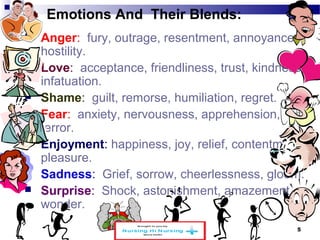
Emotions And Their Blends: 
 Anger: fury, outrage, resentment, annoyance, 
hostility. 
 Love: acceptance, friendliness, trust, kindness, 
infatuation. 
 Shame: guilt, remorse, humiliation, regret. 
 Fear: anxiety, nervousness, apprehension, 
terror. 
 Enjoyment: happiness, joy, relief, contentment, 
pleasure. 
 Sadness: Grief, sorrow, cheerlessness, gloom. 
 Surprise: Shock, astonishment, amazement 
wonder. 
www.schoolofeducators.com
Examples of Use Of Emotions: 
 She is too s ens itive. 
 He take s eve rything too pe rsona lly. 
 He is je a lous of his colle ague s . 
 My bos s is a lways in a hos tile mood. 
 She doe s not unde rs tand the fe e lings of othe rs . 
 He is a lways nagging othe rs . 
 The HOD blurts things out without thinking of othe rs . 
 Nobody unde rs tands /lis tens to me . 
 The management is way out of touch with employee ’s emotions . 
 Why doe s it happen with me only in life . 
 I am a lways nice with the people a round me . 
The above statements refer to various emotions 
we experience in our day to day life. 
www.schoolofeducators.com 6
What Exactly Is EQ 
Emotional intelligence or Emotional Quotient 
is simply defined as: 
 knowing what feels good, what feels bad, 
and how to get from bad to good. 
 Knowing your emotions and knowing emotion 
of others. 
 It refers to emotional management skills 
which provide competency to balance 
emotions and reason so as to maximize 
long term happiness. 
www.schoolofeducators.com 7
Emotional Intelligence is “the capacity 
for recognizing our own feelings and those 
of others, for motivating ourselves, and for 
managing emotions well in ourselves and 
in our relationships. Emotional intelligence 
describes abilities distinct from, but 
complementary to, academic intelligence.” 
Daniel Goleman (1998) 
www.schoolofeducators.com 8
The Indian Perspective 
“Emotional intelligence is the ability of an individual 
to appropriately and successfully respond to a vast 
variety of emotional inputs being elicited from inner 
self and immediate environment. Emotional 
intelligence constitutes three psychological 
dimensions such as emotional competency, 
emotional maturity and emotional sensitivity, which 
motivate an individual to recognize truthfully, 
interpret honestly and handle tactfully the dynamics 
of human behaviour”. 
www.schoolofeducators.com 9
Are we giving EQ education in schools /colleges 
 NO. Our educational system gives stress on IQ 
and not on EQ. We are taught History, Hindi, 
English, Geography, Physics, anthropology, 
Botany, Computers, Medicine, Engineering etc. 
 We are not TAUGHT how to handle frustration, 
anxieties, stress, failure, depression, burnout, 
inferiority complexes, ego problems 
 We are not told to learn how to manage emotions 
i.e.; interaction, coordination, Adjustment, 
communication 
We are expected to learn all these from our 
parents, peer group of other role models 
At the later stages of our lives we are told to 
master emotional competencies to be successful. 
www.schoolofeducators.com 10
IQ v/s EQ 
(Intelligence Quotient v/s Emotional Quotient) 
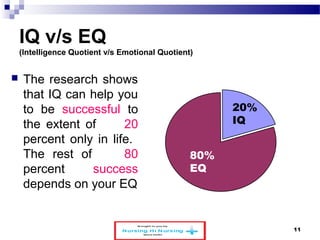
 The research shows 
that IQ can help you 
to be successful to 
the extent of 20 
percent only in life. 
The rest of 80 
percent success 
depends on your EQ 
80% 
EQ 
20% 
IQ 
www.schoolofeducators.com 11
WHAT IS “SUCCESS” 
 Is it your IQ: Exams passed, competitions 
cleared, percentage of marks in schools and 
colleges,academic qualifications etc 
 Earning fat salary, top positions in 
workplace, being rich and wealthy, 
powerful,dominating, being influential etc 
www.schoolofeducators.com 12
OR SUCCESS IS SOMETHING ELSE 
 The word "success" is a relative term 
 Living a healthy and happy married life may be an 
indicator of success for some. 
 Reaching a top position in carrier may be an indicator 
of success for others 
 For some having a satisfying job life or personal 
satisfaction may be an indicator of success 
 Only the tangible achievements may not be indicators 
of success in life. Many a times non-tangible 
performance or achievements may be termed as 
successful. 
www.schoolofeducators.com 13
www.schoolofeducators.com 14 
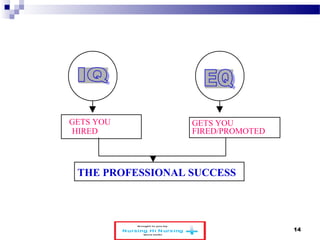
GETS YOU 
HIRED 
GETS YOU 
FIRED/PROMOTED 
THE PROFESSIONAL SUCCESS
What experts say 
Psychologists, Psychiatrists, Management 
consultants and Medical Doctors have been 
proving that there are personal 
characteristics called emotional intelligence 
which are responsible for the ways how we 
behave, how we feel, how we relate to 
others, how well we do at our jobs, and how 
healthy we are. 
www.schoolofeducators.com 15
Conted….. 
Emotional Intelligence tendencies can 
result in being uncomfortable with other 
people, not being happy with your job, not 
succeeding at your job, and even being 
physically and psychologically unhealthy - 
with stress-related problems, or not having 
satisfactory interpersonal relations 
www.schoolofeducators.com 16
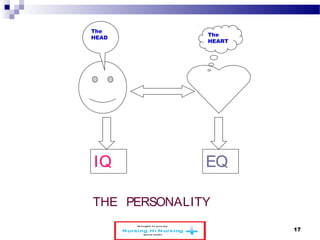
The 
HEAD The 
HEART 
IQ EQ 
THE PERSONALITY 
www.schoolofeducators.com 17
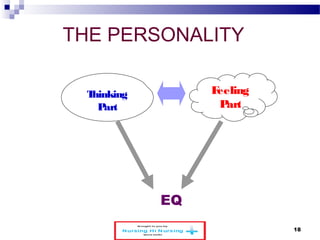
THE PERSONALITY 
EQ 
Thinking 
Part 
Feeling 
Part 
www.schoolofeducators.com 18
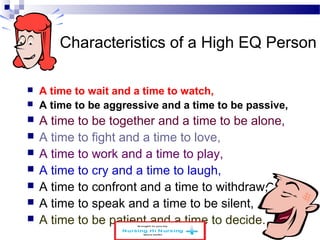
Characteristics of a High EQ Person 
 A time to wait and a time to watch, 
 A time to be aggressive and a time to be passive, 
 A time to be together and a time to be alone, 
 A time to fight and a time to love, 
 A time to work and a time to play, 
 A time to cry and a time to laugh, 
 A time to confront and a time to withdraw, 
 A time to speak and a time to be silent, 
 A time to be patient and a time to decide. 
www.schoolofeducators.com 19
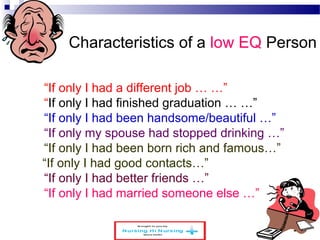
Characteristics of a low EQ Person 
“If only I had a different job … …” 
“If only I had finished graduation … …” 
“If only I had been handsome/beautiful …” 
“If only my spouse had stopped drinking …” 
“If only I had been born rich and famous…” 
“If only I had good contacts…” 
“If only I had better friends …” 
“If only I had married someone else …” 
www.schoolofeducators.com 20
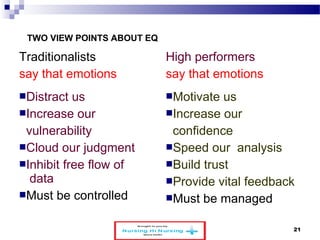
TWO VIEW POINTS ABOUT EQ 
Traditionalists 
say that emotions 
High performers 
say that emotions 
Distract us 
Increase our 
vulnerability 
Cloud our judgment 
Inhibit free flow of 
data 
Must be controlled 
Motivate us 
Increase our 
confidence 
Speed our analysis 
Build trust 
Provide vital feedback 
Must be managed 
www.schoolofeducators.com 21
EMOTIONAL SKILLS MANAGERS SHOULD LEARN 
 EMOTIONAL COMPETENCY 
 EMOTIONAL MATURITY 
 EMOTIONAL SENSITIVITY 
www.schoolofeducators.com 22
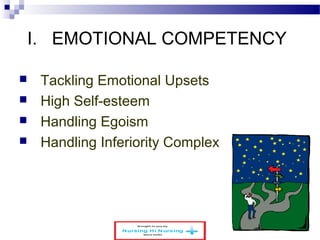
I. EMOTIONAL COMPETENCY 
 Tackling Emotional Upsets 
 High Self-esteem 
 Handling Egoism 
 Handling Inferiority Complex 
www.schoolofeducators.com 23
II. EMOTIONAL MATURITY 
 Self-Awareness 
 Developing Others 
 Delaying Gratification 
 Adaptability and Flexibility 
www.schoolofeducators.com 24
III. EMOTIONAL SENSITIVITY 
 Understanding Threshold of 
Emotional Arousal 
 Empathy 
 Improving Inter-personal Relations 
 Communicability of Emotions 
www.schoolofeducators.com 25
The Empirical Research 
A study of 80 Ph.D.’s 
A study of Insurance Sector 
A study of IAS officers 
A study on stress and burnout 
A study of different professions 
www.schoolofeducators.com 26
A study of 80 Ph.D.’s by EQ Consortium 
A study of 80 Ph.D.’s in science who underwent a battery 
of personality tests, IQ tests, and interviews in the 1950s 
when they were graduate students at Berkeley. 
Forty years later, when they were in their early seventies, 
they were tracked down and estimates were made of their 
success based on resumes, evaluations by experts in their 
own fields, and sources like American Men and Women of 
Science. 
It turned out that social and emotional abilities were four 
times more important than IQ in establishing professional 
success and prestige. 
(EQ CONSORTIUM) 
www.schoolofeducators.com 27
A STUDY OF INSURANCE SECTOR 
In another research it has 
been found that Insurance 
salespersons who were 
optimists 
sold 37 percent more 
insurance policies in 
their first two years 
than did 
pessimists. 
www.schoolofeducators.com 28
A STUDY OF IAS OFFICERS 
After studying 60 IAS officers of 
Assam Cadre it was found that 77 
% of them fall in the category of 
Average EQ. 
 Only 15 % showed High EQ 
(Prof NK Chadha, Psychology Dept, Delhi University) 
www.schoolofeducators.com 29
A STUDY OF STRESS AND BURNOUT 
 The managers High on EQ were low on 
‘burnout’ implying that they can cope up 
better with stress. 
(Prof NK Chadha, Psychology Dept, Delhi University) 
www.schoolofeducators.com 30
Do different professions require different Levels 
of EQ? 
CLUSTER I: EXTREMELY HIGH 
Artist, Insurance, Advertisement, Social Work 
CLUSTER II:HIGH 
Teaching, Legal, Tourism, Politics, Business/ 
Entrepreneurship, Police 
CLUSTER III:AVERAGE 
Judiciary, Administration, Information 
Technology, Medicine, Banking, Engineering, 
Accountancy, Nursing 
www.schoolofeducators.com 31
SOME MYTHS/FACTS ABOUT EQ 
 Being EI does not mean a weak, submissive or 
defensive personality. 
 Being highly EI does not not mean being extra 
nice, polite or sugar coating your language 
 The females are NOT superior to males in 
expressing/experiences emotions as most of us 
tend to believe incorrectly. In fact, the research 
shows that males are equally emotional when 
compared to females. 
 There is no direct evidence to prove that EQ is 
dependent upon heredity. 
 However, the environment does seem to 
influence the EQ. 
www.schoolofeducators.com 32
www.schoolofeducators.com 33 
Myths….. 
 Advocating EQ does not mean that we are 
promoting low scorers or average IQ people. 
 Having average EQ is not bad or undesirable 
 Having high EQ is always welcome. 
 We are not negating the IQ. In fact a 
combination of high EQ and high IQ would be a 
most ideal personality. It would be a win win 
situation.
CAN EQ BE DEVELOPED? 
 YES. You can develop your EQ by 
upgrading your emotional skills. The 
popular thinking that EQ is entirely 
inherited is incorrect. Emotional 
Intelligence is not fixed at birth. There is 
no emotional intelligence genes as such 
that we know of today. It is something one 
has learned. 
www.schoolofeducators.com 34
Conted…….. 
Can EQ be developed at any stage/age 
of personal or professional life. The 
answer is YES. You can upgrade your 
emotional skills at any stage of your life. 
In fact, age and maturity are positively 
correlated with the EQ. 
Same is not true about IQ which is 
more or less static. 
www.schoolofeducators.com 35
Can EQ Be Measured? 
YES. Though some critics may argue that 
emotional traits can not be measured 
accurately the psychologists have shown 
that EI can be measured by using 
standardized scientific tools. 
www.schoolofeducators.com 36
APPLYING EQ IN BUSINESS ORGANISATIONS 
•Customer Service 
•Hiring 
•Turnover 
•Training 
•Corporate Culture 
•Productivity 
•Goal Setting 
•Emotional Support 
•Leadership 
www.schoolofeducators.com 37
CONCLUSION: Applying EQ makes you 
feel comfortable within your own skin and 
with people around you. You can also 
understand what makes you incompatible 
with certain people or jobs and learn ways 
to deal with the emotional difficulties ease. 
You can also understand the specific 
feelings that cause you stress and learn 
ways to become more at peace. 
www.schoolofeducators.com 38
www.schoolofeducators.com 39 
QUOTES 
 “Anyone can be angry—that is easy. But 
to be angry with the right person, to the 
right degree, at the right time, for the 
right purpose, and in the right way — 
that is not easy.”
This platform has been started by 
Parveen Kumar Chadha with the vision 
that nobody should suffer the way he 
has suffered because of lack and 
improper healthcare facilities in India. 
We need lots of funds manpower etc. to 
make this vision a reality please contact 
us. Join us as a member for a noble 
cause.
Our views have increased 
the mark of the 35,000 
 Thank you viewers 
 Looking forward for franchise, 
collaboration, partners.
Contact us:- 011-25464531, 9818569476 
E-mail:- nursingnursing@yahoo.in 
Saxbee Consultants Details :-www.parveenchadha.com
Thank you for your 
attention

Emotional intelligence at work

  • 1.
  • 2.
    ARE YOU EMOTIONALLY INTELLIGENT? OR YOU STILL THINK (not feel) THAT IQ MATTERS MORE THAN EQ
  • 3.
    3 Before wemove ahead please note that:  IQ means intelligence quotient  EQ means emotional quotient  EI means emotional intelligence www.schoolofeducators.com
  • 4.
    4 WHAT AREEMOTIONS ? Happiness, fear, anger, affection, shame, disgust, surprise, lust, sadness, elation, love, frustration, anxiety, failure, achievement etc. The above are the emotions which directly affect our day-to-day life. There are TWO dimensions of emotions: Physiological side: ‘Emotion’ is a complex state of human mind, involving bodily changes of widespread character such as breathing, pounding heart, flushed face, sweating palms, pulse rate, gland secretions, etc. Psychological side, a state of excitement or perturbation marked by strong feelings. www.schoolofeducators.com
  • 5.
    5 Emotions AndTheir Blends:  Anger: fury, outrage, resentment, annoyance, hostility.  Love: acceptance, friendliness, trust, kindness, infatuation.  Shame: guilt, remorse, humiliation, regret.  Fear: anxiety, nervousness, apprehension, terror.  Enjoyment: happiness, joy, relief, contentment, pleasure.  Sadness: Grief, sorrow, cheerlessness, gloom.  Surprise: Shock, astonishment, amazement wonder. www.schoolofeducators.com
  • 6.
    Examples of UseOf Emotions:  She is too s ens itive.  He take s eve rything too pe rsona lly.  He is je a lous of his colle ague s .  My bos s is a lways in a hos tile mood.  She doe s not unde rs tand the fe e lings of othe rs .  He is a lways nagging othe rs .  The HOD blurts things out without thinking of othe rs .  Nobody unde rs tands /lis tens to me .  The management is way out of touch with employee ’s emotions .  Why doe s it happen with me only in life .  I am a lways nice with the people a round me . The above statements refer to various emotions we experience in our day to day life. www.schoolofeducators.com 6
  • 7.
    What Exactly IsEQ Emotional intelligence or Emotional Quotient is simply defined as:  knowing what feels good, what feels bad, and how to get from bad to good.  Knowing your emotions and knowing emotion of others.  It refers to emotional management skills which provide competency to balance emotions and reason so as to maximize long term happiness. www.schoolofeducators.com 7
  • 8.
    Emotional Intelligence is“the capacity for recognizing our own feelings and those of others, for motivating ourselves, and for managing emotions well in ourselves and in our relationships. Emotional intelligence describes abilities distinct from, but complementary to, academic intelligence.” Daniel Goleman (1998) www.schoolofeducators.com 8
  • 9.
    The Indian Perspective “Emotional intelligence is the ability of an individual to appropriately and successfully respond to a vast variety of emotional inputs being elicited from inner self and immediate environment. Emotional intelligence constitutes three psychological dimensions such as emotional competency, emotional maturity and emotional sensitivity, which motivate an individual to recognize truthfully, interpret honestly and handle tactfully the dynamics of human behaviour”. www.schoolofeducators.com 9
  • 10.
    Are we givingEQ education in schools /colleges  NO. Our educational system gives stress on IQ and not on EQ. We are taught History, Hindi, English, Geography, Physics, anthropology, Botany, Computers, Medicine, Engineering etc.  We are not TAUGHT how to handle frustration, anxieties, stress, failure, depression, burnout, inferiority complexes, ego problems  We are not told to learn how to manage emotions i.e.; interaction, coordination, Adjustment, communication We are expected to learn all these from our parents, peer group of other role models At the later stages of our lives we are told to master emotional competencies to be successful. www.schoolofeducators.com 10
  • 11.
    IQ v/s EQ (Intelligence Quotient v/s Emotional Quotient)  The research shows that IQ can help you to be successful to the extent of 20 percent only in life. The rest of 80 percent success depends on your EQ 80% EQ 20% IQ www.schoolofeducators.com 11
  • 12.
    WHAT IS “SUCCESS”  Is it your IQ: Exams passed, competitions cleared, percentage of marks in schools and colleges,academic qualifications etc  Earning fat salary, top positions in workplace, being rich and wealthy, powerful,dominating, being influential etc www.schoolofeducators.com 12
  • 13.
    OR SUCCESS ISSOMETHING ELSE  The word "success" is a relative term  Living a healthy and happy married life may be an indicator of success for some.  Reaching a top position in carrier may be an indicator of success for others  For some having a satisfying job life or personal satisfaction may be an indicator of success  Only the tangible achievements may not be indicators of success in life. Many a times non-tangible performance or achievements may be termed as successful. www.schoolofeducators.com 13
  • 14.
    www.schoolofeducators.com 14 GETSYOU HIRED GETS YOU FIRED/PROMOTED THE PROFESSIONAL SUCCESS
  • 15.
    What experts say Psychologists, Psychiatrists, Management consultants and Medical Doctors have been proving that there are personal characteristics called emotional intelligence which are responsible for the ways how we behave, how we feel, how we relate to others, how well we do at our jobs, and how healthy we are. www.schoolofeducators.com 15
  • 16.
    Conted….. Emotional Intelligencetendencies can result in being uncomfortable with other people, not being happy with your job, not succeeding at your job, and even being physically and psychologically unhealthy - with stress-related problems, or not having satisfactory interpersonal relations www.schoolofeducators.com 16
  • 17.
    The HEAD The HEART IQ EQ THE PERSONALITY www.schoolofeducators.com 17
  • 18.
    THE PERSONALITY EQ Thinking Part Feeling Part www.schoolofeducators.com 18
  • 19.
    Characteristics of aHigh EQ Person  A time to wait and a time to watch,  A time to be aggressive and a time to be passive,  A time to be together and a time to be alone,  A time to fight and a time to love,  A time to work and a time to play,  A time to cry and a time to laugh,  A time to confront and a time to withdraw,  A time to speak and a time to be silent,  A time to be patient and a time to decide. www.schoolofeducators.com 19
  • 20.
    Characteristics of alow EQ Person “If only I had a different job … …” “If only I had finished graduation … …” “If only I had been handsome/beautiful …” “If only my spouse had stopped drinking …” “If only I had been born rich and famous…” “If only I had good contacts…” “If only I had better friends …” “If only I had married someone else …” www.schoolofeducators.com 20
  • 21.
    TWO VIEW POINTSABOUT EQ Traditionalists say that emotions High performers say that emotions Distract us Increase our vulnerability Cloud our judgment Inhibit free flow of data Must be controlled Motivate us Increase our confidence Speed our analysis Build trust Provide vital feedback Must be managed www.schoolofeducators.com 21
  • 22.
    EMOTIONAL SKILLS MANAGERSSHOULD LEARN  EMOTIONAL COMPETENCY  EMOTIONAL MATURITY  EMOTIONAL SENSITIVITY www.schoolofeducators.com 22
  • 23.
    I. EMOTIONAL COMPETENCY  Tackling Emotional Upsets  High Self-esteem  Handling Egoism  Handling Inferiority Complex www.schoolofeducators.com 23
  • 24.
    II. EMOTIONAL MATURITY  Self-Awareness  Developing Others  Delaying Gratification  Adaptability and Flexibility www.schoolofeducators.com 24
  • 25.
    III. EMOTIONAL SENSITIVITY  Understanding Threshold of Emotional Arousal  Empathy  Improving Inter-personal Relations  Communicability of Emotions www.schoolofeducators.com 25
  • 26.
    The Empirical Research A study of 80 Ph.D.’s A study of Insurance Sector A study of IAS officers A study on stress and burnout A study of different professions www.schoolofeducators.com 26
  • 27.
    A study of80 Ph.D.’s by EQ Consortium A study of 80 Ph.D.’s in science who underwent a battery of personality tests, IQ tests, and interviews in the 1950s when they were graduate students at Berkeley. Forty years later, when they were in their early seventies, they were tracked down and estimates were made of their success based on resumes, evaluations by experts in their own fields, and sources like American Men and Women of Science. It turned out that social and emotional abilities were four times more important than IQ in establishing professional success and prestige. (EQ CONSORTIUM) www.schoolofeducators.com 27
  • 28.
    A STUDY OFINSURANCE SECTOR In another research it has been found that Insurance salespersons who were optimists sold 37 percent more insurance policies in their first two years than did pessimists. www.schoolofeducators.com 28
  • 29.
    A STUDY OFIAS OFFICERS After studying 60 IAS officers of Assam Cadre it was found that 77 % of them fall in the category of Average EQ.  Only 15 % showed High EQ (Prof NK Chadha, Psychology Dept, Delhi University) www.schoolofeducators.com 29
  • 30.
    A STUDY OFSTRESS AND BURNOUT  The managers High on EQ were low on ‘burnout’ implying that they can cope up better with stress. (Prof NK Chadha, Psychology Dept, Delhi University) www.schoolofeducators.com 30
  • 31.
    Do different professionsrequire different Levels of EQ? CLUSTER I: EXTREMELY HIGH Artist, Insurance, Advertisement, Social Work CLUSTER II:HIGH Teaching, Legal, Tourism, Politics, Business/ Entrepreneurship, Police CLUSTER III:AVERAGE Judiciary, Administration, Information Technology, Medicine, Banking, Engineering, Accountancy, Nursing www.schoolofeducators.com 31
  • 32.
    SOME MYTHS/FACTS ABOUTEQ  Being EI does not mean a weak, submissive or defensive personality.  Being highly EI does not not mean being extra nice, polite or sugar coating your language  The females are NOT superior to males in expressing/experiences emotions as most of us tend to believe incorrectly. In fact, the research shows that males are equally emotional when compared to females.  There is no direct evidence to prove that EQ is dependent upon heredity.  However, the environment does seem to influence the EQ. www.schoolofeducators.com 32
  • 33.
    www.schoolofeducators.com 33 Myths…..  Advocating EQ does not mean that we are promoting low scorers or average IQ people.  Having average EQ is not bad or undesirable  Having high EQ is always welcome.  We are not negating the IQ. In fact a combination of high EQ and high IQ would be a most ideal personality. It would be a win win situation.
  • 34.
    CAN EQ BEDEVELOPED?  YES. You can develop your EQ by upgrading your emotional skills. The popular thinking that EQ is entirely inherited is incorrect. Emotional Intelligence is not fixed at birth. There is no emotional intelligence genes as such that we know of today. It is something one has learned. www.schoolofeducators.com 34
  • 35.
    Conted…….. Can EQbe developed at any stage/age of personal or professional life. The answer is YES. You can upgrade your emotional skills at any stage of your life. In fact, age and maturity are positively correlated with the EQ. Same is not true about IQ which is more or less static. www.schoolofeducators.com 35
  • 36.
    Can EQ BeMeasured? YES. Though some critics may argue that emotional traits can not be measured accurately the psychologists have shown that EI can be measured by using standardized scientific tools. www.schoolofeducators.com 36
  • 37.
    APPLYING EQ INBUSINESS ORGANISATIONS •Customer Service •Hiring •Turnover •Training •Corporate Culture •Productivity •Goal Setting •Emotional Support •Leadership www.schoolofeducators.com 37
  • 38.
    CONCLUSION: Applying EQmakes you feel comfortable within your own skin and with people around you. You can also understand what makes you incompatible with certain people or jobs and learn ways to deal with the emotional difficulties ease. You can also understand the specific feelings that cause you stress and learn ways to become more at peace. www.schoolofeducators.com 38
  • 39.
    www.schoolofeducators.com 39 QUOTES  “Anyone can be angry—that is easy. But to be angry with the right person, to the right degree, at the right time, for the right purpose, and in the right way — that is not easy.”
  • 40.
    This platform hasbeen started by Parveen Kumar Chadha with the vision that nobody should suffer the way he has suffered because of lack and improper healthcare facilities in India. We need lots of funds manpower etc. to make this vision a reality please contact us. Join us as a member for a noble cause.
  • 41.
    Our views haveincreased the mark of the 35,000  Thank you viewers  Looking forward for franchise, collaboration, partners.
  • 42.
    Contact us:- 011-25464531,9818569476 E-mail:- nursingnursing@yahoo.in Saxbee Consultants Details :-www.parveenchadha.com
  • 43.
    Thank you foryour attention

Editor's Notes

  • #5 Manahtyf hsgjsil giolj