Created By
Milan Hirani
Civil TF-1
To consider verbal and non-verbal communication methods
To understand and practise effective listening skills
To communicate in clear, respectful and non-judgemental ways
To know when to seek advice
OBJECTIVES
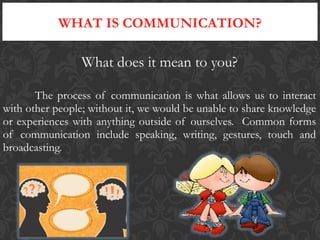
What does it mean to you?
The process of communication is what allows us to interact
with other people; without it, we would be unable to share knowledge
or experiences with anything outside of ourselves. Common forms
of communication include speaking, writing, gestures, touch and
broadcasting.
WHAT IS COMMUNICATION?
Can we communicate without words?
-:Voice Attributes:-
What are they and how do they affect communication?
-:Physical attributes:-
What could be considered here and how do they affect
communication?
-:The power of touch:-
What and when is OK?
Which is better, verbal or non verbal?
VERBAL V/S NON VERBAL
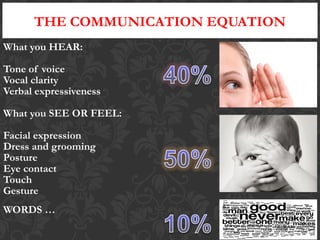
What you HEAR:
Tone of voice
Vocal clarity
Verbal expressiveness
What you SEE OR FEEL:
Facial expression
Dress and grooming
Posture
Eye contact
Touch
Gesture
WORDS …
THE COMMUNICATION EQUATION
We are going to consider:
The 2-Way communication process
Effective communication skills
Barriers to effective communication
UNDERSTANDING COMMUNICATION
Communication skills involve:
Listening to others (Receiving)
Asserting/ Expressing (Sending)
Barriers to communication can lead to misunderstanding and
confusion
COMMUNICATION IS A 2-WAY PROCESS
Sender
Receiver
Values and Attitudes
“Generation gap”
Cultural Differences
Language
Noise
Hearing
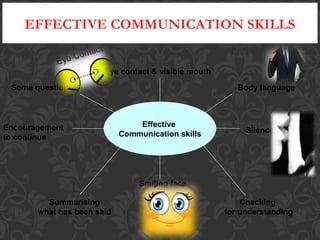
EFFECTIVE COMMUNICATION SKILLS
Effective
Communication skills
Eye contact & visible mouth
Body language
Silence
Checking
for understanding
Smiling face
Summarising
what has been said
Encouragement
to continue
Some questions
BARRIERS TO EFFECTIVE COMMUNICATION
Barriers to
effective
communication
Language
NoiseTime
DistractionsOther people
Put downsToo many questions
Distance
Discomfort
with
the topic
Disability
Lack of interest
“If we were supposed to talk more than
listen, we would have been given two mouths and
one ear.”
-Mark Twain
THE ART OF LISTENING
Active Listening
Responding
Paraphrasing
Asking questions for clarification
Mirroring the other person’s language
LISTENING SKILLS
Responses to check that your perceptions are correct
Responses to encourage further communication
RESPONDING
Open ended and Closed questions
Diverse Questioning techniques
Participants to practise
Then try the Questioning Quiz.
QUESTIONING TECHNIQUES
What individual factors could affect the way a person “sends” or
“receives” a message?
Is gender/ age a factor?
How can we adapt if :-
we have a problem ourselves or
the other person seems to have a problem?
INDIVIDUAL DIFFERENCES
What do we know about the communication styles of
different cultures?
Consider verbal and non verbal, including dress
constraints, language difficulties, taboos.
CULTURAL DIVERSITY
In groups there are obviously more people, so good communication
skills are paramount.
Be mindful to practise:
Observing non verbal cues
Listening, responding, clarifying, paraphrasing and summarising
Identifying barriers to communication
Remember, silence is golden
AND
No one is perfect!
GROUP PROCESSES
Legal Obligations
Anti Discrimination
Privacy Laws
Confidentiality and Gossip
Seeking Advice
CONSTRAINTS ON COMMUNICATION
To consider verbal and non-verbal communication methods
To understand and practise effective listening skills
To communicate in clear, respectful and non-judgemental ways
To know when to seek advice
OBJECTIVES
For more details
Email : milan.hirani8591@marwadieducation.edu.in
Phone: +919408837825

Effective communication presentation

  • 1.
  • 2.
    To consider verbaland non-verbal communication methods To understand and practise effective listening skills To communicate in clear, respectful and non-judgemental ways To know when to seek advice OBJECTIVES
  • 4.
    What does itmean to you? The process of communication is what allows us to interact with other people; without it, we would be unable to share knowledge or experiences with anything outside of ourselves. Common forms of communication include speaking, writing, gestures, touch and broadcasting. WHAT IS COMMUNICATION?
  • 5.
    Can we communicatewithout words? -:Voice Attributes:- What are they and how do they affect communication? -:Physical attributes:- What could be considered here and how do they affect communication? -:The power of touch:- What and when is OK? Which is better, verbal or non verbal? VERBAL V/S NON VERBAL
  • 6.
    What you HEAR: Toneof voice Vocal clarity Verbal expressiveness What you SEE OR FEEL: Facial expression Dress and grooming Posture Eye contact Touch Gesture WORDS … THE COMMUNICATION EQUATION
  • 7.
    We are goingto consider: The 2-Way communication process Effective communication skills Barriers to effective communication UNDERSTANDING COMMUNICATION
  • 8.
    Communication skills involve: Listeningto others (Receiving) Asserting/ Expressing (Sending) Barriers to communication can lead to misunderstanding and confusion COMMUNICATION IS A 2-WAY PROCESS Sender Receiver Values and Attitudes “Generation gap” Cultural Differences Language Noise Hearing
  • 9.
    EFFECTIVE COMMUNICATION SKILLS Effective Communicationskills Eye contact & visible mouth Body language Silence Checking for understanding Smiling face Summarising what has been said Encouragement to continue Some questions
  • 10.
    BARRIERS TO EFFECTIVECOMMUNICATION Barriers to effective communication Language NoiseTime DistractionsOther people Put downsToo many questions Distance Discomfort with the topic Disability Lack of interest
  • 11.
    “If we weresupposed to talk more than listen, we would have been given two mouths and one ear.” -Mark Twain THE ART OF LISTENING
  • 12.
    Active Listening Responding Paraphrasing Asking questionsfor clarification Mirroring the other person’s language LISTENING SKILLS
  • 13.
    Responses to checkthat your perceptions are correct Responses to encourage further communication RESPONDING
  • 14.
    Open ended andClosed questions Diverse Questioning techniques Participants to practise Then try the Questioning Quiz. QUESTIONING TECHNIQUES
  • 15.
    What individual factorscould affect the way a person “sends” or “receives” a message? Is gender/ age a factor? How can we adapt if :- we have a problem ourselves or the other person seems to have a problem? INDIVIDUAL DIFFERENCES
  • 16.
    What do weknow about the communication styles of different cultures? Consider verbal and non verbal, including dress constraints, language difficulties, taboos. CULTURAL DIVERSITY
  • 17.
    In groups thereare obviously more people, so good communication skills are paramount. Be mindful to practise: Observing non verbal cues Listening, responding, clarifying, paraphrasing and summarising Identifying barriers to communication Remember, silence is golden AND No one is perfect! GROUP PROCESSES
  • 18.
    Legal Obligations Anti Discrimination PrivacyLaws Confidentiality and Gossip Seeking Advice CONSTRAINTS ON COMMUNICATION
  • 19.
    To consider verbaland non-verbal communication methods To understand and practise effective listening skills To communicate in clear, respectful and non-judgemental ways To know when to seek advice OBJECTIVES
  • 21.
    For more details Email: milan.hirani8591@marwadieducation.edu.in Phone: +919408837825

Editor's Notes

  • #2 TIME: Start on time Allow NO MORE than 10 minutes (TOTAL ELAPSED TIME 10 MINS) ACTIVITY: Ice Breaker Introduce yourself ( your name should already be on the Board) – very brief!! Set the example!! Welcome INCLUDING brief Traditional welcome. Housekeeping Toilets, Coffee, Break time - 15 mins at half time. Note taking - Handouts will include all reference such as website/texts etc. Time Management “for the benefit of the whole group” Introductions : Say who you are, your organisation, what you want from today –say one sentence about something you like OR hate Trainer Boards these for later reference
  • #3 Check that these objectives are what participants expect.
  • #7 Discuss how this came across in the introductions when people talked about their LOVE items and their HATE items. How did they sound? How did they look? How much weight did the actual words carry compared with their vocal expression and faces?
  • #8 Explain that this is a little bit of theory but helps make sense as to why communication can go right or wrong and can be handy to remember in lots of circumstances.
  • #10 Encourage participants to think about a situation where they must communicate with someone who is hard of hearing; anxious; has been put down in the past; doesn’t know who you are – what are some of the things you can do to help communication?
  • #11 Show the title of this slide and ask people to see if they can suggest some of the barriers-Then reveal the diagram when there has been 2 to 3 mins of ideas from the group
  • #13 Discuss what each of these means and give/ask for examples. Practise in pairs; One participant is given a situation/problem to talk about and the partner has to practise some of the listening and responding skills. Practice is also attempted in paraphrasing and clarifying.
  • #14 Handouts “Keeping the Communication door Open” – if time, have a practice
  • #15 3 handouts 1: Open and closed questions; Questioning techniques; Questioning Quiz; _ use jelly beans for “prizes” for correct answers.
  • #17 Ask participants in pairs to identify as many different cultural groups that they can think of that they may come across in their vol work. Are their differences in communicating? What are they? Which are the ones that matter?
  • #18 Give participants a group scenario with a card for each individual describing their character. Ask them to try to resolve the issue using their best communications skills (Like DeBono’s Thinking caps)
  • #19 Ask participants to identify any laws that may place constraints on communication in a workplace….write on whiteboard and add any that may be missing. Discuss also what constraints the organisation may place on the nature of communication. Could use a case study to explore Confidentiality issue if time permits- I have attached the two from the Frail Aged module by way of example. Participants to identify confidentiality issues and the harm that can come from “gossip”. If in doubt, they should be encouraged to seek advice within the organisation. Who should they turn to?