Interpersonal Skills
The ability to understand self and other
people in an organization to work
Co-operatively with them. It includes
four components;
Self Awareness,
Self Management
Social Awareness
Social Skills
Self-Awareness/Self-Perception
 This is a key aspect of being a leader
 The ability to recognize and understand your moods,
emotions, and drives, as well as their effect on others
 Self-confidence (but not arrogance)
 Self-assessment
 Self-deprecating - sense of humor (rolling with the
punches)
 What are my strengths and weaknesses
Knowing Yourself
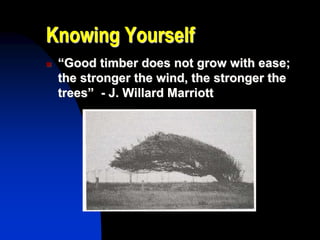
 “Good timber does not grow with ease;
the stronger the wind, the stronger the
trees” - J. Willard Marriott
Knowing Yourself
 Being aware of how people
respond to you
Self-Regulation
 This is another key aspect of
being a leader
 Self-regulation is the ability to
manage your emotions and
reactions
 Others can and should be
understanding, but SELF-
regulation -- is up to YOU!
 Bad scenes stick in people’s
minds
Self-Regulation
 Creates an environment of trust, safety,
and fairness
 Discourages those around you from
losing control or reacting impulsively
 Helps you avoid the temptation of easy or
quick fixes
 Is characterized by thoughtful reflection
and being comfortable with uncertainty
Six ways to make people like you
Become genuinely interested in other people.
Smile.
Remember that a person's name is to that person the sweetest
and most important sound in any language.
Be a good listener. Encourage others to talk about themselves.
Talk in terms of the other person's interests.
Make the other person feel important - and do it sincerely.
Fundamental Techniques in Handling
People
 Don't criticize, condemn or complain.
 Give honest and sincere appreciation.
 Arouse in the other person an eager
want.
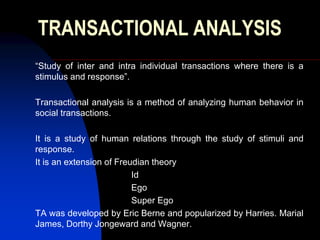
TRANSACTIONAL ANALYSIS
“Study of inter and intra individual transactions where there is a
stimulus and response”.
Transactional analysis is a method of analyzing human behavior in
social transactions.
It is a study of human relations through the study of stimuli and
response.
It is an extension of Freudian theory
Id
Ego
Super Ego
TA was developed by Eric Berne and popularized by Harries. Marial
James, Dorthy Jongeward and Wagner.
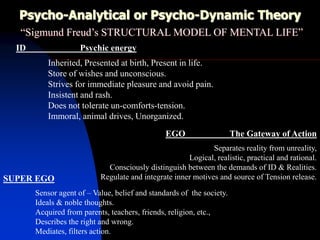
Psycho-Analytical or Psycho-Dynamic Theory
“Sigmund Freud’s STRUCTURAL MODEL OF MENTAL LIFE”
ID Psychic energy
Inherited, Presented at birth, Present in life.
Store of wishes and unconscious.
Strives for immediate pleasure and avoid pain.
Insistent and rash.
Does not tolerate un-comforts-tension.
Immoral, animal drives, Unorganized.
EGO The Gateway of Action
Separates reality from unreality,
Logical, realistic, practical and rational.
Consciously distinguish between the demands of ID & Realities.
Regulate and integrate inner motives and source of Tension release.
SUPER EGO
Sensor agent of – Value, belief and standards of the society.
Ideals & noble thoughts.
Acquired from parents, teachers, friends, religion, etc.,
Describes the right and wrong.
Mediates, filters action.
EGO
A Psychological State of an Individual, which Guide
the Way of Feeling, Thinking and Behavior
EGO Status
PARENT
(Taught Ego)
Help
---------------
Control
Controlling
Protective
Critical
Nurturing
Instructive
ADULT
(Acquired by Maturity)
Rational
Factual
Unemotional
Independent
Problem solver
Free
Adp
LP
CHILD
(Felt Ego)
Dependent Spontaneous
Curious Creative
Rebel Clumsy
Frustrated Pleasure seeking
LIFE POSITIONS
“Assumption about self and others in the Societies”
I am OK - You are not OK
I am not OK - You are OK
I am not OK - You are not OK
I am OK - You are OK
I am OK
You are not OK
I am OK
You are OK
I am not OK
You are not OK
I am not OK
You are OK
POSITIVE
NEGATIVE
NEGATIVE POSITIVE
Attitude
Towards
Self
Types of Transactions
P P
A A
C C
P P
A A
C C
OPEN
CROSS
COMPLIMENTARY
P – P – C P= Parent
A – A – C A=Adult
C – C C=Child
BLOCKED
P – A
C - P
ULTERIOR - - Transactions influenced by other than ego status (Hidden Meanings)
GALLOWS TRANSACTIONS - - In appropriate smile or love
GAMES – Repeat, Find it ulterior, Sense at superficial level
INEFFECTIVE STYLES OF GAMES – Perfectionist, Driver, Power game,
and Pleasure game
LIFE SCRIPTS AND STROKES:
A stroke is a unit of recognition may be positive or negative of a condition or
both, strokes are required for healthy behavior.
Strokes may be physical, verbal or eye-to-eye contact.
 Child hood learning influences the behavior
 If a child lives with criticism, he/she learns to fight.
 If a child lives with hostility, he/she learns to condemn.
 If a child lives with ridicule, he/she learns to be shy.
 If a child lives with shame, he/she learns to feel guilty.
 If a child lives with tolerance, he/she learns to be patient.
 If a child lives with encouragement, he/she learns confidence.
 If a child lives with praise, he/she learns to appreciate.
 If a child lives with fairness, he/she learns justice.
 If a child lives with security, he/she learns to have faith.
 If a child lives with approval, he/she learns to like himself.
 If a child lives with acceptance and friendship, he/she learns to find love in
the world.
Open Area Blind Area
Hidden Area Unknown Area
Known to
others
Unknown to
others
Discussion
Feed Back
Known to Self Unknown to Self
JOHARI WINDOW
Dealing with Difficult
People
How to deal with Difficult people?
Hostile – Aggressive
 Stand up for your self
 Give them time to turn down
 use self assertive language
 avoid direct Confrontation.
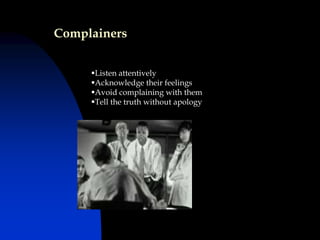
Complainers
Listen attentively
Acknowledge their feelings
Avoid complaining with them
Tell the truth without apology
Clams
 Ask open ended questions.
 Be patient and wait for response.
 If there is no response, tell your opinion.
Super Agreeables
 Find out why they will not work
 Let them know that you respect them
 Ready to act, don’t allow to make unrealistic commitments
 Discern the hidden meaning in their humour
Negatives
 Don’t get dragged to their despair
 Don’t try to Cajole them out of their negativism
 Discuss the issue in detail - show the negative side of
yours
 Ready to act without agreement
Know it all
Bulldozers
 Prepare yourself.
 Listen and paraphrase their main points.
 Use the Questioning forms to raise problems.
Balloons
 State facts as your perspective of reality.
 Find a way for them to save face.
 Confront them alone, not in public.
Indecisive Stallers
 Raise the issue why they are hesitant .
 If you are the problem, ask for help.
 Keep the action at your own hand.
 Remove them from the situation, if possible.
Emotional Intelligence (EI)
 The capacity for recognizing our feelings
and those of others; for motivating
ourselves and others; for managing
emotions in ourselves and in our
relationships
 Understanding yourself (self-awareness)
 Managing yourself (self-regulation)
 Understanding others (empathy)
 Managing others (motivation, social skills)
Knowing Yourself
 Taking criticism – tough medicine to
swallow, but usually always valuable
Knowing Yourself
 Giving criticism -- kindly?
 Leaders have to bring correction, but
HOW it’s brought can make or literally
break someone

INTERPERSONAL-SKILLS.pptx

  • 1.
    Interpersonal Skills The abilityto understand self and other people in an organization to work Co-operatively with them. It includes four components; Self Awareness, Self Management Social Awareness Social Skills
  • 2.
    Self-Awareness/Self-Perception  This isa key aspect of being a leader  The ability to recognize and understand your moods, emotions, and drives, as well as their effect on others  Self-confidence (but not arrogance)  Self-assessment  Self-deprecating - sense of humor (rolling with the punches)  What are my strengths and weaknesses
  • 3.
    Knowing Yourself  “Goodtimber does not grow with ease; the stronger the wind, the stronger the trees” - J. Willard Marriott
  • 4.
    Knowing Yourself  Beingaware of how people respond to you
  • 5.
    Self-Regulation  This isanother key aspect of being a leader  Self-regulation is the ability to manage your emotions and reactions  Others can and should be understanding, but SELF- regulation -- is up to YOU!  Bad scenes stick in people’s minds
  • 6.
    Self-Regulation  Creates anenvironment of trust, safety, and fairness  Discourages those around you from losing control or reacting impulsively  Helps you avoid the temptation of easy or quick fixes  Is characterized by thoughtful reflection and being comfortable with uncertainty
  • 7.
    Six ways tomake people like you Become genuinely interested in other people. Smile. Remember that a person's name is to that person the sweetest and most important sound in any language. Be a good listener. Encourage others to talk about themselves. Talk in terms of the other person's interests. Make the other person feel important - and do it sincerely.
  • 8.
    Fundamental Techniques inHandling People  Don't criticize, condemn or complain.  Give honest and sincere appreciation.  Arouse in the other person an eager want.
  • 9.
    TRANSACTIONAL ANALYSIS “Study ofinter and intra individual transactions where there is a stimulus and response”. Transactional analysis is a method of analyzing human behavior in social transactions. It is a study of human relations through the study of stimuli and response. It is an extension of Freudian theory Id Ego Super Ego TA was developed by Eric Berne and popularized by Harries. Marial James, Dorthy Jongeward and Wagner.
  • 10.
    Psycho-Analytical or Psycho-DynamicTheory “Sigmund Freud’s STRUCTURAL MODEL OF MENTAL LIFE” ID Psychic energy Inherited, Presented at birth, Present in life. Store of wishes and unconscious. Strives for immediate pleasure and avoid pain. Insistent and rash. Does not tolerate un-comforts-tension. Immoral, animal drives, Unorganized. EGO The Gateway of Action Separates reality from unreality, Logical, realistic, practical and rational. Consciously distinguish between the demands of ID & Realities. Regulate and integrate inner motives and source of Tension release. SUPER EGO Sensor agent of – Value, belief and standards of the society. Ideals & noble thoughts. Acquired from parents, teachers, friends, religion, etc., Describes the right and wrong. Mediates, filters action.
  • 11.
    EGO A Psychological Stateof an Individual, which Guide the Way of Feeling, Thinking and Behavior EGO Status PARENT (Taught Ego) Help --------------- Control Controlling Protective Critical Nurturing Instructive ADULT (Acquired by Maturity) Rational Factual Unemotional Independent Problem solver Free Adp LP CHILD (Felt Ego) Dependent Spontaneous Curious Creative Rebel Clumsy Frustrated Pleasure seeking
  • 12.
    LIFE POSITIONS “Assumption aboutself and others in the Societies” I am OK - You are not OK I am not OK - You are OK I am not OK - You are not OK I am OK - You are OK I am OK You are not OK I am OK You are OK I am not OK You are not OK I am not OK You are OK POSITIVE NEGATIVE NEGATIVE POSITIVE Attitude Towards Self
  • 13.
    Types of Transactions PP A A C C P P A A C C OPEN CROSS COMPLIMENTARY P – P – C P= Parent A – A – C A=Adult C – C C=Child BLOCKED P – A C - P ULTERIOR - - Transactions influenced by other than ego status (Hidden Meanings) GALLOWS TRANSACTIONS - - In appropriate smile or love GAMES – Repeat, Find it ulterior, Sense at superficial level INEFFECTIVE STYLES OF GAMES – Perfectionist, Driver, Power game, and Pleasure game
  • 14.
    LIFE SCRIPTS ANDSTROKES: A stroke is a unit of recognition may be positive or negative of a condition or both, strokes are required for healthy behavior. Strokes may be physical, verbal or eye-to-eye contact.  Child hood learning influences the behavior  If a child lives with criticism, he/she learns to fight.  If a child lives with hostility, he/she learns to condemn.  If a child lives with ridicule, he/she learns to be shy.  If a child lives with shame, he/she learns to feel guilty.  If a child lives with tolerance, he/she learns to be patient.  If a child lives with encouragement, he/she learns confidence.  If a child lives with praise, he/she learns to appreciate.  If a child lives with fairness, he/she learns justice.  If a child lives with security, he/she learns to have faith.  If a child lives with approval, he/she learns to like himself.  If a child lives with acceptance and friendship, he/she learns to find love in the world.
  • 15.
    Open Area BlindArea Hidden Area Unknown Area Known to others Unknown to others Discussion Feed Back Known to Self Unknown to Self JOHARI WINDOW
  • 16.
  • 17.
    How to dealwith Difficult people? Hostile – Aggressive  Stand up for your self  Give them time to turn down  use self assertive language  avoid direct Confrontation.
  • 18.
    Complainers Listen attentively Acknowledge theirfeelings Avoid complaining with them Tell the truth without apology
  • 19.
    Clams  Ask openended questions.  Be patient and wait for response.  If there is no response, tell your opinion.
  • 20.
    Super Agreeables  Findout why they will not work  Let them know that you respect them  Ready to act, don’t allow to make unrealistic commitments  Discern the hidden meaning in their humour
  • 21.
    Negatives  Don’t getdragged to their despair  Don’t try to Cajole them out of their negativism  Discuss the issue in detail - show the negative side of yours  Ready to act without agreement
  • 22.
    Know it all Bulldozers Prepare yourself.  Listen and paraphrase their main points.  Use the Questioning forms to raise problems.
  • 23.
    Balloons  State factsas your perspective of reality.  Find a way for them to save face.  Confront them alone, not in public.
  • 24.
    Indecisive Stallers  Raisethe issue why they are hesitant .  If you are the problem, ask for help.  Keep the action at your own hand.  Remove them from the situation, if possible.
  • 25.
    Emotional Intelligence (EI) The capacity for recognizing our feelings and those of others; for motivating ourselves and others; for managing emotions in ourselves and in our relationships  Understanding yourself (self-awareness)  Managing yourself (self-regulation)  Understanding others (empathy)  Managing others (motivation, social skills)
  • 26.
    Knowing Yourself  Takingcriticism – tough medicine to swallow, but usually always valuable
  • 27.
    Knowing Yourself  Givingcriticism -- kindly?  Leaders have to bring correction, but HOW it’s brought can make or literally break someone