International Payment
Mechanism
International Payment Mechanism


Mechanism available for settlement of International Transactions



Through international payment domestic currency of one country is
converted into the currency of another country through foreign
exchange market.



Three major form of international money are
1) Gold
2) Foreign Reserve currencies
3) SDR – Special Drawing Rights
Instruments of External Payments
1. Foreign Bills of Exchange:
It is a customary form of making international payments.
A written request or an order form between two transacting parties.
2. Cheques and Bank Drafts
3. Telegraphic Transfers:
Transferred by cable or telax
4. Mail Transfer:
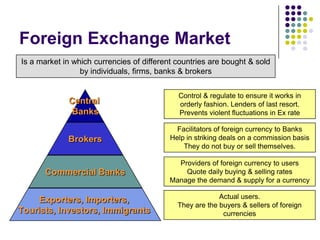
Foreign Exchange Market
Is a market in which currencies of different countries are bought & sold
by individuals, firms, banks & brokers

Central
Banks

Control & regulate to ensure it works in
orderly fashion. Lenders of last resort.
Prevents violent fluctuations in Ex rate

Brokers

Facilitators of foreign currency to Banks
Help in striking deals on a commission basis
They do not buy or sell themselves.

Commercial Banks

Providers of foreign currency to users
Quote daily buying & selling rates
Manage the demand & supply for a currency

Exporters, Importers,
Tourists, Investors, Immigrants

Actual users.
They are the buyers & sellers of foreign
currencies
Function of Foreign Exchange
Market?
FE market is a market in which foreign Exchange transactions take
place

1) Transfer of Purchasing Power:
Transfer funds from one country to another for facilitating
international trade and capital movement.
2) Provision of Credit:
Growth of Foreign Trade
3) Minimising Risk: - “ Hedging”
The FE Markets
It classified on the basis of nature of Transaction

FE Market

Spot Market

Forward Market
The Markets


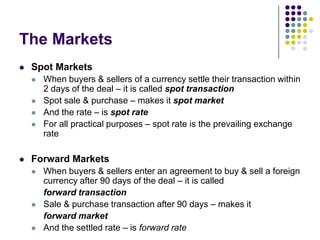
Spot Markets







When buyers & sellers of a currency settle their transaction within
2 days of the deal – it is called spot transaction
Spot sale & purchase – makes it spot market
And the rate – is spot rate
For all practical purposes – spot rate is the prevailing exchange
rate

Forward Markets






When buyers & sellers enter an agreement to buy & sell a foreign
currency after 90 days of the deal – it is called
forward transaction
Sale & purchase transaction after 90 days – makes it
forward market
And the settled rate – is forward rate
The Transactions
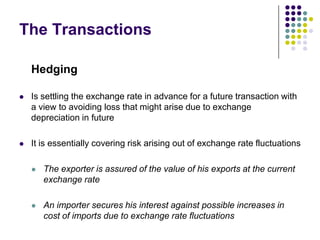
Hedging


Is settling the exchange rate in advance for a future transaction with
a view to avoiding loss that might arise due to exchange
depreciation in future



It is essentially covering risk arising out of exchange rate fluctuations


The exporter is assured of the value of his exports at the current
exchange rate



An importer secures his interest against possible increases in
cost of imports due to exchange rate fluctuations
The Transactions
Arbitrage


Is an act of simultaneous purchase & sale of different currencies in
two or more exchange markets



The objective is to make profit – taking advantage of exchange rate
differentials in various markets



It equates the foreign exchange rates in all major foreign exchange
markets
 It leads to transfer of foreign exchange from the markets where
rate is low to the markets where the rate is high



It works as a stabilising factor in foreign exchange markets
 As it equates demand for foreign exchange with its supply
The Transactions
Speculations


Is an act of buying & selling currency under uncertain conditions with
a view to make profits



Speculators
 Buy a currency when its weak and sell when its strong
 If they expect rate to decrease – they may sell forward at the
current rate and buy spot when they need currency for delivery
 And If they expect rate to increase – they may buy forward at the
current rate and then sell spot immediately.



It has both effects
 Stabilizing – if speculators buy when its cheap and sell when its
dear.
 Destabilizing – if they sell when rate is cheap expecting it decrease
more and buy if rates are rising expecting them rise further
What is Foreign Exchange Rate?
Price of one currency in terms of another currency.
It is rate at which one currency is exchanged for another
Determination of Exchange Rate

Exchange Rate is determined by demand
and supply of Foreign Exchange
The Equilibrium Exchange Rate
D
Excess Supply

R’ = 44
Exchange
Rate (Rs / $)

R = 42

S

E

R”= 40
Excess Demand
D
S
O

Q
Quantity of Dollars
Determination of Exchange Rate
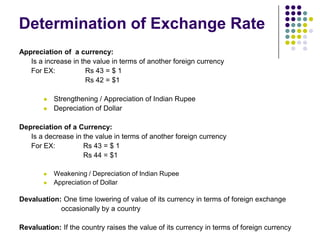
Appreciation of a currency:
Is a increase in the value in terms of another foreign currency
For EX:
Rs 43 = $ 1
Rs 42 = $1



Strengthening / Appreciation of Indian Rupee
Depreciation of Dollar

Depreciation of a Currency:
Is a decrease in the value in terms of another foreign currency
For EX:
Rs 43 = $ 1
Rs 44 = $1



Weakening / Depreciation of Indian Rupee
Appreciation of Dollar

Devaluation: One time lowering of value of its currency in terms of foreign exchange
occasionally by a country

Revaluation: If the country raises the value of its currency in terms of foreign currency
Determination of Exchange Rate
Demand for Foreign Exchange ( US Dollar)








When Dollar Depreciates / Rupee Appreciate






The Indian individuals, firms or Govt who import goods from the USA
Indians travellers and Students
Indians who want to invest in equity , shares and bonds of US
Indian firms who want to invest in physical assets in US

Import becomes cheaper
Demand (Import) increases
More demand of Dollar

When Dollar Appreciates / Rupee Depreciate




Import becomes expensive
Demand (Import) decreases
Less demand of dollar

Therefore lower price of dollar, greater quantity is demanded for imports
Higher price of dollar, smaller quantity is demanded for imports.
Determination of Exchange Rate
Supply of Foreign Exchange ( US Dollar )






The Indian individuals, firms or Govt who export goods to USA
Foreign travellers to India
Americans who want to invest in equity, shares and bonds of India
American firms who want to invest in physical assets
Indians settled aboard send money home (Remittances)



When Dollar Appreciates / Rupee Depreciate
 Indian exports cheaper
 Increase in exports
 More supply of dollars



When Dollar Depreciates / Rupee Appreciate
 Indian goods become expensive
 Decrease in exports
 Less supply of dollar
Determination of Exchange Rate

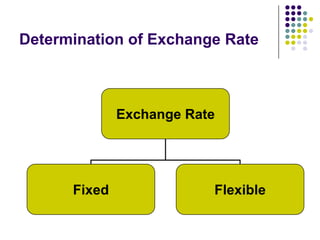
Exchange Rate

Fixed

Flexible
Fixed Exchange Rate
When the Govt agrees to maintain the convertibility of the
currency.
The Govt acting through the central bank agrees to buy and
sell as much currency as it is needed.

Countries keep there currency at a fixed rate and change their
value only at infrequent intervals – when the economic situation
forces them to do so.
Maintaining Fixed Rates
- Demand For Rupee Increases
Demand increase

D1
D

That is demand for Indian
Goods & Services has risen

S
Exchange Rate (Re /$)

R’ = 0.026

R = 0.025

Rupee appreciates vs $

E
D1

To get it back to its original
rate Supply has to increase

D

RBI – prints more money &
Sells them in exchange for $

S
O

Q
Quantity of Rupees

Foreign Exchange Reserves
Increases
Maintaining Fixed Rates
- Demand For Rupee Decreases

Demand reduces

D

Exchange Rate (Re /$)

S

Rupee depreciates vs $
R = 0.025

E

To get it back to its original
rate Supply has to decrease

R”= 0.024
Less Demand
D

S
O

Q
Quantity of Rupees

RBI – buys Rupees
in exchange for $
Foreign Exchange Reserves
Reduces
Arguments for Fixed Exchange Rate











It provides development and growth of Foreign Trade.
It provides stability in foreign exchange market and reduces risk
and uncertainty.
It prevents depreciation of currency for the countries (developing) which
faces persistent problem of deficit in BOP.
Smooth flow of International capital as investors are interested in a
country having stable currency.
Eliminates the possibility of speculations.
Necessary for the growth of international money and capital market
Encourages Globalisation or integration of the world economy
Demerits of Fixed Exchange Rate


Countries with persistent deficit / surplus in BOP have long term
disequilibrium.



Deficit in BOP cannot always be corrected by a regular drawing form the
foreign exchange and sale of gold.



Borrowing money from IMF could lead to devaluation



Which leads to inflation



Surplus in BOP could also lead to inflation
Flexible Exchange Rate


The rate of exchange is allowed to be freely determined by
interaction between demand and supply of foreign exchange
in the foreign exchange market.



Under this the first impact of BOP is on the Exchange Rate.


Surplus:
Excess demand for country’s currency and exchange rate will rise.



Deficit:
Excess supply of the country’s currency and exchange rate will fall.
Factors effecting Demand and
Supply













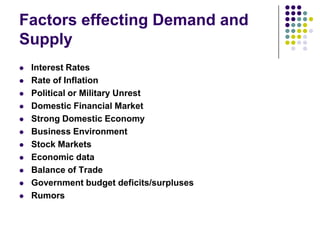
Interest Rates
Rate of Inflation
Political or Military Unrest
Domestic Financial Market
Strong Domestic Economy
Business Environment
Stock Markets
Economic data
Balance of Trade
Government budget deficits/surpluses
Rumors
Maintaining Flexible Rates
- Increase in Supply
Increase USA Income
S

D

Exchange Rate (Re /$)

S’

Increase in Supply of $
Supply curve shift to S’S’

E

R

That is demand for Indian
Goods & Services has risen

E1

R’

Rupee appreciates vs $
D
S
O

S’

Dollar Depreciate
Q

Quantity of US Dollars

New Exchange Rate at E1
Maintaining Flexible Rates
- Increase in Demand
Increase in India Income

D’
S

D

Increase in Demand for
US Exports

Exchange Rate (Re /$)

E1
R’

Increase in Demand of $
Demand curve shift to D’D’

E

R

Rupee depreciates vs $
D’
D
S

Dollar appreciate
O

Q

Q1

Quantity of US Dollars

New Exchange Rate at E1
Arguments for Flexible Exchange
Rate








It automatically deals with the BOP problem.
During Deficit: External value falls , discourages import and
encourages export.
It provides freedom in respect of domestic economic policies.
 It is not necessary for economies to depend upon exchange rate
for planning there domestic economic policy.
Its self adjusting and Govt intervention are not required.
You can predict the exchange rate
It gives a true picture of the strength of the currency in foreign exchange
market
Which system should a
country adopt?
It depends upon
 The characteristics of the economy
 Values and view of a political nature

International payment

  • 1.
  • 2.
    International Payment Mechanism  Mechanismavailable for settlement of International Transactions  Through international payment domestic currency of one country is converted into the currency of another country through foreign exchange market.  Three major form of international money are 1) Gold 2) Foreign Reserve currencies 3) SDR – Special Drawing Rights
  • 3.
    Instruments of ExternalPayments 1. Foreign Bills of Exchange: It is a customary form of making international payments. A written request or an order form between two transacting parties. 2. Cheques and Bank Drafts 3. Telegraphic Transfers: Transferred by cable or telax 4. Mail Transfer:
  • 4.
    Foreign Exchange Market Isa market in which currencies of different countries are bought & sold by individuals, firms, banks & brokers Central Banks Control & regulate to ensure it works in orderly fashion. Lenders of last resort. Prevents violent fluctuations in Ex rate Brokers Facilitators of foreign currency to Banks Help in striking deals on a commission basis They do not buy or sell themselves. Commercial Banks Providers of foreign currency to users Quote daily buying & selling rates Manage the demand & supply for a currency Exporters, Importers, Tourists, Investors, Immigrants Actual users. They are the buyers & sellers of foreign currencies
  • 5.
    Function of ForeignExchange Market? FE market is a market in which foreign Exchange transactions take place 1) Transfer of Purchasing Power: Transfer funds from one country to another for facilitating international trade and capital movement. 2) Provision of Credit: Growth of Foreign Trade 3) Minimising Risk: - “ Hedging”
  • 6.
    The FE Markets Itclassified on the basis of nature of Transaction FE Market Spot Market Forward Market
  • 7.
    The Markets  Spot Markets      Whenbuyers & sellers of a currency settle their transaction within 2 days of the deal – it is called spot transaction Spot sale & purchase – makes it spot market And the rate – is spot rate For all practical purposes – spot rate is the prevailing exchange rate Forward Markets    When buyers & sellers enter an agreement to buy & sell a foreign currency after 90 days of the deal – it is called forward transaction Sale & purchase transaction after 90 days – makes it forward market And the settled rate – is forward rate
  • 8.
    The Transactions Hedging  Is settlingthe exchange rate in advance for a future transaction with a view to avoiding loss that might arise due to exchange depreciation in future  It is essentially covering risk arising out of exchange rate fluctuations  The exporter is assured of the value of his exports at the current exchange rate  An importer secures his interest against possible increases in cost of imports due to exchange rate fluctuations
  • 9.
    The Transactions Arbitrage  Is anact of simultaneous purchase & sale of different currencies in two or more exchange markets  The objective is to make profit – taking advantage of exchange rate differentials in various markets  It equates the foreign exchange rates in all major foreign exchange markets  It leads to transfer of foreign exchange from the markets where rate is low to the markets where the rate is high  It works as a stabilising factor in foreign exchange markets  As it equates demand for foreign exchange with its supply
  • 10.
    The Transactions Speculations  Is anact of buying & selling currency under uncertain conditions with a view to make profits  Speculators  Buy a currency when its weak and sell when its strong  If they expect rate to decrease – they may sell forward at the current rate and buy spot when they need currency for delivery  And If they expect rate to increase – they may buy forward at the current rate and then sell spot immediately.  It has both effects  Stabilizing – if speculators buy when its cheap and sell when its dear.  Destabilizing – if they sell when rate is cheap expecting it decrease more and buy if rates are rising expecting them rise further
  • 11.
    What is ForeignExchange Rate? Price of one currency in terms of another currency. It is rate at which one currency is exchanged for another
  • 12.
    Determination of ExchangeRate Exchange Rate is determined by demand and supply of Foreign Exchange
  • 13.
    The Equilibrium ExchangeRate D Excess Supply R’ = 44 Exchange Rate (Rs / $) R = 42 S E R”= 40 Excess Demand D S O Q Quantity of Dollars
  • 14.
    Determination of ExchangeRate Appreciation of a currency: Is a increase in the value in terms of another foreign currency For EX: Rs 43 = $ 1 Rs 42 = $1   Strengthening / Appreciation of Indian Rupee Depreciation of Dollar Depreciation of a Currency: Is a decrease in the value in terms of another foreign currency For EX: Rs 43 = $ 1 Rs 44 = $1   Weakening / Depreciation of Indian Rupee Appreciation of Dollar Devaluation: One time lowering of value of its currency in terms of foreign exchange occasionally by a country Revaluation: If the country raises the value of its currency in terms of foreign currency
  • 15.
    Determination of ExchangeRate Demand for Foreign Exchange ( US Dollar)      When Dollar Depreciates / Rupee Appreciate     The Indian individuals, firms or Govt who import goods from the USA Indians travellers and Students Indians who want to invest in equity , shares and bonds of US Indian firms who want to invest in physical assets in US Import becomes cheaper Demand (Import) increases More demand of Dollar When Dollar Appreciates / Rupee Depreciate    Import becomes expensive Demand (Import) decreases Less demand of dollar Therefore lower price of dollar, greater quantity is demanded for imports Higher price of dollar, smaller quantity is demanded for imports.
  • 16.
    Determination of ExchangeRate Supply of Foreign Exchange ( US Dollar )      The Indian individuals, firms or Govt who export goods to USA Foreign travellers to India Americans who want to invest in equity, shares and bonds of India American firms who want to invest in physical assets Indians settled aboard send money home (Remittances)  When Dollar Appreciates / Rupee Depreciate  Indian exports cheaper  Increase in exports  More supply of dollars  When Dollar Depreciates / Rupee Appreciate  Indian goods become expensive  Decrease in exports  Less supply of dollar
  • 17.
    Determination of ExchangeRate Exchange Rate Fixed Flexible
  • 18.
    Fixed Exchange Rate Whenthe Govt agrees to maintain the convertibility of the currency. The Govt acting through the central bank agrees to buy and sell as much currency as it is needed. Countries keep there currency at a fixed rate and change their value only at infrequent intervals – when the economic situation forces them to do so.
  • 19.
    Maintaining Fixed Rates -Demand For Rupee Increases Demand increase D1 D That is demand for Indian Goods & Services has risen S Exchange Rate (Re /$) R’ = 0.026 R = 0.025 Rupee appreciates vs $ E D1 To get it back to its original rate Supply has to increase D RBI – prints more money & Sells them in exchange for $ S O Q Quantity of Rupees Foreign Exchange Reserves Increases
  • 20.
    Maintaining Fixed Rates -Demand For Rupee Decreases Demand reduces D Exchange Rate (Re /$) S Rupee depreciates vs $ R = 0.025 E To get it back to its original rate Supply has to decrease R”= 0.024 Less Demand D S O Q Quantity of Rupees RBI – buys Rupees in exchange for $ Foreign Exchange Reserves Reduces
  • 21.
    Arguments for FixedExchange Rate        It provides development and growth of Foreign Trade. It provides stability in foreign exchange market and reduces risk and uncertainty. It prevents depreciation of currency for the countries (developing) which faces persistent problem of deficit in BOP. Smooth flow of International capital as investors are interested in a country having stable currency. Eliminates the possibility of speculations. Necessary for the growth of international money and capital market Encourages Globalisation or integration of the world economy
  • 22.
    Demerits of FixedExchange Rate  Countries with persistent deficit / surplus in BOP have long term disequilibrium.  Deficit in BOP cannot always be corrected by a regular drawing form the foreign exchange and sale of gold.  Borrowing money from IMF could lead to devaluation  Which leads to inflation  Surplus in BOP could also lead to inflation
  • 23.
    Flexible Exchange Rate  Therate of exchange is allowed to be freely determined by interaction between demand and supply of foreign exchange in the foreign exchange market.  Under this the first impact of BOP is on the Exchange Rate.  Surplus: Excess demand for country’s currency and exchange rate will rise.  Deficit: Excess supply of the country’s currency and exchange rate will fall.
  • 24.
    Factors effecting Demandand Supply            Interest Rates Rate of Inflation Political or Military Unrest Domestic Financial Market Strong Domestic Economy Business Environment Stock Markets Economic data Balance of Trade Government budget deficits/surpluses Rumors
  • 25.
    Maintaining Flexible Rates -Increase in Supply Increase USA Income S D Exchange Rate (Re /$) S’ Increase in Supply of $ Supply curve shift to S’S’ E R That is demand for Indian Goods & Services has risen E1 R’ Rupee appreciates vs $ D S O S’ Dollar Depreciate Q Quantity of US Dollars New Exchange Rate at E1
  • 26.
    Maintaining Flexible Rates -Increase in Demand Increase in India Income D’ S D Increase in Demand for US Exports Exchange Rate (Re /$) E1 R’ Increase in Demand of $ Demand curve shift to D’D’ E R Rupee depreciates vs $ D’ D S Dollar appreciate O Q Q1 Quantity of US Dollars New Exchange Rate at E1
  • 27.
    Arguments for FlexibleExchange Rate      It automatically deals with the BOP problem. During Deficit: External value falls , discourages import and encourages export. It provides freedom in respect of domestic economic policies.  It is not necessary for economies to depend upon exchange rate for planning there domestic economic policy. Its self adjusting and Govt intervention are not required. You can predict the exchange rate It gives a true picture of the strength of the currency in foreign exchange market
  • 28.
    Which system shoulda country adopt? It depends upon  The characteristics of the economy  Values and view of a political nature