Cost
Concepts
Introduction
• Cost of production changes with the change in output.
• The relations between cost and output is called as
Cost Function.
• The cost function depends upon
• Production conditions
• Prices of the factors of production
• Level of output
• Whatever level of output a firm produces, it is produced
at the minimum cost.
Concepts of Cost
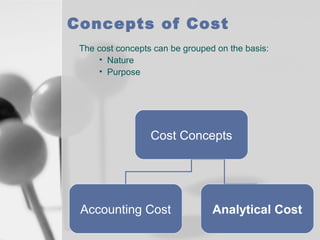
The cost concepts can be grouped on the basis:
• Nature
• Purpose

Cost Concepts

Accounting Cost

Analytical Cost
Concepts of Cost
1) Concepts used Accounting purpose
The contractual cash payments which the firms makes to
the other factor owners for purchasing and hiring the
other factors (Explicit cost).
2) Analytical Cost concepts(for economic analysis of business )
Economic Cost = Accounting cost + Implicit Cost
Implicit cost is the normal return on capital invested by the
entrepreneur and the wages or salary for his services and
money rewards for the other factors which the entrepreneur
himself owns and employs
Concepts of Cost

A firm will earn Economic profits only when its making
revenue to excess of the total of accounting and implicit
cost.
Economic profit = Total revenue – Economic cost
Accounting Cost Concepts
1.

Actual cost ( Outlay or Acquisition cost:
The cost that the firm incurs while producing or acquiring a
goods or services. ( cost of raw material, labour, rent…).
They are recorded in the book of accounts

2.

Opportunity Cost:
The return of the second best use of the firm resources
which the firm forgoes in order to avail of the return form
the best use of the resources.
It is an example of implicit cost.

3.

Sunk cost:
The cost which are not altered by change in quantity and
cannot be recovered ( depreciation). They are part of
outlay cost.
Accounting Cost Concepts
4.

Business cost and Full cost
Business Cost includes all the expenses which are
incurred to carry out a business.
Full Cost is equal to business cost plus opportunity cost
and normal profit.

5.

Explicit Cost and Implicit cost (Imputed):
Explicit Cost are those which are actually paid by the firm.
Implicit are theoretical cost and go unrecognised by the
firm
Opportunity cost is a part of implicit cost
Analytical Cost Concept
1.

Fixed Cost:
Cost which are fixed in volume and do not vary for a
certain level of output
Cost of managerial and administrative staff, depreciation
of machinery, building and fixed assets, maintenance of
land

2.

Variable Cost:
Vary with the variation of total output.
Cost of raw material, cost of direct labour, running
expenses of fixed capital such as fuel, repairs , routine
maintenance
Analytical Cost Concept
3.

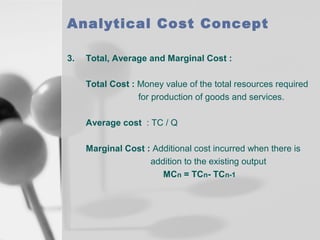
Total, Average and Marginal Cost :
Total Cost : Money value of the total resources required
for production of goods and services.
Average cost : TC / Q
Marginal Cost : Additional cost incurred when there is
addition to the existing output
MCn = TCn- TCn-1
Theory of Cost
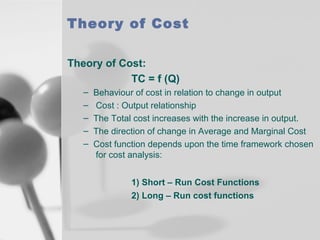
Theory of Cost:
TC = f (Q)
–
–
–
–
–

Behaviour of cost in relation to change in output
Cost : Output relationship
The Total cost increases with the increase in output.
The direction of change in Average and Marginal Cost
Cost function depends upon the time framework chosen
for cost analysis:
1) Short – Run Cost Functions
2) Long – Run cost functions
Short – Run Cost Functions
•

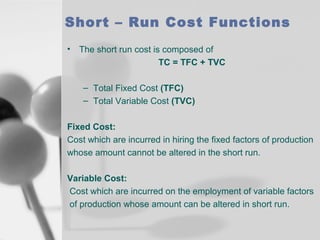
The short run cost is composed of
TC = TFC + TVC
– Total Fixed Cost (TFC)
– Total Variable Cost (TVC)

Fixed Cost:
Cost which are incurred in hiring the fixed factors of production
whose amount cannot be altered in the short run.
Variable Cost:
Cost which are incurred on the employment of variable factors
of production whose amount can be altered in short run.
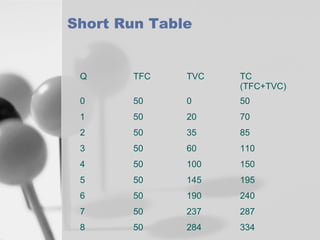
Short Run Table

Q

TFC

TVC

TC
(TFC+TVC)

0

50

0

50

1

50

20

70

2

50

35

85

3

50

60

110

4

50

100

150

5

50

145

195

6

50

190

240

7

50

237

287

8

50

284

334
Short – Run Cost Functions
TC
TVC

Cost
TFC

B
O

Q1

Output

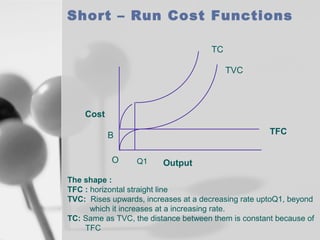
The shape :
TFC : horizontal straight line
TVC: Rises upwards, increases at a decreasing rate uptoQ1, beyond
which it increases at a increasing rate.
TC: Same as TVC, the distance between them is constant because of
TFC
Short – Run Cost Functions
AFC: TFC / Q
It falls steadily as output increases. It slopes downwards,
as with increase in output TFC spreads over more units,
as output becomes large, AFC approaches zero.
AVC: TVC / Q
It falls with increase in output (increasing return), but
beyond a normal capacity output, AVC will rise steeply –
diminishing returns.
ATC: TC / Q
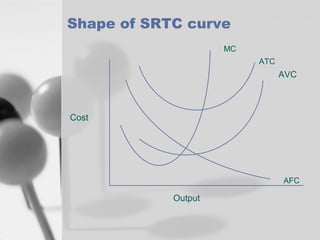
ATC curve depends upon the behaviour of AFC and AVC.
Beginning both AVC and AFC falls so ATC also falls.
AVC curve starts rising, but AFC falls, so ATC also falls
With the increase in output, a sharp rise in AVC leads to
rise of ATC.
Shape of SRTC curve
MC
ATC

AVC

Cost

AFC

Output
Shape of SRTC curve
•
•
•
•

The shape of AC curve depend upon AVC and AFC
In the beginning both AFC and AVC falls, so AC falls
AVC rising and AFC falling, AC still falls
But as output increases, a sharp rise AVC offset the fall
of AFC and AC start to rise
Short – Run Cost Functions
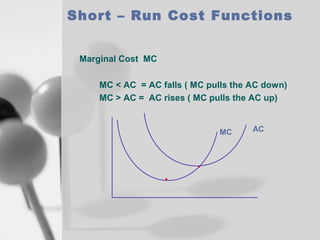
Marginal Cost MC
MC < AC = AC falls ( MC pulls the AC down)
MC > AC = AC rises ( MC pulls the AC up)

MC

AC
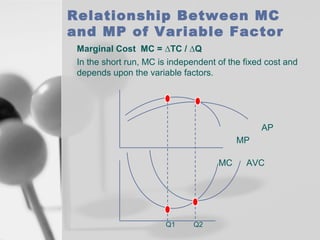
Relationship Between MC
and MP of Variable Factor
Marginal Cost MC = ∆TC / ∆Q
In the short run, MC is independent of the fixed cost and
depends upon the variable factors.

AP
MP
MC

Q1

Q2

AVC
Relationship Between
MC and MP of Variable
Factor
•

The behaviour of Marginal Product (MP) determines the
shape of MC.

•

The MC is an inverse of MP, with maximum of MP
corresponding to minimum of MC.

•

MC is the transformation of MP from physical term to
money term.
Long – Run Cost Functions
•

A firm can vary all its input

•

The entrepreneur has before him number of alternative plant
sizes and levels of output.

•

In short run the size of the plant ( capital equipment,
machinery, land…) are fixed.

•

In long run the firm can move from one plant to another plant

•

The LRAC is the least possible average cost production of
producing any given level of output when all the inputs are
variable.
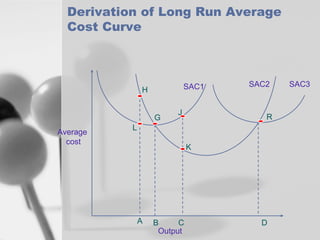
Derivation of Long Run Average
Cost Curve

SAC1

H
G
Average
cost

J

SAC2

R

L
K

A

B
C
Output

D

SAC3
• In long run firm can vary all its input.
• The firm moves from one plant to larger plant if it has to
increase its output.
• The long run average cost of production is the least
possible average cost of producing any given level of output
when all the inputs are variable.
• The short run average cost curves are called as Plant
curves.
• Suppose there are only three technically possible size of
plant.
• The firm can choose among the three possible sizes of
plant
• Upto OB amount of output, the firm will operate on the
SAC1, though it could produce on SAC2.
• For OA output . It will cost AL per unit cost on SAC1 curve
but it will cost AH if on SAC2. (AL < AH).
• If the firm plans to produce larger output than OB then it has
to move to a bigger plant size.
• Thus OC if produced on SAC2 cost CK per unit which is
lower than CJ when produced on SAC1.
• If the firm produce output between OB and OD it will
employ the plant corresponding to SAC2.
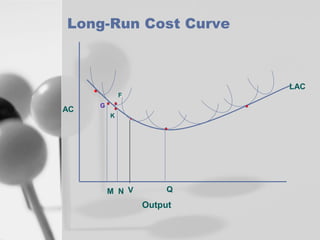
Long-Run Cost Curve

LAC
F

AC

G
K

M N V

Q

Output
Long – Run Cost Functions
•

The LAC is the locus of all the tangency points with the
short run average cost curve.

•

The long curve is also called as Envelope curve.

•

LAC is not tangent to the minimum point of SAC.

•

LRAC is called the planning curve: as the firm plans
to produce any output in the long run by choosing a
plant on the LRAC corresponding to the given output.

•

Point G lies on the falling portion of SAC2, the firm is
using the given plant below its full capacity. Point F is
the minimum point
Why LAC is of U- Shape
•

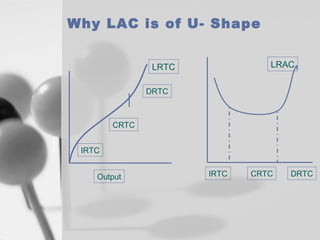
Why does LAC fall in the beginning: Economies of
Scale
- Use of technically efficient Machines
- Division of Labour
- Indivisibility of factors
- Productive capacity of capital equipments rises faster then
purchase price
- Discounts from bulk purchases
- Lower cost of raising funds
- Inventory management

•

Why does LAC rise eventually: Diseconomies of scale
- Rise in transportation cost
- Input market imperfection
- Management co-ordination and control problems
- Depletion of raw material
Why LAC is of U- Shape
LRAC

LRTC
DRTC

CRTC
IRTC
Output

IRTC

CRTC

DRTC
The Concept of Optimum
Firm
•

The best or the ideal size of the firm

•

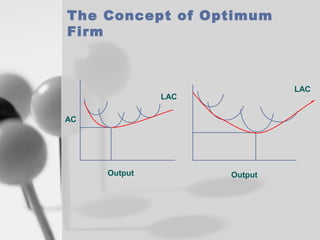
The optimum firm is the one which operates on the scale at
which, in the existing condition of techniques and organising
ability has the lowest average cost of production.

•

The optimum size of the firm varies a great deal in different
industries.
– In some industries the minimum point of the long run
average cost curve reaches at a comparatively small
output ( agriculture, wholesale, retail…)
– Optimum size in steel, automobile, heavy industries is
very large and the minimum point is reached at a very
large output.
The Concept of Optimum
Firm

LAC

LAC
AC

Output

Output
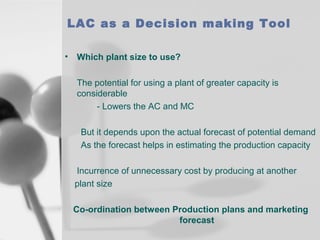
LAC as a Decision making Tool
•

Which plant size to use?
The potential for using a plant of greater capacity is
considerable
- Lowers the AC and MC
But it depends upon the actual forecast of potential demand
As the forecast helps in estimating the production capacity
Incurrence of unnecessary cost by producing at another
plant size
Co-ordination between Production plans and marketing
forecast
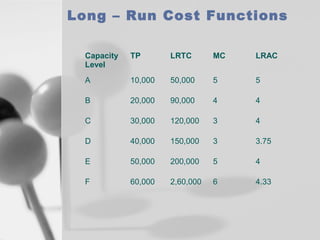
Long – Run Cost Functions
Capacity
Level

TP

LRTC

MC

LRAC

A

10,000

50,000

5

5

B

20,000

90,000

4

4

C

30,000

120,000

3

4

D

40,000

150,000

3

3.75

E

50,000

200,000

5

4

F

60,000

2,60,000

6

4.33
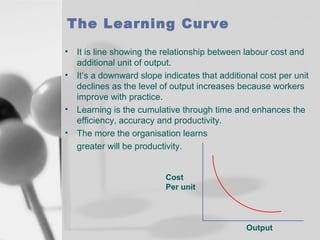
The Learning Curve
•
•

•
•

It is line showing the relationship between labour cost and
additional unit of output.
It’s a downward slope indicates that additional cost per unit
declines as the level of output increases because workers
improve with practice.
Learning is the cumulative through time and enhances the
efficiency, accuracy and productivity.
The more the organisation learns
greater will be productivity.
Cost
Per unit

Output
The Learning Curve
• Reasons for fall in average cost:
– Job familiarisation and reduced time to instruct
– Improved operating processes, machine speeds
and feeds
– Improvements in machine and tooling
– Larger manufacturing lots and reducing set up
time
– Better co-ordination and managerial control
Thus learning curve describes the reduction in cost
per unit of Output as a firms cumulative output over
successive time periods increases, while output per
period may remain the same.
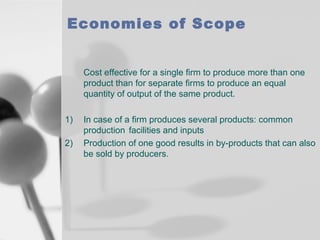
Economies of Scope
Cost effective for a single firm to produce more than one
product than for separate firms to produce an equal
quantity of output of the same product.
1)
2)

In case of a firm produces several products: common
production facilities and inputs
Production of one good results in by-products that can also
be sold by producers.
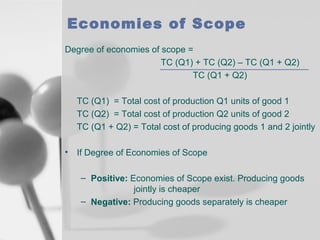
Economies of Scope
Degree of economies of scope =
TC (Q1) + TC (Q2) – TC (Q1 + Q2)
TC (Q1 + Q2)
TC (Q1) = Total cost of production Q1 units of good 1
TC (Q2) = Total cost of production Q2 units of good 2
TC (Q1 + Q2) = Total cost of producing goods 1 and 2 jointly
•

If Degree of Economies of Scope
– Positive: Economies of Scope exist. Producing goods
jointly is cheaper
– Negative: Producing goods separately is cheaper
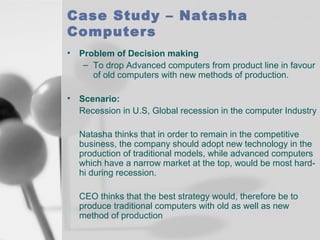
Case Study – Natasha
Computers
•

Problem of Decision making
– To drop Advanced computers from product line in favour
of old computers with new methods of production.

•

Scenario:
Recession in U.S, Global recession in the computer Industry
Natasha thinks that in order to remain in the competitive
business, the company should adopt new technology in the
production of traditional models, while advanced computers
which have a narrow market at the top, would be most hardhi during recession.
CEO thinks that the best strategy would, therefore be to
produce traditional computers with old as well as new
method of production
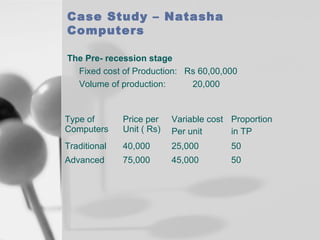
Case Study – Natasha
Computers
The Pre- recession stage
Fixed cost of Production: Rs 60,00,000
Volume of production:
20,000

Type of
Computers

Price per
Unit ( Rs)

Variable cost Proportion
Per unit
in TP

Traditional

40,000

25,000

50

Advanced

75,000

45,000

50
Case Study – Natasha
Computers

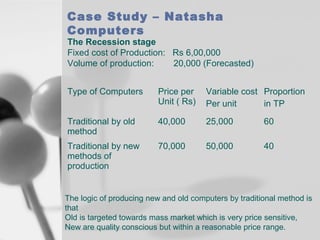
The Recession stage
Fixed cost of Production: Rs 6,00,000
Volume of production:
20,000 (Forecasted)
Type of Computers

Price per
Unit ( Rs)

Variable cost Proportion
Per unit
in TP

Traditional by old
method

40,000

25,000

60

Traditional by new
methods of
production

70,000

50,000

40

The logic of producing new and old computers by traditional method is
that
Old is targeted towards mass market which is very price sensitive,
New are quality conscious but within a reasonable price range.

Cost

  • 1.
  • 2.
    Introduction • Cost ofproduction changes with the change in output. • The relations between cost and output is called as Cost Function. • The cost function depends upon • Production conditions • Prices of the factors of production • Level of output • Whatever level of output a firm produces, it is produced at the minimum cost.
  • 3.
    Concepts of Cost Thecost concepts can be grouped on the basis: • Nature • Purpose Cost Concepts Accounting Cost Analytical Cost
  • 4.
    Concepts of Cost 1)Concepts used Accounting purpose The contractual cash payments which the firms makes to the other factor owners for purchasing and hiring the other factors (Explicit cost). 2) Analytical Cost concepts(for economic analysis of business ) Economic Cost = Accounting cost + Implicit Cost Implicit cost is the normal return on capital invested by the entrepreneur and the wages or salary for his services and money rewards for the other factors which the entrepreneur himself owns and employs
  • 5.
    Concepts of Cost Afirm will earn Economic profits only when its making revenue to excess of the total of accounting and implicit cost. Economic profit = Total revenue – Economic cost
  • 6.
    Accounting Cost Concepts 1. Actualcost ( Outlay or Acquisition cost: The cost that the firm incurs while producing or acquiring a goods or services. ( cost of raw material, labour, rent…). They are recorded in the book of accounts 2. Opportunity Cost: The return of the second best use of the firm resources which the firm forgoes in order to avail of the return form the best use of the resources. It is an example of implicit cost. 3. Sunk cost: The cost which are not altered by change in quantity and cannot be recovered ( depreciation). They are part of outlay cost.
  • 7.
    Accounting Cost Concepts 4. Businesscost and Full cost Business Cost includes all the expenses which are incurred to carry out a business. Full Cost is equal to business cost plus opportunity cost and normal profit. 5. Explicit Cost and Implicit cost (Imputed): Explicit Cost are those which are actually paid by the firm. Implicit are theoretical cost and go unrecognised by the firm Opportunity cost is a part of implicit cost
  • 8.
    Analytical Cost Concept 1. FixedCost: Cost which are fixed in volume and do not vary for a certain level of output Cost of managerial and administrative staff, depreciation of machinery, building and fixed assets, maintenance of land 2. Variable Cost: Vary with the variation of total output. Cost of raw material, cost of direct labour, running expenses of fixed capital such as fuel, repairs , routine maintenance
  • 9.
    Analytical Cost Concept 3. Total,Average and Marginal Cost : Total Cost : Money value of the total resources required for production of goods and services. Average cost : TC / Q Marginal Cost : Additional cost incurred when there is addition to the existing output MCn = TCn- TCn-1
  • 10.
    Theory of Cost Theoryof Cost: TC = f (Q) – – – – – Behaviour of cost in relation to change in output Cost : Output relationship The Total cost increases with the increase in output. The direction of change in Average and Marginal Cost Cost function depends upon the time framework chosen for cost analysis: 1) Short – Run Cost Functions 2) Long – Run cost functions
  • 11.
    Short – RunCost Functions • The short run cost is composed of TC = TFC + TVC – Total Fixed Cost (TFC) – Total Variable Cost (TVC) Fixed Cost: Cost which are incurred in hiring the fixed factors of production whose amount cannot be altered in the short run. Variable Cost: Cost which are incurred on the employment of variable factors of production whose amount can be altered in short run.
  • 12.
  • 13.
    Short – RunCost Functions TC TVC Cost TFC B O Q1 Output The shape : TFC : horizontal straight line TVC: Rises upwards, increases at a decreasing rate uptoQ1, beyond which it increases at a increasing rate. TC: Same as TVC, the distance between them is constant because of TFC
  • 14.
    Short – RunCost Functions AFC: TFC / Q It falls steadily as output increases. It slopes downwards, as with increase in output TFC spreads over more units, as output becomes large, AFC approaches zero. AVC: TVC / Q It falls with increase in output (increasing return), but beyond a normal capacity output, AVC will rise steeply – diminishing returns. ATC: TC / Q ATC curve depends upon the behaviour of AFC and AVC. Beginning both AVC and AFC falls so ATC also falls. AVC curve starts rising, but AFC falls, so ATC also falls With the increase in output, a sharp rise in AVC leads to rise of ATC.
  • 15.
    Shape of SRTCcurve MC ATC AVC Cost AFC Output
  • 16.
    Shape of SRTCcurve • • • • The shape of AC curve depend upon AVC and AFC In the beginning both AFC and AVC falls, so AC falls AVC rising and AFC falling, AC still falls But as output increases, a sharp rise AVC offset the fall of AFC and AC start to rise
  • 17.
    Short – RunCost Functions Marginal Cost MC MC < AC = AC falls ( MC pulls the AC down) MC > AC = AC rises ( MC pulls the AC up) MC AC
  • 18.
    Relationship Between MC andMP of Variable Factor Marginal Cost MC = ∆TC / ∆Q In the short run, MC is independent of the fixed cost and depends upon the variable factors. AP MP MC Q1 Q2 AVC
  • 19.
    Relationship Between MC andMP of Variable Factor • The behaviour of Marginal Product (MP) determines the shape of MC. • The MC is an inverse of MP, with maximum of MP corresponding to minimum of MC. • MC is the transformation of MP from physical term to money term.
  • 20.
    Long – RunCost Functions • A firm can vary all its input • The entrepreneur has before him number of alternative plant sizes and levels of output. • In short run the size of the plant ( capital equipment, machinery, land…) are fixed. • In long run the firm can move from one plant to another plant • The LRAC is the least possible average cost production of producing any given level of output when all the inputs are variable.
  • 21.
    Derivation of LongRun Average Cost Curve SAC1 H G Average cost J SAC2 R L K A B C Output D SAC3
  • 22.
    • In longrun firm can vary all its input. • The firm moves from one plant to larger plant if it has to increase its output. • The long run average cost of production is the least possible average cost of producing any given level of output when all the inputs are variable. • The short run average cost curves are called as Plant curves. • Suppose there are only three technically possible size of plant. • The firm can choose among the three possible sizes of plant • Upto OB amount of output, the firm will operate on the SAC1, though it could produce on SAC2. • For OA output . It will cost AL per unit cost on SAC1 curve but it will cost AH if on SAC2. (AL < AH). • If the firm plans to produce larger output than OB then it has to move to a bigger plant size. • Thus OC if produced on SAC2 cost CK per unit which is lower than CJ when produced on SAC1. • If the firm produce output between OB and OD it will employ the plant corresponding to SAC2.
  • 23.
  • 24.
    Long – RunCost Functions • The LAC is the locus of all the tangency points with the short run average cost curve. • The long curve is also called as Envelope curve. • LAC is not tangent to the minimum point of SAC. • LRAC is called the planning curve: as the firm plans to produce any output in the long run by choosing a plant on the LRAC corresponding to the given output. • Point G lies on the falling portion of SAC2, the firm is using the given plant below its full capacity. Point F is the minimum point
  • 25.
    Why LAC isof U- Shape • Why does LAC fall in the beginning: Economies of Scale - Use of technically efficient Machines - Division of Labour - Indivisibility of factors - Productive capacity of capital equipments rises faster then purchase price - Discounts from bulk purchases - Lower cost of raising funds - Inventory management • Why does LAC rise eventually: Diseconomies of scale - Rise in transportation cost - Input market imperfection - Management co-ordination and control problems - Depletion of raw material
  • 26.
    Why LAC isof U- Shape LRAC LRTC DRTC CRTC IRTC Output IRTC CRTC DRTC
  • 27.
    The Concept ofOptimum Firm • The best or the ideal size of the firm • The optimum firm is the one which operates on the scale at which, in the existing condition of techniques and organising ability has the lowest average cost of production. • The optimum size of the firm varies a great deal in different industries. – In some industries the minimum point of the long run average cost curve reaches at a comparatively small output ( agriculture, wholesale, retail…) – Optimum size in steel, automobile, heavy industries is very large and the minimum point is reached at a very large output.
  • 28.
    The Concept ofOptimum Firm LAC LAC AC Output Output
  • 29.
    LAC as aDecision making Tool • Which plant size to use? The potential for using a plant of greater capacity is considerable - Lowers the AC and MC But it depends upon the actual forecast of potential demand As the forecast helps in estimating the production capacity Incurrence of unnecessary cost by producing at another plant size Co-ordination between Production plans and marketing forecast
  • 30.
    Long – RunCost Functions Capacity Level TP LRTC MC LRAC A 10,000 50,000 5 5 B 20,000 90,000 4 4 C 30,000 120,000 3 4 D 40,000 150,000 3 3.75 E 50,000 200,000 5 4 F 60,000 2,60,000 6 4.33
  • 31.
    The Learning Curve • • • • Itis line showing the relationship between labour cost and additional unit of output. It’s a downward slope indicates that additional cost per unit declines as the level of output increases because workers improve with practice. Learning is the cumulative through time and enhances the efficiency, accuracy and productivity. The more the organisation learns greater will be productivity. Cost Per unit Output
  • 32.
    The Learning Curve •Reasons for fall in average cost: – Job familiarisation and reduced time to instruct – Improved operating processes, machine speeds and feeds – Improvements in machine and tooling – Larger manufacturing lots and reducing set up time – Better co-ordination and managerial control Thus learning curve describes the reduction in cost per unit of Output as a firms cumulative output over successive time periods increases, while output per period may remain the same.
  • 33.
    Economies of Scope Costeffective for a single firm to produce more than one product than for separate firms to produce an equal quantity of output of the same product. 1) 2) In case of a firm produces several products: common production facilities and inputs Production of one good results in by-products that can also be sold by producers.
  • 34.
    Economies of Scope Degreeof economies of scope = TC (Q1) + TC (Q2) – TC (Q1 + Q2) TC (Q1 + Q2) TC (Q1) = Total cost of production Q1 units of good 1 TC (Q2) = Total cost of production Q2 units of good 2 TC (Q1 + Q2) = Total cost of producing goods 1 and 2 jointly • If Degree of Economies of Scope – Positive: Economies of Scope exist. Producing goods jointly is cheaper – Negative: Producing goods separately is cheaper
  • 35.
    Case Study –Natasha Computers • Problem of Decision making – To drop Advanced computers from product line in favour of old computers with new methods of production. • Scenario: Recession in U.S, Global recession in the computer Industry Natasha thinks that in order to remain in the competitive business, the company should adopt new technology in the production of traditional models, while advanced computers which have a narrow market at the top, would be most hardhi during recession. CEO thinks that the best strategy would, therefore be to produce traditional computers with old as well as new method of production
  • 36.
    Case Study –Natasha Computers The Pre- recession stage Fixed cost of Production: Rs 60,00,000 Volume of production: 20,000 Type of Computers Price per Unit ( Rs) Variable cost Proportion Per unit in TP Traditional 40,000 25,000 50 Advanced 75,000 45,000 50
  • 37.
    Case Study –Natasha Computers The Recession stage Fixed cost of Production: Rs 6,00,000 Volume of production: 20,000 (Forecasted) Type of Computers Price per Unit ( Rs) Variable cost Proportion Per unit in TP Traditional by old method 40,000 25,000 60 Traditional by new methods of production 70,000 50,000 40 The logic of producing new and old computers by traditional method is that Old is targeted towards mass market which is very price sensitive, New are quality conscious but within a reasonable price range.