WHAT IS FOREIGN EXCHANGE
Foreign exchange is the mechanism by which the
currency of one country gets converted into the
currency of another country.
The conversion of currency is done by the banks who
deal in foreign exchange. These banks maintain stocks
of one currencies in the form of balances with banks
Contd……
It also refers to the stock of foreign currencies and other
foreign assets. The foreign exchange management ACT
1999 defines “Foreign exchange means foreign currency
and includes…
(a) Deposits credits and balances payable in any foreign
currency.
(b) Draft traveler’s cheques, letter or credit or bills of
exchange expressed or drawn in Indian currency but
payable in any foreign currency.
(c) Drafts travelers cheques, letter of credit or bills of
exchange drawn by banks, institution or persons outside
India, but payable in Indian currency
Nature of foreign exchange
Volatile, affected by hedger, arbitrager, speculator.
Affected by demand and supply.
Affected by rate of interest.
Affected by balance of payment surplus and deficit.
Affected inflation rate.
Spot and forward rates are different.
Affected by the economic stability of the country.
Affected by the fiscal policy of the government.
Affected by the political condition of the country.
It can be quoted directly or indirectly
Exchange Rate
►Fixed Exchange Rate System
Fixed rates provide greater certainty for exporters and
importers.
►Flexible Exchange Rate System
Flexible exchange rate or floating exchange rates
change freely and are determined by trading in the
forex market.
FOREIGN EXCHANGE MARKET
A foreign exchange market refers to buying foreign
currencies with domestic currencies and selling
foreign currencies for domestic currencies
According to Ellsworth, "A Foreign Exchange Market
comprises of all those institutions and individuals
who buy and sell foreign exchange which may be
defined as foreign money or any liquid claim on
foreign money"
FOREIGN EXCHANGE MARKET
STRUCTURE
Market Segments
Foreign exchange market activity takes place onshore
with many countries prohibiting onshore entities
from undertaking the operations in offshore markets
for their currencies. It is the central bank, or
professional dealers association, which normally
issues the code of conduct (Canales-Kriljenko,
2004).In auction markets, an auctioneer or auction
mechanism allocates foreign exchange by matching
supply and demand orders.
The Foreign Exchange Market for
Beginners
►The foreign exchange market or forex market as it is often
called is the market in which currencies are traded.
►Currency Trading is the world’s largest market consisting of
almost trillion in daily volumes and as investors learn more and
become more interested, market continues to rapidly grow.
►All trades that take place in the foreign exchange market
involve the buying of one currency and the selling of another
currency simultaneously. This is because the value of one
currency is determined by its comparison to another currency.
►The first currency of a currency pair is called the “base
currency,” while the second currency is called the counter
currency.
Contd….
►Foreign exchange Capital Markets (FXCM) is an
online currency trading firm that offers a free demo
account to traders who are new and interested in the
foreign exchange market.
►Registering for a demo account allows a new trader to
download the online trading platform that is used by
the company’s clients trading live accounts and make
trades as if they were doing it with real money.
►NB You can try opening a demo account using this
link
http://www.forex.com/uk/forex_demo_thanks.html
How to go about getting a demo
account
 You can try opening a demo account using this link
http://www.forex.com/uk/forex_demo_thanks.html
 FOREXTraderPRO - Active trader download platform featuring the most
advanced tools. http://www.forex.com/uk/land-windows.html
FOREXTrader PRO.web – A browser-based version of FOREXTrader PRO,
compatible with Mac and PC. http://www.forex.com/uk/login.html?type=java
FOREXTrader Mobile - iPhone, iPad and Android apps, plus mobile trading
for most smartphones. Read more at
http://www.forex.com/uk/FOREXTrader-Mobile.html
Website Trading – Simplified online trading from any computer at
http://www.forex.com/uk
**Read more about FOREX.com platforms at:
http://www.forex.com/uk/ways-to-trade.html
Characteristics of foreign exchange
market
1. It has huge trading volume representing the largest asset
class in the world leading to high liquidity;
2. It has wide geographical dispersion;
3. It’s a continuous operation: 24 hours a day except
weekends, i.e., trading from 22:00 GMT on Sunday (
Sydney) until 22:00 GMT Friday (New York);
4. the variety of factors that affect exchange rates;
5. the use of leverage to enhance profit and loss margins
and with respect to account size
6. low margins of relative profit compared with other
markets of fixed income
FUNCTIONS OF FOREIGN
EXCHANGE MARKET
1. Transfer of Purchasing Power /Clearing Function-
The basic function of the foreign exchange market is to
facilitate the conversion of one currency into another
2. Credit Function-The foreign exchange market also
provides credit to both national and international, to
promote foreign trade
3. Hedging Function-By hedging, we mean covering of a
foreign exchange risk arising out of the changes in
exchange rates. foreign exchange market tries to protect
the interest of the persons dealing in the market from
any unforseen changes in exchange rate
PARTICIPANTS / DEALERS IN FOREIGN EXCHANGE
MARKET
1. Retail Clients- They deal through commercial
banks and authorised agents. They comprise people,
international investors, multinational corporations
and others who need foreign exchange.
2. Commercial Banks- Commercial banks carry out
buy and sell orders from their retail clients and of
their own account. They deal with other commercial
banks and also through foreign exchange brokers.
PARTICIPANTS / DEALERS IN FOREIGN EXCHANGE
MARKET cont…..
3. Foreign Exchange Brokers- Each foreign exchange
market centre has some authorized brokers. Brokers
act as intermediaries between buyers and sellers,
mainly banks. Commercial banks prefer brokers.
4. Central Banks- National central banks play an
important role in the foreign exchange markets.
They try to control the money supply, inflation,
and/or interest rates and often have official or
unofficial target rates for their currencies.
TYPES OF FOREIGN EXCHANGE
MARKET
1. Retail Market - The retail market is a secondary price
maker. Here travellers, tourists and people who are in
need of foreign exchange for permitted small
transactions, exchange one currency for another.
2. Wholesale Market-The wholesale market is also called
interbank market. The size of transactions in this market
is very large. Dealers are highly professionals and are
primary price makers. The main participants are
Commercial banks, Business corporations and Central
banks. Multinational banks are mainly responsible for
determining exchange rate.
Contd……
3. Other Participants
a)Brokers- Brokers have more information and better
knowledge of market. They provide information to
banks about the prices at which there are buyers and
sellers of a pair of currencies. They act as middlemen
between the price makers
b)Price Takers - Price takers are those who buy foreign
exchange which they require and sell what they earn
at the price determined by primary price makers.
Operation of foreign exchange
market:
Foreign exchange market operates either as:-
1. Spot Market: (Current Market)-Spot market for foreign
exchange is that market which handles only spot
transaction or current transactions.
Principle characteristics:-
 Spot Market is of daily nature. It does not trade in future
deliveries.
 Spot rate of exchange is that rate which happens to
prevail at the time when transactions are incurred.
Contd….
2. Forward Market: -Forward Market for foreign exchange
is that market which handles such transaction of foreign
exchange as are meant for future delivery.
Principles Characteristics:-
 It only caters to forward transaction.
 It determines forward exchange rate at which forward
transaction are to be honored.
Factors Influencing Forward
Exchange Rate
a) Interest rates.
b) Degree of speculation in foreign exchange
market.
c) Inflation rate
d) Foreign investor’s confidence in domestic
country.
e) Economic situation in the country
f) Political situation in the country.
g) Balance of payments position etc.
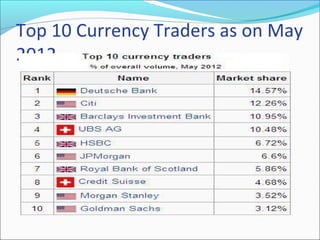
Top 10 Currency Traders as on May
2012
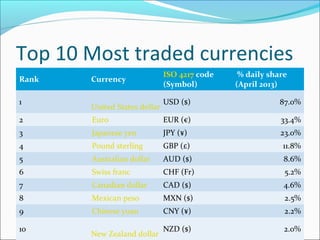
Top 10 Most traded currencies
Rank Currency
ISO 4217 code
(Symbol)
% daily share
(April 2013)
1
 
United States dollar
USD ($) 87.0%
2  Euro EUR (€) 33.4%
3  Japanese yen JPY (¥) 23.0%
4  Pound sterling GBP (£) 11.8%
5  Australian dollar AUD ($) 8.6%
6  Swiss franc CHF (Fr) 5.2%
7  Canadian dollar CAD ($) 4.6%
8  Mexican peso MXN ($) 2.5%
9  Chinese yuan CNY (¥) 2.2%
10
 
New Zealand dollar
NZD ($) 2.0%
Trend in the global forex
market
According to the Bank for International Settlements,[
the
preliminary global results from the 2013 Triennial Central Bank
Survey of Foreign Exchange and OTC Derivatives Markets
Activity show that trading in foreign exchange markets
averaged $5.3 trillion per day in April 2013. This is up from $4.0
trillion in April 2010 and $3.3 trillion in April 2007. Foreign
exchange swaps were the most actively traded instruments in
April 2013, at $2.2 trillion per day, followed by spot trading at
$2.0 trillion.
According to the Bank for International Settlements, as of April
2010, average daily turnover in global foreign exchange markets
is estimated at $3.98 trillion, a growth of approximately 20%
over the $3.21 trillion daily volume as of April 2007. Some firms
specializing on foreign exchange market had put the average
daily turnover in excess of US$4 trillion.
Contd…….
The $3.98 trillion break-down is as follows:
$1.490 trillion in spot transactions
$475 billion in outright forwards
$1.765 trillion in foreign exchange swaps
$43 billion currency swaps
$207 billion in options and other products
Merits and Demerits of foreign
Exchange market
Advantages
The forex market is extremely liquid, hence its rapidly growing
popularity. Currencies may be converted when bought or sold
without causing too much movement in the price and keeping
losses to a minimum.
As there is no central bank, trading can take place anywhere in
the world and operates on a 24-hour basis apart from weekends.
An investor needs only small amounts of capital compared with
other investments. Forex trading is outstanding in this regard.
It is an unregulated market, meaning that there is no trade
commission overseeing transactions and there are no
restrictions on trade.
Contd….
In common with futures, forex is traded using a “good
faith deposit” rather than a loan. The interest rate spread
is an attractive advantage.
Demerits
The major risk is that one counterparty fails to deliver the
currency involved in a very large transaction. In theory at
least, such a failure could bring ruin to the forex market as
a whole.
Investors need a lot of capital to make good profits
because the profit margins on small-scale trades are very
low.
CURRENCY TRADING RULES
Plan your trade and trade your plan.
The trend is your friend.
Focus on capital preservation.
Know when to cut loss.
Take profit when trade is good.
Be emotionless
Not trade based on a tip from a friend or a brocker.
Mistakes of Foreign exchange
Traders
Trading Out of Boredom or Anger
Having Unrealistic Expectations.
Taking Highly Correlated Trades.
Failing to Use a Stop.
Taking Unnecessary Risks.
Being Too Patient With Losers and Not Patient
Enough With Winners.
Being a “Possum Trader”.
References
http://www.bloomberg.com
http://research.stlouisfed.org/fred
http://www.imf.org
Archer, Michael Duane. Getting Started in Currency
Trading: Winning in Today’s Market. 4th ed.
Hoboken, NJ: Wiley, 2012.
Chen, James. Essentials of Foreign Exchange Trading.
Hoboken, NJ: Wiley, 2009.

Global foreign exchange 1

  • 1.
    WHAT IS FOREIGNEXCHANGE Foreign exchange is the mechanism by which the currency of one country gets converted into the currency of another country. The conversion of currency is done by the banks who deal in foreign exchange. These banks maintain stocks of one currencies in the form of balances with banks
  • 2.
    Contd…… It also refersto the stock of foreign currencies and other foreign assets. The foreign exchange management ACT 1999 defines “Foreign exchange means foreign currency and includes… (a) Deposits credits and balances payable in any foreign currency. (b) Draft traveler’s cheques, letter or credit or bills of exchange expressed or drawn in Indian currency but payable in any foreign currency. (c) Drafts travelers cheques, letter of credit or bills of exchange drawn by banks, institution or persons outside India, but payable in Indian currency
  • 3.
    Nature of foreignexchange Volatile, affected by hedger, arbitrager, speculator. Affected by demand and supply. Affected by rate of interest. Affected by balance of payment surplus and deficit. Affected inflation rate. Spot and forward rates are different. Affected by the economic stability of the country. Affected by the fiscal policy of the government. Affected by the political condition of the country. It can be quoted directly or indirectly
  • 4.
    Exchange Rate ►Fixed ExchangeRate System Fixed rates provide greater certainty for exporters and importers. ►Flexible Exchange Rate System Flexible exchange rate or floating exchange rates change freely and are determined by trading in the forex market.
  • 5.
    FOREIGN EXCHANGE MARKET FOREIGNEXCHANGE MARKET A foreign exchange market refers to buying foreign currencies with domestic currencies and selling foreign currencies for domestic currencies According to Ellsworth, "A Foreign Exchange Market comprises of all those institutions and individuals who buy and sell foreign exchange which may be defined as foreign money or any liquid claim on foreign money"
  • 6.
    FOREIGN EXCHANGE MARKET STRUCTURE MarketSegments Foreign exchange market activity takes place onshore with many countries prohibiting onshore entities from undertaking the operations in offshore markets for their currencies. It is the central bank, or professional dealers association, which normally issues the code of conduct (Canales-Kriljenko, 2004).In auction markets, an auctioneer or auction mechanism allocates foreign exchange by matching supply and demand orders.
  • 7.
    The Foreign ExchangeMarket for Beginners ►The foreign exchange market or forex market as it is often called is the market in which currencies are traded. ►Currency Trading is the world’s largest market consisting of almost trillion in daily volumes and as investors learn more and become more interested, market continues to rapidly grow. ►All trades that take place in the foreign exchange market involve the buying of one currency and the selling of another currency simultaneously. This is because the value of one currency is determined by its comparison to another currency. ►The first currency of a currency pair is called the “base currency,” while the second currency is called the counter currency.
  • 8.
    Contd…. ►Foreign exchange CapitalMarkets (FXCM) is an online currency trading firm that offers a free demo account to traders who are new and interested in the foreign exchange market. ►Registering for a demo account allows a new trader to download the online trading platform that is used by the company’s clients trading live accounts and make trades as if they were doing it with real money. ►NB You can try opening a demo account using this link http://www.forex.com/uk/forex_demo_thanks.html
  • 9.
    How to goabout getting a demo account  You can try opening a demo account using this link http://www.forex.com/uk/forex_demo_thanks.html  FOREXTraderPRO - Active trader download platform featuring the most advanced tools. http://www.forex.com/uk/land-windows.html FOREXTrader PRO.web – A browser-based version of FOREXTrader PRO, compatible with Mac and PC. http://www.forex.com/uk/login.html?type=java FOREXTrader Mobile - iPhone, iPad and Android apps, plus mobile trading for most smartphones. Read more at http://www.forex.com/uk/FOREXTrader-Mobile.html Website Trading – Simplified online trading from any computer at http://www.forex.com/uk **Read more about FOREX.com platforms at: http://www.forex.com/uk/ways-to-trade.html
  • 10.
    Characteristics of foreignexchange market 1. It has huge trading volume representing the largest asset class in the world leading to high liquidity; 2. It has wide geographical dispersion; 3. It’s a continuous operation: 24 hours a day except weekends, i.e., trading from 22:00 GMT on Sunday ( Sydney) until 22:00 GMT Friday (New York); 4. the variety of factors that affect exchange rates; 5. the use of leverage to enhance profit and loss margins and with respect to account size 6. low margins of relative profit compared with other markets of fixed income
  • 11.
    FUNCTIONS OF FOREIGN EXCHANGEMARKET 1. Transfer of Purchasing Power /Clearing Function- The basic function of the foreign exchange market is to facilitate the conversion of one currency into another 2. Credit Function-The foreign exchange market also provides credit to both national and international, to promote foreign trade 3. Hedging Function-By hedging, we mean covering of a foreign exchange risk arising out of the changes in exchange rates. foreign exchange market tries to protect the interest of the persons dealing in the market from any unforseen changes in exchange rate
  • 12.
    PARTICIPANTS / DEALERSIN FOREIGN EXCHANGE MARKET 1. Retail Clients- They deal through commercial banks and authorised agents. They comprise people, international investors, multinational corporations and others who need foreign exchange. 2. Commercial Banks- Commercial banks carry out buy and sell orders from their retail clients and of their own account. They deal with other commercial banks and also through foreign exchange brokers.
  • 13.
    PARTICIPANTS / DEALERSIN FOREIGN EXCHANGE MARKET cont….. 3. Foreign Exchange Brokers- Each foreign exchange market centre has some authorized brokers. Brokers act as intermediaries between buyers and sellers, mainly banks. Commercial banks prefer brokers. 4. Central Banks- National central banks play an important role in the foreign exchange markets. They try to control the money supply, inflation, and/or interest rates and often have official or unofficial target rates for their currencies.
  • 14.
    TYPES OF FOREIGNEXCHANGE MARKET 1. Retail Market - The retail market is a secondary price maker. Here travellers, tourists and people who are in need of foreign exchange for permitted small transactions, exchange one currency for another. 2. Wholesale Market-The wholesale market is also called interbank market. The size of transactions in this market is very large. Dealers are highly professionals and are primary price makers. The main participants are Commercial banks, Business corporations and Central banks. Multinational banks are mainly responsible for determining exchange rate.
  • 15.
    Contd…… 3. Other Participants a)Brokers-Brokers have more information and better knowledge of market. They provide information to banks about the prices at which there are buyers and sellers of a pair of currencies. They act as middlemen between the price makers b)Price Takers - Price takers are those who buy foreign exchange which they require and sell what they earn at the price determined by primary price makers.
  • 16.
    Operation of foreignexchange market: Foreign exchange market operates either as:- 1. Spot Market: (Current Market)-Spot market for foreign exchange is that market which handles only spot transaction or current transactions. Principle characteristics:-  Spot Market is of daily nature. It does not trade in future deliveries.  Spot rate of exchange is that rate which happens to prevail at the time when transactions are incurred.
  • 17.
    Contd…. 2. Forward Market:-Forward Market for foreign exchange is that market which handles such transaction of foreign exchange as are meant for future delivery. Principles Characteristics:-  It only caters to forward transaction.  It determines forward exchange rate at which forward transaction are to be honored.
  • 18.
    Factors Influencing Forward ExchangeRate a) Interest rates. b) Degree of speculation in foreign exchange market. c) Inflation rate d) Foreign investor’s confidence in domestic country. e) Economic situation in the country f) Political situation in the country. g) Balance of payments position etc.
  • 19.
    Top 10 CurrencyTraders as on May 2012
  • 20.
    Top 10 Mosttraded currencies Rank Currency ISO 4217 code (Symbol) % daily share (April 2013) 1   United States dollar USD ($) 87.0% 2  Euro EUR (€) 33.4% 3  Japanese yen JPY (¥) 23.0% 4  Pound sterling GBP (£) 11.8% 5  Australian dollar AUD ($) 8.6% 6  Swiss franc CHF (Fr) 5.2% 7  Canadian dollar CAD ($) 4.6% 8  Mexican peso MXN ($) 2.5% 9  Chinese yuan CNY (¥) 2.2% 10   New Zealand dollar NZD ($) 2.0%
  • 21.
    Trend in theglobal forex market According to the Bank for International Settlements,[ the preliminary global results from the 2013 Triennial Central Bank Survey of Foreign Exchange and OTC Derivatives Markets Activity show that trading in foreign exchange markets averaged $5.3 trillion per day in April 2013. This is up from $4.0 trillion in April 2010 and $3.3 trillion in April 2007. Foreign exchange swaps were the most actively traded instruments in April 2013, at $2.2 trillion per day, followed by spot trading at $2.0 trillion. According to the Bank for International Settlements, as of April 2010, average daily turnover in global foreign exchange markets is estimated at $3.98 trillion, a growth of approximately 20% over the $3.21 trillion daily volume as of April 2007. Some firms specializing on foreign exchange market had put the average daily turnover in excess of US$4 trillion.
  • 22.
    Contd……. The $3.98 trillionbreak-down is as follows: $1.490 trillion in spot transactions $475 billion in outright forwards $1.765 trillion in foreign exchange swaps $43 billion currency swaps $207 billion in options and other products
  • 23.
    Merits and Demeritsof foreign Exchange market Advantages The forex market is extremely liquid, hence its rapidly growing popularity. Currencies may be converted when bought or sold without causing too much movement in the price and keeping losses to a minimum. As there is no central bank, trading can take place anywhere in the world and operates on a 24-hour basis apart from weekends. An investor needs only small amounts of capital compared with other investments. Forex trading is outstanding in this regard. It is an unregulated market, meaning that there is no trade commission overseeing transactions and there are no restrictions on trade.
  • 24.
    Contd…. In common withfutures, forex is traded using a “good faith deposit” rather than a loan. The interest rate spread is an attractive advantage. Demerits The major risk is that one counterparty fails to deliver the currency involved in a very large transaction. In theory at least, such a failure could bring ruin to the forex market as a whole. Investors need a lot of capital to make good profits because the profit margins on small-scale trades are very low.
  • 25.
    CURRENCY TRADING RULES Planyour trade and trade your plan. The trend is your friend. Focus on capital preservation. Know when to cut loss. Take profit when trade is good. Be emotionless Not trade based on a tip from a friend or a brocker.
  • 26.
    Mistakes of Foreignexchange Traders Trading Out of Boredom or Anger Having Unrealistic Expectations. Taking Highly Correlated Trades. Failing to Use a Stop. Taking Unnecessary Risks. Being Too Patient With Losers and Not Patient Enough With Winners. Being a “Possum Trader”.
  • 27.
    References http://www.bloomberg.com http://research.stlouisfed.org/fred http://www.imf.org Archer, Michael Duane.Getting Started in Currency Trading: Winning in Today’s Market. 4th ed. Hoboken, NJ: Wiley, 2012. Chen, James. Essentials of Foreign Exchange Trading. Hoboken, NJ: Wiley, 2009.