
Assignment on
Unit – 5
Macro Economics and policy
FOREIGN EXCHANGE RATEDETERMINATION
Submitted to :
Dr. Y. C. Zala
Principle & Dean
college of IABM
AAU Anand - 388110
1
Submitted by :
Sondarva Yagnesh m
Reg. no. 04-2664-2015
M.Sc. (Agri.) 1st Sem.
FOREIGN EXCHANGE
RATEDETERMINATION
2
Foreign Exchange Rate
 What is Exchange Rate ?
 Exchange Rate is a rate at which one currency can be
exchanged into another currency.
In other words it is value one currency in terms of other.
say:
US $ 1 = Rs.45.18
This rate is the conversion rate of every US $ 1 to Rs.
45.18
Factors Determining Exchange Rates
(a). Fundamental Reasons:
- Balance of Payment – surplus leads to stronger currency.
- Economic Growth Rates –High/Low growth rate.
- Fiscal / Monetary Policy- deficit financing leads to depreciation of currency.
- Interest Rates –currency with higher interest will appreciate in the short term.
- Political Issues –Political stability leads to stable rates
(b). Technical Reasons
- Government Control can lead to unrealistic value.
- Free flow of Capital from lower interest rate to higher
interest rates.
(c). Speculation – higher the speculation higher the volatility in rates
What Determines Exchange Rates?
 Factors that cause the supply and demand
schedules of currencies to change
 Market fundamentals (economic variables)
 Productivity, inflation rates, real interest rates, consumer
preferences, and government trade policy
 Market expectations
 News about future market fundamentals
 Traders’ opinions about future exchange rates
5
What Determines Exchange Rates
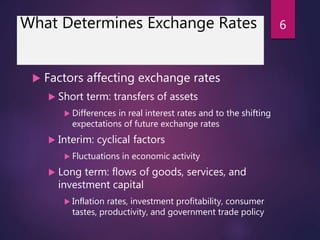
 Factors affecting exchange rates
 Short term: transfers of assets
 Differences in real interest rates and to the shifting
expectations of future exchange rates
 Interim: cyclical factors
 Fluctuations in economic activity
 Long term: flows of goods, services, and
investment capital
 Inflation rates, investment profitability, consumer
tastes, productivity, and government trade policy
6
Determining Long-Term
Exchange Rates
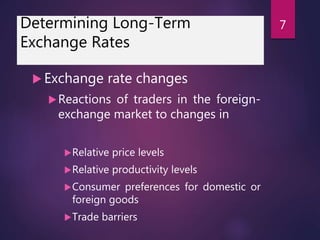
 Exchange rate changes
Reactions of traders in the foreign-
exchange market to changes in
Relative price levels
Relative productivity levels
Consumer preferences for domestic or
foreign goods
Trade barriers
7
Determining Long-Term
Exchange Rates
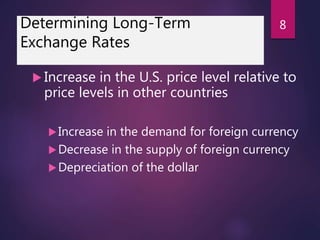
 Increase in the U.S. price level relative to
price levels in other countries
Increase in the demand for foreign currency
Decrease in the supply of foreign currency
Depreciation of the dollar
8
Determining Long-Term
Exchange Rates
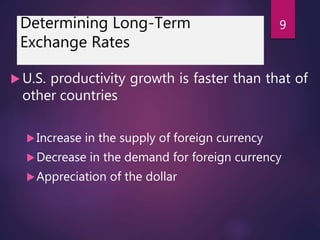
 U.S. productivity growth is faster than that of
other countries
Increase in the supply of foreign currency
Decrease in the demand for foreign currency
Appreciation of the dollar
9
Determining Long-Term
Exchange Rates
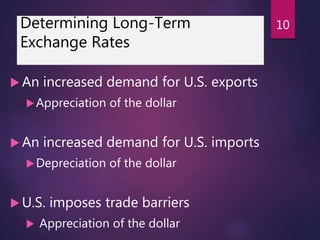
 An increased demand for U.S. exports
Appreciation of the dollar
 An increased demand for U.S. imports
Depreciation of the dollar
 U.S. imposes trade barriers
 Appreciation of the dollar
10
11
12
13
14
15
International comparisons of GDP:
purchasing power parity
 Gross domestic product (GDP)
 Add up the market values of the goods and services its
economy produces
 Use market exchange rate
 Misleading: not all goods and services are traded in a
world market
16
International comparisons of GDP:
purchasing power parity
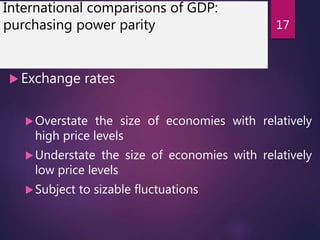
 Exchange rates
Overstate the size of economies with relatively
high price levels
Understate the size of economies with relatively
low price levels
Subject to sizable fluctuations
17
18
Comparing GDPs internationally, 2008: top 8
countries (billions of dollars)

Foreign exchange rate determination

  • 1.
    Assignment on Unit –5 Macro Economics and policy FOREIGN EXCHANGE RATEDETERMINATION Submitted to : Dr. Y. C. Zala Principle & Dean college of IABM AAU Anand - 388110 1 Submitted by : Sondarva Yagnesh m Reg. no. 04-2664-2015 M.Sc. (Agri.) 1st Sem.
  • 2.
  • 3.
    Foreign Exchange Rate What is Exchange Rate ?  Exchange Rate is a rate at which one currency can be exchanged into another currency. In other words it is value one currency in terms of other. say: US $ 1 = Rs.45.18 This rate is the conversion rate of every US $ 1 to Rs. 45.18
  • 4.
    Factors Determining ExchangeRates (a). Fundamental Reasons: - Balance of Payment – surplus leads to stronger currency. - Economic Growth Rates –High/Low growth rate. - Fiscal / Monetary Policy- deficit financing leads to depreciation of currency. - Interest Rates –currency with higher interest will appreciate in the short term. - Political Issues –Political stability leads to stable rates (b). Technical Reasons - Government Control can lead to unrealistic value. - Free flow of Capital from lower interest rate to higher interest rates. (c). Speculation – higher the speculation higher the volatility in rates
  • 5.
    What Determines ExchangeRates?  Factors that cause the supply and demand schedules of currencies to change  Market fundamentals (economic variables)  Productivity, inflation rates, real interest rates, consumer preferences, and government trade policy  Market expectations  News about future market fundamentals  Traders’ opinions about future exchange rates 5
  • 6.
    What Determines ExchangeRates  Factors affecting exchange rates  Short term: transfers of assets  Differences in real interest rates and to the shifting expectations of future exchange rates  Interim: cyclical factors  Fluctuations in economic activity  Long term: flows of goods, services, and investment capital  Inflation rates, investment profitability, consumer tastes, productivity, and government trade policy 6
  • 7.
    Determining Long-Term Exchange Rates Exchange rate changes Reactions of traders in the foreign- exchange market to changes in Relative price levels Relative productivity levels Consumer preferences for domestic or foreign goods Trade barriers 7
  • 8.
    Determining Long-Term Exchange Rates Increase in the U.S. price level relative to price levels in other countries Increase in the demand for foreign currency Decrease in the supply of foreign currency Depreciation of the dollar 8
  • 9.
    Determining Long-Term Exchange Rates U.S. productivity growth is faster than that of other countries Increase in the supply of foreign currency Decrease in the demand for foreign currency Appreciation of the dollar 9
  • 10.
    Determining Long-Term Exchange Rates An increased demand for U.S. exports Appreciation of the dollar  An increased demand for U.S. imports Depreciation of the dollar  U.S. imposes trade barriers  Appreciation of the dollar 10
  • 11.
  • 12.
  • 13.
  • 14.
  • 15.
  • 16.
    International comparisons ofGDP: purchasing power parity  Gross domestic product (GDP)  Add up the market values of the goods and services its economy produces  Use market exchange rate  Misleading: not all goods and services are traded in a world market 16
  • 17.
    International comparisons ofGDP: purchasing power parity  Exchange rates Overstate the size of economies with relatively high price levels Understate the size of economies with relatively low price levels Subject to sizable fluctuations 17
  • 18.
    18 Comparing GDPs internationally,2008: top 8 countries (billions of dollars)