Foreign Exchange Market
1. Definition and Organization of the
Foreign Exchange Markets
• foreign exchange markets are markets on which
individuals, firms and banks buy and sell foreign
currencies:
– foreign exchange trading occurs with the help of the
telecommunication net between buyers and sellers of
foreign exchange that are located all over the world
– a single international foreign exchange market for
every single currency
– foreign exchange trading takes place at least in some
of the world financial centers in every moment
The Currency Market
Where money denominated in one currency is
bought and sold with money denominated in
another currency.
International Trade and Capital Transactions:
• facilitated with the ability to transfer
purchasing power between countries.
Location
1. OTC-type: no specific location
2. Most trades by phone, telex, or SWIFT
SWIFT: Society for Worldwide Interbank
Financial Telecommunications
Participants in the foreign exchange
market
Participants at 2 Levels
1. Wholesale Level (95%) - major banks
2. Retail Level (business customers)
Two Types of Currency Markets
1. Spot Market:
- immediate transaction
- recorded by 2nd business day
2. Forward Market:
- transactions take place at a specified future date
Participants by Market
• Spot Market
a. commercial banks
b. Brokers
c. customers of commercial and central banks
• Forward Market
a. arbitrageurs
b. traders
c. hedgers
d. speculators
CLEARING SYSTEMS
A. Clearing House Interbank Payments System
(CHIPS)
- used in U.S. for electronic fund transfers.
B.FedWire
- operated by the Fed
- used for domestic transfers
ELECTRONIC TRADING
A. Automated Trading
- genuine screen-based market
B.Results:
1. Reduces cost of trading
2. Threatens traders’ oligopoly of information
3. Provides liquidity
2. Foreign Exchange Market Functions
Clearing of Currencies and Provision of Credit
• Clearing of currencies:
– service of exchanging one currency for another
• Provision of Credit:
– trader that bought a certain good from the
manufacturer, needs time to sell this good to the
final customer and to pay the manufacturer with
the money he received from the customer
Foreign Exchange Market and Insurance
Against Foreign Exchange Risk
–activities with which the foreign exchange
market participants avoid exchange rate risk
or activities with which they are closing
their open foreign exchange position
–closed foreign exchange position:
• size of the assets in a certain currency is equal
to the size of the liabilities in the same currency
• full insurance against exchange rate risk with
respect to this currency
Foreign Exchange Market and Insurance
Against Foreign Exchange Risk
– open foreign exchange position:
• long: net assets in a certain currency
• short: net liabilities in a certain currency
– in the spot or forward foreign exchange market
– standardized forward contracts and options
Foreign Exchange Markets and Conscious
Foreign Exchange Risk Acceptance
• activities in which economic agents
consciously open their foreign exchange
positions – long or short – hoping to get
profits in all foreign exchange market
segments
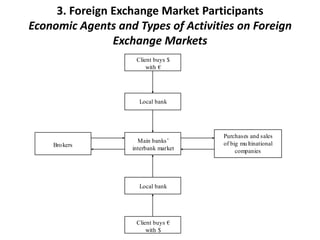
3. Foreign Exchange Market Participants
Economic Agents and Types of Activities on Foreign
Exchange Markets
Client buys $
with €
Local bank
Main banks’
interbank market
Local bank
Client buys €
with $
Purchases and sales
of big multinational
companies
Brokers
Economic Agents and Types of Activities
on Foreign Exchange Markets
• bank clients (individuals, firms, non-banking
financial institutions):
– all those groups of legal and physical persons that
need foreign currency in doing their commercial
or investment business
• commercial banks:
the most important group of foreign exchange
market participants
they buy and sell foreign currencies for their
clients and trade for themselves
• brokers:
– agents that connects dealers interested in
buying and selling foreign exchange, but does
not become an active client in the transaction
– they provide their client, the bank, with the
information about the exchange rates at which
banks are willing to buy or sell a particular
currency
Economic Agents and Types of Activities
on Foreign Exchange Markets
• central banks:
foreign exchange market interventions are meant
to influence the exchange rate of the domestic
currency in a way that is beneficial for the
domestic economy and, consequently, for the
country
it does not necessarily have a profit, it can also
have a loss
Economic Agents and Types of Activities
on Foreign Exchange Markets
Economic Agents and Motivation for the
Foreign Exchange Market Participation
• arbitragers:
–they want to earn a profit without taking
any kind of risk (usually commercial banks):
• try to profit from simultaneous exchange rate
differences in different markets
• making use of the interest rate differences that
exist in national financial markets of two
countries along with transactions on spot and
forward foreign exchange market at the same
time (covered interest parity)
Economic Agents and Motivation for the
Foreign Exchange Market Participation
• hedgers and speculators:
hedgers do not want to take risk while
participating in the market, they want to insure
themselves against the exchange rate changes
speculators think they know what the future
exchange rate of a particular currency will be, and
they are willing to accept exchange rate risk with
the goal of making profit
every foreign exchange market participant can
behave either as a hedger or as a speculator in the
context of a particular transaction
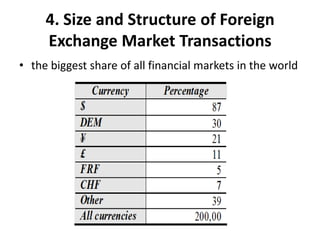
4. Size and Structure of Foreign
Exchange Market Transactions
• the biggest share of all financial markets in the world
5. Types of Foreign Exchange Market
Transactions Spot Foreign Exchange
Transactions
• almost immediate delivery of foreign
exchange
Outright Forward Transactions
 buyer and seller establish the exchange rate at the time of
the agreement, payment and delivery are not required until
maturity
 forward exchange rates:
 1, 3, 6, 9 months, one year
Swap Transactions
• simultaneous purchase and sale of a given
amount of foreign exchange for two different
value dates:
– “spot against forward” swaps:
Hedging
• the act of reducing exchange rate risk
Forward Rate Quotations
Two Methods:
a) Outright Rate: quoted to
commercial customers.
b) Swap Rate: quoted in the interbank
market as a discount or premium.
Futures positions
• Futures are similar to forwards
• First, futures positions require a margin deposit to be
posted and maintained daily.
• If a loss is taken on the contract, the amount is debited
from the margin account after the close of trading.
• In other words, these futures are cash settled and no
underlying instruments or principals are exchanged.
• Secondly, all contract specifications such as expiration
time, face amount, and margins are determined by the
exchange instead of by the individual trading parties.
Futures
• basic characteristics of futures:
– the amount of the currency that is being traded
– type of currency quotation
– contract expiration
– last day of trading with the contract
– settlement day
– margin requirements
• information about futures trading
• futures usage:
– arbitrage between outright forward contract and
futures
– rarely used as an insurance instrument (rigidity!)
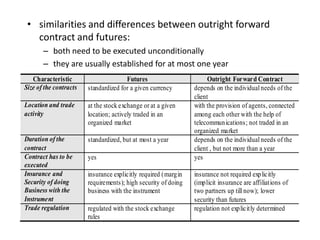
• similarities and differences between outright forward
contract and futures:
– both need to be executed unconditionally
– they are usually established for at most one year
Characteristic Futures Outright Forward Contract
Size of the contracts standardized for a given currency depends on the individual needs of the
client
Location and trade
activity
at the stock exchange or at a given
location; actively traded in an
organized market
with the provision of agents, connected
among each other with the help of
telecommunications; not traded in an
organized market
Duration of the
contract
standardized, but at most a year depends on the individual needs of the
client , but not more than a year
Contract has to be
executed
yes yes
Insurance and
Security of doing
Business with the
Instrument
insurance explicitly required (margin
requirements); high security of doing
business with the instrument
insurance not required explicitly
(implicit insurance are affiliations of
two partners up till now); lower
security than futures
Trade regulation regulated with the stock exchange
rules
regulation not explicitly determined
Options
• Options are a way of buying or selling a currency
at a certain point in the future.
• An option is a contract which specifies the price
at which an amount of currency can be bought at
a date in the future called the expiration date.
• Unlike forwards and futures, the owner of an
option does not have to go through with the
transaction if he or she does not wish to do so.
Types of options
• The buyer of a call has the right but not the obligation to buy the
underlying asset at the strike price on or before a specified date in
the future.
• However, the seller has a potential obligation to sell the underlying
asset at the strike price on or before a specified date in the future if
the holder of the option exercises his or her right.
• The buyer of a put has the right but not the obligation to sell the
underlying asset at the strike price on or before a specified date in
the future.
• On the other hand, the seller of a put has a potential obligation to
buy the underlying asset at the strike price on or before a specified
date in the future if the holder of the option exercises his/her right.
Options
• basic characteristics of options:
– financial instrument that gives the buyer the
right, but not the obligation, to buy or sell a
standardized amount of a foreign currency, that
is traded, at a fixed price at a particular time, or
until a particular time in the future
– call option and put option
– American and European options
– three different prices:
• exercise/strike price
• cost, price or value of the option
• underlying or actual spot exchange rate
Options
• types of options trading:
– in organized markets:
• standardized contracts with given strike prices,
standardized durations (1, 3, 6, 9, 12 months) and
expirations
• only certain currencies, contract amounts are
standardized
– over-the-counter trading:
• expiration date, strike price and contract amount
depend on the individual needs of the client
• counterparty risk!
• retail and interbank market
• Usage of options:
– when the economic agent expects that the
exchange rate trend of a particular currency
could change drastically
– when the economic agent does not know for
sure that a certain foreign exchange flow will
occur in the future
– advantages:
• fixed option costs
• options do not need to be executed
Options
6. Quotations of Currencies on Foreign
Exchange Markets
• quotation of a currency tells us at what price is a
financial mediator willing to buy or sell a certain
currency
Currency Quotations in Spot Foreign Exchange
Markets
 European and American quotation
 direct and indirect quotation (which currency is regarded
as a domestic/basis currency)
Forward Contract
• an agreement between a bank and a customer
to deliver a specified amount of currency
against another currency at a specified future
date and at a fixed exchange rate.

Foreign exchange market

  • 1.
  • 2.
    1. Definition andOrganization of the Foreign Exchange Markets • foreign exchange markets are markets on which individuals, firms and banks buy and sell foreign currencies: – foreign exchange trading occurs with the help of the telecommunication net between buyers and sellers of foreign exchange that are located all over the world – a single international foreign exchange market for every single currency – foreign exchange trading takes place at least in some of the world financial centers in every moment
  • 3.
    The Currency Market Wheremoney denominated in one currency is bought and sold with money denominated in another currency. International Trade and Capital Transactions: • facilitated with the ability to transfer purchasing power between countries.
  • 4.
    Location 1. OTC-type: nospecific location 2. Most trades by phone, telex, or SWIFT SWIFT: Society for Worldwide Interbank Financial Telecommunications
  • 5.
    Participants in theforeign exchange market Participants at 2 Levels 1. Wholesale Level (95%) - major banks 2. Retail Level (business customers) Two Types of Currency Markets 1. Spot Market: - immediate transaction - recorded by 2nd business day 2. Forward Market: - transactions take place at a specified future date
  • 6.
    Participants by Market •Spot Market a. commercial banks b. Brokers c. customers of commercial and central banks • Forward Market a. arbitrageurs b. traders c. hedgers d. speculators
  • 7.
    CLEARING SYSTEMS A. ClearingHouse Interbank Payments System (CHIPS) - used in U.S. for electronic fund transfers. B.FedWire - operated by the Fed - used for domestic transfers
  • 8.
    ELECTRONIC TRADING A. AutomatedTrading - genuine screen-based market B.Results: 1. Reduces cost of trading 2. Threatens traders’ oligopoly of information 3. Provides liquidity
  • 9.
    2. Foreign ExchangeMarket Functions Clearing of Currencies and Provision of Credit • Clearing of currencies: – service of exchanging one currency for another • Provision of Credit: – trader that bought a certain good from the manufacturer, needs time to sell this good to the final customer and to pay the manufacturer with the money he received from the customer
  • 10.
    Foreign Exchange Marketand Insurance Against Foreign Exchange Risk –activities with which the foreign exchange market participants avoid exchange rate risk or activities with which they are closing their open foreign exchange position –closed foreign exchange position: • size of the assets in a certain currency is equal to the size of the liabilities in the same currency • full insurance against exchange rate risk with respect to this currency
  • 11.
    Foreign Exchange Marketand Insurance Against Foreign Exchange Risk – open foreign exchange position: • long: net assets in a certain currency • short: net liabilities in a certain currency – in the spot or forward foreign exchange market – standardized forward contracts and options
  • 12.
    Foreign Exchange Marketsand Conscious Foreign Exchange Risk Acceptance • activities in which economic agents consciously open their foreign exchange positions – long or short – hoping to get profits in all foreign exchange market segments
  • 13.
    3. Foreign ExchangeMarket Participants Economic Agents and Types of Activities on Foreign Exchange Markets Client buys $ with € Local bank Main banks’ interbank market Local bank Client buys € with $ Purchases and sales of big multinational companies Brokers
  • 14.
    Economic Agents andTypes of Activities on Foreign Exchange Markets • bank clients (individuals, firms, non-banking financial institutions): – all those groups of legal and physical persons that need foreign currency in doing their commercial or investment business • commercial banks: the most important group of foreign exchange market participants they buy and sell foreign currencies for their clients and trade for themselves
  • 15.
    • brokers: – agentsthat connects dealers interested in buying and selling foreign exchange, but does not become an active client in the transaction – they provide their client, the bank, with the information about the exchange rates at which banks are willing to buy or sell a particular currency Economic Agents and Types of Activities on Foreign Exchange Markets
  • 16.
    • central banks: foreignexchange market interventions are meant to influence the exchange rate of the domestic currency in a way that is beneficial for the domestic economy and, consequently, for the country it does not necessarily have a profit, it can also have a loss Economic Agents and Types of Activities on Foreign Exchange Markets
  • 17.
    Economic Agents andMotivation for the Foreign Exchange Market Participation • arbitragers: –they want to earn a profit without taking any kind of risk (usually commercial banks): • try to profit from simultaneous exchange rate differences in different markets • making use of the interest rate differences that exist in national financial markets of two countries along with transactions on spot and forward foreign exchange market at the same time (covered interest parity)
  • 18.
    Economic Agents andMotivation for the Foreign Exchange Market Participation • hedgers and speculators: hedgers do not want to take risk while participating in the market, they want to insure themselves against the exchange rate changes speculators think they know what the future exchange rate of a particular currency will be, and they are willing to accept exchange rate risk with the goal of making profit every foreign exchange market participant can behave either as a hedger or as a speculator in the context of a particular transaction
  • 19.
    4. Size andStructure of Foreign Exchange Market Transactions • the biggest share of all financial markets in the world
  • 20.
    5. Types ofForeign Exchange Market Transactions Spot Foreign Exchange Transactions • almost immediate delivery of foreign exchange Outright Forward Transactions  buyer and seller establish the exchange rate at the time of the agreement, payment and delivery are not required until maturity  forward exchange rates:  1, 3, 6, 9 months, one year
  • 21.
    Swap Transactions • simultaneouspurchase and sale of a given amount of foreign exchange for two different value dates: – “spot against forward” swaps:
  • 22.
    Hedging • the actof reducing exchange rate risk Forward Rate Quotations Two Methods: a) Outright Rate: quoted to commercial customers. b) Swap Rate: quoted in the interbank market as a discount or premium.
  • 23.
    Futures positions • Futuresare similar to forwards • First, futures positions require a margin deposit to be posted and maintained daily. • If a loss is taken on the contract, the amount is debited from the margin account after the close of trading. • In other words, these futures are cash settled and no underlying instruments or principals are exchanged. • Secondly, all contract specifications such as expiration time, face amount, and margins are determined by the exchange instead of by the individual trading parties.
  • 24.
    Futures • basic characteristicsof futures: – the amount of the currency that is being traded – type of currency quotation – contract expiration – last day of trading with the contract – settlement day – margin requirements • information about futures trading • futures usage: – arbitrage between outright forward contract and futures – rarely used as an insurance instrument (rigidity!)
  • 25.
    • similarities anddifferences between outright forward contract and futures: – both need to be executed unconditionally – they are usually established for at most one year Characteristic Futures Outright Forward Contract Size of the contracts standardized for a given currency depends on the individual needs of the client Location and trade activity at the stock exchange or at a given location; actively traded in an organized market with the provision of agents, connected among each other with the help of telecommunications; not traded in an organized market Duration of the contract standardized, but at most a year depends on the individual needs of the client , but not more than a year Contract has to be executed yes yes Insurance and Security of doing Business with the Instrument insurance explicitly required (margin requirements); high security of doing business with the instrument insurance not required explicitly (implicit insurance are affiliations of two partners up till now); lower security than futures Trade regulation regulated with the stock exchange rules regulation not explicitly determined
  • 26.
    Options • Options area way of buying or selling a currency at a certain point in the future. • An option is a contract which specifies the price at which an amount of currency can be bought at a date in the future called the expiration date. • Unlike forwards and futures, the owner of an option does not have to go through with the transaction if he or she does not wish to do so.
  • 27.
    Types of options •The buyer of a call has the right but not the obligation to buy the underlying asset at the strike price on or before a specified date in the future. • However, the seller has a potential obligation to sell the underlying asset at the strike price on or before a specified date in the future if the holder of the option exercises his or her right. • The buyer of a put has the right but not the obligation to sell the underlying asset at the strike price on or before a specified date in the future. • On the other hand, the seller of a put has a potential obligation to buy the underlying asset at the strike price on or before a specified date in the future if the holder of the option exercises his/her right.
  • 28.
    Options • basic characteristicsof options: – financial instrument that gives the buyer the right, but not the obligation, to buy or sell a standardized amount of a foreign currency, that is traded, at a fixed price at a particular time, or until a particular time in the future – call option and put option – American and European options – three different prices: • exercise/strike price • cost, price or value of the option • underlying or actual spot exchange rate
  • 29.
    Options • types ofoptions trading: – in organized markets: • standardized contracts with given strike prices, standardized durations (1, 3, 6, 9, 12 months) and expirations • only certain currencies, contract amounts are standardized – over-the-counter trading: • expiration date, strike price and contract amount depend on the individual needs of the client • counterparty risk! • retail and interbank market
  • 30.
    • Usage ofoptions: – when the economic agent expects that the exchange rate trend of a particular currency could change drastically – when the economic agent does not know for sure that a certain foreign exchange flow will occur in the future – advantages: • fixed option costs • options do not need to be executed Options
  • 31.
    6. Quotations ofCurrencies on Foreign Exchange Markets • quotation of a currency tells us at what price is a financial mediator willing to buy or sell a certain currency Currency Quotations in Spot Foreign Exchange Markets  European and American quotation  direct and indirect quotation (which currency is regarded as a domestic/basis currency)
  • 32.
    Forward Contract • anagreement between a bank and a customer to deliver a specified amount of currency against another currency at a specified future date and at a fixed exchange rate.