EXCHANGE RATE
DETERMINATION


    Prepared By
 Mariya Jasmine M Y
FOREIGN EXCHANGE

• Popularly referred to as "FOREX"
• The conversion of one country's currency into
  that of another.
• It is the minimum number of units of one
  countries currency required to purchase one
  unit of the other countries currency.
WHY IT NEEDED???.....
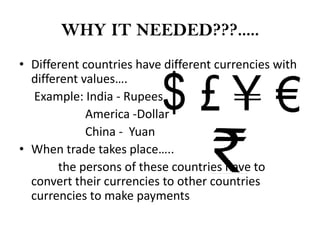
• Different countries have different currencies with
  different values….
   Example: India - Rupees
             America -Dollar
             China - Yuan
• When trade takes place…..
        the persons of these countries have to
  convert their currencies to other countries
  currencies to make payments
• For this purpose the concept of foreign
  exchange come into operation.
• Under mechanism of international
  payments, the currency of a country is
  converted in to the currency of another
  country through FOREIGN EXCHANGE
  MARKET.
• The effect of globalization and international
  trade
• Increased import and export
FOREIGN EXCHANGE MARKET

• Also called “FOREX” market.
• It is the place were foreign moneys were
  bought and sold.
• It involves the buying of one currency and
  selling of another currency simultaneously.
• Exchange rates are determined here….
• Has no geographical boundaries…..
FOREIGN EXCHANGE RATE
• It is the rate at which one currency will be
  exchanged for another in foreign exchange.
• It is also regarded as the value of one
  country’s currency in terms of another
  currency.
         There are three basic types;
                Fixed rate
                Floating rate
                Managed rate
FIXED EXCHANGE RATE

• It is the system of following a fixed rate for
  converting currencies.
• In this system, the government (or the central
  bank acting on its behalf) intervenes in the
  currency market in order to keep the exchange
  rate close to a fixed target.
• It does not allow major fluctuations from the
  central rate.
Advantages
 It provide the stability of exchange rate.
Fixed rates provide greater certainty for
  exporters and importers.

 Disadvantages
 Too rigid to take care of major upheavals.
 Need large reserves to defend the fixed
  exchange rate.
 May cause destabilizing speculations; most
  currency crisis took place under a fixed
  exchange system.
FLOATING/FLEXIBLE
         EXCHANGE RATE
• Under the flexible exchange rate system, the
  rate of exchange is allowed to vary to suit the
  economic policies of the government.
• Flexible exchange rates are exchange
  rates, which fluctuate according to market
  forces.
• The value of the currency is determined solely
  by the forces of demand and supply in the
  exchange market.(self correcting mechanism)
Advantages

Automatic adjustment for countries with a
 large balance of payments deficit.
Flexibility in determining interest rates
Allow countries to maintain independent
 economic policies.
Permit a smooth adjustment to external
 shocks.
Don't need to maintain large international
 reserves.
Disadvantages
Flexible exchange rates are highly unstable so
  that flows of foreign trade and investment
  may be discouraged.
They are inherently inflationary.
MANAGED EXCHANGE RATE
• Managed exchange rate systems permit the
  government to place some influence on an
  exchange rate that would otherwise be freely
  floating.
• Managed means the exchange rate system has
  attributes of both systems.
• Through such official interventions it is
  possible to manage both fixed and floating
  exchange rates.
Simple Mechanism of Demand &
              Supply
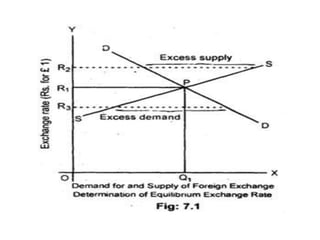
• As stated earlier exchange rate is determined
  by its the forces of supply and demand.
• Therefore, if for some reason people increase
  their demand for a specific currency, then the
  price will rise provided that the supply
  remains stable.
• On the contrary, if the supply is increased the
  price will decline and it is provided that the
  demand remains stable.
Purchasing Power Parity Theory (PPP Theory)

•     Most widely accepted theory
     “According to PPP theory, when exchange rates
      are of a fluctuating nature, the rate of exchange
      between two currencies in the long run will be
      fixed by their respective purchasing powers in
      their own nations.”

•    i.e the price of a good that is charged in one
     country should be equal to the one charged for
     the same good in another country, being
     exchanged at the current rate.
• This rule is also known as the law of one price.
• It is an economic theory that estimates the
  amount of adjustment needed on the
  exchange rate between countries in order for
  the exchange to be equivalent to each
  currency's purchasing power.
The Balance of Payment Theory
• The balance of payments approach is another method
  that explains what the factors are that determine the
  supply and demand curves of a country’s currency.
• As it is known from macroeconomics, the balance of
  payments is a method of recording all the international
  monetary transactions of a country during a specific
  period of time.
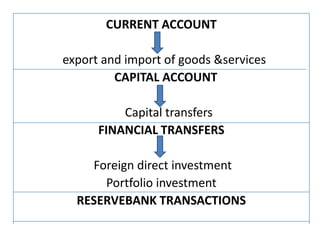
• The transactions recorded are divided into four
  categories: the current account transactions, the
  capital account transactions, financial account and the
  central bank transaction.
CURRENT ACCOUNT

export and import of goods &services
         CAPITAL ACCOUNT

          Capital transfers
      FINANCIAL TRANSFERS

    Foreign direct investment
      Portfolio investment
  RESERVEBANK TRANSACTIONS
• According to the theory, a deficit in the balance of
  payments leads to fall or depreciation in the rate of
  exchange, while a surplus in the balance of payments
  strengthens the foreign exchange reserves, causing an
  appreciation in the price of home currency in terms of
  foreign currency. A deficit balance of payments of a
  country implies that demand for foreign exchange is
  exceeding its supply.
• As a result, the price of foreign money in terms of
  domestic currency must rise, i.e., the exchange rate of
  domestic currency must fall. On the other hand, a
  surplus in the balance of payments of the country
  implies a greater demand for home currency in a
  foreign country than the available supply. As a
  result, the price of home currency in terms of foreign
  money rises, i.e., the rate of exchange improves.
DETERMINANTS OF FOREIGN
            EXCHANGE RATE
1. Interest Rate
  Whenever there is an increase interest rates in domestic
  market there will be increase investment funds causing a
  decrease in demand for foreign currency and an increase in
  supply of foreign currency.
2. Inflation Rate
   when inflation increases there will be less demand for
   local goods (decreased supply of foreign currency) and more
   demand for foreign goods (increased demand for foreign
   currency).
3. Government budget deficit or surplus
  The market usually react negatively to widening govt.
  budget deficits and positively to narrowing budget
  deficits. This will result in change in the value of
  countries currency.
4. Political conditions
   Internal, regional and international political
   conditions and events can have a profound effect
   on currency market

Exchange rate determination

  • 1.
    EXCHANGE RATE DETERMINATION Prepared By Mariya Jasmine M Y
  • 2.
    FOREIGN EXCHANGE • Popularlyreferred to as "FOREX" • The conversion of one country's currency into that of another. • It is the minimum number of units of one countries currency required to purchase one unit of the other countries currency.
  • 3.
    WHY IT NEEDED???..... •Different countries have different currencies with different values…. Example: India - Rupees America -Dollar China - Yuan • When trade takes place….. the persons of these countries have to convert their currencies to other countries currencies to make payments
  • 4.
    • For thispurpose the concept of foreign exchange come into operation. • Under mechanism of international payments, the currency of a country is converted in to the currency of another country through FOREIGN EXCHANGE MARKET. • The effect of globalization and international trade • Increased import and export
  • 5.
    FOREIGN EXCHANGE MARKET •Also called “FOREX” market. • It is the place were foreign moneys were bought and sold. • It involves the buying of one currency and selling of another currency simultaneously. • Exchange rates are determined here…. • Has no geographical boundaries…..
  • 6.
    FOREIGN EXCHANGE RATE •It is the rate at which one currency will be exchanged for another in foreign exchange. • It is also regarded as the value of one country’s currency in terms of another currency. There are three basic types; Fixed rate Floating rate Managed rate
  • 7.
    FIXED EXCHANGE RATE •It is the system of following a fixed rate for converting currencies. • In this system, the government (or the central bank acting on its behalf) intervenes in the currency market in order to keep the exchange rate close to a fixed target. • It does not allow major fluctuations from the central rate.
  • 8.
    Advantages  It providethe stability of exchange rate. Fixed rates provide greater certainty for exporters and importers. Disadvantages  Too rigid to take care of major upheavals.  Need large reserves to defend the fixed exchange rate.  May cause destabilizing speculations; most currency crisis took place under a fixed exchange system.
  • 9.
    FLOATING/FLEXIBLE EXCHANGE RATE • Under the flexible exchange rate system, the rate of exchange is allowed to vary to suit the economic policies of the government. • Flexible exchange rates are exchange rates, which fluctuate according to market forces. • The value of the currency is determined solely by the forces of demand and supply in the exchange market.(self correcting mechanism)
  • 10.
    Advantages Automatic adjustment forcountries with a large balance of payments deficit. Flexibility in determining interest rates Allow countries to maintain independent economic policies. Permit a smooth adjustment to external shocks. Don't need to maintain large international reserves.
  • 11.
    Disadvantages Flexible exchange ratesare highly unstable so that flows of foreign trade and investment may be discouraged. They are inherently inflationary.
  • 12.
    MANAGED EXCHANGE RATE •Managed exchange rate systems permit the government to place some influence on an exchange rate that would otherwise be freely floating. • Managed means the exchange rate system has attributes of both systems. • Through such official interventions it is possible to manage both fixed and floating exchange rates.
  • 13.
    Simple Mechanism ofDemand & Supply • As stated earlier exchange rate is determined by its the forces of supply and demand. • Therefore, if for some reason people increase their demand for a specific currency, then the price will rise provided that the supply remains stable. • On the contrary, if the supply is increased the price will decline and it is provided that the demand remains stable.
  • 15.
    Purchasing Power ParityTheory (PPP Theory) • Most widely accepted theory “According to PPP theory, when exchange rates are of a fluctuating nature, the rate of exchange between two currencies in the long run will be fixed by their respective purchasing powers in their own nations.” • i.e the price of a good that is charged in one country should be equal to the one charged for the same good in another country, being exchanged at the current rate.
  • 16.
    • This ruleis also known as the law of one price. • It is an economic theory that estimates the amount of adjustment needed on the exchange rate between countries in order for the exchange to be equivalent to each currency's purchasing power.
  • 17.
    The Balance ofPayment Theory • The balance of payments approach is another method that explains what the factors are that determine the supply and demand curves of a country’s currency. • As it is known from macroeconomics, the balance of payments is a method of recording all the international monetary transactions of a country during a specific period of time. • The transactions recorded are divided into four categories: the current account transactions, the capital account transactions, financial account and the central bank transaction.
  • 18.
    CURRENT ACCOUNT export andimport of goods &services CAPITAL ACCOUNT Capital transfers FINANCIAL TRANSFERS Foreign direct investment Portfolio investment RESERVEBANK TRANSACTIONS
  • 19.
    • According tothe theory, a deficit in the balance of payments leads to fall or depreciation in the rate of exchange, while a surplus in the balance of payments strengthens the foreign exchange reserves, causing an appreciation in the price of home currency in terms of foreign currency. A deficit balance of payments of a country implies that demand for foreign exchange is exceeding its supply. • As a result, the price of foreign money in terms of domestic currency must rise, i.e., the exchange rate of domestic currency must fall. On the other hand, a surplus in the balance of payments of the country implies a greater demand for home currency in a foreign country than the available supply. As a result, the price of home currency in terms of foreign money rises, i.e., the rate of exchange improves.
  • 20.
    DETERMINANTS OF FOREIGN EXCHANGE RATE 1. Interest Rate Whenever there is an increase interest rates in domestic market there will be increase investment funds causing a decrease in demand for foreign currency and an increase in supply of foreign currency. 2. Inflation Rate when inflation increases there will be less demand for local goods (decreased supply of foreign currency) and more demand for foreign goods (increased demand for foreign currency).
  • 21.
    3. Government budgetdeficit or surplus The market usually react negatively to widening govt. budget deficits and positively to narrowing budget deficits. This will result in change in the value of countries currency. 4. Political conditions Internal, regional and international political conditions and events can have a profound effect on currency market