Foreign Exchange
What is Foreign Exchange?
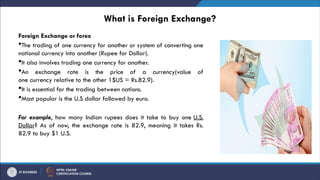
Foreign Exchange or forex
The trading of one currency for another or system of converting one
national currency into another (Rupee for Dollar).
It also involves trading one currency for another.
An exchange rate is the price of a currency(value of
one currency relative to the other 1$US = Rs.82.9).
It is essential for the trading between nations.
Most popular is the U.S dollar followed by euro.
For example, how many Indian rupees does it take to buy one U.S.
Dollar? As of now, the exchange rate is 82.9, meaning it takes Rs.
82.9 to buy $1 U.S.
Foreign Exchange Market
 A market in which National currencies are bought and sold against
one another. Some foreign exchange markets are Mumbai, London,
New York, Tokyo, Zurich and Frankfurt)
 The foreign exchange market is one of the largest and most liquid
markets in the world. It is dominated by the U.S. dollar, the Euro,
the Japanese yen, and the British pound.
 The Forex market has an estimated turnover of $7.5 trillion a day
as per Bureau of International Settlements (2022)
 Without the foreign exchange market, international trade and
international investment would be impossible; companies would
have to resort to barter.
Features of Foreign Exchange Market
The foreign exchange market is unique because of
• The foreign exchange market is a global network of banks, brokers, and foreign exchange dealers
connected by electronic communications systems. (JP Morgan Chase, Bank of America Merrill Lynch, Citi,
Goldman Sachs, HSBC, Deutsche Bank, Standard Chartered)
• Foreign exchange market functions 24 hours of the day (different time zones of the globe).
• If exchange rates quoted in different markets were not essentially the same, there would be an
opportunity for arbitrage - the process of buying a currency low and selling it high.
For example:
If the dollar price of the euro $0.99 in New York and $1.01 in Frankfurt. An arbitrageur would
purchase Euros at $0.99 in New York and immediately resell them in Frankfurt for $1.01, thus
realizing a profits of $0.02 per euro.
• The variety of factors that affect exchange rates like inflation rate, interest rate, money supply etc.
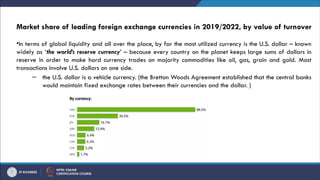
Market share of leading foreign exchange currencies in 2019/2022, by value of turnover
•In terms of global liquidity and all over the place, by far the most utilized currency is the U.S. dollar – known
widely as ‘the world’s reserve currency’ – because every country on the planet keeps large sums of dollars in
reserve in order to make hard currency trades on majority commodities like oil, gas, grain and gold. Most
transactions involve U.S. dollars on one side.
– the U.S. dollar is a vehicle currency. (the Bretton Woods Agreement established that the central banks
would maintain fixed exchange rates between their currencies and the dollar. )
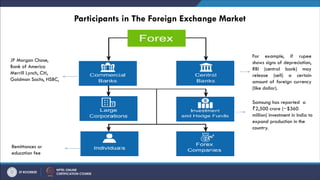
Participants in The Foreign Exchange Market
For example, if rupee
shows signs of depreciation,
RBI (central bank) may
release (sell) a certain
amount of foreign currency
(like dollar).
JP Morgan Chase,
Bank of America
Merrill Lynch, Citi,
Goldman Sachs, HSBC,
Remittances or
education fee
Samsung has reported a
2,500 crore (~$360
₹
million) investment in India to
expand production in the
country.
Participants
• Commercial Banks: These banks serve their retail clients, the bank customers, in conducting foreign commerce or
making international investment in financial assets that require foreign exchange.
• Foreign exchange brokers: they operate in the international currency market and act as agents who facilitate
trading between dealers. Unlike the banks, brokers serve merely as matchmakers and do not put their own money
at risk.
• Central banks: Another important player in the foreign market is Central bank of the various countries. Central
banks frequently intervene in the market to maintain the exchange rates of their currencies within a desired
range and to smooth fluctuations within that range.
• MNCs: are the major non-bank participants in the forward market as they exchange cash flows associated with
their multinational operations. MNCs often contract to either pay or receive fixed amounts in foreign currencies at
future dates, so they are exposed to foreign currency risk. This is why they often hedge these future cash flows
through the inter-bank forward exchange market.
• Individuals and Small Businesses: Individuals and small businesses also use foreign exchange market to
facilitate execution of commercial or investment transactions. The foreign needs of these players are usually small
and account for only a fraction of all foreign exchange transactions.
• Fund Managers, Hedge Funds, and Sovereign Wealth Funds: They are basically transnational and home-
country’s money managers who may deal in hundreds of millions of dollars, as their portfolios of investment funds
are often quite large. The major aim of hedge funds is to make profits and grow their portfolios.
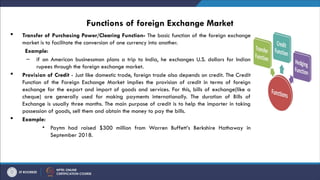
Functions of foreign Exchange Market
 Transfer of Purchasing Power/Clearing Function- The basic function of the foreign exchange
market is to facilitate the conversion of one currency into another.
Example:
– if an American businessman plans a trip to India, he exchanges U.S. dollars for Indian
rupees through the foreign exchange market.
 Provision of Credit - Just like domestic trade, foreign trade also depends on credit. The Credit
Function of the Foreign Exchange Market implies the provision of credit in terms of foreign
exchange for the export and import of goods and services. For this, bills of exchange(like a
cheque) are generally used for making payments internationally. The duration of Bills of
Exchange is usually three months. The main purpose of credit is to help the importer in taking
possession of goods, sell them and obtain the money to pay the bills.
 Example:
• Paytm had raised $300 million from Warren Buffett’s Berkshire Hathaway in
September 2018.
Conti..
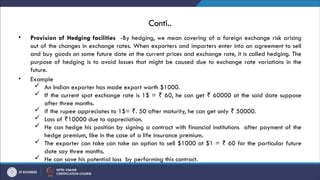
• Provision of Hedging facilities -By hedging, we mean covering of a foreign exchange risk arising
out of the changes in exchange rates. When exporters and importers enter into an agreement to sell
and buy goods on some future date at the current prices and exchange rate, it is called hedging. The
purpose of hedging is to avoid losses that might be caused due to exchange rate variations in the
future.
• Example
 An Indian exporter has made export worth $1000.
 If the current spot exchange rate is 1$ = 60, he can get 60000 at the said date suppose
₹ ₹
after three months.
 if the rupee appreciates to 1$= . 50 after maturity, he can get only 50000.
₹ ₹
 Loss of 10000 due to appreciation.
₹
 He can hedge his position by signing a contract with financial institutions after payment of the
hedge premium, like in the case of a life insurance premium.
 The exporter can take can take an option to sell $1000 at $1 = 60 for the particular future
₹
date say three months.
 He can save his potential loss by performing this contract.
Factors Affecting Exchange Rate
Introduction
Foreign Exchange rate indicates a
country’s economic health and stability.
It may fluctuate daily with the
changing market forces of supply and
demand of currencies from one
country to another.
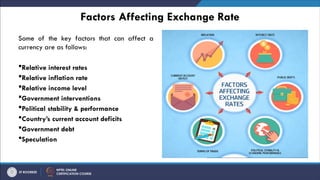
Factors Affecting Exchange Rate
Some of the key factors that can affect a
currency are as follows:
Relative interest rates
Relative inflation rate
Relative income level
Government interventions
Political stability & performance
Country’s current account deficits
Government debt
Speculation
Relative Interest Rates
Higher interest rates offer lenders in an economy
a higher return relative to other countries.
Therefore, higher interest rates attract foreign
capital and cause the exchange rate to rise.
The impact of higher interest rates is mitigated,
however, if inflation in the country is much higher
than in others, or if additional factors serve to
drive the currency down. The opposite relationship
exists for decreasing interest rates – that is, lower
interest rates tend to decrease exchange rates.
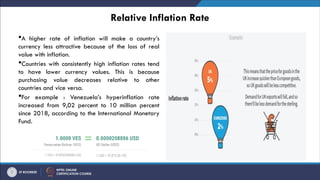
Relative Inflation Rate
A higher rate of inflation will make a country’s
currency less attractive because of the loss of real
value with inflation.
Countries with consistently high inflation rates tend
to have lower currency values. This is because
purchasing value decreases relative to other
countries and vice versa.
For example : Venezuela’s hyperinflation rate
increased from 9,02 percent to 10 million percent
since 2018, according to the International Monetary
Fund.
Relative Income Level
• Citizens with higher incomes look for
new consumption opportunities in other
countries, driving up the demand for
those currencies and shifting the
demand curve to the right.
• Thus, as incomes rise in one country, the
prices of foreign currencies rise as well
and the local currency will depreciate.
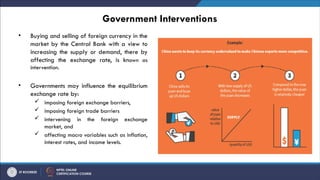
Government Interventions
• Buying and selling of foreign currency in the
market by the Central Bank with a view to
increasing the supply or demand, there by
affecting the exchange rate, is known as
intervention.
• Governments may influence the equilibrium
exchange rate by:
 imposing foreign exchange barriers,
 imposing foreign trade barriers
 intervening in the foreign exchange
market, and
 affecting macro variables such as inflation,
interest rates, and income levels.
Example
• In 2007, India experienced rapid appreciation of its currency against the US dollar. The reasons for
the appreciation of the rupee were a generally weak dollar in international currency markets and
sharp increase in dollar inflows into the country, partly due to India's increasing attractiveness to
foreign investors. Although India had been seeing a steady rise in dollar inflows into the country for
quite some time, on earlier occasions, the Reserve Bank of India (RBI intervened in the foreign
currency market and purchased excess dollars so as to avoid any appreciation in the value of the
rupee.
• On November 24, 2016, the rupee hit a record low of 69.09, sliding past its earlier trough of 68.86.
so, to curb the Indian currency’s fall , the Reserve Bank of India (RBI) sold $400-500 million in the spot
market.
• On Sept. 2018, India raised import duty on a range of items including air-conditioners, refrigerators,
washing machines, footwear, jewellery, furniture fittings and tableware besides imposing it on aviation
turbine fuel (ATF) as the government seeks to rein in the current account deficit and shore up the
rupee.
https://economictimes.indiatimes.com/
Political Stability & Performance
A country's political state and economic performance can affect its currency strength.
Foreign investors inevitably seek out stable countries with strong economic performance in which to invest
their capital. A country with such positive attributes will draw investment funds away from other countries
perceived to have more political and economic risk.
If an economy is growing at a faster rate, in the long-run, it is generally expected to have a better
performance on Balance of Trade .
Political turmoil, for example, can cause a loss of confidence in a currency and a movement of capital to
the currencies of more stable countries.
For example, if markets feared the US would default on its debt, foreign investors would sell their
holdings of US bonds. This would cause a fall in the value of the dollar.
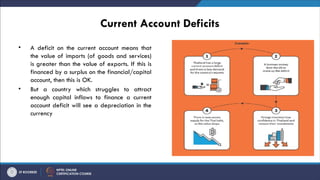
Current Account Deficits
• A deficit on the current account means that
the value of imports (of goods and services)
is greater than the value of exports. If this is
financed by a surplus on the financial/capital
account, then this is OK.
• But a country which struggles to attract
enough capital inflows to finance a current
account deficit will see a depreciation in the
currency
Example
What is Kenya’s experience?
• Kenya’s current account balance has generally been in deficit since 2004 when the deficit stood at 0.82 percent
of GDP. The deficit widened to stand at about 10 percent of GDP in 2012 largely reflecting a faster growth in
imports of goods into the country relative to exports.
• The imports have been largely in machinery and transport equipment, manufactured goods and oil products for
industrial purposes. These are essential goods whose demand is not responsive to price changes. Growth in
exports has been sluggish with little diversification away from the traditional exports of coffee, tea and
horticulture.
• International trade in services which form part of the current account balance has been in a surplus over the
years, mainly due to improved earnings in export of transportation services, tourism services, communication
services among others. Net current transfers also increased, supported largely by rising emigrant remittances.
• However, the growth in the services account and net current transfers was not sufficient to offset the deficit
in the merchandise or goods account.
• The huge import bill in the current account increases demand for foreign currency, while slowdown in exports of
goods reduces the inflow of foreign currency.
• The combined effect exerts pressure on the exchange rate to depreciate (weaken).
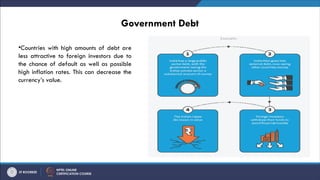
Government Debt
•Countries with high amounts of debt are
less attractive to foreign investors due to
the chance of default as well as possible
high inflation rates. This can decrease the
currency’s value.
Speculation or Expectations
 Most trades in the forex markets are speculative trades, which means that sentiment and momentum
can play big roles in market activity. Even if the fundamentals don’t align, the market for a currency
can continue soaring or depreciating if traders and governments perceive it should.
 If a country's currency value is expected to rise, investors will demand more of that currency in order
to make a profit in the near future. As a result, the value of the currency will rise due to the increase
in demand. With this increase in currency value comes a rise in the exchange rate as well and vice
versa.
 Because of speculative transactions, foreign exchange rates can be very volatile.
Conti…
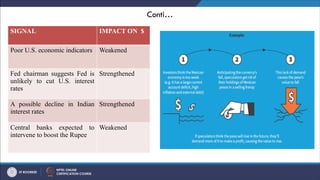
SIGNAL IMPACT ON $
Poor U.S. economic indicators Weakened
Fed chairman suggests Fed is
unlikely to cut U.S. interest
rates
Strengthened
A possible decline in Indian
interest rates
Strengthened
Central banks expected to
intervene to boost the Rupee
Weakened
CONTI..
Example
• Suppose the exchange rate today is . 70 /US $ .
₹
• The speculator anticipates this rate to become . 71/US within the coming three months .
₹
• Under these circumstances , he will buy US $1,000 for 70000 and hold this amount for three months
₹
, although he is not committed to this particular time horizon .
• When the target exchange rate is reached , he will sell US $1000 at the new exchange rate , that is
at 71 per dollar and
₹
• Earn a profit of . 71000- 70000 = . 1000
₹ ₹
Foreign Exchange Exposure
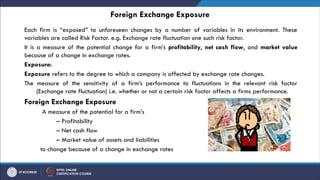
Each firm is “exposed” to unforeseen changes by a number of variables in its environment. These
variables are called Risk Factor. e.g. Exchange rate fluctuation one such risk factor.
It is a measure of the potential change for a firm’s profitability, net cash flow, and market value
because of a change in exchange rates.
Exposure:
Exposure refers to the degree to which a company is affected by exchange rate changes.
The measure of the sensitivity of a firm’s performance to fluctuations in the relevant risk factor
(Exchange rate fluctuation) i.e. whether or not a certain risk factor affects a firms performance.
Foreign Exchange Exposure
A measure of the potential for a firm’s
– Profitability
– Net cash flow
– Market value of assets and liabilities
to change because of a change in exchange rates
Some examples
• Starbucks: In fiscal 2004, its revenue increased almost 32%, (in part) because of the weakening U.S.
dollar against both the Canadian dollar and the British pound.
• McDonalds: In 2000, the weak euro, British pound and Australian dollar had a negative impact upon
reported (US dollar) results.
• In 2017, General Motors reported that fourth-quarter net income declined by $500 million due to foreign
currency losses.
Types of Exposure
 Transaction exposure
 Operating/economic exposure
 Translation exposure(accounting exposure)
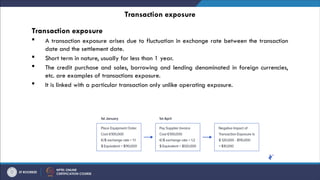
Transaction exposure
 A transaction exposure arises due to fluctuation in exchange rate between the transaction
date and the settlement date.
 Short term in nature, usually for less than 1 year.
 The credit purchase and sales, borrowing and lending denominated in foreign currencies,
etc. are examples of transactions exposure.
 It is linked with a particular transaction only unlike operating exposure.
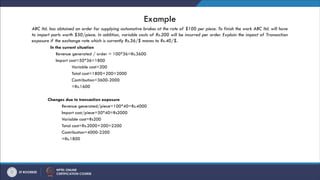
Example
ABC ltd. has obtained an order for supplying automotive brakes at the rate of $100 per piece. To finish the work ABC ltd. will have
to import parts worth $50/piece. In addition, variable costs of Rs.200 will be incurred per order. Explain the impact of Transaction
exposure if the exchange rate which is currently Rs.36/$ moves to Rs.40/$.
In the current situation
Revenue generated / order = 100*36=Rs.3600
Import cost=50*36=1800
Variable cost=200
Total cost=1800+200=2000
Contribution=3600-2000
=Rs.1600
Changes due to transaction exposure
Revenue generated/piece=100*40=Rs.4000
Import cost/piece=50*40=Rs2000
Variable cost=Rs200
Total cost=Rs.2000+200=2200
Contribution=4000-2200
=Rs.1800
Operating Exposure
Operating Exposure
• An operating exposure is the measurement of the extent to which the firm’s operating cash
flows are affected by the exchange rate. Operating exposure is the degree to which
exchange rate changes, in combination with price changes, will alter a company’s future
operating cash flows, and in turn profitability.
• It is long term in nature and is affected by exchange rate as well as inflation rate.
• This not only affects a particular firm but the entire industry as well.
• It is difficult to measure as the cash flows are directly impacted by competition, entry
barriers etc.
• Economic exposure can be mitigated either through operational strategies or currency risk mitigation
strategies. Operational strategies involve diversification of production facilities, end-product markets,
and financing sources, since currency effects may offset each other to some extent if a number of
different currencies are involved.
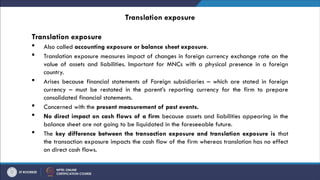
Translation exposure
 Also called accounting exposure or balance sheet exposure.
 Translation exposure measures impact of changes in foreign currency exchange rate on the
value of assets and liabilities. Important for MNCs with a physical presence in a foreign
country.
 Arises because financial statements of Foreign subsidiaries – which are stated in foreign
currency – must be restated in the parent’s reporting currency for the firm to prepare
consolidated financial statements.
 Concerned with the present measurement of past events.
 No direct impact on cash flows of a firm because assets and liabilities appearing in the
balance sheet are not going to be liquidated in the foreseeable future.
 The key difference between the transaction exposure and translation exposure is that
the transaction exposure impacts the cash flow of the firm whereas translation has no effect
on direct cash flows.
Conti…
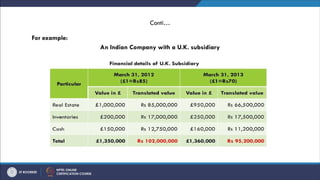
For example:
An Indian Company with a U.K. subsidiary
Conti…
Reducing translation and transaction exposure
– A lead strategy involves attempting to collect foreign currency receivables (payments from
customers) early when a foreign currency is expected to depreciate and paying foreign
currency payables (to supplier) before they are due when a currency is expected to
appreciate. (pay or collect early)
– A lag strategy involves delaying collection of foreign currency receivables if that currency
is expected to appreciate and delaying payables if the currency is expected to depreciate.
(pay or collect late )
Economic exposure
 also called as economic exposure, competitive exposure, or strategic exposure
 It measures any change in the present value of a firm resulting from changes in future
operating cash flows caused by an unexpected change in exchange rates.
• Concerned with the long run effect of changes in exchange rates on future prices, sales, and
costs.
• The two cash flow exposures – operating exposures and transaction exposure – combine to
equal a firm’s economic exposure. Economic exposure is measured by taking in to consideration
the expected future cash flow duly adjusted by exchange rate, and then through the application
of rate of return, the present value is worked out.
Example:
 Consider the effect of wide swings in the value of the dollar on many U.S. firms' international
competitiveness. The rapid rise in the value of the dollar on the foreign exchange market in the
1990s hurt the price competitiveness of many U.S. producer in world markets. U.S. manufacturer
that relied heavily on exports (such as Caterpillar) saw their export volume and world market
share decline.
Conti…
Reducing economic exposure
 Distribute the firm's productive assets to various locations so the firm's long-term financial well-
being is no severely affected by adverse changes in exchange rates.
For example:
 Toyota has production plants distributed around the world in part to make sure that a
rising yen does not price Toyota cars out of local markets.
 Caterpillar has also pursued this strategy, setting up factories around the world that can
act as a hedge against the possibility that a strong dollar will price Caterpillar's exports
out of foreign markets.
Currency or Foreign Exchange Hedging
 Hedging refers to avoidance of foreign exchange risk because spot rates vary
over time..
 It provides a mechanism to guard against losses arising from fluctuations in
exchange rates.
 Investors, trade , businesses and other market participants use forex hedges.
₹
 A forex hedge is meant to protect from losses, not to make a profit.
 It allows hedge to
₹ manage and minimize their exposure to any adverse
exchange rate movement.
 Risk and reward are often proportional to one other; thus reducing risk means
reducing profits.
Example
• An Indian exporter has made export worth $1000.
• If the current spot exchange rate is 1$ = 60, he can get 60000 at the said
₹ ₹
date suppose after three months.
• if the rupee appreciates to 1$= . 50 after maturity, he can get only 50000.
₹ ₹
• Loss of 10000 due to appreciation.
₹
• He can hedge his position by signing a contract with financial institutions after
payment of the hedge premium, like in the case of a life insurance premium.
• The exporter can take an option to sell $1000 at $1 = 60 for the particular
₹
future date say three months.
• He can save his potential loss by performing this contract.
Case of BMW
How BMW dealt with exchange rate risk
• BMW Group, owner of the BMW, Mini and Rolls-Royce brands, has been based in Munich since its founding in
1916. But by 2011, only 17 per cent of the cars it sold were bought in Germany. In recent years, China has
become BMW’s fastest-growing market, accounting for 14 per cent of BMW’s global sales volume in 2011. India,
Russia and eastern Europe have also become key markets.
• Despite rising sales revenues, BMW was conscious that its profits were often severely eroded by changes in
exchange rates. The company’s own calculations in its annual reports suggest that the negative effect of exchange
rates totalled €2.4bn between 2005 and 2009. BMW did not want to pass on its exchange rate costs to
consumers through price increases. Its rival Porsche had done this at the end of the 1980s in the US and sales had
plunged.
Source: Xu Bin and Liu Ying October 29, 2012(Internet)
Steps taken by BMW
• BMW took a two-pronged approach to managing its foreign exchange exposure.
• One strategy was to use a “natural hedge” – meaning it would develop ways to spend money in the same
currency as where sales were taking place, meaning revenues would also be in the local currency. However, not
all exposure could be offset in this way,
• So, BMW decided it would also use formal financial hedges. To achieve this, BMW set up regional treasury
centres in the US, the UK and Singapore.
Strategies adopted by BMW
• The first involved establishing factories in the markets where it sold its products; the second involved making
more purchases denominated in the currencies of its main markets.
Cont.
• BMW now has production facilities for cars and components in 13 countries. In 2000, its overseas production
volume accounted for 20 per cent of the total. By 2011, it had risen to 44 per cent.
• In the 1990s, BMW had become one of the first premium carmakers from overseas to set up a plant in the US –
in Spartanburg, South Carolina. In 2008, BMW announced it was investing $750m to expand its Spartanburg
plant. This would create 5,000 jobs in the US while cutting 8,100 jobs in Germany.
• This also had the effect of shortening the supply chain between Germany and the US market.
• The company boosted its purchasing in US dollars generally, especially in the North American Free Trade
Agreement region. Its office in Mexico City made $615m of purchases of Mexican auto parts in 2009, expected
to rise significantly in following years.
Cont..
• A joint venture with Brilliance China Automotive was set up in Shenyang, China, where half the BMW cars for sale
in the country are now manufactured. The carmaker also set up a local office to help its group purchasing
department to select competitive suppliers in China. By the end of 2009, Rmb6bn worth of purchases were from
local suppliers. Again, this had the effect of shortening supply chains and improving customer service.
• At the end of 2010, BMW announced it would invest 1.8bn rupees in its production plant in Chennai, India, and
increase production capacity in India from 6,000 to 10,000 units. It also announced plans to increase production
in Kaliningrad, Russia.
• Meanwhile, the overseas regional treasury centres were instructed to review the exchange rate exposure in their
regions on a weekly basis and report it to a group treasurer, part of the group finance operation, in Munich. The
group treasurer team then consolidates risk figures globally and recommends actions to mitigate foreign
exchange risk.
Inference
• By moving production to foreign markets the company not only reduces its foreign
exchange exposure but also benefits from being close to its customers.
• In addition, sourcing parts overseas, and therefore closer to its foreign markets, also
helps to diversify supply chain risks.
Currency Convertibility
Convertibility essentially means the ability of residents and nonresidents to exchange domestic currency
for foreign currency, without limit, whatever be the purpose of the transactions.
Currency convertibility refers to the freedom to convert the domestic currency into other internationally
accepted currencies and vice versa at market determined rates of exchange.
A convertible currency can be easily traded on forex markets with little to no restrictions.
A convertible currency (e.g., U.S. dollar, Euro, Japanese Yen, and the British pound) is seen as a reliable
store of value, meaning an investor will have no trouble buying and selling the currency.
For example: Rupee can be converted in USA dollars more easily and USA dollars can be converted in
Indian currency for buying and selling of goods and services.
CONTI..
Non-convertible Currency
– Also known as a "blocked currency". (A blocked currency is a currency that can’t freely be
converted to other currencies on the foreign exchange (FX) market as a result of exchange
controls.)
– Any currency that is used primarily for domestic transactions and is not openly traded on a
foreign exchange market. This usually is a result of government restrictions, which prevent it from
being exchanged for foreign currencies.
– The currency is generally blocked because of government restrictions, including foreign exchange
regulations, government restrictions, physical barriers, political sanctions or extremely high
volatility.​
​
​
​
​
​
​
For example:
 Cuba- Cuban peso (CUP)
 Iran-Iranian rial (IRR)
 North Korean Won
Convertible virtual currency
• The rise in popularity of cryptocurrencies in recent years has brought about the need of convertible
virtual currency. This refers to digital currencies such as bitcoin, Ether, and Ripple, which are
unregulated but can be used as a substitute for real and legally recognized currency even though
they do not have the status of legal tender.
Why do countries limit currency convertibility?
 The main reason is to preserve foreign exchange reserves and prevent capital flight: when residents
and nonresidents rush to convert their holdings of domestic currency into a foreign currency. Capital flight
is most likely to occur when the value of the domestic currency is depreciating rapidly because of
hyperinflation, or when a country's economic prospects are shaky in other respects.
 By restricting the exchange of one money to an outside currency, a country would try to control and
keep its currency more stable.
 In the case of a nonconvertible currency, firms may turn to countertrade (barter like agreements by
which goods and services can be traded for other goods and services) to facilitate international trade.
Types of Currency Convertibility
 Non-convertible when neither residents nor nonresidents are allowed to convert it into a foreign
currency.
 Partial Convertible when only nonresidents may convert domestic currency into a foreign
currency without any limitations.
 Full convertible when the country's government allows both residents and nonresidents to
purchase unlimited amounts of a foreign currency with the domestic currency.
Conti…
Non-Convertible-
 Example: capital Cuba(peso) and North Korea(won)
 Non participation in FOREX market Major challenge for domestic currencies there.
Partial Convertible-
 Example: Indian Rupee
 RBI’s restriction on the inflow and outflow of capital
Full Convertible-
 Example: U.S. dollar, Euro, Japanese Yen, and the British pound.
 No restrictions or limitation on the amount to be traded
 Thus, this is one of the major currency traded in FOREX market
Conti…
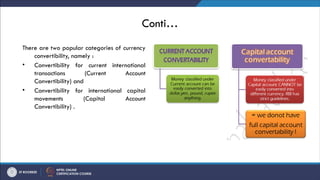
There are two popular categories of currency
convertibility, namely :
• Convertibility for current international
transactions (Current Account
Convertibility) and
• Convertibility for international capital
movements (Capital Account
Convertibility) .
Current Account Convertibility
Current account convertibility refers to freedom in respect of payments and transfers for current
international transactions.
Transactions relating to:
• Exchange of goods and services
• Money transfers
• In other words, if Indians are allowed to buy only foreign goods and services but restrictions remain
on the purchase of assets abroad, it is only current account convertibility.
• Convertibility of the rupee into foreign currencies is almost wholly free for current account i.e. in case
of transactions such as trade, access foreign currency for travel and tourism, education abroad, make
remittances, medical treatment and gifts, etc.
Current Account Transactions
 All imports and exports of merchandise.
 Invisible Exports and Imports (sale/purchase of services)
 Inward private remittances (to & fro)
 Pension payments (to & fro)
 Government Grants (both ways)
Capital Account Convertibility
Capital account convertibility refers to the freedom of converting local financial assets into foreign
financial assets and vice versa at market determined rates of exchange. It refers to the elimination of
restraints on international flows on a country’s capital account, facilitating full currency convertibility
and opening of the financial system.
– Article VI (3) of agreement of the International Monetary Fund allows members to
exercise such controls as are necessary to regulate international capital movements,
but not so as to restrict payments for current transactions.
Conti…
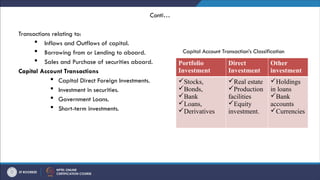
Transactions relating to:
 Inflows and Outflows of capital.
 Borrowing from or Lending to aboard.
 Sales and Purchase of securities aboard.
Capital Account Transactions
 Capital Direct Foreign Investments.
 Investment in securities.
 Government Loans.
 Short-term investments.
Portfolio
Investment
Direct
Investment
Other
investment
Stocks,
Bonds,
Bank
Loans,
Derivatives
Real estate
Production
facilities
Equity
investment.
Holdings
in loans
Bank
accounts
Currencies
Capital Account Transaction’s Classification
Rupee Convertibility
• Till 1991, one had to get permission from the Government or RBI as the case may be to procure
foreign currency, say US Dollars, for any purpose. Be it import of raw material, travel abroad,
procuring books or paying fees for a ward who pursues higher studies abroad. Similarly, any
exporter who exports goods or services and brings foreign currency into the country has to surrender
the foreign exchange to RBI and get it converted at a rate pre-determined by RBI.
• Up to1991, there was rigid control on both Capital and Current account.
• After start of liberalization in1991, India had accepted the IMF rules for currency reforms.
• After the announcement of economic liberalization in July 1991, Govt. of India announced partial
convertibility of Rupee from March 1, 1992. Under this partial convertibility 40% of the current
account transactions were convertible in rupee at officially determined exchange rate and remaining
60% at market determined exchange rate.
• India is still a country of partial convertibility (40:60) in the capital account.
• In March’ 1994, even indivisibles and remittances from abroad were allowed to be freely convertible
into rupees at market determined exchange rate on the basis of strict guidelines.
Conti…
• Capital account convertibility was introduced in India in August 1994.
• In 1997 the government had set up a committee (Tarapore committee) to spell out a road map for
the full convertibility of the rupee.
• Reserve Bank of India appointed the second Tarapore committee to set out the framework for fuller
Capital Account Convertibility.
• The committee was established to revisit the subject of fuller capital account convertibility in the
context of the progress in economic reforms, the stability of the external and financial sectors,
accelerated growth and global integration.
• The report of this committee was made public by RBI on 1st September 2006 had drawn up a
roadmap for 2011 as the target date for fuller capital convertibility of rupee.
The government is adopting a cautious approach, taking into consideration all aspects and the risks
involved in opening up the economy by allowing convertibility of the currency.
Benefits of Capital Account Convertibility to India
The Tarapore Committee mentioned the following benefits of capital account convertibility to India:
 Availability of large funds to supplement domestic resources and thereby promote economic growth.
 Improved access to international financial markets and reduction in cost of capital.
 Incentive for Indians to acquire and hold international securities and assets, and
 Improvement of the financial system in the context of global competition.
 Freedom to convert local financial assets into foreign ones at market determined exchange rates
 Leads to free exchange of currency at lower rates and an unrestricted mobility of capital
FERA
The Foreign Exchange Regulation Act was formulated with the aim of controlling foreign exchange to preserve the foreign reserves,
which were seen as a scarce resource back then. The aim was to regulate foreign payments, regulate the dealings in foreign
exchanges and security and conservation the foreign exchange for the nation. There are a total of 81 sections under this act. Some
important features of the FERA are as follows:
• The RBI shall authorise a company/individual for dealings in foreign exchange
• RBI has the power to authorise the dealers for transactions in foreign currencies and even revoke the authorisation in cases of non-
compliance
• Money changers, the individuals who are entrusted with the responsibility of converting currency, shall be authorised by the RBI to
do so at the specified rates (by RBI)
• No individual apart from the authorised dealers shall attempt to deal in cases of foreign exchange
• The foreign currency shall only be used for the purposes it was acquired for
• In case that is not possible, the currency shall be sold to another dealer within 30 days
• No person, without permission from RBI, is liable to make any transactions with a partner, not a resident of India
• No negotiations shall be made regarding any bills of exchange in which the right to receive payment is outside India
• No person is permissible to make any credits into the account of any person outside India
• No individual, other than the ones authorised by the RBI is liable to send foreign currency outside the territory of India
• The person, liable to make foreign exchanges, shall not delay the receipt of the foreign exchange
The FERA faced severe criticism and received backlash from the economic experts because it hindered growth and also produced
several impediments in the path of modernisation of Indian industries.
FEMA
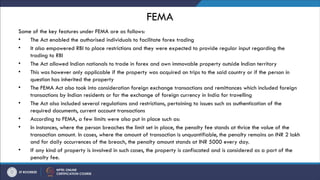
Some of the key features under FEMA are as follows:
• The Act enabled the authorised individuals to facilitate forex trading
• It also empowered RBI to place restrictions and they were expected to provide regular input regarding the
trading to RBI
• The Act allowed Indian nationals to trade in forex and own immovable property outside Indian territory
• This was however only applicable if the property was acquired on trips to the said country or if the person in
question has inherited the property
• The FEMA Act also took into consideration foreign exchange transactions and remittances which included foreign
transactions by Indian residents or for the exchange of foreign currency in India for travelling
• The Act also included several regulations and restrictions, pertaining to issues such as authentication of the
required documents, current account transactions
• According to FEMA, a few limits were also put in place such as:
• In instances, where the person breaches the limit set in place, the penalty fee stands at thrice the value of the
transaction amount. In cases, where the amount of transaction is unquantifiable, the penalty remains on INR 2 lakh
and for daily occurrences of the breach, the penalty amount stands at INR 5000 every day.
• If any kind of property is involved in such cases, the property is confiscated and is considered as a part of the
penalty fee.
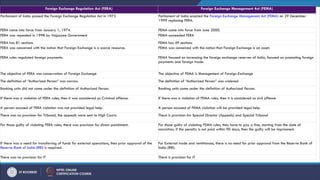
Foreign Exchange Regulation Act (FERA) Foreign Exchange Management Act (FEMA)
Parliament of India passed the Foreign Exchange Regulation Act in 1973 Parliament of India enacted the Foreign Exchange Management Act (FEMA) on 29 December
1999 replacing FERA.
FERA came into force from January 1, 1974. FEMA came into force from June 2000.
FERA was repealed in 1998 by Vajpayee Government FEMA succeeded FERA
FERA has 81 sections FEMA has 49 sections
FERA was conceived with the notion that Foreign Exchange is a scarce resource. FEMA was conceived with the notion that Foreign Exchange is an asset.
FERA rules regulated foreign payments. FEMA focused on increasing the foreign exchange reserves of India, focused on promoting foreign
payments and foreign trade.
The objective of FERA was conservation of Foreign Exchange The objective of FEMA is Management of Foreign Exchange
The definition of “Authorized Person” was narrow. The definition of “Authorized Person” was widened
Banking units did not come under the definition of Authorized Person. Banking units came under the definition of Authorized Person.
If there was a violation of FERA rules, then it was considered as Criminal offence. If there was a violation of FEMA rules, then it is considered as civil offence
A person accused of FERA violation was not provided legal help. A person accused of FEMA violation will be provided legal help.
There was no provision for Tribunal, the appeals were sent to High Courts There is provision for Special Director (Appeals) and Special Tribunal
For those guilty of violating FERA rules, there was provision for direct punishment. For those guilty of violating FEMA rules, they have to pay a fine, starting from the date of
conviction, if the penalty is not paid within 90 days, then the guilty will be imprisoned.
If there was a need for transferring of funds for external operations, then prior approval of the
Reserve Bank of India (RBI) is required.
For External trade and remittances, there is no need for prior approval from the Reserve Bank of
India (RBI).
There was no provision for IT There is provision for IT
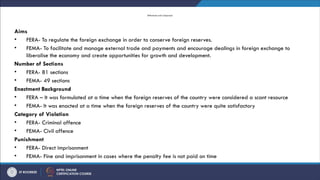
Differences and Comparison
Aims
• FERA- To regulate the foreign exchange in order to conserve foreign reserves.
• FEMA- To facilitate and manage external trade and payments and encourage dealings in foreign exchange to
liberalise the economy and create opportunities for growth and development.
Number of Sections
• FERA- 81 sections
• FEMA- 49 sections
Enactment Background
• FERA – It was formulated at a time when the foreign reserves of the country were considered a scant resource
• FEMA- It was enacted at a time when the foreign reserves of the country were quite satisfactory
Category of Violation
• FERA- Criminal offence
• FEMA- Civil offence
Punishment
• FERA- Direct imprisonment
• FEMA- Fine and imprisonment in cases where the penalty fee is not paid on time
THANK YOU

15.Foreign exchange.pptx methodolies and policies

  • 1.
  • 2.
    What is ForeignExchange? Foreign Exchange or forex The trading of one currency for another or system of converting one national currency into another (Rupee for Dollar). It also involves trading one currency for another. An exchange rate is the price of a currency(value of one currency relative to the other 1$US = Rs.82.9). It is essential for the trading between nations. Most popular is the U.S dollar followed by euro. For example, how many Indian rupees does it take to buy one U.S. Dollar? As of now, the exchange rate is 82.9, meaning it takes Rs. 82.9 to buy $1 U.S.
  • 3.
    Foreign Exchange Market A market in which National currencies are bought and sold against one another. Some foreign exchange markets are Mumbai, London, New York, Tokyo, Zurich and Frankfurt)  The foreign exchange market is one of the largest and most liquid markets in the world. It is dominated by the U.S. dollar, the Euro, the Japanese yen, and the British pound.  The Forex market has an estimated turnover of $7.5 trillion a day as per Bureau of International Settlements (2022)  Without the foreign exchange market, international trade and international investment would be impossible; companies would have to resort to barter.
  • 4.
    Features of ForeignExchange Market The foreign exchange market is unique because of • The foreign exchange market is a global network of banks, brokers, and foreign exchange dealers connected by electronic communications systems. (JP Morgan Chase, Bank of America Merrill Lynch, Citi, Goldman Sachs, HSBC, Deutsche Bank, Standard Chartered) • Foreign exchange market functions 24 hours of the day (different time zones of the globe). • If exchange rates quoted in different markets were not essentially the same, there would be an opportunity for arbitrage - the process of buying a currency low and selling it high. For example: If the dollar price of the euro $0.99 in New York and $1.01 in Frankfurt. An arbitrageur would purchase Euros at $0.99 in New York and immediately resell them in Frankfurt for $1.01, thus realizing a profits of $0.02 per euro. • The variety of factors that affect exchange rates like inflation rate, interest rate, money supply etc.
  • 5.
    Market share ofleading foreign exchange currencies in 2019/2022, by value of turnover •In terms of global liquidity and all over the place, by far the most utilized currency is the U.S. dollar – known widely as ‘the world’s reserve currency’ – because every country on the planet keeps large sums of dollars in reserve in order to make hard currency trades on majority commodities like oil, gas, grain and gold. Most transactions involve U.S. dollars on one side. – the U.S. dollar is a vehicle currency. (the Bretton Woods Agreement established that the central banks would maintain fixed exchange rates between their currencies and the dollar. )
  • 6.
    Participants in TheForeign Exchange Market For example, if rupee shows signs of depreciation, RBI (central bank) may release (sell) a certain amount of foreign currency (like dollar). JP Morgan Chase, Bank of America Merrill Lynch, Citi, Goldman Sachs, HSBC, Remittances or education fee Samsung has reported a 2,500 crore (~$360 ₹ million) investment in India to expand production in the country.
  • 7.
    Participants • Commercial Banks:These banks serve their retail clients, the bank customers, in conducting foreign commerce or making international investment in financial assets that require foreign exchange. • Foreign exchange brokers: they operate in the international currency market and act as agents who facilitate trading between dealers. Unlike the banks, brokers serve merely as matchmakers and do not put their own money at risk. • Central banks: Another important player in the foreign market is Central bank of the various countries. Central banks frequently intervene in the market to maintain the exchange rates of their currencies within a desired range and to smooth fluctuations within that range. • MNCs: are the major non-bank participants in the forward market as they exchange cash flows associated with their multinational operations. MNCs often contract to either pay or receive fixed amounts in foreign currencies at future dates, so they are exposed to foreign currency risk. This is why they often hedge these future cash flows through the inter-bank forward exchange market. • Individuals and Small Businesses: Individuals and small businesses also use foreign exchange market to facilitate execution of commercial or investment transactions. The foreign needs of these players are usually small and account for only a fraction of all foreign exchange transactions. • Fund Managers, Hedge Funds, and Sovereign Wealth Funds: They are basically transnational and home- country’s money managers who may deal in hundreds of millions of dollars, as their portfolios of investment funds are often quite large. The major aim of hedge funds is to make profits and grow their portfolios.
  • 8.
    Functions of foreignExchange Market  Transfer of Purchasing Power/Clearing Function- The basic function of the foreign exchange market is to facilitate the conversion of one currency into another. Example: – if an American businessman plans a trip to India, he exchanges U.S. dollars for Indian rupees through the foreign exchange market.  Provision of Credit - Just like domestic trade, foreign trade also depends on credit. The Credit Function of the Foreign Exchange Market implies the provision of credit in terms of foreign exchange for the export and import of goods and services. For this, bills of exchange(like a cheque) are generally used for making payments internationally. The duration of Bills of Exchange is usually three months. The main purpose of credit is to help the importer in taking possession of goods, sell them and obtain the money to pay the bills.  Example: • Paytm had raised $300 million from Warren Buffett’s Berkshire Hathaway in September 2018.
  • 9.
    Conti.. • Provision ofHedging facilities -By hedging, we mean covering of a foreign exchange risk arising out of the changes in exchange rates. When exporters and importers enter into an agreement to sell and buy goods on some future date at the current prices and exchange rate, it is called hedging. The purpose of hedging is to avoid losses that might be caused due to exchange rate variations in the future. • Example  An Indian exporter has made export worth $1000.  If the current spot exchange rate is 1$ = 60, he can get 60000 at the said date suppose ₹ ₹ after three months.  if the rupee appreciates to 1$= . 50 after maturity, he can get only 50000. ₹ ₹  Loss of 10000 due to appreciation. ₹  He can hedge his position by signing a contract with financial institutions after payment of the hedge premium, like in the case of a life insurance premium.  The exporter can take can take an option to sell $1000 at $1 = 60 for the particular future ₹ date say three months.  He can save his potential loss by performing this contract.
  • 10.
  • 11.
    Introduction Foreign Exchange rateindicates a country’s economic health and stability. It may fluctuate daily with the changing market forces of supply and demand of currencies from one country to another.
  • 12.
    Factors Affecting ExchangeRate Some of the key factors that can affect a currency are as follows: Relative interest rates Relative inflation rate Relative income level Government interventions Political stability & performance Country’s current account deficits Government debt Speculation
  • 13.
    Relative Interest Rates Higherinterest rates offer lenders in an economy a higher return relative to other countries. Therefore, higher interest rates attract foreign capital and cause the exchange rate to rise. The impact of higher interest rates is mitigated, however, if inflation in the country is much higher than in others, or if additional factors serve to drive the currency down. The opposite relationship exists for decreasing interest rates – that is, lower interest rates tend to decrease exchange rates.
  • 14.
    Relative Inflation Rate Ahigher rate of inflation will make a country’s currency less attractive because of the loss of real value with inflation. Countries with consistently high inflation rates tend to have lower currency values. This is because purchasing value decreases relative to other countries and vice versa. For example : Venezuela’s hyperinflation rate increased from 9,02 percent to 10 million percent since 2018, according to the International Monetary Fund.
  • 15.
    Relative Income Level •Citizens with higher incomes look for new consumption opportunities in other countries, driving up the demand for those currencies and shifting the demand curve to the right. • Thus, as incomes rise in one country, the prices of foreign currencies rise as well and the local currency will depreciate.
  • 16.
    Government Interventions • Buyingand selling of foreign currency in the market by the Central Bank with a view to increasing the supply or demand, there by affecting the exchange rate, is known as intervention. • Governments may influence the equilibrium exchange rate by:  imposing foreign exchange barriers,  imposing foreign trade barriers  intervening in the foreign exchange market, and  affecting macro variables such as inflation, interest rates, and income levels.
  • 17.
    Example • In 2007,India experienced rapid appreciation of its currency against the US dollar. The reasons for the appreciation of the rupee were a generally weak dollar in international currency markets and sharp increase in dollar inflows into the country, partly due to India's increasing attractiveness to foreign investors. Although India had been seeing a steady rise in dollar inflows into the country for quite some time, on earlier occasions, the Reserve Bank of India (RBI intervened in the foreign currency market and purchased excess dollars so as to avoid any appreciation in the value of the rupee. • On November 24, 2016, the rupee hit a record low of 69.09, sliding past its earlier trough of 68.86. so, to curb the Indian currency’s fall , the Reserve Bank of India (RBI) sold $400-500 million in the spot market. • On Sept. 2018, India raised import duty on a range of items including air-conditioners, refrigerators, washing machines, footwear, jewellery, furniture fittings and tableware besides imposing it on aviation turbine fuel (ATF) as the government seeks to rein in the current account deficit and shore up the rupee. https://economictimes.indiatimes.com/
  • 18.
    Political Stability &Performance A country's political state and economic performance can affect its currency strength. Foreign investors inevitably seek out stable countries with strong economic performance in which to invest their capital. A country with such positive attributes will draw investment funds away from other countries perceived to have more political and economic risk. If an economy is growing at a faster rate, in the long-run, it is generally expected to have a better performance on Balance of Trade . Political turmoil, for example, can cause a loss of confidence in a currency and a movement of capital to the currencies of more stable countries. For example, if markets feared the US would default on its debt, foreign investors would sell their holdings of US bonds. This would cause a fall in the value of the dollar.
  • 19.
    Current Account Deficits •A deficit on the current account means that the value of imports (of goods and services) is greater than the value of exports. If this is financed by a surplus on the financial/capital account, then this is OK. • But a country which struggles to attract enough capital inflows to finance a current account deficit will see a depreciation in the currency
  • 20.
    Example What is Kenya’sexperience? • Kenya’s current account balance has generally been in deficit since 2004 when the deficit stood at 0.82 percent of GDP. The deficit widened to stand at about 10 percent of GDP in 2012 largely reflecting a faster growth in imports of goods into the country relative to exports. • The imports have been largely in machinery and transport equipment, manufactured goods and oil products for industrial purposes. These are essential goods whose demand is not responsive to price changes. Growth in exports has been sluggish with little diversification away from the traditional exports of coffee, tea and horticulture. • International trade in services which form part of the current account balance has been in a surplus over the years, mainly due to improved earnings in export of transportation services, tourism services, communication services among others. Net current transfers also increased, supported largely by rising emigrant remittances. • However, the growth in the services account and net current transfers was not sufficient to offset the deficit in the merchandise or goods account. • The huge import bill in the current account increases demand for foreign currency, while slowdown in exports of goods reduces the inflow of foreign currency. • The combined effect exerts pressure on the exchange rate to depreciate (weaken).
  • 21.
    Government Debt •Countries withhigh amounts of debt are less attractive to foreign investors due to the chance of default as well as possible high inflation rates. This can decrease the currency’s value.
  • 22.
    Speculation or Expectations Most trades in the forex markets are speculative trades, which means that sentiment and momentum can play big roles in market activity. Even if the fundamentals don’t align, the market for a currency can continue soaring or depreciating if traders and governments perceive it should.  If a country's currency value is expected to rise, investors will demand more of that currency in order to make a profit in the near future. As a result, the value of the currency will rise due to the increase in demand. With this increase in currency value comes a rise in the exchange rate as well and vice versa.  Because of speculative transactions, foreign exchange rates can be very volatile.
  • 23.
    Conti… SIGNAL IMPACT ON$ Poor U.S. economic indicators Weakened Fed chairman suggests Fed is unlikely to cut U.S. interest rates Strengthened A possible decline in Indian interest rates Strengthened Central banks expected to intervene to boost the Rupee Weakened
  • 24.
    CONTI.. Example • Suppose theexchange rate today is . 70 /US $ . ₹ • The speculator anticipates this rate to become . 71/US within the coming three months . ₹ • Under these circumstances , he will buy US $1,000 for 70000 and hold this amount for three months ₹ , although he is not committed to this particular time horizon . • When the target exchange rate is reached , he will sell US $1000 at the new exchange rate , that is at 71 per dollar and ₹ • Earn a profit of . 71000- 70000 = . 1000 ₹ ₹
  • 25.
  • 26.
    Foreign Exchange Exposure Eachfirm is “exposed” to unforeseen changes by a number of variables in its environment. These variables are called Risk Factor. e.g. Exchange rate fluctuation one such risk factor. It is a measure of the potential change for a firm’s profitability, net cash flow, and market value because of a change in exchange rates. Exposure: Exposure refers to the degree to which a company is affected by exchange rate changes. The measure of the sensitivity of a firm’s performance to fluctuations in the relevant risk factor (Exchange rate fluctuation) i.e. whether or not a certain risk factor affects a firms performance. Foreign Exchange Exposure A measure of the potential for a firm’s – Profitability – Net cash flow – Market value of assets and liabilities to change because of a change in exchange rates
  • 27.
    Some examples • Starbucks:In fiscal 2004, its revenue increased almost 32%, (in part) because of the weakening U.S. dollar against both the Canadian dollar and the British pound. • McDonalds: In 2000, the weak euro, British pound and Australian dollar had a negative impact upon reported (US dollar) results. • In 2017, General Motors reported that fourth-quarter net income declined by $500 million due to foreign currency losses.
  • 28.
    Types of Exposure Transaction exposure  Operating/economic exposure  Translation exposure(accounting exposure)
  • 29.
    Transaction exposure Transaction exposure A transaction exposure arises due to fluctuation in exchange rate between the transaction date and the settlement date.  Short term in nature, usually for less than 1 year.  The credit purchase and sales, borrowing and lending denominated in foreign currencies, etc. are examples of transactions exposure.  It is linked with a particular transaction only unlike operating exposure.
  • 30.
    Example ABC ltd. hasobtained an order for supplying automotive brakes at the rate of $100 per piece. To finish the work ABC ltd. will have to import parts worth $50/piece. In addition, variable costs of Rs.200 will be incurred per order. Explain the impact of Transaction exposure if the exchange rate which is currently Rs.36/$ moves to Rs.40/$. In the current situation Revenue generated / order = 100*36=Rs.3600 Import cost=50*36=1800 Variable cost=200 Total cost=1800+200=2000 Contribution=3600-2000 =Rs.1600 Changes due to transaction exposure Revenue generated/piece=100*40=Rs.4000 Import cost/piece=50*40=Rs2000 Variable cost=Rs200 Total cost=Rs.2000+200=2200 Contribution=4000-2200 =Rs.1800
  • 31.
    Operating Exposure Operating Exposure •An operating exposure is the measurement of the extent to which the firm’s operating cash flows are affected by the exchange rate. Operating exposure is the degree to which exchange rate changes, in combination with price changes, will alter a company’s future operating cash flows, and in turn profitability. • It is long term in nature and is affected by exchange rate as well as inflation rate. • This not only affects a particular firm but the entire industry as well. • It is difficult to measure as the cash flows are directly impacted by competition, entry barriers etc. • Economic exposure can be mitigated either through operational strategies or currency risk mitigation strategies. Operational strategies involve diversification of production facilities, end-product markets, and financing sources, since currency effects may offset each other to some extent if a number of different currencies are involved.
  • 32.
    Translation exposure Translation exposure Also called accounting exposure or balance sheet exposure.  Translation exposure measures impact of changes in foreign currency exchange rate on the value of assets and liabilities. Important for MNCs with a physical presence in a foreign country.  Arises because financial statements of Foreign subsidiaries – which are stated in foreign currency – must be restated in the parent’s reporting currency for the firm to prepare consolidated financial statements.  Concerned with the present measurement of past events.  No direct impact on cash flows of a firm because assets and liabilities appearing in the balance sheet are not going to be liquidated in the foreseeable future.  The key difference between the transaction exposure and translation exposure is that the transaction exposure impacts the cash flow of the firm whereas translation has no effect on direct cash flows.
  • 33.
    Conti… For example: An IndianCompany with a U.K. subsidiary
  • 34.
    Conti… Reducing translation andtransaction exposure – A lead strategy involves attempting to collect foreign currency receivables (payments from customers) early when a foreign currency is expected to depreciate and paying foreign currency payables (to supplier) before they are due when a currency is expected to appreciate. (pay or collect early) – A lag strategy involves delaying collection of foreign currency receivables if that currency is expected to appreciate and delaying payables if the currency is expected to depreciate. (pay or collect late )
  • 35.
    Economic exposure  alsocalled as economic exposure, competitive exposure, or strategic exposure  It measures any change in the present value of a firm resulting from changes in future operating cash flows caused by an unexpected change in exchange rates. • Concerned with the long run effect of changes in exchange rates on future prices, sales, and costs. • The two cash flow exposures – operating exposures and transaction exposure – combine to equal a firm’s economic exposure. Economic exposure is measured by taking in to consideration the expected future cash flow duly adjusted by exchange rate, and then through the application of rate of return, the present value is worked out. Example:  Consider the effect of wide swings in the value of the dollar on many U.S. firms' international competitiveness. The rapid rise in the value of the dollar on the foreign exchange market in the 1990s hurt the price competitiveness of many U.S. producer in world markets. U.S. manufacturer that relied heavily on exports (such as Caterpillar) saw their export volume and world market share decline.
  • 36.
    Conti… Reducing economic exposure Distribute the firm's productive assets to various locations so the firm's long-term financial well- being is no severely affected by adverse changes in exchange rates. For example:  Toyota has production plants distributed around the world in part to make sure that a rising yen does not price Toyota cars out of local markets.  Caterpillar has also pursued this strategy, setting up factories around the world that can act as a hedge against the possibility that a strong dollar will price Caterpillar's exports out of foreign markets.
  • 37.
    Currency or ForeignExchange Hedging  Hedging refers to avoidance of foreign exchange risk because spot rates vary over time..  It provides a mechanism to guard against losses arising from fluctuations in exchange rates.  Investors, trade , businesses and other market participants use forex hedges. ₹  A forex hedge is meant to protect from losses, not to make a profit.  It allows hedge to ₹ manage and minimize their exposure to any adverse exchange rate movement.  Risk and reward are often proportional to one other; thus reducing risk means reducing profits.
  • 38.
    Example • An Indianexporter has made export worth $1000. • If the current spot exchange rate is 1$ = 60, he can get 60000 at the said ₹ ₹ date suppose after three months. • if the rupee appreciates to 1$= . 50 after maturity, he can get only 50000. ₹ ₹ • Loss of 10000 due to appreciation. ₹ • He can hedge his position by signing a contract with financial institutions after payment of the hedge premium, like in the case of a life insurance premium. • The exporter can take an option to sell $1000 at $1 = 60 for the particular ₹ future date say three months. • He can save his potential loss by performing this contract.
  • 39.
    Case of BMW HowBMW dealt with exchange rate risk • BMW Group, owner of the BMW, Mini and Rolls-Royce brands, has been based in Munich since its founding in 1916. But by 2011, only 17 per cent of the cars it sold were bought in Germany. In recent years, China has become BMW’s fastest-growing market, accounting for 14 per cent of BMW’s global sales volume in 2011. India, Russia and eastern Europe have also become key markets. • Despite rising sales revenues, BMW was conscious that its profits were often severely eroded by changes in exchange rates. The company’s own calculations in its annual reports suggest that the negative effect of exchange rates totalled €2.4bn between 2005 and 2009. BMW did not want to pass on its exchange rate costs to consumers through price increases. Its rival Porsche had done this at the end of the 1980s in the US and sales had plunged. Source: Xu Bin and Liu Ying October 29, 2012(Internet)
  • 40.
    Steps taken byBMW • BMW took a two-pronged approach to managing its foreign exchange exposure. • One strategy was to use a “natural hedge” – meaning it would develop ways to spend money in the same currency as where sales were taking place, meaning revenues would also be in the local currency. However, not all exposure could be offset in this way, • So, BMW decided it would also use formal financial hedges. To achieve this, BMW set up regional treasury centres in the US, the UK and Singapore. Strategies adopted by BMW • The first involved establishing factories in the markets where it sold its products; the second involved making more purchases denominated in the currencies of its main markets.
  • 41.
    Cont. • BMW nowhas production facilities for cars and components in 13 countries. In 2000, its overseas production volume accounted for 20 per cent of the total. By 2011, it had risen to 44 per cent. • In the 1990s, BMW had become one of the first premium carmakers from overseas to set up a plant in the US – in Spartanburg, South Carolina. In 2008, BMW announced it was investing $750m to expand its Spartanburg plant. This would create 5,000 jobs in the US while cutting 8,100 jobs in Germany. • This also had the effect of shortening the supply chain between Germany and the US market. • The company boosted its purchasing in US dollars generally, especially in the North American Free Trade Agreement region. Its office in Mexico City made $615m of purchases of Mexican auto parts in 2009, expected to rise significantly in following years.
  • 42.
    Cont.. • A jointventure with Brilliance China Automotive was set up in Shenyang, China, where half the BMW cars for sale in the country are now manufactured. The carmaker also set up a local office to help its group purchasing department to select competitive suppliers in China. By the end of 2009, Rmb6bn worth of purchases were from local suppliers. Again, this had the effect of shortening supply chains and improving customer service. • At the end of 2010, BMW announced it would invest 1.8bn rupees in its production plant in Chennai, India, and increase production capacity in India from 6,000 to 10,000 units. It also announced plans to increase production in Kaliningrad, Russia. • Meanwhile, the overseas regional treasury centres were instructed to review the exchange rate exposure in their regions on a weekly basis and report it to a group treasurer, part of the group finance operation, in Munich. The group treasurer team then consolidates risk figures globally and recommends actions to mitigate foreign exchange risk.
  • 43.
    Inference • By movingproduction to foreign markets the company not only reduces its foreign exchange exposure but also benefits from being close to its customers. • In addition, sourcing parts overseas, and therefore closer to its foreign markets, also helps to diversify supply chain risks.
  • 44.
  • 45.
    Currency Convertibility Convertibility essentiallymeans the ability of residents and nonresidents to exchange domestic currency for foreign currency, without limit, whatever be the purpose of the transactions. Currency convertibility refers to the freedom to convert the domestic currency into other internationally accepted currencies and vice versa at market determined rates of exchange. A convertible currency can be easily traded on forex markets with little to no restrictions. A convertible currency (e.g., U.S. dollar, Euro, Japanese Yen, and the British pound) is seen as a reliable store of value, meaning an investor will have no trouble buying and selling the currency. For example: Rupee can be converted in USA dollars more easily and USA dollars can be converted in Indian currency for buying and selling of goods and services.
  • 46.
    CONTI.. Non-convertible Currency – Alsoknown as a "blocked currency". (A blocked currency is a currency that can’t freely be converted to other currencies on the foreign exchange (FX) market as a result of exchange controls.) – Any currency that is used primarily for domestic transactions and is not openly traded on a foreign exchange market. This usually is a result of government restrictions, which prevent it from being exchanged for foreign currencies. – The currency is generally blocked because of government restrictions, including foreign exchange regulations, government restrictions, physical barriers, political sanctions or extremely high volatility.​ ​ ​ ​ ​ ​ ​ For example:  Cuba- Cuban peso (CUP)  Iran-Iranian rial (IRR)  North Korean Won
  • 47.
    Convertible virtual currency •The rise in popularity of cryptocurrencies in recent years has brought about the need of convertible virtual currency. This refers to digital currencies such as bitcoin, Ether, and Ripple, which are unregulated but can be used as a substitute for real and legally recognized currency even though they do not have the status of legal tender.
  • 48.
    Why do countrieslimit currency convertibility?  The main reason is to preserve foreign exchange reserves and prevent capital flight: when residents and nonresidents rush to convert their holdings of domestic currency into a foreign currency. Capital flight is most likely to occur when the value of the domestic currency is depreciating rapidly because of hyperinflation, or when a country's economic prospects are shaky in other respects.  By restricting the exchange of one money to an outside currency, a country would try to control and keep its currency more stable.  In the case of a nonconvertible currency, firms may turn to countertrade (barter like agreements by which goods and services can be traded for other goods and services) to facilitate international trade.
  • 49.
    Types of CurrencyConvertibility  Non-convertible when neither residents nor nonresidents are allowed to convert it into a foreign currency.  Partial Convertible when only nonresidents may convert domestic currency into a foreign currency without any limitations.  Full convertible when the country's government allows both residents and nonresidents to purchase unlimited amounts of a foreign currency with the domestic currency.
  • 50.
    Conti… Non-Convertible-  Example: capitalCuba(peso) and North Korea(won)  Non participation in FOREX market Major challenge for domestic currencies there. Partial Convertible-  Example: Indian Rupee  RBI’s restriction on the inflow and outflow of capital Full Convertible-  Example: U.S. dollar, Euro, Japanese Yen, and the British pound.  No restrictions or limitation on the amount to be traded  Thus, this is one of the major currency traded in FOREX market
  • 51.
    Conti… There are twopopular categories of currency convertibility, namely : • Convertibility for current international transactions (Current Account Convertibility) and • Convertibility for international capital movements (Capital Account Convertibility) .
  • 52.
    Current Account Convertibility Currentaccount convertibility refers to freedom in respect of payments and transfers for current international transactions. Transactions relating to: • Exchange of goods and services • Money transfers • In other words, if Indians are allowed to buy only foreign goods and services but restrictions remain on the purchase of assets abroad, it is only current account convertibility. • Convertibility of the rupee into foreign currencies is almost wholly free for current account i.e. in case of transactions such as trade, access foreign currency for travel and tourism, education abroad, make remittances, medical treatment and gifts, etc.
  • 53.
    Current Account Transactions All imports and exports of merchandise.  Invisible Exports and Imports (sale/purchase of services)  Inward private remittances (to & fro)  Pension payments (to & fro)  Government Grants (both ways)
  • 54.
    Capital Account Convertibility Capitalaccount convertibility refers to the freedom of converting local financial assets into foreign financial assets and vice versa at market determined rates of exchange. It refers to the elimination of restraints on international flows on a country’s capital account, facilitating full currency convertibility and opening of the financial system. – Article VI (3) of agreement of the International Monetary Fund allows members to exercise such controls as are necessary to regulate international capital movements, but not so as to restrict payments for current transactions.
  • 55.
    Conti… Transactions relating to: Inflows and Outflows of capital.  Borrowing from or Lending to aboard.  Sales and Purchase of securities aboard. Capital Account Transactions  Capital Direct Foreign Investments.  Investment in securities.  Government Loans.  Short-term investments. Portfolio Investment Direct Investment Other investment Stocks, Bonds, Bank Loans, Derivatives Real estate Production facilities Equity investment. Holdings in loans Bank accounts Currencies Capital Account Transaction’s Classification
  • 56.
    Rupee Convertibility • Till1991, one had to get permission from the Government or RBI as the case may be to procure foreign currency, say US Dollars, for any purpose. Be it import of raw material, travel abroad, procuring books or paying fees for a ward who pursues higher studies abroad. Similarly, any exporter who exports goods or services and brings foreign currency into the country has to surrender the foreign exchange to RBI and get it converted at a rate pre-determined by RBI. • Up to1991, there was rigid control on both Capital and Current account. • After start of liberalization in1991, India had accepted the IMF rules for currency reforms. • After the announcement of economic liberalization in July 1991, Govt. of India announced partial convertibility of Rupee from March 1, 1992. Under this partial convertibility 40% of the current account transactions were convertible in rupee at officially determined exchange rate and remaining 60% at market determined exchange rate. • India is still a country of partial convertibility (40:60) in the capital account. • In March’ 1994, even indivisibles and remittances from abroad were allowed to be freely convertible into rupees at market determined exchange rate on the basis of strict guidelines.
  • 57.
    Conti… • Capital accountconvertibility was introduced in India in August 1994. • In 1997 the government had set up a committee (Tarapore committee) to spell out a road map for the full convertibility of the rupee. • Reserve Bank of India appointed the second Tarapore committee to set out the framework for fuller Capital Account Convertibility. • The committee was established to revisit the subject of fuller capital account convertibility in the context of the progress in economic reforms, the stability of the external and financial sectors, accelerated growth and global integration. • The report of this committee was made public by RBI on 1st September 2006 had drawn up a roadmap for 2011 as the target date for fuller capital convertibility of rupee. The government is adopting a cautious approach, taking into consideration all aspects and the risks involved in opening up the economy by allowing convertibility of the currency.
  • 58.
    Benefits of CapitalAccount Convertibility to India The Tarapore Committee mentioned the following benefits of capital account convertibility to India:  Availability of large funds to supplement domestic resources and thereby promote economic growth.  Improved access to international financial markets and reduction in cost of capital.  Incentive for Indians to acquire and hold international securities and assets, and  Improvement of the financial system in the context of global competition.  Freedom to convert local financial assets into foreign ones at market determined exchange rates  Leads to free exchange of currency at lower rates and an unrestricted mobility of capital
  • 59.
    FERA The Foreign ExchangeRegulation Act was formulated with the aim of controlling foreign exchange to preserve the foreign reserves, which were seen as a scarce resource back then. The aim was to regulate foreign payments, regulate the dealings in foreign exchanges and security and conservation the foreign exchange for the nation. There are a total of 81 sections under this act. Some important features of the FERA are as follows: • The RBI shall authorise a company/individual for dealings in foreign exchange • RBI has the power to authorise the dealers for transactions in foreign currencies and even revoke the authorisation in cases of non- compliance • Money changers, the individuals who are entrusted with the responsibility of converting currency, shall be authorised by the RBI to do so at the specified rates (by RBI) • No individual apart from the authorised dealers shall attempt to deal in cases of foreign exchange • The foreign currency shall only be used for the purposes it was acquired for • In case that is not possible, the currency shall be sold to another dealer within 30 days • No person, without permission from RBI, is liable to make any transactions with a partner, not a resident of India • No negotiations shall be made regarding any bills of exchange in which the right to receive payment is outside India • No person is permissible to make any credits into the account of any person outside India • No individual, other than the ones authorised by the RBI is liable to send foreign currency outside the territory of India • The person, liable to make foreign exchanges, shall not delay the receipt of the foreign exchange The FERA faced severe criticism and received backlash from the economic experts because it hindered growth and also produced several impediments in the path of modernisation of Indian industries.
  • 60.
    FEMA Some of thekey features under FEMA are as follows: • The Act enabled the authorised individuals to facilitate forex trading • It also empowered RBI to place restrictions and they were expected to provide regular input regarding the trading to RBI • The Act allowed Indian nationals to trade in forex and own immovable property outside Indian territory • This was however only applicable if the property was acquired on trips to the said country or if the person in question has inherited the property • The FEMA Act also took into consideration foreign exchange transactions and remittances which included foreign transactions by Indian residents or for the exchange of foreign currency in India for travelling • The Act also included several regulations and restrictions, pertaining to issues such as authentication of the required documents, current account transactions • According to FEMA, a few limits were also put in place such as: • In instances, where the person breaches the limit set in place, the penalty fee stands at thrice the value of the transaction amount. In cases, where the amount of transaction is unquantifiable, the penalty remains on INR 2 lakh and for daily occurrences of the breach, the penalty amount stands at INR 5000 every day. • If any kind of property is involved in such cases, the property is confiscated and is considered as a part of the penalty fee.
  • 61.
    Foreign Exchange RegulationAct (FERA) Foreign Exchange Management Act (FEMA) Parliament of India passed the Foreign Exchange Regulation Act in 1973 Parliament of India enacted the Foreign Exchange Management Act (FEMA) on 29 December 1999 replacing FERA. FERA came into force from January 1, 1974. FEMA came into force from June 2000. FERA was repealed in 1998 by Vajpayee Government FEMA succeeded FERA FERA has 81 sections FEMA has 49 sections FERA was conceived with the notion that Foreign Exchange is a scarce resource. FEMA was conceived with the notion that Foreign Exchange is an asset. FERA rules regulated foreign payments. FEMA focused on increasing the foreign exchange reserves of India, focused on promoting foreign payments and foreign trade. The objective of FERA was conservation of Foreign Exchange The objective of FEMA is Management of Foreign Exchange The definition of “Authorized Person” was narrow. The definition of “Authorized Person” was widened Banking units did not come under the definition of Authorized Person. Banking units came under the definition of Authorized Person. If there was a violation of FERA rules, then it was considered as Criminal offence. If there was a violation of FEMA rules, then it is considered as civil offence A person accused of FERA violation was not provided legal help. A person accused of FEMA violation will be provided legal help. There was no provision for Tribunal, the appeals were sent to High Courts There is provision for Special Director (Appeals) and Special Tribunal For those guilty of violating FERA rules, there was provision for direct punishment. For those guilty of violating FEMA rules, they have to pay a fine, starting from the date of conviction, if the penalty is not paid within 90 days, then the guilty will be imprisoned. If there was a need for transferring of funds for external operations, then prior approval of the Reserve Bank of India (RBI) is required. For External trade and remittances, there is no need for prior approval from the Reserve Bank of India (RBI). There was no provision for IT There is provision for IT
  • 62.
    Differences and Comparison Aims •FERA- To regulate the foreign exchange in order to conserve foreign reserves. • FEMA- To facilitate and manage external trade and payments and encourage dealings in foreign exchange to liberalise the economy and create opportunities for growth and development. Number of Sections • FERA- 81 sections • FEMA- 49 sections Enactment Background • FERA – It was formulated at a time when the foreign reserves of the country were considered a scant resource • FEMA- It was enacted at a time when the foreign reserves of the country were quite satisfactory Category of Violation • FERA- Criminal offence • FEMA- Civil offence Punishment • FERA- Direct imprisonment • FEMA- Fine and imprisonment in cases where the penalty fee is not paid on time
  • 63.