Presentation onIntroductionto Foreign ExchangeRichaPyakurel,MIB IIIrd Sem.,Bangalore City College.
AgendaDefine and interpret exchange rates.Describe foreign exchange market actors and characteristics. Consider foreign exchange risk.Describe the instruments of foreign exchange trading meant to manage this risk.Briefly discuss hedging and speculation as strategies to manage and exploit risk.
Exchange ratesInternational transaction in cash requires two distinct purchasesPurchase of foreign currencyPurchase of good/service with the FCTerm foreign exchange is used to denote foreign currencyForeign exchange market exists to cater to the demand for foreign currency/currencies
Exchange Rates (Contd.)Exchange Rate = Relative Price of CurrenciesDirect or Natural or Right Quote/American Termsdollar price of 1 unit foreign currency; $/FX1 = dollars per unit foreign exchangeused in futures marketIndirect or Reverse or Left Quote/European Termsforeign currency price of $; FX/$1used in Cash market.  Most currencies quoted this way, except £
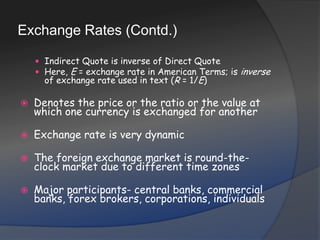
Exchange Rates (Contd.)Indirect Quote is inverse of Direct QuoteHere, E = exchange rate in American Terms; is inverse of exchange rate used in text (R = 1/E)Denotes the price or the ratio or the value at which one currency is exchanged for anotherExchange rate is very dynamicThe foreign exchange market is round-the-clock market due to different time zones Major participants- central banks, commercial banks, forex brokers, corporations, individuals
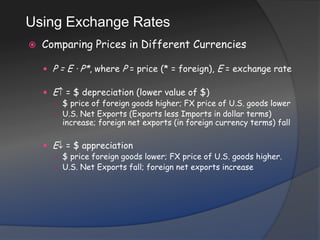
Using Exchange RatesComparing Prices in Different CurrenciesP = E · P*, where P = price (* = foreign), E = exchange rateE = $ depreciation (lower value of $) $ price of foreign goods higher; FX price of U.S. goods lowerU.S. Net Exports (Exports less Imports in dollar terms) increase; foreign net exports (in foreign currency terms) fallE = $ appreciation$ price foreign goods lower; FX price of U.S. goods higher.U.S. Net Exports fall; foreign net exports increase
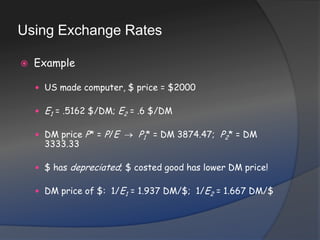
Using Exchange RatesExampleUS made computer, $ price = $2000E1 = .5162 $/DM; E2 = .6 $/DMDM price P* = P/E  P1* = DM 3874.47;  P2* = DM 3333.33$ has depreciated; $ costed good has lower DM price!DM price of $:  1/E1 = 1.937 DM/$;  1/E2 = 1.667 DM/$
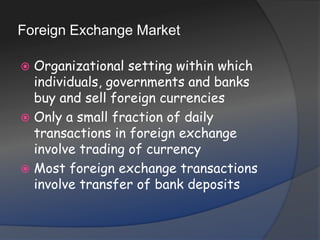
Foreign Exchange MarketOrganizational setting within which individuals, governments and banks buy and sell foreign currenciesOnly a small fraction of daily transactions in foreign exchange involve trading of currencyMost foreign exchange transactions involve transfer of bank deposits
Definition of foreign exchangeDeposits, credits and balances payable in foreign currencyDrafts, travelers’ cheques, letter of credit or bill of exchange expressed or drawn in Indian currency but payable in foreign currencyDrafts, travelers' cheques, L/Cs, etc. drawn by banks, institutions or persons outside India but payable in Indian currencyThe above definition is as per FEMA (1999)
Factors affecting Exchange rateMajor banks that act as market-makers always give two-way quotes; gives depth and volume to the marketFundamental reasonsTechnical reasonsSpeculation
Factors affecting exchange rate (Contd.)Fundamental reasonsBalance of payments->surplus->appreciationGrowth rate of the economy-> higher growth->depreciation of currencyFiscal policy-> financing of fiscal deficit influences exchange rateMonetary policy->loose monetary policy-> depreciation of exchange rate
Factors affecting exchange rate (Contd.)Technical reasonsFreedom or restrictions on capital movements can affect exchange rates to a large extentAmong other factors there are:Huge trade surpluses of oil exporting countriesCapital moving from low-yielding currencies to high yielding currencies (interest differential)
Factors affecting exchange rate (Contd.)SpeculationSelf-fulfilling propheciesAnticipation of depreciation of a currency can cause dealers to sell that currencySpeculation serves to provide depth and liquidity to the FOREX marketActs as a cushion as well- contrarian traders exist in the market
Types of exchange rateReady/cash- Settlement of funds on the same day (date of the deal). Tom- Settlement of funds takes place on the next working day of the date of the dealSpot- Settlement of funds takes place on the second working day following the date of the deal
Types of Exchange Rate (Contd.)Forward- Delivery takes place on any day after the date of the dealIn the FOREX market all rates that are quoted are generally spot ratesWhen delivery takes place beyond the spot date then it is a forward transaction and the forward rate is applicableForward rate = Spot rate + Premium (- discount)
Forward rateIf the forward value of a currency is higher than the spot value the currency is said to be at a premiumIf the above is reversed the currency is said to be at a discountThe forward premium/discount is based on interest rate differentials of the two currencies involvedDirect and indirect quotes of exchange rate- direct quote, local currency is variable
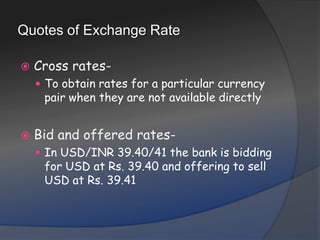
Quotes of Exchange RateCross rates- To obtain rates for a particular currency pair when they are not available directlyBid and offered rates- In USD/INR 39.40/41 the bank is bidding for USD at Rs. 39.40 and offering to sell USD at Rs. 39.41
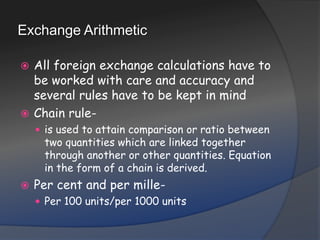
Exchange ArithmeticAll foreign exchange calculations have to be worked with care and accuracy and several rules have to be kept in mindChain rule- is used to attain comparison or ratio between two quantities which are linked together through another or other quantities. Equation in the form of a chain is derived.Per cent and per mille- Per 100 units/per 1000 units
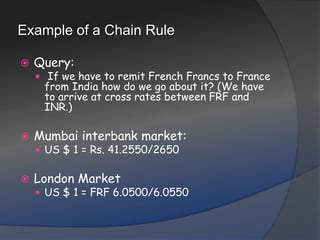
Example of a Chain RuleQuery: If we have to remit French Francs to France from India how do we go about it? (We have to arrive at cross rates between FRF and INR.)Mumbai interbank market:US $ 1 = Rs. 41.2550/2650London Market US $ 1 = FRF 6.0500/6.0550
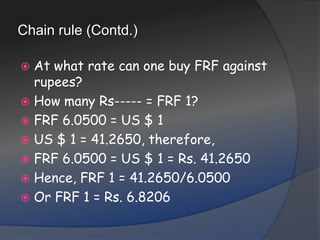
Chain rule (Contd.)At what rate can one buy FRF against rupees?How many Rs----- = FRF 1?FRF 6.0500 = US $ 1US $ 1 = 41.2650, therefore,FRF 6.0500 = US $ 1 = Rs. 41.2650Hence, FRF 1 = 41.2650/6.0500Or FRF 1 = Rs. 6.8206
Forward RateValue date:  It is customary, in foreign exchange market, to quote a rate to do the deal but exchange the currencies not on the same day but generally afterwards.Forward rate: Has two componentsSpot rateForward points or forward differentialsForward rate is the rate when the value of the deal is fixed beyond the spot date i.e. beyond the second working day after the deal
Forward Rate (Contd.)Forward transactions are necessary in the foreign exchange market as they serve number of purposes like:One can hedge or cover an existing future financial, commercial or trade related exchange riskThese types of deals, in combination with spot deals, are used for money market operations through ‘swap’ transactionsTaking a view of the market, these can be used for speculation
Forward Rate (Contd.)When a currency is costlier in the future (forward) as compared to the spot, the currency is said to be at a premium vis-à-vis another currencyIn ‘direct rate’ premium is added to both the buying and selling rate whereas discount is deductedIn ‘indirect rate’ premium is deducted and discount is added to the buying and selling rates
ForwardRate (Contd.)Base currency is the currency which is being bought and sold and the other currency is incidental.Forwards are quoted as followsSpot/1 month 17/18Spot/ 2 months 35/37Spot/ 3 months 53/56If forward differentials are in the ascending order (1st figure is lower than the 2nd) the base currency is at premium
Actors in the Foreign Exchange MarketCommercial & Investment  Banks (“Inter-bank” market)amounts > $1m, typically $10mliquid market (vis-à-vis loans) with limited credit exposurefor clients and themselvesallows “bit” players to economize on transactions costsCentral Banksnon-commercial motivesrelatively small portion of trading volumemay intervene to address perceived economic/financial imbalances
Actors in the Foreign ExchangeHedge Fundspartnership of high net-worth individualshighly leveraged global investingadd liquidity, flexibility, and sometimes instability to FX markets
Actors in the Foreign Exchange (cont.)Corporationsmostly act through intermediariesIndividualstourists ~ insignificant volumeIntermediaries – Brokersmostly service commercial banks and trading housesanonymousconnected to many banks ~ shop for best price (exchange rate)Direct Dealingthrough dealing system ~ e.g., Reuters, Quotronquotes valid for 20 sec.
Physical MarketDaily Turnover in excess of $1.5 trillionmore than 50 times U.S. daily GDP; more than 30 times global goods and services tradeFX market activity far in excess of that necessary to purchase global output!Major Markets: London, New York, Tokyotrading around the clockUS$ as vehicle currencymore than half of all trades against US$lower transactions costs when trading indirectly against US$, even if $ not actually needed.€, ¥ also function as lesser vehicle currencies
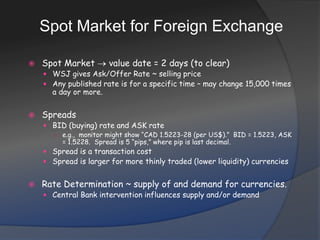
Spot Market for Foreign ExchangeSpot Market  value date = 2 days (to clear)WSJ gives Ask/Offer Rate ~ selling priceAny published rate is for a specific time – may change 15,000 times a day or more.SpreadsBID (buying) rate and ASK ratee.g.,  monitor might show “CAD 1.5223-28 (per US$).”  BID = 1.5223, ASK = 1.5228.  Spread is 5 “pips,” where pip is last decimal.Spread is a transaction costSpread is larger for more thinly traded (lower liquidity) currenciesRate Determination ~ supply of and demand for currencies.Central Bank intervention influences supply and/or demand
Foreign Exchange RiskSpot Rates may change in a way that makes a transaction less (or more) profitable.You are “uncovered” if you depend on spot markete.g., ¥10m account payable due in 90d.  If you wait 90d to buy yen and $ depreciates, the ¥10m costs you more.Types of Risk ExposureTranslation ExposureEconomic ExposureTransaction Exposuredomestic currency value of future transactions.Managing XR Risk: Forward, Futures, and Option Markets
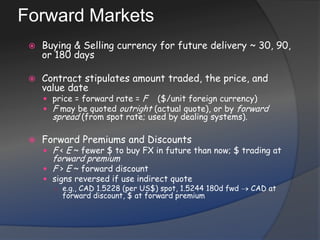
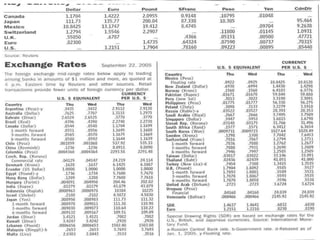
Forward MarketsBuying & Selling currency for future delivery ~ 30, 90, or 180 daysContract stipulates amount traded, the price, and value dateprice = forward rate = F    ($/unit foreign currency)F may be quoted outright (actual quote), or by forward spread (from spot rate; used by dealing systems).Forward Premiums and DiscountsF < E ~ fewer $ to buy FX in future than now; $ trading at forwardpremiumF > E ~ forward discountsigns reversed if use indirect quotee.g., CAD 1.5228 (per US$) spot, 1.5244 180d fwd  CAD at forward discount, $ at forward premium
Forward Markets, (cont.)Forward rates reflect relative rates of return and expectations of future exchange rates.Actors using forward contracts are covered or hedged.Problems with ForwardsDefault Risk Illiquidity ~ contracts customized, limited transferabilitySolutions:  short maturity; margins; limited clientele.SwapsCombine two transactions into oneForeign Exchange Swap: spot trade with opposing forward tradeCurrency Swap: firms borrow domestic currency, swap principal w/ foreign firm ~ cheaper foreign currency borrowing.
FuturesLike Forward, exceptactive secondary marketstandardized contracts ~ fewer currencies, standardized value and expiry datesmaller than forwards ~ more accessible to smaller businessesa clearing house guarantees contract against default, requires margin against unprofitable positions.day-to-day losses & gains posted against margin deposit; defaulting only saves last day’s losses, not cumulative losses.if margin account falls too low, have to top it off
OptionsUnderlying Asset = future or spot cashRight, but not obligation, to buy or sell at strike priceCALL ~ right to buyPUT ~ right to sellPremium ~ up-front cost of obtaining rightAmerican vs. European optionsProtects against unfavorable spot XR changes, while not limiting ability to exploit favorable spot XR changes“In the money” ~ can profitably exercise optionCALL in the money when currency appreciates; hedge accounts payable in foreign currenciesPUT in the money when currency depreciates; hedge accounts receivable in foreign currencies STRADDLE: CALL and PUT ~ in the money for any large swing in exchange rates ~ useful for highly volatile currencies
Hedging and SpeculationDistinction can be fuzzy, buthedge = reduced risk; speculation = increased riskSpeculationlong position ~ buy FX (any contract) to sell at higher-than-expected future spot XR (future spot higher than expected by market)short position ~ sell FX you don’t have for future delivery at what you think is higher than expected future spot price; buy spot in future, close your position at a profit (future spot less than expected)ExampleC$5m account payable due 90d.  E (spot) = .69$/CAD, F = .67$/CAD.  Call option strike = .68$/CAD.  Expect $ depreciation.Future spot  = .72  exercise option, save .03/CAD or $150,000 over previous spot, though F @ .67 was better.Future spot = .65  just buy spot; save .02/CAD over fwd
Foreign exchange transactionsArbitrage: Is an operation by which one can make risk free profit by undertaking offsetting transactions.Can be in interest rates: borrow in one centre and lend in anotherCan be in exchange rates: Buy a currency in one market and sell in anotherArbitrage keeps exchange rates uniform in all markets
Foreign exchange transactions (Contd.)Merchant rates: Quotes offered to merchants (importers, exporters) by banks.Inter-bank rates: The rates quoted by banks for dealing in the inter-bank market.Merchant quotations: In India all merchant quotations for foreign currencies shall be in so many rupees for one unit of foreign currency except for Japanese Yen, Italian Lira and Belgian Franc (Rs/100 units of the currency)All quotes are in four decimal places with the last two digits in the multiple of 25
Modes of remittancesTelegraphic Transfers (TT) :of funds are done from one centre to another by way of instructions through telex, telegram or SWIFT (Society for Worldwide Interbank Financial Transfer). Of late SWIFT is becoming popularMail Transfer (MT) :of funds is done by way of instructions sent by mail. An MT is an order in writing on the correspondent bank/branch abroad to pay the beneficiary the sum mentioned
Modes of Remittances (Contd.)Demand draft (DD): A DD is an order in writing on the correspondent bank/branch abroad to pay the beneficiary the sum mentioned therein.Fedai prescribed types of rates of merchant transactions:TT (buying)- clean inward remittancesBill (buying)- purchase/discount of export billsTT (selling) clean outward remittancesBill (selling) remittance for import bills
RBI/FEDAI GuidelinesRBI has issued Authorised Dealers (AD) licences to banks, all India financial institutions and a few co-operative banks to undertake foreign exchange transactions in IndiaIt has also issued Money Changer licences to a large number of established firms, companies, hotels, shops, etc.
RBI/FEDAI Guidelines (Contd.)Money changers help facilitate encashment of foreign currencies of foreign touristsEntities authorized to buy and sell foreign currency notes, coins and travelers' cheques are called full fledged money changersThose authorized only to buy are called restricted money changers
RBI/FEDAI GuidelinesFEDAI (Foreign Exchange Dealers’ Association of India) is a non-profit making body formed in 1958 with the approval of RBIIts members are authorized dealers and it prescribes guidelines and rules of the game for market operations, merchant rates, quotations, delivery dates, holidays, interest on defaults, etc.FEDAI also advises RBI on market related issues and supplements RBI on strengthening the market
Thank You!!RichaPyakurel© 2010|Richa Pyakurel|

Forex

  • 1.
    Presentation onIntroductionto ForeignExchangeRichaPyakurel,MIB IIIrd Sem.,Bangalore City College.
  • 2.
    AgendaDefine and interpretexchange rates.Describe foreign exchange market actors and characteristics. Consider foreign exchange risk.Describe the instruments of foreign exchange trading meant to manage this risk.Briefly discuss hedging and speculation as strategies to manage and exploit risk.
  • 3.
    Exchange ratesInternational transactionin cash requires two distinct purchasesPurchase of foreign currencyPurchase of good/service with the FCTerm foreign exchange is used to denote foreign currencyForeign exchange market exists to cater to the demand for foreign currency/currencies
  • 4.
    Exchange Rates (Contd.)ExchangeRate = Relative Price of CurrenciesDirect or Natural or Right Quote/American Termsdollar price of 1 unit foreign currency; $/FX1 = dollars per unit foreign exchangeused in futures marketIndirect or Reverse or Left Quote/European Termsforeign currency price of $; FX/$1used in Cash market. Most currencies quoted this way, except £
  • 5.
    Exchange Rates (Contd.)IndirectQuote is inverse of Direct QuoteHere, E = exchange rate in American Terms; is inverse of exchange rate used in text (R = 1/E)Denotes the price or the ratio or the value at which one currency is exchanged for anotherExchange rate is very dynamicThe foreign exchange market is round-the-clock market due to different time zones Major participants- central banks, commercial banks, forex brokers, corporations, individuals
  • 6.
    Using Exchange RatesComparingPrices in Different CurrenciesP = E · P*, where P = price (* = foreign), E = exchange rateE = $ depreciation (lower value of $) $ price of foreign goods higher; FX price of U.S. goods lowerU.S. Net Exports (Exports less Imports in dollar terms) increase; foreign net exports (in foreign currency terms) fallE = $ appreciation$ price foreign goods lower; FX price of U.S. goods higher.U.S. Net Exports fall; foreign net exports increase
  • 7.
    Using Exchange RatesExampleUSmade computer, $ price = $2000E1 = .5162 $/DM; E2 = .6 $/DMDM price P* = P/E P1* = DM 3874.47; P2* = DM 3333.33$ has depreciated; $ costed good has lower DM price!DM price of $: 1/E1 = 1.937 DM/$; 1/E2 = 1.667 DM/$
  • 8.
    Foreign Exchange MarketOrganizationalsetting within which individuals, governments and banks buy and sell foreign currenciesOnly a small fraction of daily transactions in foreign exchange involve trading of currencyMost foreign exchange transactions involve transfer of bank deposits
  • 9.
    Definition of foreignexchangeDeposits, credits and balances payable in foreign currencyDrafts, travelers’ cheques, letter of credit or bill of exchange expressed or drawn in Indian currency but payable in foreign currencyDrafts, travelers' cheques, L/Cs, etc. drawn by banks, institutions or persons outside India but payable in Indian currencyThe above definition is as per FEMA (1999)
  • 10.
    Factors affecting ExchangerateMajor banks that act as market-makers always give two-way quotes; gives depth and volume to the marketFundamental reasonsTechnical reasonsSpeculation
  • 11.
    Factors affecting exchangerate (Contd.)Fundamental reasonsBalance of payments->surplus->appreciationGrowth rate of the economy-> higher growth->depreciation of currencyFiscal policy-> financing of fiscal deficit influences exchange rateMonetary policy->loose monetary policy-> depreciation of exchange rate
  • 12.
    Factors affecting exchangerate (Contd.)Technical reasonsFreedom or restrictions on capital movements can affect exchange rates to a large extentAmong other factors there are:Huge trade surpluses of oil exporting countriesCapital moving from low-yielding currencies to high yielding currencies (interest differential)
  • 13.
    Factors affecting exchangerate (Contd.)SpeculationSelf-fulfilling propheciesAnticipation of depreciation of a currency can cause dealers to sell that currencySpeculation serves to provide depth and liquidity to the FOREX marketActs as a cushion as well- contrarian traders exist in the market
  • 14.
    Types of exchangerateReady/cash- Settlement of funds on the same day (date of the deal). Tom- Settlement of funds takes place on the next working day of the date of the dealSpot- Settlement of funds takes place on the second working day following the date of the deal
  • 15.
    Types of ExchangeRate (Contd.)Forward- Delivery takes place on any day after the date of the dealIn the FOREX market all rates that are quoted are generally spot ratesWhen delivery takes place beyond the spot date then it is a forward transaction and the forward rate is applicableForward rate = Spot rate + Premium (- discount)
  • 16.
    Forward rateIf theforward value of a currency is higher than the spot value the currency is said to be at a premiumIf the above is reversed the currency is said to be at a discountThe forward premium/discount is based on interest rate differentials of the two currencies involvedDirect and indirect quotes of exchange rate- direct quote, local currency is variable
  • 17.
    Quotes of ExchangeRateCross rates- To obtain rates for a particular currency pair when they are not available directlyBid and offered rates- In USD/INR 39.40/41 the bank is bidding for USD at Rs. 39.40 and offering to sell USD at Rs. 39.41
  • 18.
    Exchange ArithmeticAll foreignexchange calculations have to be worked with care and accuracy and several rules have to be kept in mindChain rule- is used to attain comparison or ratio between two quantities which are linked together through another or other quantities. Equation in the form of a chain is derived.Per cent and per mille- Per 100 units/per 1000 units
  • 19.
    Example of aChain RuleQuery: If we have to remit French Francs to France from India how do we go about it? (We have to arrive at cross rates between FRF and INR.)Mumbai interbank market:US $ 1 = Rs. 41.2550/2650London Market US $ 1 = FRF 6.0500/6.0550
  • 20.
    Chain rule (Contd.)Atwhat rate can one buy FRF against rupees?How many Rs----- = FRF 1?FRF 6.0500 = US $ 1US $ 1 = 41.2650, therefore,FRF 6.0500 = US $ 1 = Rs. 41.2650Hence, FRF 1 = 41.2650/6.0500Or FRF 1 = Rs. 6.8206
  • 21.
    Forward RateValue date: It is customary, in foreign exchange market, to quote a rate to do the deal but exchange the currencies not on the same day but generally afterwards.Forward rate: Has two componentsSpot rateForward points or forward differentialsForward rate is the rate when the value of the deal is fixed beyond the spot date i.e. beyond the second working day after the deal
  • 22.
    Forward Rate (Contd.)Forwardtransactions are necessary in the foreign exchange market as they serve number of purposes like:One can hedge or cover an existing future financial, commercial or trade related exchange riskThese types of deals, in combination with spot deals, are used for money market operations through ‘swap’ transactionsTaking a view of the market, these can be used for speculation
  • 23.
    Forward Rate (Contd.)Whena currency is costlier in the future (forward) as compared to the spot, the currency is said to be at a premium vis-à-vis another currencyIn ‘direct rate’ premium is added to both the buying and selling rate whereas discount is deductedIn ‘indirect rate’ premium is deducted and discount is added to the buying and selling rates
  • 24.
    ForwardRate (Contd.)Base currencyis the currency which is being bought and sold and the other currency is incidental.Forwards are quoted as followsSpot/1 month 17/18Spot/ 2 months 35/37Spot/ 3 months 53/56If forward differentials are in the ascending order (1st figure is lower than the 2nd) the base currency is at premium
  • 25.
    Actors in theForeign Exchange MarketCommercial & Investment Banks (“Inter-bank” market)amounts > $1m, typically $10mliquid market (vis-à-vis loans) with limited credit exposurefor clients and themselvesallows “bit” players to economize on transactions costsCentral Banksnon-commercial motivesrelatively small portion of trading volumemay intervene to address perceived economic/financial imbalances
  • 26.
    Actors in theForeign ExchangeHedge Fundspartnership of high net-worth individualshighly leveraged global investingadd liquidity, flexibility, and sometimes instability to FX markets
  • 27.
    Actors in theForeign Exchange (cont.)Corporationsmostly act through intermediariesIndividualstourists ~ insignificant volumeIntermediaries – Brokersmostly service commercial banks and trading housesanonymousconnected to many banks ~ shop for best price (exchange rate)Direct Dealingthrough dealing system ~ e.g., Reuters, Quotronquotes valid for 20 sec.
  • 28.
    Physical MarketDaily Turnoverin excess of $1.5 trillionmore than 50 times U.S. daily GDP; more than 30 times global goods and services tradeFX market activity far in excess of that necessary to purchase global output!Major Markets: London, New York, Tokyotrading around the clockUS$ as vehicle currencymore than half of all trades against US$lower transactions costs when trading indirectly against US$, even if $ not actually needed.€, ¥ also function as lesser vehicle currencies
  • 29.
    Spot Market forForeign ExchangeSpot Market  value date = 2 days (to clear)WSJ gives Ask/Offer Rate ~ selling priceAny published rate is for a specific time – may change 15,000 times a day or more.SpreadsBID (buying) rate and ASK ratee.g., monitor might show “CAD 1.5223-28 (per US$).” BID = 1.5223, ASK = 1.5228. Spread is 5 “pips,” where pip is last decimal.Spread is a transaction costSpread is larger for more thinly traded (lower liquidity) currenciesRate Determination ~ supply of and demand for currencies.Central Bank intervention influences supply and/or demand
  • 30.
    Foreign Exchange RiskSpotRates may change in a way that makes a transaction less (or more) profitable.You are “uncovered” if you depend on spot markete.g., ¥10m account payable due in 90d. If you wait 90d to buy yen and $ depreciates, the ¥10m costs you more.Types of Risk ExposureTranslation ExposureEconomic ExposureTransaction Exposuredomestic currency value of future transactions.Managing XR Risk: Forward, Futures, and Option Markets
  • 31.
    Forward MarketsBuying &Selling currency for future delivery ~ 30, 90, or 180 daysContract stipulates amount traded, the price, and value dateprice = forward rate = F ($/unit foreign currency)F may be quoted outright (actual quote), or by forward spread (from spot rate; used by dealing systems).Forward Premiums and DiscountsF < E ~ fewer $ to buy FX in future than now; $ trading at forwardpremiumF > E ~ forward discountsigns reversed if use indirect quotee.g., CAD 1.5228 (per US$) spot, 1.5244 180d fwd  CAD at forward discount, $ at forward premium
  • 33.
    Forward Markets, (cont.)Forwardrates reflect relative rates of return and expectations of future exchange rates.Actors using forward contracts are covered or hedged.Problems with ForwardsDefault Risk Illiquidity ~ contracts customized, limited transferabilitySolutions: short maturity; margins; limited clientele.SwapsCombine two transactions into oneForeign Exchange Swap: spot trade with opposing forward tradeCurrency Swap: firms borrow domestic currency, swap principal w/ foreign firm ~ cheaper foreign currency borrowing.
  • 34.
    FuturesLike Forward, exceptactivesecondary marketstandardized contracts ~ fewer currencies, standardized value and expiry datesmaller than forwards ~ more accessible to smaller businessesa clearing house guarantees contract against default, requires margin against unprofitable positions.day-to-day losses & gains posted against margin deposit; defaulting only saves last day’s losses, not cumulative losses.if margin account falls too low, have to top it off
  • 35.
    OptionsUnderlying Asset =future or spot cashRight, but not obligation, to buy or sell at strike priceCALL ~ right to buyPUT ~ right to sellPremium ~ up-front cost of obtaining rightAmerican vs. European optionsProtects against unfavorable spot XR changes, while not limiting ability to exploit favorable spot XR changes“In the money” ~ can profitably exercise optionCALL in the money when currency appreciates; hedge accounts payable in foreign currenciesPUT in the money when currency depreciates; hedge accounts receivable in foreign currencies STRADDLE: CALL and PUT ~ in the money for any large swing in exchange rates ~ useful for highly volatile currencies
  • 36.
    Hedging and SpeculationDistinctioncan be fuzzy, buthedge = reduced risk; speculation = increased riskSpeculationlong position ~ buy FX (any contract) to sell at higher-than-expected future spot XR (future spot higher than expected by market)short position ~ sell FX you don’t have for future delivery at what you think is higher than expected future spot price; buy spot in future, close your position at a profit (future spot less than expected)ExampleC$5m account payable due 90d. E (spot) = .69$/CAD, F = .67$/CAD. Call option strike = .68$/CAD. Expect $ depreciation.Future spot = .72  exercise option, save .03/CAD or $150,000 over previous spot, though F @ .67 was better.Future spot = .65  just buy spot; save .02/CAD over fwd
  • 37.
    Foreign exchange transactionsArbitrage:Is an operation by which one can make risk free profit by undertaking offsetting transactions.Can be in interest rates: borrow in one centre and lend in anotherCan be in exchange rates: Buy a currency in one market and sell in anotherArbitrage keeps exchange rates uniform in all markets
  • 38.
    Foreign exchange transactions(Contd.)Merchant rates: Quotes offered to merchants (importers, exporters) by banks.Inter-bank rates: The rates quoted by banks for dealing in the inter-bank market.Merchant quotations: In India all merchant quotations for foreign currencies shall be in so many rupees for one unit of foreign currency except for Japanese Yen, Italian Lira and Belgian Franc (Rs/100 units of the currency)All quotes are in four decimal places with the last two digits in the multiple of 25
  • 39.
    Modes of remittancesTelegraphicTransfers (TT) :of funds are done from one centre to another by way of instructions through telex, telegram or SWIFT (Society for Worldwide Interbank Financial Transfer). Of late SWIFT is becoming popularMail Transfer (MT) :of funds is done by way of instructions sent by mail. An MT is an order in writing on the correspondent bank/branch abroad to pay the beneficiary the sum mentioned
  • 40.
    Modes of Remittances(Contd.)Demand draft (DD): A DD is an order in writing on the correspondent bank/branch abroad to pay the beneficiary the sum mentioned therein.Fedai prescribed types of rates of merchant transactions:TT (buying)- clean inward remittancesBill (buying)- purchase/discount of export billsTT (selling) clean outward remittancesBill (selling) remittance for import bills
  • 41.
    RBI/FEDAI GuidelinesRBI hasissued Authorised Dealers (AD) licences to banks, all India financial institutions and a few co-operative banks to undertake foreign exchange transactions in IndiaIt has also issued Money Changer licences to a large number of established firms, companies, hotels, shops, etc.
  • 42.
    RBI/FEDAI Guidelines (Contd.)Moneychangers help facilitate encashment of foreign currencies of foreign touristsEntities authorized to buy and sell foreign currency notes, coins and travelers' cheques are called full fledged money changersThose authorized only to buy are called restricted money changers
  • 43.
    RBI/FEDAI GuidelinesFEDAI (ForeignExchange Dealers’ Association of India) is a non-profit making body formed in 1958 with the approval of RBIIts members are authorized dealers and it prescribes guidelines and rules of the game for market operations, merchant rates, quotations, delivery dates, holidays, interest on defaults, etc.FEDAI also advises RBI on market related issues and supplements RBI on strengthening the market
  • 44.