Currency Fluctuation
Prepared by:-
Neel Adroja
Dhruvesh Modi
Heerak Choubisa
Anuj Patel
• What is Currency Fluctuation ?
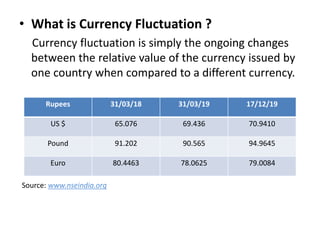
Currency fluctuation is simply the ongoing changes
between the relative value of the currency issued by
one country when compared to a different currency.
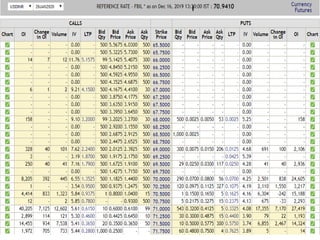
Rupees 31/03/18 31/03/19 17/12/19
US $ 65.076 69.436 70.9410
Pound 91.202 90.565 94.9645
Euro 80.4463 78.0625 79.0084
Source: www.nseindia.org
Why Is It Needed?
• Different countries have different currencies with different values.
• Example: India – Rupees
America -Dollar
• When trade takes place, the persons of these countries have to convert
their currencies to other country’s currencies to make payments. For this
purpose the concept of foreign exchange come into operation.
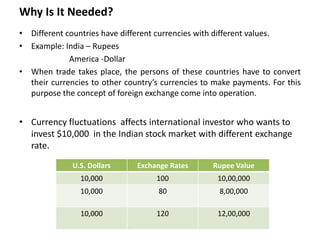
• Currency fluctuations affects international investor who wants to
invest $10,000 in the Indian stock market with different exchange
rate.
U.S. Dollars Exchange Rates Rupee Value
10,000 100 10,00,000
10,000 80 8,00,000
10,000 120 12,00,000
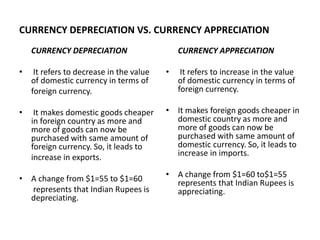
CURRENCY DEPRECIATION VS. CURRENCY APPRECIATION
CURRENCY DEPRECIATION
• It refers to decrease in the value
of domestic currency in terms of
foreign currency.
• It makes domestic goods cheaper
in foreign country as more and
more of goods can now be
purchased with same amount of
foreign currency. So, it leads to
increase in exports.
• A change from $1=55 to $1=60
represents that Indian Rupees is
depreciating.
CURRENCY APPRECIATION
• It refers to increase in the value
of domestic currency in terms of
foreign currency.
• It makes foreign goods cheaper in
domestic country as more and
more of goods can now be
purchased with same amount of
domestic currency. So, it leads to
increase in imports.
• A change from $1=60 to$1=55
represents that Indian Rupees is
appreciating.
Causes of Currency Fluctuation
• Economic Position
• Foreign Debt
• International Profits
• National Income
• Inflation
• Interest Rates
• Balance of Trade
• Market Speculators
Exchange Rate System
• Fixed Exchange Rate System
It refers a system in which exchange rate for a currency is fixed by the
government. Basic purpose of adopting this system is to ensure stability in
foreign trade and capital market. Under this system, each country keeps
value of its currency fixed in terms of some ‘external standard’.
• Flexible Exchange rate System
It refers to a rate system in which exchange rate is determined by forces of
demand and supply of different currencies in foreign exchange marker.
There is no official (Govt.) intervention in foreign exchange market. Also
known as ‘flotation exchange rate’.
• Managed Floating Rate System
It refers to a system in which foreign exchange rate is determined by
market forces and central bank influences the exchange rate through
intervention in foreign exchange market. It is hybrid of a fixed exchange
rate and a flexible exchange rate system. Aim is to keep exchange rate
close to desired targets value. Also known as “ Dirty Floating”.
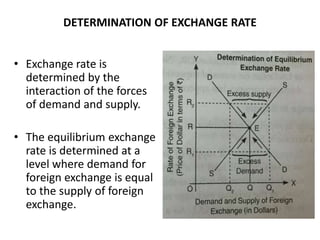
DETERMINATION OF EXCHANGE RATE
• Exchange rate is
determined by the
interaction of the forces
of demand and supply.
• The equilibrium exchange
rate is determined at a
level where demand for
foreign exchange is equal
to the supply of foreign
exchange.
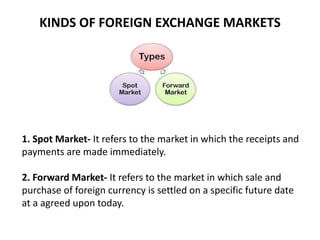
KINDS OF FOREIGN EXCHANGE MARKETS
1. Spot Market- It refers to the market in which the receipts and
payments are made immediately.
2. Forward Market- It refers to the market in which sale and
purchase of foreign currency is settled on a specific future date
at a agreed upon today.
Impact of currency fluctuation
• Higher landing cost for commodities
• Impact on current account deficit
• Impact on flow
• Adds to inflationary pressure
• Impact on GDP
• Rise in interest cost for India Inc
Impact Of Rising Rupee On The Indian Economy
• The main reason for the INR’s appreciation since late 2006 has
been a flood of foreign exchange inflows, specially US $. The
surge of capital and other inflows into india has taken a
variety of forms, ringing from FDI’s to remittance sent home
by indian expatriates. Major forms of capitals and other
inflows are:
1. Foreign Direct Investment
2. External Commercial Borrowings
3.Foreign Portfolio Inflows
4. Investments & Remittances
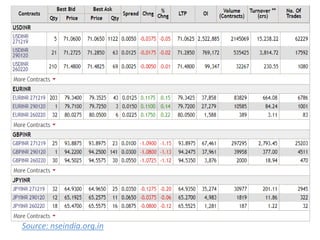
Source: nseindia.org.in

Currency fluctuation

  • 1.
    Currency Fluctuation Prepared by:- NeelAdroja Dhruvesh Modi Heerak Choubisa Anuj Patel
  • 2.
    • What isCurrency Fluctuation ? Currency fluctuation is simply the ongoing changes between the relative value of the currency issued by one country when compared to a different currency. Rupees 31/03/18 31/03/19 17/12/19 US $ 65.076 69.436 70.9410 Pound 91.202 90.565 94.9645 Euro 80.4463 78.0625 79.0084 Source: www.nseindia.org
  • 3.
    Why Is ItNeeded? • Different countries have different currencies with different values. • Example: India – Rupees America -Dollar • When trade takes place, the persons of these countries have to convert their currencies to other country’s currencies to make payments. For this purpose the concept of foreign exchange come into operation. • Currency fluctuations affects international investor who wants to invest $10,000 in the Indian stock market with different exchange rate. U.S. Dollars Exchange Rates Rupee Value 10,000 100 10,00,000 10,000 80 8,00,000 10,000 120 12,00,000
  • 4.
    CURRENCY DEPRECIATION VS.CURRENCY APPRECIATION CURRENCY DEPRECIATION • It refers to decrease in the value of domestic currency in terms of foreign currency. • It makes domestic goods cheaper in foreign country as more and more of goods can now be purchased with same amount of foreign currency. So, it leads to increase in exports. • A change from $1=55 to $1=60 represents that Indian Rupees is depreciating. CURRENCY APPRECIATION • It refers to increase in the value of domestic currency in terms of foreign currency. • It makes foreign goods cheaper in domestic country as more and more of goods can now be purchased with same amount of domestic currency. So, it leads to increase in imports. • A change from $1=60 to$1=55 represents that Indian Rupees is appreciating.
  • 5.
    Causes of CurrencyFluctuation • Economic Position • Foreign Debt • International Profits • National Income • Inflation • Interest Rates • Balance of Trade • Market Speculators
  • 6.
    Exchange Rate System •Fixed Exchange Rate System It refers a system in which exchange rate for a currency is fixed by the government. Basic purpose of adopting this system is to ensure stability in foreign trade and capital market. Under this system, each country keeps value of its currency fixed in terms of some ‘external standard’. • Flexible Exchange rate System It refers to a rate system in which exchange rate is determined by forces of demand and supply of different currencies in foreign exchange marker. There is no official (Govt.) intervention in foreign exchange market. Also known as ‘flotation exchange rate’. • Managed Floating Rate System It refers to a system in which foreign exchange rate is determined by market forces and central bank influences the exchange rate through intervention in foreign exchange market. It is hybrid of a fixed exchange rate and a flexible exchange rate system. Aim is to keep exchange rate close to desired targets value. Also known as “ Dirty Floating”.
  • 7.
    DETERMINATION OF EXCHANGERATE • Exchange rate is determined by the interaction of the forces of demand and supply. • The equilibrium exchange rate is determined at a level where demand for foreign exchange is equal to the supply of foreign exchange.
  • 8.
    KINDS OF FOREIGNEXCHANGE MARKETS 1. Spot Market- It refers to the market in which the receipts and payments are made immediately. 2. Forward Market- It refers to the market in which sale and purchase of foreign currency is settled on a specific future date at a agreed upon today.
  • 10.
    Impact of currencyfluctuation • Higher landing cost for commodities • Impact on current account deficit • Impact on flow • Adds to inflationary pressure • Impact on GDP • Rise in interest cost for India Inc
  • 11.
    Impact Of RisingRupee On The Indian Economy • The main reason for the INR’s appreciation since late 2006 has been a flood of foreign exchange inflows, specially US $. The surge of capital and other inflows into india has taken a variety of forms, ringing from FDI’s to remittance sent home by indian expatriates. Major forms of capitals and other inflows are: 1. Foreign Direct Investment 2. External Commercial Borrowings 3.Foreign Portfolio Inflows 4. Investments & Remittances
  • 13.