Demand
forecasting
Why Demand Forecasting?
•
•

Demand results in sales
Which is the primary source of Revenue
•
•
•
•

•

Predicting future demand for a product
To avoid under or over production
Minimize the “Uncertainties”
Rough estimate of the demand prospects

Demand forecasting helps in planning to acquire inputs
( men & material), organizing production, advertisement
and organizing sales channels.
Purpose of Forecasting Demand
•

Short –run Forecast :
– Seasonal patterns are important
– Forecasting helps in preparing suitable sales policy and
proper scheduling of output.
– Pricing policy and modification in advertising and sales
techniques

•

Long-run Forecast :
– Capital planning
– Planning of production, material, man-hours, machine
time
– Changes in variables are included
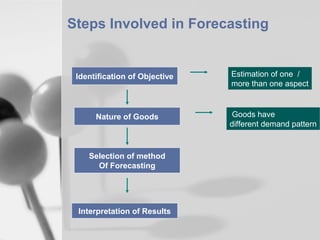
Steps Involved in Forecasting

Identification of Objective

Nature of Goods

Selection of method
Of Forecasting

Interpretation of Results

Estimation of one /
more than one aspect

Goods have
different demand pattern
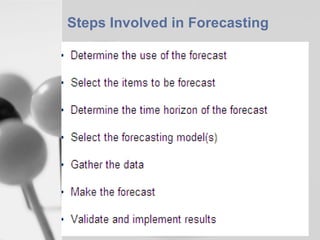
Steps Involved in Forecasting
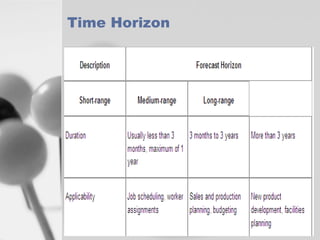
Time Horizon
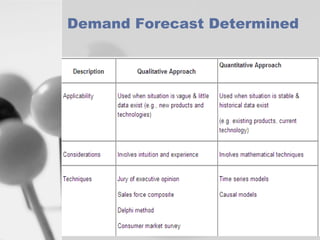
Demand Forecast Determined
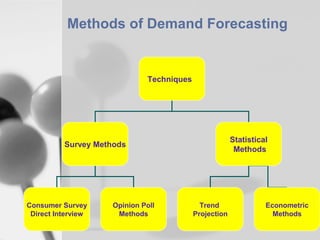
Methods of Demand Forecasting

Techniques

Statistical
Methods

Survey Methods

Consumer Survey
Direct Interview

Opinion Poll
Methods

Trend
Projection

Econometric
Methods
Survey Methods
•
•

Where the purpose is to make short- run forecast of
demand.
Consumer surveys are conducted to collect information
about their intentions and future plans.
1) Survey of potential consumers on their intentions and
plan.
2) Opinion polling of experts
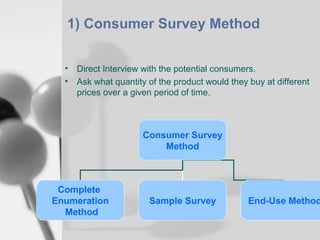
1) Consumer Survey Method
•
•

Direct Interview with the potential consumers.
Ask what quantity of the product would they buy at different
prices over a given period of time.

Consumer Survey
Method

Complete
Enumeration
Method

Sample Survey

End-Use Method
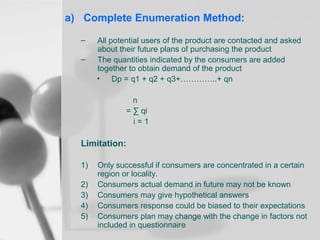
a) Complete Enumeration Method:
–
–

All potential users of the product are contacted and asked
about their future plans of purchasing the product
The quantities indicated by the consumers are added
together to obtain demand of the product
• Dp = q1 + q2 + q3+…………..+ qn
n
= ∑ qi
i=1

Limitation:
1)
2)
3)
4)
5)

Only successful if consumers are concentrated in a certain
region or locality.
Consumers actual demand in future may not be known
Consumers may give hypothetical answers
Consumers response could be biased to their expectations
Consumers plan may change with the change in factors not
included in questionnaire
b) Sample Survey Method:
–
–
–
–
–

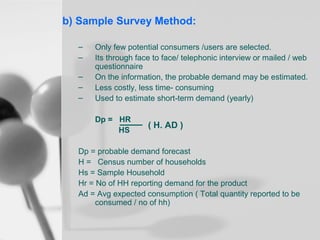
Only few potential consumers /users are selected.
Its through face to face/ telephonic interview or mailed / web
questionnaire
On the information, the probable demand may be estimated.
Less costly, less time- consuming
Used to estimate short-term demand (yearly)
Dp = HR
HS

( H. AD )

Dp = probable demand forecast
H = Census number of households
Hs = Sample Household
Hr = No of HH reporting demand for the product
Ad = Avg expected consumption ( Total quantity reported to be
consumed / no of hh)
–
–

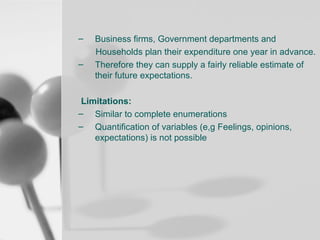
Business firms, Government departments and
Households plan their expenditure one year in advance.
Therefore they can supply a fairly reliable estimate of
their future expectations.

Limitations:
– Similar to complete enumerations
– Quantification of variables (e,g Feelings, opinions,
expectations) is not possible
c) End- Use Method:
–

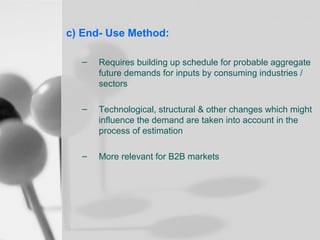
Requires building up schedule for probable aggregate
future demands for inputs by consuming industries /
sectors

–

Technological, structural & other changes which might
influence the demand are taken into account in the
process of estimation

–

More relevant for B2B markets
c) End- Use Method:
–

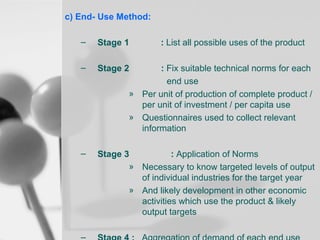
Stage 1

–

Stage 2

–

Stage 3
: Application of Norms
» Necessary to know targeted levels of output
of individual industries for the target year
» And likely development in other economic
activities which use the product & likely
output targets

: List all possible uses of the product

: Fix suitable technical norms for each
end use
» Per unit of production of complete product /
per unit of investment / per capita use
» Questionnaires used to collect relevant
information
Limitations
•
•
•
•
•
•

Enumeration of all possible uses – due to lack of
published data
Despatch records of the manufactures, if available need
not enumerate all the final users.
Impossible to organise and collect data of wide network of
wholesale and retail agencies
Possibility of missing out end-uses or new applications
– Therefore estimations should provide some margin of
error
Establishing norms – is difficult
Inaccuracy in estimating sales of target industries

Advantages
•

Probing into current use-pattern of consumption of
product – it provides opportunity to determine the demand
by types, categories & sizes etc

•

It facilitates in diagnosis & pin-pointing as to where & why
did the actual consumption deviate from estimated
demand
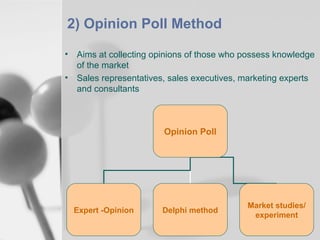
2) Opinion Poll Method
•
•

Aims at collecting opinions of those who possess knowledge
of the market
Sales representatives, sales executives, marketing experts
and consultants

Opinion Poll

Expert -Opinion

Delphi method

Market studies/
experiment
a)

Expert – Opinion Method:
–
–
–

–

Firms having good network of sales representatives
can ask them to assess demand
As they are in touch with consumers and
consumption pattern
Can provide a approximate figure of likely demand

Limitations:
• Estimates are reliable only to the extent of their
skill to analyse the market.
• The assessor may have subjective judgement
which may lead to over / under estimation
• Inadequate information may be available to the
assessor as they may have narrow view of the
market.
b)

Delphi Method:
–

To consolidate the expert opinions and arrive at
estimate of future demand.

–

Experts are provided information on the estimates of
other experts, and they revise their own estimates

–

The consensus of experts about the forecast
constitutes the final forecast

This technique can be used for cross – checking
information on forecasts.
c)

Market studies and experiments
To carry out studies on consumer behaviour under actual,
controlled market conditions.
Market studies:
– Firms select areas of market having similar features
( populations, income levels, cultural/ social
backgrounds, choices….)
– Carry out experiments by changing variables of
demand functions
– Consequent changes in demand are recorded
–
Assessment of demand of the product is made.
Experiments:
– Consumers are given money to buy goods with varying
prices, packages, displays…
– It reveals consumers responsiveness to the changes
Limitations:
– Expensive – unaffordable for small firms
– Experiments are carried out on a small scale leads to
generalization
– Studies are based on short term and controlled
conditions may not exist in uncontrolled market.
– Changes in socio-economic , climatic conditions may
alter the results.
Statistical Methods
• Advantages
–
–
–
–

Subjectivity is minimum
Method of estimation is scientific
Estimates are relatively more reliable
Involves smaller cost
Methods
1) Trend Projection Method
2) Econometric Method
a)
•
•
•

Trend Projection
It is a study of movement of variables through time.
Requires long and reliable time-series data
Its based on the assumption that factors responsible for
the past trends will continue to be the same in future.
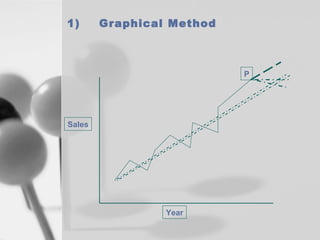
a) Graphical Method:
– Annual sales data is plotted on a graph
– Line is drawn through the plotted points
– Free line is drawn that the total distance between the
line and points is minimum.
– Second line drawn taking the mid values of variations.
– The trend line is then extended to forecast the
demand for next year.
• The projections may not be realisable as the
extension of trend line involves subjectivity and
personal bias.
1)

Graphical Method

P

Sales

Year
2) Fitting Trend equation:
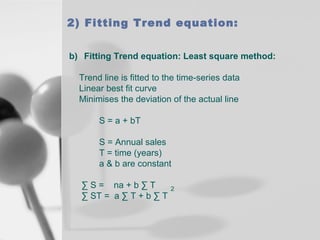
b) Fitting Trend equation: Least square method:
Trend line is fitted to the time-series data
Linear best fit curve
Minimises the deviation of the actual line
S = a + bT
S = Annual sales
T = time (years)
a & b are constant
∑ S = na + b ∑ T
∑ ST = a ∑ T + b ∑ T

2
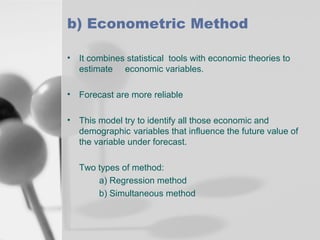
b) Econometric Method
• It combines statistical tools with economic theories to
estimate economic variables.
• Forecast are more reliable
• This model try to identify all those economic and
demographic variables that influence the future value of
the variable under forecast.
Two types of method:
a) Regression method
b) Simultaneous method
b) Econometric Method
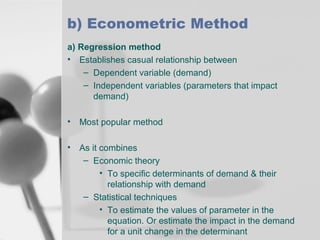
a) Regression method
• Establishes casual relationship between
– Dependent variable (demand)
– Independent variables (parameters that impact
demand)
•

Most popular method

•

As it combines
– Economic theory
• To specific determinants of demand & their
relationship with demand
– Statistical techniques
• To estimate the values of parameter in the
equation. Or estimate the impact in the demand
for a unit change in the determinant
b) Econometric Method
a) Regression method
•

Simple / Bivariate regression
– If demand of a commodity depends on a single independent
variable
• E.g. – demand for salt / sugar depends largely on
population
– The relationship can be established using ‘least square
method’
• As used in time series
• Only difference is time is replaced by the ‘independent
variable’ on which the demand depends the most
b) Econometric Method
a) Regression method
•

Multi-variate regression
– If demand of a commodity depends on a more than one
independent variables
• E.g. – demand for sweets, fruits, & vegetables depends
on price of the product, price of its substitutes,
household income, population etc.
– Procedure
• Specify variables that have an impact on demand. This
will be different for different categories
• Next specify the form of equation – linear, logarithmic,
power etc
• Collect the necessary data
• Estimate the value of co-efficient of the independent
variables through statistical techniques. Essentially
done with the help of computer
b) Econometric Method
a) Regression method
– It uses one single equation
– It assumes one-way causation i.e. only independent variable
causes
variation in dependent variable and not vice versa
• However, realistically demand for a product also has an
impact on price of the product
– This issue can be addressed through simultaneous equation
model
b) Econometric Method
b) Simultaneous method
•
•
•

Is a complete & systematic approach to forecasting
It involves solving several simultaneous equations for estimating
demand.
It takes two- way causation i.e: simultaneous interaction between
dependent and independent variable. As well as inter-dependence
of independent variables

– For instance
• Demand for white goods depends on product price, price of
substitute, household income, consumer preference,
availability of credit & interest rate
• Interest rate depends on Availability of credit
• Which in turn may depend on many other economic
parameters & government policies at that point.
• And so on

– Thus estimation of demand will require solving all such
functions simultaneously
Salient features of good forecasting
method

•
•
•
•
•

Simplicity
Accuracy
Economy
Availability
Applicability
Though mere possession of right tools is does not
necessarily mean accurate forecast. Equally important
is analysts judgement.

Demand forcasting

  • 1.
  • 2.
    Why Demand Forecasting? • • Demandresults in sales Which is the primary source of Revenue • • • • • Predicting future demand for a product To avoid under or over production Minimize the “Uncertainties” Rough estimate of the demand prospects Demand forecasting helps in planning to acquire inputs ( men & material), organizing production, advertisement and organizing sales channels.
  • 3.
    Purpose of ForecastingDemand • Short –run Forecast : – Seasonal patterns are important – Forecasting helps in preparing suitable sales policy and proper scheduling of output. – Pricing policy and modification in advertising and sales techniques • Long-run Forecast : – Capital planning – Planning of production, material, man-hours, machine time – Changes in variables are included
  • 4.
    Steps Involved inForecasting Identification of Objective Nature of Goods Selection of method Of Forecasting Interpretation of Results Estimation of one / more than one aspect Goods have different demand pattern
  • 5.
    Steps Involved inForecasting
  • 6.
  • 7.
  • 8.
    Methods of DemandForecasting Techniques Statistical Methods Survey Methods Consumer Survey Direct Interview Opinion Poll Methods Trend Projection Econometric Methods
  • 9.
    Survey Methods • • Where thepurpose is to make short- run forecast of demand. Consumer surveys are conducted to collect information about their intentions and future plans. 1) Survey of potential consumers on their intentions and plan. 2) Opinion polling of experts
  • 10.
    1) Consumer SurveyMethod • • Direct Interview with the potential consumers. Ask what quantity of the product would they buy at different prices over a given period of time. Consumer Survey Method Complete Enumeration Method Sample Survey End-Use Method
  • 11.
    a) Complete EnumerationMethod: – – All potential users of the product are contacted and asked about their future plans of purchasing the product The quantities indicated by the consumers are added together to obtain demand of the product • Dp = q1 + q2 + q3+…………..+ qn n = ∑ qi i=1 Limitation: 1) 2) 3) 4) 5) Only successful if consumers are concentrated in a certain region or locality. Consumers actual demand in future may not be known Consumers may give hypothetical answers Consumers response could be biased to their expectations Consumers plan may change with the change in factors not included in questionnaire
  • 12.
    b) Sample SurveyMethod: – – – – – Only few potential consumers /users are selected. Its through face to face/ telephonic interview or mailed / web questionnaire On the information, the probable demand may be estimated. Less costly, less time- consuming Used to estimate short-term demand (yearly) Dp = HR HS ( H. AD ) Dp = probable demand forecast H = Census number of households Hs = Sample Household Hr = No of HH reporting demand for the product Ad = Avg expected consumption ( Total quantity reported to be consumed / no of hh)
  • 13.
    – – Business firms, Governmentdepartments and Households plan their expenditure one year in advance. Therefore they can supply a fairly reliable estimate of their future expectations. Limitations: – Similar to complete enumerations – Quantification of variables (e,g Feelings, opinions, expectations) is not possible
  • 14.
    c) End- UseMethod: – Requires building up schedule for probable aggregate future demands for inputs by consuming industries / sectors – Technological, structural & other changes which might influence the demand are taken into account in the process of estimation – More relevant for B2B markets
  • 15.
    c) End- UseMethod: – Stage 1 – Stage 2 – Stage 3 : Application of Norms » Necessary to know targeted levels of output of individual industries for the target year » And likely development in other economic activities which use the product & likely output targets : List all possible uses of the product : Fix suitable technical norms for each end use » Per unit of production of complete product / per unit of investment / per capita use » Questionnaires used to collect relevant information
  • 16.
    Limitations • • • • • • Enumeration of allpossible uses – due to lack of published data Despatch records of the manufactures, if available need not enumerate all the final users. Impossible to organise and collect data of wide network of wholesale and retail agencies Possibility of missing out end-uses or new applications – Therefore estimations should provide some margin of error Establishing norms – is difficult Inaccuracy in estimating sales of target industries Advantages • Probing into current use-pattern of consumption of product – it provides opportunity to determine the demand by types, categories & sizes etc • It facilitates in diagnosis & pin-pointing as to where & why did the actual consumption deviate from estimated demand
  • 17.
    2) Opinion PollMethod • • Aims at collecting opinions of those who possess knowledge of the market Sales representatives, sales executives, marketing experts and consultants Opinion Poll Expert -Opinion Delphi method Market studies/ experiment
  • 18.
    a) Expert – OpinionMethod: – – – – Firms having good network of sales representatives can ask them to assess demand As they are in touch with consumers and consumption pattern Can provide a approximate figure of likely demand Limitations: • Estimates are reliable only to the extent of their skill to analyse the market. • The assessor may have subjective judgement which may lead to over / under estimation • Inadequate information may be available to the assessor as they may have narrow view of the market.
  • 19.
    b) Delphi Method: – To consolidatethe expert opinions and arrive at estimate of future demand. – Experts are provided information on the estimates of other experts, and they revise their own estimates – The consensus of experts about the forecast constitutes the final forecast This technique can be used for cross – checking information on forecasts.
  • 20.
    c) Market studies andexperiments To carry out studies on consumer behaviour under actual, controlled market conditions. Market studies: – Firms select areas of market having similar features ( populations, income levels, cultural/ social backgrounds, choices….) – Carry out experiments by changing variables of demand functions – Consequent changes in demand are recorded – Assessment of demand of the product is made. Experiments: – Consumers are given money to buy goods with varying prices, packages, displays… – It reveals consumers responsiveness to the changes
  • 21.
    Limitations: – Expensive –unaffordable for small firms – Experiments are carried out on a small scale leads to generalization – Studies are based on short term and controlled conditions may not exist in uncontrolled market. – Changes in socio-economic , climatic conditions may alter the results.
  • 22.
    Statistical Methods • Advantages – – – – Subjectivityis minimum Method of estimation is scientific Estimates are relatively more reliable Involves smaller cost Methods 1) Trend Projection Method 2) Econometric Method
  • 23.
    a) • • • Trend Projection It isa study of movement of variables through time. Requires long and reliable time-series data Its based on the assumption that factors responsible for the past trends will continue to be the same in future. a) Graphical Method: – Annual sales data is plotted on a graph – Line is drawn through the plotted points – Free line is drawn that the total distance between the line and points is minimum. – Second line drawn taking the mid values of variations. – The trend line is then extended to forecast the demand for next year. • The projections may not be realisable as the extension of trend line involves subjectivity and personal bias.
  • 24.
  • 25.
    2) Fitting Trendequation: b) Fitting Trend equation: Least square method: Trend line is fitted to the time-series data Linear best fit curve Minimises the deviation of the actual line S = a + bT S = Annual sales T = time (years) a & b are constant ∑ S = na + b ∑ T ∑ ST = a ∑ T + b ∑ T 2
  • 26.
    b) Econometric Method •It combines statistical tools with economic theories to estimate economic variables. • Forecast are more reliable • This model try to identify all those economic and demographic variables that influence the future value of the variable under forecast. Two types of method: a) Regression method b) Simultaneous method
  • 27.
    b) Econometric Method a)Regression method • Establishes casual relationship between – Dependent variable (demand) – Independent variables (parameters that impact demand) • Most popular method • As it combines – Economic theory • To specific determinants of demand & their relationship with demand – Statistical techniques • To estimate the values of parameter in the equation. Or estimate the impact in the demand for a unit change in the determinant
  • 28.
    b) Econometric Method a)Regression method • Simple / Bivariate regression – If demand of a commodity depends on a single independent variable • E.g. – demand for salt / sugar depends largely on population – The relationship can be established using ‘least square method’ • As used in time series • Only difference is time is replaced by the ‘independent variable’ on which the demand depends the most
  • 29.
    b) Econometric Method a)Regression method • Multi-variate regression – If demand of a commodity depends on a more than one independent variables • E.g. – demand for sweets, fruits, & vegetables depends on price of the product, price of its substitutes, household income, population etc. – Procedure • Specify variables that have an impact on demand. This will be different for different categories • Next specify the form of equation – linear, logarithmic, power etc • Collect the necessary data • Estimate the value of co-efficient of the independent variables through statistical techniques. Essentially done with the help of computer
  • 30.
    b) Econometric Method a)Regression method – It uses one single equation – It assumes one-way causation i.e. only independent variable causes variation in dependent variable and not vice versa • However, realistically demand for a product also has an impact on price of the product – This issue can be addressed through simultaneous equation model
  • 31.
    b) Econometric Method b)Simultaneous method • • • Is a complete & systematic approach to forecasting It involves solving several simultaneous equations for estimating demand. It takes two- way causation i.e: simultaneous interaction between dependent and independent variable. As well as inter-dependence of independent variables – For instance • Demand for white goods depends on product price, price of substitute, household income, consumer preference, availability of credit & interest rate • Interest rate depends on Availability of credit • Which in turn may depend on many other economic parameters & government policies at that point. • And so on – Thus estimation of demand will require solving all such functions simultaneously
  • 32.
    Salient features ofgood forecasting method • • • • • Simplicity Accuracy Economy Availability Applicability Though mere possession of right tools is does not necessarily mean accurate forecast. Equally important is analysts judgement.