EXCHANGE RATE
DETERMINATION
FOREIGN EXCHANGE
• Foreign Exchange refers to he mechanism of the ways and means by which payment
in connection with International Trade are affected.
• Foreign exchange refers to all currencies other than the domestic currency of a given
country.
• For example- Indian's domestic currency is Indian Rupee and all other currencies like
Us dollar, British pound etc. are foreign exchange.
• The rate of exchange is the price of one currency expressed in terms of another
currency, it is the reflection of the external value of the domestic currency.
• It should be noted here that exchange rate is not always constant, it goes on
changing from time to time on account of change in demand and supply of foreign
currency.
Factors influencing exchange rate
1. Differentials in inflation
2. Differentials in interest rates
3. Public debt
4. Terms of trade
5. Political instability and economic
performance
Different countries have different
currencies with different values
Example:
India - Rupees
America – Dollar
When trade takes place, the persons of these countries have
to converter currencies to other countries currencies to make
payments. For this purpose the concept of foreign exchange
come into operation.
Foreign exchange rate
• It refers to the rate at which one currency is exchanged for the
other.
• it represents the price of one currency in terms of another
currencies.
Types of foreign exchange rate:
1. Fixed exchange rate system
2. Flexible exchange rate system
3. Managed floating rate system
Currency
Depreciation
vs.
Currency Appreciation
Currency Depreciation vs. Currency Appreciation
I. It refers to decrease in the value of
domestic currency in terms of foreign
currency.
II. II. It makes domestic goods cheaper in
foreign country as more and more of
goods can now be purchased with same
amount of foreign currency. So, it leads
to increase in export.
III. III. A change from 1$ = 55 to $1 = 60
represents that Indian Rupees is
depreciating.
I. It refers to increase in the value of
domestic currency in terms of foreign
currency.
II. It makes foreign goods cheaper in
domestic country as more and more of
goods cannot be purchased with same
amount of domestic currency. So, it leads to
increase in import.
III. Change from 1$ = 60 t0 1$ = 55
represents that Indian Rupees is
appreciating.
Flexible exchanged rate system
• also known as " floating exchange rate“.
• it refers to a system in which exchange rate is determined by forces
of demand and supply of different currencies in foreign exchange
market.
• there is no official (government) intervention in foreign exchange
market.
Managed floating rate system
• also known as "Dirty floating“.
• it refers to a system in which foreign exchange rate is
determined by market process and central bank influences the
exchange rate through intervention in foreign exchange
market.
• it is a hybrid of a fixed exchange rate and a flexible
exchange rate system.• aims2 is to keep exchange rate close
to desired targets value.
Demand for foreign exchange
• The demand ( or outflow ) of foreign exchange comes from those people
who need it to make payment in foreign currency.
It is demanded by the domestic residence for the following reasons:
1. Imports of goods and services.
2. Tourism
3. Unilateral transfer sent abroad
4. Purchase of assets in foreign countries
5. Speculation
Demand curve of foreign exchange
- Demand curve of foreign
exchange slopes downwards
due to inverse relationships
between demand for foreign
exchange and foreign
exchange rate
Supply of foreign exchange
• The supply (in flow) a foreign exchange comes from
those people receive it due to following reasons:
1. Exports of goods and services
2. Foreign investment
3. Unilateral transfer from abroad
4. Speculation
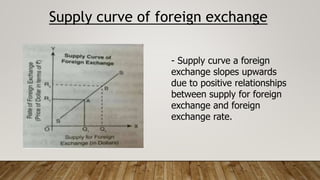
Supply curve of foreign exchange
- Supply curve a foreign
exchange slopes upwards
due to positive relationships
between supply for foreign
exchange and foreign
exchange rate.
Determination of exchange rate
• Exchange rate is determined by the interaction
of the forces of demand and supply.
• the equilibrium exchange rate is a term in that
a level where demand for foreign exchange is
equal to the supply of foreign exchange.
Foreign exchange market
- Foreign exchange market is a market in which foreign currencies are bought and sold.
- the buyers and sellers include individuals, firms, foreign exchange brokers, commercial
banks and the central bank.
• largest market in the world
• market with no central trading location and no set hours of trading.
• prices and other terms of traits are determined by computerized negotiations
Functions-
Transfer Function
Credit Function
Hedging Function
Kinds of foreign exchange markets
1. Spot market - it refers to the market in which
the receipts and payments are made immediately.
2. Forward market - it refers to the market in
which sale purchase of foreign currency is settle on a
specific future date at agreed-upon today.
PRESENTED BY:
ALLAM, JENMER ROSE
DELA CRUZ, PRECIOUS JEM C.
INTERNATIONAL
CAPITAL MARKETS
International Capital Markets
-International asset (capital) markets are a group of markets (in London,
Tokyo, New York, Singapore, and other financial cities) that trade different
types of financial and physical assets (capital), including
• Stocks bonds (government and private sector)
• Deposits denominated in different currencies
• Commodities (like petroleum, wheat, bauxite, gold)
• Forward contracts, futures contracts, swaps, options contracts
• Real estate and land
• Factories and equipment.
Gains from Trade
• How will international capital markets increased the gains
from trade?
• When a buyer and a seller engage in a voluntary
transaction, both receive something that they want and both
can be made better off.
• A buyer and seller can trade
- goods or services for other goods or services
- goods or services for assets
- assets for assets
The Three Types of International
Transaction Trade
Gains from Trade (cont.)
• The theory of comparative advantage describes the gains from
trade of goods and services for other goods and services:
- with a finite amount of resources and time, use those resources
and time to produce what you are most productive at (compared to
alternatives), then trade those products for goods and services that
you want.
- be a specialist in production, while enjoying many goods and
services as a consumer through trade.
Gains from Trade (cont.)
• The theory of intertemporal trade describes the gains from trade of
goods and services for assets, of goods and services today for claims to
goods and services in the future (today’s assets).
- Savers want to buy assets (claims to future goods and services) and
borrowers want to use assets to consume or invest in more goods and
services than they can buy with current income.
- Savers earn a rate of return on their assets, while borrowers are able to
use goods and services when they want to use them: they both can be
made better off.
Gains from Trade (cont.)
• The theory of portfolio diversification describes the gains from trade of
assets for assets, of assets with one type of risk with assets of another type
of risk.
- Investing in a diverse set, or portfolio, of assets is a way for investors to
avoid or reduce risk.
- Most people most of the time want to avoid risk: they would rather have a
sure gain of wealth than invest in risky assets when other factors are
constant.
• People usually display risk aversion: they are usually averse to risk.
Classification of Assets
Assets can be classified as either
1. Debt instruments
• Examples include bonds and deposits
• They specify that the issuer must repay a fixed amount regardless of economic
conditions.
2. Equity instruments
• Examples include stocks or a title to real estate
• They specify ownership (equity = ownership) of variable profits or returns, which
vary according to economic conditions.
International Capital Markets
The participants:
1. Commercial banks and other depository institutions:
accept deposits
• lend to commercial businesses, other banks, governments,
and/or individuals
• buy and sell bonds and other assets
• Some commercial banks underwrite new stocks and bonds by
agreeing to find buyers for those assets at a specified price.
International Capital Markets (cont.)
2. Non-bank financial institutions: securities firms, pension funds,
insurance companies, mutual funds
• Securities firms specialize in underwriting stocks and bonds
(securities) and in making various investments.
• Pension funds accept funds from workers and invest them until
the workers retire.
• Insurance companies accept premiums from policy holders and
invest them until an accident or another unexpected event occurs.
• Mutual funds accept funds from investors and invest them in a
diversified portfolio of stocks.
International Capital Markets (cont.)
3. Private firms:
• Corporations may issue stock, may issue bonds or may
borrow to acquire funds for investment purposes.
• Other private firms may issue bonds or may borrow
from commercial banks.
4. Central banks and government agencies:
• Central banks sometimes intervene in foreign exchange
markets.
• Government agencies issue bonds to acquire funds, and
may borrow from commercial banks or securities firms.
International Capital Markets (cont.)
• Because of international capital markets, policy makers
generally have a choice of 2 of the following 3 policies:
1.A fixed exchange rate
2. Monetary policy aimed at achieving domestic economic goals
3. Free international flows of financial capital
International Capital Markets (cont.)
• A fixed exchange rate and an independent monetary policy can exist if
restrictions on flows of assets prevent speculation and capital flight.
• An independent monetary policy and free flows of financial capital can
exist when the exchange rate fluctuates.
• A fixed exchange rate and free flows of financial capital can exist if the
central bank gives up its domestic goals and maintains the fixed exchange
rate.
Exchange Rate Determination.pptx

Exchange Rate Determination.pptx

  • 1.
  • 3.
    FOREIGN EXCHANGE • ForeignExchange refers to he mechanism of the ways and means by which payment in connection with International Trade are affected. • Foreign exchange refers to all currencies other than the domestic currency of a given country. • For example- Indian's domestic currency is Indian Rupee and all other currencies like Us dollar, British pound etc. are foreign exchange. • The rate of exchange is the price of one currency expressed in terms of another currency, it is the reflection of the external value of the domestic currency. • It should be noted here that exchange rate is not always constant, it goes on changing from time to time on account of change in demand and supply of foreign currency.
  • 7.
    Factors influencing exchangerate 1. Differentials in inflation 2. Differentials in interest rates 3. Public debt 4. Terms of trade 5. Political instability and economic performance
  • 8.
    Different countries havedifferent currencies with different values Example: India - Rupees America – Dollar When trade takes place, the persons of these countries have to converter currencies to other countries currencies to make payments. For this purpose the concept of foreign exchange come into operation.
  • 9.
    Foreign exchange rate •It refers to the rate at which one currency is exchanged for the other. • it represents the price of one currency in terms of another currencies. Types of foreign exchange rate: 1. Fixed exchange rate system 2. Flexible exchange rate system 3. Managed floating rate system
  • 10.
  • 11.
    Currency Depreciation vs.Currency Appreciation I. It refers to decrease in the value of domestic currency in terms of foreign currency. II. II. It makes domestic goods cheaper in foreign country as more and more of goods can now be purchased with same amount of foreign currency. So, it leads to increase in export. III. III. A change from 1$ = 55 to $1 = 60 represents that Indian Rupees is depreciating. I. It refers to increase in the value of domestic currency in terms of foreign currency. II. It makes foreign goods cheaper in domestic country as more and more of goods cannot be purchased with same amount of domestic currency. So, it leads to increase in import. III. Change from 1$ = 60 t0 1$ = 55 represents that Indian Rupees is appreciating.
  • 12.
    Flexible exchanged ratesystem • also known as " floating exchange rate“. • it refers to a system in which exchange rate is determined by forces of demand and supply of different currencies in foreign exchange market. • there is no official (government) intervention in foreign exchange market.
  • 13.
    Managed floating ratesystem • also known as "Dirty floating“. • it refers to a system in which foreign exchange rate is determined by market process and central bank influences the exchange rate through intervention in foreign exchange market. • it is a hybrid of a fixed exchange rate and a flexible exchange rate system.• aims2 is to keep exchange rate close to desired targets value.
  • 14.
    Demand for foreignexchange • The demand ( or outflow ) of foreign exchange comes from those people who need it to make payment in foreign currency. It is demanded by the domestic residence for the following reasons: 1. Imports of goods and services. 2. Tourism 3. Unilateral transfer sent abroad 4. Purchase of assets in foreign countries 5. Speculation
  • 15.
    Demand curve offoreign exchange - Demand curve of foreign exchange slopes downwards due to inverse relationships between demand for foreign exchange and foreign exchange rate
  • 16.
    Supply of foreignexchange • The supply (in flow) a foreign exchange comes from those people receive it due to following reasons: 1. Exports of goods and services 2. Foreign investment 3. Unilateral transfer from abroad 4. Speculation
  • 17.
    Supply curve offoreign exchange - Supply curve a foreign exchange slopes upwards due to positive relationships between supply for foreign exchange and foreign exchange rate.
  • 18.
    Determination of exchangerate • Exchange rate is determined by the interaction of the forces of demand and supply. • the equilibrium exchange rate is a term in that a level where demand for foreign exchange is equal to the supply of foreign exchange.
  • 19.
    Foreign exchange market -Foreign exchange market is a market in which foreign currencies are bought and sold. - the buyers and sellers include individuals, firms, foreign exchange brokers, commercial banks and the central bank. • largest market in the world • market with no central trading location and no set hours of trading. • prices and other terms of traits are determined by computerized negotiations Functions- Transfer Function Credit Function Hedging Function
  • 20.
    Kinds of foreignexchange markets 1. Spot market - it refers to the market in which the receipts and payments are made immediately. 2. Forward market - it refers to the market in which sale purchase of foreign currency is settle on a specific future date at agreed-upon today.
  • 21.
    PRESENTED BY: ALLAM, JENMERROSE DELA CRUZ, PRECIOUS JEM C. INTERNATIONAL CAPITAL MARKETS
  • 22.
    International Capital Markets -Internationalasset (capital) markets are a group of markets (in London, Tokyo, New York, Singapore, and other financial cities) that trade different types of financial and physical assets (capital), including • Stocks bonds (government and private sector) • Deposits denominated in different currencies • Commodities (like petroleum, wheat, bauxite, gold) • Forward contracts, futures contracts, swaps, options contracts • Real estate and land • Factories and equipment.
  • 23.
    Gains from Trade •How will international capital markets increased the gains from trade? • When a buyer and a seller engage in a voluntary transaction, both receive something that they want and both can be made better off. • A buyer and seller can trade - goods or services for other goods or services - goods or services for assets - assets for assets
  • 24.
    The Three Typesof International Transaction Trade
  • 25.
    Gains from Trade(cont.) • The theory of comparative advantage describes the gains from trade of goods and services for other goods and services: - with a finite amount of resources and time, use those resources and time to produce what you are most productive at (compared to alternatives), then trade those products for goods and services that you want. - be a specialist in production, while enjoying many goods and services as a consumer through trade.
  • 26.
    Gains from Trade(cont.) • The theory of intertemporal trade describes the gains from trade of goods and services for assets, of goods and services today for claims to goods and services in the future (today’s assets). - Savers want to buy assets (claims to future goods and services) and borrowers want to use assets to consume or invest in more goods and services than they can buy with current income. - Savers earn a rate of return on their assets, while borrowers are able to use goods and services when they want to use them: they both can be made better off.
  • 27.
    Gains from Trade(cont.) • The theory of portfolio diversification describes the gains from trade of assets for assets, of assets with one type of risk with assets of another type of risk. - Investing in a diverse set, or portfolio, of assets is a way for investors to avoid or reduce risk. - Most people most of the time want to avoid risk: they would rather have a sure gain of wealth than invest in risky assets when other factors are constant. • People usually display risk aversion: they are usually averse to risk.
  • 28.
    Classification of Assets Assetscan be classified as either 1. Debt instruments • Examples include bonds and deposits • They specify that the issuer must repay a fixed amount regardless of economic conditions. 2. Equity instruments • Examples include stocks or a title to real estate • They specify ownership (equity = ownership) of variable profits or returns, which vary according to economic conditions.
  • 29.
    International Capital Markets Theparticipants: 1. Commercial banks and other depository institutions: accept deposits • lend to commercial businesses, other banks, governments, and/or individuals • buy and sell bonds and other assets • Some commercial banks underwrite new stocks and bonds by agreeing to find buyers for those assets at a specified price.
  • 30.
    International Capital Markets(cont.) 2. Non-bank financial institutions: securities firms, pension funds, insurance companies, mutual funds • Securities firms specialize in underwriting stocks and bonds (securities) and in making various investments. • Pension funds accept funds from workers and invest them until the workers retire. • Insurance companies accept premiums from policy holders and invest them until an accident or another unexpected event occurs. • Mutual funds accept funds from investors and invest them in a diversified portfolio of stocks.
  • 31.
    International Capital Markets(cont.) 3. Private firms: • Corporations may issue stock, may issue bonds or may borrow to acquire funds for investment purposes. • Other private firms may issue bonds or may borrow from commercial banks. 4. Central banks and government agencies: • Central banks sometimes intervene in foreign exchange markets. • Government agencies issue bonds to acquire funds, and may borrow from commercial banks or securities firms.
  • 32.
    International Capital Markets(cont.) • Because of international capital markets, policy makers generally have a choice of 2 of the following 3 policies: 1.A fixed exchange rate 2. Monetary policy aimed at achieving domestic economic goals 3. Free international flows of financial capital
  • 33.
    International Capital Markets(cont.) • A fixed exchange rate and an independent monetary policy can exist if restrictions on flows of assets prevent speculation and capital flight. • An independent monetary policy and free flows of financial capital can exist when the exchange rate fluctuates. • A fixed exchange rate and free flows of financial capital can exist if the central bank gives up its domestic goals and maintains the fixed exchange rate.