CHAPTER IV
FOREIGN EXCHANGE
ABID RAHMAN K A
Guest Faculty
Dept of Economics
Sullamussalam science College Areekode
Module IV
Foreign Exchange:
• Foreign exchange market – functions - Defining foreign
exchange
• Exchange rate – Exchange rate concepts
• Exchange rate changes
• Different systems of exchange rate determination - fixed
and flexible exchange rate – Hybrid exchange rate systems
– Managed floating
• Theories of exchange rate – Mint Parity theory – Purchasing
Power Parity Theory – Balance of Payments Theory -
• Components of Foreign exchange .
FOREIGN EXCHANGE MARKET
• Foreign Exchange market is the market for the purchase and
sale of currencies. It is a global market which operates in all
times (24x7 market).
• The price prevailing in this market is called foreign exchange
rate.
• An exchange rate is the rate at which one currency can be
exchanged for another. In other words, it is the price of
foreign currency in terms of the domestic currency. Just like
the price of any asset, the exchange rate is the price at which
one can buy another currency.
• Exchange rates are determined in the foreign exchange
market.
• Thus, economists predict that movements in exchange rates
should reflect changes in the relative demand for and supply
of the two currencies.
Functions
• 1. Fund Transfer: It convenes the transfer of funds and
purchasing power from one nation and currency to another
as foreign exchange is demanded to exchange commodities
between nations. It is realized through the inflow and
outflow of money by exports and imports.
• 2. Credit for Trade: The flow of goods and services across
countries demand sufficient financial support. Through
various monetary instruments like external commercial
borrowing, Eurobonds, foreign bonds etc. foreign exchange
market performs this function effectively.
• 3. Hedging and Speculation: Exchange rate risk is very
fundamental to the foreign exchange market. The market
itself offers ways to reduce or avoid it. Hedging means the
measures adopted for avoiding risks. But speculation is an
open position in the market with an expectation of gains
through the fluctuations.
PARTICIPANTS IN THE MARKET
• It is an organizational framework within which individuals,
firms and banks buy and sell foreign currencies or foreign
exchange.
• This 24x7 hour market is the most liquid market in the
world level. It has global outreach and the currencies are
traded worldwide.
• The different monetary centers are connected by a
telephone network.
• Commercial banks, brokers and clients are the major
participants of this system.
• Exporters and importers are the real clients of the market.
• Now a days speculators also involve in the market with an
eye on the profit.
Types of Foreign exchange transaction
• Foreign exchange transaction refers to purchase and sale of
foreign currencies.
• The transactions are done with an exchange of a specific
country’s currency for another at an agreed exchange rate
on a specific date.
1. Spot Transactions
• This method of transaction is the fastest way to exchange
currencies.
• Spot transaction refers to the exchange or settlement of
the currencies by the buyer and seller within two days of
the deal without a signed contract.
• The Spot Exchange Rate is the prevailing exchange rate in
the market.
2. Forward Transactions
• Forward transactions are future transactions when the buyer
and seller enter into an agreement of purchase and sale of
currency after 90 days.
• The agreement is framed on the basis of a fixed exchange
rate for a definite date in the future.
• The rate at which the deal is fixed is termed as Forward
Exchange Rate.
3. Future Transaction
• Future transactions also deals with contracts in the same
manner as forward transactions.
• However, in case of future transactions, standardized
contracts in terms of features, date, and size should be
followed.
• Whereas, regular forward transactions have flexibility and
can be customised.
• In future transactions, an initial margin is fixed and kept as
collateral in order to establish a future position.
4.Swap Transactions
• A simultaneous lending and borrowing of two
different currencies between two investors are
referred to as swap transaction.
• One investor borrows a currency and repays in the
form of a second currency to the second investor.
• Swap transactions are done to pay off obligations
without suffering a foreign exchange risk.
5. Option Transactions
• The exchange of currency from one denomination to
another at an agreed rate on a specific date is an
option for an investor.
• Every investor owns the right to convert the currency
but is not obligated to do so.
6. Arbitrage
• Arbitrage is the process of a simultaneous sale and
purchase of currencies in two or more foreign
exchange markets with an objective to make profits
by capitalizing on the exchange-rate differentials in
various markets.
7. Hedging
• A foreign exchange hedge (also called a FOREX hedge)
is a method used by companies to eliminate or
"hedge" their foreign exchange risk resulting from
transactions in foreign currencies
8. Speculation
• Speculation in the foreign exchange market involves
the buying and selling of currencies with the view of
making a profit.
• It is called speculation because of the uncertainty
involved as no one can say for sure whether the
market will be going up or down.
EXCHANGE RATE CONCEPTS
• Nominal Exchange Rate: The nominal exchange rate is
the amount of domestic currency needed to purchase
foreign currency.
• Real Exchange Rate: the real exchange rates are the
inflation-adjusted exchange rates between two
currencies.
• Spot Exchange Rate: it refers to the current exchange rate. It
is the day to day rate.
• Forward Exchange Rate: it refers to an exchange rate that is
quoted and traded today but for delivery and payment on a
specific future date.
Changes in Exchange Rate
1. Devaluation
2. Revaluation
3. Depreciation
4. Appreciation
5. Overvaluation
6. Undervaluation
Devaluation
• Under a fixed exchange rate system, devaluation is official
changes in the value of a country's currency relative to
other currencies.
• It can be conducted by policymakers, usually motivated by
market pressures. Under a fixed exchange rate system, only
a decision by a country's government or monetary
authority can alter the official value of the currency.
• Governments do, occasionally, take such measures, often in
response to unusual market pressures.
• Devaluation, the deliberate downward adjustment in the
official exchange rate, reduces the currency's value.
Devaluation
• A key effect of devaluation is that it makes the
domestic currency cheaper relative to other currencies.
• There are two implications of a devaluation.
• First, devaluation makes the country's exports
relatively less expensive for foreigners.
• Second, the devaluation makes foreign products
relatively more expensive for domestic consumers,
thus discouraging imports.
• This may help to increase the country's exports and
decrease imports, and may therefore help to reduce
the current account deficit.
Effects of Devaluation
• A significant danger is that by increasing the price of
imports and stimulating greater demand for domestic
products, devaluation can aggravate inflation.
• Another risk of devaluation is psychological. To the
extent that devaluation is viewed as a sign of economic
weakness, the creditworthiness of the nation may be
jeopardized.
• Another possible consequence is a round of successive
devaluations. For instance, trading partners may
become concerned that devaluation might negatively
affect their own export industries.
Revaluation
• Under a fixed exchange rate system, Revaluation is official changes
in the value of a country's currency relative to other currencies.
• It can be conducted by policymakers, usually motivated by market
pressures. Under a fixed exchange rate system, only a decision by a
country's government or monetary authority can alter the official
value of the currency.
• Governments do, occasionally, take such measures, often in
response to unusual market pressures.
• Revaluation is an upward change in the currency's value.
• Revaluation, which makes a currency more expensive, might be
undertaken in an effort to reduce a current account surplus, where
exports exceed imports, or to attempt to contain inflationary
pressures.
Appreciation & Depreciation
• When the value of the currency goes up as compared
to other currency it is known as appreciation.
• When the value of currency falls as compared to other
currency it is known as depreciation.
• Under a floating exchange rate system, market forces
generate changes in the value of the currency, known
as currency depreciation or appreciation.
• Depreciation is the downward trend whereas
appreciation is the upward trend in rate of exchange.
Overvaluation and Undervaluation
• Overvaluation is a situation in which exchange
rate of currency exceeds what open market is
willing to pay.
• Undervaluation means the rate at which it can
be exchanged for other currencies is too low.
Different Systems of Exchange
Rate Determinations
Fixed Exchange Rates
• A fixed or pegged, rate is a rate the government
(central bank)) sets and maintains as the official
exchange rate.
• A rate will be determined against a major world
currency (usually the U.S. dollar)
• In order to maintain the local exchange rate, the
central bank buys and sells its own currency on
the foreign exchange market in return for the
currency to which it is pegged.
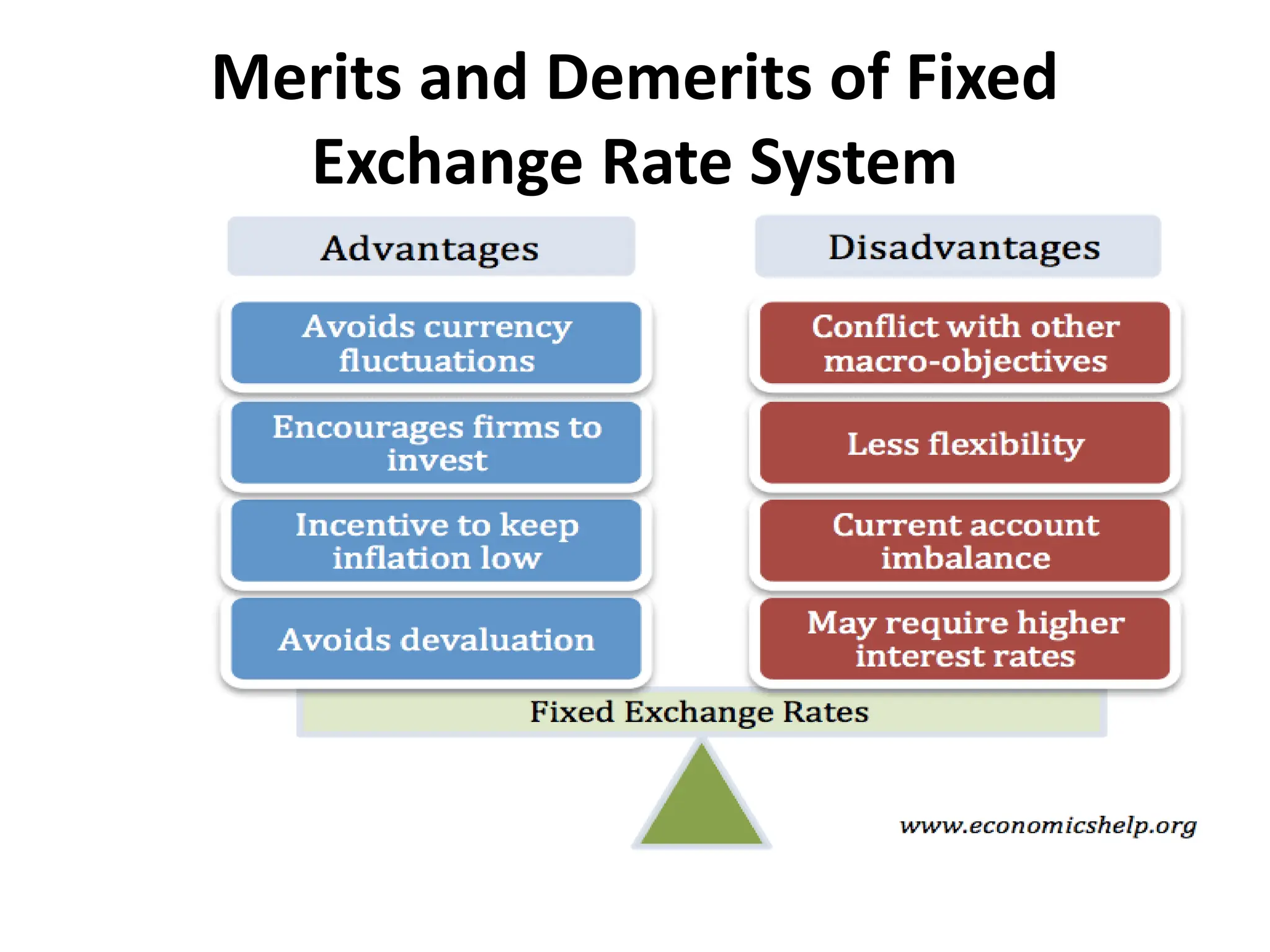
Merits and Demerits of Fixed
Exchange Rate System
Floating Exchange Rates
• Floating exchange rate is determined by the private market through supply
and demand.
• A floating rate is often termed "self-correcting," as any differences in
supply and demand will automatically be corrected in the market.
• A floating exchange rate is constantly changing. In a floating regime, the
central bank may also intervene when it is necessary to ensure stability
and to avoid inflation but the frequency is comparatively low.
• In reality, no currency is wholly fixed or floating. In a fixed regime, market
pressures can also influence changes in the exchange rate. Sometimes,
when a local currency reflects its true value against its pegged currency, a
"black market“ may develop.
• A central bank will often then be forced to revalue or devalue the official
rate so that the rate is in line with the unofficial one, thereby halting the
activity of the black market.
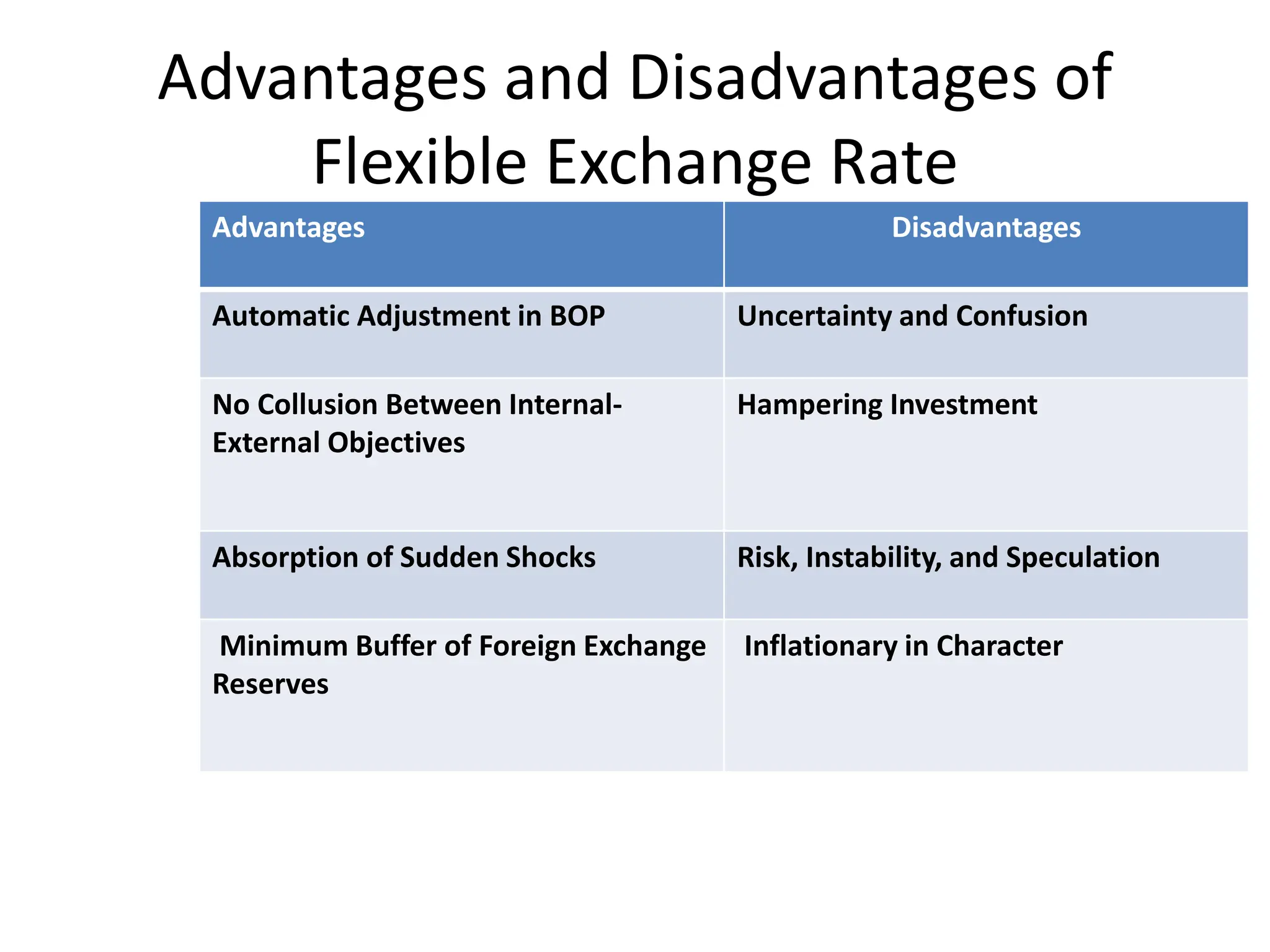
Advantages and Disadvantages of
Flexible Exchange Rate
Advantages Disadvantages
Automatic Adjustment in BOP Uncertainty and Confusion
No Collusion Between Internal-
External Objectives
Hampering Investment
Absorption of Sudden Shocks Risk, Instability, and Speculation
Minimum Buffer of Foreign Exchange
Reserves
Inflationary in Character
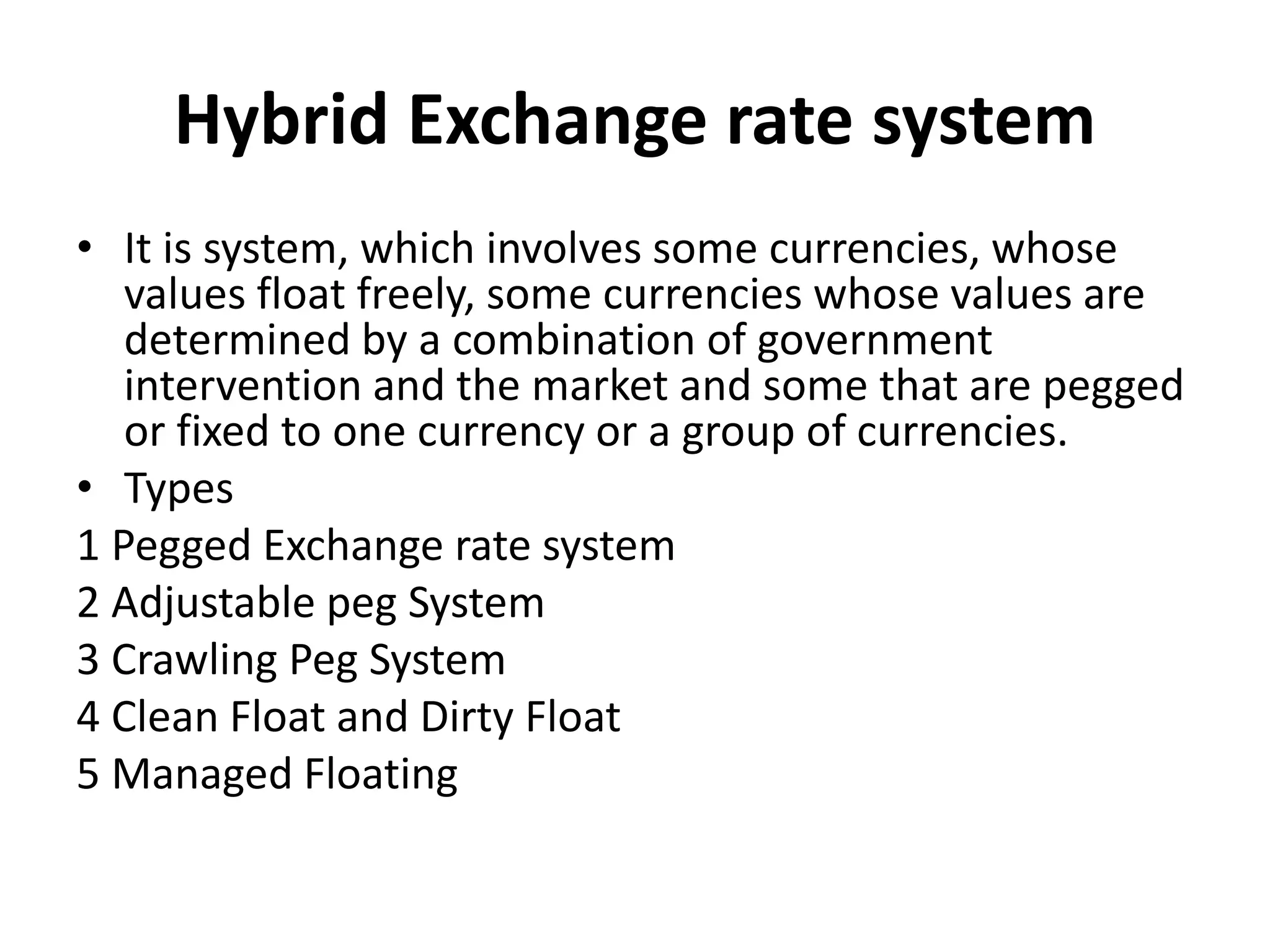
Hybrid Exchange rate system
• It is system, which involves some currencies, whose
values float freely, some currencies whose values are
determined by a combination of government
intervention and the market and some that are pegged
or fixed to one currency or a group of currencies.
• Types
1 Pegged Exchange rate system
2 Adjustable peg System
3 Crawling Peg System
4 Clean Float and Dirty Float
5 Managed Floating
THEORIES OF EXCHANGE RATE
• There are two prominent theories which
determine exchange rate systematically.
1 Gold standard
2 Purchasing power parity theory.
Purchasing-power parity theory
• Purchasing power parity is both a theory about exchange
rate determination and a tool to make more accurate
comparisons of data between countries.
• The concept of purchasing power parity is quite old. It is
believed to have been propounded by the sixteenth-
century scholars of the University of Salamanca of Spain.
• It relates the price level in a country to the exchange rate.
• Purchasing power parity (PPP) is a theory of exchange rate
determination which compares the average costs of goods
and services between countries.
Purchasing-power parity theory
• The theory states that the exchange rate between one currency and
another is in equilibrium when their domestic purchasing powers at
that rate of exchange are equivalent.
• PPP indicates that exchange rate between two countries should
equal to the ratio of similar goods and services in both countries. In
short, what this means is that a bundle of goods should cost the
same in India and Pakistan when we take the exchange rate
between them.
• Purchasing-power parity theory tells us that price differentials
between countries are not sustainable in the long run as market
forces will equalize prices between countries and change exchange
rates in doing so.
• Since the price for any one good should be equal across markets,
the price for any combination or basket of goods should be
equalized.
Purchasing-power parity theory
• PPP calculated by comparing price of one
good across in different currencies is known as
Absolute PPP.
• For example, if one kg of wheat costs INR 12 in
India and similar quality of wheat costs 2
dollars in USA, then the PPP exchange rate
would be INR 6 per USD.
• This is the absolute version of theory of
purchasing power of parity.
Purchasing-power parity theory
• There is an alternative version of the PPP theory
called the “relative PPP theory.”
• In essence this is a dynamic version of the absolute
PPP theory In other words; the spot rate between two
countries can be determined by comparing the price
index of a basket of similar goods and services.
• It is very important to understand at this point is that
price index should comprise of “similar” goods &
services” consumed by residents of both country.
• If the actual spot exchange rate equals the rate
calculated by PPP, then PPP holds true. However, it is
empirically proved that PPP in absolute form based
on single product or based on a price index does not
hold good.
Problems with the PPP Theory
• Transportation costs and trade restrictions: Since transport costs
and trade restrictions do exist in the real world, this would tend to
drive prices for similar goods apart.
• Transport costs should make a good cheaper in the exporting
market and more expensive in the importing market. Similarly, an
import tariff would drive a wedge between the prices of an
identical good in two trading countries’ markets, raising it in the
import market relative to the export market price.
• Costs of non tradable inputs: Many items that are homogeneous
nevertheless sell for different prices because they require a non
tradable input in the production process.
Problems with the PPP Theory
• Perfect information: The law of one price assumes that individuals have
good, even perfect, information about the prices of goods in other
markets. Only with this knowledge will profit seekers begin to export
goods to the high price market and import goods from the low-priced
market.
• Other market participants
• Notice that in the PPP equilibrium stories, it is the behavior of profit-
seeking importers and exporters that forces the exchange rate to adjust to
the PPP level. These activities would be recorded on the current account
of a country’s balance of payments. Thus it is reasonable to say that the
PPP theory is based on current account transactions. This contrasts with
the interest rate parity theory in which the behavior of investors seeking
the highest rates of return on investments motivates adjustments in the
exchange rate. Since investors are trading assets, these transactions would
appear on a country’s capital account of its balance of payments. Thus the
interest rate parity theory is based on capital account transactions.
Mint Parity Theory
• Mint parity theory explains the determination of
exchange rate between the two countries which are on
gold standard.
• In a country which is on gold standard, the currency is
either made of gold or is convertible into gold at a fixed
rate.
• There are also no restrictions on the export or import
of gold. The central bank of the country was always
ready to buy and sell gold at the specified price.
• The rate at which the standard money of the country
was convertible into gold was called mint price of gold.
Determination of Exchange Rate.
• The rate of exchange between the gold standard
countries is determined on a weight to weight basis of
the gold contents of their currencies.
• In other words, the exchange rate is determined by
the, gold equivalents of the currencies involved.
• For examples, before World Warll (1926-1931)
England and American currencies were on gold
standard. The mint par between
• these two countries was pound one of England=4.86
dollars of America. The ratio of weights of metal was
called the mint parity.
• The mint par was a fixed rate. It remained constant so
long as the monetary laws of the country remained
unchanged. The current or the market rate of
exchange, however, fluctuated from time to time due
to changes in the balance of payments of the
respective countries.
Calculations of gold points
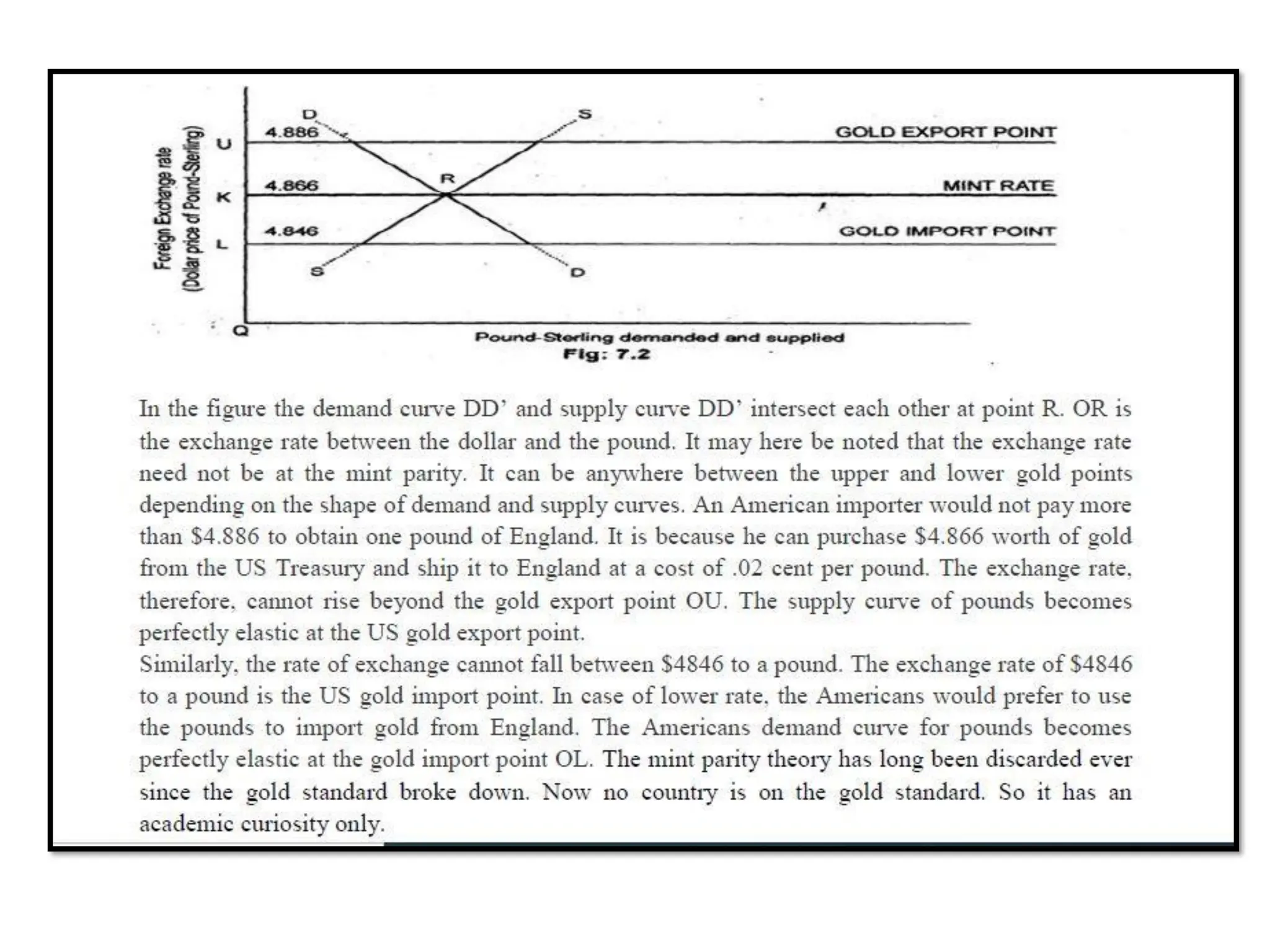
• But the actual rate of exchange could very above and below the
mint parity by the cost of shipping gold between the two countries
• The gold points are determined by the costs of transporting gold
(such as shipping, packing’, insurance charges, etc.) from one
country to another. The upper gold point (upper specie point) is
obtained by adding the cost of shipping gold to the mint parity rate
of exchange.
• The lower gold point (lower specie point) is arrived at by deducting
the cost of shipping gold from the mint parity rate of exchange. For
example, the mint parity rate of exchange between England and
America is £1=$4.866. The shipping cost of gold from America to
England worth 4.866 dollars of gold is .02 cent.
• In that case the upper gold point = £1=$4.866 + .02=$4.886. The
lower gold point = £1$4.866 .02= $4.846.
Gold export point and gold import
point
• The upper gold point is also called gold export
point. It is the rate of exchange above which the
gold will be exported.
• The lower gold point is also called the gold import
point. It is the rate of exchange below which gold
will be imported.
• Under the gold standard, the exchange rate
between the two currencies cannot vary above
the upper gold point and below the lower gold
point
Thanks

Module IV to Foreign Exchange.pdf Calicut University pdf economics

  • 1.
    CHAPTER IV FOREIGN EXCHANGE ABIDRAHMAN K A Guest Faculty Dept of Economics Sullamussalam science College Areekode
  • 2.
    Module IV Foreign Exchange: •Foreign exchange market – functions - Defining foreign exchange • Exchange rate – Exchange rate concepts • Exchange rate changes • Different systems of exchange rate determination - fixed and flexible exchange rate – Hybrid exchange rate systems – Managed floating • Theories of exchange rate – Mint Parity theory – Purchasing Power Parity Theory – Balance of Payments Theory - • Components of Foreign exchange .
  • 3.
    FOREIGN EXCHANGE MARKET •Foreign Exchange market is the market for the purchase and sale of currencies. It is a global market which operates in all times (24x7 market). • The price prevailing in this market is called foreign exchange rate. • An exchange rate is the rate at which one currency can be exchanged for another. In other words, it is the price of foreign currency in terms of the domestic currency. Just like the price of any asset, the exchange rate is the price at which one can buy another currency. • Exchange rates are determined in the foreign exchange market. • Thus, economists predict that movements in exchange rates should reflect changes in the relative demand for and supply of the two currencies.
  • 4.
    Functions • 1. FundTransfer: It convenes the transfer of funds and purchasing power from one nation and currency to another as foreign exchange is demanded to exchange commodities between nations. It is realized through the inflow and outflow of money by exports and imports. • 2. Credit for Trade: The flow of goods and services across countries demand sufficient financial support. Through various monetary instruments like external commercial borrowing, Eurobonds, foreign bonds etc. foreign exchange market performs this function effectively. • 3. Hedging and Speculation: Exchange rate risk is very fundamental to the foreign exchange market. The market itself offers ways to reduce or avoid it. Hedging means the measures adopted for avoiding risks. But speculation is an open position in the market with an expectation of gains through the fluctuations.
  • 5.
    PARTICIPANTS IN THEMARKET • It is an organizational framework within which individuals, firms and banks buy and sell foreign currencies or foreign exchange. • This 24x7 hour market is the most liquid market in the world level. It has global outreach and the currencies are traded worldwide. • The different monetary centers are connected by a telephone network. • Commercial banks, brokers and clients are the major participants of this system. • Exporters and importers are the real clients of the market. • Now a days speculators also involve in the market with an eye on the profit.
  • 6.
    Types of Foreignexchange transaction • Foreign exchange transaction refers to purchase and sale of foreign currencies. • The transactions are done with an exchange of a specific country’s currency for another at an agreed exchange rate on a specific date. 1. Spot Transactions • This method of transaction is the fastest way to exchange currencies. • Spot transaction refers to the exchange or settlement of the currencies by the buyer and seller within two days of the deal without a signed contract. • The Spot Exchange Rate is the prevailing exchange rate in the market.
  • 7.
    2. Forward Transactions •Forward transactions are future transactions when the buyer and seller enter into an agreement of purchase and sale of currency after 90 days. • The agreement is framed on the basis of a fixed exchange rate for a definite date in the future. • The rate at which the deal is fixed is termed as Forward Exchange Rate. 3. Future Transaction • Future transactions also deals with contracts in the same manner as forward transactions. • However, in case of future transactions, standardized contracts in terms of features, date, and size should be followed. • Whereas, regular forward transactions have flexibility and can be customised. • In future transactions, an initial margin is fixed and kept as collateral in order to establish a future position.
  • 8.
    4.Swap Transactions • Asimultaneous lending and borrowing of two different currencies between two investors are referred to as swap transaction. • One investor borrows a currency and repays in the form of a second currency to the second investor. • Swap transactions are done to pay off obligations without suffering a foreign exchange risk. 5. Option Transactions • The exchange of currency from one denomination to another at an agreed rate on a specific date is an option for an investor. • Every investor owns the right to convert the currency but is not obligated to do so.
  • 9.
    6. Arbitrage • Arbitrageis the process of a simultaneous sale and purchase of currencies in two or more foreign exchange markets with an objective to make profits by capitalizing on the exchange-rate differentials in various markets. 7. Hedging • A foreign exchange hedge (also called a FOREX hedge) is a method used by companies to eliminate or "hedge" their foreign exchange risk resulting from transactions in foreign currencies 8. Speculation • Speculation in the foreign exchange market involves the buying and selling of currencies with the view of making a profit. • It is called speculation because of the uncertainty involved as no one can say for sure whether the market will be going up or down.
  • 10.
    EXCHANGE RATE CONCEPTS •Nominal Exchange Rate: The nominal exchange rate is the amount of domestic currency needed to purchase foreign currency. • Real Exchange Rate: the real exchange rates are the inflation-adjusted exchange rates between two currencies. • Spot Exchange Rate: it refers to the current exchange rate. It is the day to day rate. • Forward Exchange Rate: it refers to an exchange rate that is quoted and traded today but for delivery and payment on a specific future date.
  • 11.
    Changes in ExchangeRate 1. Devaluation 2. Revaluation 3. Depreciation 4. Appreciation 5. Overvaluation 6. Undervaluation
  • 12.
    Devaluation • Under afixed exchange rate system, devaluation is official changes in the value of a country's currency relative to other currencies. • It can be conducted by policymakers, usually motivated by market pressures. Under a fixed exchange rate system, only a decision by a country's government or monetary authority can alter the official value of the currency. • Governments do, occasionally, take such measures, often in response to unusual market pressures. • Devaluation, the deliberate downward adjustment in the official exchange rate, reduces the currency's value.
  • 13.
    Devaluation • A keyeffect of devaluation is that it makes the domestic currency cheaper relative to other currencies. • There are two implications of a devaluation. • First, devaluation makes the country's exports relatively less expensive for foreigners. • Second, the devaluation makes foreign products relatively more expensive for domestic consumers, thus discouraging imports. • This may help to increase the country's exports and decrease imports, and may therefore help to reduce the current account deficit.
  • 14.
    Effects of Devaluation •A significant danger is that by increasing the price of imports and stimulating greater demand for domestic products, devaluation can aggravate inflation. • Another risk of devaluation is psychological. To the extent that devaluation is viewed as a sign of economic weakness, the creditworthiness of the nation may be jeopardized. • Another possible consequence is a round of successive devaluations. For instance, trading partners may become concerned that devaluation might negatively affect their own export industries.
  • 15.
    Revaluation • Under afixed exchange rate system, Revaluation is official changes in the value of a country's currency relative to other currencies. • It can be conducted by policymakers, usually motivated by market pressures. Under a fixed exchange rate system, only a decision by a country's government or monetary authority can alter the official value of the currency. • Governments do, occasionally, take such measures, often in response to unusual market pressures. • Revaluation is an upward change in the currency's value. • Revaluation, which makes a currency more expensive, might be undertaken in an effort to reduce a current account surplus, where exports exceed imports, or to attempt to contain inflationary pressures.
  • 16.
    Appreciation & Depreciation •When the value of the currency goes up as compared to other currency it is known as appreciation. • When the value of currency falls as compared to other currency it is known as depreciation. • Under a floating exchange rate system, market forces generate changes in the value of the currency, known as currency depreciation or appreciation. • Depreciation is the downward trend whereas appreciation is the upward trend in rate of exchange.
  • 17.
    Overvaluation and Undervaluation •Overvaluation is a situation in which exchange rate of currency exceeds what open market is willing to pay. • Undervaluation means the rate at which it can be exchanged for other currencies is too low.
  • 18.
    Different Systems ofExchange Rate Determinations
  • 19.
    Fixed Exchange Rates •A fixed or pegged, rate is a rate the government (central bank)) sets and maintains as the official exchange rate. • A rate will be determined against a major world currency (usually the U.S. dollar) • In order to maintain the local exchange rate, the central bank buys and sells its own currency on the foreign exchange market in return for the currency to which it is pegged.
  • 20.
    Merits and Demeritsof Fixed Exchange Rate System
  • 21.
    Floating Exchange Rates •Floating exchange rate is determined by the private market through supply and demand. • A floating rate is often termed "self-correcting," as any differences in supply and demand will automatically be corrected in the market. • A floating exchange rate is constantly changing. In a floating regime, the central bank may also intervene when it is necessary to ensure stability and to avoid inflation but the frequency is comparatively low. • In reality, no currency is wholly fixed or floating. In a fixed regime, market pressures can also influence changes in the exchange rate. Sometimes, when a local currency reflects its true value against its pegged currency, a "black market“ may develop. • A central bank will often then be forced to revalue or devalue the official rate so that the rate is in line with the unofficial one, thereby halting the activity of the black market.
  • 22.
    Advantages and Disadvantagesof Flexible Exchange Rate Advantages Disadvantages Automatic Adjustment in BOP Uncertainty and Confusion No Collusion Between Internal- External Objectives Hampering Investment Absorption of Sudden Shocks Risk, Instability, and Speculation Minimum Buffer of Foreign Exchange Reserves Inflationary in Character
  • 23.
    Hybrid Exchange ratesystem • It is system, which involves some currencies, whose values float freely, some currencies whose values are determined by a combination of government intervention and the market and some that are pegged or fixed to one currency or a group of currencies. • Types 1 Pegged Exchange rate system 2 Adjustable peg System 3 Crawling Peg System 4 Clean Float and Dirty Float 5 Managed Floating
  • 24.
    THEORIES OF EXCHANGERATE • There are two prominent theories which determine exchange rate systematically. 1 Gold standard 2 Purchasing power parity theory.
  • 25.
    Purchasing-power parity theory •Purchasing power parity is both a theory about exchange rate determination and a tool to make more accurate comparisons of data between countries. • The concept of purchasing power parity is quite old. It is believed to have been propounded by the sixteenth- century scholars of the University of Salamanca of Spain. • It relates the price level in a country to the exchange rate. • Purchasing power parity (PPP) is a theory of exchange rate determination which compares the average costs of goods and services between countries.
  • 26.
    Purchasing-power parity theory •The theory states that the exchange rate between one currency and another is in equilibrium when their domestic purchasing powers at that rate of exchange are equivalent. • PPP indicates that exchange rate between two countries should equal to the ratio of similar goods and services in both countries. In short, what this means is that a bundle of goods should cost the same in India and Pakistan when we take the exchange rate between them. • Purchasing-power parity theory tells us that price differentials between countries are not sustainable in the long run as market forces will equalize prices between countries and change exchange rates in doing so. • Since the price for any one good should be equal across markets, the price for any combination or basket of goods should be equalized.
  • 27.
    Purchasing-power parity theory •PPP calculated by comparing price of one good across in different currencies is known as Absolute PPP. • For example, if one kg of wheat costs INR 12 in India and similar quality of wheat costs 2 dollars in USA, then the PPP exchange rate would be INR 6 per USD. • This is the absolute version of theory of purchasing power of parity.
  • 28.
    Purchasing-power parity theory •There is an alternative version of the PPP theory called the “relative PPP theory.” • In essence this is a dynamic version of the absolute PPP theory In other words; the spot rate between two countries can be determined by comparing the price index of a basket of similar goods and services. • It is very important to understand at this point is that price index should comprise of “similar” goods & services” consumed by residents of both country. • If the actual spot exchange rate equals the rate calculated by PPP, then PPP holds true. However, it is empirically proved that PPP in absolute form based on single product or based on a price index does not hold good.
  • 29.
    Problems with thePPP Theory • Transportation costs and trade restrictions: Since transport costs and trade restrictions do exist in the real world, this would tend to drive prices for similar goods apart. • Transport costs should make a good cheaper in the exporting market and more expensive in the importing market. Similarly, an import tariff would drive a wedge between the prices of an identical good in two trading countries’ markets, raising it in the import market relative to the export market price. • Costs of non tradable inputs: Many items that are homogeneous nevertheless sell for different prices because they require a non tradable input in the production process.
  • 30.
    Problems with thePPP Theory • Perfect information: The law of one price assumes that individuals have good, even perfect, information about the prices of goods in other markets. Only with this knowledge will profit seekers begin to export goods to the high price market and import goods from the low-priced market. • Other market participants • Notice that in the PPP equilibrium stories, it is the behavior of profit- seeking importers and exporters that forces the exchange rate to adjust to the PPP level. These activities would be recorded on the current account of a country’s balance of payments. Thus it is reasonable to say that the PPP theory is based on current account transactions. This contrasts with the interest rate parity theory in which the behavior of investors seeking the highest rates of return on investments motivates adjustments in the exchange rate. Since investors are trading assets, these transactions would appear on a country’s capital account of its balance of payments. Thus the interest rate parity theory is based on capital account transactions.
  • 31.
    Mint Parity Theory •Mint parity theory explains the determination of exchange rate between the two countries which are on gold standard. • In a country which is on gold standard, the currency is either made of gold or is convertible into gold at a fixed rate. • There are also no restrictions on the export or import of gold. The central bank of the country was always ready to buy and sell gold at the specified price. • The rate at which the standard money of the country was convertible into gold was called mint price of gold.
  • 32.
    Determination of ExchangeRate. • The rate of exchange between the gold standard countries is determined on a weight to weight basis of the gold contents of their currencies. • In other words, the exchange rate is determined by the, gold equivalents of the currencies involved. • For examples, before World Warll (1926-1931) England and American currencies were on gold standard. The mint par between • these two countries was pound one of England=4.86 dollars of America. The ratio of weights of metal was called the mint parity. • The mint par was a fixed rate. It remained constant so long as the monetary laws of the country remained unchanged. The current or the market rate of exchange, however, fluctuated from time to time due to changes in the balance of payments of the respective countries.
  • 33.
    Calculations of goldpoints • But the actual rate of exchange could very above and below the mint parity by the cost of shipping gold between the two countries • The gold points are determined by the costs of transporting gold (such as shipping, packing’, insurance charges, etc.) from one country to another. The upper gold point (upper specie point) is obtained by adding the cost of shipping gold to the mint parity rate of exchange. • The lower gold point (lower specie point) is arrived at by deducting the cost of shipping gold from the mint parity rate of exchange. For example, the mint parity rate of exchange between England and America is £1=$4.866. The shipping cost of gold from America to England worth 4.866 dollars of gold is .02 cent. • In that case the upper gold point = £1=$4.866 + .02=$4.886. The lower gold point = £1$4.866 .02= $4.846.
  • 34.
    Gold export pointand gold import point • The upper gold point is also called gold export point. It is the rate of exchange above which the gold will be exported. • The lower gold point is also called the gold import point. It is the rate of exchange below which gold will be imported. • Under the gold standard, the exchange rate between the two currencies cannot vary above the upper gold point and below the lower gold point
  • 36.