Dr.P.Viswakumar.,M.S 
Assistant professor, 
Dept of General surgery, 
PSGIMSR.
The term “hernia” is derived from 
the Greek word hernios, which 
means “budding.” 
Hernia – Protrusion of visceral contents 
through the Abdominal wall. 
Two key components 
Defect Hernial Sac
• Erect Human posture – Vulnerability between 
abdominal muscle wall & hard pelvic bones. 
• Passage of various structure from trunk to 
extremities (Femoral nerve,Iliac vessels and 
Spermatic cord). 
• So Adult hernia is in part results from weakness of 
inner envelope of Abdominal wall (Transversalis 
fascia). 
• Weakest points – Inguinal, Femoral and Umblical.
Why ? 
“ No disease of human body belonging to the 
province of the surgeon requires in its treatment a 
better combination of accurate knowledge with 
surgical skill than hernia in all its varities” 
- Sir Astley paston cooper ;1804
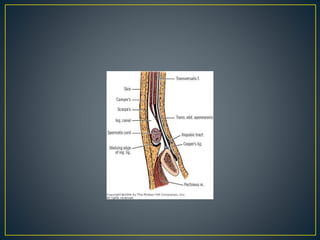
• Layers of Abdominal wall ?? 
- 9 layers 
1) Skin 
2) Camper’s fascia 
3) Scarpa’s fascia 
4) External oblique muscle & aponeurosis. 
5) Internal oblique muscle & aponeurosis. 
6) Transverse abdominus & aponeurosis. 
7) Transversalis fascia 
8) Preperitoneal fat. 
9) Peritoneum.
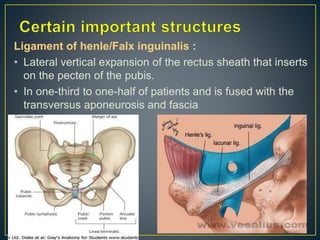
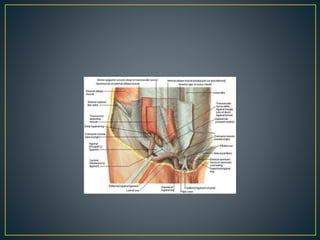
Ligament of henle/Falx inguinalis : 
• Lateral vertical expansion of the rectus sheath that inserts 
on the pecten of the pubis. 
• In one-third to one-half of patients and is fused with the 
transversus aponeurosis and fascia
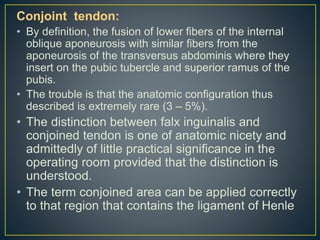
Conjoint tendon: 
• By definition, the fusion of lower fibers of the internal 
oblique aponeurosis with similar fibers from the 
aponeurosis of the transversus abdominis where they 
insert on the pubic tubercle and superior ramus of the 
pubis. 
• The trouble is that the anatomic configuration thus 
described is extremely rare (3 – 5%). 
• The distinction between falx inguinalis and 
conjoined tendon is one of anatomic nicety and 
admittedly of little practical significance in the 
operating room provided that the distinction is 
understood. 
• The term conjoined area can be applied correctly 
to that region that contains the ligament of Henle
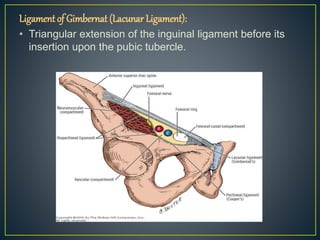
Ligament of Gimbernat (Lacunar Ligament): 
• Triangular extension of the inguinal ligament before its 
insertion upon the pubic tubercle.
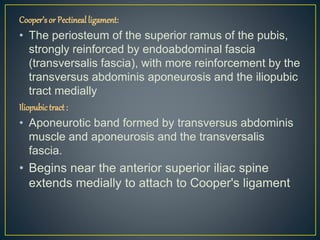
Cooper’s or Pectineal ligament: 
• The periosteum of the superior ramus of the pubis, 
strongly reinforced by endoabdominal fascia 
(transversalis fascia), with more reinforcement by the 
transversus abdominis aponeurosis and the iliopubic 
tract medially 
Iliopubic tract : 
• Aponeurotic band formed by transversus abdominis 
muscle and aponeurosis and the transversalis 
fascia. 
• Begins near the anterior superior iliac spine 
extends medially to attach to Cooper's ligament
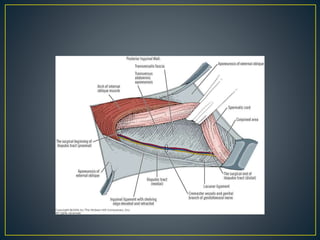
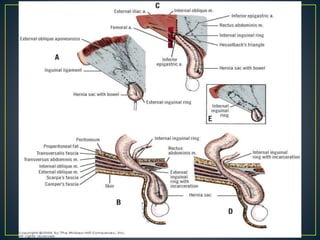
• The inguinal canal is formed in relation to the relocation 
of the testis during fetal development. 
• The inguinal canal in adults is an oblique passage 
approximately 4 cm long directed inferomedially. 
• The main occupant is the spermatic cord in males and 
the round ligament of the uterus in females. 
• The deep (internal) inguinal ring defect in fascia 
transversalis. 
• The superficial ring is a split that occurs in the diagonal, 
otherwise parallel fibers of the external oblique 
aponeurosis. The lateral crus attaches to the pubic 
tubercle, and the medial crus attaches to the pubic crest.
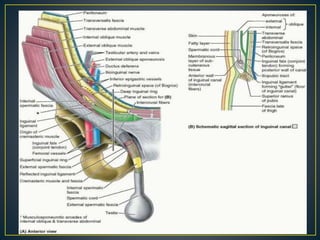
• Anterior wall: external oblique aponeurosis throughout the 
length of the canal; its lateral part is reinforced by muscle 
fibers of the internal oblique. 
• Posterior wall: transversalis fascia; its medial part is 
reinforced by pubic attachments of the internal oblique and 
transversus abdominis aponeuroses that frequently merge to 
variable extents into a common tendon—the inguinal falx 
(conjoint tendon)—and the reflected inguinal ligament. 
• Roof: laterally by the transversalis fascia, centrally by 
musculoaponeurotic arches of the internal oblique and 
transversus abdominis, and medially by the medial crus of the 
external oblique aponeurosis. 
• Floor: laterally by the iliopubic tract, centrally by gutter formed 
by the infolded inguinal ligament, and medially by the lacunar 
ligament.
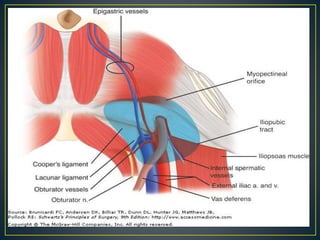
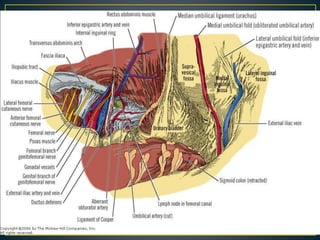
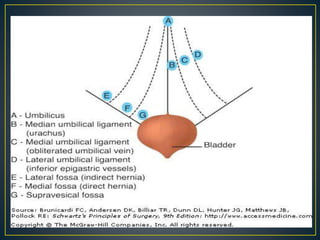
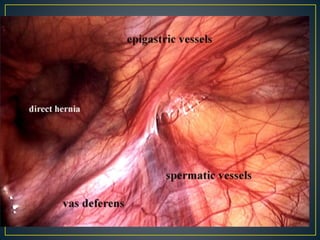
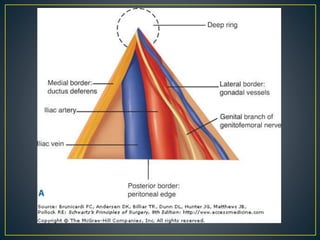
• The laparoscopic anatomy of the inguinal area based on 
Myopectineal orifice of Fruchaud. 
• Superior: Arch of internal oblique muscle and transversus 
abdominis muscle 
• Lateral: Iliopsoas muscle 
• Medial: Lateral border of rectus muscle and its anterior 
lamina 
• Inferior: Pubic pecten
Preperitoneal space: 
Space of Retzius- Retropubic space 
Space of Bogros – Lateral extension of space of 
retzius 
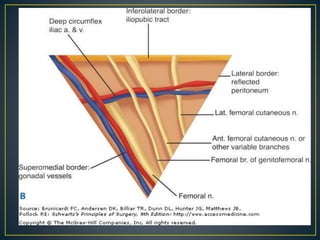
Contains inferior epigastric artery
Types : 
Anatomical types: 
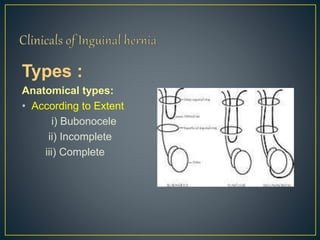
• According to Extent 
i) Bubonocele 
ii) Incomplete 
iii) Complete
According to its site of Exit : 
i) Indirect hernia. 
ii) Direct hernia. 
Indirect(oblique) Hernia : 
• 80 % of cases 
• Almost all pediatric and women cases comprise this 
group 
• Often a complete variety 
• Two forms Congenital and Acquired 
Congenital 
1) Congenital vaginal(complete) 
2) congenital funicular 
Acquired 
Differentiated from above by as it wont 
form complete hernia
According to its contents: 
1) Enterocele 
2) Epiplocele or Omentocele 
3) Cystocele 
Clinical types: 
i) Reducible 
ii) Irreducible 
iii) Obstructed or Incarcerated (irreducibility + obstruction) 
iv) Strangulated 
v) Inflammed
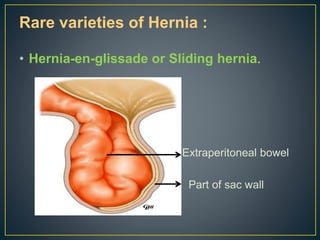
Rare varieties of Hernia : 
• Hernia-en-glissade or Sliding hernia. 
Extraperitoneal bowel 
Part of sac wall
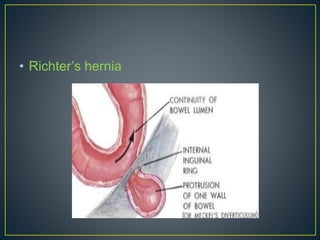
• Richter’s hernia
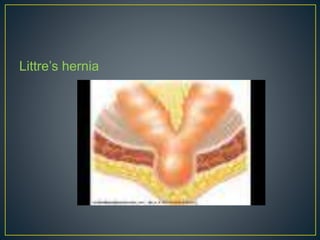
Littre’s hernia
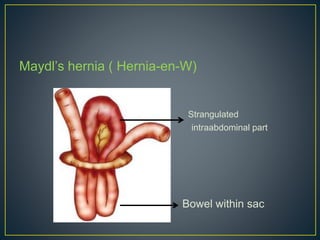
Maydl’s hernia ( Hernia-en-W) 
Strangulated 
intraabdominal part 
Bowel within sac
Coughing 
Chronic obstructive pulmonary disease 
Obesity 
 Straining 
 Constipation 
 Prostatism 
Pregnancy 
Birthweight <1500 g 
Family history of a hernia 
Valsalva's maneuvers
Ascites 
Upright position 
Congenital connective tissue disorders 
Defective collagen synthesis 
Previous right lower quadrant incision 
Arterial aneurysms 
Cigarette smoking 
Heavy lifting 
Physical exertion (?)
Gilbert Classification : 
Type 1 : Small, indirect 
Type 2 : Medium, indirect 
Type 3 : Large, indirect 
Type 4 : Entire floor, direct 
Type 5 : Diverticular, direct 
Type 6 : Combined (pantaloon) 
Type 7 : Femoral
Nyhus classification : 
Type I : Indirect hernia; internal abdominal ring normal; 
typically in infants, children, small adults 
Type II: Indirect hernia; internal ring enlarged without 
impingement on the floor of the inguinal canal; does not 
extend to the scrotum 
Type IIIA :Direct hernia; size is not taken into account 
Type IIIB :Indirect hernia that has enlarged enough to 
encroach upon the posterior inguinal wall; indirect sliding or 
scrotal hernias are usually placed in this category because 
they are commonly associated with extension to the direct 
space; also includes pantaloon hernias 
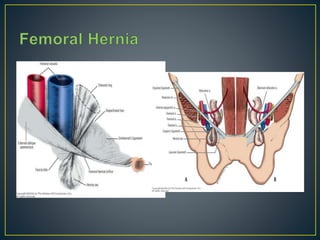
Type IIIC : Femoral hernia 
Type IV : Recurrent hernia; modifiers A–D are sometimes 
added, which correspond to indirect, direct, femoral, and 
mixed, respectively
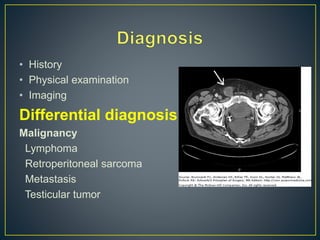
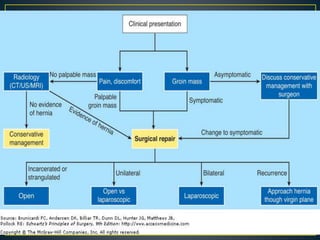
• History 
• Physical examination 
• Imaging 
Differential diagnosis : 
Malignancy 
Lymphoma 
Retroperitoneal sarcoma 
Metastasis 
Testicular tumor
Primary testicular 
Varicocele 
Epididymitis 
Testicular torsion 
Hydrocele 
Ectopic testicle 
Undescended testicle 
Femoral artery aneurysm or pseudoaneurysm 
Lymph node 
Sebaceous cyst 
Hidradenitis 
Cyst of the canal of Nuck (female) 
Saphenous varix 
Psoas abscess 
Hematoma 
Ascites
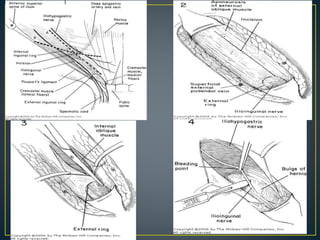
Open Repair 
Anterior Repairs, Nonprosthetic 
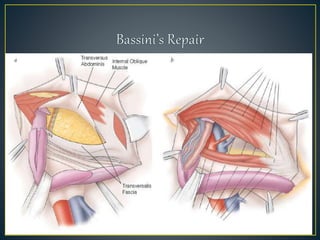
i) Bassini’s repair 
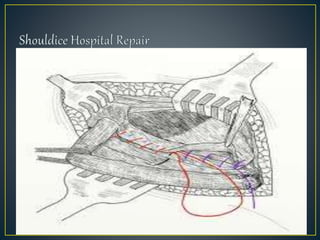
ii) Shouldice Repair 
iii) McVay Repair 
iv) Moloney darn 
Anterior Repairs, Prosthetic 
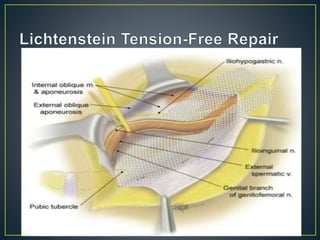
i) Lichtenstein tension free Hernioplasty 
ii) Mesh plug and patch 
iii) Read-Rives 
iv) Kugel 
v) Nyhus-Condon 
vi) Wantz, Stoppa, and Rives
• Recurrence 
• Chronic groin pain 
• Nociceptive 
• Neuropathic 
• Cord and testicular 
• Hematoma 
• Ischemic orchitis 
• Testicular atrophy 
• Injury to vas deferens 
• Hydrocele 
• Testicular descent 
• Bowel and bladder injury
• Osteitis pubis 
• Prosthetic complications 
• Contraction 
• Erosion 
• Infection 
• Rejection 
• Fracture 
• Miscellaneous complications 
• Seroma 
• Hematoma 
• Wound infection 
• General complications
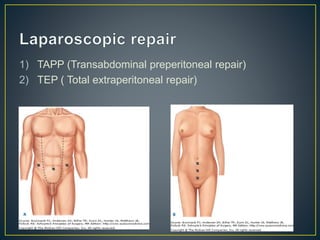
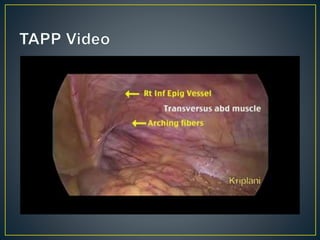
1) TAPP (Transabdominal preperitoneal repair) 
2) TEP ( Total extraperitoneal repair)
Inguinal hernia ppt
Inguinal hernia ppt
Inguinal hernia ppt

Inguinal hernia ppt

  • 1.
    Dr.P.Viswakumar.,M.S Assistant professor, Dept of General surgery, PSGIMSR.
  • 2.
    The term “hernia”is derived from the Greek word hernios, which means “budding.” Hernia – Protrusion of visceral contents through the Abdominal wall. Two key components Defect Hernial Sac
  • 3.
    • Erect Humanposture – Vulnerability between abdominal muscle wall & hard pelvic bones. • Passage of various structure from trunk to extremities (Femoral nerve,Iliac vessels and Spermatic cord). • So Adult hernia is in part results from weakness of inner envelope of Abdominal wall (Transversalis fascia). • Weakest points – Inguinal, Femoral and Umblical.
  • 4.
    Why ? “No disease of human body belonging to the province of the surgeon requires in its treatment a better combination of accurate knowledge with surgical skill than hernia in all its varities” - Sir Astley paston cooper ;1804
  • 5.
    • Layers ofAbdominal wall ?? - 9 layers 1) Skin 2) Camper’s fascia 3) Scarpa’s fascia 4) External oblique muscle & aponeurosis. 5) Internal oblique muscle & aponeurosis. 6) Transverse abdominus & aponeurosis. 7) Transversalis fascia 8) Preperitoneal fat. 9) Peritoneum.
  • 7.
    Ligament of henle/Falxinguinalis : • Lateral vertical expansion of the rectus sheath that inserts on the pecten of the pubis. • In one-third to one-half of patients and is fused with the transversus aponeurosis and fascia
  • 8.
    Conjoint tendon: •By definition, the fusion of lower fibers of the internal oblique aponeurosis with similar fibers from the aponeurosis of the transversus abdominis where they insert on the pubic tubercle and superior ramus of the pubis. • The trouble is that the anatomic configuration thus described is extremely rare (3 – 5%). • The distinction between falx inguinalis and conjoined tendon is one of anatomic nicety and admittedly of little practical significance in the operating room provided that the distinction is understood. • The term conjoined area can be applied correctly to that region that contains the ligament of Henle
  • 10.
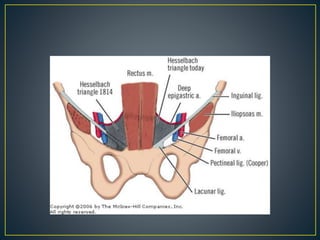
    Ligament of Gimbernat(Lacunar Ligament): • Triangular extension of the inguinal ligament before its insertion upon the pubic tubercle.
  • 11.
    Cooper’s or Pectinealligament: • The periosteum of the superior ramus of the pubis, strongly reinforced by endoabdominal fascia (transversalis fascia), with more reinforcement by the transversus abdominis aponeurosis and the iliopubic tract medially Iliopubic tract : • Aponeurotic band formed by transversus abdominis muscle and aponeurosis and the transversalis fascia. • Begins near the anterior superior iliac spine extends medially to attach to Cooper's ligament
  • 13.
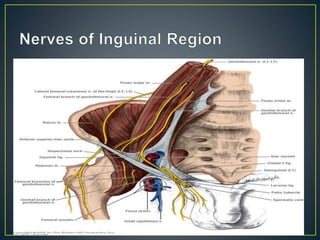
    • The inguinalcanal is formed in relation to the relocation of the testis during fetal development. • The inguinal canal in adults is an oblique passage approximately 4 cm long directed inferomedially. • The main occupant is the spermatic cord in males and the round ligament of the uterus in females. • The deep (internal) inguinal ring defect in fascia transversalis. • The superficial ring is a split that occurs in the diagonal, otherwise parallel fibers of the external oblique aponeurosis. The lateral crus attaches to the pubic tubercle, and the medial crus attaches to the pubic crest.
  • 14.
    • Anterior wall:external oblique aponeurosis throughout the length of the canal; its lateral part is reinforced by muscle fibers of the internal oblique. • Posterior wall: transversalis fascia; its medial part is reinforced by pubic attachments of the internal oblique and transversus abdominis aponeuroses that frequently merge to variable extents into a common tendon—the inguinal falx (conjoint tendon)—and the reflected inguinal ligament. • Roof: laterally by the transversalis fascia, centrally by musculoaponeurotic arches of the internal oblique and transversus abdominis, and medially by the medial crus of the external oblique aponeurosis. • Floor: laterally by the iliopubic tract, centrally by gutter formed by the infolded inguinal ligament, and medially by the lacunar ligament.
  • 18.
    • The laparoscopicanatomy of the inguinal area based on Myopectineal orifice of Fruchaud. • Superior: Arch of internal oblique muscle and transversus abdominis muscle • Lateral: Iliopsoas muscle • Medial: Lateral border of rectus muscle and its anterior lamina • Inferior: Pubic pecten
  • 26.
    Preperitoneal space: Spaceof Retzius- Retropubic space Space of Bogros – Lateral extension of space of retzius Contains inferior epigastric artery
  • 27.
    Types : Anatomicaltypes: • According to Extent i) Bubonocele ii) Incomplete iii) Complete
  • 28.
    According to itssite of Exit : i) Indirect hernia. ii) Direct hernia. Indirect(oblique) Hernia : • 80 % of cases • Almost all pediatric and women cases comprise this group • Often a complete variety • Two forms Congenital and Acquired Congenital 1) Congenital vaginal(complete) 2) congenital funicular Acquired Differentiated from above by as it wont form complete hernia
  • 29.
    According to itscontents: 1) Enterocele 2) Epiplocele or Omentocele 3) Cystocele Clinical types: i) Reducible ii) Irreducible iii) Obstructed or Incarcerated (irreducibility + obstruction) iv) Strangulated v) Inflammed
  • 31.
    Rare varieties ofHernia : • Hernia-en-glissade or Sliding hernia. Extraperitoneal bowel Part of sac wall
  • 32.
  • 33.
  • 34.
    Maydl’s hernia (Hernia-en-W) Strangulated intraabdominal part Bowel within sac
  • 36.
    Coughing Chronic obstructivepulmonary disease Obesity  Straining  Constipation  Prostatism Pregnancy Birthweight <1500 g Family history of a hernia Valsalva's maneuvers
  • 37.
    Ascites Upright position Congenital connective tissue disorders Defective collagen synthesis Previous right lower quadrant incision Arterial aneurysms Cigarette smoking Heavy lifting Physical exertion (?)
  • 38.
    Gilbert Classification : Type 1 : Small, indirect Type 2 : Medium, indirect Type 3 : Large, indirect Type 4 : Entire floor, direct Type 5 : Diverticular, direct Type 6 : Combined (pantaloon) Type 7 : Femoral
  • 39.
    Nyhus classification : Type I : Indirect hernia; internal abdominal ring normal; typically in infants, children, small adults Type II: Indirect hernia; internal ring enlarged without impingement on the floor of the inguinal canal; does not extend to the scrotum Type IIIA :Direct hernia; size is not taken into account Type IIIB :Indirect hernia that has enlarged enough to encroach upon the posterior inguinal wall; indirect sliding or scrotal hernias are usually placed in this category because they are commonly associated with extension to the direct space; also includes pantaloon hernias Type IIIC : Femoral hernia Type IV : Recurrent hernia; modifiers A–D are sometimes added, which correspond to indirect, direct, femoral, and mixed, respectively
  • 40.
    • History •Physical examination • Imaging Differential diagnosis : Malignancy Lymphoma Retroperitoneal sarcoma Metastasis Testicular tumor
  • 41.
    Primary testicular Varicocele Epididymitis Testicular torsion Hydrocele Ectopic testicle Undescended testicle Femoral artery aneurysm or pseudoaneurysm Lymph node Sebaceous cyst Hidradenitis Cyst of the canal of Nuck (female) Saphenous varix Psoas abscess Hematoma Ascites
  • 43.
    Open Repair AnteriorRepairs, Nonprosthetic i) Bassini’s repair ii) Shouldice Repair iii) McVay Repair iv) Moloney darn Anterior Repairs, Prosthetic i) Lichtenstein tension free Hernioplasty ii) Mesh plug and patch iii) Read-Rives iv) Kugel v) Nyhus-Condon vi) Wantz, Stoppa, and Rives
  • 49.
    • Recurrence •Chronic groin pain • Nociceptive • Neuropathic • Cord and testicular • Hematoma • Ischemic orchitis • Testicular atrophy • Injury to vas deferens • Hydrocele • Testicular descent • Bowel and bladder injury
  • 50.
    • Osteitis pubis • Prosthetic complications • Contraction • Erosion • Infection • Rejection • Fracture • Miscellaneous complications • Seroma • Hematoma • Wound infection • General complications
  • 51.
    1) TAPP (Transabdominalpreperitoneal repair) 2) TEP ( Total extraperitoneal repair)