INTESTINAL
PERFORATION
PRESENTED BY:
DR. SARA KHALID MEMON
HOUSE OFFICER, SURGICAL UNIT 04
ETIOLOGY
 Penetrating injury to the lower chest or abdomen (i.e, knife
injuries)
 Blunt abdominal trauma to the stomach(esp in children)
 Presence of a predisposing condition - Predisposing
conditions include peptic ulcer disease, acute appendicitis,
acute diverticulitis, and inflamed Meckel diverticulum
 Bacterial infections (eg, typhoid fever, Tuberculosis, etc)
 Ingestion of aspirin, NSAIDs and steroids (esp in elderly)
 Bowel perforation by intra-abdominal malignancy,
lymphoma, or metastatic renal carcinoma
 Perforation secondary to intestinal ischemia
 Radiotherapy of cervical carcinoma and other intra-abdominal
malignancies - This may be associated with late complications,
including bowel obstruction and bowel perforation.
 Necrotizing vasculitis (WG)
 Inflammatory bowel disease (CD>UC)
Bowel injuries associated with endoscopy - Injuries can occur with
ERCP and Colonoscopy.
 Endoscopic biliary stent
 Intestinal puncture as a complication of laparoscopy
 Ingestion of caustic substances
 Foreign body ingestion
CLASSIFICATION
Small bowel Perforation
Free
Contained
Large bowel Perforation
How would you diagnose ?
HISTORY
 Age
 Abdominal Pain(All questions of pain)
 Vomiting
 Hiccups
 Endoscopic procedures
 Chronic history (As in UC)
 History of Trauma (Penetrating)
 History of NSAID use
EXAMINATION
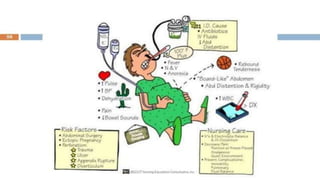
 Assess the patient's general appearance
 Examine the abdomen for any external signs of injury, abrasion, and/or
ecchymosis.
 Observe patients' breathing patterns and abdominal movements with
breathing, and note any abdominal distention or discoloration.
 Tenderness on percussion may suggest peritoneal inflammation.
 Bowel sounds are usually absent in generalized peritonitis.
 Rectal and bimanual vaginal and pelvic examinations may help in assessing
conditions such as acute appendicitis, ruptured tubo-ovarian abscess, and
perforated acute diverticulitis.
INVESTIGATIONS
Baseline Investigations
Complete blood count
Serum Electrolytes
RBS
Virology
LFTs and RFTs
Specific Investigations
 Ultrasound Abdomen
 X-ray ABDOMEN erect and supine
 CT Scan abdomen
 Laparoscopy
 Peritoneal Diagnostic Tap
 Peritoneal lavage (Alkaline phosphatase concentration)
 Fine-catheter peritoneal cytology
TREATMENT
TREATMENT FOR INTESTINAL PERFORATION IS
ALWAYS SURGICAL !!!
Contraindications to Surgery are:
 Severe heart failure, respiratory or multi organ failure
 If Patient doesn’t give CONSENT.
 If a contrast meal confirms spontaneous sealing of the perforation
MEDICAL THERAPY (or pre operative
therapy)
 Keep Patient NPO
 Establish intravenous access, and initiate crystalloid therapy in
patients with clinical signs of dehydration or septicemia
 Start intravenous administration of antibiotics to patients with signs
of septicemia
 Metronidazole(7.5 mg/kg IV before surgery)
 Gentamicin (for an aerobic cover)(It may be given IV/IM. In adults, the loading dose before
surgery is 2 mg/kg IV; thereafter, dosing is 3-5 mg/kg/day divided tid/qid)
 Cefotetan or Cefoxitin (2gmIV before surgery)
 Cefoperazone sodium (Adult dosing is 2-4 g/day IV divided q12hr. Pediatric dosing is 100-150
mg/kg/day IV divided q8-12hr, not to exceed 12 g/day.
SURGICAL THERAPY
The goals of surgical therapy are as follows:
 To correct the underlying anatomic problem
 To correct the cause of peritonitis
 To remove any foreign material in the peritoneal cavity that might
inhibit WBC function and promote bacterial growth (eg, feces, food,
bile, gastric or intestinal secretions, blood)
CONVENTIONAL LAPAROTOMY
 Operative management depends on the cause of perforation.
Perform urgent surgery either on patients not responding to
resuscitation or following stabilization and maintenance of
adequate urine output. All necrotic material and contaminated fluid
should be removed and accompanied by lavage with antibiotics
(tetracycline 1 mg/mL). Decompress distended bowel via a
nasogastric tube.
LAPROSCOPIC LAPARATOMY/MINI LAPAROTOMY
 Laparoscopic or laparoscopic-assisted (minilaparotomy) surgery is
also being increasingly used with outcomes comparable with
conventional laparotomy.Experience and the advancement in
accessories have enabled endoscopic repair of a significant number
of intestinal perforations, such as iatrogenic perforation.
POST OPERATIVE CARE
Intravenous replacement therapy
Nasogastric drainage
Antibiotics
Analgesics
If no obvious improvement in the patient's condition
occurs within 2-3 days, consider the following
possibilities:
The initial operative procedure was inadequate.
Complications have occurred.
A superinfection has occurred at a new site.
The dose of antibiotic is inadequate.
The antibiotics used do not provide adequate
coverage for anaerobes and gram-negative
organisms.
COMPLICATIONS
Wound infection
Localized abdominal abscess
Multi organ failure OR Septic shock
Renal failure and fluid, electrolyte, and pH
imbalance.
Gastrointestinal mucosal hemorrhage is usually
associated with failure of multiple organ systems
and is probably related to a defect in the
protective gastric mucosa.
Mechanical obstruction of the intestine is most
often caused by postoperative adhesions.
PATIENT related causes of wound
failure:
Malnutrition
Sepsis
Uremia
Diabetes mellitus
Corticosteroid therapy
Obesity
Heavy coughing
Hematoma (with or without infection)
SURGEON related causes of
Wound Failure:
In proper suturing material used
In proper technique for suturing
Increased stress on wound edges
JAZAKALLAHUKHAIR
FOR LISTENING

Intestinal perforation

  • 1.
    INTESTINAL PERFORATION PRESENTED BY: DR. SARAKHALID MEMON HOUSE OFFICER, SURGICAL UNIT 04
  • 3.
  • 4.
     Penetrating injuryto the lower chest or abdomen (i.e, knife injuries)  Blunt abdominal trauma to the stomach(esp in children)  Presence of a predisposing condition - Predisposing conditions include peptic ulcer disease, acute appendicitis, acute diverticulitis, and inflamed Meckel diverticulum  Bacterial infections (eg, typhoid fever, Tuberculosis, etc)  Ingestion of aspirin, NSAIDs and steroids (esp in elderly)  Bowel perforation by intra-abdominal malignancy, lymphoma, or metastatic renal carcinoma
  • 5.
     Perforation secondaryto intestinal ischemia  Radiotherapy of cervical carcinoma and other intra-abdominal malignancies - This may be associated with late complications, including bowel obstruction and bowel perforation.  Necrotizing vasculitis (WG)  Inflammatory bowel disease (CD>UC) Bowel injuries associated with endoscopy - Injuries can occur with ERCP and Colonoscopy.  Endoscopic biliary stent  Intestinal puncture as a complication of laparoscopy  Ingestion of caustic substances  Foreign body ingestion
  • 6.
  • 7.
  • 9.
    How would youdiagnose ? HISTORY  Age  Abdominal Pain(All questions of pain)  Vomiting  Hiccups  Endoscopic procedures  Chronic history (As in UC)  History of Trauma (Penetrating)  History of NSAID use
  • 10.
    EXAMINATION  Assess thepatient's general appearance  Examine the abdomen for any external signs of injury, abrasion, and/or ecchymosis.  Observe patients' breathing patterns and abdominal movements with breathing, and note any abdominal distention or discoloration.  Tenderness on percussion may suggest peritoneal inflammation.  Bowel sounds are usually absent in generalized peritonitis.  Rectal and bimanual vaginal and pelvic examinations may help in assessing conditions such as acute appendicitis, ruptured tubo-ovarian abscess, and perforated acute diverticulitis.
  • 12.
    INVESTIGATIONS Baseline Investigations Complete bloodcount Serum Electrolytes RBS Virology LFTs and RFTs
  • 13.
    Specific Investigations  UltrasoundAbdomen  X-ray ABDOMEN erect and supine  CT Scan abdomen  Laparoscopy  Peritoneal Diagnostic Tap  Peritoneal lavage (Alkaline phosphatase concentration)  Fine-catheter peritoneal cytology
  • 16.
    TREATMENT TREATMENT FOR INTESTINALPERFORATION IS ALWAYS SURGICAL !!! Contraindications to Surgery are:  Severe heart failure, respiratory or multi organ failure  If Patient doesn’t give CONSENT.  If a contrast meal confirms spontaneous sealing of the perforation
  • 17.
    MEDICAL THERAPY (orpre operative therapy)  Keep Patient NPO  Establish intravenous access, and initiate crystalloid therapy in patients with clinical signs of dehydration or septicemia  Start intravenous administration of antibiotics to patients with signs of septicemia  Metronidazole(7.5 mg/kg IV before surgery)  Gentamicin (for an aerobic cover)(It may be given IV/IM. In adults, the loading dose before surgery is 2 mg/kg IV; thereafter, dosing is 3-5 mg/kg/day divided tid/qid)  Cefotetan or Cefoxitin (2gmIV before surgery)  Cefoperazone sodium (Adult dosing is 2-4 g/day IV divided q12hr. Pediatric dosing is 100-150 mg/kg/day IV divided q8-12hr, not to exceed 12 g/day.
  • 18.
    SURGICAL THERAPY The goalsof surgical therapy are as follows:  To correct the underlying anatomic problem  To correct the cause of peritonitis  To remove any foreign material in the peritoneal cavity that might inhibit WBC function and promote bacterial growth (eg, feces, food, bile, gastric or intestinal secretions, blood)
  • 19.
    CONVENTIONAL LAPAROTOMY  Operativemanagement depends on the cause of perforation. Perform urgent surgery either on patients not responding to resuscitation or following stabilization and maintenance of adequate urine output. All necrotic material and contaminated fluid should be removed and accompanied by lavage with antibiotics (tetracycline 1 mg/mL). Decompress distended bowel via a nasogastric tube. LAPROSCOPIC LAPARATOMY/MINI LAPAROTOMY  Laparoscopic or laparoscopic-assisted (minilaparotomy) surgery is also being increasingly used with outcomes comparable with conventional laparotomy.Experience and the advancement in accessories have enabled endoscopic repair of a significant number of intestinal perforations, such as iatrogenic perforation.
  • 21.
    POST OPERATIVE CARE Intravenousreplacement therapy Nasogastric drainage Antibiotics Analgesics
  • 22.
    If no obviousimprovement in the patient's condition occurs within 2-3 days, consider the following possibilities: The initial operative procedure was inadequate. Complications have occurred. A superinfection has occurred at a new site. The dose of antibiotic is inadequate. The antibiotics used do not provide adequate coverage for anaerobes and gram-negative organisms.
  • 23.
  • 24.
    Wound infection Localized abdominalabscess Multi organ failure OR Septic shock Renal failure and fluid, electrolyte, and pH imbalance. Gastrointestinal mucosal hemorrhage is usually associated with failure of multiple organ systems and is probably related to a defect in the protective gastric mucosa. Mechanical obstruction of the intestine is most often caused by postoperative adhesions.
  • 25.
    PATIENT related causesof wound failure: Malnutrition Sepsis Uremia Diabetes mellitus Corticosteroid therapy Obesity Heavy coughing Hematoma (with or without infection)
  • 26.
    SURGEON related causesof Wound Failure: In proper suturing material used In proper technique for suturing Increased stress on wound edges
  • 27.

Editor's Notes

  • #5 - Dislocation and migration of biliary stents to the intestine may cause bowel perforation.
  • #6 Even benign tumours, such as desmoid tumours (eg, those originating from the fibrous tissues of the mesentery), may cause bowel perforation.
  • #8 Upper-bowel perforation can be described as either free or contained. Free perforation occurs when bowel contents spill freely into the abdominal cavity, causing diffuse peritonitis (eg, duodenal or gastric perforation). Contained perforation occurs when a full-thickness hole is created by an ulcer, but free spillage is prevented because contiguous organs wall off the area (as occurs, for example, when a duodenal ulcer penetrates into the pancreas). Lower-bowel perforation (eg, in patients with acute diverticulitis or acute appendicitis) results in free intraperitoneal contamination.
  • #10 Sharp, severe, sudden-onset epigastric pain that awakens the patient from sleep often suggests perforated peptic ulcer. Differentiate this from conditions such as cholecystitis and pancreatitis. Painless perforation of a peptic ulcer can occur with steroid use. The presence of shoulder pain suggests involvement of the parietal peritoneum of the diaphragm. n young adults with pain in the lower abdominal quadrant, consider perforated appendicitis as a possible diagnosis. Acute appendicitis with sudden perforation is usually associated with illness of several hours. The pain is typically localized in the right lower quadrant of the abdomen, unless the disease process has progressed to generalized peritonitis. In young women, also consider ruptured ovarian cyst and ruptured tubo-ovarian abscess in the differential diagnosis.
  • #11 In perforated peptic ulcer disease, patients lie immobile, occasionally with knees flexed, and the abdomen is described as boardlike.
  • #13 A complete blood count (CBC) may reveal parameters suggestive of infection (eg, leukocytosis), though leukocytosis may be absent in elderly patients. Elevated packed blood cell volume suggests a shift of intravascular fluid. Blood culture for aerobic and anaerobic organisms is indicated. Findings from liver function and renal function tests may be within reference ranges (or nearly so) if no preexisting disorder is present.
  • #14 Plain supine and erect radiographs of the abdomen are the most common first steps in the diagnostic imaging evaluation of patients presenting with medical history and/or clinical signs suggestive of bowel perforation. Findings suggestive of perforation include the following: Free air trapped in the subdiaphragmatic locations - If the quantity of free air is great enough, its presence can be visualized on the supine radiograph of the abdomen, allowing clear definition of the inner and outer surface of the wall of the bowel Visible falciform ligament - The ligament may appear as an oblique structure extending from the right upper quadrant toward the umbilicus, particularly when large quantities of gas are present on either side of the ligament Air-fluid level - This is indicated by the presence of hydropneumoperitoneum or pyopneumoperitoneum on erect radiographs of the abdomen
  • #25  Septic shock is associated with a combination of the following: Loss of vasomotor tone Increased capillary permeability Myocardial depression Consumption of WBCs and platelets Dissemination of powerful vasoactive substances, such as histamine, serotonin, and prostaglandins, resulting in capillary permeability Complement activation and damage of capillary endothelium