AntepartumAntepartum
Haemorrhage (APH)Haemorrhage (APH)
Nadir khan AurakzaiNadir khan Aurakzai
Batch ‘’M’’Batch ‘’M’’
08-23108-231
Ayub Medical College, AbbottabadAyub Medical College, Abbottabad
ContentsContents
• Definition
• Importance
• Causes
• Management of APH
• Prognosis
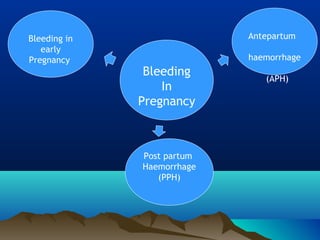
Bleeding
In
Pregnancy
Bleeding in
early
Pregnancy
Antepartum
haemorrhage
(APH)
Post partum
Haemorrhage
(PPH)
Antepartum HaemorrhageAntepartum Haemorrhage
• Antepartum haemorrhage (APH,prepartum
hemorrhage) is bleeding from the vagina during
pregnancy from twenty four weeks of gestational age
to term.
• Epidemiology
Affects 3-5% of all pregnancies
3 times more common in multiparous
than primiparous women
ImportanceImportance
• Obstetric emergency
• Attention should be sought immediately
• If left untreated can lead to death of the
mother and/or foetus
• Can leads to DVT
• Management reduce the risk of
premature delivery and
maternal/perinatal morbidity/mortality
CausesCauses
• 1: Placental causes:
• A. Placental abruption
• B. Placenta previa
• C. Vasa previa
• 2: Causes in genital tract:
• A. Labour
• B: rupture of uterus
• C. Trauma
• D. Infection (cervicitis & vulvovginitis)
• E. Tumours
• 3: Bleeding disorders
• A. Congenital (von willebrand’s disease)
• B. Acquired ( DIC)
Placenta praeviaPlacenta praevia
• Definition
Insertion of the placenta, partially or fully,
in the lower segment of the uterus
EtiologyEtiology
• No definitive cause
• Endometrial factors:
– A scarred endometrium
– Curettage for several times
– Abnormal uterus
• Placental factors
– Large plcenta
– Abnormal formation of the placenta
Risk factors for Placenta praeviaRisk factors for Placenta praevia
• Multiparity
• Advanced maternal age
• Prior LSCS or other uterine surgery
• Prior placenta praevia
• Uterine structural anomaly
Degrees of Placenta praeviaDegrees of Placenta praevia
Classification of degrees ofClassification of degrees of
Placenta praeviaPlacenta praevia
• Four grades:
– Type I ( Low lying): Placenta encroaches
lower segment but does not reach the
internal os
– Type II (Marginal placenta previa): Reaches
internal os but does not cover it
– Type III (Partial Placenta previa): Covers part
of the internal os
– Type IV (Complete): Completely covers the
os, even when the cervix is dilated
Placenta praevia-Placenta praevia- ClinicalClinical
FeaturesFeatures
• Recurrent painless vaginal bleeding (not always)
• Abdominal findings
Uterus is soft, relaxed and non tender
Contraction may be palpated
Presenting part is usually high
Abnormal presentations
• Maternal cardiovascular compromise
• Foetal condition satisfactory until severe maternal
compromise
• Vaginal examination- should not be done
InvestigationInvestigation
• 1: For Localization of placenta:
• Ultrasound:
• Abdominal ultrasound can easily diagnose
placenta previa with an accuracy of 93-
97%.
• Transvaginal ultrasound is safe and is more
accurate than transabdominal ultrasound in
locating the placenta
• 2: Haematological Investigations:
• A. Complete blood picture.
• B. Blood grouping. C:Renal profile
Placenta praevia-ComplicationsPlacenta praevia-Complications
Maternal
• Major hemorrhage, shock, and death
• Renal tubular necrosis and acute renal failure
• Post partum haemorrhage
• Morbid adherence of Placenta : placenta accreta
complicates approximately 10% of placenta praevia
cases
• Anaemia in chronic haemorrhage
• Disseminated intravascular coagulopathy (DIC)
Placenta praevia-Placenta praevia-
Complications cont….Complications cont….
Foetal
• IUD
• Hypoxic ischemic encephalopathy
• Cerebral paulsy
• Placental abruption
• Premature labour
Placental abruptionPlacental abruption
• Definition
Premature separation of a normally
situated placenta in a viable foetus
• Placental abruption should be considered
in any pregnant woman with abdominal
pain with or without PV bleeding, as mild
cases may not be clinically obvious
EtiologyEtiology
Risk factors
1.Increased age and parity
2.Vascular diseases: preeclampsia, maternal
hypertension, renal disease,SLE
3.Mechanical factors: Trauma, intercourse
Sudden decompression
of uterus
Polyhydroamnios
Multiple pregnancy
4. Smoking, cocaine use,
5.Premature rupture of membranes
PathologyPathology
• Main changes
Hemorrhage into the decidua basalis decidua→
splits decidural hematoma separation,→ →
compression, destruction of the placenta
adjacent to it
• Types of abruption
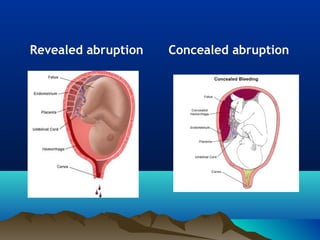
1. Revealed abruption
2. Concealed abruption
3. Mixed type
Revealed abruption Concealed abruption
Diagnosis-Clinical FeaturesDiagnosis-Clinical Features
•Vaginal bleeding associate with
persistent abdominal pain
• Tenderness on the uterus
• “Woody” hard uterus
• Change of foetal heart rate
• Features of hypovolemic shock
Complication ofComplication of PlacentalPlacental
abruptionabruption
Maternal
• Disseminated intravascular coagulopathy
• Hypovolemic shock
• Amnionic fluid embolism
• Renal tubular necrosis and acute renal failure
• Post partum haemorrhage
• Maternal death
Complication ofComplication of PlacentalPlacental
abruptionabruption
Feotal
• Premature labour
• IUGR in chronic abruption
• Hypoxic ischemic encepalopathy and
cerebral paulsy
• Foetal death
InvestigationsInvestigations
• 1: Diagnostic investigations:
• Ultrasonography
Mainly to exclude placenta praevia
Can detect
Retroplacental hematoma
Feotal viability
Most of the time findings will be negative
Negative findings do not exclude placental abruption
• 2: Laboratory investigations
1. Investigation for Consumptive coagulopathy – Platelet
count/BT/CT/PT/INR & APTT
2. Liver and Renal function tests
Vasa praeviaVasa praevia
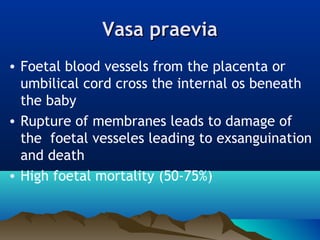
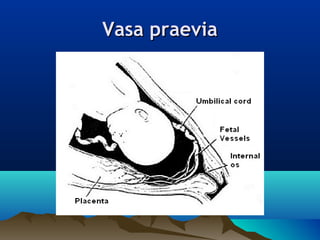
• Foetal blood vessels from the placenta or
umbilical cord cross the internal os beneath
the baby
• Rupture of membranes leads to damage of
the foetal vesseles leading to exsanguination
and death
• High foetal mortality (50-75%)
Vasa praeviaVasa praevia
Risk factorsRisk factors
• Eccentric (velamentous) cord insertion
• Bilobed or succenturiate lobe of placenta
• Multiple gestation
• Placenta praevia
• In vitro fertilization (IVF) pregnancies
• History of uterine surgery or D & C
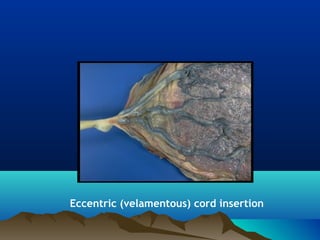
Eccentric (velamentous) cord insertion
Diagnosis - Vasa praeviaDiagnosis - Vasa praevia
1.Moderate vaginal bleeding + feotal distress
2.Vessels may be palpable through dilated
cervix
3.Vessels may be visible on ultrasound
(Transvaginal colour Doppler ultrasound)
• Difficult to distinguish from abruption
• Can look for feotal Hb (Kleihauer-Betke test)
or nucleated RBC’s in shed blood
• Tachycardia or bradycardia in CTG
Management of APH
Management of APHManagement of APH
• Admit to hospital for assessment and management
• May need resuscitation measures if shocked or severe
bleeding
Airway, breathing and circulation
Senior staff must be involved –Consultant
obstetrician and consultant anaesthetist,
neonatalogist
Two wide bore canula
Take blood for Grouping & FBC , coagulation
profile,Liver & renal function
Management of APHManagement of APH
• Volume should be replaced by Crystalloid
/ colloid until blood is available
• Severe bleeding or feotal distress: Urgent
delivery of baby irrespective of
gestational age
Management of APH cont…Management of APH cont…
History
• Obtain a history if patient’s condition allow
including:
• Colour and consistency of bleeding
• Quantity and rate of blood loss
• Precipitating factors i.e. Sexual intercourse,
Vaginal examination
• Degree of pain, site and type
• Placental location-review ultrasound report
if available
• Ascertain foetal movements
• Ascertain blood group
Management of APH cont…Management of APH cont…
Examination
• Assess maternal and foetal well-being
Pallor, record temperature, pulse and BP
• Perform abdominal examination
Note areas of tenderness and hypertonicity
Determine gestational age of foetus, presentation
and position, auscultate foetal heart
• No vaginal examination should be attempted at least until
a placenta praevia is excluded
• Do speculum examination to assess cervix / bleeding and
exclude local lesions  
Management of APH cont…Management of APH cont…
Investigations
• Arrange urgent ultrasound scan
• Foetal monitoring
Continuos electronic foetal monitoring
is indicated
Further management of APHFurther management of APH
• Further management will depend on
Cause of the APH
Extent of bleeding
Presence of feotal distress
Gestational age and feotal maturity
Placenta praevia - ManagementPlacenta praevia - Management
1.Near term / Term
• Delivery is considered
Types I and II - May be able to deliver
vaginally
Types III and IV - Will require caesarean
section by senior obstetrician
Placenta praevia – ManagementPlacenta praevia – Management
cont…cont…
2.Early in pregnancy
• Continuation of pregnancy better if possible
• Need bed rest
• Educate patient regarding condition and risk
• 3 pint of crossed matched blood should be
available till delivery
• Foetal well being and growth should be
monitored
• Medications may be given to prevent premature
labour- Nifidipine, Atosiban
Placental abruption –Placental abruption –
Management ctdManagement ctd
• Small abruption
Conservative management depending
on gestational age
Careful monitoring of feotal condition
Placental abruption -Placental abruption -
managementmanagement
• Moderate or severe placental abruption:
• Restore blood loss
• Ideally measure central venous pressure (CVP) and
adjust transfusion accordingly
• Prevent coagulopathy
• Monitor urinary output
• Delivery
1.Caesarean section
2.Vaginal
If coagulopathy present
If feotus is not compromised
If feotus is dead
Vasa Previa managementVasa Previa management
• Urgent delivery
Most of the time urgent LSCS
• Neonatologist involvement
• Aggressive resuscitation of the baby with
blood transfusion following delivery
Prognosis of APHPrognosis of APH
• Feotus may die from hypoxia during
heavy bleeding
• Perinatal mortality more than 50 per
1000 even with tertiary care facilities
• High rates of maternal mortality
Antepartum haemorhage

Antepartum haemorhage

  • 1.
    AntepartumAntepartum Haemorrhage (APH)Haemorrhage (APH) Nadirkhan AurakzaiNadir khan Aurakzai Batch ‘’M’’Batch ‘’M’’ 08-23108-231 Ayub Medical College, AbbottabadAyub Medical College, Abbottabad
  • 2.
    ContentsContents • Definition • Importance •Causes • Management of APH • Prognosis
  • 3.
  • 4.
    Antepartum HaemorrhageAntepartum Haemorrhage •Antepartum haemorrhage (APH,prepartum hemorrhage) is bleeding from the vagina during pregnancy from twenty four weeks of gestational age to term. • Epidemiology Affects 3-5% of all pregnancies 3 times more common in multiparous than primiparous women
  • 5.
    ImportanceImportance • Obstetric emergency •Attention should be sought immediately • If left untreated can lead to death of the mother and/or foetus • Can leads to DVT • Management reduce the risk of premature delivery and maternal/perinatal morbidity/mortality
  • 6.
    CausesCauses • 1: Placentalcauses: • A. Placental abruption • B. Placenta previa • C. Vasa previa • 2: Causes in genital tract: • A. Labour • B: rupture of uterus • C. Trauma • D. Infection (cervicitis & vulvovginitis) • E. Tumours
  • 7.
    • 3: Bleedingdisorders • A. Congenital (von willebrand’s disease) • B. Acquired ( DIC)
  • 8.
    Placenta praeviaPlacenta praevia •Definition Insertion of the placenta, partially or fully, in the lower segment of the uterus
  • 9.
    EtiologyEtiology • No definitivecause • Endometrial factors: – A scarred endometrium – Curettage for several times – Abnormal uterus • Placental factors – Large plcenta – Abnormal formation of the placenta
  • 10.
    Risk factors forPlacenta praeviaRisk factors for Placenta praevia • Multiparity • Advanced maternal age • Prior LSCS or other uterine surgery • Prior placenta praevia • Uterine structural anomaly
  • 11.
    Degrees of PlacentapraeviaDegrees of Placenta praevia
  • 12.
    Classification of degreesofClassification of degrees of Placenta praeviaPlacenta praevia • Four grades: – Type I ( Low lying): Placenta encroaches lower segment but does not reach the internal os – Type II (Marginal placenta previa): Reaches internal os but does not cover it – Type III (Partial Placenta previa): Covers part of the internal os – Type IV (Complete): Completely covers the os, even when the cervix is dilated
  • 13.
    Placenta praevia-Placenta praevia-ClinicalClinical FeaturesFeatures • Recurrent painless vaginal bleeding (not always) • Abdominal findings Uterus is soft, relaxed and non tender Contraction may be palpated Presenting part is usually high Abnormal presentations • Maternal cardiovascular compromise • Foetal condition satisfactory until severe maternal compromise • Vaginal examination- should not be done
  • 14.
    InvestigationInvestigation • 1: ForLocalization of placenta: • Ultrasound: • Abdominal ultrasound can easily diagnose placenta previa with an accuracy of 93- 97%. • Transvaginal ultrasound is safe and is more accurate than transabdominal ultrasound in locating the placenta • 2: Haematological Investigations: • A. Complete blood picture. • B. Blood grouping. C:Renal profile
  • 15.
    Placenta praevia-ComplicationsPlacenta praevia-Complications Maternal •Major hemorrhage, shock, and death • Renal tubular necrosis and acute renal failure • Post partum haemorrhage • Morbid adherence of Placenta : placenta accreta complicates approximately 10% of placenta praevia cases • Anaemia in chronic haemorrhage • Disseminated intravascular coagulopathy (DIC)
  • 16.
    Placenta praevia-Placenta praevia- Complicationscont….Complications cont…. Foetal • IUD • Hypoxic ischemic encephalopathy • Cerebral paulsy • Placental abruption • Premature labour
  • 17.
    Placental abruptionPlacental abruption •Definition Premature separation of a normally situated placenta in a viable foetus • Placental abruption should be considered in any pregnant woman with abdominal pain with or without PV bleeding, as mild cases may not be clinically obvious
  • 18.
    EtiologyEtiology Risk factors 1.Increased ageand parity 2.Vascular diseases: preeclampsia, maternal hypertension, renal disease,SLE 3.Mechanical factors: Trauma, intercourse Sudden decompression of uterus Polyhydroamnios Multiple pregnancy 4. Smoking, cocaine use, 5.Premature rupture of membranes
  • 19.
    PathologyPathology • Main changes Hemorrhageinto the decidua basalis decidua→ splits decidural hematoma separation,→ → compression, destruction of the placenta adjacent to it • Types of abruption 1. Revealed abruption 2. Concealed abruption 3. Mixed type
  • 20.
  • 21.
    Diagnosis-Clinical FeaturesDiagnosis-Clinical Features •Vaginalbleeding associate with persistent abdominal pain • Tenderness on the uterus • “Woody” hard uterus • Change of foetal heart rate • Features of hypovolemic shock
  • 22.
    Complication ofComplication ofPlacentalPlacental abruptionabruption Maternal • Disseminated intravascular coagulopathy • Hypovolemic shock • Amnionic fluid embolism • Renal tubular necrosis and acute renal failure • Post partum haemorrhage • Maternal death
  • 23.
    Complication ofComplication ofPlacentalPlacental abruptionabruption Feotal • Premature labour • IUGR in chronic abruption • Hypoxic ischemic encepalopathy and cerebral paulsy • Foetal death
  • 24.
    InvestigationsInvestigations • 1: Diagnosticinvestigations: • Ultrasonography Mainly to exclude placenta praevia Can detect Retroplacental hematoma Feotal viability Most of the time findings will be negative Negative findings do not exclude placental abruption • 2: Laboratory investigations 1. Investigation for Consumptive coagulopathy – Platelet count/BT/CT/PT/INR & APTT 2. Liver and Renal function tests
  • 25.
    Vasa praeviaVasa praevia •Foetal blood vessels from the placenta or umbilical cord cross the internal os beneath the baby • Rupture of membranes leads to damage of the foetal vesseles leading to exsanguination and death • High foetal mortality (50-75%)
  • 26.
  • 27.
    Risk factorsRisk factors •Eccentric (velamentous) cord insertion • Bilobed or succenturiate lobe of placenta • Multiple gestation • Placenta praevia • In vitro fertilization (IVF) pregnancies • History of uterine surgery or D & C
  • 28.
  • 29.
    Diagnosis - VasapraeviaDiagnosis - Vasa praevia 1.Moderate vaginal bleeding + feotal distress 2.Vessels may be palpable through dilated cervix 3.Vessels may be visible on ultrasound (Transvaginal colour Doppler ultrasound) • Difficult to distinguish from abruption • Can look for feotal Hb (Kleihauer-Betke test) or nucleated RBC’s in shed blood • Tachycardia or bradycardia in CTG
  • 30.
  • 31.
    Management of APHManagementof APH • Admit to hospital for assessment and management • May need resuscitation measures if shocked or severe bleeding Airway, breathing and circulation Senior staff must be involved –Consultant obstetrician and consultant anaesthetist, neonatalogist Two wide bore canula Take blood for Grouping & FBC , coagulation profile,Liver & renal function
  • 32.
    Management of APHManagementof APH • Volume should be replaced by Crystalloid / colloid until blood is available • Severe bleeding or feotal distress: Urgent delivery of baby irrespective of gestational age
  • 33.
    Management of APHcont…Management of APH cont… History • Obtain a history if patient’s condition allow including: • Colour and consistency of bleeding • Quantity and rate of blood loss • Precipitating factors i.e. Sexual intercourse, Vaginal examination • Degree of pain, site and type • Placental location-review ultrasound report if available • Ascertain foetal movements • Ascertain blood group
  • 34.
    Management of APHcont…Management of APH cont… Examination • Assess maternal and foetal well-being Pallor, record temperature, pulse and BP • Perform abdominal examination Note areas of tenderness and hypertonicity Determine gestational age of foetus, presentation and position, auscultate foetal heart • No vaginal examination should be attempted at least until a placenta praevia is excluded • Do speculum examination to assess cervix / bleeding and exclude local lesions  
  • 35.
    Management of APHcont…Management of APH cont… Investigations • Arrange urgent ultrasound scan • Foetal monitoring Continuos electronic foetal monitoring is indicated
  • 36.
    Further management ofAPHFurther management of APH • Further management will depend on Cause of the APH Extent of bleeding Presence of feotal distress Gestational age and feotal maturity
  • 37.
    Placenta praevia -ManagementPlacenta praevia - Management 1.Near term / Term • Delivery is considered Types I and II - May be able to deliver vaginally Types III and IV - Will require caesarean section by senior obstetrician
  • 38.
    Placenta praevia –ManagementPlacenta praevia – Management cont…cont… 2.Early in pregnancy • Continuation of pregnancy better if possible • Need bed rest • Educate patient regarding condition and risk • 3 pint of crossed matched blood should be available till delivery • Foetal well being and growth should be monitored • Medications may be given to prevent premature labour- Nifidipine, Atosiban
  • 39.
    Placental abruption –Placentalabruption – Management ctdManagement ctd • Small abruption Conservative management depending on gestational age Careful monitoring of feotal condition
  • 40.
    Placental abruption -Placentalabruption - managementmanagement • Moderate or severe placental abruption: • Restore blood loss • Ideally measure central venous pressure (CVP) and adjust transfusion accordingly • Prevent coagulopathy • Monitor urinary output • Delivery 1.Caesarean section 2.Vaginal If coagulopathy present If feotus is not compromised If feotus is dead
  • 41.
    Vasa Previa managementVasaPrevia management • Urgent delivery Most of the time urgent LSCS • Neonatologist involvement • Aggressive resuscitation of the baby with blood transfusion following delivery
  • 42.
    Prognosis of APHPrognosisof APH • Feotus may die from hypoxia during heavy bleeding • Perinatal mortality more than 50 per 1000 even with tertiary care facilities • High rates of maternal mortality