University of
Alexandria
Inguinal hernia Examination
GI Surgery Unit
Faculty of Medicine
University of Alexandria
By: Mohamed Mourad
Assistant lecturer of general surgery
University of
Alexandria
History (elective presentation)
 Age
– Infant
– Late teens and early adolescent
– 40-60 years
 Sex
 Occupation
– Heavy object lifting
University of
Alexandria
History (elective presentation)
 Local Symptoms
– Swelling
– Discomfort
 Ask about PPT factors
– Chronic constipation
– Cough
– Straining with micturation
University of
Alexandria
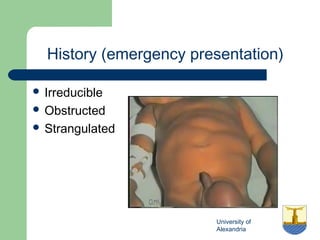
History (emergency presentation)
 Irreducible
 Obstructed
 Strangulated
University of
Alexandria
University of
Alexandria
University of
Alexandria
University of
Alexandria
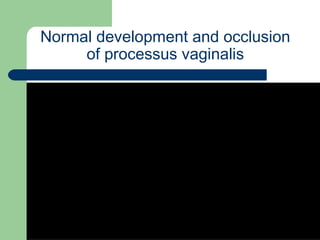
Normal development and occlusion
of processus vaginalis
University of
Alexandria
Standing position
 Exposure (nipple to
knee)
 Inspection
– Site
 Right or left
 Above or below groin
cease
 Reaches the scrotum
or not
– Size
– Shape
University of
Alexandria
Standing position
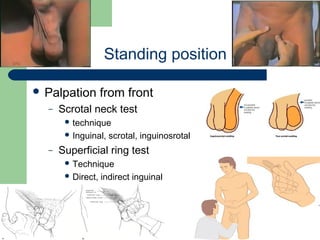
 Palpation from front
– Scrotal neck test
 technique
 Inguinal, scrotal, inguinosrotal
– Superficial ring test
 Technique
 Direct, indirect inguinal
University of
Alexandria
Superficial ring test
University of
Alexandria
Standing position
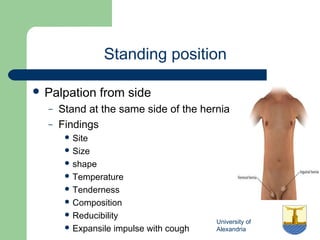
 Palpation from side
– Stand at the same side of the hernia
– Findings
 Site
 Size
 shape
 Temperature
 Tenderness
 Composition
 Reducibility
 Expansile impulse with cough
University of
Alexandria
Standing position
 Expansile impulse with cough
– Technique
– The swelling should become tense and expand
with cough not moves up and down only
 It is diagnostic for hernia but can be absent
in complicated ones.
University of
Alexandria
Expansile impulse with cough
University of
Alexandria
Standing position
 Pubic tubercle test (refers to site of reduction
of the hernia not the position of the whole
hernia)
– Above and medial
– Above and lateral
– Below and medial
– Below and latera
University of
Alexandria
Standing and supine position
 Reducibility
– Can be tried on standing position, if failed, repeat
in supine position
– Technique
– Finding
 Reducible, irreducible
 Direction of reduction
 Difficulty in reduction
University of
Alexandria
Standing and supine position
 Deep ring test
– Only if the hernia is reducible
– Technique
– Findings
 Indirect, direct inguinal hernia
– Why false results?
University of
Alexandria
Standing and supine position
University of
Alexandria
Standing and supine position
Three finger test (Zieman’s technique)
 technique
 Findings
 Indirect,
 direct,
 femoral hernia
University of
Alexandria
Standing or supine position
 Percussion
– Intestinal or omental contents
 Auscultation
– Peristalsis.
University of
Alexandria
DO NOT FORGET
 To examine the contra-lateral side of the
hernia,
 To examine the scrotum,
 To examine the abdomen.
University of
Alexandria
Examine the abdomen
 For any cause can elevate the intra-
abdominal pressure
– Ascites
– Enlarged prostate
– Intestinal obstruction
– Pregnancy
 Scar of previous operation
University of
Alexandria
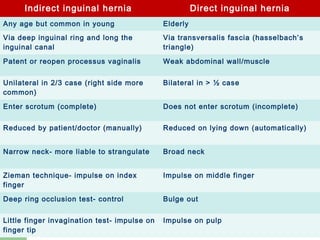
Indirect inguinal hernia Direct inguinal hernia
Any age but common in young Elderly
Via deep inguinal ring and long the
inguinal canal
Via transversalis fascia (hasselbach’s
triangle)
Patent or reopen processus vaginalis Weak abdominal wall/muscle
Unilateral in 2/3 case (right side more
common)
Bilateral in > ½ case
Enter scrotum (complete) Does not enter scrotum (incomplete)
Reduced by patient/doctor (manually) Reduced on lying down (automatically)
Narrow neck- more liable to strangulate Broad neck
Zieman technique- impulse on index
finger
Impulse on middle finger
Deep ring occlusion test- control Bulge out
Little finger invagination test- impulse on
finger tip
Impulse on pulp
University of
Alexandria
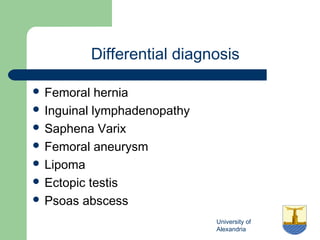
Differential diagnosis
 Femoral hernia
 Inguinal lymphadenopathy
 Saphena Varix
 Femoral aneurysm
 Lipoma
 Ectopic testis
 Psoas abscess
University of
Alexandria
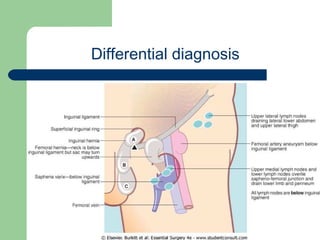
Differential diagnosis
University of
Alexandria
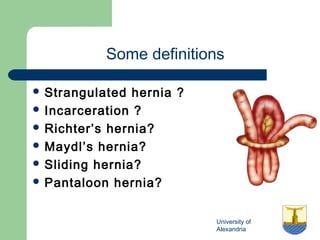
Some definitions
 Strangulated hernia ?
 Incarceration ?
 Richter’s hernia?
 Maydl’s hernia?
 Sliding hernia?
 Pantaloon hernia?
University of
Alexandria
Types of indirect inguinal hernia
 Incomplete;
– Bubonocele—limited within the inguinal canal
– Funicular—limited just above the epididymis
 Complete;
– traverses to the bottom of the scrotum
University of
Alexandria
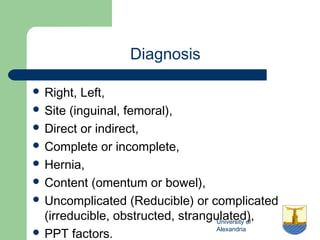
Diagnosis
 Right, Left,
 Site (inguinal, femoral),
 Direct or indirect,
 Complete or incomplete,
 Hernia,
 Content (omentum or bowel),
 Uncomplicated (Reducible) or complicated
(irreducible, obstructed, strangulated),
 PPT factors.
University of Alexandria
Inguinal hernia examination
Thank You

Inguinal hernia examination