POLYHYDRAMNIOSwww.freelivedoctor.com
Definition:An amount of amniotic fluid more than 2000 ml.Incidence:About 1:200.www.freelivedoctor.com
AetiologyIncreased production or decreased consumption of amniotic fluid will result in polyhydramnios.www.freelivedoctor.com
Aetiology>POLYHYDRAMNIOS>Foetal causes:a.Congenital anomalies:b. Uniovular twins:c. Increased placental mass:>Maternal causes:Diabetes mellitus Pregnancy induced hypertensionSevere generalisedoedemawww.freelivedoctor.com
Foetal causes>Congenital anomalies:Anencephaly:     1.transudation of the cerebro-spinal fluid from the exposed meninges.      2. absence of swallowing of the liquor.      3. foetalpolyuria resulting from lack of antidiuretic hormone or irritation of the exposed centres.b. Atresia of the oesophagus or duodenum enables the foetus to swallow the liquor.www.freelivedoctor.com
Foetal causes>Uniovular twins: Due to interconnecting vascularity in the placenta, one foetus obtains more circulation so that its heart and kidneys hypertrophy leading to increased urine production. So one amniotic sac only is affected.www.freelivedoctor.com
Foetal causes> Increased placental massa. Oedema of the placenta due to:  1.hydrops foetalis resulting from Rh-       inompatibility, severe anaemia, haemoglobinopathies particularly a-thalassaemia major and cytomegalovirus infection.  2.true knot of the cord causes obstruction of venous return with placental congestion.  3. foetal liver cirrhosis as in syphilis. b. Chorio-angioma and large placenta.www.freelivedoctor.com
Maternal causes>Diabetes mellitusDiabetes mellitus due to: a. increased osmotic pressure of the liquor   amnii due to its high sugar content, b. foetalpolyuria resulting from hyperglycaemia.www.freelivedoctor.com
Maternal causes>Pregnancy induced hypertension Pregnancy induced hypertension:         Due to oedema of the placenta.www.freelivedoctor.com
Maternal causes>Severe generalisedoedemaSevere generalisedoedema:          Cardiac, hepatic or renal.www.freelivedoctor.com
Clinical VarietiesAcute hydramnios:a.Very rare,                                      b. rapid accumulation of liquor,c. occurs before 20 weeks,d.the commonest cause is uniovular twins but foetal anomalies Chronic hydramniosa.More common,b. accumulation of liquor is gradual,c.it occurs in late pregnancy, d.the condition may end by preterm labour.www.freelivedoctor.com
Clinical Picturea.Abdominal discomfort and pain in acute hydramnios.b.Pressure symptoms: dyspnoea, palpitation, indigestion, haemorrhoids, oedema and varicosities of the lower limbs.www.freelivedoctor.com
Clinical PictureSignsa.Generalexamination:may reveal pregnancy-induced hypertension.b.Abdominal examination:Inspection: overdistended abdomen.Palpation:1.The fundal level is higher than gestational age.2.The uterus is tense cystic.3.The foetal parts are felt with difficulty by dipping. 4.Fluid thrill can be elicited. 5.Malpresentation and nonegagement are common.www.freelivedoctor.com
Differential Diagnosis    a. Causes of oversized pregnant uterus. b.Ovarian cyst with pregnancy.c.Ascites.www.freelivedoctor.com
Management>Acute hydramniosTermination of pregnancy by high artificial rupture of membranes. This allows gradual escape of liquor thus shock and separation of the placenta are avoided.Shock results from rapid accumulation of blood in the splanchnic area after sudden drop of intrauterine pressure.Separation of the placenta occurs due to sudden drop of intrauterine pressure and shrinkage of the placental site following this. Drew Smythe catheter is used for rupture of hind water in such conditions.www.freelivedoctor.com
Management>Chronic hydramniosDuring pregnancy:a.Termination of pregnancy by high artificial rupture of membranes if the foetus is dead or malformed.b. Expectant treatment if the foetus is healthy. > rest, >sedative, >salt restriction,> treatment of the underlying cause as diabetes and toxoplasmosis.> Termination of pregnancy if the condition is not improved or get worse.www.freelivedoctor.com
Management>Chronic hydramniosDuring pregnancy:    Repeated amniocentesis may be indicated in premature foetus with marked pressure symptoms. 1.5-2 litres can be aspirated in a rate not exceeding 500 ml/hour under sonographic control. However, the amniotic fluid is rapidly reaccumulating and there is risk of premature labour, injury to the foetus or umbilical cord vessels.www.freelivedoctor.com
Management>Chronic hydramniosDuring labour:a. Malpresentation, cord presentation and / or cord prolapse should be detected and the labour is managed according to the condition. b. When the cervix is half dilated Drew Smythe catheter is passed to rupture the hind water. This will initiate uterine contractions which can be enhanced by oxytocins. c. Active management of third stage is carried out to guard against postpartum haemorrhage.www.freelivedoctor.com
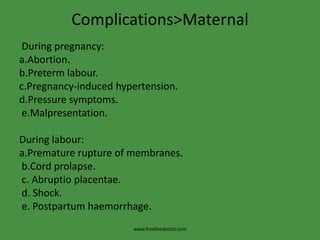
Complications>Maternal During pregnancy: a.Abortion.b.Pretermlabour.c.Pregnancy-induced hypertension.d.Pressure symptoms.e.Malpresentation.During labour:a.Premature rupture of membranes.b.Cordprolapse. c. Abruptioplacentae. d. Shock. e. Postpartum haemorrhage.www.freelivedoctor.com
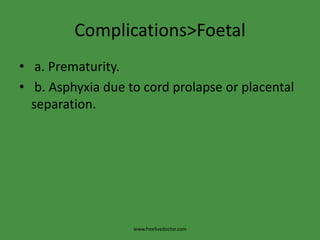
Complications>Foetal a. Prematurity. b. Asphyxia due to cord prolapse or placental separation.www.freelivedoctor.com

Polyhydramios

  • 1.
  • 2.
    Definition:An amount ofamniotic fluid more than 2000 ml.Incidence:About 1:200.www.freelivedoctor.com
  • 3.
    AetiologyIncreased production ordecreased consumption of amniotic fluid will result in polyhydramnios.www.freelivedoctor.com
  • 4.
    Aetiology>POLYHYDRAMNIOS>Foetal causes:a.Congenital anomalies:b.Uniovular twins:c. Increased placental mass:>Maternal causes:Diabetes mellitus Pregnancy induced hypertensionSevere generalisedoedemawww.freelivedoctor.com
  • 5.
    Foetal causes>Congenital anomalies:Anencephaly: 1.transudation of the cerebro-spinal fluid from the exposed meninges. 2. absence of swallowing of the liquor. 3. foetalpolyuria resulting from lack of antidiuretic hormone or irritation of the exposed centres.b. Atresia of the oesophagus or duodenum enables the foetus to swallow the liquor.www.freelivedoctor.com
  • 6.
    Foetal causes>Uniovular twins:Due to interconnecting vascularity in the placenta, one foetus obtains more circulation so that its heart and kidneys hypertrophy leading to increased urine production. So one amniotic sac only is affected.www.freelivedoctor.com
  • 7.
    Foetal causes> Increasedplacental massa. Oedema of the placenta due to: 1.hydrops foetalis resulting from Rh- inompatibility, severe anaemia, haemoglobinopathies particularly a-thalassaemia major and cytomegalovirus infection. 2.true knot of the cord causes obstruction of venous return with placental congestion. 3. foetal liver cirrhosis as in syphilis. b. Chorio-angioma and large placenta.www.freelivedoctor.com
  • 8.
    Maternal causes>Diabetes mellitusDiabetesmellitus due to: a. increased osmotic pressure of the liquor amnii due to its high sugar content, b. foetalpolyuria resulting from hyperglycaemia.www.freelivedoctor.com
  • 9.
    Maternal causes>Pregnancy inducedhypertension Pregnancy induced hypertension: Due to oedema of the placenta.www.freelivedoctor.com
  • 10.
    Maternal causes>Severe generalisedoedemaSeveregeneralisedoedema: Cardiac, hepatic or renal.www.freelivedoctor.com
  • 11.
    Clinical VarietiesAcute hydramnios:a.Veryrare, b. rapid accumulation of liquor,c. occurs before 20 weeks,d.the commonest cause is uniovular twins but foetal anomalies Chronic hydramniosa.More common,b. accumulation of liquor is gradual,c.it occurs in late pregnancy, d.the condition may end by preterm labour.www.freelivedoctor.com
  • 12.
    Clinical Picturea.Abdominal discomfortand pain in acute hydramnios.b.Pressure symptoms: dyspnoea, palpitation, indigestion, haemorrhoids, oedema and varicosities of the lower limbs.www.freelivedoctor.com
  • 13.
    Clinical PictureSignsa.Generalexamination:may revealpregnancy-induced hypertension.b.Abdominal examination:Inspection: overdistended abdomen.Palpation:1.The fundal level is higher than gestational age.2.The uterus is tense cystic.3.The foetal parts are felt with difficulty by dipping. 4.Fluid thrill can be elicited. 5.Malpresentation and nonegagement are common.www.freelivedoctor.com
  • 14.
    Differential Diagnosis a. Causes of oversized pregnant uterus. b.Ovarian cyst with pregnancy.c.Ascites.www.freelivedoctor.com
  • 15.
    Management>Acute hydramniosTermination ofpregnancy by high artificial rupture of membranes. This allows gradual escape of liquor thus shock and separation of the placenta are avoided.Shock results from rapid accumulation of blood in the splanchnic area after sudden drop of intrauterine pressure.Separation of the placenta occurs due to sudden drop of intrauterine pressure and shrinkage of the placental site following this. Drew Smythe catheter is used for rupture of hind water in such conditions.www.freelivedoctor.com
  • 16.
    Management>Chronic hydramniosDuring pregnancy:a.Terminationof pregnancy by high artificial rupture of membranes if the foetus is dead or malformed.b. Expectant treatment if the foetus is healthy. > rest, >sedative, >salt restriction,> treatment of the underlying cause as diabetes and toxoplasmosis.> Termination of pregnancy if the condition is not improved or get worse.www.freelivedoctor.com
  • 17.
    Management>Chronic hydramniosDuring pregnancy: Repeated amniocentesis may be indicated in premature foetus with marked pressure symptoms. 1.5-2 litres can be aspirated in a rate not exceeding 500 ml/hour under sonographic control. However, the amniotic fluid is rapidly reaccumulating and there is risk of premature labour, injury to the foetus or umbilical cord vessels.www.freelivedoctor.com
  • 18.
    Management>Chronic hydramniosDuring labour:a.Malpresentation, cord presentation and / or cord prolapse should be detected and the labour is managed according to the condition. b. When the cervix is half dilated Drew Smythe catheter is passed to rupture the hind water. This will initiate uterine contractions which can be enhanced by oxytocins. c. Active management of third stage is carried out to guard against postpartum haemorrhage.www.freelivedoctor.com
  • 19.
    Complications>Maternal During pregnancy:a.Abortion.b.Pretermlabour.c.Pregnancy-induced hypertension.d.Pressure symptoms.e.Malpresentation.During labour:a.Premature rupture of membranes.b.Cordprolapse. c. Abruptioplacentae. d. Shock. e. Postpartum haemorrhage.www.freelivedoctor.com
  • 20.
    Complications>Foetal a. Prematurity.b. Asphyxia due to cord prolapse or placental separation.www.freelivedoctor.com