SMALL FOR GESTATIONAL AGE (SGA)
LARGE FOR GESTATIONAL AGE(LGA)
&
ADEQUATE FOR GESTATIONAL AGE (AGA)
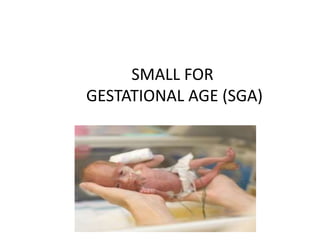
SMALL FOR
GESTATIONAL AGE (SGA)
LOW BIRTH WEIGHT ( < 2.5 kg)

PRETERM
BABIES

SMALL FOR
AGE BABIES
SMALL
FOR DATE

PRETERM

LBW
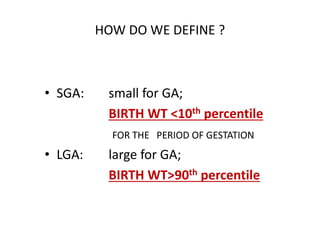
HOW DO WE DEFINE ?

• SGA:

small for GA;
BIRTH WT <10th percentile
FOR THE PERIOD OF GESTATION

• LGA:

large for GA;
BIRTH WT>90th percentile
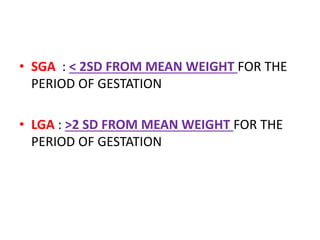
• SGA : < 2SD FROM MEAN WEIGHT FOR THE
PERIOD OF GESTATION
• LGA : >2 SD FROM MEAN WEIGHT FOR THE
PERIOD OF GESTATION
SGA

< 10TH
PERCENTILE
OF BIRTH WT

< 2SD FROM
MEAN WT
Types of SGA

Malnourished
SGA

Hypoplastic
SGA

Mixed SGA
Malnourished SGA
Commonest type of SGA
Asymmetric IUGR
2/3 rd of IUGR
malnourishment during latter part of
gestation – placental dysfunction
(uteroplacental insufficiency)
MALNOURISHED SGA/ ASYMMETRIC IUGR
LONG,THIN & MARASMIC

Head Circumference,brain unaffected
Internal organs,liver grossly shrunken
HC > CC by 3cm
Loose skin folds
Ponderal index ( g/cm3) < 2
 ONLY DECREASE IN CELL SIZE, CELL NUMBER
NORMAL
 GROWTH POTENTIAL (+)
 NUTRITIONAL REHABILITATION
 NEONATAL PROGNOSIS - BETTER
Hypoplastic SGA
 Symmetric IUGR
 1/3 rd of IUGR
 Growth retardation in early pregnancy a/w
intrauterine infection
genetic defects,
chromosomal aberrations
 Incidence of anomalies 10 – 20 times higher
FEATURES OF HYPOPLASTIC SGA
o
o
o
o
o

DECREASE IN CELL NUMBER
ALL ORGANS AFFECTED,INCLUDING BRAIN
ALL PARAMETERS ARE PROPORTIONATELY SMALL
PONDERAL INDEX - NORMAL
POOR PROGNOSIS
PERMANENT PHYSICAL & MENTAL RETARDATION
MIXED SGA
 ADVERSE FACTORS DURING BOTH EARLY & MID PREGNANCY
 NEITHER OBVIOUS MALNOURISHED,NOR GROSSLY
HYPOPLASTIC
 DECREASE IN BOTH CELL SIZE AND COUNT
Causes of SGA
•
•
•
•

Maternal
Fetal
Placental
Environmental
MATERNAL
NUTRITION
POOR
WEIGHT
GAIN

PREVIOUS
HISTORY

MATERNAL
FACTORS

SMOKING

GRAND
MULTIPARA

TOBACCO

ALCOHOL
MATERNAL
DISEASES
FIRST BORN

IU
INFECTIONS

FETAL
FACTORS

MULTIPLE
PREGNANCY

GENETIC
DEFECTS
ABRUPTION

VASCULAR
THROMBOSIS

PLACENTAL

STRUCTURAL
ABNORMALITY

PLACENTA
INFARCTS
Environmental factors
Ethnic/racial/geographic
Socio-economic status
Nutritional
COMMON PROBLEMS OF SGA BABIES
1.
2.
3.
4.
5.
6.
7.
8.

IUD
BIRTH ASPHYXIA
HYPOGLYCEMIA,HYPOCALCEMIA
HYPOTHERMIA
CONGENITAL MALFORMATOINS
INFECTIONS
POLYCYTHEMIA
POOR GROWTH POTENTIAL
THOSE 3 LETTER WORDS!!

•
•
•
•
•
•

RDS
ROP
IVH
PDA
NEC
BPD
MANAGEMENT OF SGA
•
•
•
•
•

Emergency CS – fetal distress
Screening for cong.malformations
Early and adequate breast feeding (NGT/IVF)
Correct hypoglycemia,hypocalcemia,polycythemia
Control infections,temperature regulation
LARGE FOR GESTATIONAL AGE
•
•
•
•
•

DEFINITION
CAUSES OF LGA
VARIOUS SYNDROMES a/w LGA
COMPLICATIONS DUE TO LGA BABIES
MANAGEMENT OF LGA
LGA babies have
• Birth wt > 90th percentile for their
gestational age
• birthweight >2 SD from the mean weight for
gestation
CAUSES OF LGA
1.GENETICS
TALL & HEAVY MOTHERS

2. Maternal

BIG BABY

Diabetes

COMMONEST CAUSE for LGA babies
•

INFANT OF DIABETIC MOTHER

UTILISE LARGE AMOUNT OF TRANSPLACENTALLY TRANSMITTED GLUCOSE

ISLET CELL HYPERPLASIA & HYPERINSULINEMIA

INCREASE IN GROWTH FACTORS IGF-1 , IGF-2

INCREASED GROWTH & ADIPOSITY IN INSULIN DEPENDENT AREAS
(FETAL TRUNK,SHOULDERS)
MACROSOMIA
•
ADIPOSITY
•
SKIN FOLD THICKNESS
• VISCEROMEGALY (LIVER)
OTHER PROBLEMS IN GDM??

1) Hypoglycemia,Hypocalcemia
2) Increased incidence of birth defects-TGA
3) RDS
4) Hyperbilirubinemia
5) polycythemia
6)Birth trauma
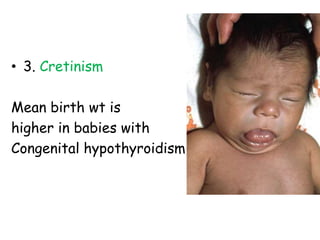
• 3. Cretinism
Mean birth wt is
higher in babies with
Congenital hypothyroidism
4.Hydrops fetalis
large size is due to generalised anasarca rather
than due to somatic growth
• Birth weight may also be related to the amount of
weight a mother gains during pregnancy.

• Excessive weight gain

increased fetal weight.
Overgrown syndromes with advanced
maturation…

a)Congenital adrenal hyperplasia
b)Thyrotoxicosis
c)Beckwith- Wiedemann syndrome
d)Marshall Smith Syndrome
e)Cerebral gigantism/ Sotos syndrome

skeletal
Beckwith Wiedemann syndrome

•
•
•
•

Visceromegaly
Exomphalos
Macroglossia
Characteristic groove in the
ear lobes
Marshall Smith Syndrome
craniofacial characteristics:
large forehead,
hypertelorism,
micrognathia,
long philtrum
Advanced maturation of carpal bones
Sotos syndrome
(cerebral gigantism)

large baby
macrognathia
large hands & feet
mentally subnormal
&
lag in maturation of carpal
bones
Why is LGA a concern…?

•
•
•
•

Prolonged vaginal delivery time
Difficult birth
Birth injury
Increased risk of caesarean delivery
How is LGA diagnosed…?
> Ultrasound
> A mother's weight gain
Prevention of LGA

Prenatal care.
Careful management of diabetes
Proper weight gain.
AGA
Appropriate for gestational age
(AGA) describes a fetus or newborn
infant whose size is within the
normal range for his or
her gestational age
• AGA:
Appropriate for Gestational Age;
birthweight b/w 10th & 90th percentile
An appropriate for gestational age full-term
infant is heavier than 2500 grams and lighter
than about 4000 grams
THANK YOU

SMALL FOR GESTATIONAL AGE,LARGE FOR GESTATIONAL AGE -SSJ, CALICUT MEDICAL COLLEGE