Inguinal Hernia:
Options for Surgery
Syed Fahad Ali Zaidi
PGR SU II BBH
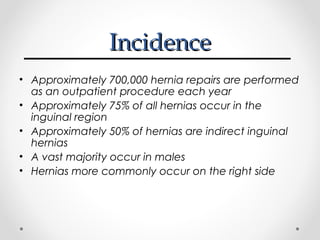
Incidence
• Approximately 700,000 hernia repairs are performed
as an outpatient procedure each year
• Approximately 75% of all hernias occur in the
inguinal region
• Approximately 50% of hernias are indirect inguinal
hernias
• A vast majority occur in males
• Hernias more commonly occur on the right side
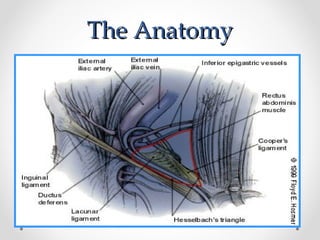
The Anatomy
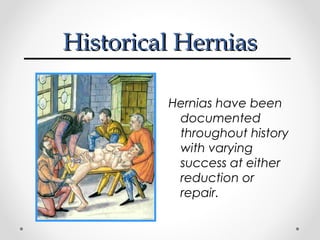
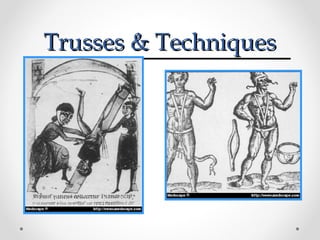
Historical Hernias
Hernias have been
documented
throughout history
with varying
success at either
reduction or
repair.
Trusses & Techniques
Anatomic
Considerations
• The inguinal region must be understood with
regard to its three-dimensional configuration
• A knowledge of the convergence of tissue
planes is essential
• If repairing the hernia laparoscopically, the
anatomy must be well understood from the
peritoneal surface outward
• There is a considerable amount of anatomic
variability with regard to:
o Size and location of the hernia
o Degree of adipose tissue
Pelvic & Inguinal Anatomy
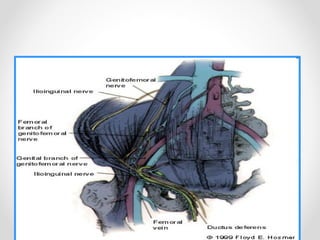
• Both the ilioinguinal nerve and the
genitofemoral nerve traverse the usual
hernia-repair operative field. The femoral
vein also runs just deep to the inguinal floor
laterally.
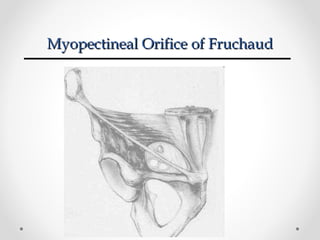
Myopectineal Orifice of Fruchaud
The MPO is bordered:
• Above by the arching fibers of the internal
oblique and transversus abdominus Muscles,
• Medially by the Rectus Abdominus Muscle
and its fascial Rectus Sheath
• Inferiorly by Coopers Ligament, and
• Laterally by the Ileopsoas Muscle
• Running diagonally thru the MPO is the
inguinal ligament
Myopectineal Orifice of Fruchaud
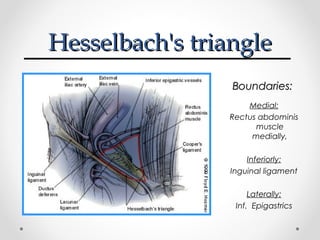
Hesselbach's triangle
Boundaries:
Medial:
Rectus abdominis
muscle
medially,
Inferiorly:
Inguinal ligament
Laterally:
Inf. Epigastrics
Diagnosis
• The patient usually presents (for groin hernia)
with the complaint of a bulge in the inguinal
region
• They may describe minor pain or vague
discomfort associated with the bulge
• Extreme pain usually represents
incarceration with intestinal vascular
compromise
• Paresthesias may be present if inguinal
nerves are compressed
Diagnosis
• Physical exam
o The patient should be standing and facing the
examiner
o Visual inspection may reveal a loss of symmetry in
the inguinal area or bulge
o Having the patient perform valsalva’s maneuver
or cough may accentuate the bulge
o A fingertip is then placed in the inguinal canal;
Valsalva maneuver is repeated
o Differentiation between indirect and direct
hernias at the time of examination is not essential
Nyhus Classification
• Type I: Indirect inguinal hernia Internal inguinal
ring normal (simple pediatric hernia)
• Type II: Indirect inguinal hernia
Internal inguinal ring dilated but posterior inguinal
wall intact (inferior deep epigastric vessels not
displaced)
Nyhus Classification
• Type III: Posterior wall defect
o A. Direct inguinal hernia
o B. Indirect inguinal hernia- internal inguinal ring
dilated (massive scrotal or sliding hernia)
o C. Femoral hernia

• Type IV: Recurrent hernia
o
o
o
o

A. Direct
B. Indirect
C. Femoral
D. Combined
Inguinal Hernia
• Indirect inguinal hernia
o Is a congenital lesion
o Occurs when bowel, omentum or other
abdominal organs protrudes through the
abdominal ring within a patent processus
vaginalis
o If the processus vaginalis does not remain patent
an indirect hernia cannot develop
o Most common type of hernia
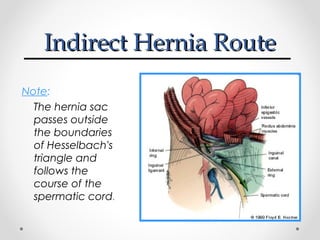
Indirect Hernia Route
Note:
The hernia sac
passes outside
the boundaries
of Hesselbach's
triangle and
follows the
course of the
spermatic cord.
Inguinal Hernia
• Direct inguinal hernia
o Proceeds directly through the posterior inguinal
wall
o Direct hernias protrude medial to the inferior
epigastric vessels and are not associated with
the processus vaginalis
o They are generally believed to be acquired
lesions
o Usually occur in older males as a result of pressure
and tension on the muscles and fascia
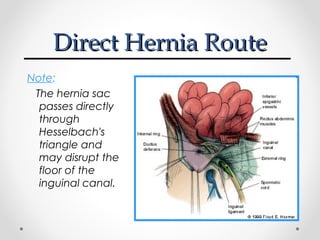
Direct Hernia Route
Note:
The hernia sac
passes directly
through
Hesselbach's
triangle and
may disrupt the
floor of the
inguinal canal.
Specific Surgical Procedures
• Lichenstein (Tension Free) Repair
• McVay (Cooper’s Ligament) Repair
• Halstead’s Repair
• Shouldice (Canadian) Repair
• Laproscopic Hernia Repair
• Bassini Repair
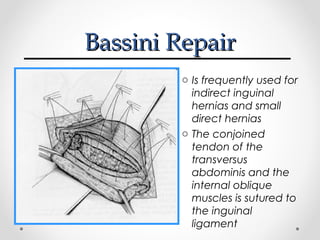
Bassini Repair
o Is frequently used for
indirect inguinal
hernias and small
direct hernias
o The conjoined
tendon of the
transversus
abdominis and the
internal oblique
muscles is sutured to
the inguinal
ligament
McVay Repair
• AKA: Cooper’s ligament Repair
o Is for the repair of large inguinal hernias, direct
inguinal hernias, recurrent hernias and femoral
hernias
o The conjoined tendon is sutured to Cooper’s
ligament from the pubic tubercle laterally to
femoral vein, and to inguinal ligament laterally
from here
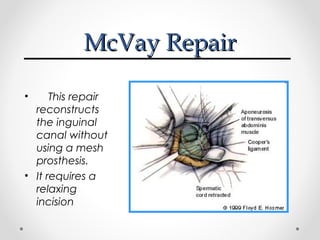
McVay Repair
This repair
reconstructs
the inguinal
canal without
using a mesh
prosthesis.
• It requires a
relaxing
incision
•
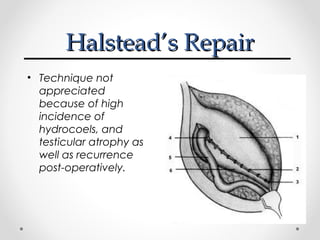
Halstead’s Repair
• In this repair, (which otherwise resembles Bassini)
external oblique aponeurosis is used to strengthen
the posterior wall.
• This exteriorizes the spermatic cord, placing it
beneath the layers of abdominal wall facia
Halstead’s Repair
• Technique not
appreciated
because of high
incidence of
hydrocoels, and
testicular atrophy as
well as recurrence
post-operatively.
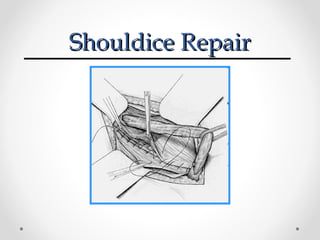
Shouldice Repair
• AKA: Canadian Repair
o A primary repair of the hernia defect
with 4 overlapping layers of tissue.
o Two continuous back-and-forth
sutures of permanent suture material
are employed. The closure can be
under tension, leading to swelling
and patient discomfort.
Shouldice Repair
Shouldice Repair
• At the shouldice hospital, steel wires are used for
the closure of all layers upto subcutaneous fat, and
recurrence rates of less than one percent are
reported
• Other centers which practiced this technique do
not report similar success rates
Lichtenstein Repair
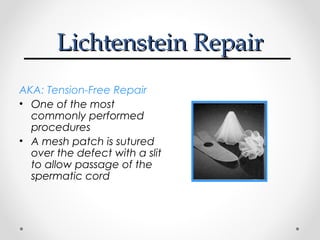
AKA: Tension-Free Repair
• One of the most
commonly performed
procedures
• A mesh patch is sutured
over the defect with a slit
to allow passage of the
spermatic cord
Lichtenstein Repair
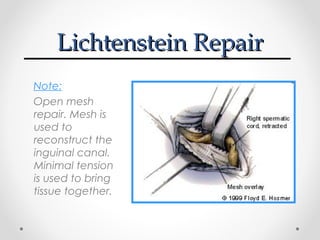
Note:
Open mesh
repair. Mesh is
used to
reconstruct the
inguinal canal.
Minimal tension
is used to bring
tissue together.
Other repairs using Mesh
• Patch & plug technique involvs placementof a
preformed mesh plug in the hernia defect that is
sutured to the facial margins of defect.
• Stoppa ‘s Repair uses posterior approach for
implanting a mesh in the preperitoneal plane
without closing peritoneal defect per se
• Kugel’s repair is a preperitoneal repair in which a
preformed mesh with a stiff ring around the edges is
placed in the preperitoneal space.
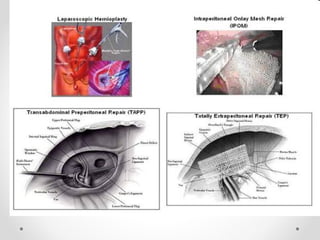
Laparoscopic Hernia Repair
o Early attempts resulted in exceptionally high
reoccurrence rates
o Current techniques include
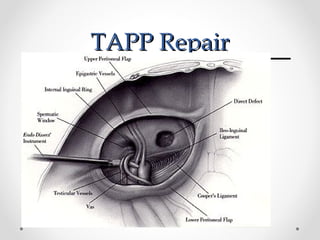
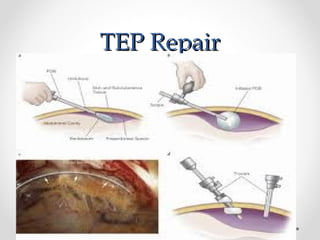
• Transabdominal preperitoneal repair (TAPP)
• Totally extraperitoneal approach (TEPA)
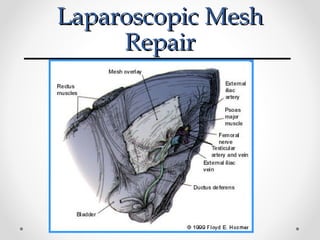
Laparoscopic Mesh Repair

Note:
Viewed from inside the pelvis toward the direct and
indirect sites. A broad portion of mesh is stapled to
span both hernia defects. Staples are not used in
proximity to neurovascular structures.
Laparoscopic Mesh
Repair
TAPP Repair
TEP Repair
• Contraindication to laparoscopic repair is :
o Patients with large inguinoscrotal hernias
o Patients with previous abdominal surgeries
Inguinal hernia

Inguinal hernia

  • 1.
    Inguinal Hernia: Options forSurgery Syed Fahad Ali Zaidi PGR SU II BBH
  • 3.
    Incidence • Approximately 700,000hernia repairs are performed as an outpatient procedure each year • Approximately 75% of all hernias occur in the inguinal region • Approximately 50% of hernias are indirect inguinal hernias • A vast majority occur in males • Hernias more commonly occur on the right side
  • 4.
  • 5.
    Historical Hernias Hernias havebeen documented throughout history with varying success at either reduction or repair.
  • 6.
  • 7.
    Anatomic Considerations • The inguinalregion must be understood with regard to its three-dimensional configuration • A knowledge of the convergence of tissue planes is essential • If repairing the hernia laparoscopically, the anatomy must be well understood from the peritoneal surface outward • There is a considerable amount of anatomic variability with regard to: o Size and location of the hernia o Degree of adipose tissue
  • 8.
    Pelvic & InguinalAnatomy • Both the ilioinguinal nerve and the genitofemoral nerve traverse the usual hernia-repair operative field. The femoral vein also runs just deep to the inguinal floor laterally.
  • 10.
    Myopectineal Orifice ofFruchaud The MPO is bordered: • Above by the arching fibers of the internal oblique and transversus abdominus Muscles, • Medially by the Rectus Abdominus Muscle and its fascial Rectus Sheath • Inferiorly by Coopers Ligament, and • Laterally by the Ileopsoas Muscle • Running diagonally thru the MPO is the inguinal ligament
  • 11.
  • 12.
  • 13.
    Diagnosis • The patientusually presents (for groin hernia) with the complaint of a bulge in the inguinal region • They may describe minor pain or vague discomfort associated with the bulge • Extreme pain usually represents incarceration with intestinal vascular compromise • Paresthesias may be present if inguinal nerves are compressed
  • 14.
    Diagnosis • Physical exam oThe patient should be standing and facing the examiner o Visual inspection may reveal a loss of symmetry in the inguinal area or bulge o Having the patient perform valsalva’s maneuver or cough may accentuate the bulge o A fingertip is then placed in the inguinal canal; Valsalva maneuver is repeated o Differentiation between indirect and direct hernias at the time of examination is not essential
  • 15.
    Nyhus Classification • TypeI: Indirect inguinal hernia Internal inguinal ring normal (simple pediatric hernia) • Type II: Indirect inguinal hernia Internal inguinal ring dilated but posterior inguinal wall intact (inferior deep epigastric vessels not displaced)
  • 16.
    Nyhus Classification • TypeIII: Posterior wall defect o A. Direct inguinal hernia o B. Indirect inguinal hernia- internal inguinal ring dilated (massive scrotal or sliding hernia) o C. Femoral hernia • Type IV: Recurrent hernia o o o o A. Direct B. Indirect C. Femoral D. Combined
  • 17.
    Inguinal Hernia • Indirectinguinal hernia o Is a congenital lesion o Occurs when bowel, omentum or other abdominal organs protrudes through the abdominal ring within a patent processus vaginalis o If the processus vaginalis does not remain patent an indirect hernia cannot develop o Most common type of hernia
  • 18.
    Indirect Hernia Route Note: Thehernia sac passes outside the boundaries of Hesselbach's triangle and follows the course of the spermatic cord.
  • 19.
    Inguinal Hernia • Directinguinal hernia o Proceeds directly through the posterior inguinal wall o Direct hernias protrude medial to the inferior epigastric vessels and are not associated with the processus vaginalis o They are generally believed to be acquired lesions o Usually occur in older males as a result of pressure and tension on the muscles and fascia
  • 20.
    Direct Hernia Route Note: Thehernia sac passes directly through Hesselbach's triangle and may disrupt the floor of the inguinal canal.
  • 21.
    Specific Surgical Procedures •Lichenstein (Tension Free) Repair • McVay (Cooper’s Ligament) Repair • Halstead’s Repair • Shouldice (Canadian) Repair • Laproscopic Hernia Repair • Bassini Repair
  • 22.
    Bassini Repair o Isfrequently used for indirect inguinal hernias and small direct hernias o The conjoined tendon of the transversus abdominis and the internal oblique muscles is sutured to the inguinal ligament
  • 23.
    McVay Repair • AKA:Cooper’s ligament Repair o Is for the repair of large inguinal hernias, direct inguinal hernias, recurrent hernias and femoral hernias o The conjoined tendon is sutured to Cooper’s ligament from the pubic tubercle laterally to femoral vein, and to inguinal ligament laterally from here
  • 24.
    McVay Repair This repair reconstructs theinguinal canal without using a mesh prosthesis. • It requires a relaxing incision •
  • 25.
    Halstead’s Repair • Inthis repair, (which otherwise resembles Bassini) external oblique aponeurosis is used to strengthen the posterior wall. • This exteriorizes the spermatic cord, placing it beneath the layers of abdominal wall facia
  • 26.
    Halstead’s Repair • Techniquenot appreciated because of high incidence of hydrocoels, and testicular atrophy as well as recurrence post-operatively.
  • 27.
    Shouldice Repair • AKA:Canadian Repair o A primary repair of the hernia defect with 4 overlapping layers of tissue. o Two continuous back-and-forth sutures of permanent suture material are employed. The closure can be under tension, leading to swelling and patient discomfort.
  • 28.
  • 29.
    Shouldice Repair • Atthe shouldice hospital, steel wires are used for the closure of all layers upto subcutaneous fat, and recurrence rates of less than one percent are reported • Other centers which practiced this technique do not report similar success rates
  • 30.
    Lichtenstein Repair AKA: Tension-FreeRepair • One of the most commonly performed procedures • A mesh patch is sutured over the defect with a slit to allow passage of the spermatic cord
  • 31.
    Lichtenstein Repair Note: Open mesh repair.Mesh is used to reconstruct the inguinal canal. Minimal tension is used to bring tissue together.
  • 32.
    Other repairs usingMesh • Patch & plug technique involvs placementof a preformed mesh plug in the hernia defect that is sutured to the facial margins of defect. • Stoppa ‘s Repair uses posterior approach for implanting a mesh in the preperitoneal plane without closing peritoneal defect per se • Kugel’s repair is a preperitoneal repair in which a preformed mesh with a stiff ring around the edges is placed in the preperitoneal space.
  • 33.
    Laparoscopic Hernia Repair oEarly attempts resulted in exceptionally high reoccurrence rates o Current techniques include • Transabdominal preperitoneal repair (TAPP) • Totally extraperitoneal approach (TEPA)
  • 35.
    Laparoscopic Mesh Repair Note: Viewedfrom inside the pelvis toward the direct and indirect sites. A broad portion of mesh is stapled to span both hernia defects. Staples are not used in proximity to neurovascular structures.
  • 36.
  • 37.
  • 38.
  • 39.
    • Contraindication tolaparoscopic repair is : o Patients with large inguinoscrotal hernias o Patients with previous abdominal surgeries