FISTULA-IN-ANO
Contents
• Introduction
• Anatomy
• Risk factors
• Classification
• Clinical features
• Diagnosis
• Treatment
• Conclusion
FISTULA-IN-ANO
• Defined as track lined by granulation tissues, which
connects deeply in the anal canal or rectum and
superficially on the skin around the anus.
• Common in men 2:1 to 7:1
• Common in 3rd
and 4th
decades.
ANATOMY
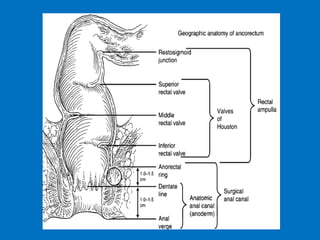
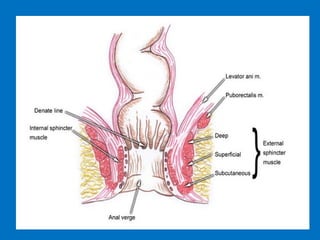
• Anal canal extends for a distance of about 3 cm
from the anorectal ring to the anal verge.
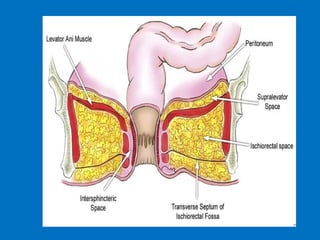
Anatomy of the anal canal and
perianal space
The external sphincter is a striated muscle
– Under voluntary control
– Supplied by pudendal nerve
– As 3 components: subcutaneous, superficial, and deep
muscle.
•Its deep segment is continuous with the puborectalis
muscle and forms the anorectal ring, which is palpable
upon digital examination.
The internal sphincter muscle
•is a smooth muscle
•under autonomic control and
•is an extension of the circular muscle of the rectum.
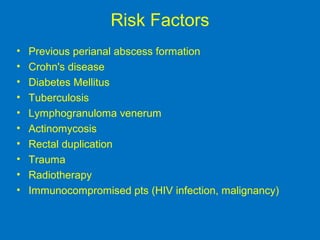
Risk Factors
• Previous perianal abscess formation
• Crohn's disease
• Diabetes Mellitus
• Tuberculosis
• Lymphogranuloma venerum
• Actinomycosis
• Rectal duplication
• Trauma
• Radiotherapy
• Immunocompromised pts (HIV infection, malignancy)
Crypto glandular Hypothesis
• The crypto glandular hypothesis states that an infection
begins in the anal gland and progresses into the
muscular wall of the anal sphincters to cause an
anorectal abscess.
• It accounts for 90%
Classifications of fistula in ano
1. Park’s classification
2. High and low fistula in ano
3. Simple and complex fistula in ano
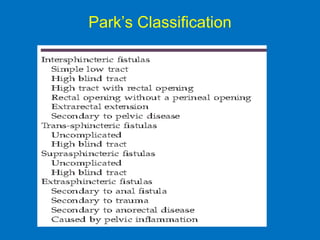
Park’s Classification
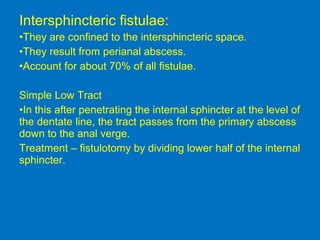
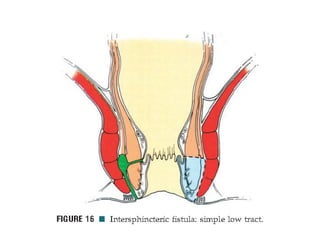
Intersphincteric fistulae:
•They are confined to the intersphincteric space.
•They result from perianal abscess.
•Account for about 70% of all fistulae.
Simple Low Tract
•In this after penetrating the internal sphincter at the level of
the dentate line, the tract passes from the primary abscess
down to the anal verge.
Treatment – fistulotomy by dividing lower half of the internal
sphincter.
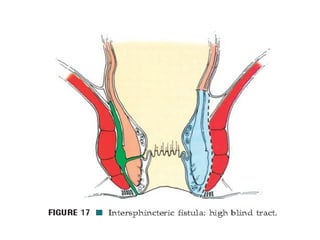
High Blind Tract
•Here in addition to the downward extension, tracks
proximally, resulting in a fistula between the internal
sphincter and the longitudinal muscle of the upper anal
canal and the rectal wall itself.
•Treatment – Division the internal sphincter as high as the
high blind tract ascends.
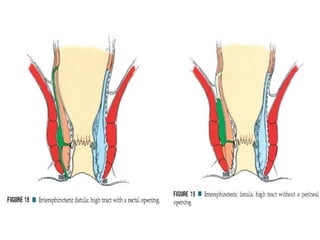
High Tract with Rectal Opening
•This type of fistula is an extension of the previous variety,
with the fistula breaking back into the lower rectum.
•Treatment - laying the tract open into the rectum.
High Tract Without Perineal Opening
•Infection passes in the intersphincteric plane upward into the
rectal wall and terminates as a blind tract or re-enters the gut
through a high secondary opening.
•There is no downward extension to the anal margin and no
external evidence of a fistula.
•Treatment - laying the tract open into the rectum.
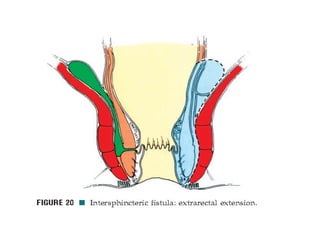
Extrarectal Extension
•Infection may spread upward in the intersphincteric plane to
reach the true pelvic cavity.
•Fistula is above the levator plate.
Treatment
•Drainage into the rectum.
•Any attempt to drain through ischioanal fossa will result in
suprasphincteric fistula.
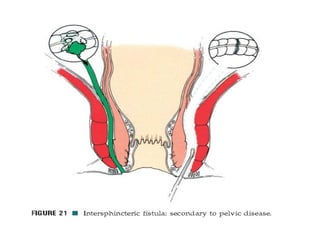
Secondary to Pelvic Disease
•Originates in the pelvis and usually caused by perforated
diverticulitis or Crohn’s abscess.
Treament – Eliminate the cause.
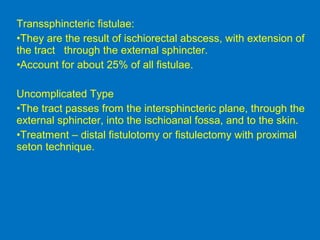
Transsphincteric fistulae:
•They are the result of ischiorectal abscess, with extension of
the tract through the external sphincter.
•Account for about 25% of all fistulae.
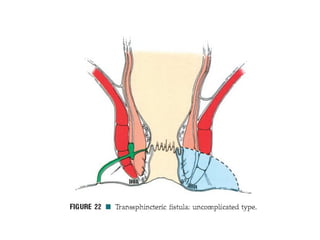
Uncomplicated Type
•The tract passes from the intersphincteric plane, through the
external sphincter, into the ischioanal fossa, and to the skin.
•Treatment – distal fistulotomy or fistulectomy with proximal
seton technique.
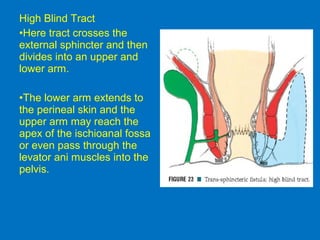
High Blind Tract
•Here tract crosses the
external sphincter and then
divides into an upper and
lower arm.
•The lower arm extends to
the perineal skin and the
upper arm may reach the
apex of the ischioanal fossa
or even pass through the
levator ani muscles into the
pelvis.
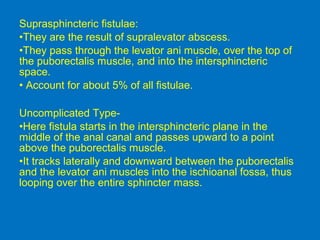
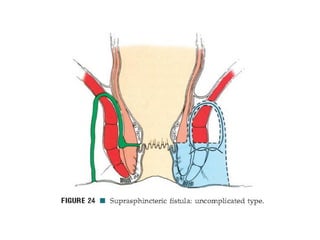
Suprasphincteric fistulae:
•They are the result of supralevator abscess.
•They pass through the levator ani muscle, over the top of
the puborectalis muscle, and into the intersphincteric
space.
• Account for about 5% of all fistulae.
Uncomplicated Type-
•Here fistula starts in the intersphincteric plane in the
middle of the anal canal and passes upward to a point
above the puborectalis muscle.
•It tracks laterally and downward between the puborectalis
and the levator ani muscles into the ischioanal fossa, thus
looping over the entire sphincter mass.
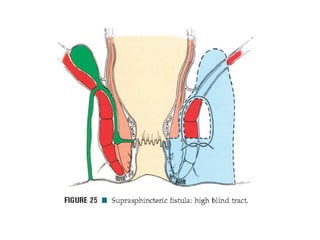
High Blind Tract
•In addition to taking the path of the uncomplicated
suprasphincteric fistula, sends an extension into the
supralevator compartment.
•This variety tends to spread in a horseshoe fashion in the
supralevator compartment.
Extrasphincteric fistulae -
•Bypass the anal canal and sphincter mechanism, passing
through the ischiorectal fossa and levator ani muscle, and
open high in the rectum.
•Accounts for about only 1% of all fistulae.
Secondary to Anal Fistula
•A trans-sphincteric fistula with a high extension may burst
spontaneously into the rectum.
•More commonly, a secondary opening above the
puborectalis muscle is iatrogenic.
Secondary to Trauma
•A fistula may be caused by trauma in two ways: a foreign
body may penetrate the perineum and enter the rectum; or a
swallowed foreign body (e.g., fish or chicken bone) may reach
the rectum, straddle the sphincters, and be forced through the
rectal wall, levator muscles, and ischioanal fossa to the
perineum.
Secondary to Specific Anorectal Disease and PID
•Chronic ulcerative colitis, Crohn’s disease, and carcinoma
may cause fistula.
According to whether their natural opening is below or above
the anorectal ring
Low level -e.g., subcutaneous, low anal, sub mucous.
High level – open into anal canal at or above the anorectal
ring . e.g., high anal, pelvi-rectal
Current procedural terminology codes classification
This includes the following:
•Subcutaneous
•Sub muscular (intersphincteric, low transsphincteric)
•Complex, recurrent (high transsphincteric,
suprasphincteric and extrasphincteric, multiple tracts,
recurrent)
• Unlike the current procedural terminology coding, the
Parks and colleagues classification system does not
include the subcutaneous fistula.
• These fistulas are not of crypto glandular origin but are
usually caused by unhealed anal fissures or anorectal
procedures, such as hemorrhoidectomy or
sphincterotomy.
Clinical Presentation
• Perianal discharge - intermittent or constant, either
bloody or purulent
• Perianal pain- worse during defecation, may be constant
• Swelling /lump in the perianal area
• Bleeding -in the perianal area
• Diarrhea
• Discoloration of skin surrounding the fistula
• External opening in the perianal discharging
• Fever
Past medical history
•History that may suggest a complex fistula include the
following:-
•Inflammatory bowel disease, Diverticulitis
•History of trauma
•Previous radiation therapy for prostate or rectal cancer -
•Tuberculosis
•Immune suppression-Steroid therapy, HIV infection
Diagnosis
• Physical examination findings remain the mainstay
of diagnosis.
• The examiner should observe the entire perineum
• External opening that appears as an open sinus or elevation
of granulation tissue.
• Spontaneous discharge via the external opening may be
apparent or expressible upon digital rectal examination.
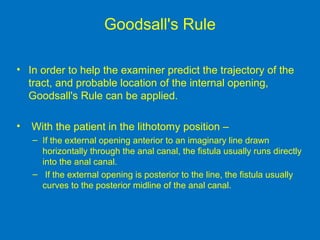
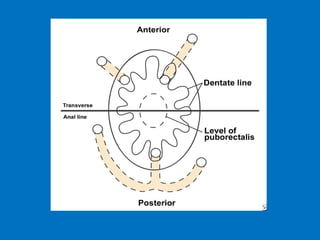
Goodsall's Rule
• In order to help the examiner predict the trajectory of the
tract, and probable location of the internal opening,
Goodsall's Rule can be applied.
• With the patient in the lithotomy position –
– If the external opening anterior to an imaginary line drawn
horizontally through the anal canal, the fistula usually runs directly
into the anal canal.
– If the external opening is posterior to the line, the fistula usually
curves to the posterior midline of the anal canal.
• EXCEPTION : anterior external opening >3cm from anal
verge  usually follow curved track to posterior midline
• It should be noted, further away the external opening is
from the anus, the less reliable Goodsall's rule
becomes.
• The trajectory of a complex fistula is unpredictable by
goodsall’s rule.
DRE
External Anal sphincter tone
Tenderness on examination
Fibrous tract or cord beneath the skin.
Bogginess-any abscess.
Lateral or posterior induration suggests deep postanal or
ischiorectal extension.
Anoscopy
• The opening of the fistula onto the skin may be seen
• There may be redness
• A discharge may be seen
• It may be possible to explore the fistula using a fistula
probe (a narrow instrument) and in this way it may be
possible to find both openings of the fistula.
Imaging Studies
• These are not performed for routine fistula evaluation.
• They can be helpful when the primary opening is difficult to
identify or in the case of recurrent or multiple fistulae to
identify secondary tracts or missed primary openings.
Fistulography
• This involves injection of contrast via the internal opening,
which is followed by antero posterior, lateral, and oblique x-
ray images to outline the course of the fistula tract.
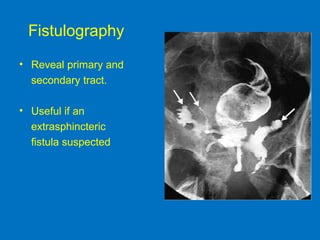
Fistulography
• Reveal primary and
secondary tract.
• Useful if an
extrasphincteric
fistula suspected
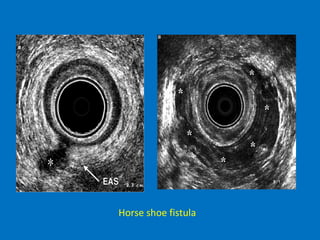
Endorectal ultrasound
• To help define muscular anatomy differentiating
intersphincteric from transsphincteric lesions.
• Determine sphincter integrity
• Complexity of the fistula
Horse shoe fistula
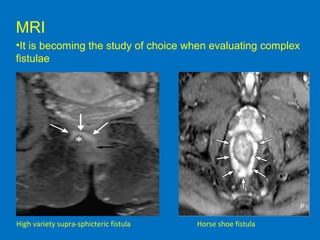
MRI
•It is becoming the study of choice when evaluating complex
fistulae
High variety supra-sphicteric fistula Horse shoe fistula
CT scan
• A CT scan is more helpful in the setting of perirectal
inflammatory disease than in the setting of small fistulae
because it is better for delineating fluid pockets that require
drainage than for small fistulae
Proctosigmoidoscopy/colonoscopy
Rigid sigmoidoscopy can be performed at the initial
evaluation to rule out any associated disease process in
the rectum.
MANAGEMENT
Medical Management
•Some patients will have active infection when they
present with a fistula, and this requires clearing up
before definitive treatment can be decided.
•Broad spectrum antibiotics are used.
Surgical Management
• 1. Lay open
• 2. Lay open +Primary sphincter repair
• 3. Sliding flap
• 4. Cutting seton
• 5. Draining seton
• 6. Park’s fistulectomy
• 7. Fibrin Glue
• 8. Collagen plug
• 9. LIFT Procedure
Fistulotomy
• It involves division of all structures lying between internal
and external openings.
• Applied mainly to low variety intersphincteric and trans-
sphinceric fistula
• The laying-open technique (fistulotomy) is useful for 85-
95%of primary fistulae (ie, submucosal, intersphincteric,
lowtranssphincteric).
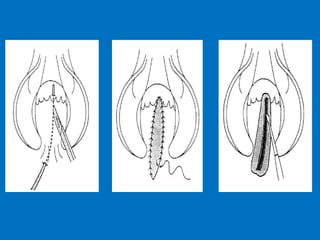
• A probe is passed into the tract through the external and
internal openings and the tract is opened.
• If the fistula tract courses higher into the
sphincter mechanism, seton – placement should be
performed
Fistulectomy
• Excision of a fistula
• Complete fistulectomy creates larger wounds that take
longer to heal and offers no recurrence advantage
over fistulotomy.
• When a fistula lies either too close to the sphincter or goes
through it then it is not possible to lay it open or remove it
without the risk of incontinence.
• In those cases the treatment consists of drainage of abscess
or infection plus placement of a seton.
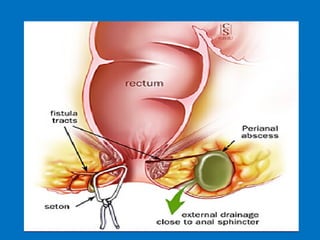
Seton
• A seton a is thread of nylon, prolene, rubber or other
material that is non absorbable and is placed through the
fistula track with the purpose of keeping it open for a
certain period of time.
• It was first described by Hippocrates.
• The principle of seton is that no fistula will close
permanently if the “feeding” abscess or infection does
not drain completely.
• After a partial excision of a fistula the external (skin)
orifice has a tendency to close much faster than the
internal orifice.
• The internal orifice is inside either an abscess cavity
or the anus/rectum (which contains faeces and plenty of
bacteria).
• Thus, early closure of the external fistula orifice will
“trap” infection inside the fistula track and will result in a
recurrent abscess/ infection.
• A seton may stay in place for a long time: 3 -12 months
or more.
Setons have 2 purposes beyond giving a visual
identification of the amount of sphincter muscle involved.
•Drain and promote fibrosis
•Cut through the fistula.
The seton is tightened on subsequent office visits until it is
pulled through over 6-8 weeks.
Seton placement
•A Seton can be placed alone, combined with fistulotomy,
or in a staged fashion.
•This technique indicated in:
Complex fistulae
- high transsphincteric, suprasphincteric, extrasphincteric,
multiple fistulae
Recurrent fistulae
after previous fistulotomy
Poor preoperative sphincter pressures
Patients with Crohn disease or patients who are
immunosuppressed
Single-stage Seton (cutting)
• Pass the seton through the fistula tract around the deep
external sphincter and the seton is tightened down and
secured with a separate silk tie.
• With time, fibrosis occurs above the seton as it gradually
cuts through the sphincter muscles and essentially
exteriorizes the tract.
• The seton is tightened over 6-8 weeks.
• A cutting seton can also be used without associated
fistulotomy.
• The success rates for cutting setons range from 82-
100%.
Complications:
• Recurrence and
• Incontinence
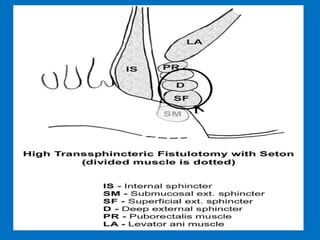
Two-stage seton (draining/fibrosing)
• Unlike the cutting seton, the seton is left loose to drain
the intersphincteric space and to promote fibrosis in the
deep sphincter muscle.
• Once the superficial wound is healed completely (2-3mo
later), the seton-bound sphincter muscle is divided.
Draining seton are used in
•In patients with inflammatory bowel disease
•More than 50% sphincter muscle involved
•Patient with poor continence
•When advancement flap is not technically feasible
Mucosal Advancement Flap
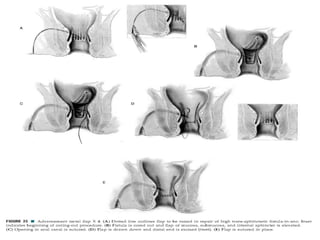
• It is reserved for use in patients with chronic high fistula.
• But is indicated for the same disease process as seton use.
• This procedure involves total fistulectomy, with removal of
the primary and secondary tracts and complete excision of
the internal opening.
• A rectal mucomuscular flap with a wide proximal base (2
times the apex width) is raised.
• The internal muscle defect is closed with an absorbable
suture, and the flap is sewn down over the internal opening
so that its suture line does not overlap the muscular repair.
Advantages
Single stage procedure with no additional sphincter damage.
Disadvantages
Poor success in patients with Crohn disease or acute
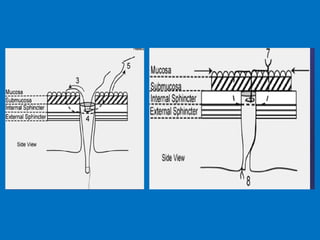
infection.
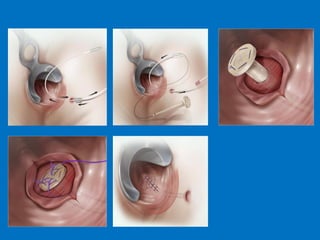
Plugs and Adhesives
• Advances in biotechnology have led to the development of
many new tissue adhesives and biomaterials formed as
fistula plugs.
• Involves plugging the fistula with a device made from small
intestinal submucosa.
• The fistula plug is positioned from the inside of the anus with
suture.
• The idea was to bridge the defect of the fistula with a
biocompatible material that would act as a scaffold for the
patients own fibroblasts to come in and promote tissue
healing in the fistula tract.
Advantages
•Easy application
•Muscle is not cut-no incontinence
•Minimal patient discomfort
•Requires hospitalization for only about 24 hours.
•Repeat applications for treatment failures.
Fibrin glue
• Fibrin glue was first described for plugging fistulae in 1982
by Hedelin et al.
• The mode of action is thought to be by stimulating the
growth of fibroblasts and pluripotent endothelial cells into
the fistula tract to seal it off.
• This is achieved by using the fibronectin and collagen
present in the mixture as a matrix for the cells to integrate
into these cells .
• Then lay collagen and extracellular matrix in the next stage
of wound healing.
• The glue is deployed after curettage of the tract.
• Also, before application the primary opening is
inspected to ensure that it is not closed and that it does
not lie in the high-pressure zone of the anorectum.
• This results in the glue being pushed out of the fistula
tract.
Disadvantage
In the presence of infection the glue fails to close
the fistula.
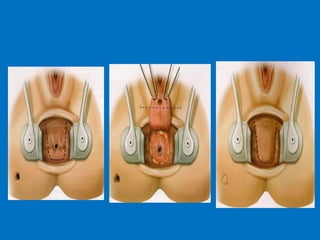
Endorectal advancement flap
• It is a procedure in which the internal opening of the fistula is
identified and a flap of mucosal tissue is cut around the
opening.
• The flap is lifted to expose the fistula, which is then cleaned
and the internal opening is sewn shut.
• After cutting the end of the flap on which the internal opening
was, the flap is pulled down over the sewn internal opening
and sutured in place.
• The external opening is cleaned and sutured.
• Success rates are variable and high recurrence rates are
directly related to previous attempts to correct the fistula.
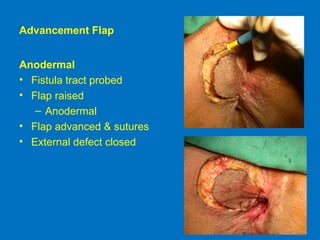
Advancement Flap
Anodermal
• Fistula tract probed
• Flap raised
– Anodermal
• Flap advanced & sutures
• External defect closed
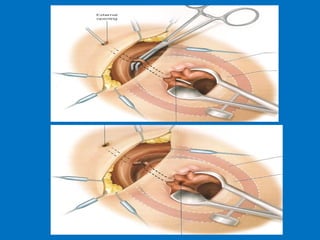
LIFT Procedure
• Ligation of the intersphincteric fistula tract (LIFT)
• It is a sphincter-sparing procedure for complex
transsphincteric fistulas.
• It is performed through access to the intersphincteric plane
with the goal of performing a secure closure of the internal
opening and by removing the infected crypto glandular
tissue.
Diversion
• The creation of a diverting stoma is rarely done for
fistula-in-ano.
Indications
• Perineal necrotizing fasciitis,
• Severe ano rectal Crohn disease,
• Re operative rectovaginal fistulas, and
• Radiation-induced fistulas.
Postoperative complications
 Early postoperative complications
• Urinary retention
• Bleeding
• Fecal impaction
• Thrombosed hemorrhoids
 Delayed postoperative complications
• Recurrence
• Incontinence (stool)
Postoperative complications
• Anal stenosis - The healing process causes fibrosis of
the anal canal; bulking agents for stool help to prevent
narrowing.
• Delayed wound healing - Complete healing occurs by
12 weeks unless an underlying disease process is
present (ie, recurrence, Crohn disease)
Postoperative complications
• Confirmation of Anatomy of Fistula
• Not every fistula needs an operation
• Be conservative
• Use staged procedures
• Reduce to a simple tract - draining seton
• Use non division techniques
• Reassess the situation after each intervention
Thank u

Fistula in-ano

  • 1.
  • 2.
    Contents • Introduction • Anatomy •Risk factors • Classification • Clinical features • Diagnosis • Treatment • Conclusion
  • 3.
    FISTULA-IN-ANO • Defined astrack lined by granulation tissues, which connects deeply in the anal canal or rectum and superficially on the skin around the anus. • Common in men 2:1 to 7:1 • Common in 3rd and 4th decades.
  • 4.
    ANATOMY • Anal canalextends for a distance of about 3 cm from the anorectal ring to the anal verge.
  • 6.
    Anatomy of theanal canal and perianal space The external sphincter is a striated muscle – Under voluntary control – Supplied by pudendal nerve – As 3 components: subcutaneous, superficial, and deep muscle. •Its deep segment is continuous with the puborectalis muscle and forms the anorectal ring, which is palpable upon digital examination.
  • 7.
    The internal sphinctermuscle •is a smooth muscle •under autonomic control and •is an extension of the circular muscle of the rectum.
  • 10.
    Risk Factors • Previousperianal abscess formation • Crohn's disease • Diabetes Mellitus • Tuberculosis • Lymphogranuloma venerum • Actinomycosis • Rectal duplication • Trauma • Radiotherapy • Immunocompromised pts (HIV infection, malignancy)
  • 11.
    Crypto glandular Hypothesis •The crypto glandular hypothesis states that an infection begins in the anal gland and progresses into the muscular wall of the anal sphincters to cause an anorectal abscess. • It accounts for 90%
  • 12.
    Classifications of fistulain ano 1. Park’s classification 2. High and low fistula in ano 3. Simple and complex fistula in ano
  • 13.
  • 14.
    Intersphincteric fistulae: •They areconfined to the intersphincteric space. •They result from perianal abscess. •Account for about 70% of all fistulae. Simple Low Tract •In this after penetrating the internal sphincter at the level of the dentate line, the tract passes from the primary abscess down to the anal verge. Treatment – fistulotomy by dividing lower half of the internal sphincter.
  • 16.
    High Blind Tract •Herein addition to the downward extension, tracks proximally, resulting in a fistula between the internal sphincter and the longitudinal muscle of the upper anal canal and the rectal wall itself. •Treatment – Division the internal sphincter as high as the high blind tract ascends.
  • 18.
    High Tract withRectal Opening •This type of fistula is an extension of the previous variety, with the fistula breaking back into the lower rectum. •Treatment - laying the tract open into the rectum. High Tract Without Perineal Opening •Infection passes in the intersphincteric plane upward into the rectal wall and terminates as a blind tract or re-enters the gut through a high secondary opening. •There is no downward extension to the anal margin and no external evidence of a fistula. •Treatment - laying the tract open into the rectum.
  • 20.
    Extrarectal Extension •Infection mayspread upward in the intersphincteric plane to reach the true pelvic cavity. •Fistula is above the levator plate. Treatment •Drainage into the rectum. •Any attempt to drain through ischioanal fossa will result in suprasphincteric fistula.
  • 22.
    Secondary to PelvicDisease •Originates in the pelvis and usually caused by perforated diverticulitis or Crohn’s abscess. Treament – Eliminate the cause.
  • 24.
    Transsphincteric fistulae: •They arethe result of ischiorectal abscess, with extension of the tract through the external sphincter. •Account for about 25% of all fistulae. Uncomplicated Type •The tract passes from the intersphincteric plane, through the external sphincter, into the ischioanal fossa, and to the skin. •Treatment – distal fistulotomy or fistulectomy with proximal seton technique.
  • 26.
    High Blind Tract •Heretract crosses the external sphincter and then divides into an upper and lower arm. •The lower arm extends to the perineal skin and the upper arm may reach the apex of the ischioanal fossa or even pass through the levator ani muscles into the pelvis.
  • 27.
    Suprasphincteric fistulae: •They arethe result of supralevator abscess. •They pass through the levator ani muscle, over the top of the puborectalis muscle, and into the intersphincteric space. • Account for about 5% of all fistulae. Uncomplicated Type- •Here fistula starts in the intersphincteric plane in the middle of the anal canal and passes upward to a point above the puborectalis muscle. •It tracks laterally and downward between the puborectalis and the levator ani muscles into the ischioanal fossa, thus looping over the entire sphincter mass.
  • 29.
    High Blind Tract •Inaddition to taking the path of the uncomplicated suprasphincteric fistula, sends an extension into the supralevator compartment. •This variety tends to spread in a horseshoe fashion in the supralevator compartment.
  • 31.
    Extrasphincteric fistulae - •Bypassthe anal canal and sphincter mechanism, passing through the ischiorectal fossa and levator ani muscle, and open high in the rectum. •Accounts for about only 1% of all fistulae. Secondary to Anal Fistula •A trans-sphincteric fistula with a high extension may burst spontaneously into the rectum. •More commonly, a secondary opening above the puborectalis muscle is iatrogenic.
  • 32.
    Secondary to Trauma •Afistula may be caused by trauma in two ways: a foreign body may penetrate the perineum and enter the rectum; or a swallowed foreign body (e.g., fish or chicken bone) may reach the rectum, straddle the sphincters, and be forced through the rectal wall, levator muscles, and ischioanal fossa to the perineum. Secondary to Specific Anorectal Disease and PID •Chronic ulcerative colitis, Crohn’s disease, and carcinoma may cause fistula.
  • 33.
    According to whethertheir natural opening is below or above the anorectal ring Low level -e.g., subcutaneous, low anal, sub mucous. High level – open into anal canal at or above the anorectal ring . e.g., high anal, pelvi-rectal
  • 34.
    Current procedural terminologycodes classification This includes the following: •Subcutaneous •Sub muscular (intersphincteric, low transsphincteric) •Complex, recurrent (high transsphincteric, suprasphincteric and extrasphincteric, multiple tracts, recurrent)
  • 35.
    • Unlike thecurrent procedural terminology coding, the Parks and colleagues classification system does not include the subcutaneous fistula. • These fistulas are not of crypto glandular origin but are usually caused by unhealed anal fissures or anorectal procedures, such as hemorrhoidectomy or sphincterotomy.
  • 36.
    Clinical Presentation • Perianaldischarge - intermittent or constant, either bloody or purulent • Perianal pain- worse during defecation, may be constant • Swelling /lump in the perianal area • Bleeding -in the perianal area • Diarrhea • Discoloration of skin surrounding the fistula • External opening in the perianal discharging • Fever
  • 37.
    Past medical history •Historythat may suggest a complex fistula include the following:- •Inflammatory bowel disease, Diverticulitis •History of trauma •Previous radiation therapy for prostate or rectal cancer - •Tuberculosis •Immune suppression-Steroid therapy, HIV infection
  • 38.
    Diagnosis • Physical examinationfindings remain the mainstay of diagnosis. • The examiner should observe the entire perineum • External opening that appears as an open sinus or elevation of granulation tissue. • Spontaneous discharge via the external opening may be apparent or expressible upon digital rectal examination.
  • 39.
    Goodsall's Rule • Inorder to help the examiner predict the trajectory of the tract, and probable location of the internal opening, Goodsall's Rule can be applied. • With the patient in the lithotomy position – – If the external opening anterior to an imaginary line drawn horizontally through the anal canal, the fistula usually runs directly into the anal canal. – If the external opening is posterior to the line, the fistula usually curves to the posterior midline of the anal canal.
  • 41.
    • EXCEPTION :anterior external opening >3cm from anal verge  usually follow curved track to posterior midline • It should be noted, further away the external opening is from the anus, the less reliable Goodsall's rule becomes. • The trajectory of a complex fistula is unpredictable by goodsall’s rule.
  • 42.
    DRE External Anal sphinctertone Tenderness on examination Fibrous tract or cord beneath the skin. Bogginess-any abscess. Lateral or posterior induration suggests deep postanal or ischiorectal extension.
  • 43.
    Anoscopy • The openingof the fistula onto the skin may be seen • There may be redness • A discharge may be seen • It may be possible to explore the fistula using a fistula probe (a narrow instrument) and in this way it may be possible to find both openings of the fistula.
  • 44.
    Imaging Studies • Theseare not performed for routine fistula evaluation. • They can be helpful when the primary opening is difficult to identify or in the case of recurrent or multiple fistulae to identify secondary tracts or missed primary openings. Fistulography • This involves injection of contrast via the internal opening, which is followed by antero posterior, lateral, and oblique x- ray images to outline the course of the fistula tract.
  • 45.
    Fistulography • Reveal primaryand secondary tract. • Useful if an extrasphincteric fistula suspected
  • 46.
    Endorectal ultrasound • Tohelp define muscular anatomy differentiating intersphincteric from transsphincteric lesions. • Determine sphincter integrity • Complexity of the fistula
  • 47.
  • 48.
    MRI •It is becomingthe study of choice when evaluating complex fistulae High variety supra-sphicteric fistula Horse shoe fistula
  • 49.
    CT scan • ACT scan is more helpful in the setting of perirectal inflammatory disease than in the setting of small fistulae because it is better for delineating fluid pockets that require drainage than for small fistulae Proctosigmoidoscopy/colonoscopy Rigid sigmoidoscopy can be performed at the initial evaluation to rule out any associated disease process in the rectum.
  • 50.
    MANAGEMENT Medical Management •Some patientswill have active infection when they present with a fistula, and this requires clearing up before definitive treatment can be decided. •Broad spectrum antibiotics are used.
  • 51.
    Surgical Management • 1.Lay open • 2. Lay open +Primary sphincter repair • 3. Sliding flap • 4. Cutting seton • 5. Draining seton • 6. Park’s fistulectomy • 7. Fibrin Glue • 8. Collagen plug • 9. LIFT Procedure
  • 52.
    Fistulotomy • It involvesdivision of all structures lying between internal and external openings. • Applied mainly to low variety intersphincteric and trans- sphinceric fistula • The laying-open technique (fistulotomy) is useful for 85- 95%of primary fistulae (ie, submucosal, intersphincteric, lowtranssphincteric). • A probe is passed into the tract through the external and internal openings and the tract is opened. • If the fistula tract courses higher into the sphincter mechanism, seton – placement should be performed
  • 54.
    Fistulectomy • Excision ofa fistula • Complete fistulectomy creates larger wounds that take longer to heal and offers no recurrence advantage over fistulotomy. • When a fistula lies either too close to the sphincter or goes through it then it is not possible to lay it open or remove it without the risk of incontinence. • In those cases the treatment consists of drainage of abscess or infection plus placement of a seton.
  • 55.
    Seton • A setona is thread of nylon, prolene, rubber or other material that is non absorbable and is placed through the fistula track with the purpose of keeping it open for a certain period of time. • It was first described by Hippocrates. • The principle of seton is that no fistula will close permanently if the “feeding” abscess or infection does not drain completely.
  • 56.
    • After apartial excision of a fistula the external (skin) orifice has a tendency to close much faster than the internal orifice. • The internal orifice is inside either an abscess cavity or the anus/rectum (which contains faeces and plenty of bacteria). • Thus, early closure of the external fistula orifice will “trap” infection inside the fistula track and will result in a recurrent abscess/ infection. • A seton may stay in place for a long time: 3 -12 months or more.
  • 57.
    Setons have 2purposes beyond giving a visual identification of the amount of sphincter muscle involved. •Drain and promote fibrosis •Cut through the fistula. The seton is tightened on subsequent office visits until it is pulled through over 6-8 weeks.
  • 58.
    Seton placement •A Setoncan be placed alone, combined with fistulotomy, or in a staged fashion. •This technique indicated in: Complex fistulae - high transsphincteric, suprasphincteric, extrasphincteric, multiple fistulae Recurrent fistulae after previous fistulotomy Poor preoperative sphincter pressures Patients with Crohn disease or patients who are immunosuppressed
  • 59.
    Single-stage Seton (cutting) •Pass the seton through the fistula tract around the deep external sphincter and the seton is tightened down and secured with a separate silk tie. • With time, fibrosis occurs above the seton as it gradually cuts through the sphincter muscles and essentially exteriorizes the tract. • The seton is tightened over 6-8 weeks. • A cutting seton can also be used without associated fistulotomy.
  • 60.
    • The successrates for cutting setons range from 82- 100%. Complications: • Recurrence and • Incontinence
  • 62.
    Two-stage seton (draining/fibrosing) •Unlike the cutting seton, the seton is left loose to drain the intersphincteric space and to promote fibrosis in the deep sphincter muscle. • Once the superficial wound is healed completely (2-3mo later), the seton-bound sphincter muscle is divided.
  • 63.
    Draining seton areused in •In patients with inflammatory bowel disease •More than 50% sphincter muscle involved •Patient with poor continence •When advancement flap is not technically feasible
  • 65.
    Mucosal Advancement Flap •It is reserved for use in patients with chronic high fistula. • But is indicated for the same disease process as seton use. • This procedure involves total fistulectomy, with removal of the primary and secondary tracts and complete excision of the internal opening. • A rectal mucomuscular flap with a wide proximal base (2 times the apex width) is raised. • The internal muscle defect is closed with an absorbable suture, and the flap is sewn down over the internal opening so that its suture line does not overlap the muscular repair.
  • 67.
    Advantages Single stage procedurewith no additional sphincter damage. Disadvantages Poor success in patients with Crohn disease or acute infection.
  • 68.
    Plugs and Adhesives •Advances in biotechnology have led to the development of many new tissue adhesives and biomaterials formed as fistula plugs. • Involves plugging the fistula with a device made from small intestinal submucosa. • The fistula plug is positioned from the inside of the anus with suture. • The idea was to bridge the defect of the fistula with a biocompatible material that would act as a scaffold for the patients own fibroblasts to come in and promote tissue healing in the fistula tract.
  • 71.
    Advantages •Easy application •Muscle isnot cut-no incontinence •Minimal patient discomfort •Requires hospitalization for only about 24 hours. •Repeat applications for treatment failures.
  • 72.
    Fibrin glue • Fibringlue was first described for plugging fistulae in 1982 by Hedelin et al. • The mode of action is thought to be by stimulating the growth of fibroblasts and pluripotent endothelial cells into the fistula tract to seal it off. • This is achieved by using the fibronectin and collagen present in the mixture as a matrix for the cells to integrate into these cells . • Then lay collagen and extracellular matrix in the next stage of wound healing.
  • 73.
    • The glueis deployed after curettage of the tract. • Also, before application the primary opening is inspected to ensure that it is not closed and that it does not lie in the high-pressure zone of the anorectum. • This results in the glue being pushed out of the fistula tract. Disadvantage In the presence of infection the glue fails to close the fistula.
  • 74.
    Endorectal advancement flap •It is a procedure in which the internal opening of the fistula is identified and a flap of mucosal tissue is cut around the opening. • The flap is lifted to expose the fistula, which is then cleaned and the internal opening is sewn shut. • After cutting the end of the flap on which the internal opening was, the flap is pulled down over the sewn internal opening and sutured in place. • The external opening is cleaned and sutured. • Success rates are variable and high recurrence rates are directly related to previous attempts to correct the fistula.
  • 76.
    Advancement Flap Anodermal • Fistulatract probed • Flap raised – Anodermal • Flap advanced & sutures • External defect closed
  • 77.
    LIFT Procedure • Ligationof the intersphincteric fistula tract (LIFT) • It is a sphincter-sparing procedure for complex transsphincteric fistulas. • It is performed through access to the intersphincteric plane with the goal of performing a secure closure of the internal opening and by removing the infected crypto glandular tissue.
  • 79.
    Diversion • The creationof a diverting stoma is rarely done for fistula-in-ano. Indications • Perineal necrotizing fasciitis, • Severe ano rectal Crohn disease, • Re operative rectovaginal fistulas, and • Radiation-induced fistulas.
  • 80.
    Postoperative complications  Earlypostoperative complications • Urinary retention • Bleeding • Fecal impaction • Thrombosed hemorrhoids  Delayed postoperative complications • Recurrence • Incontinence (stool)
  • 81.
    Postoperative complications • Analstenosis - The healing process causes fibrosis of the anal canal; bulking agents for stool help to prevent narrowing. • Delayed wound healing - Complete healing occurs by 12 weeks unless an underlying disease process is present (ie, recurrence, Crohn disease)
  • 82.
    Postoperative complications • Confirmationof Anatomy of Fistula • Not every fistula needs an operation • Be conservative • Use staged procedures • Reduce to a simple tract - draining seton • Use non division techniques • Reassess the situation after each intervention
  • 83.