APH
By: Huzaifa Hamid
Definition
 is defined as vaginal bleeding from 24 weeks to
delivery of the baby.
 Or any bleeding occurring in the antenatal
period after 20 weeks gestation.
 It complicates 2–5% of pregnancies.
 It is associated with increased risks of fetal and
maternal morbidity and mortality
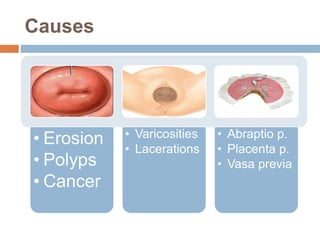
Causes
• Erosion
• Polyps
• Cancer
• Varicosities
• Lacerations
• Abraptio p.
• Placenta p.
• Vasa previa
Initial steps in management of late
pregnancy bleeding:
initial management:
 patient’s vitals
 FHM
 IV fluids
Order lab tests:
 CBC
 DIC workup (platelets, PT,
PTT, fibrinogen, and D-
dimer)
 Type and cross-match
 Ultrasound “The most
accurate”
further steps in management:
 Give blood transfusion for
large volume loss.
 Place Foley catheter and
measure urine output.
 Perform vaginal exam to rule
out lacerations.
 Schedule delivery if fetus is
in jeopardy or gestational
age is ≥ 36 weeks.
Never perform a digital or speculum examination in a patient with late
vaginal bleeding until a vaginal ultrasound first rules out placenta previa.
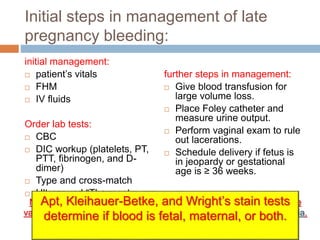
Apt, Kleihauer-Betke, and Wright’s stain tests
determine if blood is fetal, maternal, or both.
ABRUPTIO
PLACENTA
Introduction
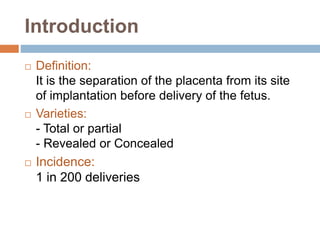
 Definition:
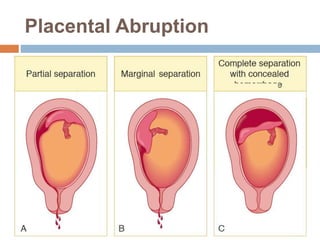
It is the separation of the placenta from its site
of implantation before delivery of the fetus.
 Varieties:
- Total or partial
- Revealed or Concealed
 Incidence:
1 in 200 deliveries
Placental Abruption
Pathophysiology
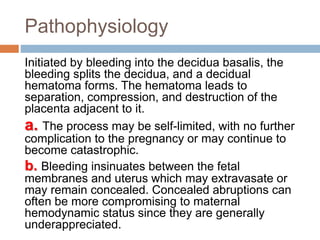
Initiated by bleeding into the decidua basalis, the
bleeding splits the decidua, and a decidual
hematoma forms. The hematoma leads to
separation, compression, and destruction of the
placenta adjacent to it.
a. The process may be self-limited, with no further
complication to the pregnancy or may continue to
become catastrophic.
b. Bleeding insinuates between the fetal
membranes and uterus which may extravasate or
may remain concealed. Concealed abruptions can
often be more compromising to maternal
hemodynamic status since they are generally
underappreciated.
Risk Factors
 Increased age & parity.
 Hypertension.
 Preterm ruptured
membranes.
 Multiple gestation.
 Polyhydramnios.
 Smoking.
 Cocaine use.
 Prior abruption.
 Uterine fibroid.
 Trauma
Clinical presentation
 Vaginal bleeding.
 Constant and severe abdominal pain.
 Irritable, tender, and typically hypertonic
uterus.
 Evidence of fetal distress (if severe).
 Maternal shock.
 Disseminated intravascular coagulation.Up to 20% of placental abruptions can present
without vaginal bleeding because bleeding is
concealed.
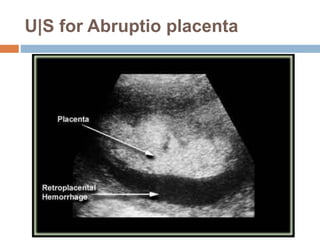
U|S for Abruptio placenta
Abratio Placenta
Diagnosis:
Clinically:
 Late trimester painful bleeding
 Normal placental implantation
 Disseminated intravascular coagulopathy
(DIC)
Ultrasonography:
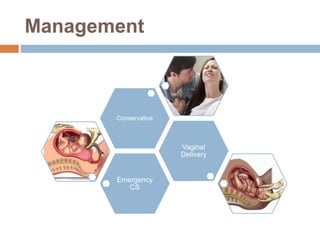
Management
Emergency
CS
Vaginal
Delivery
Conservative
Management
 Emergency cesarean delivery: if maternal or fetal jeopardy is
present as soon as the mother is stabilized.
 Vaginal delivery: if bleeding is heavy but controlled or
pregnancy is >36 weeks. Perform amniotomy and induce
labor. Place external monitors to assess fetal heart rate
pattern and contractions. Avoid cesarean delivery if the fetus
is dead.
 Conservative in-hospital observation: if mother and fetus are
stable and remote from term, bleeding is minimal or
decreasing, and contractions are subsiding. Confirm normal
placental implantation with sonogram and replace blood loss
with crystalloid and blood products as needed.
Complications
Maternal :
 Hypovolemia.
 DIC.
 Renal failure.
 Death.
 Uterine rupture
Fetal :
 Hypoxia.
 IUGR.
 IUFD.
 Anemia
PLACENTA
PREVIA
Introduction
Definition:
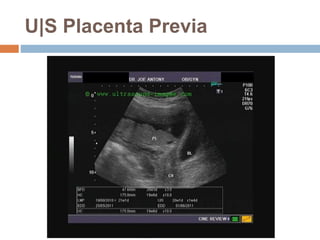
the placenta is implanted in the lower uterine segment.
Classification:
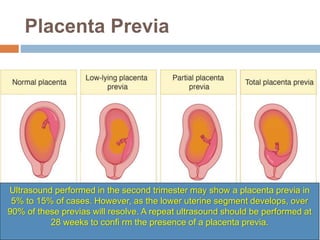
 Complete placenta previa: The placenta covers the
entire internal cervical os.
 Partial placenta previa: The placenta partially covers
the internal cervical os.
 Marginal placenta previa: One edge of the placenta
extends to the edge of the internal cervical os.
 Low-lying placenta: Within 2 cm of the internal
cervical os.
Incidence:
Complicates approximately 1 in 300 pregnancies.
Placenta Previa
Ultrasound performed in the second trimester may show a placenta previa in
5% to 15% of cases. However, as the lower uterine segment develops, over
90% of these previas will resolve. A repeat ultrasound should be performed at
28 weeks to confi rm the presence of a placenta previa.
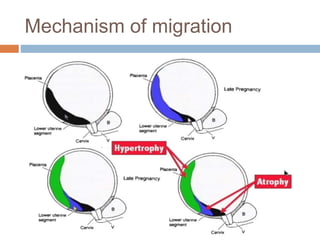
Placental migration
 At 16 weeks 20%
 At 40 weeks 0.5%
 Why the difference?
 TrophoTropism
Placental migration
Mechanism of migration
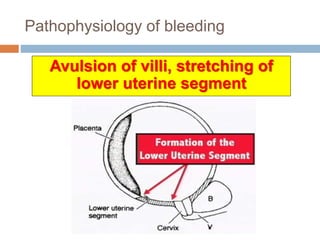
Pathophysiology of bleeding
Avulsion of villi, stretching of
lower uterine segment
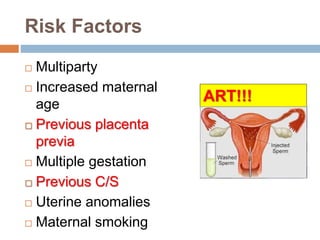
Risk Factors
 Multiparty
 Increased maternal
age
 Previous placenta
previa
 Multiple gestation
 Previous C/S
 Uterine anomalies
 Maternal smoking
ART!!!
Presentation & Diagnosis
 Late trimester bleeding
 Lower segment placental implantation
 No pain
 MRI or Double set-up
Transabdominal US
(95% accurate)
U|S Placenta Previa
Management
Emergency cesarean delivery
Conservative in-hospital observation
Vaginal delivery
Scheduled cesarean delivery
Management
 Emergency cesarean delivery: if maternal or fetal jeopardy
is present after stabilization of the mother.
 Conservative in-hospital observation: Conservative
management of bed rest is performed in preterm gestations if
mother and fetus are stable and remote from term. The initial
bleed is rarely severe. Confirm abnormal placental
implantation with sonogram and replace blood loss with
crystalloid and blood products as needed.
 Vaginal delivery: This may be attempted if the lower
placental edge is >2 cm from the internal cervical os.
 Scheduled cesarean delivery: if the mother has been
stable after fetal lung maturity has been confirmed by
amniocentesis, usually at 36 weeks’ gestation.
Complications of Placenta
praevia
 Preterm delivery.
 PPROM.
 IUGR
 Malpresentation
 Fetal abnormalities
 ↑ number of C/S.
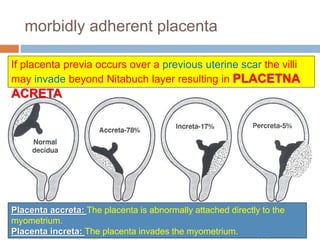
 morbidly adherent placenta
 Postpartum haemorrhage
morbidly adherent placenta
Placenta accreta: The placenta is abnormally attached directly to the
myometrium.
Placenta increta: The placenta invades the myometrium.
If placenta previa occurs over a previous uterine scar the villi
may invade beyond Nitabuch layer resulting in PLACETNA
ACRETA
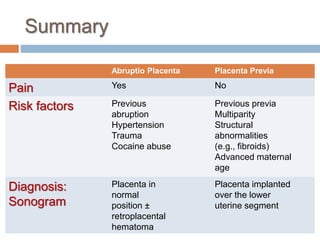
Summary
Abruptio Placenta Placenta Previa
Pain Yes No
Risk factors Previous
abruption
Hypertension
Trauma
Cocaine abuse
Previous previa
Multiparity
Structural
abnormalities
(e.g., fibroids)
Advanced maternal
age
Diagnosis:
Sonogram
Placenta in
normal
position ±
retroplacental
hematoma
Placenta implanted
over the lower
uterine segment
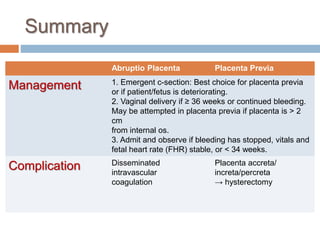
Summary
Abruptio Placenta Placenta Previa
Management 1. Emergent c-section: Best choice for placenta previa
or if patient/fetus is deteriorating.
2. Vaginal delivery if ≥ 36 weeks or continued bleeding.
May be attempted in placenta previa if placenta is > 2
cm
from internal os.
3. Admit and observe if bleeding has stopped, vitals and
fetal heart rate (FHR) stable, or < 34 weeks.
Complication Disseminated
intravascular
coagulation
Placenta accreta/
increta/percreta
→ hysterectomy
Any question?

Aph Antepartum hemorrhage

  • 1.
  • 2.
    Definition  is definedas vaginal bleeding from 24 weeks to delivery of the baby.  Or any bleeding occurring in the antenatal period after 20 weeks gestation.  It complicates 2–5% of pregnancies.  It is associated with increased risks of fetal and maternal morbidity and mortality
  • 3.
    Causes • Erosion • Polyps •Cancer • Varicosities • Lacerations • Abraptio p. • Placenta p. • Vasa previa
  • 4.
    Initial steps inmanagement of late pregnancy bleeding: initial management:  patient’s vitals  FHM  IV fluids Order lab tests:  CBC  DIC workup (platelets, PT, PTT, fibrinogen, and D- dimer)  Type and cross-match  Ultrasound “The most accurate” further steps in management:  Give blood transfusion for large volume loss.  Place Foley catheter and measure urine output.  Perform vaginal exam to rule out lacerations.  Schedule delivery if fetus is in jeopardy or gestational age is ≥ 36 weeks. Never perform a digital or speculum examination in a patient with late vaginal bleeding until a vaginal ultrasound first rules out placenta previa. Apt, Kleihauer-Betke, and Wright’s stain tests determine if blood is fetal, maternal, or both.
  • 5.
  • 6.
    Introduction  Definition: It isthe separation of the placenta from its site of implantation before delivery of the fetus.  Varieties: - Total or partial - Revealed or Concealed  Incidence: 1 in 200 deliveries
  • 7.
  • 8.
    Pathophysiology Initiated by bleedinginto the decidua basalis, the bleeding splits the decidua, and a decidual hematoma forms. The hematoma leads to separation, compression, and destruction of the placenta adjacent to it. a. The process may be self-limited, with no further complication to the pregnancy or may continue to become catastrophic. b. Bleeding insinuates between the fetal membranes and uterus which may extravasate or may remain concealed. Concealed abruptions can often be more compromising to maternal hemodynamic status since they are generally underappreciated.
  • 9.
    Risk Factors  Increasedage & parity.  Hypertension.  Preterm ruptured membranes.  Multiple gestation.  Polyhydramnios.  Smoking.  Cocaine use.  Prior abruption.  Uterine fibroid.  Trauma
  • 10.
    Clinical presentation  Vaginalbleeding.  Constant and severe abdominal pain.  Irritable, tender, and typically hypertonic uterus.  Evidence of fetal distress (if severe).  Maternal shock.  Disseminated intravascular coagulation.Up to 20% of placental abruptions can present without vaginal bleeding because bleeding is concealed.
  • 11.
  • 12.
    Abratio Placenta Diagnosis: Clinically:  Latetrimester painful bleeding  Normal placental implantation  Disseminated intravascular coagulopathy (DIC) Ultrasonography:
  • 13.
  • 14.
    Management  Emergency cesareandelivery: if maternal or fetal jeopardy is present as soon as the mother is stabilized.  Vaginal delivery: if bleeding is heavy but controlled or pregnancy is >36 weeks. Perform amniotomy and induce labor. Place external monitors to assess fetal heart rate pattern and contractions. Avoid cesarean delivery if the fetus is dead.  Conservative in-hospital observation: if mother and fetus are stable and remote from term, bleeding is minimal or decreasing, and contractions are subsiding. Confirm normal placental implantation with sonogram and replace blood loss with crystalloid and blood products as needed.
  • 15.
    Complications Maternal :  Hypovolemia. DIC.  Renal failure.  Death.  Uterine rupture Fetal :  Hypoxia.  IUGR.  IUFD.  Anemia
  • 16.
  • 17.
    Introduction Definition: the placenta isimplanted in the lower uterine segment. Classification:  Complete placenta previa: The placenta covers the entire internal cervical os.  Partial placenta previa: The placenta partially covers the internal cervical os.  Marginal placenta previa: One edge of the placenta extends to the edge of the internal cervical os.  Low-lying placenta: Within 2 cm of the internal cervical os. Incidence: Complicates approximately 1 in 300 pregnancies.
  • 18.
    Placenta Previa Ultrasound performedin the second trimester may show a placenta previa in 5% to 15% of cases. However, as the lower uterine segment develops, over 90% of these previas will resolve. A repeat ultrasound should be performed at 28 weeks to confi rm the presence of a placenta previa.
  • 19.
    Placental migration  At16 weeks 20%  At 40 weeks 0.5%  Why the difference?  TrophoTropism Placental migration
  • 20.
  • 21.
    Pathophysiology of bleeding Avulsionof villi, stretching of lower uterine segment
  • 22.
    Risk Factors  Multiparty Increased maternal age  Previous placenta previa  Multiple gestation  Previous C/S  Uterine anomalies  Maternal smoking ART!!!
  • 23.
    Presentation & Diagnosis Late trimester bleeding  Lower segment placental implantation  No pain  MRI or Double set-up Transabdominal US (95% accurate)
  • 24.
  • 25.
    Management Emergency cesarean delivery Conservativein-hospital observation Vaginal delivery Scheduled cesarean delivery
  • 26.
    Management  Emergency cesareandelivery: if maternal or fetal jeopardy is present after stabilization of the mother.  Conservative in-hospital observation: Conservative management of bed rest is performed in preterm gestations if mother and fetus are stable and remote from term. The initial bleed is rarely severe. Confirm abnormal placental implantation with sonogram and replace blood loss with crystalloid and blood products as needed.  Vaginal delivery: This may be attempted if the lower placental edge is >2 cm from the internal cervical os.  Scheduled cesarean delivery: if the mother has been stable after fetal lung maturity has been confirmed by amniocentesis, usually at 36 weeks’ gestation.
  • 27.
    Complications of Placenta praevia Preterm delivery.  PPROM.  IUGR  Malpresentation  Fetal abnormalities  ↑ number of C/S.  morbidly adherent placenta  Postpartum haemorrhage
  • 28.
    morbidly adherent placenta Placentaaccreta: The placenta is abnormally attached directly to the myometrium. Placenta increta: The placenta invades the myometrium. If placenta previa occurs over a previous uterine scar the villi may invade beyond Nitabuch layer resulting in PLACETNA ACRETA
  • 29.
    Summary Abruptio Placenta PlacentaPrevia Pain Yes No Risk factors Previous abruption Hypertension Trauma Cocaine abuse Previous previa Multiparity Structural abnormalities (e.g., fibroids) Advanced maternal age Diagnosis: Sonogram Placenta in normal position ± retroplacental hematoma Placenta implanted over the lower uterine segment
  • 30.
    Summary Abruptio Placenta PlacentaPrevia Management 1. Emergent c-section: Best choice for placenta previa or if patient/fetus is deteriorating. 2. Vaginal delivery if ≥ 36 weeks or continued bleeding. May be attempted in placenta previa if placenta is > 2 cm from internal os. 3. Admit and observe if bleeding has stopped, vitals and fetal heart rate (FHR) stable, or < 34 weeks. Complication Disseminated intravascular coagulation Placenta accreta/ increta/percreta → hysterectomy
  • 31.