DR Laxman Singh Charan
Neonatal division
Department of Pediatrics
Safdarjang Hospital
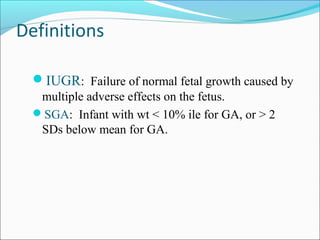
Definitions
IUGR: Failure of normal fetal growth caused by
multiple adverse effects on the fetus.
SGA: Infant with wt < 10% ile for GA, or > 2
SDs below mean for GA.
Easiest way to think about these terms are
IUGR: is a term used by Obstetricians to describe

a pattern of growth over a period of time.
SGA: is a term used by Pediatrician to describe a
single point on a growth curve.
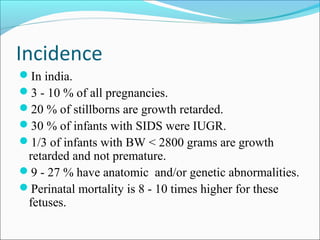
Incidence
In india.
3 - 10 % of all pregnancies.
20 % of stillborns are growth retarded.
30 % of infants with SIDS were IUGR.
1/3 of infants with BW < 2800 grams are growth

retarded and not premature.
9 - 27 % have anatomic and/or genetic abnormalities.
Perinatal mortality is 8 - 10 times higher for these
fetuses.
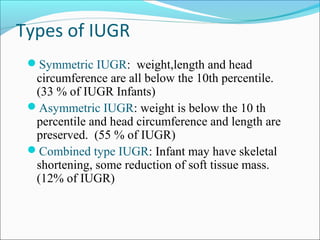
Types of IUGR
Symmetric IUGR: weight,length and head

circumference are all below the 10th percentile.
(33 % of IUGR Infants)
Asymmetric IUGR: weight is below the 10 th
percentile and head circumference and length are
preserved. (55 % of IUGR)
Combined type IUGR: Infant may have skeletal
shortening, some reduction of soft tissue mass.
(12% of IUGR)
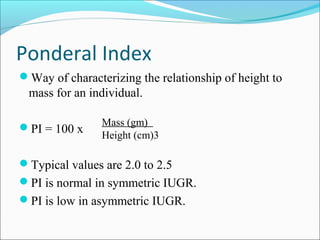
Ponderal Index
Way of characterizing the relationship of height to

mass for an individual.
PI = 100 x

Mass (gm)
Height (cm)3

Typical values are 2.0 to 2.5
PI is normal in symmetric IUGR.
PI is low in asymmetric IUGR.
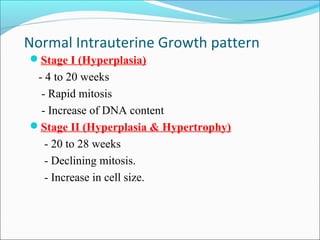
Normal Intrauterine Growth pattern
Stage I (Hyperplasia)

- 4 to 20 weeks
- Rapid mitosis
- Increase of DNA content
Stage II (Hyperplasia & Hypertrophy)
- 20 to 28 weeks
- Declining mitosis.
- Increase in cell size.
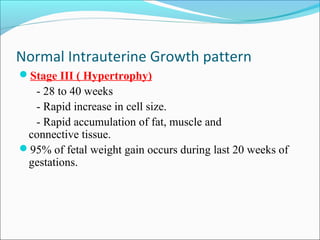
Normal Intrauterine Growth pattern
Stage III ( Hypertrophy)

- 28 to 40 weeks
- Rapid increase in cell size.
- Rapid accumulation of fat, muscle and
connective tissue.
95% of fetal weight gain occurs during last 20 weeks of
gestations.
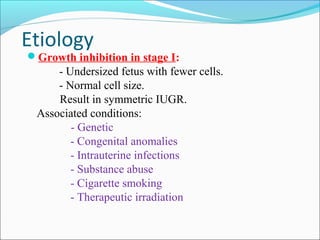
Etiology

Growth inhibition in stage I:

- Undersized fetus with fewer cells.
- Normal cell size.
Result in symmetric IUGR.
Associated conditions:
- Genetic
- Congenital anomalies
- Intrauterine infections
- Substance abuse
- Cigarette smoking
- Therapeutic irradiation
Etiology
Growth Inhibition in Stage II/III

-Decrease in cell size and fetal weight
- Less effect on total cell numeric, fetal length,
head circumferance.
Result in asymmetric IUGR.
Associated Conditions:
- Uteroplacental insufficiency.
• Combination above associated mixed type IUGR.
Pathophysiology
(1) Fetal factors:
Genetic Factors:

- Race, ethnicity, nationality
- sex ( male weight 150 -200 gm more than
female )
- parity ( primiparous, weight less than
subsequent siblings)
-genetic disorders ( Achondroplasia,
Russell-silver syndrome.)
Chromosomal anomalies:
- Chromosomal deletions
- trisomies 13,18 & 21
Pathophysiology
Congenital malformations:

Anencephaly, GI atresia,
potter’s syndrome, and pancreatic agenesis.
Fetal Cardiovascular anomalies
Congenital Infections:
mainly TORCH infections.
Inborn error of metabolism:
- Transient neonatal diabetes
- Galactosemia
- PKU
Pathophysiology

(2) Maternal Factors:
Decrease Uteroplacental blood flow:

- Pre eclampsia / eclampsia
- Chronic renovascular disease
- Chronic hypertension
Maternal malnutrition
Multiple pregnancy
Drugs

- Cigarettes, alcohol, heroin, cocaine

- Teratogens, antimetabolites and therapeutic
agents such as trimethadione, warfarin, phenytoin
Pathophysiology

Maternal hypoxemia
- Hemoglobinopathies
- High altitudes

• Others

- Short stature

- Younger or older age (<15 and >45)
- Low socioeconomic class
- Primiparity
- Grand multiparity
- Low pregnancy weight
- Previous h/o preterm IUGR baby
- Chronic illness ( DM, renal failure, cyanotic heartdisease etc.)
Pathophysiology
(3) Placental Factors:
Placental insufficiency (most importent in 3rd

trimester)
Anatomic problems:
Multiple infarcts

Aberrant cord insertions
Umbilical vascular thrombosis & hemangiomas
Premature placental separation
Small Placenta
Postnatal Assessment
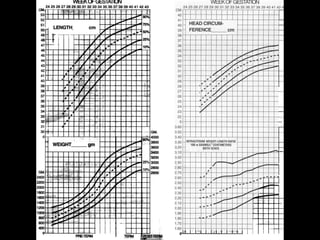
Growth parameters- weight, height, HC
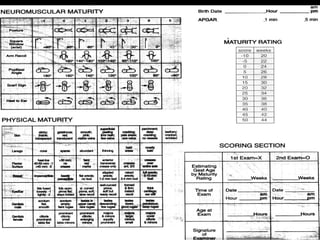
Assess GA-with Ballard score.
Growth chart -Plotted growth parameters in growth chart.
Physical appearance:
• Heads are disproportionately large for their trunks and

extremities
• Facial appearance has been likened to that of a
“wizened old man”.
• Long nails.
• Scaphoid abdomen
• Signs of recent wasting-

- soft tissue wasting
- diminished skin fold thickness
- decrease breast tissue
- reduced thigh circumference

• Signs of long term growth failure-

- Widened skull sutures, large fontanelles
- shortened crown – heel length
- delayed development of epiphyses

• Comparison to premature infants,IUGR has brain

and heart larger in proportion to the body weight,
in contrast the liver, spleen, adrenals and thymus
are smaller.
Complication
Hypoxia

- Perinatal asphyxia
- Persistent pulmonary hypertension
- meconium aspiration

Thermoregulation
- Hypothermia due to diminished subcutaneous fat and
elevated surface/volume ratio.
Complications
Metabolic
- Hypoglycemia
- result from inadequate glycogen stores.

- diminished gluconeogenesis.
- increased BMR
- Hypocalcemia
- due to high serum glucagon level, which

stimulate calcitonin excretion.
Complications
Hematologic

- Hyperviscosity and polycythemia due to increase
erythropoietin level secondary to hypoxia
Immunologic
- IUGR have increased protein catabolism and
decreased in protein, prealbumin and
immunoglobulins, which decreased humoral and
cellular immunity.
Management
Antenatal diagnosis and management is the key to proper

management of IUGR
Delivery and Resuscitation

- appropriate timing of delivery
- skilled resuscitation should be available
- prevention of heat loss
Hypoglycemia

- close monitoring of blood glucose
- early treatment ( IV dextrose,early feeding)
Management
Hematological Disorder

- Hematocrit to detect polycythemia
- CBC with differential to rule out leukopenia or
thrombocytopenia

Congenital infection

- Infant should be examined for signs of congenital

infection (eg.rash, microcephaly hepatosplenomegaly,
lymphadenopathy, cardiac anomalies etc….)
- TORCH titer screening
- Examination of urine, nasopharynx
- Head CT to rule out calcification
Management
Genetic anomalies

- screening as indicated by physical exam
- chromosomal analysis (infant with
dysmorphic features)
Others
- serum calcium to r/o hypocalcemia
- fractionated bilirubin secondary to polycythmia.
congenital infection
- urine,meconium for substance abuse
Management
Early feeding and caloric intake should be 100-120

kcal/kg/d
Developmental and growth f/u in all IUGR infants
Outcome
Symmetric vs. Asymmetric IUGR

- symmetric has poor outcome compare to asymmetric
Preterm IUGR has high incidence of abnormalities
IUGR with chromosomal disease has 100% incidence
of handicap
Congenital infection has poor outcome - handicap
rate > 50%
IUGR has higher rate of learning disability.
FOLLOW-UP
IUGR babies are risk for poor growth and neuro-

developmental outcome.
Routinely follow IUGR babies with birth weight below 3rd
centile and those with birth weight 3-10th centile if they
develop significant morbidities (e.g. hypoglycemia,
polycythemia,birth asphyxia) during hospital stay.
Iugr and sga

Iugr and sga

  • 1.
    DR Laxman SinghCharan Neonatal division Department of Pediatrics Safdarjang Hospital
  • 2.
    Definitions IUGR: Failure ofnormal fetal growth caused by multiple adverse effects on the fetus. SGA: Infant with wt < 10% ile for GA, or > 2 SDs below mean for GA.
  • 3.
    Easiest way tothink about these terms are IUGR: is a term used by Obstetricians to describe a pattern of growth over a period of time. SGA: is a term used by Pediatrician to describe a single point on a growth curve.
  • 4.
    Incidence In india. 3 -10 % of all pregnancies. 20 % of stillborns are growth retarded. 30 % of infants with SIDS were IUGR. 1/3 of infants with BW < 2800 grams are growth retarded and not premature. 9 - 27 % have anatomic and/or genetic abnormalities. Perinatal mortality is 8 - 10 times higher for these fetuses.
  • 5.
    Types of IUGR SymmetricIUGR: weight,length and head circumference are all below the 10th percentile. (33 % of IUGR Infants) Asymmetric IUGR: weight is below the 10 th percentile and head circumference and length are preserved. (55 % of IUGR) Combined type IUGR: Infant may have skeletal shortening, some reduction of soft tissue mass. (12% of IUGR)
  • 6.
    Ponderal Index Way ofcharacterizing the relationship of height to mass for an individual. PI = 100 x Mass (gm) Height (cm)3 Typical values are 2.0 to 2.5 PI is normal in symmetric IUGR. PI is low in asymmetric IUGR.
  • 7.
    Normal Intrauterine Growthpattern Stage I (Hyperplasia) - 4 to 20 weeks - Rapid mitosis - Increase of DNA content Stage II (Hyperplasia & Hypertrophy) - 20 to 28 weeks - Declining mitosis. - Increase in cell size.
  • 8.
    Normal Intrauterine Growthpattern Stage III ( Hypertrophy) - 28 to 40 weeks - Rapid increase in cell size. - Rapid accumulation of fat, muscle and connective tissue. 95% of fetal weight gain occurs during last 20 weeks of gestations.
  • 9.
    Etiology Growth inhibition instage I: - Undersized fetus with fewer cells. - Normal cell size. Result in symmetric IUGR. Associated conditions: - Genetic - Congenital anomalies - Intrauterine infections - Substance abuse - Cigarette smoking - Therapeutic irradiation
  • 10.
    Etiology Growth Inhibition inStage II/III -Decrease in cell size and fetal weight - Less effect on total cell numeric, fetal length, head circumferance. Result in asymmetric IUGR. Associated Conditions: - Uteroplacental insufficiency. • Combination above associated mixed type IUGR.
  • 11.
    Pathophysiology (1) Fetal factors: GeneticFactors: - Race, ethnicity, nationality - sex ( male weight 150 -200 gm more than female ) - parity ( primiparous, weight less than subsequent siblings) -genetic disorders ( Achondroplasia, Russell-silver syndrome.) Chromosomal anomalies: - Chromosomal deletions - trisomies 13,18 & 21
  • 12.
    Pathophysiology Congenital malformations: Anencephaly, GIatresia, potter’s syndrome, and pancreatic agenesis. Fetal Cardiovascular anomalies Congenital Infections: mainly TORCH infections. Inborn error of metabolism: - Transient neonatal diabetes - Galactosemia - PKU
  • 13.
    Pathophysiology (2) Maternal Factors: DecreaseUteroplacental blood flow: - Pre eclampsia / eclampsia - Chronic renovascular disease - Chronic hypertension Maternal malnutrition Multiple pregnancy Drugs - Cigarettes, alcohol, heroin, cocaine - Teratogens, antimetabolites and therapeutic agents such as trimethadione, warfarin, phenytoin
  • 14.
    Pathophysiology  Maternal hypoxemia - Hemoglobinopathies -High altitudes • Others - Short stature - Younger or older age (<15 and >45) - Low socioeconomic class - Primiparity - Grand multiparity - Low pregnancy weight - Previous h/o preterm IUGR baby - Chronic illness ( DM, renal failure, cyanotic heartdisease etc.)
  • 15.
    Pathophysiology (3) Placental Factors: Placentalinsufficiency (most importent in 3rd trimester) Anatomic problems: Multiple infarcts Aberrant cord insertions Umbilical vascular thrombosis & hemangiomas Premature placental separation Small Placenta
  • 16.
    Postnatal Assessment Growth parameters-weight, height, HC Assess GA-with Ballard score. Growth chart -Plotted growth parameters in growth chart.
  • 19.
    Physical appearance: • Headsare disproportionately large for their trunks and extremities • Facial appearance has been likened to that of a “wizened old man”. • Long nails. • Scaphoid abdomen
  • 20.
    • Signs ofrecent wasting- - soft tissue wasting - diminished skin fold thickness - decrease breast tissue - reduced thigh circumference • Signs of long term growth failure- - Widened skull sutures, large fontanelles - shortened crown – heel length - delayed development of epiphyses • Comparison to premature infants,IUGR has brain and heart larger in proportion to the body weight, in contrast the liver, spleen, adrenals and thymus are smaller.
  • 21.
    Complication Hypoxia - Perinatal asphyxia -Persistent pulmonary hypertension - meconium aspiration Thermoregulation - Hypothermia due to diminished subcutaneous fat and elevated surface/volume ratio.
  • 22.
    Complications Metabolic - Hypoglycemia - resultfrom inadequate glycogen stores. - diminished gluconeogenesis. - increased BMR - Hypocalcemia - due to high serum glucagon level, which stimulate calcitonin excretion.
  • 23.
    Complications Hematologic - Hyperviscosity andpolycythemia due to increase erythropoietin level secondary to hypoxia Immunologic - IUGR have increased protein catabolism and decreased in protein, prealbumin and immunoglobulins, which decreased humoral and cellular immunity.
  • 24.
    Management Antenatal diagnosis andmanagement is the key to proper management of IUGR Delivery and Resuscitation - appropriate timing of delivery - skilled resuscitation should be available - prevention of heat loss Hypoglycemia - close monitoring of blood glucose - early treatment ( IV dextrose,early feeding)
  • 25.
    Management Hematological Disorder - Hematocritto detect polycythemia - CBC with differential to rule out leukopenia or thrombocytopenia Congenital infection - Infant should be examined for signs of congenital infection (eg.rash, microcephaly hepatosplenomegaly, lymphadenopathy, cardiac anomalies etc….) - TORCH titer screening - Examination of urine, nasopharynx - Head CT to rule out calcification
  • 26.
    Management Genetic anomalies - screeningas indicated by physical exam - chromosomal analysis (infant with dysmorphic features) Others - serum calcium to r/o hypocalcemia - fractionated bilirubin secondary to polycythmia. congenital infection - urine,meconium for substance abuse
  • 27.
    Management Early feeding andcaloric intake should be 100-120 kcal/kg/d Developmental and growth f/u in all IUGR infants
  • 28.
    Outcome Symmetric vs. AsymmetricIUGR - symmetric has poor outcome compare to asymmetric Preterm IUGR has high incidence of abnormalities IUGR with chromosomal disease has 100% incidence of handicap Congenital infection has poor outcome - handicap rate > 50% IUGR has higher rate of learning disability.
  • 29.
    FOLLOW-UP IUGR babies arerisk for poor growth and neuro- developmental outcome. Routinely follow IUGR babies with birth weight below 3rd centile and those with birth weight 3-10th centile if they develop significant morbidities (e.g. hypoglycemia, polycythemia,birth asphyxia) during hospital stay.