ULCERS
DR.V.MUKESH KRISHNA
Definition
A break in the epithelial continuity
Discontinuity of the skin or mucous
membrane which occurs due to the
microscopic death of the tissues
Aetiology
 Venous Disease (Varicose Veins)
 Arterial Disease ; Large vessel (Atherosclerosis) or Small
vessel (Diabetes)
 Arteritis : Autoimmune (Rheumatoid Arthritis, Lupus)
 Trauma
 Chronic Infection : TB/Syphilis
 Neoplastic : Squamous or BCC, Sarcoma
Wagner’s Grading of ulcers
 Grade 0 - Preulcerative lesion/healed ulcer
 Grade 1 - Superficial ulcer
 Grade 2 - Ulcer deeper to Subcutaneous tissue
exposing soft tissue or bone
 Grade 3 - Abscess formation or osteomyelitis
 Grade 4 - Gangrene of part of tissues/limb/foot
 Grade 5 - Gangrene of entire one area/foot
Classification
A. Clinical
B. Pathological
A. Clinical
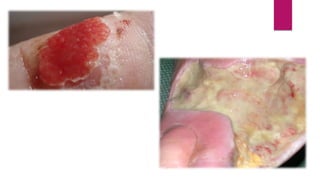
Spreading : (Edge - Inflamed & Edematous)
Healing : (Edge is sloping with healthy red
granulation tissue & serous discharge)
Callous : (Floor contains pale unhealthy
granulation tissue with indurated edge)
B.Pathological
1. Nonspecific
2. Specific
3. Malignant
1. Non specific
Traumatic Ulcer
Arterial Ulcer
Venous Ulcer
Neurogenic Ulcer
Infective Ulcer
1. Non specific contd.
Diabetic Ulcer
Tropical Ulcer
Cryopathic Ulcer
Martorell’s Ulcer
Bazin’s Ulcer
• Traumatic ulcer
1. Mechanical- Dental ulcer on tongue ( jagged tooth )
2. Physical- Electrical burn
3. Chemical- Application of caustics
 Acute, Superficial, Painful, Tender
• Arterial Ulcer
• Caused due to peripheral vascular disease
• LL : Atherosclerosis & TAO
• UL : Cervical Rib, Raynauds
• Chief complaint : Severe Pain
• Toes, Feet, Legs & UL Digits
• Venous ulcers
 Medial aspect of lower 3rd of lower limb
 Ankle ( Gaiters Zone ) : Chronic Venous HTN
 Ulcers are Painless
 Varicose Veins or Post Phlebitic limb ( PTS )
• Trophic Ulcer
• Pressure Sore or Decubitus Ulcer
• Punched out edge with slough on the floor
• Ex: Bed Sores & Perforating ulcers
• Develop as a result of Prolonged Pressure
• Sites : Ischial Tuberosity > Greater Trochanter >
Sacrum > Heel > Malleolus > Occiput
• Tropical ulcer
• Tropical regions : Africa, India, S.America
• Trauma or Insect Bite
• Fusobacterium fusiformis & Borrelia
vincentii
• Abrasions, Redness, Papules & Pustules
• Severe Pain
• Diabetic Ulcer
It may be caused due to
• Diabetic Neuropathy
• Diabetic Microangiopathy
• Increased Glucose : Increased Infection
• Foot ( Plantar ), Leg, Back, Scrotum, Perineum
• Ischemia, Septicemia, Osteomyelitis,
2. Specific
Tuberculosis
Syphilis
Actinomycosis
Meleney’s ulcer
Soft sore
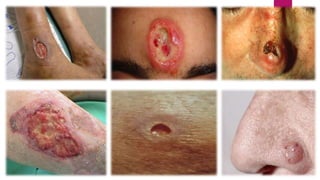
3. Malignant
Squamous cell ca
Basal cell ca
Malignant melanoma
Examination
Inspection
Palpation
Examination of lymph nodes
Vascular insufficiency
 Nerve lesions
 INSPECTION
Location, size, shape, floor, edge, discharge, surrounding area.
 PALPATION
Tenderness, local rise of temperature, bleeding on touch,
consistency of the ulcer, edge, surrounding area - oedema,
mobility.
 REGIONAL LYMPH NODES
 SENSATIONS
 PULSATIONS
 FUNCTION OF THE JOINT
 SYSTEMIC EXAMINATION
INSPECTION
LOCATION OF THE ULCER
FLOOR OF THE ULCER
DISCHARGE FROM THE ULCER
EDGE
SURROUNDING AREA
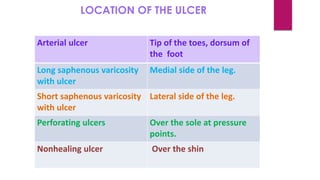
LOCATION OF THE ULCER
Arterial ulcer Tip of the toes, dorsum of
the foot
Long saphenous varicosity
with ulcer
Medial side of the leg.
Short saphenous varicosity
with ulcer
Lateral side of the leg.
Perforating ulcers Over the sole at pressure
points.
Nonhealing ulcer Over the shin
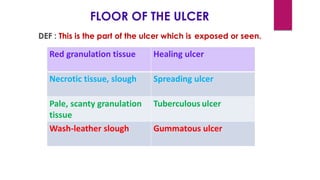
FLOOR OF THE ULCER
DEF : This is the part of the ulcer which is exposed or seen.
Red granulation tissue Healing ulcer
Necrotic tissue, slough Spreading ulcer
Pale, scanty granulation
tissue
Tuberculous ulcer
Wash-leather slough Gummatous ulcer
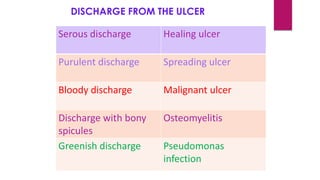
DISCHARGE FROM THE ULCER
Serous discharge Healing ulcer
Purulent discharge Spreading ulcer
Bloody discharge Malignant ulcer
Discharge with bony
spicules
Osteomyelitis
Greenish discharge Pseudomonas
infection
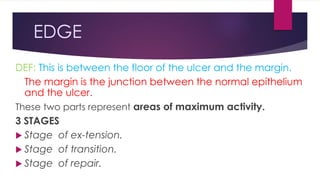
EDGE
DEF: This is between the floor of the ulcer and the margin.
The margin is the junction between the normal epithelium
and the ulcer.
These two parts represent areas of maximum activity.
3 STAGES
 Stage of ex-tension.
 Stage of transition.
 Stage of repair.
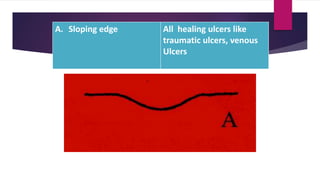
A. Sloping edge All healing ulcers like
traumatic ulcers, venous
Ulcers
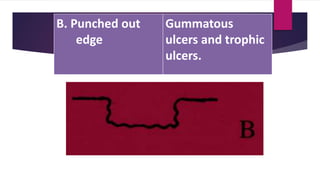
B. Punched out
edge
Gummatous
ulcers and trophic
ulcers.
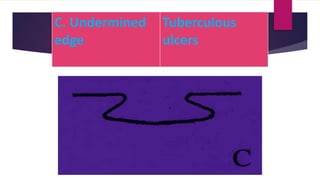
C. Undermined
edge
Tuberculous
ulcers
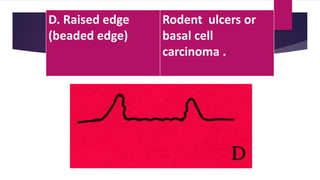
D. Raised edge
(beaded edge)
Rodent ulcers or
basal cell
carcinoma .
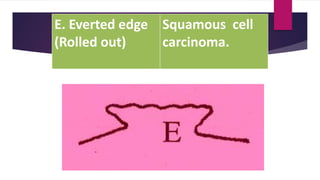
E. Everted edge
(Rolled out)
Squamous cell
carcinoma.
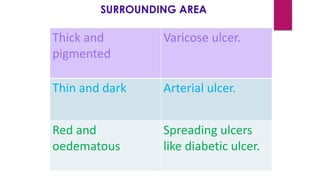
SURROUNDING AREA
Thick and
pigmented
Varicose ulcer.
Thin and dark Arterial ulcer.
Red and
oedematous
Spreading ulcers
like diabetic ulcer.
PALPATION
EDGE
BASE
MOBILITY
BLEEDING
SURROUNDING AREA
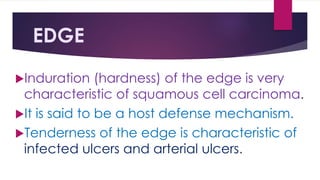
EDGE
Induration (hardness) of the edge is very
characteristic of squamous cell carcinoma.
It is said to be a host defense mechanism.
Tenderness of the edge is characteristic of
infected ulcers and arterial ulcers.
BASE
It is the area on which ulcer rests.
Marked induration at the base is diagnostic
of squamous cell carcinoma.
INDURATION
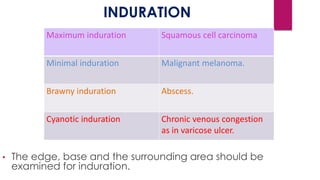
• The edge, base and the surrounding area should be
examined for induration.
Maximum induration Squamous cell carcinoma
Minimal induration Malignant melanoma.
Brawny induration Abscess.
Cyanotic induration Chronic venous congestion
as in varicose ulcer.
MOBILITY
Gentle attempt is made to move the
ulcer to know its fixity to the underlying
tissues.
Malignant ulcers are usually fixed, benign
ulcers are not.
BLEEDING
Malignant ulcer is friable like a cauliflower.
On gentle palpation, it bleeds.
 Granulation tissue as in a healing ulcer
also causes bleeding.
SURROUNDING AREA
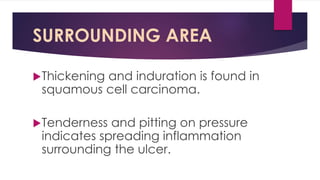
Thickening and induration is found in
squamous cell carcinoma.
Tenderness and pitting on pressure
indicates spreading inflammation
surrounding the ulcer.
RELEVANT CLINICAL EXAMINATION
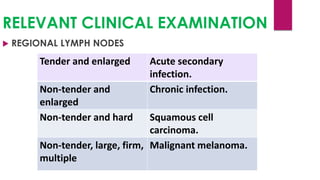
 REGIONAL LYMPH NODES
Tender and enlarged Acute secondary
infection.
Non-tender and
enlarged
Chronic infection.
Non-tender and hard Squamous cell
carcinoma.
Non-tender, large, firm,
multiple
Malignant melanoma.
MANAGEMENT
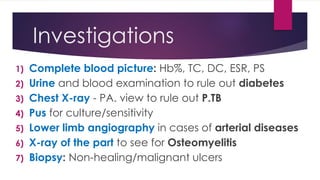
Investigations
1) Complete blood picture: Hb%, TC, DC, ESR, PS
2) Urine and blood examination to rule out diabetes
3) Chest X-ray - PA. view to rule out P.TB
4) Pus for culture/sensitivity
5) Lower limb angiography in cases of arterial diseases
6) X-ray of the part to see for Osteomyelitis
7) Biopsy: Non-healing/malignant ulcers
Treatment
Address cause
Correct deficiencies
Control pain, infection
Debridement, dressing
Closure of defect
TREATMENT OF THE ULCERS
Treatment of Spreading Ulcers
Treatment of Healing Ulcers
Treatment of Chronic Ulcers
Treatment of The Underlying Disease
TREATMENT OF SPREADING ULCERS
 Pus Culture/Sensitivity report,
 Appropriate Antibiotics
 Solutions to treat the Slough : H₂O₂ & EUSOL -
Edinburgh University Solution (Hypochlorite solution)
 Excessive Granulation Tissue (Proud Flesh) : Excision or
Application of Copper Sulphate or Silver Nitrate
 Repeated Dressings,
TREATMENT OF HEALING ULCER
 Regular dressings are done for a few days
 Antiseptic creams like Liquid Iodine, Zinc Oxide or
Silver Sulphadiazine.
 Culture swab is taken to rule out Streptococcus
Haemolyticus ( contraindication for skin grafting )
 Ulcer is small - Heals by itself ( Epithelialization )
Large - Free Split Skin Graft applied
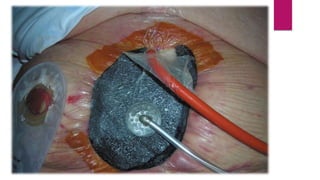
TREATMENT OF CHRONIC ULCERS
 These do not respond to conventional methods of treatment.
The following are tried:
 Infrared radiation, short-wave therapy, ultraviolet rays
decrease the size of the ulcer.
 Amnion helps in epithelialization.
 Chorion helps in granulation tissue.
 These ulcers ultimately may require skin grafting.
Ulcers Basics
Ulcers Basics

Ulcers Basics

  • 1.
  • 2.
    Definition A break inthe epithelial continuity Discontinuity of the skin or mucous membrane which occurs due to the microscopic death of the tissues
  • 3.
    Aetiology  Venous Disease(Varicose Veins)  Arterial Disease ; Large vessel (Atherosclerosis) or Small vessel (Diabetes)  Arteritis : Autoimmune (Rheumatoid Arthritis, Lupus)  Trauma  Chronic Infection : TB/Syphilis  Neoplastic : Squamous or BCC, Sarcoma
  • 4.
    Wagner’s Grading ofulcers  Grade 0 - Preulcerative lesion/healed ulcer  Grade 1 - Superficial ulcer  Grade 2 - Ulcer deeper to Subcutaneous tissue exposing soft tissue or bone  Grade 3 - Abscess formation or osteomyelitis  Grade 4 - Gangrene of part of tissues/limb/foot  Grade 5 - Gangrene of entire one area/foot
  • 5.
  • 6.
    A. Clinical Spreading :(Edge - Inflamed & Edematous) Healing : (Edge is sloping with healthy red granulation tissue & serous discharge) Callous : (Floor contains pale unhealthy granulation tissue with indurated edge)
  • 7.
  • 8.
    1. Non specific TraumaticUlcer Arterial Ulcer Venous Ulcer Neurogenic Ulcer Infective Ulcer
  • 9.
    1. Non specificcontd. Diabetic Ulcer Tropical Ulcer Cryopathic Ulcer Martorell’s Ulcer Bazin’s Ulcer
  • 10.
    • Traumatic ulcer 1.Mechanical- Dental ulcer on tongue ( jagged tooth ) 2. Physical- Electrical burn 3. Chemical- Application of caustics  Acute, Superficial, Painful, Tender
  • 11.
    • Arterial Ulcer •Caused due to peripheral vascular disease • LL : Atherosclerosis & TAO • UL : Cervical Rib, Raynauds • Chief complaint : Severe Pain • Toes, Feet, Legs & UL Digits
  • 12.
    • Venous ulcers Medial aspect of lower 3rd of lower limb  Ankle ( Gaiters Zone ) : Chronic Venous HTN  Ulcers are Painless  Varicose Veins or Post Phlebitic limb ( PTS )
  • 13.
    • Trophic Ulcer •Pressure Sore or Decubitus Ulcer • Punched out edge with slough on the floor • Ex: Bed Sores & Perforating ulcers • Develop as a result of Prolonged Pressure • Sites : Ischial Tuberosity > Greater Trochanter > Sacrum > Heel > Malleolus > Occiput
  • 14.
    • Tropical ulcer •Tropical regions : Africa, India, S.America • Trauma or Insect Bite • Fusobacterium fusiformis & Borrelia vincentii • Abrasions, Redness, Papules & Pustules • Severe Pain
  • 15.
    • Diabetic Ulcer Itmay be caused due to • Diabetic Neuropathy • Diabetic Microangiopathy • Increased Glucose : Increased Infection • Foot ( Plantar ), Leg, Back, Scrotum, Perineum • Ischemia, Septicemia, Osteomyelitis,
  • 16.
  • 17.
    3. Malignant Squamous cellca Basal cell ca Malignant melanoma
  • 21.
    Examination Inspection Palpation Examination of lymphnodes Vascular insufficiency  Nerve lesions
  • 22.
     INSPECTION Location, size,shape, floor, edge, discharge, surrounding area.  PALPATION Tenderness, local rise of temperature, bleeding on touch, consistency of the ulcer, edge, surrounding area - oedema, mobility.  REGIONAL LYMPH NODES  SENSATIONS  PULSATIONS  FUNCTION OF THE JOINT  SYSTEMIC EXAMINATION
  • 23.
    INSPECTION LOCATION OF THEULCER FLOOR OF THE ULCER DISCHARGE FROM THE ULCER EDGE SURROUNDING AREA
  • 24.
    LOCATION OF THEULCER Arterial ulcer Tip of the toes, dorsum of the foot Long saphenous varicosity with ulcer Medial side of the leg. Short saphenous varicosity with ulcer Lateral side of the leg. Perforating ulcers Over the sole at pressure points. Nonhealing ulcer Over the shin
  • 25.
    FLOOR OF THEULCER DEF : This is the part of the ulcer which is exposed or seen. Red granulation tissue Healing ulcer Necrotic tissue, slough Spreading ulcer Pale, scanty granulation tissue Tuberculous ulcer Wash-leather slough Gummatous ulcer
  • 26.
    DISCHARGE FROM THEULCER Serous discharge Healing ulcer Purulent discharge Spreading ulcer Bloody discharge Malignant ulcer Discharge with bony spicules Osteomyelitis Greenish discharge Pseudomonas infection
  • 27.
    EDGE DEF: This isbetween the floor of the ulcer and the margin. The margin is the junction between the normal epithelium and the ulcer. These two parts represent areas of maximum activity. 3 STAGES  Stage of ex-tension.  Stage of transition.  Stage of repair.
  • 28.
    A. Sloping edgeAll healing ulcers like traumatic ulcers, venous Ulcers
  • 29.
  • 30.
  • 31.
    D. Raised edge (beadededge) Rodent ulcers or basal cell carcinoma .
  • 32.
    E. Everted edge (Rolledout) Squamous cell carcinoma.
  • 33.
    SURROUNDING AREA Thick and pigmented Varicoseulcer. Thin and dark Arterial ulcer. Red and oedematous Spreading ulcers like diabetic ulcer.
  • 34.
  • 35.
    EDGE Induration (hardness) ofthe edge is very characteristic of squamous cell carcinoma. It is said to be a host defense mechanism. Tenderness of the edge is characteristic of infected ulcers and arterial ulcers.
  • 36.
    BASE It is thearea on which ulcer rests. Marked induration at the base is diagnostic of squamous cell carcinoma.
  • 37.
    INDURATION • The edge,base and the surrounding area should be examined for induration. Maximum induration Squamous cell carcinoma Minimal induration Malignant melanoma. Brawny induration Abscess. Cyanotic induration Chronic venous congestion as in varicose ulcer.
  • 38.
    MOBILITY Gentle attempt ismade to move the ulcer to know its fixity to the underlying tissues. Malignant ulcers are usually fixed, benign ulcers are not.
  • 39.
    BLEEDING Malignant ulcer isfriable like a cauliflower. On gentle palpation, it bleeds.  Granulation tissue as in a healing ulcer also causes bleeding.
  • 40.
    SURROUNDING AREA Thickening andinduration is found in squamous cell carcinoma. Tenderness and pitting on pressure indicates spreading inflammation surrounding the ulcer.
  • 41.
    RELEVANT CLINICAL EXAMINATION REGIONAL LYMPH NODES Tender and enlarged Acute secondary infection. Non-tender and enlarged Chronic infection. Non-tender and hard Squamous cell carcinoma. Non-tender, large, firm, multiple Malignant melanoma.
  • 42.
  • 43.
    Investigations 1) Complete bloodpicture: Hb%, TC, DC, ESR, PS 2) Urine and blood examination to rule out diabetes 3) Chest X-ray - PA. view to rule out P.TB 4) Pus for culture/sensitivity 5) Lower limb angiography in cases of arterial diseases 6) X-ray of the part to see for Osteomyelitis 7) Biopsy: Non-healing/malignant ulcers
  • 44.
    Treatment Address cause Correct deficiencies Controlpain, infection Debridement, dressing Closure of defect
  • 45.
    TREATMENT OF THEULCERS Treatment of Spreading Ulcers Treatment of Healing Ulcers Treatment of Chronic Ulcers Treatment of The Underlying Disease
  • 46.
    TREATMENT OF SPREADINGULCERS  Pus Culture/Sensitivity report,  Appropriate Antibiotics  Solutions to treat the Slough : H₂O₂ & EUSOL - Edinburgh University Solution (Hypochlorite solution)  Excessive Granulation Tissue (Proud Flesh) : Excision or Application of Copper Sulphate or Silver Nitrate  Repeated Dressings,
  • 47.
    TREATMENT OF HEALINGULCER  Regular dressings are done for a few days  Antiseptic creams like Liquid Iodine, Zinc Oxide or Silver Sulphadiazine.  Culture swab is taken to rule out Streptococcus Haemolyticus ( contraindication for skin grafting )  Ulcer is small - Heals by itself ( Epithelialization ) Large - Free Split Skin Graft applied
  • 48.
    TREATMENT OF CHRONICULCERS  These do not respond to conventional methods of treatment. The following are tried:  Infrared radiation, short-wave therapy, ultraviolet rays decrease the size of the ulcer.  Amnion helps in epithelialization.  Chorion helps in granulation tissue.  These ulcers ultimately may require skin grafting.