SWINE FLUSWINE FLU
A Concise Presentation
By
Mr. Deepak Sarangi M.Pharm
1
CONTENTSCONTENTS
1. Introduction
2. What is swine flu
3. Swine flu differs from human flu
4. How swine flu spreads
5. Symptoms
6. Diagnosis
7. Vaccine
8. Medicines to treat
9. Preventions
10.Conclusion
11.References
2
INTRODUCTIONINTRODUCTION
Swine flu is also known as H1N1.
Epidemics of swine flu Were in : 1918 and 1968
 The swine flu pandemic was in 2009.
Total swine flu deaths from 2009 pandemic:14,286.
Epidemic meaning: An outbreak of a contagious
disease that spreads rapidly and widely.
Pandemic meaning: Epidemic over a wide
geographic area and affecting a large proportion of
the population.
3
WHATWHAT ISIS SWINESWINE FLU (H1N1)FLU (H1N1)
 Swine Influenza (swine flu) is a
respiratory disease of pigs caused
by Type A influenza viruses that
causes regular outbreaks in pigs.
 Swine flu viruses have been
reported to spread from person-to-
person, but in the past, this
transmission was limited and not
sustained beyond three people.
4
WHAT DOES H1N1 MEAN ?WHAT DOES H1N1 MEAN ?
• The “H1” (Hemagglutinin) and “N1” (Neuraminidases) .
•Influenza viruses are split up into three broad groups known
as influenza A, B and C.
•Influenza A is the most common type, and H1N1 is a type of
influenza A.
• The designation “H1N1” indicates unique traits, which
exhibit characteristics that identify the virus to the immune
system and allows for attachment and replication of the virus.
5
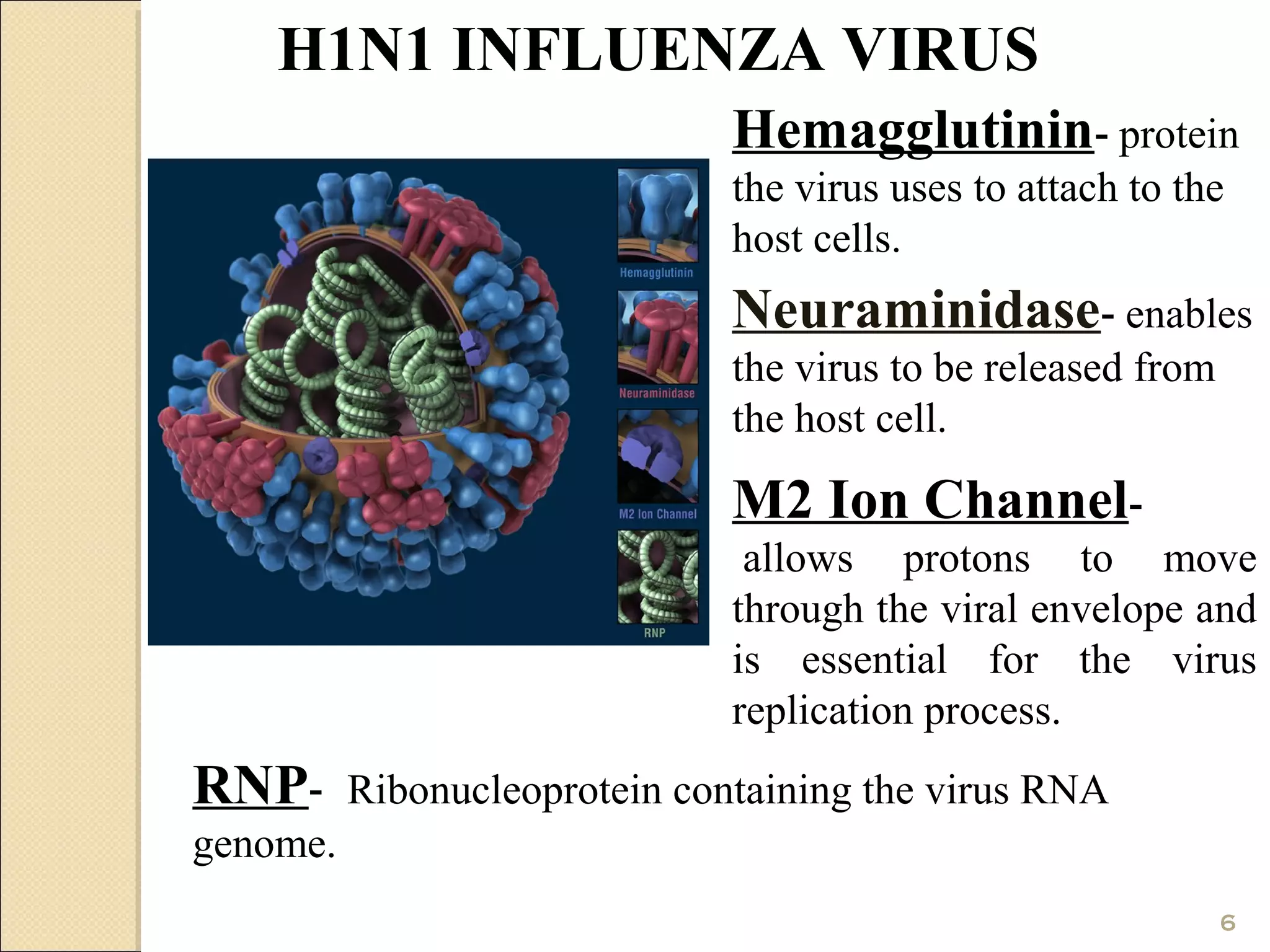
H1N1 INFLUENZA VIRUS
Hemagglutinin protein‐
the virus uses to attach to the
host cells.
Neuraminidase enables‐
the virus to be released from
the host cell.
M2 Ion Channel‐
allows protons to move
through the viral envelope and
is essential for the virus
replication process.
RNP  ‐ Ribonucleoprotein containing the virus RNA
genome.
6
SWINE FLU DIFFERS FROMSWINE FLU DIFFERS FROM
HUMAN FLUHUMAN FLU
• The H1N1 swine flu viruses are antigenically very
different from human H1N1 viruses and, therefore,
vaccines for human seasonal flu would not provide
protection from H1N1 swine flu viruses.
7
HOW IT SPREADSHOW IT SPREADS
 Spread of this swine influenza A (H1N1) virus is thought
to be happening in the same way that seasonal flu spreads.
 Flu viruses are spread mainly from person to person
through coughing or sneezing of people with influenza.
 Sometimes people may become infected by touching
something with live flu viruses on it and then touching
their mouth or nose.
8
IS THE CURRENT SWINE FLU VIRUSIS THE CURRENT SWINE FLU VIRUS
CONTAGIOUS ?CONTAGIOUS ?
 Various international agencies (US Centers for Disease
Control & Prevention, World Health Organization) have
determined that this swine influenza A (H1N1) virus is
contagious and is spreading from human to human.
 WHO has escalated the world Pandemic Phase from
Phase 3 to Phase 4 (in a 6-scale Phase), indicating that a
worldwide pandemic due to swine flu H1N1 is possible.
OMEGA COLLEGE OF PHARMACY 9
SYMPTOMSSYMPTOMS
Fever, sore throat, vomiting, diarrhoea, runny nose,
coughing and nausea are all symptoms of swine flu in
humans.
Diarrhoea, coughing, sore throat, lack of appetite,
fever, sneezing and weight loss are the main
symptoms of swine flu in pigs.
10
IN CHILDREN EMERGENCY WARNINGIN CHILDREN EMERGENCY WARNING
SIGNSSIGNS
 Fast breathing or trouble breathing.
 Bluish skin colour .
 Not drinking enough fluids .
 Not waking up or not interacting .
 Being so irritable that the child does not want to be held.
 Flu-like symptoms improve but then return with fever and
worse cough .
 Fever with a rash .
11
IN ADULT EMERGENCY WARNINGIN ADULT EMERGENCY WARNING
SIGNSSIGNS
Difficulty breathing or shortness of breath.
Pain or pressure in the chest or abdomen .
Sudden dizziness .
Confusion .
Severe or persistent vomiting .
12
13
DIAGNOSISDIAGNOSIS
To diagnose swine influenza A infection, a respiratory
specimen would generally need to be collected within
the first 4 to 5 days of illness (when an infected person
is most likely to be shedding virus).
However, some persons, especially children, may shed
virus for 10 days or longer.
Identification as a swine flu influenza A virus requires
sending the specimen to a hospital laboratory for
testing.
14
VACCINEVACCINE
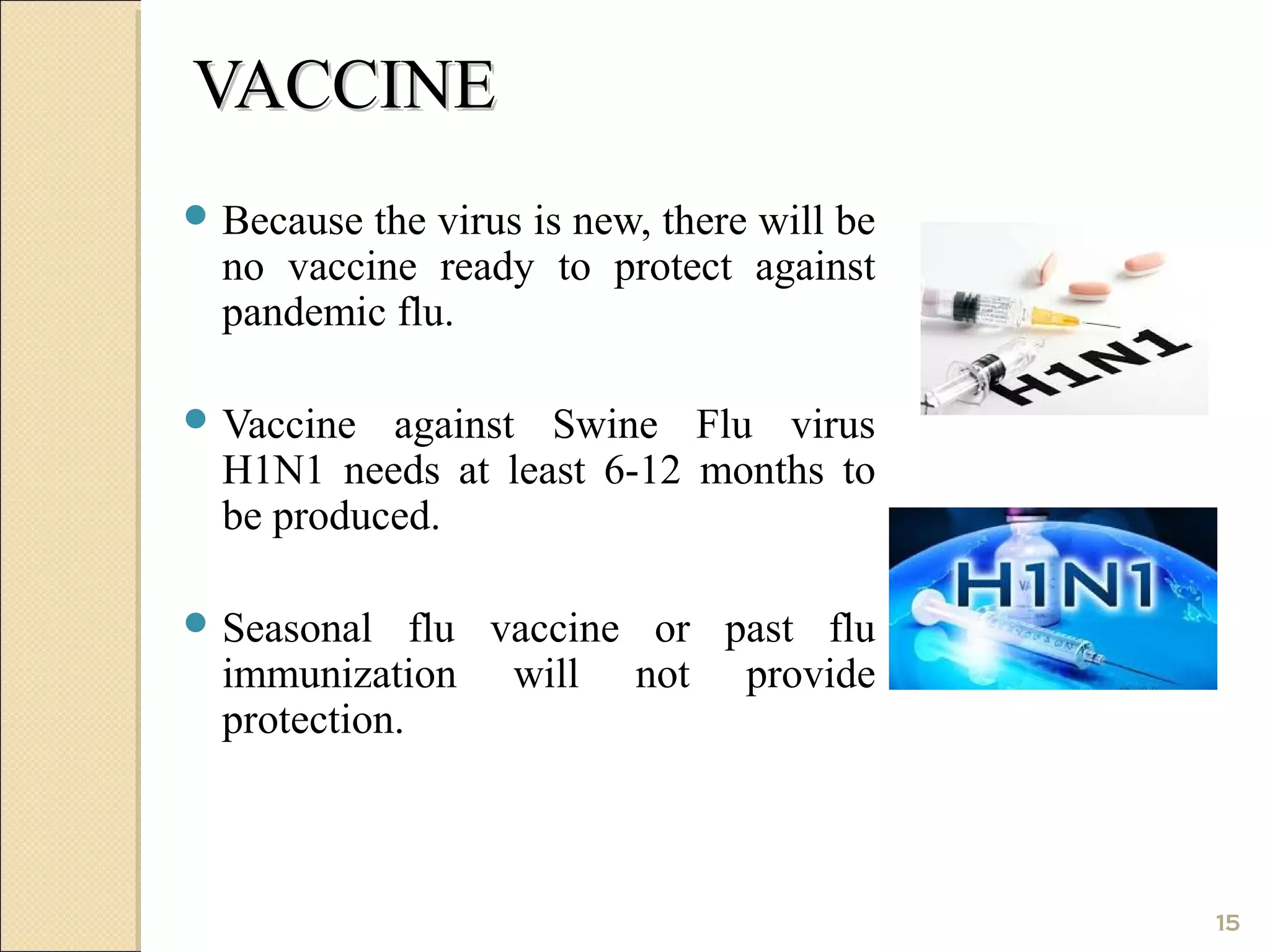
 Because the virus is new, there will be
no vaccine ready to protect against
pandemic flu.
 Vaccine against Swine Flu virus
H1N1 needs at least 6-12 months to
be produced.
 Seasonal flu vaccine or past flu
immunization will not provide
protection.
15
MEDICINES TO TREATMEDICINES TO TREAT
 The US CDC recommends the use of oseltamivir
(Tamiflu®) or zanamivir (Relenza®) for the treatment
and/or prevention of infection with these swine
influenza viruses.
 Antiviral drugs are prescription medicines (pills, liquid
or an inhaler) that fight against the flu by keeping flu
viruses from reproducing in your body.
 For treatment, antiviral drugs work best if started soon
after getting sick (within 2 days of symptoms).
16
17
PREVENTIONSPREVENTIONS OF SWINE FLUOF SWINE FLU
 Farmers should wear face masks and gloves when dealing
with infected animals to prevent swine flu.
 Cover your nose and mouth with a tissue when you cough or
sneeze. Throw the tissue in the trash after you use it.
 Wash your hands often with soap and water, especially after
you cough or sneeze. Alcohol-based hand cleaners are also
effective.
 Try to avoid close contact with sick people.
 If you get sick with influenza, stay home from work or school
and limit contact with others to keep from infecting them.
18
19
To prevent the spread of influenza virus it is important to keep
surfaces (especially bedside tables, surfaces in the bathroom,
kitchen counters and toys for children) clean by wiping them
down with a household disinfectant according to directions on
the product label.
HOUSEHOLD CLEANING TO PREVENT
THE SPREAD OF INFLUENZA VIRUS
20
SOURCES OF CONTAMINATIONSOURCES OF CONTAMINATION
 The virus can be spread when a person
touches something that is contaminated
with the virus and then touches his or her
eyes, nose, or mouth.
 Droplets from a cough or sneeze of an
infected person move through the air. The
virus can then be spread when a person
touches respiratory droplets from another
person on a surface like a desk, doorknob,
child’s toy or phone handset and then
touches their own eyes, mouth or nose
before washing their hands.
BEST WAY TO PREVENT SNEEZINGBEST WAY TO PREVENT SNEEZING
AND COUGHINGAND COUGHING
 If you are sick, limit your
contact with other people as
much as possible. Do not go to
work or school if ill.
 Cover your mouth and nose
with a tissue when coughing or
sneezing. It may prevent those
around you from getting sick.
Put your used tissue in the
waste basket.
 Cover your cough or sneeze if
you do not have a tissue. Then,
clean your hands, and do so
every time you cough or
sneeze.
CONCLUSIONCONCLUSION
1.Be aware of H1N1 virus/swine flu.
2.Know the symptoms.
3.Take precautions.
4.Get vaccinated.
5.If child/student misses school ,know about technology
learning.
6.Stay healthy and clean.
23
THANKS for viewing the ppt
For more ppts
on pharma related topics plz
contact
sarangi.dipu@gmail.com
Or find me at following link
www.facebook.com/sarangi.dipu
24

Swine flu ppt

  • 1.
    SWINE FLUSWINE FLU AConcise Presentation By Mr. Deepak Sarangi M.Pharm 1
  • 2.
    CONTENTSCONTENTS 1. Introduction 2. Whatis swine flu 3. Swine flu differs from human flu 4. How swine flu spreads 5. Symptoms 6. Diagnosis 7. Vaccine 8. Medicines to treat 9. Preventions 10.Conclusion 11.References 2
  • 3.
    INTRODUCTIONINTRODUCTION Swine flu isalso known as H1N1. Epidemics of swine flu Were in : 1918 and 1968  The swine flu pandemic was in 2009. Total swine flu deaths from 2009 pandemic:14,286. Epidemic meaning: An outbreak of a contagious disease that spreads rapidly and widely. Pandemic meaning: Epidemic over a wide geographic area and affecting a large proportion of the population. 3
  • 4.
    WHATWHAT ISIS SWINESWINEFLU (H1N1)FLU (H1N1)  Swine Influenza (swine flu) is a respiratory disease of pigs caused by Type A influenza viruses that causes regular outbreaks in pigs.  Swine flu viruses have been reported to spread from person-to- person, but in the past, this transmission was limited and not sustained beyond three people. 4
  • 5.
    WHAT DOES H1N1MEAN ?WHAT DOES H1N1 MEAN ? • The “H1” (Hemagglutinin) and “N1” (Neuraminidases) . •Influenza viruses are split up into three broad groups known as influenza A, B and C. •Influenza A is the most common type, and H1N1 is a type of influenza A. • The designation “H1N1” indicates unique traits, which exhibit characteristics that identify the virus to the immune system and allows for attachment and replication of the virus. 5
  • 6.
    H1N1 INFLUENZA VIRUS Hemagglutininprotein‐ the virus uses to attach to the host cells. Neuraminidase enables‐ the virus to be released from the host cell. M2 Ion Channel‐ allows protons to move through the viral envelope and is essential for the virus replication process. RNP  ‐ Ribonucleoprotein containing the virus RNA genome. 6
  • 7.
    SWINE FLU DIFFERSFROMSWINE FLU DIFFERS FROM HUMAN FLUHUMAN FLU • The H1N1 swine flu viruses are antigenically very different from human H1N1 viruses and, therefore, vaccines for human seasonal flu would not provide protection from H1N1 swine flu viruses. 7
  • 8.
    HOW IT SPREADSHOWIT SPREADS  Spread of this swine influenza A (H1N1) virus is thought to be happening in the same way that seasonal flu spreads.  Flu viruses are spread mainly from person to person through coughing or sneezing of people with influenza.  Sometimes people may become infected by touching something with live flu viruses on it and then touching their mouth or nose. 8
  • 9.
    IS THE CURRENTSWINE FLU VIRUSIS THE CURRENT SWINE FLU VIRUS CONTAGIOUS ?CONTAGIOUS ?  Various international agencies (US Centers for Disease Control & Prevention, World Health Organization) have determined that this swine influenza A (H1N1) virus is contagious and is spreading from human to human.  WHO has escalated the world Pandemic Phase from Phase 3 to Phase 4 (in a 6-scale Phase), indicating that a worldwide pandemic due to swine flu H1N1 is possible. OMEGA COLLEGE OF PHARMACY 9
  • 10.
    SYMPTOMSSYMPTOMS Fever, sore throat,vomiting, diarrhoea, runny nose, coughing and nausea are all symptoms of swine flu in humans. Diarrhoea, coughing, sore throat, lack of appetite, fever, sneezing and weight loss are the main symptoms of swine flu in pigs. 10
  • 11.
    IN CHILDREN EMERGENCYWARNINGIN CHILDREN EMERGENCY WARNING SIGNSSIGNS  Fast breathing or trouble breathing.  Bluish skin colour .  Not drinking enough fluids .  Not waking up or not interacting .  Being so irritable that the child does not want to be held.  Flu-like symptoms improve but then return with fever and worse cough .  Fever with a rash . 11
  • 12.
    IN ADULT EMERGENCYWARNINGIN ADULT EMERGENCY WARNING SIGNSSIGNS Difficulty breathing or shortness of breath. Pain or pressure in the chest or abdomen . Sudden dizziness . Confusion . Severe or persistent vomiting . 12
  • 13.
  • 14.
    DIAGNOSISDIAGNOSIS To diagnose swineinfluenza A infection, a respiratory specimen would generally need to be collected within the first 4 to 5 days of illness (when an infected person is most likely to be shedding virus). However, some persons, especially children, may shed virus for 10 days or longer. Identification as a swine flu influenza A virus requires sending the specimen to a hospital laboratory for testing. 14
  • 15.
    VACCINEVACCINE  Because thevirus is new, there will be no vaccine ready to protect against pandemic flu.  Vaccine against Swine Flu virus H1N1 needs at least 6-12 months to be produced.  Seasonal flu vaccine or past flu immunization will not provide protection. 15
  • 16.
    MEDICINES TO TREATMEDICINESTO TREAT  The US CDC recommends the use of oseltamivir (Tamiflu®) or zanamivir (Relenza®) for the treatment and/or prevention of infection with these swine influenza viruses.  Antiviral drugs are prescription medicines (pills, liquid or an inhaler) that fight against the flu by keeping flu viruses from reproducing in your body.  For treatment, antiviral drugs work best if started soon after getting sick (within 2 days of symptoms). 16
  • 17.
  • 18.
    PREVENTIONSPREVENTIONS OF SWINEFLUOF SWINE FLU  Farmers should wear face masks and gloves when dealing with infected animals to prevent swine flu.  Cover your nose and mouth with a tissue when you cough or sneeze. Throw the tissue in the trash after you use it.  Wash your hands often with soap and water, especially after you cough or sneeze. Alcohol-based hand cleaners are also effective.  Try to avoid close contact with sick people.  If you get sick with influenza, stay home from work or school and limit contact with others to keep from infecting them. 18
  • 19.
  • 20.
    To prevent thespread of influenza virus it is important to keep surfaces (especially bedside tables, surfaces in the bathroom, kitchen counters and toys for children) clean by wiping them down with a household disinfectant according to directions on the product label. HOUSEHOLD CLEANING TO PREVENT THE SPREAD OF INFLUENZA VIRUS 20
  • 21.
    SOURCES OF CONTAMINATIONSOURCESOF CONTAMINATION  The virus can be spread when a person touches something that is contaminated with the virus and then touches his or her eyes, nose, or mouth.  Droplets from a cough or sneeze of an infected person move through the air. The virus can then be spread when a person touches respiratory droplets from another person on a surface like a desk, doorknob, child’s toy or phone handset and then touches their own eyes, mouth or nose before washing their hands.
  • 22.
    BEST WAY TOPREVENT SNEEZINGBEST WAY TO PREVENT SNEEZING AND COUGHINGAND COUGHING  If you are sick, limit your contact with other people as much as possible. Do not go to work or school if ill.  Cover your mouth and nose with a tissue when coughing or sneezing. It may prevent those around you from getting sick. Put your used tissue in the waste basket.  Cover your cough or sneeze if you do not have a tissue. Then, clean your hands, and do so every time you cough or sneeze.
  • 23.
    CONCLUSIONCONCLUSION 1.Be aware ofH1N1 virus/swine flu. 2.Know the symptoms. 3.Take precautions. 4.Get vaccinated. 5.If child/student misses school ,know about technology learning. 6.Stay healthy and clean. 23
  • 24.
    THANKS for viewingthe ppt For more ppts on pharma related topics plz contact sarangi.dipu@gmail.com Or find me at following link www.facebook.com/sarangi.dipu 24