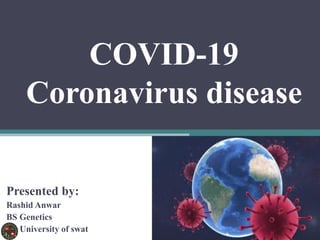
COVID-19
Coronavirus disease
Presented by:
Rashid Anwar
BS Genetics
University of swat
HISTORY
COVID-19 is one of several emerging infectious disease
outbreaks in recent decades with significant public health and
economic impacts.
The last of these were the influenza pandemics in 1957 and
1968, each killing more than a million people around the
world.
COVID-19, declared a pandemic by the World Health
Organization (WHO) on 11th March,2002.
And escalated worldwide, affecting over 2.5 million people in
185 countries, with over 187,000 deaths.
While the world is still witnessing its spread, most countries
are experiencing direct and indirect impacts of the global
pandemic on their economy and society to varying degrees.
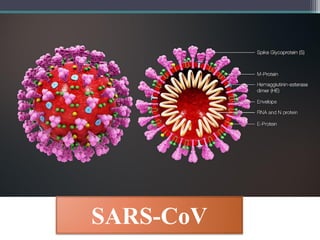
SARS-CoV
Introduction
Coronavirus:
Coronaviruses (CoV) are a large family of viruses that cause
illness ranging from the common cold to more severe diseases
such as Middle East Respiratory Syndrome (MERS-CoV) and
Severe Acute Respiratory Syndrome (SARS-CoV).
A novel coronavirus (nCoV) is a new strain that has not been
previously identified in humans.
Coronaviruses are zoonotic, meaning they are transmitted
between animals and people.
Detailed investigations found that SARS-CoV was transmitted
from civet cats to humans and MERS-CoV from dromedary
camels to humans.
Several known coronaviruses are circulating in animals that
have not yet infected humans.
COVID-19
OR
SARS-CoV
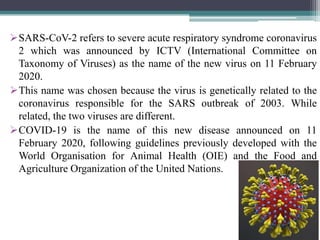
SARS-CoV-2 refers to severe acute respiratory syndrome coronavirus
2 which was announced by ICTV (International Committee on
Taxonomy of Viruses) as the name of the new virus on 11 February
2020.
This name was chosen because the virus is genetically related to the
coronavirus responsible for the SARS outbreak of 2003. While
related, the two viruses are different.
COVID-19 is the name of this new disease announced on 11
February 2020, following guidelines previously developed with the
World Organisation for Animal Health (OIE) and the Food and
Agriculture Organization of the United Nations.
Clinical Features
Incubation period: 1-27 days
Recovery time: 3 weeks to 6 weeks
Frequently reported signs and symptoms of patients include:
 Fever (77–98%)
 Cough (46%–82%)
 Myalgia or fatigue (11–52%)
 Shortness of breath (3-31%)
 Less commonly reported respiratory symptoms include sore
throat, headache, cough with sputum production
Diagnosis
Travel history to endemic countries like (China, Iran &
Italy)
CBC (leukopenia, seen in 30% to 45% of patients, and
lymphocytopenia, seen in 85% of the patients)
Chest X-Ray (cheaper & easier with 60% sensitivity)
PCR (30%-70% sensitivity)
Chest CT Scan (95% sensitivity, low specificity)
IgM/IgG combo test for COVID-19
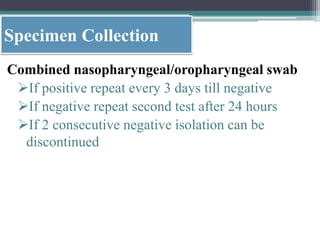
Specimen Collection
Combined nasopharyngeal/oropharyngeal swab
If positive repeat every 3 days till negative
If negative repeat second test after 24 hours
If 2 consecutive negative isolation can be
discontinued
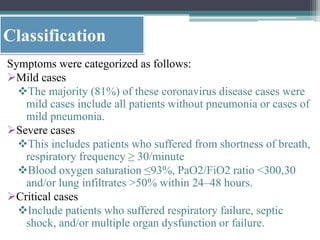
Classification
Symptoms were categorized as follows:
Mild cases
The majority (81%) of these coronavirus disease cases were
mild cases include all patients without pneumonia or cases of
mild pneumonia.
Severe cases
This includes patients who suffered from shortness of breath,
respiratory frequency ≥ 30/minute
Blood oxygen saturation ≤93%, PaO2/FiO2 ratio <300,30
and/or lung infiltrates >50% within 24–48 hours.
Critical cases
Include patients who suffered respiratory failure, septic
shock, and/or multiple organ dysfunction or failure.
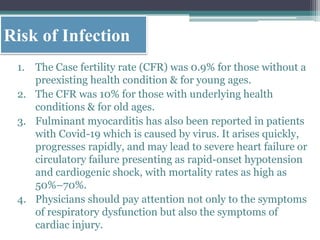
Risk of Infection
1. The Case fertility rate (CFR) was 0.9% for those without a
preexisting health condition & for young ages.
2. The CFR was 10% for those with underlying health
conditions & for old ages.
3. Fulminant myocarditis has also been reported in patients
with Covid-19 which is caused by virus. It arises quickly,
progresses rapidly, and may lead to severe heart failure or
circulatory failure presenting as rapid-onset hypotension
and cardiogenic shock, with mortality rates as high as
50%–70%.
4. Physicians should pay attention not only to the symptoms
of respiratory dysfunction but also the symptoms of
cardiac injury.
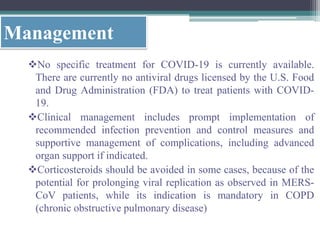
Management
No specific treatment for COVID-19 is currently available.
There are currently no antiviral drugs licensed by the U.S. Food
and Drug Administration (FDA) to treat patients with COVID-
19.
Clinical management includes prompt implementation of
recommended infection prevention and control measures and
supportive management of complications, including advanced
organ support if indicated.
Corticosteroids should be avoided in some cases, because of the
potential for prolonging viral replication as observed in MERS-
CoV patients, while its indication is mandatory in COPD
(chronic obstructive pulmonary disease)
Treatment
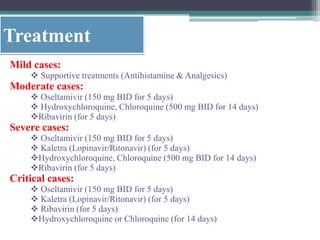
Mild cases:
 Supportive treatments (Antihistamine & Analgesics)
Moderate cases:
 Oseltamivir (150 mg BID for 5 days)
 Hydroxychloroquine, Chloroquine (500 mg BID for 14 days)
Ribavirin (for 5 days)
Severe cases:
 Oseltamivir (150 mg BID for 5 days)
 Kaletra (Lopinavir/Ritonavir) (for 5 days)
Hydroxychloroquine, Chloroquine (500 mg BID for 14 days)
Ribavirin (for 5 days)
Critical cases:
 Oseltamivir (150 mg BID for 5 days)
 Kaletra (Lopinavir/Ritonavir) (for 5 days)
 Ribavirin (for 5 days)
Hydroxychloroquine or Chloroquine (for 14 days)
Prevention
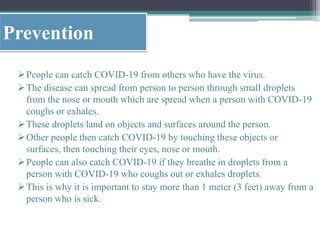
People can catch COVID-19 from others who have the virus.
The disease can spread from person to person through small droplets
from the nose or mouth which are spread when a person with COVID-19
coughs or exhales.
These droplets land on objects and surfaces around the person.
Other people then catch COVID-19 by touching these objects or
surfaces, then touching their eyes, nose or mouth.
People can also catch COVID-19 if they breathe in droplets from a
person with COVID-19 who coughs out or exhales droplets.
This is why it is important to stay more than 1 meter (3 feet) away from a
person who is sick.
Prevention
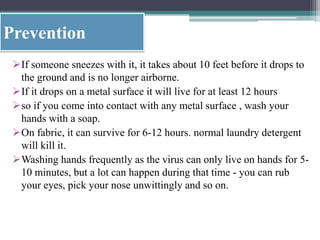
If someone sneezes with it, it takes about 10 feet before it drops to
the ground and is no longer airborne.
If it drops on a metal surface it will live for at least 12 hours
so if you come into contact with any metal surface , wash your
hands with a soap.
On fabric, it can survive for 6-12 hours. normal laundry detergent
will kill it.
Washing hands frequently as the virus can only live on hands for 5-
10 minutes, but a lot can happen during that time - you can rub
your eyes, pick your nose unwittingly and so on.
COVID-19 vaccine
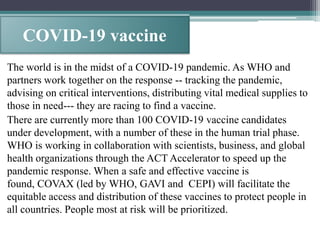
The world is in the midst of a COVID-19 pandemic. As WHO and
partners work together on the response -- tracking the pandemic,
advising on critical interventions, distributing vital medical supplies to
those in need--- they are racing to find a vaccine.
There are currently more than 100 COVID-19 vaccine candidates
under development, with a number of these in the human trial phase.
WHO is working in collaboration with scientists, business, and global
health organizations through the ACT Accelerator to speed up the
pandemic response. When a safe and effective vaccine is
found, COVAX (led by WHO, GAVI and CEPI) will facilitate the
equitable access and distribution of these vaccines to protect people in
all countries. People most at risk will be prioritized.
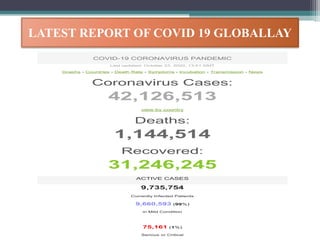
COVID-19 CORONAVIRUS PANDEMIC
Last updated: October 23, 2020, 13:51 GMT
Graphs - Countries - Death Rate - Symptoms - Incubation - Transmission - News
Coronavirus Cases:
42,126,513
view by country
Deaths:
1,144,514
Recovered:
31,246,245
ACTIVE CASES
9,735,754
Currently Infected Patients
9,660,593 (99%)
in Mild Condition
75,161 (1%)
Serious or Critical
LATEST REPORT OF COVID 19 GLOBALLAY
References:
1. Iraqi ministry of health COVID-19 guidelines
2. www.who.int/health-topics/coronavirus
3. Colombia secures COVID-19 vaccines through WHO/PAHO24 July 2020
4. https://www.who.int/news/item/15-07-2020-more-than-150-countries-engaged-in-covid-19-
vaccine-global-access-facility
5. https://www.who.int/news/item/15-07-2020-more-than-150-countries-engaged-in-covid-19-
vaccine-global-access-facility
6. https://www.who.int/health-topics/coronavirus
7. https://forum.facmedicine.com/threads/breaking-news-favilavir-approved-asexperimental-
coronavirus-drug.47832/
8. https://www.medscape.com
9. https://www.cdc.gov/coronavirus/2019-ncov/hcp/clinical-guidancemanagement-
patients.html
Covid 19

Covid 19

  • 1.
    COVID-19 Coronavirus disease Presented by: RashidAnwar BS Genetics University of swat
  • 2.
    HISTORY COVID-19 is oneof several emerging infectious disease outbreaks in recent decades with significant public health and economic impacts. The last of these were the influenza pandemics in 1957 and 1968, each killing more than a million people around the world. COVID-19, declared a pandemic by the World Health Organization (WHO) on 11th March,2002. And escalated worldwide, affecting over 2.5 million people in 185 countries, with over 187,000 deaths. While the world is still witnessing its spread, most countries are experiencing direct and indirect impacts of the global pandemic on their economy and society to varying degrees.
  • 3.
  • 4.
    Introduction Coronavirus: Coronaviruses (CoV) area large family of viruses that cause illness ranging from the common cold to more severe diseases such as Middle East Respiratory Syndrome (MERS-CoV) and Severe Acute Respiratory Syndrome (SARS-CoV). A novel coronavirus (nCoV) is a new strain that has not been previously identified in humans. Coronaviruses are zoonotic, meaning they are transmitted between animals and people. Detailed investigations found that SARS-CoV was transmitted from civet cats to humans and MERS-CoV from dromedary camels to humans. Several known coronaviruses are circulating in animals that have not yet infected humans.
  • 5.
  • 6.
    SARS-CoV-2 refers tosevere acute respiratory syndrome coronavirus 2 which was announced by ICTV (International Committee on Taxonomy of Viruses) as the name of the new virus on 11 February 2020. This name was chosen because the virus is genetically related to the coronavirus responsible for the SARS outbreak of 2003. While related, the two viruses are different. COVID-19 is the name of this new disease announced on 11 February 2020, following guidelines previously developed with the World Organisation for Animal Health (OIE) and the Food and Agriculture Organization of the United Nations.
  • 7.
    Clinical Features Incubation period:1-27 days Recovery time: 3 weeks to 6 weeks Frequently reported signs and symptoms of patients include:  Fever (77–98%)  Cough (46%–82%)  Myalgia or fatigue (11–52%)  Shortness of breath (3-31%)  Less commonly reported respiratory symptoms include sore throat, headache, cough with sputum production
  • 8.
    Diagnosis Travel history toendemic countries like (China, Iran & Italy) CBC (leukopenia, seen in 30% to 45% of patients, and lymphocytopenia, seen in 85% of the patients) Chest X-Ray (cheaper & easier with 60% sensitivity) PCR (30%-70% sensitivity) Chest CT Scan (95% sensitivity, low specificity) IgM/IgG combo test for COVID-19
  • 9.
    Specimen Collection Combined nasopharyngeal/oropharyngealswab If positive repeat every 3 days till negative If negative repeat second test after 24 hours If 2 consecutive negative isolation can be discontinued
  • 10.
    Classification Symptoms were categorizedas follows: Mild cases The majority (81%) of these coronavirus disease cases were mild cases include all patients without pneumonia or cases of mild pneumonia. Severe cases This includes patients who suffered from shortness of breath, respiratory frequency ≥ 30/minute Blood oxygen saturation ≤93%, PaO2/FiO2 ratio <300,30 and/or lung infiltrates >50% within 24–48 hours. Critical cases Include patients who suffered respiratory failure, septic shock, and/or multiple organ dysfunction or failure.
  • 11.
    Risk of Infection 1.The Case fertility rate (CFR) was 0.9% for those without a preexisting health condition & for young ages. 2. The CFR was 10% for those with underlying health conditions & for old ages. 3. Fulminant myocarditis has also been reported in patients with Covid-19 which is caused by virus. It arises quickly, progresses rapidly, and may lead to severe heart failure or circulatory failure presenting as rapid-onset hypotension and cardiogenic shock, with mortality rates as high as 50%–70%. 4. Physicians should pay attention not only to the symptoms of respiratory dysfunction but also the symptoms of cardiac injury.
  • 12.
    Management No specific treatmentfor COVID-19 is currently available. There are currently no antiviral drugs licensed by the U.S. Food and Drug Administration (FDA) to treat patients with COVID- 19. Clinical management includes prompt implementation of recommended infection prevention and control measures and supportive management of complications, including advanced organ support if indicated. Corticosteroids should be avoided in some cases, because of the potential for prolonging viral replication as observed in MERS- CoV patients, while its indication is mandatory in COPD (chronic obstructive pulmonary disease)
  • 13.
    Treatment Mild cases:  Supportivetreatments (Antihistamine & Analgesics) Moderate cases:  Oseltamivir (150 mg BID for 5 days)  Hydroxychloroquine, Chloroquine (500 mg BID for 14 days) Ribavirin (for 5 days) Severe cases:  Oseltamivir (150 mg BID for 5 days)  Kaletra (Lopinavir/Ritonavir) (for 5 days) Hydroxychloroquine, Chloroquine (500 mg BID for 14 days) Ribavirin (for 5 days) Critical cases:  Oseltamivir (150 mg BID for 5 days)  Kaletra (Lopinavir/Ritonavir) (for 5 days)  Ribavirin (for 5 days) Hydroxychloroquine or Chloroquine (for 14 days)
  • 14.
    Prevention People can catchCOVID-19 from others who have the virus. The disease can spread from person to person through small droplets from the nose or mouth which are spread when a person with COVID-19 coughs or exhales. These droplets land on objects and surfaces around the person. Other people then catch COVID-19 by touching these objects or surfaces, then touching their eyes, nose or mouth. People can also catch COVID-19 if they breathe in droplets from a person with COVID-19 who coughs out or exhales droplets. This is why it is important to stay more than 1 meter (3 feet) away from a person who is sick.
  • 15.
    Prevention If someone sneezeswith it, it takes about 10 feet before it drops to the ground and is no longer airborne. If it drops on a metal surface it will live for at least 12 hours so if you come into contact with any metal surface , wash your hands with a soap. On fabric, it can survive for 6-12 hours. normal laundry detergent will kill it. Washing hands frequently as the virus can only live on hands for 5- 10 minutes, but a lot can happen during that time - you can rub your eyes, pick your nose unwittingly and so on.
  • 16.
    COVID-19 vaccine The worldis in the midst of a COVID-19 pandemic. As WHO and partners work together on the response -- tracking the pandemic, advising on critical interventions, distributing vital medical supplies to those in need--- they are racing to find a vaccine. There are currently more than 100 COVID-19 vaccine candidates under development, with a number of these in the human trial phase. WHO is working in collaboration with scientists, business, and global health organizations through the ACT Accelerator to speed up the pandemic response. When a safe and effective vaccine is found, COVAX (led by WHO, GAVI and CEPI) will facilitate the equitable access and distribution of these vaccines to protect people in all countries. People most at risk will be prioritized.
  • 17.
    COVID-19 CORONAVIRUS PANDEMIC Lastupdated: October 23, 2020, 13:51 GMT Graphs - Countries - Death Rate - Symptoms - Incubation - Transmission - News Coronavirus Cases: 42,126,513 view by country Deaths: 1,144,514 Recovered: 31,246,245 ACTIVE CASES 9,735,754 Currently Infected Patients 9,660,593 (99%) in Mild Condition 75,161 (1%) Serious or Critical LATEST REPORT OF COVID 19 GLOBALLAY
  • 18.
    References: 1. Iraqi ministryof health COVID-19 guidelines 2. www.who.int/health-topics/coronavirus 3. Colombia secures COVID-19 vaccines through WHO/PAHO24 July 2020 4. https://www.who.int/news/item/15-07-2020-more-than-150-countries-engaged-in-covid-19- vaccine-global-access-facility 5. https://www.who.int/news/item/15-07-2020-more-than-150-countries-engaged-in-covid-19- vaccine-global-access-facility 6. https://www.who.int/health-topics/coronavirus 7. https://forum.facmedicine.com/threads/breaking-news-favilavir-approved-asexperimental- coronavirus-drug.47832/ 8. https://www.medscape.com 9. https://www.cdc.gov/coronavirus/2019-ncov/hcp/clinical-guidancemanagement- patients.html