


Prof. Dr. Saad S Al Ani
Senior Pediatric Consultant
Head of Pediatric Department
Khorfakkan Hospital
Sharjah ,UAE
aliarqialani@gmail.com
High Lights
On
Pulmonary Tuberculosis
To Diagnose Tuberculosis
 Order appropriate diagnostic
tests
12/01/2019
HighlightsonPulmonarytuberculosis
Prof.Dr.SaadSAlAni
2
‘ The first rule of TH diagnosis :
Is to think of TB…….’
 Include TB in your differential
diagnosis when history ,
symptoms are consistent with TB
diagnosis
Decreases cough reflex
Injury to the cilia
Decreased function of alveolar
macrophages
Presence of edema or congestion
Retention of secretions
12/01/2019
HighlightsonPulmonarytuberculosis
Prof.Dr.SaadSAlAni
3
Pulmonary infections
Predisposing factors
Primary
1. Single granuloma within
paranchyma and hilar lymph nodes
(Ghon complex)
2. Infection does not progress
(most common)
3. Progressive primary pneumonia ,
Miliary dissemination (Blood stream)
12/01/2019
HighlightsonPulmonarytuberculosis
Prof.Dr.SaadSAlAni
4
Pulmonary Tuberculosis
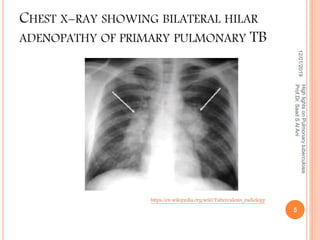
CHEST X-RAY SHOWING BILATERAL HILAR
ADENOPATHY OF PRIMARY PULMONARY TB
12/01/2019
HighlightsonPulmonarytuberculosis
Prof.Dr.SaadSAlAni
5
https://en.wikipedia.org/wiki/Tuberculosis_radiology
• Secondary
 Infection ( mostly through reactivation)
in a previously sensitized individual
 Pathology
Cavitary fibrocaseous lesions
 Bronchopneumonia
 Miliary TB
12/01/2019
HighlightsonPulmonarytuberculosis
Prof.Dr.SaadSAlAni
6
Pulmonary Tuberculosis
Typical Progression of
Pulmonary Tuberculosis
12/01/2019
7
HighlightsonPulmonarytuberculosis
Prof.Dr.SaadSAlAni
Pneumonia
Granuloma formation with fibrosis
Caseous necrosis
Calcification
Cavity formation
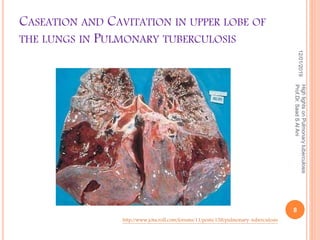
CASEATION AND CAVITATION IN UPPER LOBE OF
THE LUNGS IN PULMONARY TUBERCULOSIS
12/01/2019
8
HighlightsonPulmonarytuberculosis
Prof.Dr.SaadSAlAni
http://www.jotscroll.com/forums/11/posts/158/pulmonary-tuberculosis
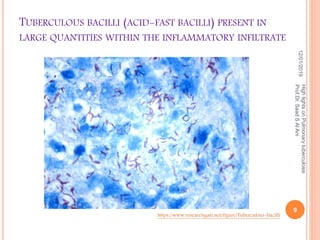
TUBERCULOUS BACILLI (ACID-FAST BACILLI) PRESENT IN
LARGE QUANTITIES WITHIN THE INFLAMMATORY INFILTRATE
12/01/2019
9
HighlightsonPulmonarytuberculosis
Prof.Dr.SaadSAlAni
https://www.researchgate.net/figure/Tuberculous-bacilli
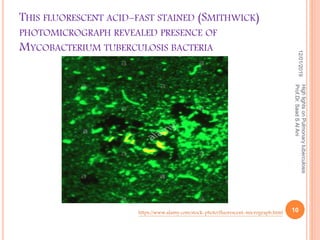
THIS FLUORESCENT ACID-FAST STAINED (SMITHWICK)
PHOTOMICROGRAPH REVEALED PRESENCE OF
MYCOBACTERIUM TUBERCULOSIS BACTERIA
12/01/2019
10
HighlightsonPulmonarytuberculosis
Prof.Dr.SaadSAlAni
https://www.alamy.com/stock-photo/fluorescent-micrograph.html
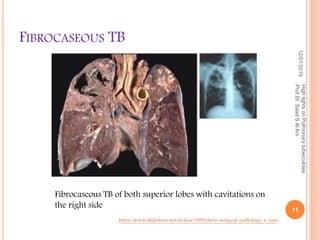
FIBROCASEOUS TB
12/01/2019
11
HighlightsonPulmonarytuberculosis
Prof.Dr.SaadSAlAni
https://www.slideshare.net/mohaa1989/chest-surgical-pathology-x-rays
Fibrocaseous TB of both superior lobes with cavitations on
the right side
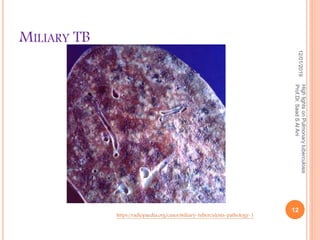
MILIARY TB
12/01/2019
12
HighlightsonPulmonarytuberculosis
Prof.Dr.SaadSAlAni
https://radiopaedia.org/cases/miliary-tuberculosis-pathology-1
GRANULOMA
12/01/2019
13
HighlightsonPulmonarytuberculosis
Prof.Dr.SaadSAlAni
https://www.researchgate.net/figure/Typical-architecture-of-a-TB-granuloma
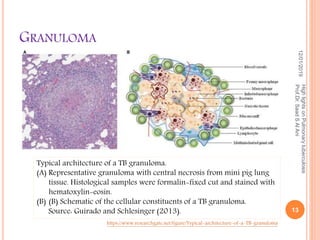
Typical architecture of a TB granuloma.
(A) Representative granuloma with central necrosis from mini pig lung
tissue. Histological samples were formalin-fixed cut and stained with
hematoxylin-eosin.
(B) (B) Schematic of the cellular constituents of a TB granuloma.
Source: Guirado and Schlesinger (2013).
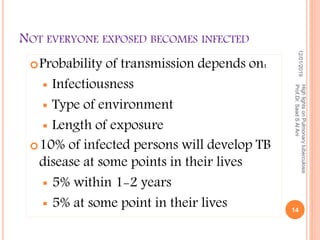
NOT EVERYONE EXPOSED BECOMES INFECTED
Probability of transmission depends on:
 Infectiousness
 Type of environment
 Length of exposure
10% of infected persons will develop TB
disease at some points in their lives
 5% within 1-2 years
 5% at some point in their lives
12/01/2019
14
HighlightsonPulmonarytuberculosis
Prof.Dr.SaadSAlAni
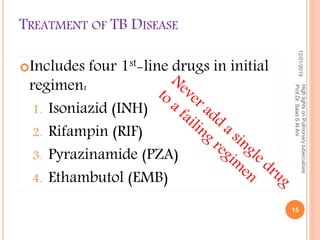
TREATMENT OF TB DISEASE
Includes four 1st-line drugs in initial
regimen:
1. Isoniazid (INH)
2. Rifampin (RIF)
3. Pyrazinamide (PZA)
4. Ethambutol (EMB)
12/01/2019
15
HighlightsonPulmonarytuberculosis
Prof.Dr.SaadSAlAni
BARRIERS TO ADHERENCE
Stigma
Extensive duration of a treatment
Adverse reactions to medications
Concerns of toxicity
Lack of knowledge about TB and its
treatment
12/01/2019
16
HighlightsonPulmonarytuberculosis
Prof.Dr.SaadSAlAni
IMPROVING ADHERENCE
Adherence is the responsibility of the
provider, NOT the patient and can be
ensured by:
 Patient education
 Directly Observed Therapy (DOT)
 Case management
 Incentives / enablers
12/01/2019
17
HighlightsonPulmonarytuberculosis
Prof.Dr.SaadSAlAni
DIRECTLY OBSERVED THERAPY (DOT)
Health care worker watches the patient
swallows each dose of medication
DOT is the best way to ensure
adherence
Should be used with all intermittent
regimen
12/01/2019
18
HighlightsonPulmonarytuberculosis
Prof.Dr.SaadSAlAni
‘A decision to test
is
A decision to treat’
12/01/2019
19
HighlightsonPulmonarytuberculosis
Prof.Dr.SaadSAlAni
http://worldartsme.com/remember-faces-clipart.html#
REFERENCES
12/01/2019
HighlightsonPulmonarytuberculosis
Prof.Dr.SaadSAlAni
20
1. https://en.wikipedia.org/wiki/Tuberculosis_radiology
2. http://www.jotscroll.com/forums/11/posts/158/pulmonary-tuberculosis
3. https://www.researchgate.net/figure/Tuberculous-bacilli
4. https://www.alamy.com/stock-photo/fluorescent-micrograph.html
5. https://www.slideshare.net/mohaa1989/chest-surgical-pathology-x-rays
6. https://radiopaedia.org/cases/miliary-tuberculosis-pathology-1
7. https://www.researchgate.net/figure/Typical-architecture-of-a-TB-granuloma
12/01/2019
21
HighlightsonPulmonarytuberculosis
Prof.Dr.SaadSAlAni

High lights on pulmonary tuberculosis