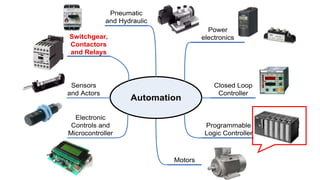
Automation
Power
electronics
Closed Loop
Controller
Sensors
and Actors
Switchgear,
Contactors
and Relays
Pneumatic
and Hydraulic
Electronic
Controls and
Microcontroller
Motors
Programmable
Logic Controller
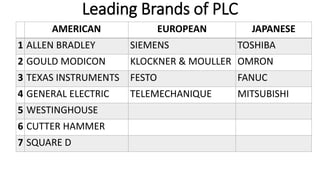
Leading Brands of PLC
AMERICAN EUROPEAN JAPANESE
1 ALLEN BRADLEY SIEMENS TOSHIBA
2 GOULD MODICON KLOCKNER & MOULLER OMRON
3 TEXAS INSTRUMENTS FESTO FANUC
4 GENERAL ELECTRIC TELEMECHANIQUE MITSUBISHI
5 WESTINGHOUSE
6 CUTTER HAMMER
7 SQUARE D
PLC Programing Software’s
1. Velocio Software
2. Siemens Software
3. Rockwell Automation (Allen-Bradley)
Software
4. Schneider Software
5. Mitsubishi Software
6. Modicon Software
7. Panasonic Software
8. Keyence Software
9. Telemecanique Software
10. Beckhoff Software
11. GE Software
12. Automation Direct Software
13. IDEC Software
14. Opto22 Software
15. Omron Software
16. Sirea Software
17. VIPA Software
18. Triangle Research International Software
19. SPLAT Software
20. Smart Software Solutions
21. LSIS Software
22. Control Microsystems Software
23. Teco Software
24. Unitronics Software
25. ABB Software
26. Horner APG Software
27. Crouzet Software
28. Xinje Software
29. Entertron Software
30. Delta Electronics Software
PLC Communications
Manufacturer Network
1 Allen-Bradley Data Highway
2 Gould Modicon Modbus
3 General Electric GE Net Factory LAN
4 Mitsubishi Melsec-NET
5 Square D SY/NET
6 Texas Instruments TIWAY
PLC Acronyms
ASCII American Standard Code for Information Interchange
BCD Binary Coded Decimal
CSA Canadian Standards Association
DIO Distributed I/O
EIA Electronic Industries Association
EMI ElectroMagnetic Interference
HMI Human Machine Interface
IEC International Electrotechnical Commission
IEEE Institute of Electrical and Electronic Engineers
I/O Input(s) and/or Output(s)
ISO International Standards Organization
LL Ladder Logic
LSB Least Significant Bit
MMI Man Machine Interface
MODICON MOdular DIgital CONtoller
MSB Most Significant Bit
PID Proportional Integral Derivative (feedback control)
RF Radio Frequency
RIO Remote I/O
RTU Remote Terminal Unit
SCADA
Supervisory Control And Data Acquisition
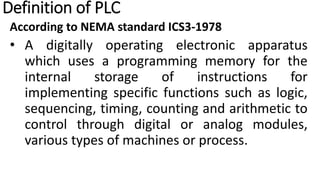
Definition of PLC
According to NEMA standard ICS3-1978
• A digitally operating electronic apparatus
which uses a programming memory for the
internal storage of instructions for
implementing specific functions such as logic,
sequencing, timing, counting and arithmetic to
control through digital or analog modules,
various types of machines or process.
Areas of PLC Applications
• Annunciators
• Injection Molding
• Auto Insertion
• Assembly
• Bagging
• Motor Winding
• Baking
• Oil Fields
• Blending
• Painting
• Boring
• Palletizers
• Brewing
• Pipelines
• Calendaring
• Polishing
• Casting
• Reactors
• Chemical Drilling
• Robots
• Color Mixing
• Rolling
• Compressors
• Security Systems
• Conveyors
• Stretch Wrap
• Cranes
• Slitting
• Crushing
• Sorting
• Cutting
• Stackers
• Digesters
• Stitching
• Drilling
• Stack Precipitators
• Electronic Testing
• Threading
• Elevators
• Tire Building
• Engine Test Stands
• Traffic Control
• Extrusion
• Textile Machine
• Forging
• Turbines
• Generators
• Turning
• Gluing
• Weaving
• Grinding
• Web Handling
• Heat Treating
• Welding
• Manufacturing/
Machining
• Food / Beverage
• Metals
• Power
• Mining
• Petrochemical/Chemi
cal
PLC in industry
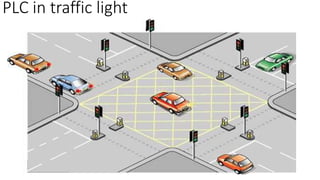
PLC in traffic light
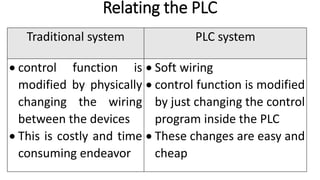
Relating the PLC
Traditional system PLC system
 control function is
modified by physically
changing the wiring
between the devices
 This is costly and time
consuming endeavor
 Soft wiring
 control function is modified
by just changing the control
program inside the PLC
 These changes are easy and
cheap
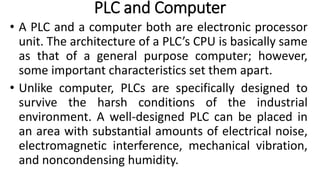
PLC and Computer
• A PLC and a computer both are electronic processor
unit. The architecture of a PLC’s CPU is basically same
as that of a general purpose computer; however,
some important characteristics set them apart.
• Unlike computer, PLCs are specifically designed to
survive the harsh conditions of the industrial
environment. A well-designed PLC can be placed in
an area with substantial amounts of electrical noise,
electromagnetic interference, mechanical vibration,
and noncondensing humidity.
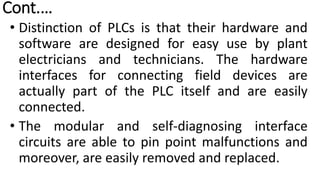
Cont.…
• Distinction of PLCs is that their hardware and
software are designed for easy use by plant
electricians and technicians. The hardware
interfaces for connecting field devices are
actually part of the PLC itself and are easily
connected.
• The modular and self-diagnosing interface
circuits are able to pin point malfunctions and
moreover, are easily removed and replaced.
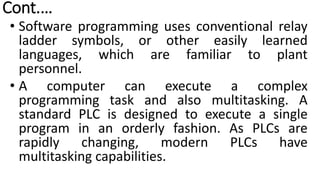
Cont.…
• Software programming uses conventional relay
ladder symbols, or other easily learned
languages, which are familiar to plant
personnel.
• A computer can execute a complex
programming task and also multitasking. A
standard PLC is designed to execute a single
program in an orderly fashion. As PLCs are
rapidly changing, modern PLCs have
multitasking capabilities.
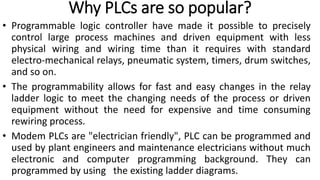
Why PLCs are so popular?
• Programmable logic controller have made it possible to precisely
control large process machines and driven equipment with less
physical wiring and wiring time than it requires with standard
electro-mechanical relays, pneumatic system, timers, drum switches,
and so on.
• The programmability allows for fast and easy changes in the relay
ladder logic to meet the changing needs of the process or driven
equipment without the need for expensive and time consuming
rewiring process.
• Modem PLCs are "electrician friendly", PLC can be programmed and
used by plant engineers and maintenance electricians without much
electronic and computer programming background. They can
programmed by using the existing ladder diagrams.
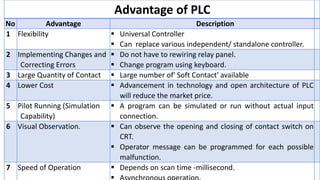
Advantage of PLC
No Advantage Description
1 Flexibility  Universal Controller
 Can replace various independent/ standalone controller.
2 Implementing Changes and
Correcting Errors
 Do not have to rewiring relay panel.
 Change program using keyboard.
3 Large Quantity of Contact  Large number of' Soft Contact' available
4 Lower Cost  Advancement in technology and open architecture of PLC
will reduce the market price.
5 Pilot Running (Simulation
Capability)
 A program can be simulated or run without actual input
connection.
6 Visual Observation.  Can observe the opening and closing of contact switch on
CRT.
 Operator message can be programmed for each possible
malfunction.
7 Speed of Operation  Depends on scan time -millisecond.
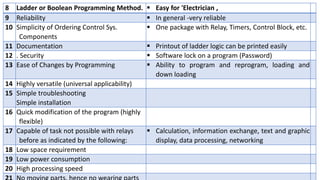
8 Ladder or Boolean Programming Method.  Easy for 'Electrician ,
9 Reliability  In general -very reliable
10 Simplicity of Ordering Control Sys.
Components
 One package with Relay, Timers, Control Block, etc.
11 Documentation  Printout of ladder logic can be printed easily
12 . Security  Software lock on a program (Password)
13 Ease of Changes by Programming  Ability to program and reprogram, loading and
down loading
14 Highly versatile (universal applicability)
15 Simple troubleshooting
Simple installation
16 Quick modification of the program (highly
flexible)
17 Capable of task not possible with relays
before as indicated by the following:
 Calculation, information exchange, text and graphic
display, data processing, networking
18 Low space requirement
19 Low power consumption
20 High processing speed
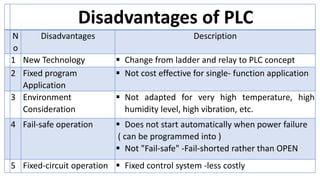
Disadvantages of PLC
N
o
Disadvantages Description
1 New Technology  Change from ladder and relay to PLC concept
2 Fixed program
Application
 Not cost effective for single- function application
3 Environment
Consideration
 Not adapted for very high temperature, high
humidity level, high vibration, etc.
4 Fail-safe operation  Does not start automatically when power failure
( can be programmed into )
 Not "Fail-safe" -Fail-shorted rather than OPEN
5 Fixed-circuit operation  Fixed control system -less costly
What Is Inside A PLC?
Cont.…
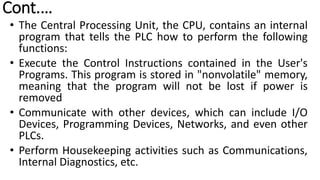
• The Central Processing Unit, the CPU, contains an internal
program that tells the PLC how to perform the following
functions:
• Execute the Control Instructions contained in the User's
Programs. This program is stored in "nonvolatile" memory,
meaning that the program will not be lost if power is
removed
• Communicate with other devices, which can include I/O
Devices, Programming Devices, Networks, and even other
PLCs.
• Perform Housekeeping activities such as Communications,
Internal Diagnostics, etc.
How Does A PLC Operate?
• There are four basic steps in the operation of all PLCs; Input Scan, Program
Scan, Output Scan, and Housekeeping. These steps continually take place in
a repeating loop.
1. Input Scan • Detects the state of all input
devices that are connected to the
PLC
2.Program Scan • Executes the user created program
logic
3. Output Scan • Energizes or de-energize all output
devices that are connected to the
PLC.
4.Housekeeping • This step includes communications
with programming terminals,
internal diagnostics, etc...
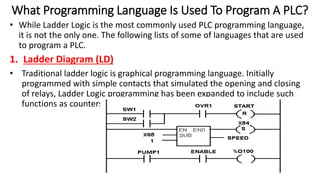
What Programming Language Is Used To Program A PLC?
• While Ladder Logic is the most commonly used PLC programming language,
it is not the only one. The following lists of some of languages that are used
to program a PLC.
1. Ladder Diagram (LD)
• Traditional ladder logic is graphical programming language. Initially
programmed with simple contacts that simulated the opening and closing
of relays, Ladder Logic programming has been expanded to include such
functions as counters, timers, shift registers, and math operations.
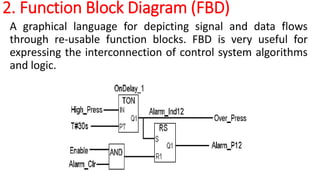
2. Function Block Diagram (FBD)
A graphical language for depicting signal and data flows
through re-usable function blocks. FBD is very useful for
expressing the interconnection of control system algorithms
and logic.
3. Structured Text (ST)
A high level text language that encourages structured
programming. It has a language structure (syntax) that
strongly resembles PASCAL and supports a wide range of
standard functions and operators. For example;
If Speed1 > 100.0 then
Flow_Rate: = 50.0 + Offset_A1;
Else
Flow_Rate: = 100.0; Steam: = ON
End_If;
4. Instruction List (IL)
A low level “assembler like” language that is based on
similar instructions list languages found in a wide
range of today’s PLCs.
LD
MPC
LD
ST
RESET:
ST
R1
RESET
PRESS_1
MAX_PRESS
LD 0
A_X43
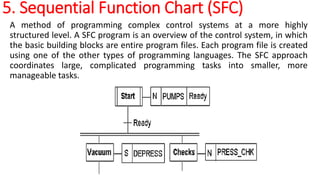
5. Sequential Function Chart (SFC)
A method of programming complex control systems at a more highly
structured level. A SFC program is an overview of the control system, in which
the basic building blocks are entire program files. Each program file is created
using one of the other types of programming languages. The SFC approach
coordinates large, complicated programming tasks into smaller, more
manageable tasks.
Input device
1. Switches and Pushbuttons
2. Sensing Devices
• Limit Switches
• Photoelectric Sensors
• Proximity Sensors
3. Condition Sensors
4. Encoders
• Pressure Switches
• Level Switches
• Temperature Switches
• Vacuum Switches
• Float Switches
OUTPUTS
• Valves
• Motor Starters
• Solenoids
• Actuators
• Horns and Alarms
• Stack lights
• Control Relays
• Counter/Totalizer
• Pumps
• Printers
• Fans

plc ICS_PLC_Integration_Tools ICS_PLC_Integration_Tools.pptx

  • 2.
    Automation Power electronics Closed Loop Controller Sensors and Actors Switchgear, Contactors andRelays Pneumatic and Hydraulic Electronic Controls and Microcontroller Motors Programmable Logic Controller
  • 3.
    Leading Brands ofPLC AMERICAN EUROPEAN JAPANESE 1 ALLEN BRADLEY SIEMENS TOSHIBA 2 GOULD MODICON KLOCKNER & MOULLER OMRON 3 TEXAS INSTRUMENTS FESTO FANUC 4 GENERAL ELECTRIC TELEMECHANIQUE MITSUBISHI 5 WESTINGHOUSE 6 CUTTER HAMMER 7 SQUARE D
  • 4.
    PLC Programing Software’s 1.Velocio Software 2. Siemens Software 3. Rockwell Automation (Allen-Bradley) Software 4. Schneider Software 5. Mitsubishi Software 6. Modicon Software 7. Panasonic Software 8. Keyence Software 9. Telemecanique Software 10. Beckhoff Software 11. GE Software 12. Automation Direct Software 13. IDEC Software 14. Opto22 Software 15. Omron Software 16. Sirea Software 17. VIPA Software 18. Triangle Research International Software 19. SPLAT Software 20. Smart Software Solutions 21. LSIS Software 22. Control Microsystems Software 23. Teco Software 24. Unitronics Software 25. ABB Software 26. Horner APG Software 27. Crouzet Software 28. Xinje Software 29. Entertron Software 30. Delta Electronics Software
  • 5.
    PLC Communications Manufacturer Network 1Allen-Bradley Data Highway 2 Gould Modicon Modbus 3 General Electric GE Net Factory LAN 4 Mitsubishi Melsec-NET 5 Square D SY/NET 6 Texas Instruments TIWAY
  • 6.
    PLC Acronyms ASCII AmericanStandard Code for Information Interchange BCD Binary Coded Decimal CSA Canadian Standards Association DIO Distributed I/O EIA Electronic Industries Association EMI ElectroMagnetic Interference HMI Human Machine Interface IEC International Electrotechnical Commission IEEE Institute of Electrical and Electronic Engineers I/O Input(s) and/or Output(s) ISO International Standards Organization LL Ladder Logic LSB Least Significant Bit MMI Man Machine Interface MODICON MOdular DIgital CONtoller MSB Most Significant Bit PID Proportional Integral Derivative (feedback control) RF Radio Frequency RIO Remote I/O RTU Remote Terminal Unit SCADA Supervisory Control And Data Acquisition
  • 7.
    Definition of PLC Accordingto NEMA standard ICS3-1978 • A digitally operating electronic apparatus which uses a programming memory for the internal storage of instructions for implementing specific functions such as logic, sequencing, timing, counting and arithmetic to control through digital or analog modules, various types of machines or process.
  • 8.
    Areas of PLCApplications • Annunciators • Injection Molding • Auto Insertion • Assembly • Bagging • Motor Winding • Baking • Oil Fields • Blending • Painting • Boring • Palletizers • Brewing • Pipelines • Calendaring • Polishing • Casting • Reactors • Chemical Drilling • Robots • Color Mixing • Rolling • Compressors • Security Systems • Conveyors • Stretch Wrap • Cranes • Slitting • Crushing • Sorting • Cutting • Stackers • Digesters • Stitching • Drilling • Stack Precipitators • Electronic Testing • Threading • Elevators • Tire Building • Engine Test Stands • Traffic Control • Extrusion • Textile Machine • Forging • Turbines • Generators • Turning • Gluing • Weaving • Grinding • Web Handling • Heat Treating • Welding • Manufacturing/ Machining • Food / Beverage • Metals • Power • Mining • Petrochemical/Chemi cal
  • 9.
  • 10.
  • 11.
    Relating the PLC Traditionalsystem PLC system  control function is modified by physically changing the wiring between the devices  This is costly and time consuming endeavor  Soft wiring  control function is modified by just changing the control program inside the PLC  These changes are easy and cheap
  • 12.
    PLC and Computer •A PLC and a computer both are electronic processor unit. The architecture of a PLC’s CPU is basically same as that of a general purpose computer; however, some important characteristics set them apart. • Unlike computer, PLCs are specifically designed to survive the harsh conditions of the industrial environment. A well-designed PLC can be placed in an area with substantial amounts of electrical noise, electromagnetic interference, mechanical vibration, and noncondensing humidity.
  • 13.
    Cont.… • Distinction ofPLCs is that their hardware and software are designed for easy use by plant electricians and technicians. The hardware interfaces for connecting field devices are actually part of the PLC itself and are easily connected. • The modular and self-diagnosing interface circuits are able to pin point malfunctions and moreover, are easily removed and replaced.
  • 14.
    Cont.… • Software programminguses conventional relay ladder symbols, or other easily learned languages, which are familiar to plant personnel. • A computer can execute a complex programming task and also multitasking. A standard PLC is designed to execute a single program in an orderly fashion. As PLCs are rapidly changing, modern PLCs have multitasking capabilities.
  • 15.
    Why PLCs areso popular? • Programmable logic controller have made it possible to precisely control large process machines and driven equipment with less physical wiring and wiring time than it requires with standard electro-mechanical relays, pneumatic system, timers, drum switches, and so on. • The programmability allows for fast and easy changes in the relay ladder logic to meet the changing needs of the process or driven equipment without the need for expensive and time consuming rewiring process. • Modem PLCs are "electrician friendly", PLC can be programmed and used by plant engineers and maintenance electricians without much electronic and computer programming background. They can programmed by using the existing ladder diagrams.
  • 17.
    Advantage of PLC NoAdvantage Description 1 Flexibility  Universal Controller  Can replace various independent/ standalone controller. 2 Implementing Changes and Correcting Errors  Do not have to rewiring relay panel.  Change program using keyboard. 3 Large Quantity of Contact  Large number of' Soft Contact' available 4 Lower Cost  Advancement in technology and open architecture of PLC will reduce the market price. 5 Pilot Running (Simulation Capability)  A program can be simulated or run without actual input connection. 6 Visual Observation.  Can observe the opening and closing of contact switch on CRT.  Operator message can be programmed for each possible malfunction. 7 Speed of Operation  Depends on scan time -millisecond.
  • 18.
    8 Ladder orBoolean Programming Method.  Easy for 'Electrician , 9 Reliability  In general -very reliable 10 Simplicity of Ordering Control Sys. Components  One package with Relay, Timers, Control Block, etc. 11 Documentation  Printout of ladder logic can be printed easily 12 . Security  Software lock on a program (Password) 13 Ease of Changes by Programming  Ability to program and reprogram, loading and down loading 14 Highly versatile (universal applicability) 15 Simple troubleshooting Simple installation 16 Quick modification of the program (highly flexible) 17 Capable of task not possible with relays before as indicated by the following:  Calculation, information exchange, text and graphic display, data processing, networking 18 Low space requirement 19 Low power consumption 20 High processing speed
  • 19.
    Disadvantages of PLC N o DisadvantagesDescription 1 New Technology  Change from ladder and relay to PLC concept 2 Fixed program Application  Not cost effective for single- function application 3 Environment Consideration  Not adapted for very high temperature, high humidity level, high vibration, etc. 4 Fail-safe operation  Does not start automatically when power failure ( can be programmed into )  Not "Fail-safe" -Fail-shorted rather than OPEN 5 Fixed-circuit operation  Fixed control system -less costly
  • 20.
  • 21.
    Cont.… • The CentralProcessing Unit, the CPU, contains an internal program that tells the PLC how to perform the following functions: • Execute the Control Instructions contained in the User's Programs. This program is stored in "nonvolatile" memory, meaning that the program will not be lost if power is removed • Communicate with other devices, which can include I/O Devices, Programming Devices, Networks, and even other PLCs. • Perform Housekeeping activities such as Communications, Internal Diagnostics, etc.
  • 22.
    How Does APLC Operate? • There are four basic steps in the operation of all PLCs; Input Scan, Program Scan, Output Scan, and Housekeeping. These steps continually take place in a repeating loop. 1. Input Scan • Detects the state of all input devices that are connected to the PLC 2.Program Scan • Executes the user created program logic 3. Output Scan • Energizes or de-energize all output devices that are connected to the PLC. 4.Housekeeping • This step includes communications with programming terminals, internal diagnostics, etc...
  • 23.
    What Programming LanguageIs Used To Program A PLC? • While Ladder Logic is the most commonly used PLC programming language, it is not the only one. The following lists of some of languages that are used to program a PLC. 1. Ladder Diagram (LD) • Traditional ladder logic is graphical programming language. Initially programmed with simple contacts that simulated the opening and closing of relays, Ladder Logic programming has been expanded to include such functions as counters, timers, shift registers, and math operations.
  • 24.
    2. Function BlockDiagram (FBD) A graphical language for depicting signal and data flows through re-usable function blocks. FBD is very useful for expressing the interconnection of control system algorithms and logic.
  • 25.
    3. Structured Text(ST) A high level text language that encourages structured programming. It has a language structure (syntax) that strongly resembles PASCAL and supports a wide range of standard functions and operators. For example; If Speed1 > 100.0 then Flow_Rate: = 50.0 + Offset_A1; Else Flow_Rate: = 100.0; Steam: = ON End_If;
  • 26.
    4. Instruction List(IL) A low level “assembler like” language that is based on similar instructions list languages found in a wide range of today’s PLCs. LD MPC LD ST RESET: ST R1 RESET PRESS_1 MAX_PRESS LD 0 A_X43
  • 27.
    5. Sequential FunctionChart (SFC) A method of programming complex control systems at a more highly structured level. A SFC program is an overview of the control system, in which the basic building blocks are entire program files. Each program file is created using one of the other types of programming languages. The SFC approach coordinates large, complicated programming tasks into smaller, more manageable tasks.
  • 29.
    Input device 1. Switchesand Pushbuttons 2. Sensing Devices • Limit Switches • Photoelectric Sensors • Proximity Sensors 3. Condition Sensors 4. Encoders • Pressure Switches • Level Switches • Temperature Switches • Vacuum Switches • Float Switches
  • 30.
    OUTPUTS • Valves • MotorStarters • Solenoids • Actuators • Horns and Alarms • Stack lights • Control Relays • Counter/Totalizer • Pumps • Printers • Fans