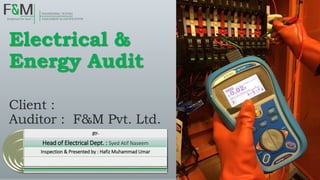
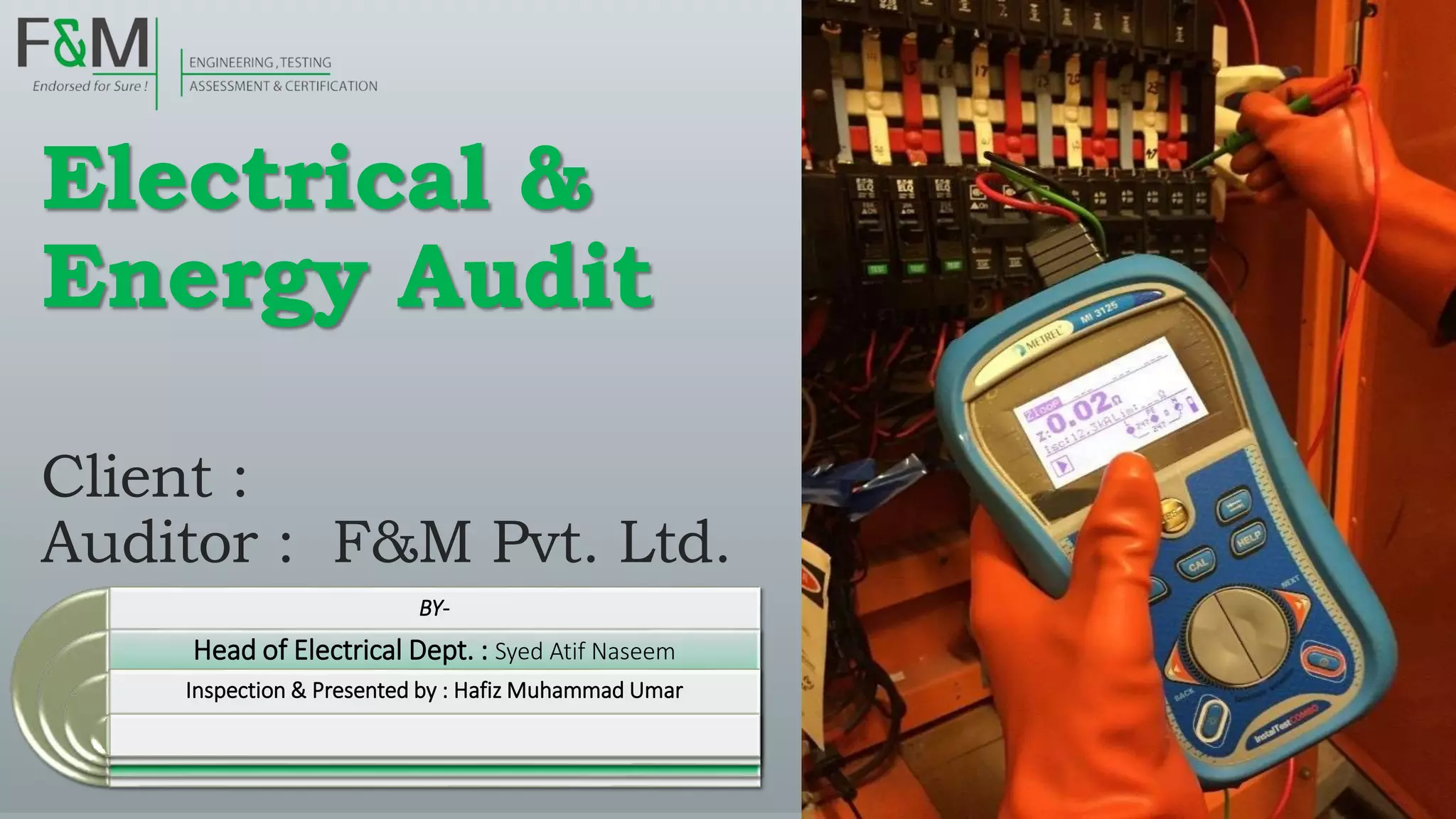
Electrical &
Energy Audit
Client :
Auditor : F&M Pvt. Ltd.
BY-
Head of Electrical Dept. : Syed Atif Naseem
Inspection & Presented by : Hafiz Muhammad Umar
F&M Pvt. Ltd.
Introduction
“F&M was established with the aim to provide one window solutions for the Industries of Pakistan with
respect to international codes and standards, quality, and integrity. We are committed and determined
to deliver innovative services and solutions that will assist our customers to accomplish their goals.”
MANAGING DIRECTOR: SYED FARUKH MAZHAR
Electrical Audit
Electrical Audit & Standard
“An electrical audit is completed at an industry or commercial building to determine its electrical
efficiency. Simply put, electrical efficiency means using less energy to do the same job. The audit will
provide you with complete electricity consumption and electrical efficiency assessment.”
Standard that we follow:
•IEC 61439, 60364-6 (Visual Inspection / Earthing)
•NFPA 70 E (Electrical Safety Audit)
•ASTM E 1934/37 (Thermography)
•BS-767 (Load Management)
•NETA/ANSI (Insulation Resistance Test)
“Visual Inspection”
Visual inspection of MD’S is conducted based on IEC 61439, 60364-6
Observations
•SMDB-1-B must be maintained / rectify on urgent basis.
•Cable tray must be cover properly.
•MDB-10, SMDB-12, MDB-14, SMDB-19 and
SMDB-1-B are critical DB’s
Recommendations
These DBs need to rectify on an urgent basis.
“Earth Testing”
“Earthing audit is conducted to ensures the good health of the complete Earthing system. It is imperative that
the Earthing system is inspected periodically to ensure efficiency.
Observations
• Earthing required in Electrical Panels.
• More than 5 ohms resistance of earth found on various DB’S.
• Total of 26 DBs were not lying in an acceptable range
•Recommendations.
Need to rectify the earthing issue as early as possible.
“Thermography”
“Thermography is the process of using an infrared camera to look for abnormally hot or cold areas on a
component operating under normal conditions. It is a viable nondestructive evaluation technique and is the
simplest of all thermal inspection techniques”.
Observations
• 5 DB’s are lying in Moderate category which are unsatisfactory.
• DB’s have overloaded circuits & equipment.
• Due to looseness or overload of circuit, Electrical Fire can erupt.
Recommendation
5*DB lies in Moderate category.
It is requires to shift the load on particular DB’s in order to
lower the temperature in a safe zone.
“Lux Calculation”
“Lighting systems present opportunities to reduce electric cost. Lighting systems include all the equipment
required for the provision of, offices area, Corridor, Lift Area, etc. including fixtures and luminaries for light
distribution of the light source and associated controls.”.
Observations
• Lux level at few locations is greater than the standard value, so it is
recommended to reduce Lux level
•Recommendation
Near lift the lux value is greater than the required value so it is recommended to
reduce lux level.
Energy Audit
“Analysis”
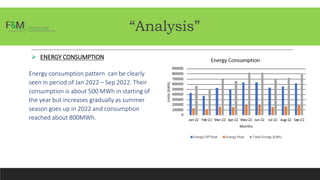
 ENERGY CONSUMPTION
Energy consumption pattern can be clearly
seen in period of Jan 2022 – Sep 2022. Their
consumption is about 500 MWh in starting of
the year but increases gradually as summer
season goes up in 2022 and consumption
reached about 800MWh.
“Analysis”
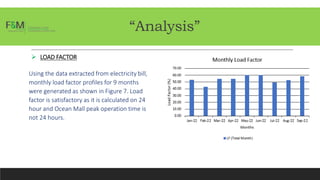
 LOAD FACTOR
Using the data extracted from electricity bill,
monthly load factor profiles for 9 months
were generated as shown in Figure 7. Load
factor is satisfactory as it is calculated on 24
hour and Ocean Mall peak operation time is
not 24 hours.
“Analysis”
 MAXIMUM DEMAND & SANCTIONED
LOAD
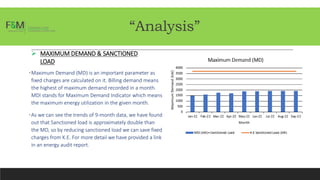
•Maximum Demand (MD) is an important parameter as
fixed charges are calculated on it. Billing demand means
the highest of maximum demand recorded in a month.
MDI stands for Maximum Demand Indicator which means
the maximum energy utilization in the given month.
•As we can see the trends of 9-month data, we have found
out that Sanctioned load is approximately double than
the MD, so by reducing sanctioned load we can save fixed
charges from K.E. For more detail we have provided a link
in an energy audit report.
“IEEE-519 Standard”
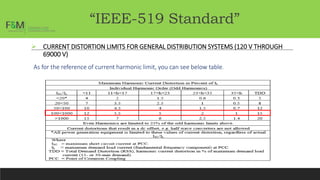
 CURRENT DISTORTION LIMITS FOR GENERAL DISTRIBUTION SYSTEMS (120 V THROUGH
69000 V)
As for the reference of current harmonic limit, you can see below table.
“Analysis”
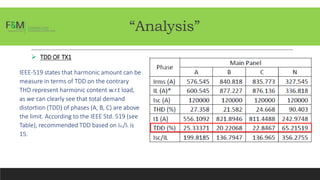
 TDD OF TX1
IEEE-519 states that harmonic amount can be
measure in terms of TDD on the contrary
THD represent harmonic content w.r.t load,
as we can clearly see that total demand
distortion (TDD) of phases (A, B, C) are above
the limit. According to the IEEE Std. 519 (see
Table), recommended TDD based on Isc/IL is
15.
“Analysis”
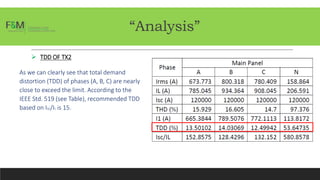
 TDD OF TX2
As we can clearly see that total demand
distortion (TDD) of phases (A, B, C) are nearly
close to exceed the limit. According to the
IEEE Std. 519 (see Table), recommended TDD
based on Isc/IL is 15.
“Analysis”
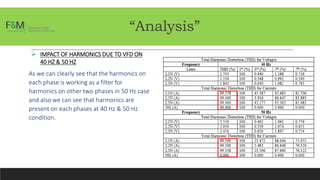
 IMPACT OF HARMONICS DUE TO VFD ON
40 HZ & 50 HZ
As we can clearly see that the harmonics on
each phase is working as a filter for
harmonics on other two phases in 50 Hz case
and also we can see that harmonics are
present on each phases at 40 Hz & 50 Hz
condition.
“Analysis”
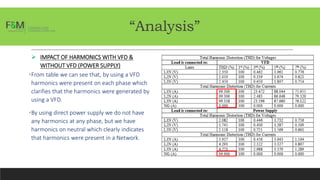
 IMPACT OF HARMONICS WITH VFD &
WITHOUT VFD (POWER SUPPLY)
•From table we can see that, by using a VFD
harmonics were present on each phase which
clarifies that the harmonics were generated by
using a VFD.
•By using direct power supply we do not have
any harmonics at any phase, but we have
harmonics on neutral which clearly indicates
that harmonics were present in a Network.
“Analysis”
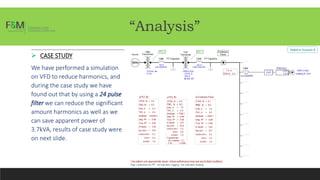
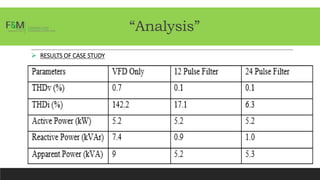
 CASE STUDY
We have performed a simulation
on VFD to reduce harmonics, and
during the case study we have
found out that by using a 24 pulse
filter we can reduce the significant
amount harmonics as well as we
can save apparent power of
3.7kVA, results of case study were
on next slide.
“Analysis”
 RESULTS OF CASE STUDY
“Analysis”
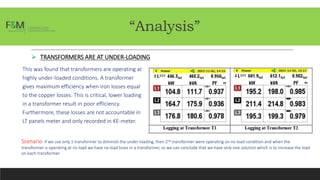
 TRANSFORMERS ARE AT UNDER-LOADING
This was found that transformers are operating at
highly under-loaded conditions. A transformer
gives maximum efficiency when iron losses equal
to the copper losses. This is critical, lower loading
in a transformer result in poor efficiency.
Furthermore, these losses are not accountable in
LT panels meter and only recorded in KE-meter.
Scenario: If we use only 1 transformer to diminish the under-loading, then 2nd transformer were operating on no load condition and when the
transformer is operating at no load we have no load loses in a transformer, so we can conclude that we have only one solution which is to increase the load
on each transformer.
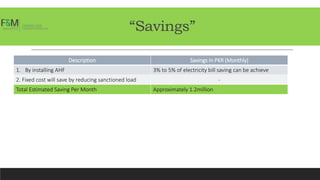
“Savings”
Description Savings in PKR (Monthly)
1. By installing AHF 3% to 5% of electricity bill saving can be achieve
2. Fixed cost will save by reducing sanctioned load -
Total Estimated Saving Per Month Approximately 1.2million
Thank you!

Electrical & Energy Audit 22 Nov.pptx

  • 1.
    Electrical & Energy Audit Client: Auditor : F&M Pvt. Ltd. BY- Head of Electrical Dept. : Syed Atif Naseem Inspection & Presented by : Hafiz Muhammad Umar
  • 2.
    F&M Pvt. Ltd. Introduction “F&Mwas established with the aim to provide one window solutions for the Industries of Pakistan with respect to international codes and standards, quality, and integrity. We are committed and determined to deliver innovative services and solutions that will assist our customers to accomplish their goals.” MANAGING DIRECTOR: SYED FARUKH MAZHAR
  • 3.
  • 4.
    Electrical Audit &Standard “An electrical audit is completed at an industry or commercial building to determine its electrical efficiency. Simply put, electrical efficiency means using less energy to do the same job. The audit will provide you with complete electricity consumption and electrical efficiency assessment.” Standard that we follow: •IEC 61439, 60364-6 (Visual Inspection / Earthing) •NFPA 70 E (Electrical Safety Audit) •ASTM E 1934/37 (Thermography) •BS-767 (Load Management) •NETA/ANSI (Insulation Resistance Test)
  • 5.
    “Visual Inspection” Visual inspectionof MD’S is conducted based on IEC 61439, 60364-6 Observations •SMDB-1-B must be maintained / rectify on urgent basis. •Cable tray must be cover properly. •MDB-10, SMDB-12, MDB-14, SMDB-19 and SMDB-1-B are critical DB’s Recommendations These DBs need to rectify on an urgent basis.
  • 6.
    “Earth Testing” “Earthing auditis conducted to ensures the good health of the complete Earthing system. It is imperative that the Earthing system is inspected periodically to ensure efficiency. Observations • Earthing required in Electrical Panels. • More than 5 ohms resistance of earth found on various DB’S. • Total of 26 DBs were not lying in an acceptable range •Recommendations. Need to rectify the earthing issue as early as possible.
  • 7.
    “Thermography” “Thermography is theprocess of using an infrared camera to look for abnormally hot or cold areas on a component operating under normal conditions. It is a viable nondestructive evaluation technique and is the simplest of all thermal inspection techniques”. Observations • 5 DB’s are lying in Moderate category which are unsatisfactory. • DB’s have overloaded circuits & equipment. • Due to looseness or overload of circuit, Electrical Fire can erupt. Recommendation 5*DB lies in Moderate category. It is requires to shift the load on particular DB’s in order to lower the temperature in a safe zone.
  • 8.
    “Lux Calculation” “Lighting systemspresent opportunities to reduce electric cost. Lighting systems include all the equipment required for the provision of, offices area, Corridor, Lift Area, etc. including fixtures and luminaries for light distribution of the light source and associated controls.”. Observations • Lux level at few locations is greater than the standard value, so it is recommended to reduce Lux level •Recommendation Near lift the lux value is greater than the required value so it is recommended to reduce lux level.
  • 9.
  • 10.
    “Analysis”  ENERGY CONSUMPTION Energyconsumption pattern can be clearly seen in period of Jan 2022 – Sep 2022. Their consumption is about 500 MWh in starting of the year but increases gradually as summer season goes up in 2022 and consumption reached about 800MWh.
  • 11.
    “Analysis”  LOAD FACTOR Usingthe data extracted from electricity bill, monthly load factor profiles for 9 months were generated as shown in Figure 7. Load factor is satisfactory as it is calculated on 24 hour and Ocean Mall peak operation time is not 24 hours.
  • 12.
    “Analysis”  MAXIMUM DEMAND& SANCTIONED LOAD •Maximum Demand (MD) is an important parameter as fixed charges are calculated on it. Billing demand means the highest of maximum demand recorded in a month. MDI stands for Maximum Demand Indicator which means the maximum energy utilization in the given month. •As we can see the trends of 9-month data, we have found out that Sanctioned load is approximately double than the MD, so by reducing sanctioned load we can save fixed charges from K.E. For more detail we have provided a link in an energy audit report.
  • 13.
    “IEEE-519 Standard”  CURRENTDISTORTION LIMITS FOR GENERAL DISTRIBUTION SYSTEMS (120 V THROUGH 69000 V) As for the reference of current harmonic limit, you can see below table.
  • 14.
    “Analysis”  TDD OFTX1 IEEE-519 states that harmonic amount can be measure in terms of TDD on the contrary THD represent harmonic content w.r.t load, as we can clearly see that total demand distortion (TDD) of phases (A, B, C) are above the limit. According to the IEEE Std. 519 (see Table), recommended TDD based on Isc/IL is 15.
  • 15.
    “Analysis”  TDD OFTX2 As we can clearly see that total demand distortion (TDD) of phases (A, B, C) are nearly close to exceed the limit. According to the IEEE Std. 519 (see Table), recommended TDD based on Isc/IL is 15.
  • 16.
    “Analysis”  IMPACT OFHARMONICS DUE TO VFD ON 40 HZ & 50 HZ As we can clearly see that the harmonics on each phase is working as a filter for harmonics on other two phases in 50 Hz case and also we can see that harmonics are present on each phases at 40 Hz & 50 Hz condition.
  • 17.
    “Analysis”  IMPACT OFHARMONICS WITH VFD & WITHOUT VFD (POWER SUPPLY) •From table we can see that, by using a VFD harmonics were present on each phase which clarifies that the harmonics were generated by using a VFD. •By using direct power supply we do not have any harmonics at any phase, but we have harmonics on neutral which clearly indicates that harmonics were present in a Network.
  • 18.
    “Analysis”  CASE STUDY Wehave performed a simulation on VFD to reduce harmonics, and during the case study we have found out that by using a 24 pulse filter we can reduce the significant amount harmonics as well as we can save apparent power of 3.7kVA, results of case study were on next slide.
  • 19.
  • 20.
    “Analysis”  TRANSFORMERS AREAT UNDER-LOADING This was found that transformers are operating at highly under-loaded conditions. A transformer gives maximum efficiency when iron losses equal to the copper losses. This is critical, lower loading in a transformer result in poor efficiency. Furthermore, these losses are not accountable in LT panels meter and only recorded in KE-meter. Scenario: If we use only 1 transformer to diminish the under-loading, then 2nd transformer were operating on no load condition and when the transformer is operating at no load we have no load loses in a transformer, so we can conclude that we have only one solution which is to increase the load on each transformer.
  • 21.
    “Savings” Description Savings inPKR (Monthly) 1. By installing AHF 3% to 5% of electricity bill saving can be achieve 2. Fixed cost will save by reducing sanctioned load - Total Estimated Saving Per Month Approximately 1.2million
  • 22.