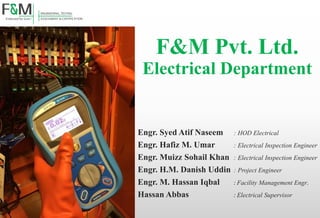
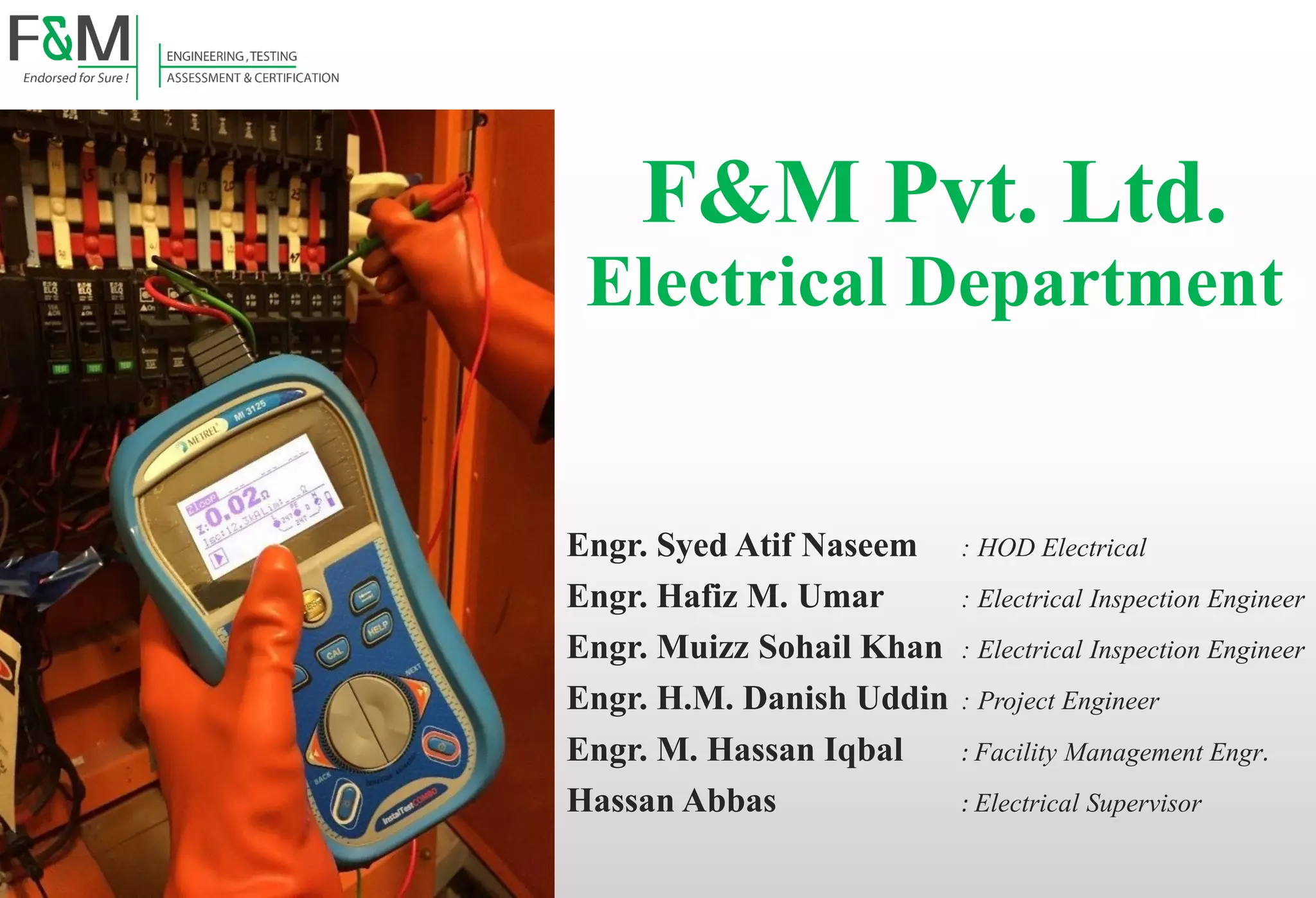
F&M Pvt. Ltd.
Electrical Department
Engr. Syed Atif Naseem : HOD Electrical
Engr. Hafiz M. Umar : Electrical Inspection Engineer
Engr. Muizz Sohail Khan : Electrical Inspection Engineer
Engr. H.M. Danish Uddin : Project Engineer
Engr. M. Hassan Iqbal : Facility Management Engr.
Hassan Abbas : Electrical Supervisor
F&M PVT. LTD.
INTRODUCTION
F&M was established with the aim to provide
one window solutions for the Industries of
Pakistan with respect to international codes
and standards, quality, and integrity. We are
committed and determined to deliver
innovative services and solutions that will
assist our customers to accomplish their
goals.
Managing Director:
Syed Farukh Mazhar
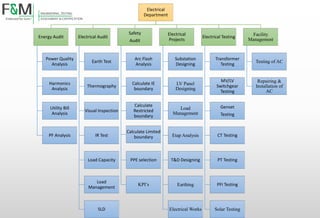
Electrical
Department
Energy Audit
Power Quality
Analysis
Harmonics
Analysis
Utility Bill
Analysis
PF Analysis
Electrical Audit
Earth Test
Thermography
Visual Inspection
IR Test
Load Capacity
Load
Management
SLD
Safety
Audit
Arc Flash
Analysis
Calculate IE
boundary
Calculate
Restricted
boundary
Calculate Limited
boundary
PPE selection
KPI’s
Electrical
Projects
Substation
Designing
LV Panel
Designing
Load
Management
Etap Analysis
T&D Designing
Earthing
Electrical Works
Electrical Testing
Transformer
Testing
MV/LV
Switchgear
Testing
Genset
Testing
CT Testing
PT Testing
PFI Testing
Solar Testing
Facility
Management
Testing of AC
Repairing &
Installation of
AC
ELECTRICALAUDIT
Why We Need for The
Electrical Audit?
ISSUES THAT OCCUR WITHOUT
ELECTRICALAUDIT
• Unplanned downtimes.
• Limited availability of spare parts in case of faults.
• High costs as a result of sudden breakdowns of electrical network
and most importantly...
• Loss in production!
THE ELECTRICALAUDIT
Electrical Audits are generally a technical survey of the electrical network of
any organization in which issues like decline in cable efficiency, breaker
efficiency or even reduction in efficiency of highly inductive loads such as
motors are eradicated and the systems are optimized to highest possible
level. It is a critical and systematic examination that determines the electrical
parameters and efficiency of the present energy system.
The electrical audit allows:
• Single line Diagrams are generated.
• Earthing systems are analyzed.
• Power quality is analyzed.
• Improve the safety of people and equipment and / or facilities.
• Detect risks, reduce incidents and resolve inadequate procedures.
• Reduce operational costs.
STANDARDS FOR ELECTRICALAUDIT
• IEC 60364-6 (Visual Inspection / Earthing)
• NFPA 70 (Visual Inspection)
• ASTM E 1934/37 (Thermography)
• BS-767 (Load Management)
• NETA/ANSI (Insulation Resistance Test)
VISUAL INSPECTION
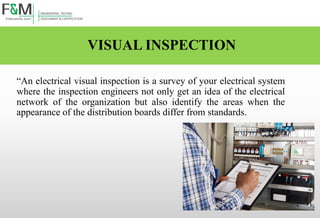
“An electrical visual inspection is a survey of your electrical system
where the inspection engineers not only get an idea of the electrical
network of the organization but also identify the areas when the
appearance of the distribution boards differ from standards.
EARTHING
“Earthing audit by F&M ensures the good health of
the complete Earthing system. Through electrical
earth testing we find out whether or not one of the
most important factors in a distribution board that is
earthing resistance is according to standards or not.
It is imperative that the Earthing system is inspected
periodically to ensure efficiency.”
F&M Pvt. Ltd. uses Fluke 1630-2 FC for the
purpose.
This solid clamp meter can measure earthing values
with highest precision.
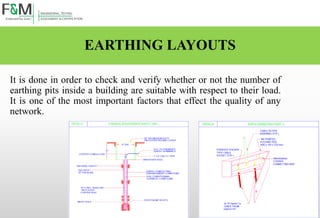
EARTHING LAYOUTS
It is done in order to check and verify whether or not the number of
earthing pits inside a building are suitable with respect to their load.
It is one of the most important factors that effect the quality of any
network.
THERMOGRAPHY
“Thermography is the process of using an infrared camera to look for
abnormally hot or cold areas on a component operating under normal
conditions. It is a viable nondestructive evaluation technique and is the
simplest of all thermal inspection techniques.”
F&M Pvt. Ltd. uses top notch equipment Fluke TiS60 for carrying out
this task.
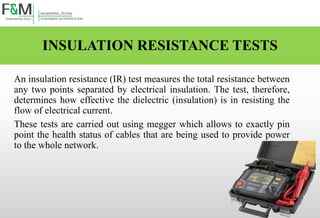
INSULATION RESISTANCE TESTS
An insulation resistance (IR) test measures the total resistance between
any two points separated by electrical insulation. The test, therefore,
determines how effective the dielectric (insulation) is in resisting the
flow of electrical current.
These tests are carried out using megger which allows to exactly pin
point the health status of cables that are being used to provide power
to the whole network.
ELECTRICAL DRAWINGS (SLD)
“Electrical Drawings are built internationally &
widely used to check the Quality of Electrical
systems & for Troubleshooting as per
International Standards. Electrical System
Studies are done to find out system deficiencies
& loopholes in existing networks via specific
studies.”
Single Line Diagrams (SLDs) are one of the
most effective way to visualize a complex
electrical network from the point of distribution
to the load. Not only it provides us with clear
information about what kind of load is being
operated on a specific breaker but also cable
rating, earthing resistance and breaker rating.
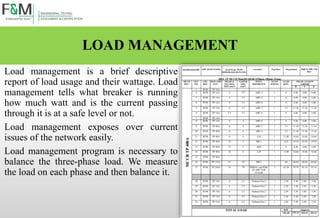
LOAD MANAGEMENT
Load management is a brief descriptive
report of load usage and their wattage. Load
management tells what breaker is running
how much watt and is the current passing
through it is at a safe level or not.
Load management exposes over current
issues of the network easily.
Load management program is necessary to
balance the three-phase load. We measure
the load on each phase and then balance it.
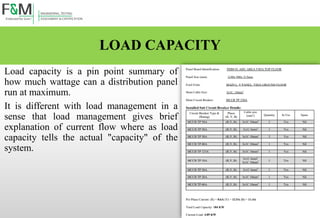
LOAD CAPACITY
Load capacity is a pin point summary of
how much wattage can a distribution panel
run at maximum.
It is different with load management in a
sense that load management gives brief
explanation of current flow where as load
capacity tells the actual "capacity" of the
system.
Why We Need for The
Energy Audit?
THE ENERGY AUDIT
An energy audit will identify energy-saving opportunities. It will help you
understand your energy usage and ways to use energy better.
An energy audit can identify safety concerns with electrical systems, wiring,
and ventilation, thus making your firm or business safer.
Energy Audit includes:
• Active power testing
• Reactive power test
• Power factor testing
• Harmonic testing
SAFETY AUDIT
SAFETY AUDIT
Safety audits are held for accountability of any organization. They are carried
out in order to ensure the implementation of proper safety regulations in
accordance with multiple international standards such as NFPA, IOSH etc.
A safety audit is a structured process that is used to collect information related
to a company's efficiency, effectiveness, reliability, and safety. An auditor will
observe the processes, work environment, the condition of equipment, and other
details to gauge these qualities
WHAT CAN HAPPEN WITHOUT SAFETY
CHECKS?
Safety audits help any organization to avoid potential injuries, damage and
recovery costs after the accident had taken place. Organizations can save
millions if they carry out such audits at least once per year by avoiding legal
claims and penalties. Out of many things some important factors that may occur
as a result of long-term gaps between audits are
• Huge reduction in productivity as well as overall revenue of any firm.
• Steep decline in public reputation.
• Greater number of legal claims over a short period of time.
• Greater worker compensation costs.
• Greater injuries, illnesses and most importantly reduced worker efficiency.
WORKPLACE SAFETY UNDER NFPA 70E ©
NFPA 70E defines definitions as basic as “volts”, “amperes”, “Ohms” to ideas
as complicated as “GFCI (ground fault circuit interrupter)”, “PPE categories”,
“Arc flash boundaries” etc. needless to say it’s descriptions are quite detailed
and effective.
These standards not only define basic definitions and processes but
a) Contains complete tables and charts of applicable regulations such as
distances from energized equipment etc. so you don’t have to calculate
them every time for implementation.
b) Also, it briefs how to calculate those value in case one needs to estimate
them for a different scenario or input, hence covering every possible
scenarios that may occur.
WORKPLACE SAFETY UNDER NFPA 70E ©
NFPA 70E addresses safety related work practices, maintenance requirements,
safety requirements for special equipment, for making identification and risk
assessments, selecting of appropriate PPEs, establishing an electrically safe
working environment, raises awareness.
Complying with this code specifically allows one to save many lives, reduces
liability, reduces unplanned downtimes and most importantly prevents huge
revenue losses.
In the slides ahead, different aspects of NFPA 70E through which it allows one
to establish safety precautions are mentioned to clarify how important and
effective NFPA 70E is…
NFPA 70E IMPLEMENTATION
NATIONAL FIRE PROTECTION ASSOCIATION 70E
The NFPA's mission is to reduce fire hazards and their impact on quality of life
through the provision of codes, standards, rules and regulations. There are
certain things that become extremely necessary in order to protect any area
from fires, these are.
• Visual Observation
• Energy Controlled Audit
• General Compliance
Therefore, these are the general steps that cover a fire safety audit.
ETAPANALYSIS
Outcome:
• Incident Energy Calculation.
• Measure Restricted Boundary approach
• Measure Limited Boundary Approach.
• Suggesting PPES.
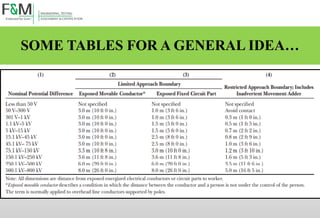
SOME TABLES FOR A GENERAL IDEA…
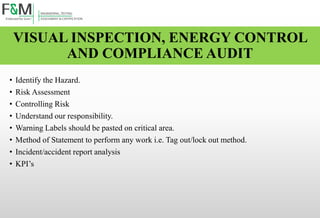
VISUAL INSPECTION, ENERGY CONTROL
AND COMPLIANCE AUDIT
• Identify the Hazard.
• Risk Assessment
• Controlling Risk
• Understand our responsibility.
• Warning Labels should be pasted on critical area.
• Method of Statement to perform any work i.e. Tag out/lock out method.
• Incident/accident report analysis
• KPI’s
Thankyou to choose
F&M Pvt.Ltd.
Head Of Electrical Department “Syed Atif Naseem”

Electrical FM Compiled.pdf

  • 1.
    F&M Pvt. Ltd. ElectricalDepartment Engr. Syed Atif Naseem : HOD Electrical Engr. Hafiz M. Umar : Electrical Inspection Engineer Engr. Muizz Sohail Khan : Electrical Inspection Engineer Engr. H.M. Danish Uddin : Project Engineer Engr. M. Hassan Iqbal : Facility Management Engr. Hassan Abbas : Electrical Supervisor
  • 2.
    F&M PVT. LTD. INTRODUCTION F&Mwas established with the aim to provide one window solutions for the Industries of Pakistan with respect to international codes and standards, quality, and integrity. We are committed and determined to deliver innovative services and solutions that will assist our customers to accomplish their goals. Managing Director: Syed Farukh Mazhar
  • 3.
    Electrical Department Energy Audit Power Quality Analysis Harmonics Analysis UtilityBill Analysis PF Analysis Electrical Audit Earth Test Thermography Visual Inspection IR Test Load Capacity Load Management SLD Safety Audit Arc Flash Analysis Calculate IE boundary Calculate Restricted boundary Calculate Limited boundary PPE selection KPI’s Electrical Projects Substation Designing LV Panel Designing Load Management Etap Analysis T&D Designing Earthing Electrical Works Electrical Testing Transformer Testing MV/LV Switchgear Testing Genset Testing CT Testing PT Testing PFI Testing Solar Testing Facility Management Testing of AC Repairing & Installation of AC
  • 4.
  • 5.
    Why We Needfor The Electrical Audit?
  • 6.
    ISSUES THAT OCCURWITHOUT ELECTRICALAUDIT • Unplanned downtimes. • Limited availability of spare parts in case of faults. • High costs as a result of sudden breakdowns of electrical network and most importantly... • Loss in production!
  • 8.
    THE ELECTRICALAUDIT Electrical Auditsare generally a technical survey of the electrical network of any organization in which issues like decline in cable efficiency, breaker efficiency or even reduction in efficiency of highly inductive loads such as motors are eradicated and the systems are optimized to highest possible level. It is a critical and systematic examination that determines the electrical parameters and efficiency of the present energy system. The electrical audit allows: • Single line Diagrams are generated. • Earthing systems are analyzed. • Power quality is analyzed. • Improve the safety of people and equipment and / or facilities. • Detect risks, reduce incidents and resolve inadequate procedures. • Reduce operational costs.
  • 9.
    STANDARDS FOR ELECTRICALAUDIT •IEC 60364-6 (Visual Inspection / Earthing) • NFPA 70 (Visual Inspection) • ASTM E 1934/37 (Thermography) • BS-767 (Load Management) • NETA/ANSI (Insulation Resistance Test)
  • 10.
    VISUAL INSPECTION “An electricalvisual inspection is a survey of your electrical system where the inspection engineers not only get an idea of the electrical network of the organization but also identify the areas when the appearance of the distribution boards differ from standards.
  • 11.
    EARTHING “Earthing audit byF&M ensures the good health of the complete Earthing system. Through electrical earth testing we find out whether or not one of the most important factors in a distribution board that is earthing resistance is according to standards or not. It is imperative that the Earthing system is inspected periodically to ensure efficiency.” F&M Pvt. Ltd. uses Fluke 1630-2 FC for the purpose. This solid clamp meter can measure earthing values with highest precision.
  • 12.
    EARTHING LAYOUTS It isdone in order to check and verify whether or not the number of earthing pits inside a building are suitable with respect to their load. It is one of the most important factors that effect the quality of any network.
  • 13.
    THERMOGRAPHY “Thermography is theprocess of using an infrared camera to look for abnormally hot or cold areas on a component operating under normal conditions. It is a viable nondestructive evaluation technique and is the simplest of all thermal inspection techniques.” F&M Pvt. Ltd. uses top notch equipment Fluke TiS60 for carrying out this task.
  • 14.
    INSULATION RESISTANCE TESTS Aninsulation resistance (IR) test measures the total resistance between any two points separated by electrical insulation. The test, therefore, determines how effective the dielectric (insulation) is in resisting the flow of electrical current. These tests are carried out using megger which allows to exactly pin point the health status of cables that are being used to provide power to the whole network.
  • 15.
    ELECTRICAL DRAWINGS (SLD) “ElectricalDrawings are built internationally & widely used to check the Quality of Electrical systems & for Troubleshooting as per International Standards. Electrical System Studies are done to find out system deficiencies & loopholes in existing networks via specific studies.” Single Line Diagrams (SLDs) are one of the most effective way to visualize a complex electrical network from the point of distribution to the load. Not only it provides us with clear information about what kind of load is being operated on a specific breaker but also cable rating, earthing resistance and breaker rating.
  • 16.
    LOAD MANAGEMENT Load managementis a brief descriptive report of load usage and their wattage. Load management tells what breaker is running how much watt and is the current passing through it is at a safe level or not. Load management exposes over current issues of the network easily. Load management program is necessary to balance the three-phase load. We measure the load on each phase and then balance it.
  • 17.
    LOAD CAPACITY Load capacityis a pin point summary of how much wattage can a distribution panel run at maximum. It is different with load management in a sense that load management gives brief explanation of current flow where as load capacity tells the actual "capacity" of the system.
  • 18.
    Why We Needfor The Energy Audit?
  • 19.
    THE ENERGY AUDIT Anenergy audit will identify energy-saving opportunities. It will help you understand your energy usage and ways to use energy better. An energy audit can identify safety concerns with electrical systems, wiring, and ventilation, thus making your firm or business safer. Energy Audit includes: • Active power testing • Reactive power test • Power factor testing • Harmonic testing
  • 20.
  • 21.
    SAFETY AUDIT Safety auditsare held for accountability of any organization. They are carried out in order to ensure the implementation of proper safety regulations in accordance with multiple international standards such as NFPA, IOSH etc. A safety audit is a structured process that is used to collect information related to a company's efficiency, effectiveness, reliability, and safety. An auditor will observe the processes, work environment, the condition of equipment, and other details to gauge these qualities
  • 22.
    WHAT CAN HAPPENWITHOUT SAFETY CHECKS? Safety audits help any organization to avoid potential injuries, damage and recovery costs after the accident had taken place. Organizations can save millions if they carry out such audits at least once per year by avoiding legal claims and penalties. Out of many things some important factors that may occur as a result of long-term gaps between audits are • Huge reduction in productivity as well as overall revenue of any firm. • Steep decline in public reputation. • Greater number of legal claims over a short period of time. • Greater worker compensation costs. • Greater injuries, illnesses and most importantly reduced worker efficiency.
  • 23.
    WORKPLACE SAFETY UNDERNFPA 70E © NFPA 70E defines definitions as basic as “volts”, “amperes”, “Ohms” to ideas as complicated as “GFCI (ground fault circuit interrupter)”, “PPE categories”, “Arc flash boundaries” etc. needless to say it’s descriptions are quite detailed and effective. These standards not only define basic definitions and processes but a) Contains complete tables and charts of applicable regulations such as distances from energized equipment etc. so you don’t have to calculate them every time for implementation. b) Also, it briefs how to calculate those value in case one needs to estimate them for a different scenario or input, hence covering every possible scenarios that may occur.
  • 24.
    WORKPLACE SAFETY UNDERNFPA 70E © NFPA 70E addresses safety related work practices, maintenance requirements, safety requirements for special equipment, for making identification and risk assessments, selecting of appropriate PPEs, establishing an electrically safe working environment, raises awareness. Complying with this code specifically allows one to save many lives, reduces liability, reduces unplanned downtimes and most importantly prevents huge revenue losses. In the slides ahead, different aspects of NFPA 70E through which it allows one to establish safety precautions are mentioned to clarify how important and effective NFPA 70E is…
  • 25.
    NFPA 70E IMPLEMENTATION NATIONALFIRE PROTECTION ASSOCIATION 70E The NFPA's mission is to reduce fire hazards and their impact on quality of life through the provision of codes, standards, rules and regulations. There are certain things that become extremely necessary in order to protect any area from fires, these are. • Visual Observation • Energy Controlled Audit • General Compliance Therefore, these are the general steps that cover a fire safety audit.
  • 26.
    ETAPANALYSIS Outcome: • Incident EnergyCalculation. • Measure Restricted Boundary approach • Measure Limited Boundary Approach. • Suggesting PPES.
  • 27.
    SOME TABLES FORA GENERAL IDEA…
  • 28.
    SOME TABLES FORA GENERAL IDEA…
  • 29.
    SOME TABLES FORA GENERAL IDEA…
  • 30.
    VISUAL INSPECTION, ENERGYCONTROL AND COMPLIANCE AUDIT • Identify the Hazard. • Risk Assessment • Controlling Risk • Understand our responsibility. • Warning Labels should be pasted on critical area. • Method of Statement to perform any work i.e. Tag out/lock out method. • Incident/accident report analysis • KPI’s
  • 32.
    Thankyou to choose F&MPvt.Ltd. Head Of Electrical Department “Syed Atif Naseem”