Programmable Logic Controller
 INTRODUTION

 Organization

Details
 Basics Of PLC
 PROGRRAMING LANGUAGES
 Plc Operation
 HMIs
 SCADA
 Project Discription
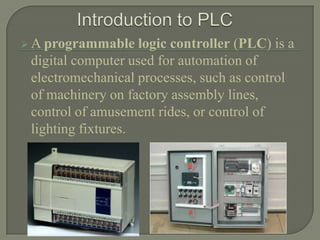
 A programmable

logic controller (PLC) is a
digital computer used for automation of
electromechanical processes, such as control
of machinery on factory assembly lines,
control of amusement rides, or control of
lighting fixtures.
‘AutoSys Indore’ is an ISO 9001:2008 certified Industrial
Automation Company-cum-training Center, providing Automation
services in INDORE from year 2007. It provide engineering, consultancy
and system integration services for Industrial Automation projects to
various Industries arround Indore
Its services comprises of practical oriented
trainings on Industrial Automation to trainees with ease and core
concepts.
It is known for providing quality automation services
along with Home Automation and professionally trained manpower in
PLC automation to various organizations.
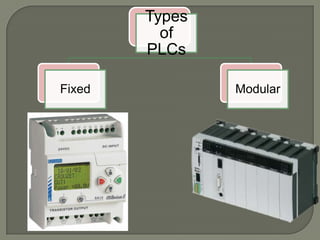
Types
of
PLCs
Fixed

Modular
BRAND NAME












Allen bardlley
Mitshubhishi
Messung
Schnider
Ceco eletronics
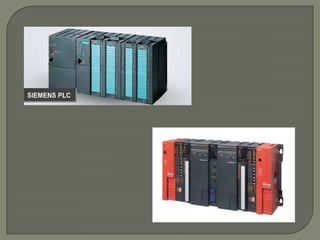
Siemens
Omron
Delta
Fatek
Ge fannu

SOFTWARE USED












RS logix 5000
Gx Devloper
Codesys V2.3
Zelio soft/twido soft
Ceco client
Step7 Microwin
Cx programming
Wpl soft
Win Pro ladder
Proficy Machine Eddition
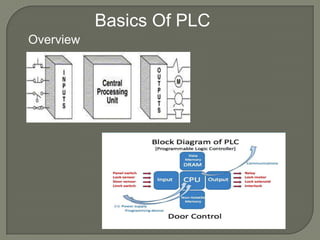
Basics Of PLC
Overview
Prossecer

Memory

unit
Power Supply unit
Input/Output Module
 Programming unit
• CPU: Its the unit containing the microprocessor.

• Power supply unit:Its needed to convert the
mains A.C. voltage to low D.C. Voltage(Normally
Internal)
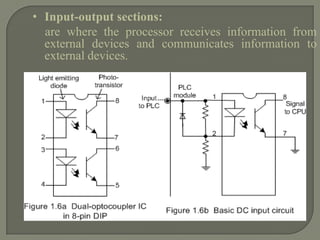
• Input-output sections:
are where the processor receives information from
external devices and communicates information to
external devices.
• Expansion Modules:
The S7-200 PLCs are expandable. Expansion
modules contain additional inputs and outputs.
These are connected to the base unit using a
ribbon connector.
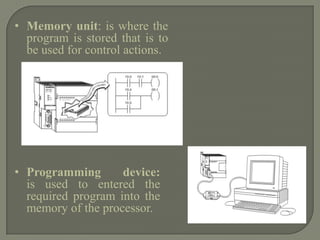
• Memory unit: is where the
program is stored that is to
be used for control actions.

• Programming
device:
is used to entered the
required program into the
memory of the processor.
CONTACTOR

PLC
OUTPUTS
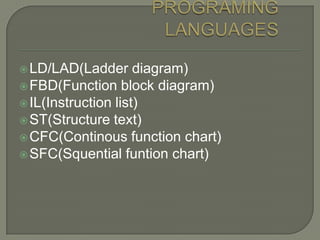
 LD/LAD(Ladder

diagram)
 FBD(Function block diagram)
 IL(Instruction list)
 ST(Structure text)
 CFC(Continous function chart)
 SFC(Squential funtion chart)
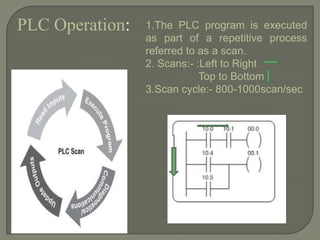
PLC Operation:

1.The PLC program is executed
as part of a repetitive process
referred to as a scan.
2. Scans:- :Left to Right
Top to Bottom
3.Scan cycle:- 800-1000scan/sec
Example:
The Ladder Diagram
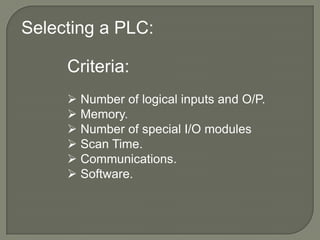
Selecting a PLC:
Criteria:
 Number of logical inputs and O/P.
 Memory.
 Number of special I/O modules
 Scan Time.
 Communications.
 Software.
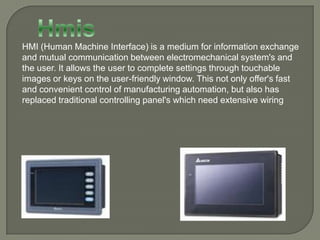
HMI (Human Machine Interface) is a medium for information exchange
and mutual communication between electromechanical system's and
the user. It allows the user to complete settings through touchable
images or keys on the user-friendly window. This not only offer's fast
and convenient control of manufacturing automation, but also has
replaced traditional controlling panel's which need extensive wiring
XBT N401

XBT RT500
Introduction (What Is SCADA?)
1.Stands for supervisory control And data
acquisition.
2.SCADA systems are used in industrial
processes: steel making, power generation
(conventional and nuclear) and distribution.
3.There Are 4 Components In the SCADA
System.
SCADA Components


Field Instrumentation.
 Sensors, devices to control.



Remote Terminal Units.
RTU Vs. PLC



Communications Network.




Equipment needed to transfer data to and from different sites

Central Monitoring Station
Collecting information gathered by the remote stations to
generate the necessary action
PLC Vs Computer
 Plc







Designed for extreme
industrial environments
Can operation in high
temperature and humidity
High immunity to noise
Integrated command
interpreter (proprietary)
No secondary memory
available (in the PLC)
Optimized for Single task

 Computer

Designed mainly for data
processing and
calculation
 Optimized for speed
 Can’t operate in extreme
environments
 Can be programmed in
different languages
 Lost of secondary
memory available
 Multitasking capability

Why PLC ?
 The controller is designed in modular form, so
that sub-assemblies could be removed easily for
replacement or repair.
 The control system needs the capability to
pass data collection to a central system.
 The system becomes reusable.
 The method used to program the controller is
simple, so that it can be easily understood by
plant personnel.
Advantages of PLCs:
 Less wiring.
 Wiring between devices and relay
contacts are done in the PLC program.
 Easier and faster to make changes.
 Trouble shooting aids make programming
easier and reduce downtime.

Reliable components make these likely
to operate for years before failure
Areas of Application
 Manufacturing/Machining
 Food/beverage
 Metals
 Power
 Mining
 Petrochemical/Chemical

Plc presentation

  • 1.
  • 2.
     INTRODUTION  Organization Details Basics Of PLC  PROGRRAMING LANGUAGES  Plc Operation  HMIs  SCADA  Project Discription
  • 3.
     A programmable logiccontroller (PLC) is a digital computer used for automation of electromechanical processes, such as control of machinery on factory assembly lines, control of amusement rides, or control of lighting fixtures.
  • 4.
    ‘AutoSys Indore’ isan ISO 9001:2008 certified Industrial Automation Company-cum-training Center, providing Automation services in INDORE from year 2007. It provide engineering, consultancy and system integration services for Industrial Automation projects to various Industries arround Indore Its services comprises of practical oriented trainings on Industrial Automation to trainees with ease and core concepts. It is known for providing quality automation services along with Home Automation and professionally trained manpower in PLC automation to various organizations.
  • 5.
  • 6.
    BRAND NAME           Allen bardlley Mitshubhishi Messung Schnider Cecoeletronics Siemens Omron Delta Fatek Ge fannu SOFTWARE USED           RS logix 5000 Gx Devloper Codesys V2.3 Zelio soft/twido soft Ceco client Step7 Microwin Cx programming Wpl soft Win Pro ladder Proficy Machine Eddition
  • 8.
  • 10.
  • 11.
    • CPU: Itsthe unit containing the microprocessor. • Power supply unit:Its needed to convert the mains A.C. voltage to low D.C. Voltage(Normally Internal)
  • 12.
    • Input-output sections: arewhere the processor receives information from external devices and communicates information to external devices.
  • 13.
    • Expansion Modules: TheS7-200 PLCs are expandable. Expansion modules contain additional inputs and outputs. These are connected to the base unit using a ribbon connector.
  • 14.
    • Memory unit:is where the program is stored that is to be used for control actions. • Programming device: is used to entered the required program into the memory of the processor.
  • 16.
  • 17.
     LD/LAD(Ladder diagram)  FBD(Functionblock diagram)  IL(Instruction list)  ST(Structure text)  CFC(Continous function chart)  SFC(Squential funtion chart)
  • 18.
    PLC Operation: 1.The PLCprogram is executed as part of a repetitive process referred to as a scan. 2. Scans:- :Left to Right Top to Bottom 3.Scan cycle:- 800-1000scan/sec
  • 19.
  • 20.
    Selecting a PLC: Criteria: Number of logical inputs and O/P.  Memory.  Number of special I/O modules  Scan Time.  Communications.  Software.
  • 21.
    HMI (Human MachineInterface) is a medium for information exchange and mutual communication between electromechanical system's and the user. It allows the user to complete settings through touchable images or keys on the user-friendly window. This not only offer's fast and convenient control of manufacturing automation, but also has replaced traditional controlling panel's which need extensive wiring
  • 22.
  • 23.
    Introduction (What IsSCADA?) 1.Stands for supervisory control And data acquisition. 2.SCADA systems are used in industrial processes: steel making, power generation (conventional and nuclear) and distribution. 3.There Are 4 Components In the SCADA System.
  • 24.
    SCADA Components  Field Instrumentation. Sensors, devices to control.  Remote Terminal Units. RTU Vs. PLC  Communications Network.   Equipment needed to transfer data to and from different sites Central Monitoring Station Collecting information gathered by the remote stations to generate the necessary action
  • 28.
    PLC Vs Computer Plc       Designed for extreme industrial environments Can operation in high temperature and humidity High immunity to noise Integrated command interpreter (proprietary) No secondary memory available (in the PLC) Optimized for Single task  Computer Designed mainly for data processing and calculation  Optimized for speed  Can’t operate in extreme environments  Can be programmed in different languages  Lost of secondary memory available  Multitasking capability 
  • 29.
    Why PLC ? The controller is designed in modular form, so that sub-assemblies could be removed easily for replacement or repair.  The control system needs the capability to pass data collection to a central system.  The system becomes reusable.  The method used to program the controller is simple, so that it can be easily understood by plant personnel.
  • 30.
    Advantages of PLCs: Less wiring.  Wiring between devices and relay contacts are done in the PLC program.  Easier and faster to make changes.  Trouble shooting aids make programming easier and reduce downtime. Reliable components make these likely to operate for years before failure
  • 31.
    Areas of Application Manufacturing/Machining  Food/beverage  Metals  Power  Mining  Petrochemical/Chemical