Rectilinear Motion
Important Terms And
Definitions
1. Kinematics :
 It is the branch of dynamics which deals
with the forces acting on bodies in
motion without considering the mass of
a body and the forces which is
responsible to cause the motion.

Rectilinear Motion


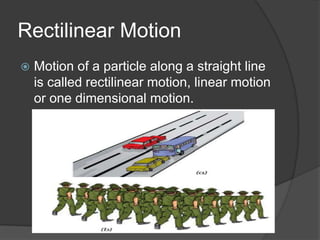
Motion of a particle along a straight line
is called rectilinear motion, linear motion
or one dimensional motion.
3.


To describe linear motion of a particle its
position at all times is to be specified.
The equations used in this case are
called ‘Equations of Motion’ or
‘Kinematical equations’.
4. Every motion is related to
the observer:


Position of a particle in motion is
described in terms of distance from
reference point or origin.
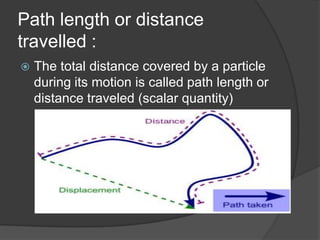
Path length or distance
travelled :


The total distance covered by a particle
during its motion is called path length or
distance traveled (scalar quantity)
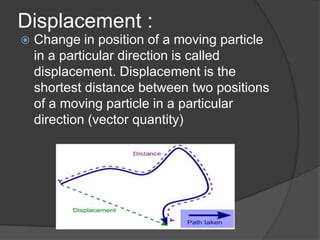
Displacement :


Change in position of a moving particle
in a particular direction is called
displacement. Displacement is the
shortest distance between two positions
of a moving particle in a particular
direction (vector quantity)


Displacement and distance traveled are
equal in rectilinear motion but distance
traveled is greater than displacement in
any other motion.
Average velocity (vector
quantity)


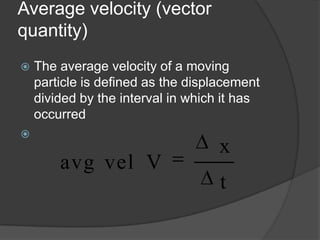
The average velocity of a moving
particle is defined as the displacement
divided by the interval in which it has
occurred



avg vel V

x
t


Average speed : Average speed of a moving
particle is defined as total distance travelled
divided by time taken



Avg speed V = total distance traveled / time


Acceleration : Acceleration of a moving
body is defined as the rate of change of
velocity with respect to time.
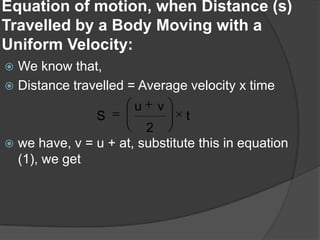
Equation of motion, when Distance (s)
Travelled by a Body Moving with a
Uniform Velocity:
We know that,
 Distance travelled = Average velocity x time


S

u

v

t

2
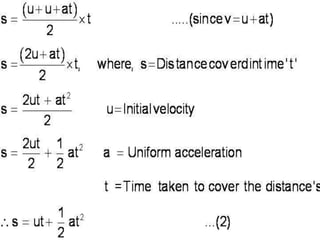
 we have, v = u + at, substitute this in equation
(1), we get
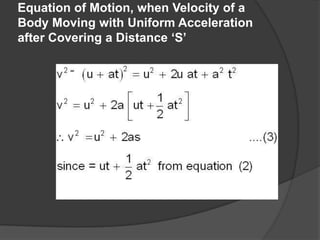
Equation of Motion, when Velocity of a
Body Moving with Uniform Acceleration
after Covering a Distance ‘S’
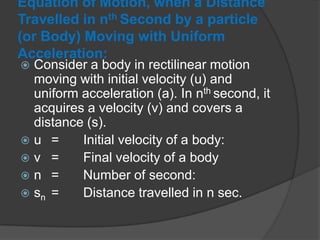
Equation of Motion, when a Distance
Travelled in nth Second by a particle
(or Body) Moving with Uniform
Acceleration:

Consider a body in rectilinear motion
moving with initial velocity (u) and
uniform acceleration (a). In nth second, it
acquires a velocity (v) and covers a
distance (s).
u =
Initial velocity of a body:
v =
Final velocity of a body
n =
Number of second:
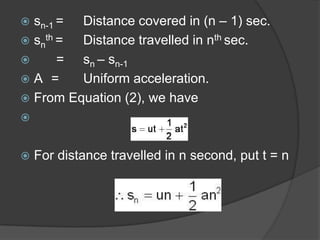
 sn =
Distance travelled in n sec.

Distance covered in (n – 1) sec.
Distance travelled in nth sec.

= sn – sn-1
A =
Uniform acceleration.
 From Equation (2), we have
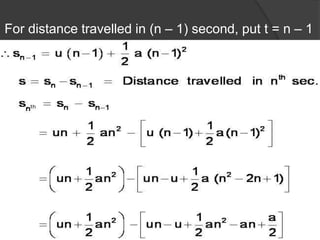
 sn-1 =
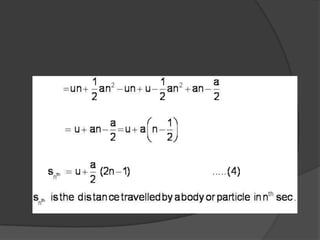
 snth =





For distance travelled in n second, put t = n
For distance travelled in (n – 1) second, put t = n – 1
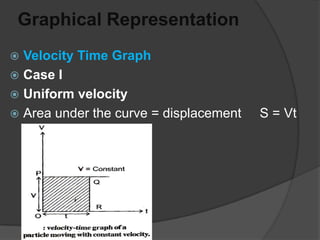
Graphical Representation
Velocity Time Graph
 Case I
 Uniform velocity
 Area under the curve = displacement


S = Vt
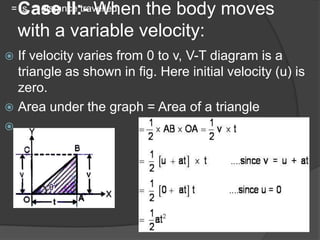
Case II:- When the body moves
with a variable velocity:

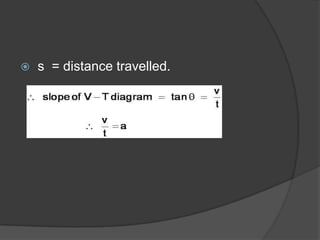
= s = distance travelled.

If velocity varies from 0 to v, V-T diagram is a
triangle as shown in fig. Here initial velocity (u) is
zero.
 Area under the graph = Area of a triangle





s = distance travelled.
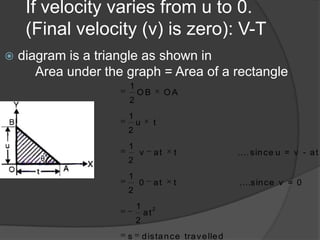
If velocity varies from u to 0.
(Final velocity (v) is zero): V-T


diagram is a triangle as shown in
Area under the graph = Area of a rectangle
1
2
1
2
1
2
1
2

OB

u

t

v

at

t

.... s in c e u = v - a t

0

at

t

....s in c e v = 0

1
2
s

OA

at

2

d is ta n c e tra v e lle d


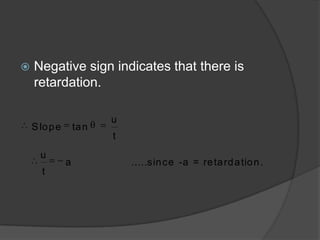
Negative sign indicates that there is
retardation.

S lo p e
u
t

ta n

a

u
t
.....sin ce -a = re ta rd a tio n .
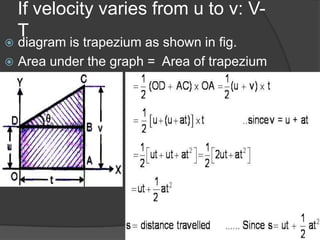
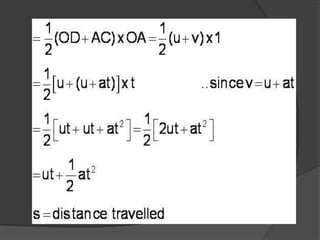
If velocity varies from u to v: VT

diagram is trapezium as shown in fig.
 Area under the graph = Area of trapezium

Important notes - Engg. Diploma FY - Physics - Rectilinear Motion

Important notes - Engg. Diploma FY - Physics - Rectilinear Motion

  • 1.
  • 2.
    Important Terms And Definitions 1.Kinematics :  It is the branch of dynamics which deals with the forces acting on bodies in motion without considering the mass of a body and the forces which is responsible to cause the motion. 
  • 3.
    Rectilinear Motion  Motion ofa particle along a straight line is called rectilinear motion, linear motion or one dimensional motion.
  • 4.
    3.  To describe linearmotion of a particle its position at all times is to be specified. The equations used in this case are called ‘Equations of Motion’ or ‘Kinematical equations’.
  • 5.
    4. Every motionis related to the observer:  Position of a particle in motion is described in terms of distance from reference point or origin.
  • 6.
    Path length ordistance travelled :  The total distance covered by a particle during its motion is called path length or distance traveled (scalar quantity)
  • 7.
    Displacement :  Change inposition of a moving particle in a particular direction is called displacement. Displacement is the shortest distance between two positions of a moving particle in a particular direction (vector quantity)
  • 8.
     Displacement and distancetraveled are equal in rectilinear motion but distance traveled is greater than displacement in any other motion.
  • 9.
    Average velocity (vector quantity)  Theaverage velocity of a moving particle is defined as the displacement divided by the interval in which it has occurred  avg vel V x t
  • 10.
     Average speed :Average speed of a moving particle is defined as total distance travelled divided by time taken  Avg speed V = total distance traveled / time
  • 11.
     Acceleration : Accelerationof a moving body is defined as the rate of change of velocity with respect to time.
  • 12.
    Equation of motion,when Distance (s) Travelled by a Body Moving with a Uniform Velocity: We know that,  Distance travelled = Average velocity x time  S u v t 2  we have, v = u + at, substitute this in equation (1), we get
  • 14.
    Equation of Motion,when Velocity of a Body Moving with Uniform Acceleration after Covering a Distance ‘S’
  • 15.
    Equation of Motion,when a Distance Travelled in nth Second by a particle (or Body) Moving with Uniform Acceleration: Consider a body in rectilinear motion moving with initial velocity (u) and uniform acceleration (a). In nth second, it acquires a velocity (v) and covers a distance (s). u = Initial velocity of a body: v = Final velocity of a body n = Number of second:  sn = Distance travelled in n sec. 
  • 16.
    Distance covered in(n – 1) sec. Distance travelled in nth sec.  = sn – sn-1 A = Uniform acceleration.  From Equation (2), we have  sn-1 =  snth =   For distance travelled in n second, put t = n
  • 17.
    For distance travelledin (n – 1) second, put t = n – 1
  • 19.
    Graphical Representation Velocity TimeGraph  Case I  Uniform velocity  Area under the curve = displacement  S = Vt
  • 20.
    Case II:- Whenthe body moves with a variable velocity: = s = distance travelled. If velocity varies from 0 to v, V-T diagram is a triangle as shown in fig. Here initial velocity (u) is zero.  Area under the graph = Area of a triangle  
  • 21.
     s = distancetravelled.
  • 22.
    If velocity variesfrom u to 0. (Final velocity (v) is zero): V-T  diagram is a triangle as shown in Area under the graph = Area of a rectangle 1 2 1 2 1 2 1 2 OB u t v at t .... s in c e u = v - a t 0 at t ....s in c e v = 0 1 2 s OA at 2 d is ta n c e tra v e lle d
  • 23.
     Negative sign indicatesthat there is retardation. S lo p e u t ta n a u t .....sin ce -a = re ta rd a tio n .
  • 24.
    If velocity variesfrom u to v: VT diagram is trapezium as shown in fig.  Area under the graph = Area of trapezium 