Class 9 | Physic
01 Motion
01 Motion
Get free trials!
Specially designed video
lectures on Misostudy.com
3
Atoms, molecules, planets, stars and galaxies are all in motion. We often perceive an object
to be in motion when its position changes with time.
An object may appear to be moving for one person and stationary for some other. For the
passengers in a moving bus, the roadside trees appear to be moving backwards. A person
standing on the road–side perceives the bus along with the passengers as moving. However, a
passenger inside the bus sees his fellow passengers to be at rest.
Atoms, molecules, planets, stars and galaxies are all in motion. We often perceive an object
to be in motion when its position changes with time.
An object may appear to be moving for one person and stationary for some other. For the
passengers in a moving bus, the roadside trees appear to be moving backwards. A person
standing on the road–side perceives the bus along with the passengers as moving. However, a
passenger inside the bus sees his fellow passengers to be at rest.
02. MOTION ALONG A STRAIGHT LINE
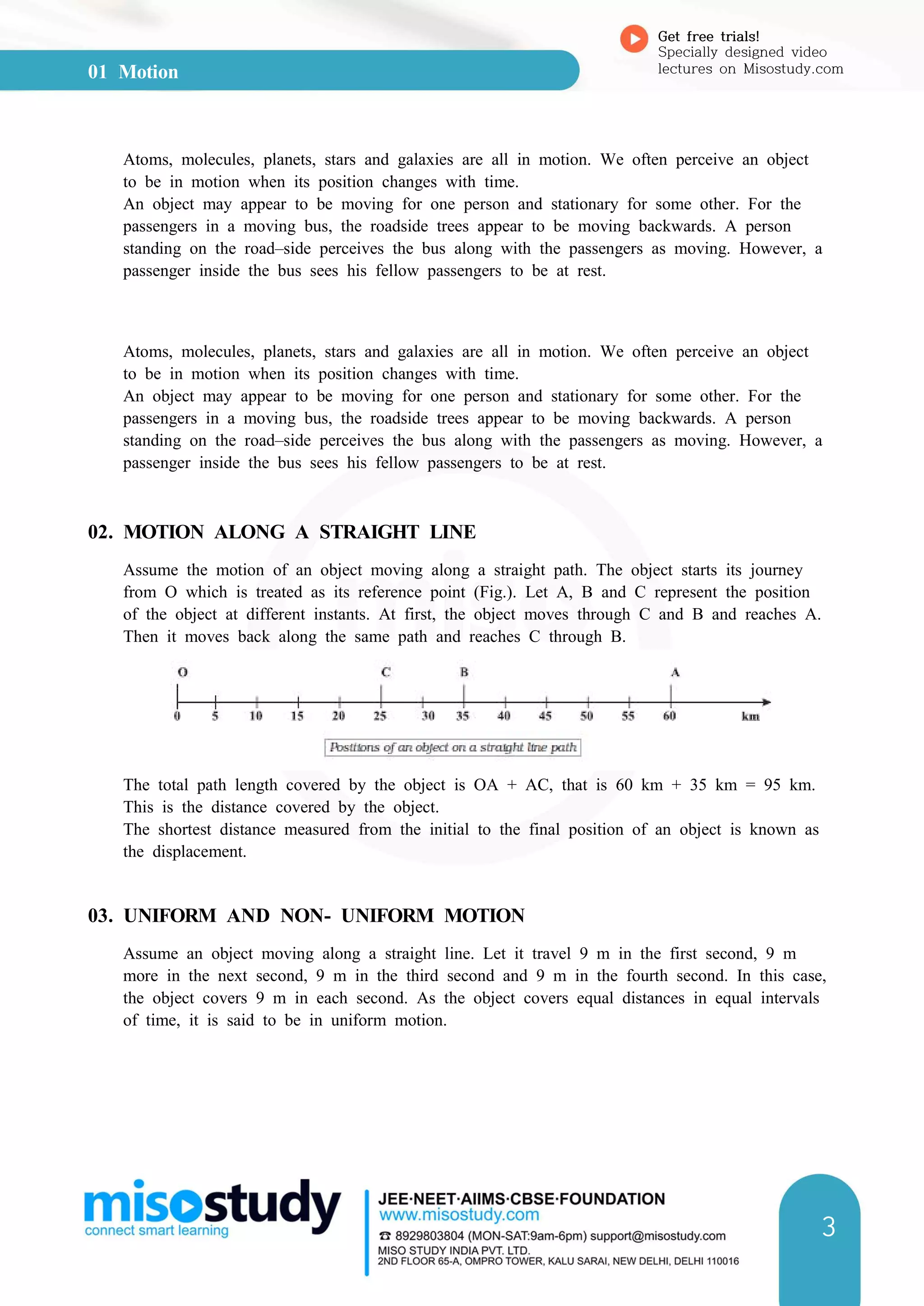
Assume the motion of an object moving along a straight path. The object starts its journey
from O which is treated as its reference point (Fig.). Let A, B and C represent the position
of the object at different instants. At first, the object moves through C and B and reaches A.
Then it moves back along the same path and reaches C through B.
The total path length covered by the object is OA + AC, that is 60 km + 35 km = 95 km.
This is the distance covered by the object.
The shortest distance measured from the initial to the final position of an object is known as
the displacement.
03. UNIFORM AND NON- UNIFORM MOTION
Assume an object moving along a straight line. Let it travel 9 m in the first second, 9 m
more in the next second, 9 m in the third second and 9 m in the fourth second. In this case,
the object covers 9 m in each second. As the object covers equal distances in equal intervals
of time, it is said to be in uniform motion.
01 Motion
Get free trials!
Specially designed video
lectures on Misostudy.com
4
Example 1 An object travels 60 m in 4 s and then another 60 m in 2 s. What is the
average speed of the object?
Solution Total distance travelled by the object =
60 m + 60 m = 120 m
Total time taken = 4 s + 2 s = 6 s
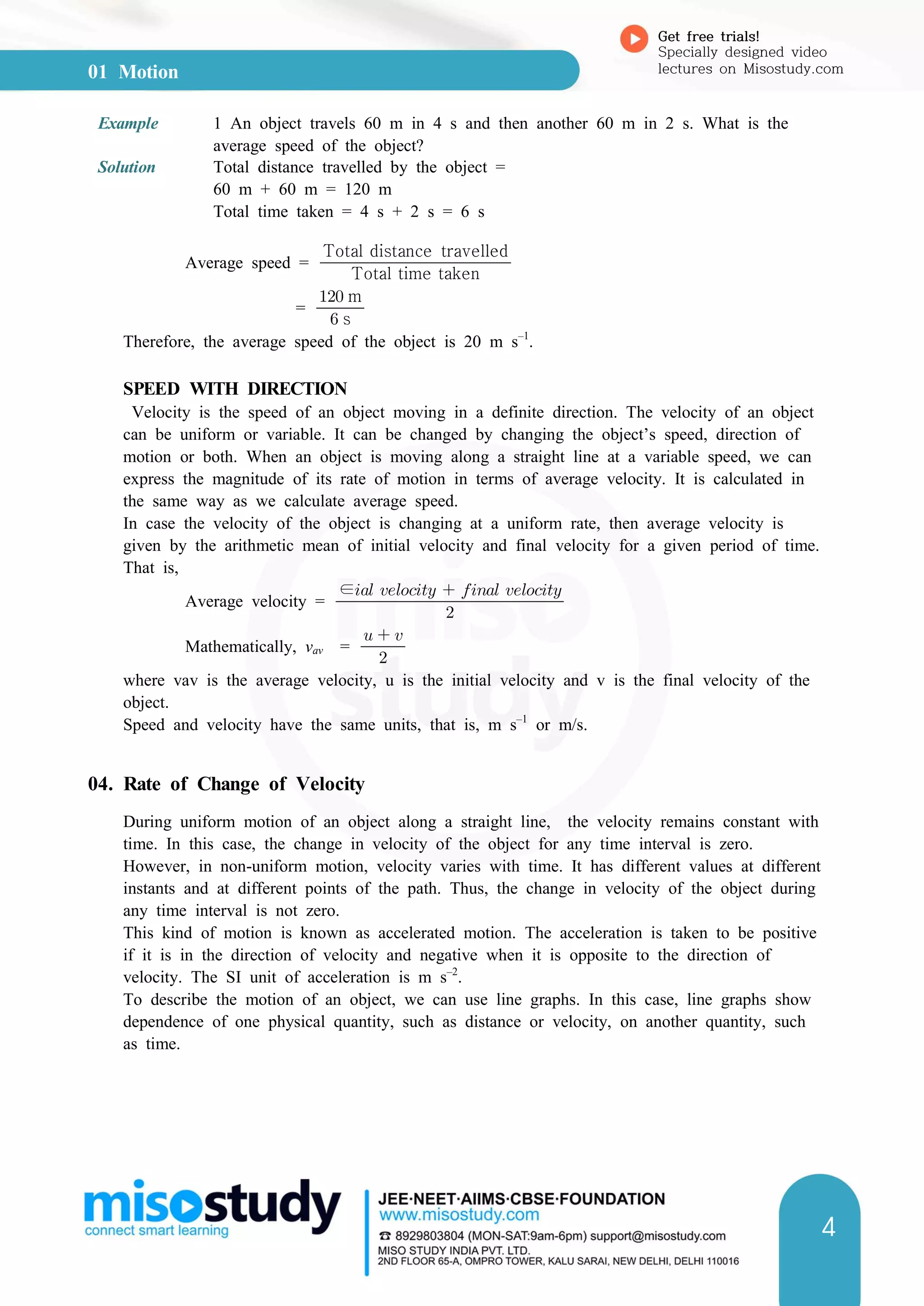
Average speed = Total time taken
Total distance travelled
=  s
 m
Therefore, the average speed of the object is 20 m s–1
.
SPEED WITH DIRECTION
Velocity is the speed of an object moving in a definite direction. The velocity of an object
can be uniform or variable. It can be changed by changing the object’s speed, direction of
motion or both. When an object is moving along a straight line at a variable speed, we can
express the magnitude of its rate of motion in terms of average velocity. It is calculated in
the same way as we calculate average speed.
In case the velocity of the object is changing at a uniform rate, then average velocity is
given by the arithmetic mean of initial velocity and final velocity for a given period of time.
That is,
Average velocity = 
∈    
Mathematically, vav = 
  
where vav is the average velocity, u is the initial velocity and v is the final velocity of the
object.
Speed and velocity have the same units, that is, m s–1
or m/s.
04. Rate of Change of Velocity
During uniform motion of an object along a straight line, the velocity remains constant with
time. In this case, the change in velocity of the object for any time interval is zero.
However, in non-uniform motion, velocity varies with time. It has different values at different
instants and at different points of the path. Thus, the change in velocity of the object during
any time interval is not zero.
This kind of motion is known as accelerated motion. The acceleration is taken to be positive
if it is in the direction of velocity and negative when it is opposite to the direction of
velocity. The SI unit of acceleration is m s–2
.
To describe the motion of an object, we can use line graphs. In this case, line graphs show
dependence of one physical quantity, such as distance or velocity, on another quantity, such
as time.
01 Motion
Get free trials!
Specially designed video
lectures on Misostudy.com
5
05. DISTANCE–TIME GRAPHS
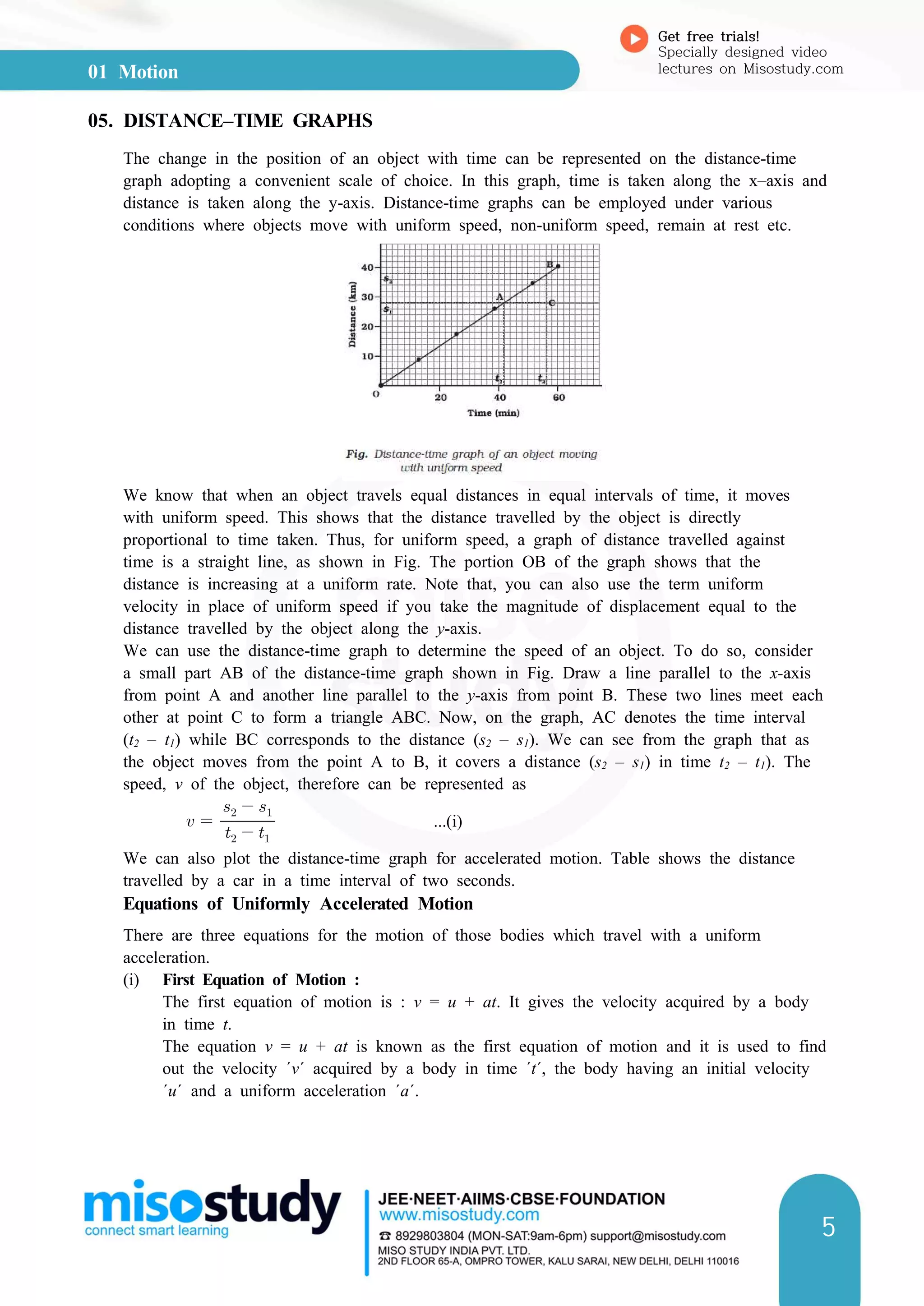
The change in the position of an object with time can be represented on the distance-time
graph adopting a convenient scale of choice. In this graph, time is taken along the x–axis and
distance is taken along the y-axis. Distance-time graphs can be employed under various
conditions where objects move with uniform speed, non-uniform speed, remain at rest etc.
We know that when an object travels equal distances in equal intervals of time, it moves
with uniform speed. This shows that the distance travelled by the object is directly
proportional to time taken. Thus, for uniform speed, a graph of distance travelled against
time is a straight line, as shown in Fig. The portion OB of the graph shows that the
distance is increasing at a uniform rate. Note that, you can also use the term uniform
velocity in place of uniform speed if you take the magnitude of displacement equal to the
distance travelled by the object along the y-axis.
We can use the distance-time graph to determine the speed of an object. To do so, consider
a small part AB of the distance-time graph shown in Fig. Draw a line parallel to the x-axis
from point A and another line parallel to the y-axis from point B. These two lines meet each
other at point C to form a triangle ABC. Now, on the graph, AC denotes the time interval
(t2 – t1) while BC corresponds to the distance (s2 – s1). We can see from the graph that as
the object moves from the point A to B, it covers a distance (s2 – s1) in time t2 – t1). The
speed, v of the object, therefore can be represented as
    
  
...(i)
We can also plot the distance-time graph for accelerated motion. Table shows the distance
travelled by a car in a time interval of two seconds.
Equations of Uniformly Accelerated Motion
There are three equations for the motion of those bodies which travel with a uniform
acceleration.
(i) First Equation of Motion :
The first equation of motion is : v = u + at. It gives the velocity acquired by a body
in time t.
The equation v = u + at is known as the first equation of motion and it is used to find
out the velocity ΄v΄ acquired by a body in time ΄t΄, the body having an initial velocity
΄u΄ and a uniform acceleration ΄a΄.
01 Motion
Get free trials!
Specially designed video
lectures on Misostudy.com
6
(ii) Second Equation of Motion :
The second equation of motion is : s = ut + 

at2
. It gives the distance travelled by a
body in time t.
(iii) Third Equation of Motion
The third equation of motion is : v2
= u2
+ 2as. It gives the velocity acquired by abody
in travelling a distance s.
To solve the problems on motion we should remember that :
(a) if a body starts from rest, its initial velocity, u = 0
(b) if a body comes to rest (it stops), its final velocity, v = 0
(c) if a body moves with uniform velocity, its acceleration, a = 0
06. Speed-Time Graphs (Or Velocity-Time Graphs)
We can have three types of speed-time graphs for a moving body. These three cases are :
(i) When the speed of the body remains constant (and there is no acceleration)
(ii) When the speed of the body changes at a uniform rate (there is uniform acceleration)
(iii) When the speed of the body changes in a non-uniform way (there is non-uniform
acceleration)
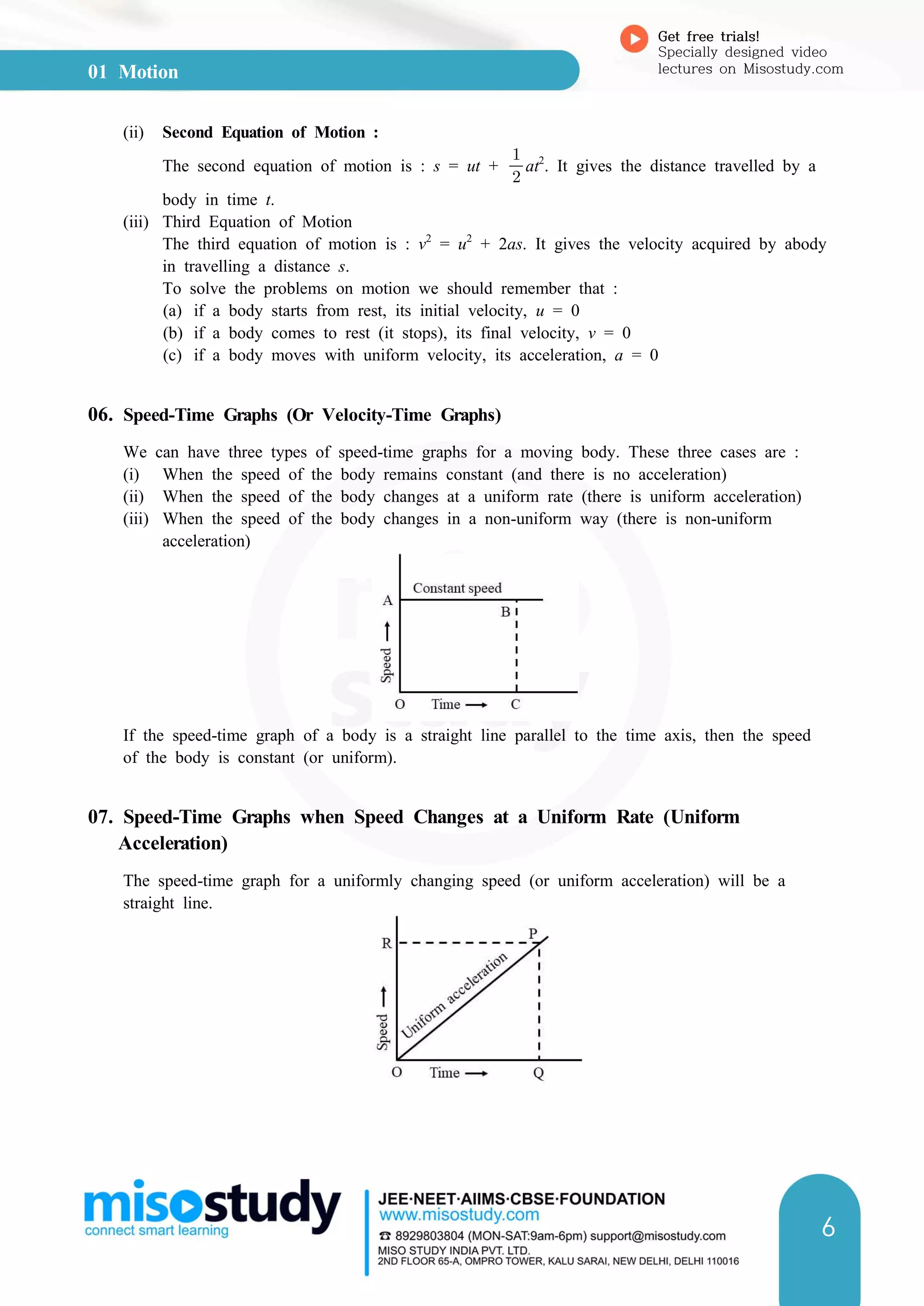
If the speed-time graph of a body is a straight line parallel to the time axis, then the speed
of the body is constant (or uniform).
07. Speed-Time Graphs when Speed Changes at a Uniform Rate (Uniform
Acceleration)
The speed-time graph for a uniformly changing speed (or uniform acceleration) will be a
straight line.
01 Motion
Get free trials!
Specially designed video
lectures on Misostudy.com
7
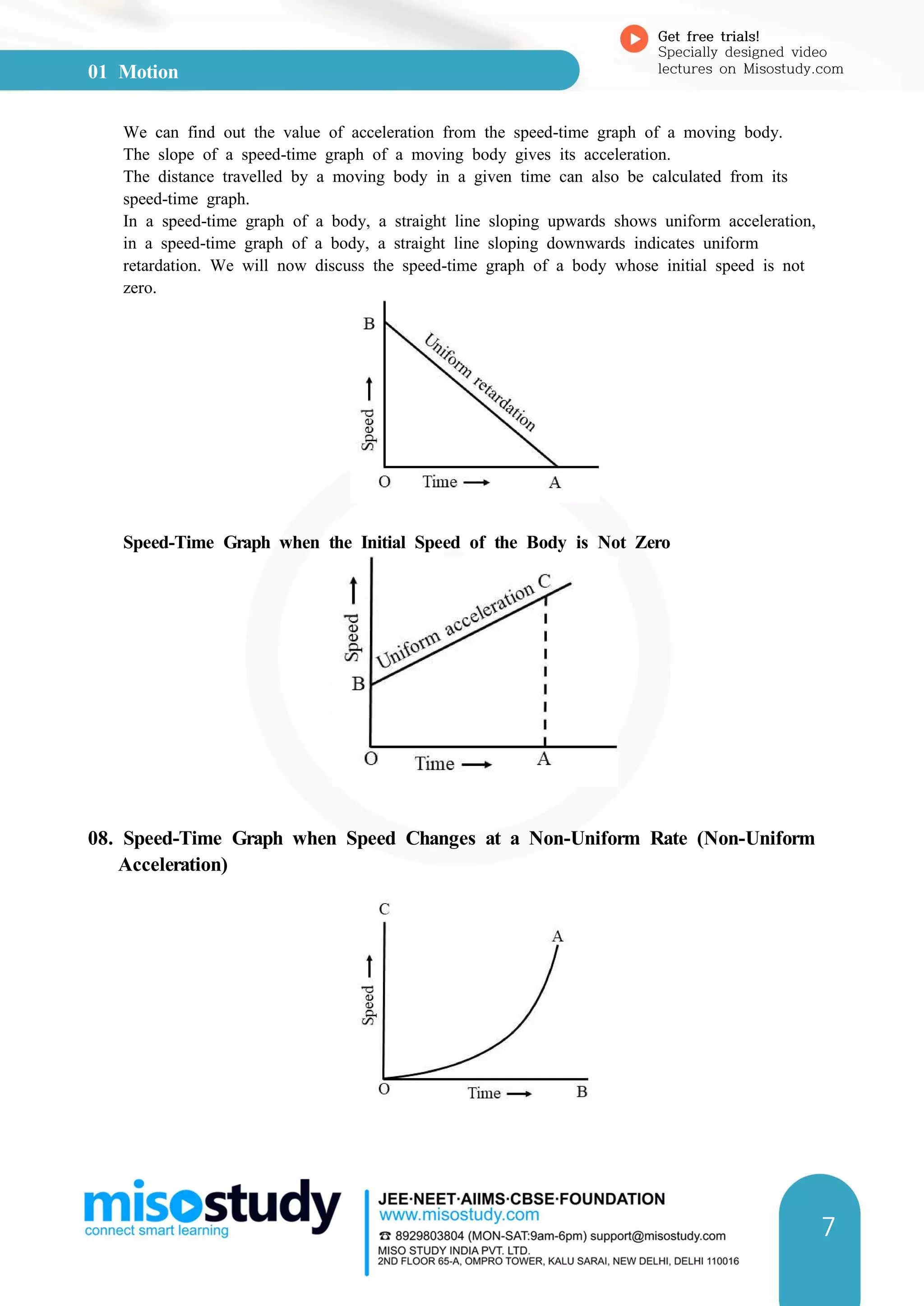
We can find out the value of acceleration from the speed-time graph of a moving body.
The slope of a speed-time graph of a moving body gives its acceleration.
The distance travelled by a moving body in a given time can also be calculated from its
speed-time graph.
In a speed-time graph of a body, a straight line sloping upwards shows uniform acceleration,
in a speed-time graph of a body, a straight line sloping downwards indicates uniform
retardation. We will now discuss the speed-time graph of a body whose initial speed is not
zero.
Speed-Time Graph when the Initial Speed of the Body is Not Zero
08. Speed-Time Graph when Speed Changes at a Non-Uniform Rate (Non-Uniform
Acceleration)
01 Motion
Get free trials!
Specially designed video
lectures on Misostudy.com
8
09. Derive The Equations of Motion by Graphical Method
The three equations of motion : v = u + at ; s = ut + 

at2
and v2
= u2
+ 2as can be
derived with the help of graphs as described below.
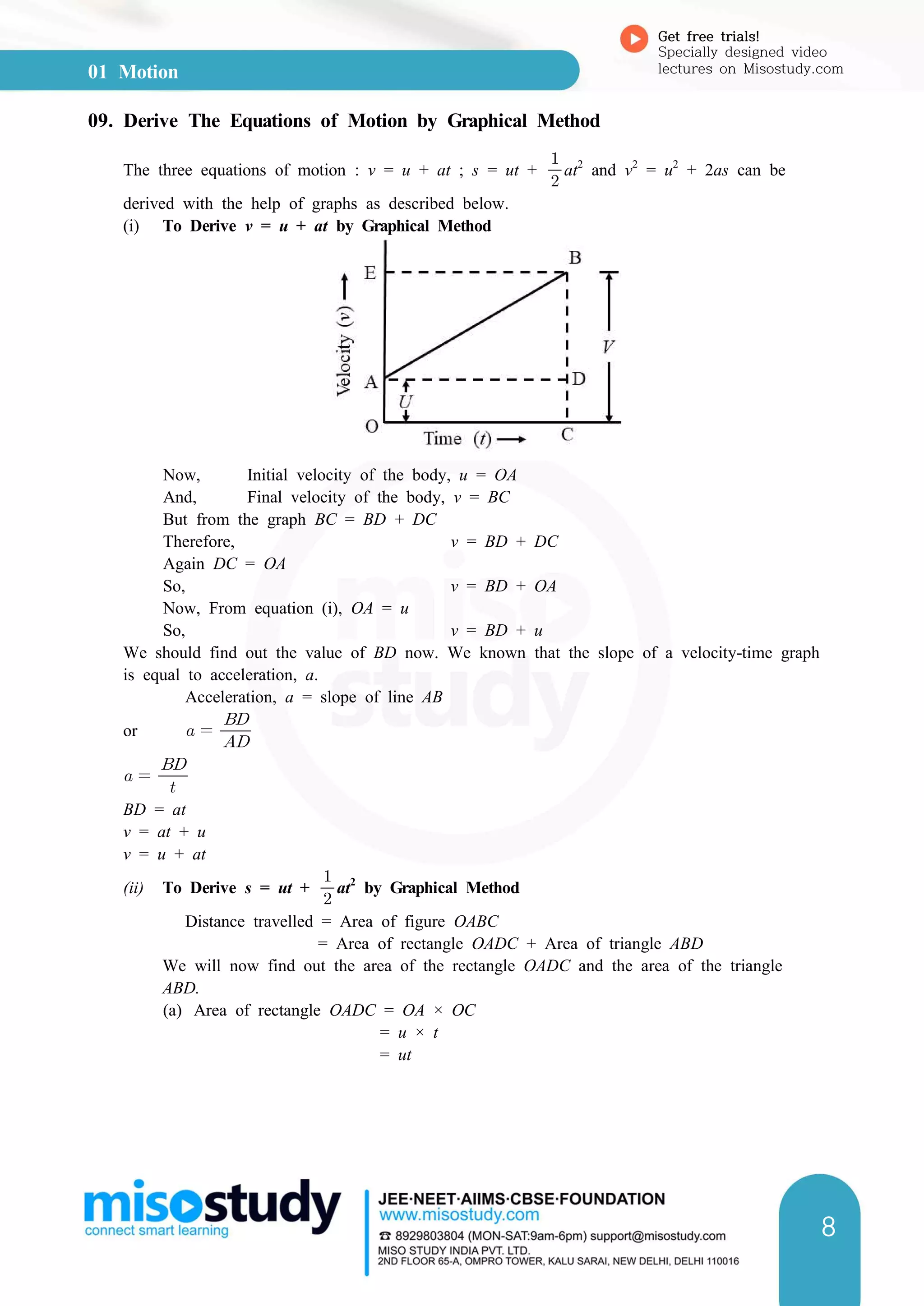
(i) To Derive v = u + at by Graphical Method
Now, Initial velocity of the body, u = OA
And, Final velocity of the body, v = BC
But from the graph BC = BD + DC
Therefore, v = BD + DC
Again DC = OA
So, v = BD + OA
Now, From equation (i), OA = u
So, v = BD + u
We should find out the value of BD now. We known that the slope of a velocity-time graph
is equal to acceleration, a.
Acceleration, a = slope of line AB
or   

  

BD = at
v = at + u
v = u + at
(ii) To Derive s = ut + 

at2
by Graphical Method
Distance travelled = Area of figure OABC
= Area of rectangle OADC + Area of triangle ABD
We will now find out the area of the rectangle OADC and the area of the triangle
ABD.
(a) Area of rectangle OADC = OA × OC
= u × t
= ut
01 Motion
Get free trials!
Specially designed video
lectures on Misostudy.com
9
(b) rea of triangle ABD = 

× Area of rectangle AEBD
= 

× AD × BD
= 

× t × at (because AD = t and BD = at)
= 

at2
So, Distance travelled, s = Area of rectangle OADC + Area of triangle ABD
or s = ut + 

at2
This is the second equation of motion. It has been derived here by the graphical
method.
(iii) To Derive v2
= u2
+ 2as by Graphical Method
Distance travelled, s = 
    × 
or s = 
   × 
Now, OA + CB = u + v and OC = t. Putting these values in the above relation, we
get :
s = 
   × 
Thus, v = u + at (First equation of motion)
And, at = v − u
So, t = 
  
Now, putting this value of t equation above, we get :
s = 
   ×   
or 2as = v2
− u2
[because (v + u) × (v − u) = v2
− u2
]
or v2
= u2
+ 2as
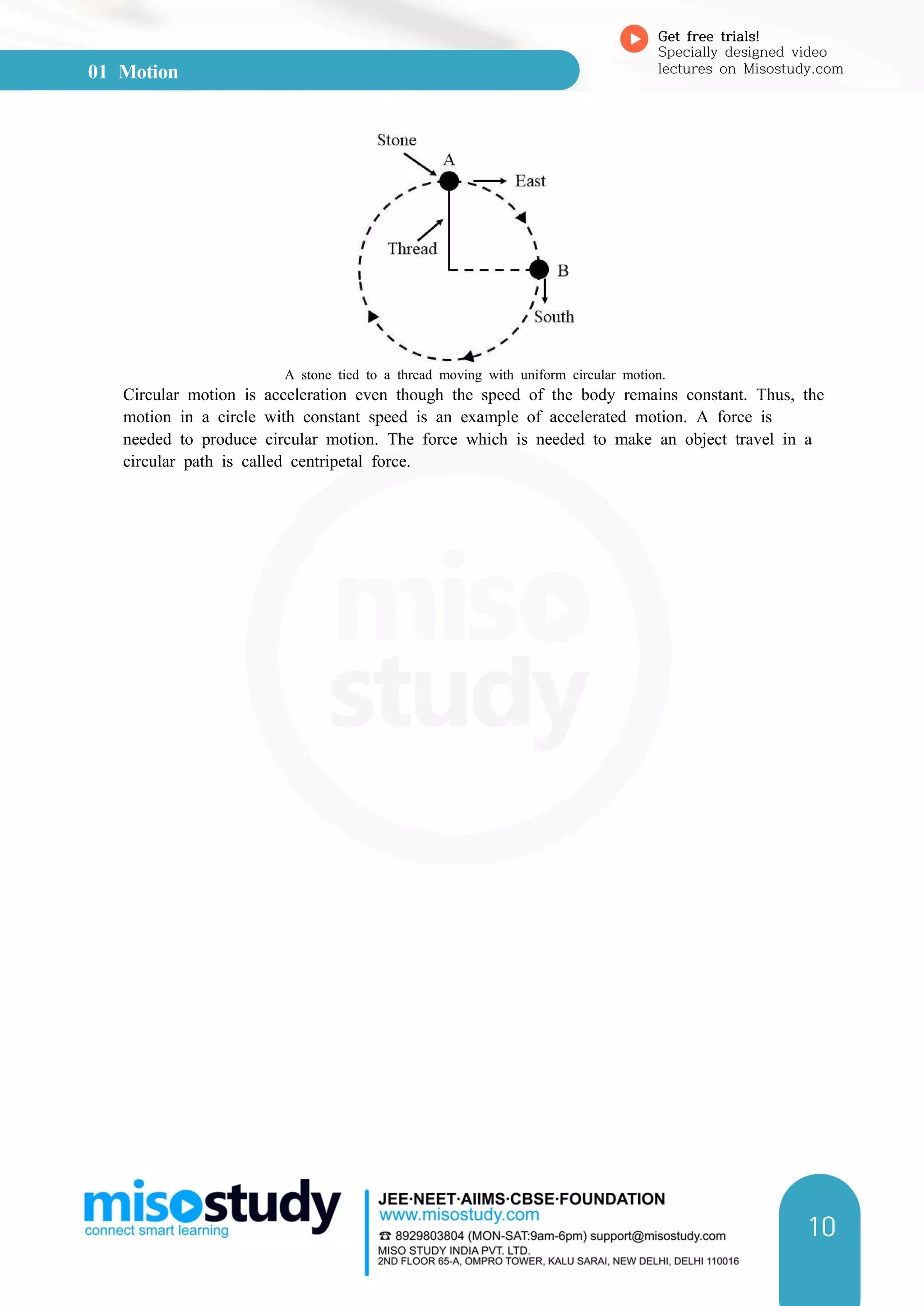
09. Uniform Circular Motion
When a body (or an object) moves in a circle, it is called circular motion.
When a body (or object) moves along a circular path, then its direction of motion (or
direction of speed) keeps changing continuously. Since the velocity changes (due to continuous
change in direction), therefore, the motion along a circular path is said to be accelerated.
When a body moves in a circular path with uniform speed (constant speed), its motion is
called uniform circular motion.
01 Motion
Get free trials!
Specially designed video
lectures on Misostudy.com
10
A stone tied to a thread moving with uniform circular motion.
Circular motion is acceleration even though the speed of the body remains constant. Thus, the
motion in a circle with constant speed is an example of accelerated motion. A force is
needed to produce circular motion. The force which is needed to make an object travel in a
circular path is called centripetal force.
01 Motion
Get free trials!
Specially designed video
lectures on Misostudy.com
11
CBSE Pattern
Exercise (1)
(Q 1 to 2) Very Short Type
1. Change the speed of 6 m/s into km/h?
2. What is the other name of negative acceleration?
(Q 3 to 5) Short Answer Type
3. What type of motion, uniform or non-uniform, is exhibited by a freely falling body?
4. A tortoise moves a distance of 100 metress in 15 minutes. What is the average speed of
tortoise in km/h?
5. If a bus travelling at 20 m/s is subjected to a steady deceleration of 5 m/s2
, how long will it
take to come to rest?
(Q 6 to 8) Multiple Choice
6. A particle is moving in a circular path of radius r. The displacement after half a circle would
be :
(a) 0
(b) πr
(c) 2r
(d) 2πr
7. The speed of a moving object is determined to be 0.06 m/s. This speed is equal to :
(a) 2.16 km/h
(b) 1.08 km/h
(c) 0.216 km/h
(d) 0.0216 km/h
8. A bus moving along a straight line at 20 m/s undergoes an acceleration of 4 m/s2
. After 2
seconds, its speed will be :
(a) 8 m/s
(b) 12 m/s
(c) 16 m/s
(d) 28 m/s
01 Motion
Get free trials!
Specially designed video
lectures on Misostudy.com
12
(Q 9 to 10) High Order Thinking Skills
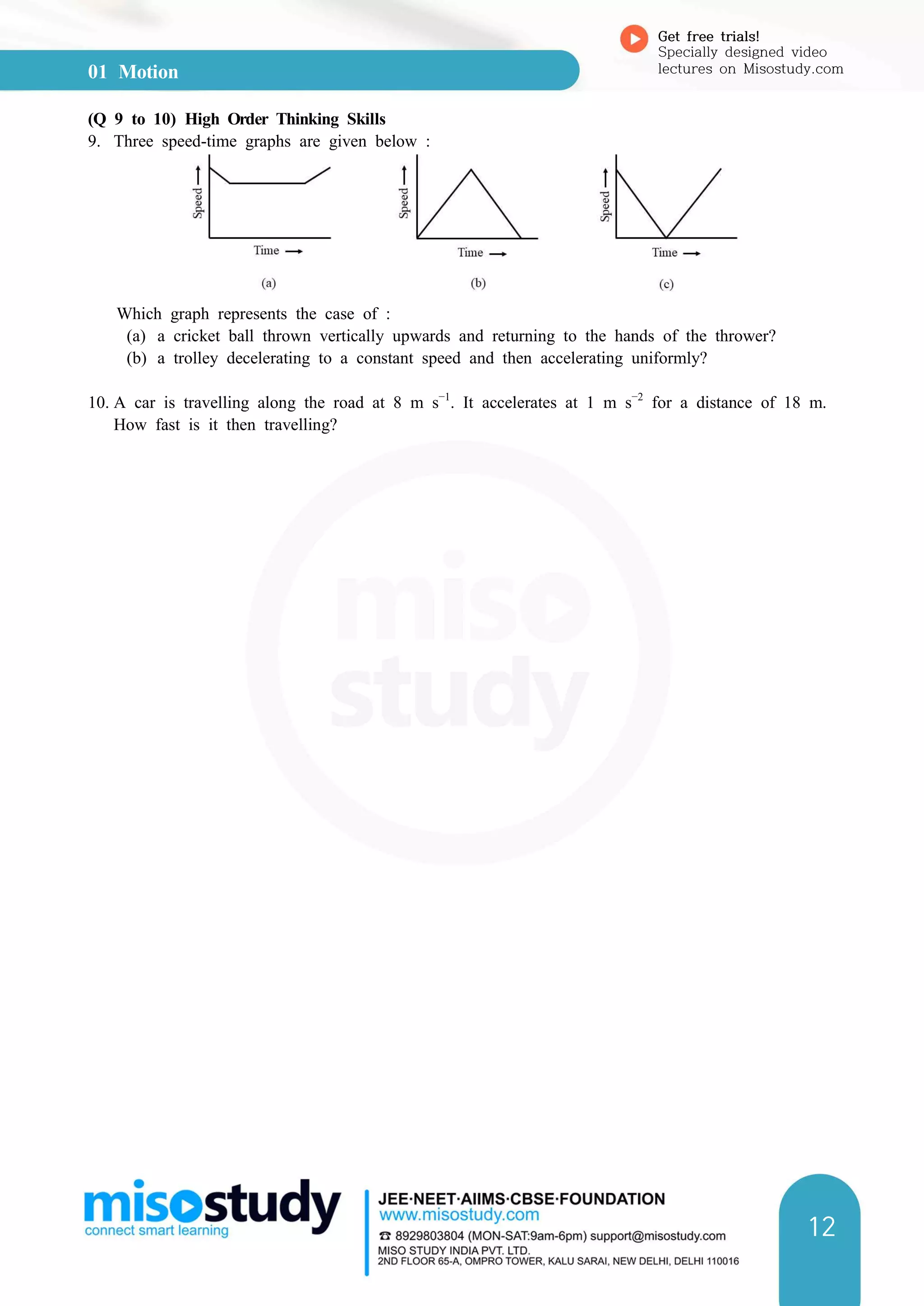
9. Three speed-time graphs are given below :
Which graph represents the case of :
(a) a cricket ball thrown vertically upwards and returning to the hands of the thrower?
(b) a trolley decelerating to a constant speed and then accelerating uniformly?
10. A car is travelling along the road at 8 m s−1
. It accelerates at 1 m s−2
for a distance of 18 m.
How fast is it then travelling?
01 Motion
Get free trials!
Specially designed video
lectures on Misostudy.com
13
Answer & Solution
Q1
21.6 km/h
Q2
Retardation (or Deceleration)
Q3
Uniformely accelerated motion with increasing velocity if no friction of air. Because ‘g’ is constant.
Q4
0.4 km/h
Q5
4 s
Q6
(c)
Q7
(c)
Q8
(d)
Q9
(i) c
Q10
10 m s−1
Class 9 | Chemistry
02 Matter in Our Surrounding
Get free trials!
Specially designed video
lectures on Misostudy.com
3
Anything which occupies space and has mass is called matter. Modern day scientists classify
matter in two ways : on the basis of its physical properties and on the basis of its chemical
properties. On the basis of physical properties matter is classified as solids, liquids and gases.
And on the basis of chemical properties, matter is classified as elements, compounds and
mixtures.
01. Matter is made of particles
Everything around us is made of tiny pieces or particles.
Evidence for Particles in Matter
(i) Dissolving a Solid in Liquid
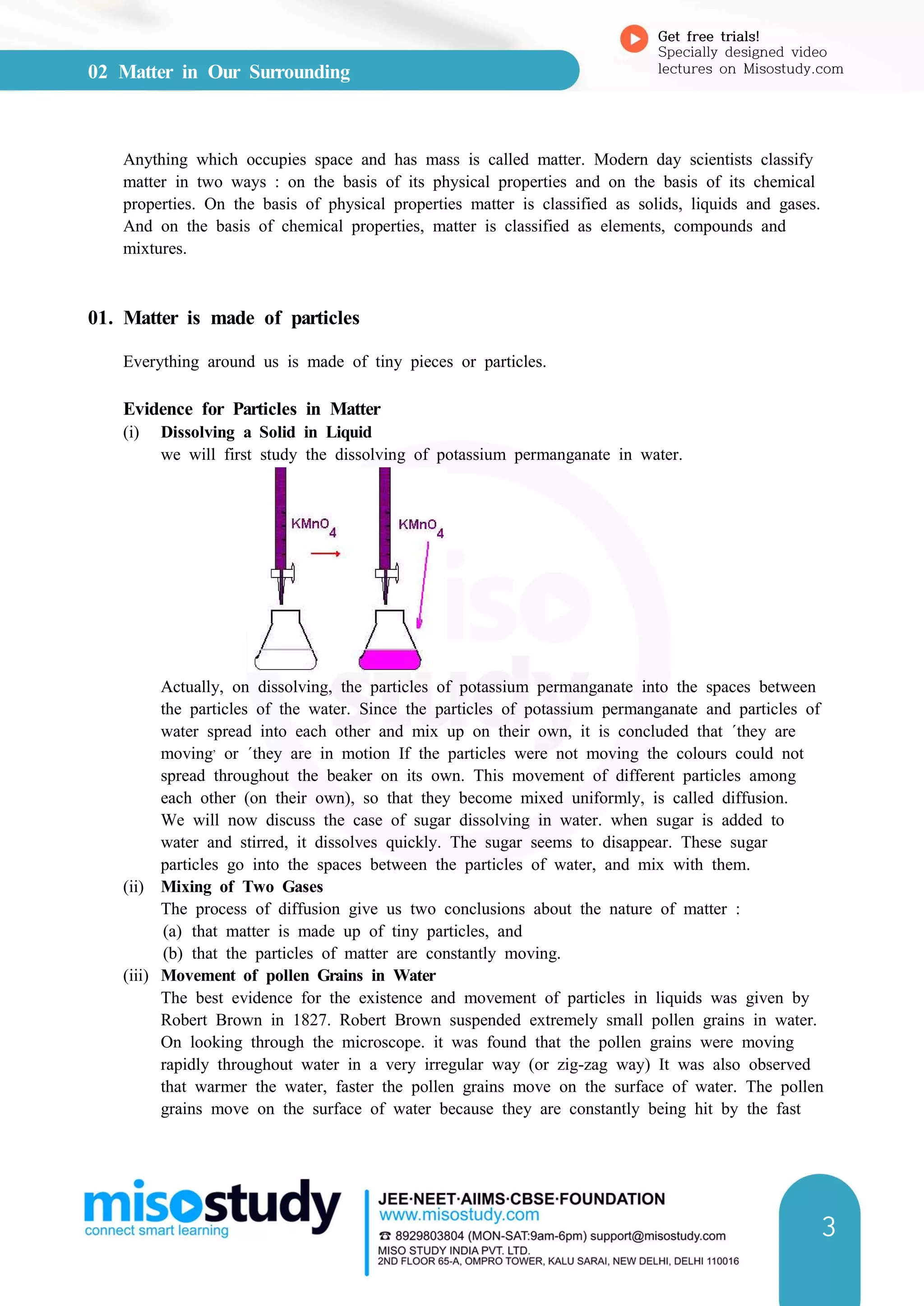
we will first study the dissolving of potassium permanganate in water.
Actually, on dissolving, the particles of potassium permanganate into the spaces between
the particles of the water. Since the particles of potassium permanganate and particles of
water spread into each other and mix up on their own, it is concluded that ΄they are
moving,
or ʹthey are in motion If the particles were not moving the colours could not
spread throughout the beaker on its own. This movement of different particles among
each other (on their own), so that they become mixed uniformly, is called diffusion.
We will now discuss the case of sugar dissolving in water. when sugar is added to
water and stirred, it dissolves quickly. The sugar seems to disappear. These sugar
particles go into the spaces between the particles of water, and mix with them.
(ii) Mixing of Two Gases
The process of diffusion give us two conclusions about the nature of matter :
(a) that matter is made up of tiny particles, and
(b) that the particles of matter are constantly moving.
(iii) Movement of pollen Grains in Water
The best evidence for the existence and movement of particles in liquids was given by
Robert Brown in 1827. Robert Brown suspended extremely small pollen grains in water.
On looking through the microscope. it was found that the pollen grains were moving
rapidly throughout water in a very irregular way (or zig-zag way) It was also observed
that warmer the water, faster the pollen grains move on the surface of water. The pollen
grains move on the surface of water because they are constantly being hit by the fast
02 Matter in Our Surrounding
Get free trials!
Specially designed video
lectures on Misostudy.com
4
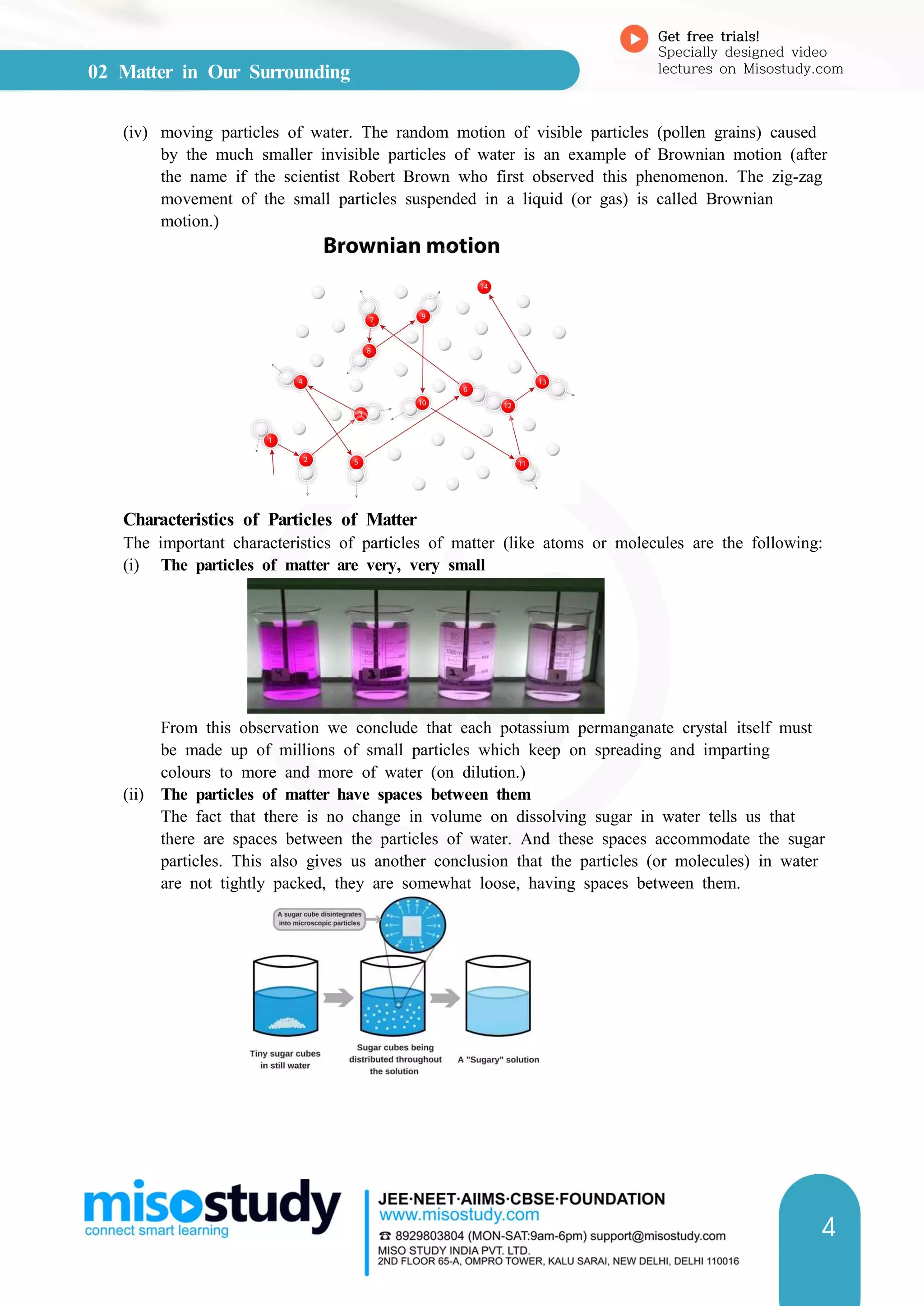
(iv) moving particles of water. The random motion of visible particles (pollen grains) caused
by the much smaller invisible particles of water is an example of Brownian motion (after
the name if the scientist Robert Brown who first observed this phenomenon. The zig-zag
movement of the small particles suspended in a liquid (or gas) is called Brownian
motion.)
Characteristics of Particles of Matter
The important characteristics of particles of matter (like atoms or molecules are the following:
(i) The particles of matter are very, very small
From this observation we conclude that each potassium permanganate crystal itself must
be made up of millions of small particles which keep on spreading and imparting
colours to more and more of water (on dilution.)
(ii) The particles of matter have spaces between them
The fact that there is no change in volume on dissolving sugar in water tells us that
there are spaces between the particles of water. And these spaces accommodate the sugar
particles. This also gives us another conclusion that the particles (or molecules) in water
are not tightly packed, they are somewhat loose, having spaces between them.
02 Matter in Our Surrounding
Get free trials!
Specially designed video
lectures on Misostudy.com
5
(iii) The particles of matter are constantly moving
The best evidence that particles of matter constantly moving comes from the studies of
diffusion and brownian motion
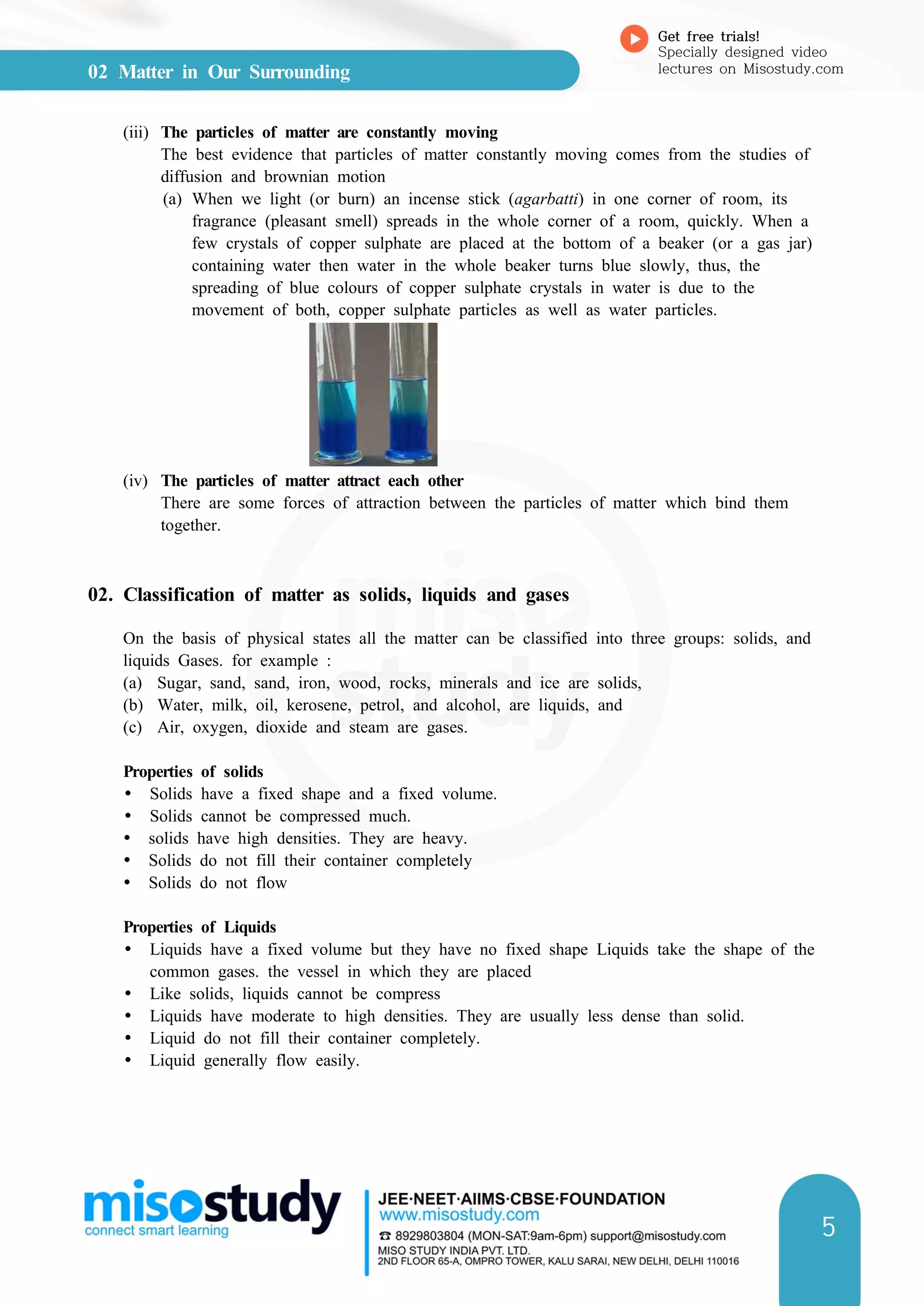
(a) When we light (or burn) an incense stick (agarbatti) in one corner of room, its
fragrance (pleasant smell) spreads in the whole corner of a room, quickly. When a
few crystals of copper sulphate are placed at the bottom of a beaker (or a gas jar)
containing water then water in the whole beaker turns blue slowly, thus, the
spreading of blue colours of copper sulphate crystals in water is due to the
movement of both, copper sulphate particles as well as water particles.
(iv) The particles of matter attract each other
There are some forces of attraction between the particles of matter which bind them
together.
02. Classification of matter as solids, liquids and gases
On the basis of physical states all the matter can be classified into three groups: solids, and
liquids Gases. for example :
(a) Sugar, sand, sand, iron, wood, rocks, minerals and ice are solids,
(b) Water, milk, oil, kerosene, petrol, and alcohol, are liquids, and
(c) Air, oxygen, dioxide and steam are gases.
Properties of solids
Ÿ Solids have a fixed shape and a fixed volume.
Ÿ Solids cannot be compressed much.
Ÿ solids have high densities. They are heavy.
Ÿ Solids do not fill their container completely
Ÿ Solids do not flow
Properties of Liquids
Ÿ Liquids have a fixed volume but they have no fixed shape Liquids take the shape of the
common gases. the vessel in which they are placed
Ÿ Like solids, liquids cannot be compress
Ÿ Liquids have moderate to high densities. They are usually less dense than solid.
Ÿ Liquid do not fill their container completely.
Ÿ Liquid generally flow easily.
02 Matter in Our Surrounding
Get free trials!
Specially designed video
lectures on Misostudy.com
6
Properties of Gases
Ÿ Gases have neither a fixed shape nor a fixed volume Gases acquire the shape and volume
of the vessel in which they are kept.
Ÿ Gases can be compressed easily (into a small volume).
Ÿ Gases have very low densities. They are very, very light. A gas is much lighter then the
same volume of a solid or a liquid
Ÿ Gases fill their container completely.
Ÿ Gases flow easily.
03. Diffusion
The spreading out and mixing of a substance with another substance due to the motion of its
particles is called diffusion.
Diffusion in Gases
Ÿ The smell of food being cooked in the kitchen in the reaches us even from a
considerable distance
Ÿ The fragrance of burning incense stick (or agarbatti) spreads all around due to the
diffusion of its smoke into the air.
Ÿ The smell of perfume due to diffusion of perfume vapours into air.
Diffusion in Liquids
Ÿ The spreading of purple colour of potassium permanganate into water, on its own, is due
to the diffusion of potassium permanganate particles into water
Ÿ The spreading of blue colour of copper sulphate into water, on its own is due to the
diffusion of copper sulphate particles into water.
Ÿ The spreading of ink water, on its own, is due to the diffusion of ink particles into
water.
Ÿ The carbon dioxide gas and oxygen gas present in air (or atmosphere) diffuse into water
(of pond, lakes, rivers and sea) and dissolve in it.
Diffusion in Solids
Diffusion in solids is a very, very slow process.
Ÿ If two metal block are bound together tightly and kept undisturbed for a few year then
the particles of one metal are found to have diffused into the other metal.
04. The common unit of temperature and si unit of temperature
0°
C=273K
The relation between kelvin scale and Celsius scale of temperature can be written as :
Temp. on Kelvin scale = Temp. on Celsius + 273
02 Matter in Our Surrounding
Get free trials!
Specially designed video
lectures on Misostudy.com
7
05. Change of state of matter
We can change the physical state of matter in two ways:
(a) By changing the temperature, and
(b) By changing the pressure.
06. Effect of change of temperature
(i) Solid to Liquid Change : Melting The process in which a solid substance changes into a
liquid on heating, is called melting (or fusion). The temperature at which a solid
substance melts and changes into a liquid at atmospheric pressure, is called melting point
of the substance. Different solids have different melting point for example, the melting
point of ice is 0°
C; the melting point of wax is 63°
C; whereas the melting point of iron
is 1535°
C. the melting point of a solid is a measure of the force of attraction between
its particles (atoms or molecules).
(ii) Liquid to Gas Change : Boiling (or Vaporisation)The process in which a liquid substance
changes into a gas rapidly on heating, is called boiling. the temperature at which a
liquid boils and changes rapidly into a gas at atmospheric pressure is called boiling
point of the liquid. Different liquid have different boiling point. For example the boiling
point af alcohol is 78°
C, the boiling point of water 100°
C,
whereas the boiling point of mercury is 357°
C the boiling point of a liquid is a measure
of the force of attraction between its particles.
(iii) Gas to Liquid Change : Condensation The process of changing a gas (or vapour) to a
liquid by cooling is called condensation.
(iv) Liquid to Solid Change : Freezing The process of changing a liquid into a solid by
cooling is called freezing For example, when water is cooled it gets converted into a
solid called ice this is called freezing. of water freezing means solidification. Please note
that freezing is the reverse of melting.
07. Latent heat
The heat energy which has to be supplied to change the state of a substance is called its
latent heat. Latent heat does not raise (or increase ) the temperature. The latent heat which
we supply is used up in overcoming the forces of attraction between the particles of a
substance during the change of state.
Latent heat is of two type:
(a) Latent heat of fusion and
(b) Latent heat of vaporisation.
02 Matter in Our Surrounding
Get free trials!
Specially designed video
lectures on Misostudy.com
8
08. Sublimation
The changing of a solid directly into vapours on heating, and of vapours into solid
on cooling, is known as sublimation.
Solid
Heating
Cooling Vapour (or Gas)
Please note that :
(a) the changing of a solid directly into vapour (or gas) is called sublimation and
(b) the changing of vapour (or gas) directly into solid is also called sublimation
The common substances which undergo sublimation are : Ammonium chloride, Iodine,
Camphor, Naphthalene and anthracene. Solid carbon dioxide (or dry ice) sublimes to form
carbon dioxide gas.
09. Effect of change of pressure
The physical state of matter can also be changed by changing the pressure.
Gases can be Liquefied by Applying Pressure And Lowering Temperature
10. Evaporation
The process of a liquid changing into vapour (or gas) even below its boiling point is called
evaporation.
Factors Affecting Evaporation
The evaporation of a liquid depends mainly on the following factors:
Ÿ Temperature : The rate of evaporation increasing the temperature of the liquid
Ÿ Surface Area of the Liquid : The rate of evaporation increases on increasing the surface
area of the liquid
Ÿ Humidity of Air : When the humidity of air is low, then the rate of evaporation is high
and water evaporates more readily. when the humidity of air of is high then rate of
evaporation is low, and water evaporates very slowly.
Ÿ Wind Speed : The rate of evaporation of a liquid increases with increasing wind speed.
02 Matter in Our Surrounding
Get free trials!
Specially designed video
lectures on Misostudy.com
9
Cooling Caused by Evaporation : The cooling caused by evaporation is based on the fact that
when a liquid evaporates, it draws (or takes) the latent heat of vaporisation from anything
which it touches. losing heat, this anything gets cooled,
Ÿ If we put a little of spirit (ether or petrol) at the back of our hand wave it around the
spirit evaporates rapidly and our hand feels very cold.
Ÿ During hot summer days, water is usually kept in an earthen pot (called pitcher or matka)
to keep it cool.
Ÿ Perspiration (or sweating) is our body s method of maintaining a constant temperature.
Ÿ We should wear cotton clothes in hot summer days to keep cool and comfortable.
Two More States of Matter : Plasma and Bose-Einstein Condensate
Scientist now say that there are actually five states of matter : Solid Liquid, Gas, Plasma and
bose-Einstein Condensate.
02 Matter in Our Surrounding
Get free trials!
Specially designed video
lectures on Misostudy.com
10
CBSE Pattern
Exercise (1)
(Q 1 to 2) One Mark
1. What is the chemical name of dry ice?
2. If the fish is being fried in a neighbouring home, we can smell it sitting in our own home.
Name the process which brings this smell to us.
(Q 3 to 5) Two Marks
3. What do you understand by the term ‘latent heat’? What are the two types of latent heat?
4. Which contain more heat, 1 kg of water at 100°C or 1 kg of steam at 100°C? Give reason for
your answer.
5. Why does our palm feel cold when we put some acetone (or perfume) on it?
(Q 6 to 7) Three Marks
6.
(a) What are the two ways in which the physical states of matter can be changed?
(b) Draw the ‘states of matter triangle’ to show the interconversion of states of matter.
(c) How can the evaporation of a liquid be made faster?
7.
(a) What is meant by ‘diffusion’? Give one example of diffusion in gases.
(b) Why do gases diffuse very fast?
(c) Name two gases of air which dissolve in water by diffusion. What is the importance of
this process in nature?
8. When extremely small particles X derived from the anther of a flower were suspended in a
liquid Y and observed through a microscope, it was found that the particles X were moving
throughout the liquid in a very zig-zag way. It was also observed that warmer the liquid Y,
faster the particles X moved on its surface.
(a) What could particles X be?
(b) What do you think liquid Y is?
(c) What is the zig-zag movement of X known as?
(d) What is causing the zig-zag movement of particles X?
(e) Name the scientist who discovered this phenomenon.
(f) What does this experiment tell us about the nature of liquid Y?
02 Matter in Our Surrounding
Get free trials!
Specially designed video
lectures on Misostudy.com
11
(Q 9 to 10) Five Marks
9. There are four substances W, X, Y, Z. The substances W is dark violet solid having diatomic
molecules. A solution of W in alcohol is used as a common antiseptic C. The substance X is a
white solid which is recovered from sea water on large scale. The substance Y is a white solid
which is insoluble in water and used in the form of small balls for safe storage of woollen
clothes. The substances Z is a yet another white solid used in dry cells.
(a) Name (i) W (ii) X (iii) Y (iv) X
(b) Out of W, X, Y, and Z, which substance/substances can undergo sublimation?
(c) Which substance is organic in nature?
(d) What is the name of substance C?
(e) Which substance belongs to halogen family?
10. When water is cooled to a temperature x, it gets converted into ice at temperature x by a
process called P. And when ice at temperature x is warmed, it gets re-converted into water at
the same temperature x in a process called Q.
(a) What is the value of temperature x in kelvin?
(b) What is the process P known as?
(c) What is the name of energy released during the process P?
(d) What is the process Q known as?
(e) What is the name of the energy absorbed during the process Q?
02 Matter in Our Surrounding
Get free trials!
Specially designed video
lectures on Misostudy.com
12
Answer & Solution
1. Carbon dioxide, CO2
2. Diffusion
3. The heat required to convert a solid into a liquid or vapour, or a liquid into a vapour, without
change of temperature. The two types of latent heats are:
Ÿ Latent heat of fusion
Ÿ Latent heat of vaporisation
4. 1 Kg of heat at 100 degree celsius contains more heat because of the following relationship:
Water at 100°C + Heat ⇄ Steam at 100°C
5. The acetone has low boiling point and thus it gets evaporated immediately by absorbing heat
from the palm making us feel cold.
6.
(a) Temperature, Pressure
(b)
(c) Evaporation can be made faster by following ways:
Ÿ Increasing temperature
Ÿ Increasing surface area
02 Matter in Our Surrounding
Get free trials!
Specially designed video
lectures on Misostudy.com
13
Ÿ Decreasing humidity in the surrounding area
Ÿ Increasing the speed of wind
7.
(a) The spreading out and mixing of a substance with another, due to the motion of the
particles is known as diffusion. Example: The smell of the perfume spreads due to the
diffusion of perfume vapours in the air.
(b) Particles move very quickly in all the directions.
(c) O2 and CO2, both are dissolved in water which is required by marine animals and plants,
respectively, for their survival.
8.
(a) Pollen Grains
(b) Water
(c) Brownian Motion
(d) The fast moving water particles are constantly hitting particles X, causing them to move in
a zig-zag manner.
(e) Robert brown
(f) The liquid Y is made up of very small particles which are constantly moving.
9.
(a) (i) Iodine, (ii) Sodium Chloride, (iii) Naphthalene, (iv) Ammonium Chloride
(b) W, Y, Z
(c) Y
(d) Tincture of Iodine
(e) W
10.
(a) 273K
(b) Freezing
(c) Latent Heat of Freezing
(d) Melting Latent Heat of Fusion
Class 9 | Biology
03 The Fundamental Units of Life : Cell
Get free trials!
Specially designed video
lectures on Misostudy.com
3
01. What is The Living Being Made Up of ?
(a) Cell is termed as the structural unit of life as it provides structure to our body.
(b) Cell is considered as the functional unit of life as all the functions of the body take
place at cell level.
Discovery of Cell :
(a) Discovered by Robert Hooke in 1665 in cork resembling the structure of honeycomb
consisting of many little compartments in self designed microscope. Cork is a substance
which is obtained from the bark of a tree.
(b) Robert Brown in 1831 discovered the nucleus in the cell.
02. Discovery of Cell
(i) Discovered by Robert Hooke in 1665 in cork resembling the structure of honeycomb
onsisting of many little compartments in self designed microscope. Cork is a substance
which is obtained from the bark of a tree.
(ii) Robert Brown in 1831 discovered the nucleus in the cell.
Cell Theory : Given by Jacob Matthias Schleiden (18-04-1881), a German botanist, first
proposed the idea that all plants consist of cells. A year later, in 1839, Theodor Schwann
(18-10-1882), a German zoologist, independently asserted that all animals and plants are made
up of cell. Cell theory states that:
All living organisms are composed of cells.
Ÿ Cell is the fundamental unit of life.
Ÿ All new cells come from pre-existing cells.
Types of Organisms on the Basis of Number of Cells
There are two kinds of organisms on the basis of cells:
Different between unicellular and multicellular organisms.
Unicellular Organisms Multicellular Organisms
Ÿ An unicellular organisms is
represented by a single cell.
Ÿ A multicellular organisms consists of
large number of cells.
Ÿ All activities of the organisms
are performed by a single cell.
Ÿ A single cell performs one or few
activities of the organisms.
Ÿ There is no division of labour
as the single cell perform all
life activities.
Ÿ Cells are specialised to perform different
functions of the body so that there is a
division of labour within cells.
Ÿ Reproduction consumes a single
cell.
Ÿ Only some cells of the body called
germ cells take part in reproduction.
Other cells (somatic cells) remain intact.
Ÿ The life span of an individual
is short.
Ÿ The life span of an individual is long.
Shape and Size of Cells
(a) Cells vary in shape and size. They may be oval, spherical, rectangular, spindle shaped, or
totally irregular like the nerve cell.
(b) The size of cell also varies in different organisms. Most of the cells are microscopic in
size like red blood cells (RBC) while some cells are fairly large like nerve cells
03 The Fundamental Units of Life : Cell
Get free trials!
Specially designed video
lectures on Misostudy.com
4
03. Types of Cells
The cells can be categorized in two types:
(i) Prokaryotic cell :
Prokaryotic cells are cells in which true nucleus is absent. They are primitive and
incomplete cells. Prokaryotes are always unicellular organisms. For example,
archaebacteria, bacteria, blue green algae are all prokaryotes.
(ii) Eukaryotic Cell
Eukaryotic cells are the cells in which true nucleus is present. They are advanced and
complete cells. Eukaryotes include all living organisms (both unicellular and
multicellular organisms) except bacteria and blue green algae.
Prokaryotic cell Eukaryotic cell
Ÿ Size of a cell generally small
(1-10mm).
Ÿ Size of a cell is generally large
(5-100mm.)
Ÿ Nucleus is absent (Nuclear region
or nucleoid is not surrounded by
a nuclear membrane).
Ÿ Nucleus is present (Nuclear material is
surrounded by a nuclear membrane).
Ÿ It contains single chromosome. Ÿ It contains more than one chromosome.
Ÿ Nucleolus is absent. Ÿ Nucleolus is present.
Ÿ Membrane bound cell organelles
are absent.
Ÿ Membrane bound cell organelles such
as mitochondria, plastids, endoplasmic
reticulum, Golgi apparatus, lysosmes,
peroxisomes, etc., are present.
Ÿ Cell division takes place by
fission or budding (no mitosis).
Ÿ Cell division occurs by mitotic or
meiotic cell division.
04. Cell Shape
The basic shape of eukaryotic cell is spherical, but the shape of cell is ultimately determined
by the specific function of the cell. Thus, the shape of the cell may be variable (i.e.,
frequently changing its shape) or fixed. Variable or irregular shape occurs in Amoeba and
03 The Fundamental Units of Life : Cell
Get free trials!
Specially designed video
lectures on Misostudy.com
5
white blood cells or leucocytes. Fixed shape of cell occurs in most plants and animals
(including Euglena and Paramecium.) In unicellular organisms, the cell shape is maintained by
tough plasma membrane (e.g. Paramecium) and exoskeleton (e.g., Elphidium or Polystomella).
In multicellular organisms, the shape of a cell depends mainly on its functional adaptation and
partly on the surface tension, viscosity of the protoplasm, the mechanical action exerted by
adioning cell and rigidity of the cell membrane (e.g., presence of rigid cell wall in plant
cells). Thus, cell may have diverse shapes such as polyhedral (with 8,12 or 14 sides),
spherical (e.g., eggs of many animals),spindle-shaped (e.g., smooth muscle fibre), elongated
(e.g., nerve cell), branched (e.g., chromatophores or pigment cells of skin), discoidal (e.g.,
erythrocytes or red blood cells) and so on
05. Cell Size
The size of cells varies from the very small cells of bacteria (0.2 to 5.0 μm) to the very
large eggs of the ostrich (18 cm).
06. Structure of Cell
Cell is generally composed of three basic components:
(i) Cell membrane or Plasma Membrane:
Plasma membrane is the covering of the cell that separates the contents of the cell from
its external environment. It is a living part of the cell and is present in cells of plants,
animals and microorganisms.
It is very thin, delicate, elastic and selectively permeable membrane.
It is composed of lipid and protein.
Function :
As it is selectively permeable membrane, it allows the flow of limited substances in and
out of the cell.
Diffusion
(a) The spontaneous movement of a substance from region of high concentration to the
region of low concentration is called diffusion
(b) Some substances like carbon dioxide or oxygen can move across the cell membrane
by a process called diffusion. Cell also obtains nutrition from the environment.
Osmosis
(a) The movements of water molecules through selectively permeable membrane along
the concentration gradient is called osmosis.
(b) Plant cell tend to obtain water through osmosis.
Hypotonic or Hypertonic or Isotonic Solution
What happened to cell in sugar or salt solution?
03 The Fundamental Units of Life : Cell
Get free trials!
Specially designed video
lectures on Misostudy.com
6
Name of the Solution Condition Result
Hypotonic solution Medium surrounding cell
has higher water
concentration that cell.
Cell will gain water by
osmosis and likey to swell up.
Isotonic solution Medium has exactly
same water concentration
as the cell.
Water crosses the cell
membrane in both directions.
Cell will stay the same size.
Hypertonic solution Medium has lower
concentration of water
than the cell.
Water crosses the cell in both
directions, but more water
leaves the cell than enters it.
Mediated Transport
Plasma membrane acts as an effective barrier to the free diffusion of most molecules of
biological significance. Yet , it is essential that some materials enter and leave the cell.
Nutrients such as sugars and materials of growth such as amino acids must enter the
cell, and the wastes of metabolism must be thrown out. Such molecules are moved
across the membrane by special proteins called transport proteins or permeases.
Endocytosis
Endocytosis is the ingestion of material by the cell through the plasma membrane. It is
a collective term that describes three similar processes: phagocytosis (’’cell eating),
potocytosis (cell drinking) and receptor – mediated endocytosis These processes are
pathways to specifically internalize solid particles, small molecules and ion, and
macromolecules, respectively. All of them require energy, so they may be regarded as
different form of active transport.
Exocytosis
Just as materials can be brought into a cell by invagination and formation of a vesicle,
the membrane of a vesicle can fuse with the plasma membrane and extrude its contents
to the surrounding medium. This process is called cell vomiting or exocytosis.
Exocytosis occurs in various cells to 1. remove undigested residues of substance
completely across a cellular barrier. For example, a substance (e.g., IgA or
immunoglobulin/ antibody) may be picked up on one side of the wall of blood vessel
by phagocytosis, moved across the cell, and released by exocytosis.
Cell Wall :
Cell wall is non-living, thick and freely permeable covering made up of cellulose.
It is present in eukaryotic plant cells and in prokaryotic cells.
Functions :
(a) It determines the shape and rigidity to the plant cell.
(b) It protects the plasma membrane.
(c) It prevents desiccation or dryness in cell.
(d) It helps in the transport of various substances in and out of the cell.
Plasmolysis
When a living plant cell loses water through osmosis, there is a shrinkage or contraction
of the protoplasm away from the cell wall This phenomenon is called plasmolysis
03 The Fundamental Units of Life : Cell
Get free trials!
Specially designed video
lectures on Misostudy.com
7
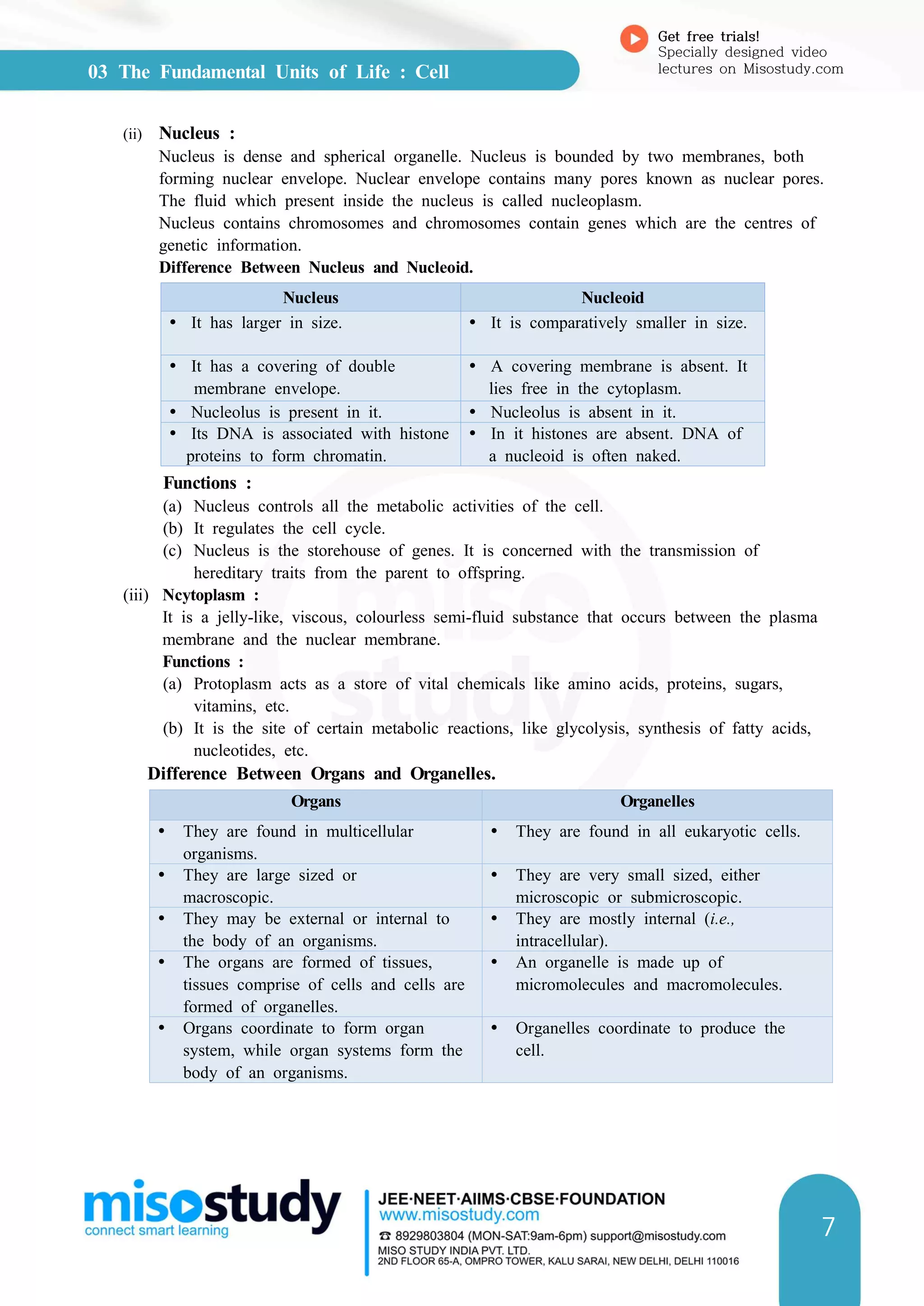
(ii) Nucleus :
Nucleus is dense and spherical organelle. Nucleus is bounded by two membranes, both
forming nuclear envelope. Nuclear envelope contains many pores known as nuclear pores.
The fluid which present inside the nucleus is called nucleoplasm.
Nucleus contains chromosomes and chromosomes contain genes which are the centres of
genetic information.
Difference Between Nucleus and Nucleoid.
Nucleus Nucleoid
Ÿ It has larger in size. Ÿ It is comparatively smaller in size.
Ÿ It has a covering of double
membrane envelope.
Ÿ A covering membrane is absent. It
lies free in the cytoplasm.
Ÿ Nucleolus is present in it. Ÿ Nucleolus is absent in it.
Ÿ Its DNA is associated with histone
proteins to form chromatin.
Ÿ In it histones are absent. DNA of
a nucleoid is often naked.
Functions :
(a) Nucleus controls all the metabolic activities of the cell.
(b) It regulates the cell cycle.
(c) Nucleus is the storehouse of genes. It is concerned with the transmission of
hereditary traits from the parent to offspring.
(iii) Ncytoplasm :
It is a jelly-like, viscous, colourless semi-fluid substance that occurs between the plasma
membrane and the nuclear membrane.
Functions :
(a) Protoplasm acts as a store of vital chemicals like amino acids, proteins, sugars,
vitamins, etc.
(b) It is the site of certain metabolic reactions, like glycolysis, synthesis of fatty acids,
nucleotides, etc.
Difference Between Organs and Organelles.
Organs Organelles
Ÿ They are found in multicellular
organisms.
Ÿ They are found in all eukaryotic cells.
Ÿ They are large sized or
macroscopic.
Ÿ They are very small sized, either
microscopic or submicroscopic.
Ÿ They may be external or internal to
the body of an organisms.
Ÿ They are mostly internal (i.e.,
intracellular).
Ÿ The organs are formed of tissues,
tissues comprise of cells and cells are
formed of organelles.
Ÿ An organelle is made up of
micromolecules and macromolecules.
Ÿ Organs coordinate to form organ
system, while organ systems form the
body of an organisms.
Ÿ Organelles coordinate to produce the
cell.
03 The Fundamental Units of Life : Cell
Get free trials!
Specially designed video
lectures on Misostudy.com
8
07. Cell Organelles
Inside the cell there are different parts performing different activities to keep the cell alive an
functionable. These part are called Cell organelles. They are explained below:
(i) Golgi Apparatus : Golgi apparatus consists of a set of membrane bound, fluid filled
vesicles, vacuoles and flattened cisternae (closed sacks). Cisternae are usually arranged
parallel to each other.
Functions :
(a) Its main function is to store, modify, package and dispatch the substances.
(b) It is also involved in the synthesis of cell wall, plasma membrane and lysosomes.
(ii) Endoplasmic Reticulum : It is a membranous network of tube like structures extending
from nuclear membrane to plasma membrane. It is absent in prokaryotic cells and
matured RBCs of mammals. There are two types of endoplasmic reticulum:
Ÿ Rough Endoplasmic Reticulum (RER): Here ribosomes are present on the surface for
the synthesis of proteins.
Ÿ Smooth Endoplasmic Reticulum (SER): Here ribosomes are absent and is meant for
secreting lipids.
Functions :
(a) It gives internal support to cell.
(b) It helps in transport of various substances from nuclear membrane to plasma
membrane or vice versa.
(c) RER helps in synthesis and transportation of proteins.
(d) SER helps in synthesis and transportation of lipids.
(iii) Ribosomes : These are extremely small, dense and spherical bodies which occur freely
in the matrix (cytosol) or remain attached to the endoplasmic reticulum.
These are made up of ribonucleic acid (RNA) and proteins.
Functions :
They play a major role in the synthesis of proteins.
(iv) Mitochondria : They are small rod-shaped organelles. It is a double membrane structure
with outer membrane being smooth and porous whereas inner membrane being thrown
into a number of folds called cristae. They contain their own DNA and ribosomes. They
are absent in bacteria and red blood cells of mammals.
Functions:
Ÿ They are the sites of cellular respiration, hence provide energy for the vital activities
of living cells.
Ÿ They store energy releases during reactions, in the form of ATP (Energy currency of
the cell). Therefore, they are also called ‘power house’ of the cell.
(v) Centrosome and Centrioles : Centrosome is found only in eukaryotic animal cells. It is
not bounded by any membrane but consists of centrioles. Centroles are hollow
cylindrical structures arranged at right angle to each other and made up of microtubules.
Functions:
Centrioles help in cell division and also help in the formation of cilia and flagella.
03 The Fundamental Units of Life : Cell
Get free trials!
Specially designed video
lectures on Misostudy.com
9
(vi) Plastids: Plastids are present in most of the plant cells and absent in animal cells. They
are usually spherical or discoidal in shaped and double membrane bound organelles.
They also have their own DNA and ribosomes. Plastids are of three types:
(a) Chloroplasts : These are the green coloured plastids containing chlorophyll.
Chloroplasts aid in the manufacture food by the process of photosynthesis.
(b) Chromoplasts : These are the colourful plastids (except green colour).
(c) Leucoplasts : These are the colourless plastids.
Difference Between Leucoplasts and Chromoplasts (Nongreen Plastids)
Mitochondria Chloroplasts
Ÿ They are colourless. Ÿ They range from brownish to
reddish n colour.
Ÿ They are cylindrical or ounded
in shape.
Ÿ They are irregular in shape.
Ÿ They are found in unexposed
cells.
Ÿ They are found in both
exposed and unexposed cells.
Ÿ They can change to other type
of plastids.
Ÿ They do not change into
other types of plastids.
Ÿ They take part in storage of
zood, e.g., amyloplasts
(carbohydrates), elaioplasts
(lipids), aleuroplasts (proteins).
Ÿ They provide colour to
organs to attract pollination
and disseminators.
Difference Between Chloroplasts and Chromoplasts.
Chloroplasts Chromoplasts
Ÿ They are green plastids. Ÿ They are non-green coloured plastids.
Ÿ They ontain chlorophylls and
carotenoids
Ÿ Chlorophylls are absent. Only carotenids
are present.
Ÿ Lamellae are present. Ÿ Lamellae are absent.
Ÿ Chloroplasts are sites of
photosynthesis.
Ÿ They add colour to the organs (e.g.,
flowers, fruits) for attracting animals to
perform pollination and fruit dispersal.
Functions :
Ÿ Chloroplasts trap solar energy and utilise it to manufacture food for the plant.
Ÿ Chromoplasts impart various colours to flowers to attract insects for pollination.
Ÿ Lecuoplasts help in the storage of food in the form of starch, proteins and fats.
03 The Fundamental Units of Life : Cell
Get free trials!
Specially designed video
lectures on Misostudy.com
10
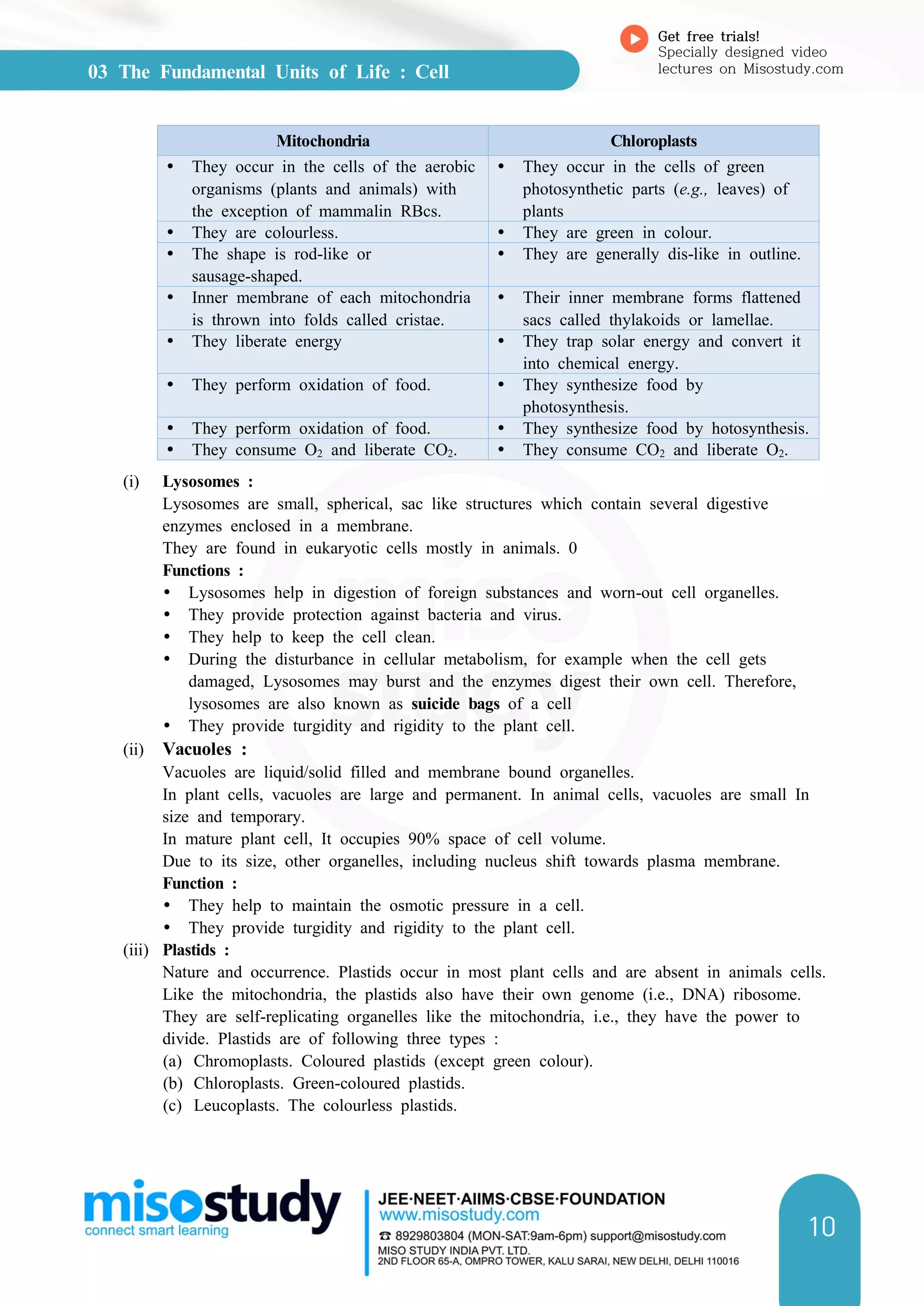
Mitochondria Chloroplasts
Ÿ They occur in the cells of the aerobic
organisms (plants and animals) with
the exception of mammalin RBcs.
Ÿ They occur in the cells of green
photosynthetic parts (e.g., leaves) of
plants
Ÿ They are colourless. Ÿ They are green in colour.
Ÿ The shape is rod-like or
sausage-shaped.
Ÿ They are generally dis-like in outline.
Ÿ Inner membrane of each mitochondria
is thrown into folds called cristae.
Ÿ Their inner membrane forms flattened
sacs called thylakoids or lamellae.
Ÿ They liberate energy Ÿ They trap solar energy and convert it
into chemical energy.
Ÿ They perform oxidation of food. Ÿ They synthesize food by
photosynthesis.
Ÿ They perform oxidation of food. Ÿ They synthesize food by hotosynthesis.
Ÿ They consume O2 and liberate CO2. Ÿ They consume CO2 and liberate O2.
(i) Lysosomes :
Lysosomes are small, spherical, sac like structures which contain several digestive
enzymes enclosed in a membrane.
They are found in eukaryotic cells mostly in animals. 0
Functions :
Ÿ Lysosomes help in digestion of foreign substances and worn-out cell organelles.
Ÿ They provide protection against bacteria and virus.
Ÿ They help to keep the cell clean.
Ÿ During the disturbance in cellular metabolism, for example when the cell gets
damaged, Lysosomes may burst and the enzymes digest their own cell. Therefore,
lysosomes are also known as suicide bags of a cell
Ÿ They provide turgidity and rigidity to the plant cell.
(ii) Vacuoles :
Vacuoles are liquid/solid filled and membrane bound organelles.
In plant cells, vacuoles are large and permanent. In animal cells, vacuoles are small In
size and temporary.
In mature plant cell, It occupies 90% space of cell volume.
Due to its size, other organelles, including nucleus shift towards plasma membrane.
Function :
Ÿ They help to maintain the osmotic pressure in a cell.
Ÿ They provide turgidity and rigidity to the plant cell.
(iii) Plastids :
Nature and occurrence. Plastids occur in most plant cells and are absent in animals cells.
Like the mitochondria, the plastids also have their own genome (i.e., DNA) ribosome.
They are self-replicating organelles like the mitochondria, i.e., they have the power to
divide. Plastids are of following three types :
(a) Chromoplasts. Coloured plastids (except green colour).
(b) Chloroplasts. Green-coloured plastids.
(c) Leucoplasts. The colourless plastids.
03 The Fundamental Units of Life : Cell
Get free trials!
Specially designed video
lectures on Misostudy.com
11
Function :
Ÿ Chloroplasts trap solar energy and utilise it to manufacture food for the plant.
Ÿ Chromoplasts impart various colours to flowers to attract insects for pollination.
Ÿ Lecuoplasts help in the storage of food in the form of starch, proteins and fats.
Peroxiomes : They are small and spherical organelles containing powerful oxidative enzymes.
They are bounded by a single membrane. They are found in kidney and liver cells.
Function : They are specialized to carry out some oxidative reactions, such as detoxification
or removal of toxic substances form cell.
Difference Between Animal Cell and Plant Cell:
S.No. Animal cell Plant cell
Ÿ Animal cells are generally small in size. Plant cells are larger than animal cells.
Ÿ Cell wall is absent. Plasma membrane of plant cell is
surrounded by a rigid cell wall of
cellulose.
Ÿ Plastids are absent except in case of
protozoan Euglena.
Plastids are present.
Ÿ Here vacuoles are many, small and
temporary.
They have a permanent and large
central sap vacuole.
Ÿ They have centrosome and centrioles. They lack centrosome and centrioles.
Structure of Plant Cell and Animal Cell :
03 The Fundamental Units of Life : Cell
Get free trials!
Specially designed video
lectures on Misostudy.com
12
CBSE Pattern
Exercise (1)
(Q 1 to 3) One Mark
1. State two important functions of nucleus.
2. Which organelles is called factory of ribosomes
3. What is plasmolysis
(Q 4 to 6) Two Marks
4. What are lysosomes termed as suicide bags of cell
5. Name any cell organelles which is non membranous
6. Why do plant cell posses large sized vacuole
(Q 7 to 8) Three Marks
7. How is prokaryotic cell differ from eukaryotic cell
8. Differentiat between unicellular and multicellular organism
(Q 9 to 10) Five Marks
9. Draw a well labeled diagram of plant cell
10.
(a) What are genes. what is difference between genes and chromosome.
(b) Why is the inner membrane of mitochondria folded.
03 The Fundamental Units of Life : Cell
Get free trials!
Specially designed video
lectures on Misostudy.com
13
Answer & Solution
Q1.
(i) The nucleus controls all metabolic activities of the cell. If the nucleus is removed from a
cell, the protoplasm ultimately dries up and dies.
(ii) It regulates the cell cycle.
Q2. Nucleolus is called factory of ribosomes
Q3. When a living plants cell loses water through osmosis. there is a shrinkage or contraction of
the protoplasm away from the cell wall This phenomenon is called plasmolysis.
Q4. During breakdown of cell structure, when the cell gets damaged, lysosomes may burst and the
enzymes eat up their own cells. Therefore, lysosomes are also known as suicide bags of a cell
Q5. Nonmembranous organelles do not contain a definite boundary for organelles. On that account,
these organelles do not possess fluid-filled cavities. All organelles in prokaryotes are
nonmembranous. Ribosomes, nucleoid, centrioles, cilia, flagella, and components of the
cytoplasm like microtubules, microfilaments, and intermediate filaments are nonmembranous
organelles
Q6. Plant cells have large sized vacuoles because these ghelp the cell in maintaining stiffness while
it withstands all the environmental conditions. They store food materials, water required by the
plant. Over a period of time the excretory products accumulated will break down in the
vacuole. Vacuoles maintain the shape of the cell constantly without getting disturbed by the
availability of the water to the plant. Hence, plants have larger vacuoles.
Animals can move f10rom place to place in search of food, water and others while plants
cannot.
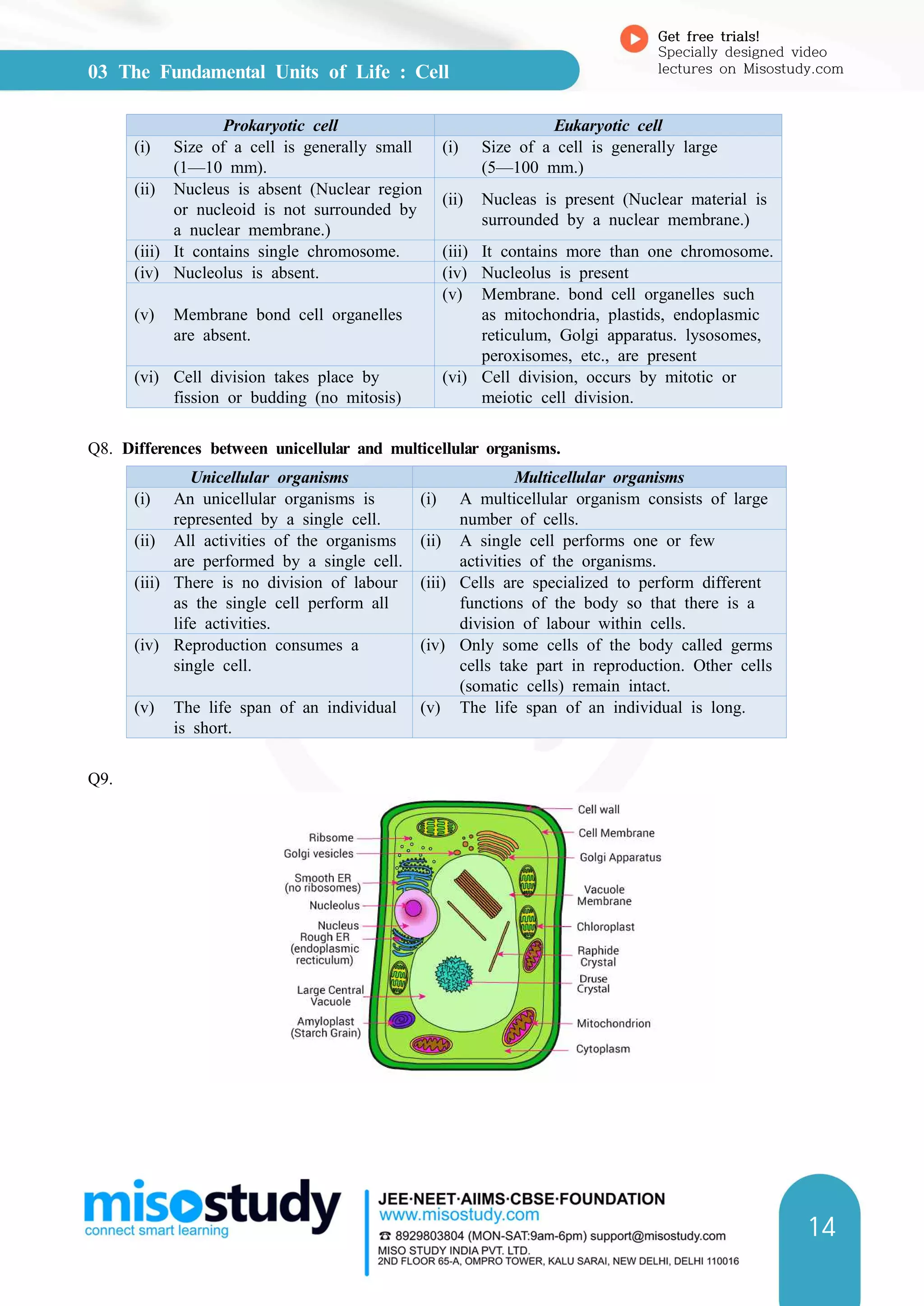
Q7. Differences between prokaryotic cells and eukaryotic cells.
03 The Fundamental Units of Life : Cell
Get free trials!
Specially designed video
lectures on Misostudy.com
14
Prokaryotic cell Eukaryotic cell
(i) Size of a cell is generally small
(1—10 mm).
(i) Size of a cell is generally large
(5—100 mm.)
(ii) Nucleus is absent (Nuclear region
or nucleoid is not surrounded by
a nuclear membrane.)
(ii) Nucleas is present (Nuclear material is
surrounded by a nuclear membrane.)
(iii) It contains single chromosome. (iii) It contains more than one chromosome.
(iv) Nucleolus is absent. (iv) Nucleolus is present
(v) Membrane bond cell organelles
are absent.
(v) Membrane. bond cell organelles such
as mitochondria, plastids, endoplasmic
reticulum, Golgi apparatus. lysosomes,
peroxisomes, etc., are present
(vi) Cell division takes place by
fission or budding (no mitosis)
(vi) Cell division, occurs by mitotic or
meiotic cell division.
Q8. Differences between unicellular and multicellular organisms.
Unicellular organisms Multicellular organisms
(i) An unicellular organisms is
represented by a single cell.
(i) A multicellular organism consists of large
number of cells.
(ii) All activities of the organisms
are performed by a single cell.
(ii) A single cell performs one or few
activities of the organisms.
(iii) There is no division of labour
as the single cell perform all
life activities.
(iii) Cells are specialized to perform different
functions of the body so that there is a
division of labour within cells.
(iv) Reproduction consumes a
single cell.
(iv) Only some cells of the body called germs
cells take part in reproduction. Other cells
(somatic cells) remain intact.
(v) The life span of an individual
is short.
(v) The life span of an individual is long.
Q9.
03 The Fundamental Units of Life : Cell
Get free trials!
Specially designed video
lectures on Misostudy.com
15
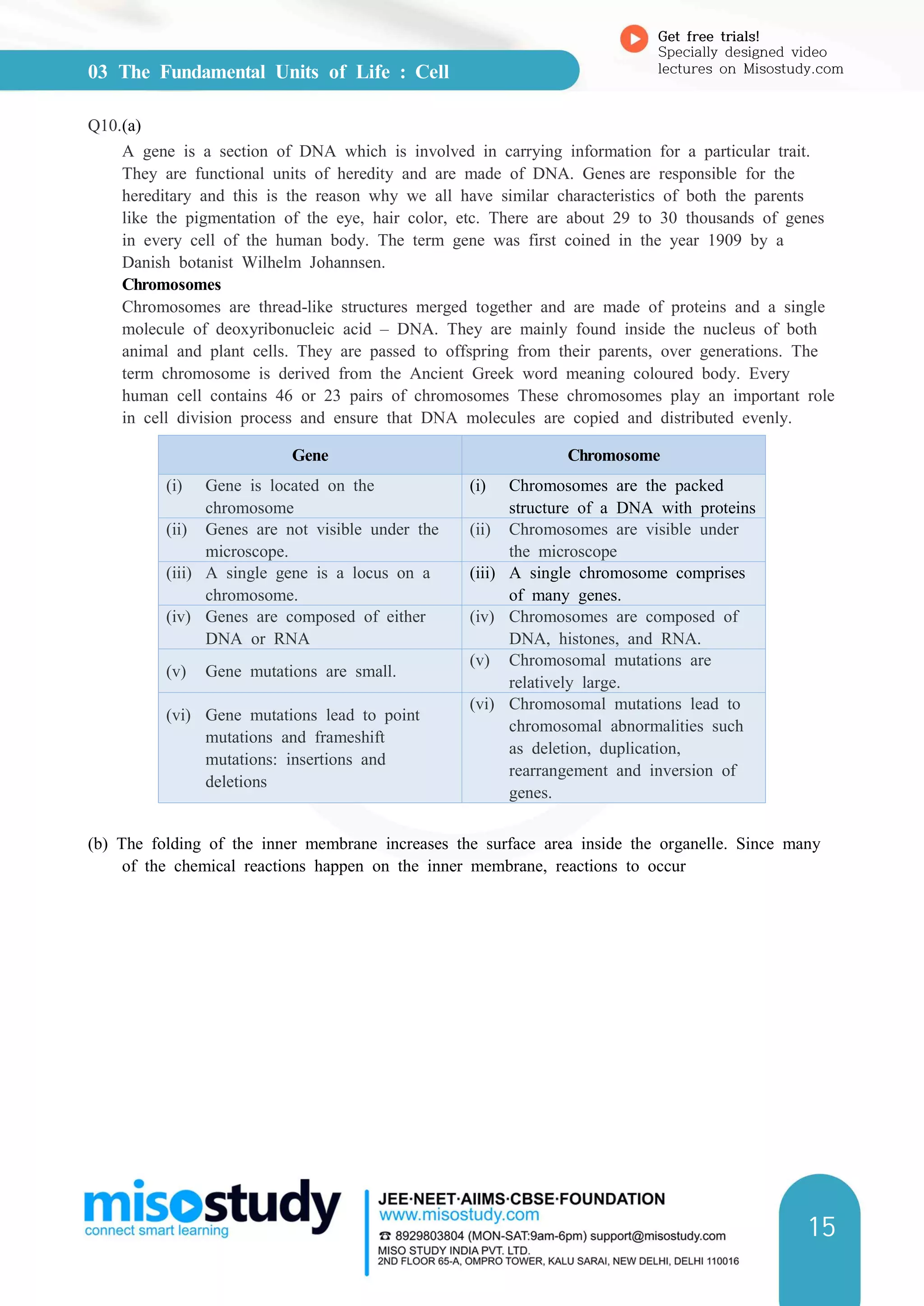
Q10.(a)
A gene is a section of DNA which is involved in carrying information for a particular trait.
They are functional units of heredity and are made of DNA. Genes are responsible for the
hereditary and this is the reason why we all have similar characteristics of both the parents
like the pigmentation of the eye, hair color, etc. There are about 29 to 30 thousands of genes
in every cell of the human body. The term gene was first coined in the year 1909 by a
Danish botanist Wilhelm Johannsen.
Chromosomes
Chromosomes are thread-like structures merged together and are made of proteins and a single
molecule of deoxyribonucleic acid – DNA. They are mainly found inside the nucleus of both
animal and plant cells. They are passed to offspring from their parents, over generations. The
term chromosome is derived from the Ancient Greek word meaning coloured body. Every
human cell contains 46 or 23 pairs of chromosomes These chromosomes play an important role
in cell division process and ensure that DNA molecules are copied and distributed evenly.
Gene Chromosome
(i) Gene is located on the
chromosome
(i) Chromosomes are the packed
structure of a DNA with proteins
(ii) Genes are not visible under the
microscope.
(ii) Chromosomes are visible under
the microscope
(iii) A single gene is a locus on a
chromosome.
(iii) A single chromosome comprises
of many genes.
(iv) Genes are composed of either
DNA or RNA
(iv) Chromosomes are composed of
DNA, histones, and RNA.
(v) Gene mutations are small.
(v) Chromosomal mutations are
relatively large.
(vi) Gene mutations lead to point
mutations and frameshift
mutations: insertions and
deletions
(vi) Chromosomal mutations lead to
chromosomal abnormalities such
as deletion, duplication,
rearrangement and inversion of
genes.
(b) The folding of the inner membrane increases the surface area inside the organelle. Since many
of the chemical reactions happen on the inner membrane, reactions to occur
Class 9 | Mathematics
04 Number System
04 Number Systems
Get free trials!
Specially designed video
lectures on Misostudy.com
3
01. Decimal Representation of Rational Numbers
A rational number is a number which can be expressed in the form 

, where m and n are
both integers and n ≠ 0. A rational number 

is said to be in its lowest terms, if n ∊ N
and m and n have no common factor other than 1. For example, 

 

 

etc are rational
numbers in their lowest terms, whereas 

is not in its lowest terms.
A rational number 

is positive rational number if m and n are of the same sign. If m and
n are such that one of them is positive and another one is negative, then the rational number


is negative.
Note Every integer m is also a rational number, as it can be written as 

.
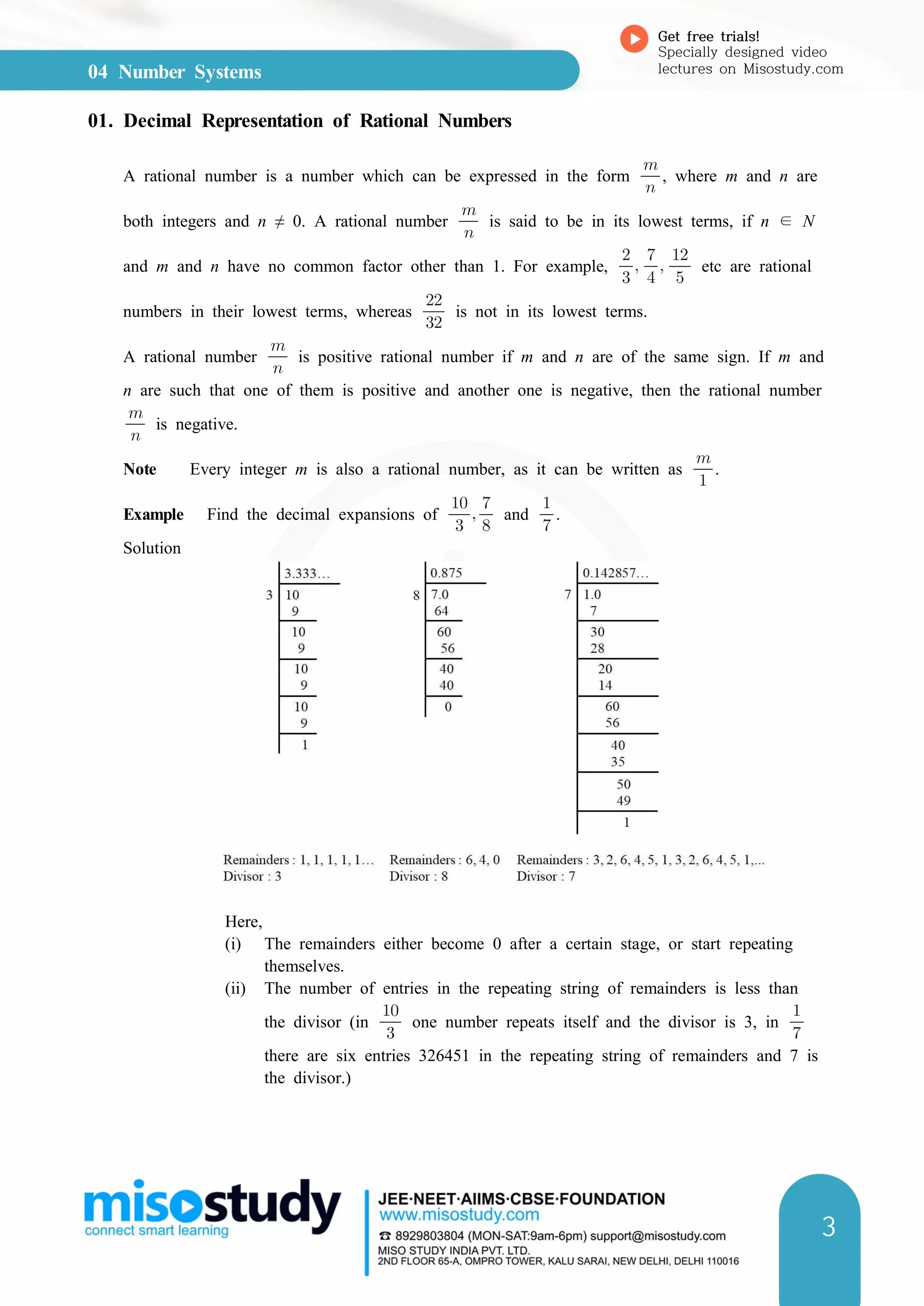
Example Find the decimal expansions of 

 

and 

.
Solution
Here,
(i) The remainders either become 0 after a certain stage, or start repeating
themselves.
(ii) The number of entries in the repeating string of remainders is less than
the divisor (in 

one number repeats itself and the divisor is 3, in 

there are six entries 326451 in the repeating string of remainders and 7 is
the divisor.)
04 Number Systems
Get free trials!
Specially designed video
lectures on Misostudy.com
4
(iii) If the remainders repeats, then we get a repeating block of digits in the
quotient (for 

, 3 repeats in the quotient and for 

, we get the
repeating block 142857 in the quotient).
Although we have noticed this pattern using only the examples above, its
is true for all rationals of the form

≠. On division of p by q, two
main things happen – either the remainder becomes zero or never becomes
zero and we get a repeating string of remainders.
Case (i) The remainder becomes zero
In the example of 

, we found that the remainder becomes zero after
some steps and the decimal expansion of 

 . Other examples
are 

  

 . In all these cases, the decimal expansion
terminates or ends after a finite number of steps. We call the decimal
expansion of such numbers terminating.
Case (ii) The remainder never becomes zero
In the examples of 

and 

, we notice that the remainders repeat
after a certain stage forcing the decimal expansion to go on for ever.
In other words, we have a repeating block of digits in the quotient.
We say that this expansion is non-terminating recurring. For example,


  and 

 
Remark The usual way of showing that 3 repeats in the quotient of 

is to write it as
. Similarly, since the block of digits 142857 repeats in the quotient of 

, we
write 

as , where the bar above the digits indicates the block of digits
that repeats. Also  can be written as . So, all these examples give
us non-terminating recurring (repeating) decimal expansions.
Thus, we see that the decimal expansion of rational numbers have only two
choices: either they are terminating or non-terminating recurring.
02. Conversion of Decimal Numbers into Rational Numbers of the Form 

We shall learn how to convert a given decimal number into an equivalent rational number in
the form 

.
04 Number Systems
Get free trials!
Specially designed video
lectures on Misostudy.com
5
We shall divide it into-two parts.
(i) When the decimal number is of terminating nature.
(ii) When the decimal representation is of non-terminating nature.
Conversion of a Terminating Decimal Number to the From 

In order to convert a rational number having finite number of digits after the decimal point,
we follow the following steps :
Step I Obtain the rational number.
Step II Determine the number of digits in its decimal part.
Step III Remove decimal point from the numerator. Write 1 in the denominator and put as
many zeros on the right side of 1 as the number of digits in the decimal part of
the given rational number.
Step IV Find a common divisor of the numerator and denominator and express the
rational number to lowest terms by dividing its numerator and denominator by the
common divisor.
Example Express each of the following decimal numbers in the form 

:
(i) 15.75 (ii) 8.0025 (iii) –25.6875
Solution
(i) We have,
  

 ÷
÷
 

(ii) We have,
  

 ÷
÷
 

(iii) We have,
  

 ÷
÷
 

Conversion of a Pure Recurring Decimal to the Form 

In a non-terminating repeating decimal, there are two types of decimal representations.
(i) A decimal in which all the digits after the decimal point are repeated. These types of
decimal are known as pure recurring decimals.
For Example :    are pure recurring decimals.
(ii) A decimal in which at least one of the digits after the decimal point is not repeated and
then some digit or digits are repeated. This type of decimals are known as mixed
recurring decimals.
For Example :    are mixed recurring decimals.
04 Number Systems
Get free trials!
Specially designed video
lectures on Misostudy.com
6
In order to convert a pure recurring decimal to the form 

, we follow the following steps :
Step I Obtain the repeating decimal and put it equal to x (say).
Step II Write the number in decimal form by removing bar from the top of repeating digits
and listing repeating digits at least twice.
For Example, write x =  as x = 0.888... and x =  as x = 0.141414...
Step III Determine the number of digits having bar on their heads.
Step IV If the repeating decimal has 1 place repetition, multiply by 10; a two place
repetition, multiply by 100; a three place repetition, multiply by 1000 and so on.
Step V Subtract the number in step II from the number obtained in step IV.
Step VI Divide both sides of the equation by the coefficient of x.
Step VII Write the rational number in its simplest form.
Example Express the following decimal in the form 

:

Solution Let x = 
⇒ x = 0.353535 ... ...(i)
Here, we have two repeating digits after the decimal point. So, we multiply sides
of (i) by 102
= 100 to get
10x = 35.3535 ... ...(ii)
Subtracting (i) from (ii), we get
100x – x = (35.3535 ...) - (0.3535 ...)
⇒ 99x = 35
⇒   

Hence,   

Conversion of a Mixed Recurring Decimal to the Form 

While converting a recurring decimal that has one or more digits before the repeating digits,,
it is necessary to isolate the repeating digits.
In order to convert a mixed recurring decimal to the form 

, we follow the following steps:
Step I Obtain the mixed recurring decimal and write it equal to x (say).
Step II Determine the number of digits after the decimal point which do not have bar on
them. Let there be n digits without bar just after the decimal point.
Step III Multiply both sides of x by 10n
so that only the repeating decimal is on the right
side of the decimal point.
Step IV Use the method of converting pure recurring decimal to the form 

and obtain
the value of x.
04 Number Systems
Get free trials!
Specially designed video
lectures on Misostudy.com
7
Example Express the following decimals in the form 

.

Solution Let x = 
Clearly, there are three digits on the right side of the decimal point which are
without bar. so, we multiply both sides of x by 103
= 1000 so that only the
repeating decimal is left on the right side of the decimal point.
∴   
⇒     
⇒     

⇒   
 ×   
⇒   
  
⇒   

⇒   

03. Irrational Numbers
Irrational Numbers
A number is an irrational number, if it has a non-terminating and non-repeating decimal
representation.
We have seen that a number in terminating decimal form or in a non-terminating but
repeating decimal form can always be written in the form 

, where p, q are integers such
that q ≠ 0. It follows from this that an irrational number cannot be written in the form 

,
where p and q are both integers and q ≠ 0.
Example Prove that  is an irrational number.
Solution We find the square root of  by long division method.
04 Number Systems
Get free trials!
Specially designed video
lectures on Misostudy.com
8
∴    
We observe that the decimal representation of  is neither terminating nor
repeating. Hence,  is an irrational number.
Remark  is not a rational number, if n is not a perfect square.
Example Find three different irrational numbers between the rational numbers 

and 

.
Solution We have,
  

  and   

 
We observe that in the first decimal place a has digit 7 and b has digit 8,
therefore a < b. In the second decimal place a has digit 1. So, if we consider
irrational numbers
x = 0.72072007200072000072...
y = 0.73073007300073000073...
z = 0.74074007400074000074...
We find that
a < x < y < z < b
Hence, x, y and z are required irrational numbers.
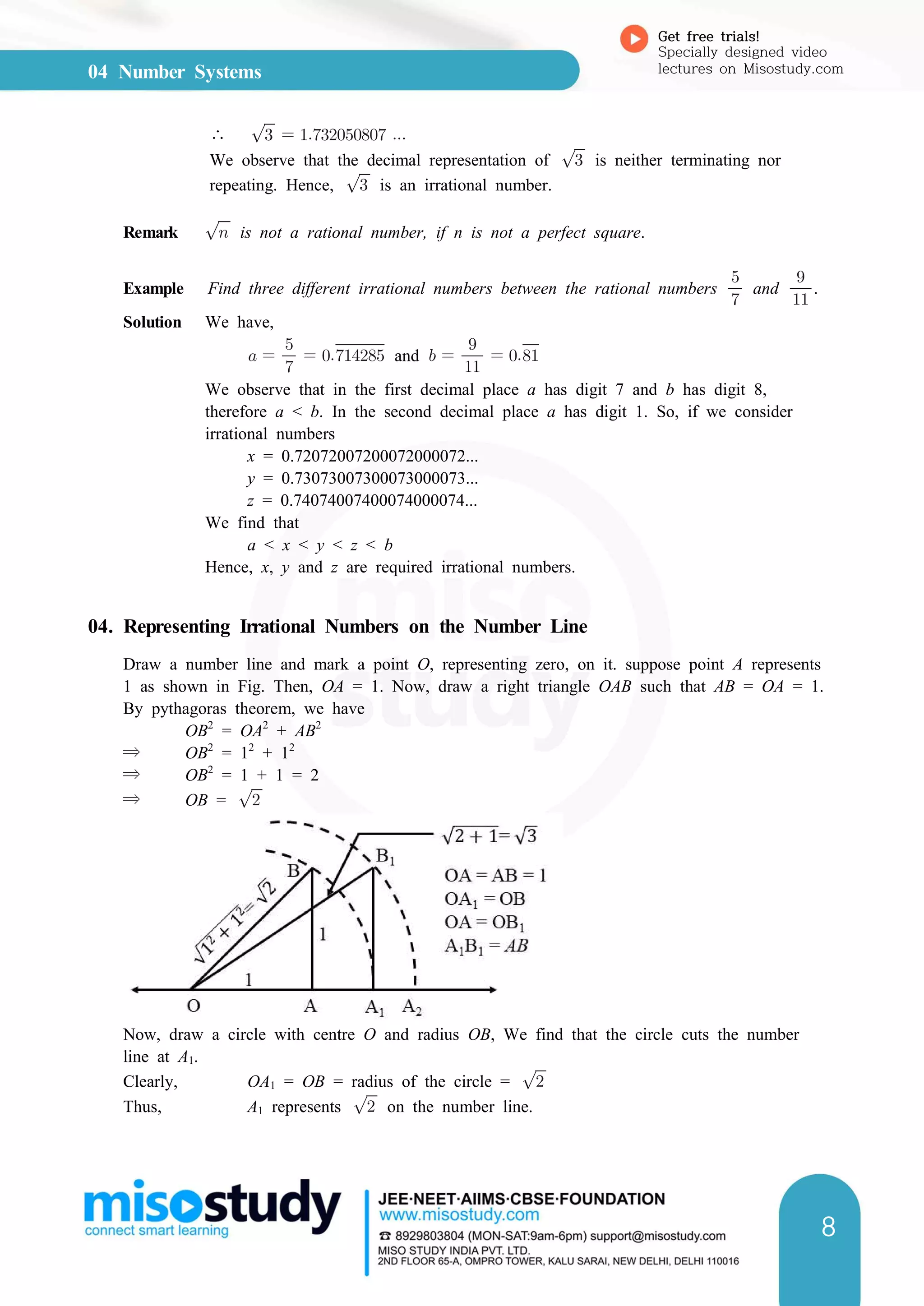
04. Representing Irrational Numbers on the Number Line
Draw a number line and mark a point O, representing zero, on it. suppose point A represents
1 as shown in Fig. Then, OA = 1. Now, draw a right triangle OAB such that AB = OA = 1.
By pythagoras theorem, we have
OB2
= OA2
+ AB2
⇒ OB2
= 12
+ 12
⇒ OB2
= 1 + 1 = 2
⇒ OB = 
Now, draw a circle with centre O and radius OB, We find that the circle cuts the number
line at A1.
Clearly, OA1 = OB = radius of the circle = 
Thus, A1 represents  on the number line.
04 Number Systems
Get free trials!
Specially designed video
lectures on Misostudy.com
9
But, we have seen that  is not a rational number. Thus, we find that there is a point on
the number which is not a rational number.
Now, draw a right triangle OA1B1 such that A1B1 = AB = 1.
Again, by Pythagoras theorem, we have


 

 

⇒ 

  
 
⇒ 

 
⇒   
Now, draw a circle with centre O and radius OB1 =  . This circle cuts the number line at
A2 as shown in Fig.
Clearly, OA2 = OB1 = 
Thus, A2 represents  on the number line.
Also, A2 is a point on the number line not representing a rational number.
Continuing in this manner, we can show that there are many other points on the number line
representing       etc. which are not rational numbers. In fact, such numbers
are irrational numbers.
05. Real Numbers and Real Number Line
Existence of Square Root of a Positive Real Number
For any positive real number x, we have










 



   
 


 



 
Therefore, to find the positive square root of a positive real number, we may follow the
following algorithm.
Algorithm
Step I Obtain the positive real number x (say).
Step II Draw a line and mark a point A on it.
Step III Mark a point B on the line such that AB = x units.
Step IV From point B mark a distance of 1 unit and mark the new point as C.
Step V Find the mid-point of AC and mark the point as O.
Step VI Draw a circle with centre O and radius OC.
Step VII Draw a line perpendicular to AC passing through B and intersecting the
semi-circle at D. Length BD is equal to  .
Justification : We have,
AB = x units and BC = 1 unit.
∴ AC = (x + 1) units
⇒ OA = OC = 
  
units
04 Number Systems
Get free trials!
Specially designed video
lectures on Misostudy.com
10
⇒ OD = 
  
units [∵ OA = OC = OD]
Now, OB = AB – OA = x – 
  
 
  
Using Pythagoras Theorem in ∆OBD, we obtain
OD2
= OB2
+ BD2
⇒ BD2
= OD2
– OB2
⇒ BD2
= 
  



 


⇒ BD = 





 



 
This shows that  exists for all real numbers x > 0.
Algorithm
In order to find the position of  on the number line, we consider BC as the number line,
with B as the origin to represent zero. Since BC = 1 so, C represents 1. Now, mark points
C1, C2, C3,... such that CC1 = BC = 1, C1C2 = BC = 1; C2C3 = BC = 1 and so on. Clearly,
C1, C2, C3,... represent 2,3,4,... respectively.
Now, draw an arc with centre at B and radius equal to BD. Suppose this arc cuts the
number line BC with B as the origin at E. Then, BE =  . Consequently, E will represent
 .
Example Represent  on the number line.
Solution In order to represent  on number line, we follow the following steps :
Step I Draw a line and mark a point A on it.
Step II Mark a point B on the line drawn in step I such that AB = 9.3 cm.
04 Number Systems
Get free trials!
Specially designed video
lectures on Misostudy.com
11
Step III Mark a point C on AB produced such that BC = 1 unit.
Step IV Find mid-point of AC. Let the mid-point be O.
Step V Taking O as the centre and OC = OA as radius draw a semi-circle.
Also, draw a line passing through B perpendicular to OB. Suppose it
cuts the semi-circle at D.
Step VI Taking B as the centre and BD as radius draw an arc cutting OC
produced at E. Point E so obtained represent  .
Suppose we want to visualise the representation of 3.765 on the number line. We observe
that 3.765 lies between 3 and 4. So, let us look closely at the portion of the number line
between 3 and 4. We divide this portion into 10 equal parts and mark each point of division
as shown in Fig.
The first mark to the right of 3 will represent 3.1, the second 3.2 and so on. to see this
clearly, we magnify this portion by taking a magnifying glass and look at the portion
between 3 and 4. Though magnifying glass this portion between 3 and 4 will look like what
we see in Fig. As 3.765 lies between 3.7 and 3.8. So, let us mark 3.7 as A1 and 3.8 as A2
and focus on the portion A1 A2 of the number line. Now, we imagine that the portion A1 A2
of the number line has been divided into ten equal parts. The first mark on the right of A1
(representing 3.7) will represent 3.71, the next 3.72, and so on. As we may find some
difficulty in observing these points of division between 3.7 and 3.8. Therefore, to have a
clear view of the same, we magnify this portion as shown in Fig. As 3.765 lies between 3.76
and 3.77. So, we identify points representing 3.76 and 3.74 and mark them as B1 and B2
respectively as shown in Fig.
04 Number Systems
Get free trials!
Specially designed video
lectures on Misostudy.com
12
Since 3.765 lies between 3.76 and 3.77. So, let us now focus on the portion B1 B2 of the
number line (Fig.) and imagine that it has been divided into ten equal parts. Let us magnify
this portion to have clear view of this portion. The first mark on the right of 3.76 will
represent 3.761, the next one represent 3.762, and so on. Clearly, 3.765 is the fifth mark in
these subdivisions as shown in Fig. and is represented by point P on the number line.
This process of visualisation of numbers on the number line, through a magnifying glass, is
known as the process of successive magnification. Thus it is possible to visualise the position
(or representation) of a real number with a terminating decimal expansion on the number line
by successive magnification. Let us now try to visualise the position (or representation) of a
real number with a non-terminating recurring decimal expansion on the number line.
Suppose we wish to visualise the representation (or position) of  (upto 4 decimal places,
i.e. upto 4.2626) on the number line. We observe that 4.2626 is located somewhere between
4 and 5 on the number line. So, let us look at the portion of the number line between 4 and
5. We divide this portion into 10 equal parts and mark each point of division as shown in
Fig. The first mark to the right of 4 will represent 4.1, the next 4.2 and so on. To see this
clearly, we magnify this portion of the number line by taking a magnifying glass and look at
the portion between 4 and 5. through magnifying glass this portion will look like what we
see in Fig. We observe that 4.2626 lies between 4.2 and 4.3. So, we mark these points as A1
and A2 respectively as shown in Fig. As 4.26 lies between 4.2 and 4.3. So, let us focus on
the portion A1 A2 of the number line. We imagine that the portion A1 A2 has been divided
into ten equal parts. The first mark on the fight side of A1 will represent 4.21, the number
4.22, and so on.
To see this clearly, we magnify this portion. Through magnifying glass this portion will look
like what we see in Fig. Now, 4.262 lies between 4.26 and 4.27.
So, let us mark 4.26 as B1 and 4.27 as B2 and focus on the portion B1 B2 of the number
line. Let us imagine that the portion B1 B2 has been divided into ten equal parts. The first
mark on the right side of B1 (representing 4.26) will represent 4.261, then next 4.262, and so
on.
To have clear view of these points of division, we magnify this portion as shown in Fig. As
4.2626 lies between 4.262 and 4.263. So, we mark the points representing 4.262 and 4.263 as
C1 and C2 respectively.
We imagine that the portion C1 C2 of the number line has been divided into ten equal parts.
The first mark on the right side of C1 (representing 4.262) will represent 4.2621, then next
4.2622, and so on. clearly, sixth point will represent 4.2626 as shown in Fig. and marked as
point P.
04 Number Systems
Get free trials!
Specially designed video
lectures on Misostudy.com
13
It is evident from the above discussion on visulalisation of real numbers on number line that
every real number is represented by a unique point on the number line and every point on
the number line represents a unique real number. That is why number line is also known as
real number line or simply real line.
04 Number Systems
Get free trials!
Specially designed video
lectures on Misostudy.com
14
CBSE Pattern
Exercise (1)
(Q 1 to 3) One Mark
1. State whether the following statements are true or false. Justify your answers.
(i) Every irrational number is a real number.
(ii) Every point on the number line is of the form  , where m is a natural number
(iii) Every real number is an irrational number
2. State whether the following statements are true or false. Give reasons for your answers.
(i) Every natural number is a whole number.
(ii) Every integer is a whole number.
(iii) Every rational number is a whole number.
3. Show that 3.142678 is a rational number. In other words, express 3.142678 in the form 


where p and q are integers and q ≠ 0.
(Q 4 to 7) Two Marks
4. Find five rational numbers between 

and 

.
5. Show that 1.272727... =  can be expressed in the form 

 where p and q are integers and
q ≠ 0.
6. Rationalise the denominator of   

.
7. Visualise  on the number line, up to 4 decimal places.
(Q 8 to 10) Four Marks
8. Look at several examples of rational numbers in the form 

(q ≠ 0), where p and q are
integers with no common factors other than 1 and having terminating decimal representations
(expansions). Can you guess what property q must satisfy?
9. Represent  on the number line.
04 Number Systems
Get free trials!
Specially designed video
lectures on Misostudy.com
15
10. Find :
(i) 


(ii) 


(iii) 


(iv) 

 
04 Number Systems
Get free trials!
Specially designed video
lectures on Misostudy.com
16
Answer & Solution
Q1
(i) True
Because all rational numbers and all irrational numbers form the group (collection) of real
numbers.
(ii) False
Because negative numbers cannot be the square root of any natural number.
(iii) False
Because rational numbers are also a part of real numbers.
Q2
(i) True
∵ The collection of all natural numbers and 0 is called whole numbers.
(ii) False
∵ Negative integers are not whole numbers.
(iii) False
∵ Rational numbers are of the form p/q ≠ 0 and q does not divide p completely that are not
whole numbers.
Q3
We have 3.142678 = 

, and hence is a rational number.
Now, let us consider the case when the decimal expansion is non-terminating recurring.
Q4
Since, we need to find five rational numbers, therefore, multiply numerator and denominator by 6.
∴ 

 ×
×
 

and 

 ×
×
 

∴ Five rational numbers between 

and 

are 

 

 

 

 

.
Q5
04 Number Systems
Get free trials!
Specially designed video
lectures on Misostudy.com
17
Let x = 1.272727... Since two digits are repeating, we multiply x by 100 to get
100x = 127.2727...
So, 100x = 126 + 1.272727... = 126 + x
Therefore, 100x – x = 126, i.e., 99x = 126
i.e. x = 

 

You can check the reverse that 

 .
Q6
We use the identity   
. Multiply and divide 

by  to get
  

× 

 

  .
Q7
 or 4.2626 lies between 4 and 5.
Q8
Let us look decimal expansion of the following terminating rational numbers :


 ×
×
  [Denominator = 2 = 21
]


 ×
×
 

  [Denominator = 5 = 51
]


 ×
×
 

  [Denominator = 8 = 23
]


 ×
×
 

  [Denominator = 125 = 53
]


 ×
×
 

  [Denominator = 20 = 22
× 51
]


 ×
×
 

  [Denominator = 16 = 24
]
04 Number Systems
Get free trials!
Specially designed video
lectures on Misostudy.com
18
We observe that the prime factorisation of q (i.e. denominator) has only powers of 2 or powers of
5 or powers of both.
Q9
Draw a line segment AB = 9.3 units and extend it to C such that BC = 1 unit.
Find mid point of AC and mark it as O.
Draw a semicircle taking O as centre and AO as radius. Draw BD⊥AC.
Draw an arc taking B as centre and BD as radius meeting AC produced at E such that BE = BD
=  units.
Q10
(i) 9 = 3 × 3 = 32
∴(9)3/2
= (32
)3/2
= 32×3/2
= 33
= 27
[(am
)n
= amn
]
(ii) 32 = 2 × 2 × 2 × 2 × 2 = 25
∴(32)2/5
= (25
)2/5
= 25×2/5
= 22
= 4
[(am
)n
= amn
]
(iii) 16 = 2 × 2 × 2 × 2 = 24
∴(16)3/4
= (24
)3/4
= 24×3/4
= 23
= 8
[(am
)n
= amn
]
(iv) 125 = 5 × 5 × 5 = 53
∴(125)–1/3
= (53
)–1/3
= 53×(–1/3)
= 5–1
= 

[a–n
an

]

CBSE Class 9th Sample eBook

  • 2.
    Class 9 |Physic 01 Motion
  • 3.
    01 Motion Get freetrials! Specially designed video lectures on Misostudy.com 3 Atoms, molecules, planets, stars and galaxies are all in motion. We often perceive an object to be in motion when its position changes with time. An object may appear to be moving for one person and stationary for some other. For the passengers in a moving bus, the roadside trees appear to be moving backwards. A person standing on the road–side perceives the bus along with the passengers as moving. However, a passenger inside the bus sees his fellow passengers to be at rest. Atoms, molecules, planets, stars and galaxies are all in motion. We often perceive an object to be in motion when its position changes with time. An object may appear to be moving for one person and stationary for some other. For the passengers in a moving bus, the roadside trees appear to be moving backwards. A person standing on the road–side perceives the bus along with the passengers as moving. However, a passenger inside the bus sees his fellow passengers to be at rest. 02. MOTION ALONG A STRAIGHT LINE Assume the motion of an object moving along a straight path. The object starts its journey from O which is treated as its reference point (Fig.). Let A, B and C represent the position of the object at different instants. At first, the object moves through C and B and reaches A. Then it moves back along the same path and reaches C through B. The total path length covered by the object is OA + AC, that is 60 km + 35 km = 95 km. This is the distance covered by the object. The shortest distance measured from the initial to the final position of an object is known as the displacement. 03. UNIFORM AND NON- UNIFORM MOTION Assume an object moving along a straight line. Let it travel 9 m in the first second, 9 m more in the next second, 9 m in the third second and 9 m in the fourth second. In this case, the object covers 9 m in each second. As the object covers equal distances in equal intervals of time, it is said to be in uniform motion.
  • 4.
    01 Motion Get freetrials! Specially designed video lectures on Misostudy.com 4 Example 1 An object travels 60 m in 4 s and then another 60 m in 2 s. What is the average speed of the object? Solution Total distance travelled by the object = 60 m + 60 m = 120 m Total time taken = 4 s + 2 s = 6 s Average speed = Total time taken Total distance travelled =  s  m Therefore, the average speed of the object is 20 m s–1 . SPEED WITH DIRECTION Velocity is the speed of an object moving in a definite direction. The velocity of an object can be uniform or variable. It can be changed by changing the object’s speed, direction of motion or both. When an object is moving along a straight line at a variable speed, we can express the magnitude of its rate of motion in terms of average velocity. It is calculated in the same way as we calculate average speed. In case the velocity of the object is changing at a uniform rate, then average velocity is given by the arithmetic mean of initial velocity and final velocity for a given period of time. That is, Average velocity =  ∈     Mathematically, vav =     where vav is the average velocity, u is the initial velocity and v is the final velocity of the object. Speed and velocity have the same units, that is, m s–1 or m/s. 04. Rate of Change of Velocity During uniform motion of an object along a straight line, the velocity remains constant with time. In this case, the change in velocity of the object for any time interval is zero. However, in non-uniform motion, velocity varies with time. It has different values at different instants and at different points of the path. Thus, the change in velocity of the object during any time interval is not zero. This kind of motion is known as accelerated motion. The acceleration is taken to be positive if it is in the direction of velocity and negative when it is opposite to the direction of velocity. The SI unit of acceleration is m s–2 . To describe the motion of an object, we can use line graphs. In this case, line graphs show dependence of one physical quantity, such as distance or velocity, on another quantity, such as time.
  • 5.
    01 Motion Get freetrials! Specially designed video lectures on Misostudy.com 5 05. DISTANCE–TIME GRAPHS The change in the position of an object with time can be represented on the distance-time graph adopting a convenient scale of choice. In this graph, time is taken along the x–axis and distance is taken along the y-axis. Distance-time graphs can be employed under various conditions where objects move with uniform speed, non-uniform speed, remain at rest etc. We know that when an object travels equal distances in equal intervals of time, it moves with uniform speed. This shows that the distance travelled by the object is directly proportional to time taken. Thus, for uniform speed, a graph of distance travelled against time is a straight line, as shown in Fig. The portion OB of the graph shows that the distance is increasing at a uniform rate. Note that, you can also use the term uniform velocity in place of uniform speed if you take the magnitude of displacement equal to the distance travelled by the object along the y-axis. We can use the distance-time graph to determine the speed of an object. To do so, consider a small part AB of the distance-time graph shown in Fig. Draw a line parallel to the x-axis from point A and another line parallel to the y-axis from point B. These two lines meet each other at point C to form a triangle ABC. Now, on the graph, AC denotes the time interval (t2 – t1) while BC corresponds to the distance (s2 – s1). We can see from the graph that as the object moves from the point A to B, it covers a distance (s2 – s1) in time t2 – t1). The speed, v of the object, therefore can be represented as         ...(i) We can also plot the distance-time graph for accelerated motion. Table shows the distance travelled by a car in a time interval of two seconds. Equations of Uniformly Accelerated Motion There are three equations for the motion of those bodies which travel with a uniform acceleration. (i) First Equation of Motion : The first equation of motion is : v = u + at. It gives the velocity acquired by a body in time t. The equation v = u + at is known as the first equation of motion and it is used to find out the velocity ΄v΄ acquired by a body in time ΄t΄, the body having an initial velocity ΄u΄ and a uniform acceleration ΄a΄.
  • 6.
    01 Motion Get freetrials! Specially designed video lectures on Misostudy.com 6 (ii) Second Equation of Motion : The second equation of motion is : s = ut +   at2 . It gives the distance travelled by a body in time t. (iii) Third Equation of Motion The third equation of motion is : v2 = u2 + 2as. It gives the velocity acquired by abody in travelling a distance s. To solve the problems on motion we should remember that : (a) if a body starts from rest, its initial velocity, u = 0 (b) if a body comes to rest (it stops), its final velocity, v = 0 (c) if a body moves with uniform velocity, its acceleration, a = 0 06. Speed-Time Graphs (Or Velocity-Time Graphs) We can have three types of speed-time graphs for a moving body. These three cases are : (i) When the speed of the body remains constant (and there is no acceleration) (ii) When the speed of the body changes at a uniform rate (there is uniform acceleration) (iii) When the speed of the body changes in a non-uniform way (there is non-uniform acceleration) If the speed-time graph of a body is a straight line parallel to the time axis, then the speed of the body is constant (or uniform). 07. Speed-Time Graphs when Speed Changes at a Uniform Rate (Uniform Acceleration) The speed-time graph for a uniformly changing speed (or uniform acceleration) will be a straight line.
  • 7.
    01 Motion Get freetrials! Specially designed video lectures on Misostudy.com 7 We can find out the value of acceleration from the speed-time graph of a moving body. The slope of a speed-time graph of a moving body gives its acceleration. The distance travelled by a moving body in a given time can also be calculated from its speed-time graph. In a speed-time graph of a body, a straight line sloping upwards shows uniform acceleration, in a speed-time graph of a body, a straight line sloping downwards indicates uniform retardation. We will now discuss the speed-time graph of a body whose initial speed is not zero. Speed-Time Graph when the Initial Speed of the Body is Not Zero 08. Speed-Time Graph when Speed Changes at a Non-Uniform Rate (Non-Uniform Acceleration)
  • 8.
    01 Motion Get freetrials! Specially designed video lectures on Misostudy.com 8 09. Derive The Equations of Motion by Graphical Method The three equations of motion : v = u + at ; s = ut +   at2 and v2 = u2 + 2as can be derived with the help of graphs as described below. (i) To Derive v = u + at by Graphical Method Now, Initial velocity of the body, u = OA And, Final velocity of the body, v = BC But from the graph BC = BD + DC Therefore, v = BD + DC Again DC = OA So, v = BD + OA Now, From equation (i), OA = u So, v = BD + u We should find out the value of BD now. We known that the slope of a velocity-time graph is equal to acceleration, a. Acceleration, a = slope of line AB or         BD = at v = at + u v = u + at (ii) To Derive s = ut +   at2 by Graphical Method Distance travelled = Area of figure OABC = Area of rectangle OADC + Area of triangle ABD We will now find out the area of the rectangle OADC and the area of the triangle ABD. (a) Area of rectangle OADC = OA × OC = u × t = ut
  • 9.
    01 Motion Get freetrials! Specially designed video lectures on Misostudy.com 9 (b) rea of triangle ABD =   × Area of rectangle AEBD =   × AD × BD =   × t × at (because AD = t and BD = at) =   at2 So, Distance travelled, s = Area of rectangle OADC + Area of triangle ABD or s = ut +   at2 This is the second equation of motion. It has been derived here by the graphical method. (iii) To Derive v2 = u2 + 2as by Graphical Method Distance travelled, s =      ×  or s =     ×  Now, OA + CB = u + v and OC = t. Putting these values in the above relation, we get : s =     ×  Thus, v = u + at (First equation of motion) And, at = v − u So, t =     Now, putting this value of t equation above, we get : s =     ×    or 2as = v2 − u2 [because (v + u) × (v − u) = v2 − u2 ] or v2 = u2 + 2as 09. Uniform Circular Motion When a body (or an object) moves in a circle, it is called circular motion. When a body (or object) moves along a circular path, then its direction of motion (or direction of speed) keeps changing continuously. Since the velocity changes (due to continuous change in direction), therefore, the motion along a circular path is said to be accelerated. When a body moves in a circular path with uniform speed (constant speed), its motion is called uniform circular motion.
  • 10.
    01 Motion Get freetrials! Specially designed video lectures on Misostudy.com 10 A stone tied to a thread moving with uniform circular motion. Circular motion is acceleration even though the speed of the body remains constant. Thus, the motion in a circle with constant speed is an example of accelerated motion. A force is needed to produce circular motion. The force which is needed to make an object travel in a circular path is called centripetal force.
  • 11.
    01 Motion Get freetrials! Specially designed video lectures on Misostudy.com 11 CBSE Pattern Exercise (1) (Q 1 to 2) Very Short Type 1. Change the speed of 6 m/s into km/h? 2. What is the other name of negative acceleration? (Q 3 to 5) Short Answer Type 3. What type of motion, uniform or non-uniform, is exhibited by a freely falling body? 4. A tortoise moves a distance of 100 metress in 15 minutes. What is the average speed of tortoise in km/h? 5. If a bus travelling at 20 m/s is subjected to a steady deceleration of 5 m/s2 , how long will it take to come to rest? (Q 6 to 8) Multiple Choice 6. A particle is moving in a circular path of radius r. The displacement after half a circle would be : (a) 0 (b) πr (c) 2r (d) 2πr 7. The speed of a moving object is determined to be 0.06 m/s. This speed is equal to : (a) 2.16 km/h (b) 1.08 km/h (c) 0.216 km/h (d) 0.0216 km/h 8. A bus moving along a straight line at 20 m/s undergoes an acceleration of 4 m/s2 . After 2 seconds, its speed will be : (a) 8 m/s (b) 12 m/s (c) 16 m/s (d) 28 m/s
  • 12.
    01 Motion Get freetrials! Specially designed video lectures on Misostudy.com 12 (Q 9 to 10) High Order Thinking Skills 9. Three speed-time graphs are given below : Which graph represents the case of : (a) a cricket ball thrown vertically upwards and returning to the hands of the thrower? (b) a trolley decelerating to a constant speed and then accelerating uniformly? 10. A car is travelling along the road at 8 m s−1 . It accelerates at 1 m s−2 for a distance of 18 m. How fast is it then travelling?
  • 13.
    01 Motion Get freetrials! Specially designed video lectures on Misostudy.com 13 Answer & Solution Q1 21.6 km/h Q2 Retardation (or Deceleration) Q3 Uniformely accelerated motion with increasing velocity if no friction of air. Because ‘g’ is constant. Q4 0.4 km/h Q5 4 s Q6 (c) Q7 (c) Q8 (d) Q9 (i) c Q10 10 m s−1
  • 15.
    Class 9 |Chemistry 02 Matter in Our Surrounding
  • 16.
    02 Matter inOur Surrounding Get free trials! Specially designed video lectures on Misostudy.com 3 Anything which occupies space and has mass is called matter. Modern day scientists classify matter in two ways : on the basis of its physical properties and on the basis of its chemical properties. On the basis of physical properties matter is classified as solids, liquids and gases. And on the basis of chemical properties, matter is classified as elements, compounds and mixtures. 01. Matter is made of particles Everything around us is made of tiny pieces or particles. Evidence for Particles in Matter (i) Dissolving a Solid in Liquid we will first study the dissolving of potassium permanganate in water. Actually, on dissolving, the particles of potassium permanganate into the spaces between the particles of the water. Since the particles of potassium permanganate and particles of water spread into each other and mix up on their own, it is concluded that ΄they are moving, or ʹthey are in motion If the particles were not moving the colours could not spread throughout the beaker on its own. This movement of different particles among each other (on their own), so that they become mixed uniformly, is called diffusion. We will now discuss the case of sugar dissolving in water. when sugar is added to water and stirred, it dissolves quickly. The sugar seems to disappear. These sugar particles go into the spaces between the particles of water, and mix with them. (ii) Mixing of Two Gases The process of diffusion give us two conclusions about the nature of matter : (a) that matter is made up of tiny particles, and (b) that the particles of matter are constantly moving. (iii) Movement of pollen Grains in Water The best evidence for the existence and movement of particles in liquids was given by Robert Brown in 1827. Robert Brown suspended extremely small pollen grains in water. On looking through the microscope. it was found that the pollen grains were moving rapidly throughout water in a very irregular way (or zig-zag way) It was also observed that warmer the water, faster the pollen grains move on the surface of water. The pollen grains move on the surface of water because they are constantly being hit by the fast
  • 17.
    02 Matter inOur Surrounding Get free trials! Specially designed video lectures on Misostudy.com 4 (iv) moving particles of water. The random motion of visible particles (pollen grains) caused by the much smaller invisible particles of water is an example of Brownian motion (after the name if the scientist Robert Brown who first observed this phenomenon. The zig-zag movement of the small particles suspended in a liquid (or gas) is called Brownian motion.) Characteristics of Particles of Matter The important characteristics of particles of matter (like atoms or molecules are the following: (i) The particles of matter are very, very small From this observation we conclude that each potassium permanganate crystal itself must be made up of millions of small particles which keep on spreading and imparting colours to more and more of water (on dilution.) (ii) The particles of matter have spaces between them The fact that there is no change in volume on dissolving sugar in water tells us that there are spaces between the particles of water. And these spaces accommodate the sugar particles. This also gives us another conclusion that the particles (or molecules) in water are not tightly packed, they are somewhat loose, having spaces between them.
  • 18.
    02 Matter inOur Surrounding Get free trials! Specially designed video lectures on Misostudy.com 5 (iii) The particles of matter are constantly moving The best evidence that particles of matter constantly moving comes from the studies of diffusion and brownian motion (a) When we light (or burn) an incense stick (agarbatti) in one corner of room, its fragrance (pleasant smell) spreads in the whole corner of a room, quickly. When a few crystals of copper sulphate are placed at the bottom of a beaker (or a gas jar) containing water then water in the whole beaker turns blue slowly, thus, the spreading of blue colours of copper sulphate crystals in water is due to the movement of both, copper sulphate particles as well as water particles. (iv) The particles of matter attract each other There are some forces of attraction between the particles of matter which bind them together. 02. Classification of matter as solids, liquids and gases On the basis of physical states all the matter can be classified into three groups: solids, and liquids Gases. for example : (a) Sugar, sand, sand, iron, wood, rocks, minerals and ice are solids, (b) Water, milk, oil, kerosene, petrol, and alcohol, are liquids, and (c) Air, oxygen, dioxide and steam are gases. Properties of solids Ÿ Solids have a fixed shape and a fixed volume. Ÿ Solids cannot be compressed much. Ÿ solids have high densities. They are heavy. Ÿ Solids do not fill their container completely Ÿ Solids do not flow Properties of Liquids Ÿ Liquids have a fixed volume but they have no fixed shape Liquids take the shape of the common gases. the vessel in which they are placed Ÿ Like solids, liquids cannot be compress Ÿ Liquids have moderate to high densities. They are usually less dense than solid. Ÿ Liquid do not fill their container completely. Ÿ Liquid generally flow easily.
  • 19.
    02 Matter inOur Surrounding Get free trials! Specially designed video lectures on Misostudy.com 6 Properties of Gases Ÿ Gases have neither a fixed shape nor a fixed volume Gases acquire the shape and volume of the vessel in which they are kept. Ÿ Gases can be compressed easily (into a small volume). Ÿ Gases have very low densities. They are very, very light. A gas is much lighter then the same volume of a solid or a liquid Ÿ Gases fill their container completely. Ÿ Gases flow easily. 03. Diffusion The spreading out and mixing of a substance with another substance due to the motion of its particles is called diffusion. Diffusion in Gases Ÿ The smell of food being cooked in the kitchen in the reaches us even from a considerable distance Ÿ The fragrance of burning incense stick (or agarbatti) spreads all around due to the diffusion of its smoke into the air. Ÿ The smell of perfume due to diffusion of perfume vapours into air. Diffusion in Liquids Ÿ The spreading of purple colour of potassium permanganate into water, on its own, is due to the diffusion of potassium permanganate particles into water Ÿ The spreading of blue colour of copper sulphate into water, on its own is due to the diffusion of copper sulphate particles into water. Ÿ The spreading of ink water, on its own, is due to the diffusion of ink particles into water. Ÿ The carbon dioxide gas and oxygen gas present in air (or atmosphere) diffuse into water (of pond, lakes, rivers and sea) and dissolve in it. Diffusion in Solids Diffusion in solids is a very, very slow process. Ÿ If two metal block are bound together tightly and kept undisturbed for a few year then the particles of one metal are found to have diffused into the other metal. 04. The common unit of temperature and si unit of temperature 0° C=273K The relation between kelvin scale and Celsius scale of temperature can be written as : Temp. on Kelvin scale = Temp. on Celsius + 273
  • 20.
    02 Matter inOur Surrounding Get free trials! Specially designed video lectures on Misostudy.com 7 05. Change of state of matter We can change the physical state of matter in two ways: (a) By changing the temperature, and (b) By changing the pressure. 06. Effect of change of temperature (i) Solid to Liquid Change : Melting The process in which a solid substance changes into a liquid on heating, is called melting (or fusion). The temperature at which a solid substance melts and changes into a liquid at atmospheric pressure, is called melting point of the substance. Different solids have different melting point for example, the melting point of ice is 0° C; the melting point of wax is 63° C; whereas the melting point of iron is 1535° C. the melting point of a solid is a measure of the force of attraction between its particles (atoms or molecules). (ii) Liquid to Gas Change : Boiling (or Vaporisation)The process in which a liquid substance changes into a gas rapidly on heating, is called boiling. the temperature at which a liquid boils and changes rapidly into a gas at atmospheric pressure is called boiling point of the liquid. Different liquid have different boiling point. For example the boiling point af alcohol is 78° C, the boiling point of water 100° C, whereas the boiling point of mercury is 357° C the boiling point of a liquid is a measure of the force of attraction between its particles. (iii) Gas to Liquid Change : Condensation The process of changing a gas (or vapour) to a liquid by cooling is called condensation. (iv) Liquid to Solid Change : Freezing The process of changing a liquid into a solid by cooling is called freezing For example, when water is cooled it gets converted into a solid called ice this is called freezing. of water freezing means solidification. Please note that freezing is the reverse of melting. 07. Latent heat The heat energy which has to be supplied to change the state of a substance is called its latent heat. Latent heat does not raise (or increase ) the temperature. The latent heat which we supply is used up in overcoming the forces of attraction between the particles of a substance during the change of state. Latent heat is of two type: (a) Latent heat of fusion and (b) Latent heat of vaporisation.
  • 21.
    02 Matter inOur Surrounding Get free trials! Specially designed video lectures on Misostudy.com 8 08. Sublimation The changing of a solid directly into vapours on heating, and of vapours into solid on cooling, is known as sublimation. Solid Heating Cooling Vapour (or Gas) Please note that : (a) the changing of a solid directly into vapour (or gas) is called sublimation and (b) the changing of vapour (or gas) directly into solid is also called sublimation The common substances which undergo sublimation are : Ammonium chloride, Iodine, Camphor, Naphthalene and anthracene. Solid carbon dioxide (or dry ice) sublimes to form carbon dioxide gas. 09. Effect of change of pressure The physical state of matter can also be changed by changing the pressure. Gases can be Liquefied by Applying Pressure And Lowering Temperature 10. Evaporation The process of a liquid changing into vapour (or gas) even below its boiling point is called evaporation. Factors Affecting Evaporation The evaporation of a liquid depends mainly on the following factors: Ÿ Temperature : The rate of evaporation increasing the temperature of the liquid Ÿ Surface Area of the Liquid : The rate of evaporation increases on increasing the surface area of the liquid Ÿ Humidity of Air : When the humidity of air is low, then the rate of evaporation is high and water evaporates more readily. when the humidity of air of is high then rate of evaporation is low, and water evaporates very slowly. Ÿ Wind Speed : The rate of evaporation of a liquid increases with increasing wind speed.
  • 22.
    02 Matter inOur Surrounding Get free trials! Specially designed video lectures on Misostudy.com 9 Cooling Caused by Evaporation : The cooling caused by evaporation is based on the fact that when a liquid evaporates, it draws (or takes) the latent heat of vaporisation from anything which it touches. losing heat, this anything gets cooled, Ÿ If we put a little of spirit (ether or petrol) at the back of our hand wave it around the spirit evaporates rapidly and our hand feels very cold. Ÿ During hot summer days, water is usually kept in an earthen pot (called pitcher or matka) to keep it cool. Ÿ Perspiration (or sweating) is our body s method of maintaining a constant temperature. Ÿ We should wear cotton clothes in hot summer days to keep cool and comfortable. Two More States of Matter : Plasma and Bose-Einstein Condensate Scientist now say that there are actually five states of matter : Solid Liquid, Gas, Plasma and bose-Einstein Condensate.
  • 23.
    02 Matter inOur Surrounding Get free trials! Specially designed video lectures on Misostudy.com 10 CBSE Pattern Exercise (1) (Q 1 to 2) One Mark 1. What is the chemical name of dry ice? 2. If the fish is being fried in a neighbouring home, we can smell it sitting in our own home. Name the process which brings this smell to us. (Q 3 to 5) Two Marks 3. What do you understand by the term ‘latent heat’? What are the two types of latent heat? 4. Which contain more heat, 1 kg of water at 100°C or 1 kg of steam at 100°C? Give reason for your answer. 5. Why does our palm feel cold when we put some acetone (or perfume) on it? (Q 6 to 7) Three Marks 6. (a) What are the two ways in which the physical states of matter can be changed? (b) Draw the ‘states of matter triangle’ to show the interconversion of states of matter. (c) How can the evaporation of a liquid be made faster? 7. (a) What is meant by ‘diffusion’? Give one example of diffusion in gases. (b) Why do gases diffuse very fast? (c) Name two gases of air which dissolve in water by diffusion. What is the importance of this process in nature? 8. When extremely small particles X derived from the anther of a flower were suspended in a liquid Y and observed through a microscope, it was found that the particles X were moving throughout the liquid in a very zig-zag way. It was also observed that warmer the liquid Y, faster the particles X moved on its surface. (a) What could particles X be? (b) What do you think liquid Y is? (c) What is the zig-zag movement of X known as? (d) What is causing the zig-zag movement of particles X? (e) Name the scientist who discovered this phenomenon. (f) What does this experiment tell us about the nature of liquid Y?
  • 24.
    02 Matter inOur Surrounding Get free trials! Specially designed video lectures on Misostudy.com 11 (Q 9 to 10) Five Marks 9. There are four substances W, X, Y, Z. The substances W is dark violet solid having diatomic molecules. A solution of W in alcohol is used as a common antiseptic C. The substance X is a white solid which is recovered from sea water on large scale. The substance Y is a white solid which is insoluble in water and used in the form of small balls for safe storage of woollen clothes. The substances Z is a yet another white solid used in dry cells. (a) Name (i) W (ii) X (iii) Y (iv) X (b) Out of W, X, Y, and Z, which substance/substances can undergo sublimation? (c) Which substance is organic in nature? (d) What is the name of substance C? (e) Which substance belongs to halogen family? 10. When water is cooled to a temperature x, it gets converted into ice at temperature x by a process called P. And when ice at temperature x is warmed, it gets re-converted into water at the same temperature x in a process called Q. (a) What is the value of temperature x in kelvin? (b) What is the process P known as? (c) What is the name of energy released during the process P? (d) What is the process Q known as? (e) What is the name of the energy absorbed during the process Q?
  • 25.
    02 Matter inOur Surrounding Get free trials! Specially designed video lectures on Misostudy.com 12 Answer & Solution 1. Carbon dioxide, CO2 2. Diffusion 3. The heat required to convert a solid into a liquid or vapour, or a liquid into a vapour, without change of temperature. The two types of latent heats are: Ÿ Latent heat of fusion Ÿ Latent heat of vaporisation 4. 1 Kg of heat at 100 degree celsius contains more heat because of the following relationship: Water at 100°C + Heat ⇄ Steam at 100°C 5. The acetone has low boiling point and thus it gets evaporated immediately by absorbing heat from the palm making us feel cold. 6. (a) Temperature, Pressure (b) (c) Evaporation can be made faster by following ways: Ÿ Increasing temperature Ÿ Increasing surface area
  • 26.
    02 Matter inOur Surrounding Get free trials! Specially designed video lectures on Misostudy.com 13 Ÿ Decreasing humidity in the surrounding area Ÿ Increasing the speed of wind 7. (a) The spreading out and mixing of a substance with another, due to the motion of the particles is known as diffusion. Example: The smell of the perfume spreads due to the diffusion of perfume vapours in the air. (b) Particles move very quickly in all the directions. (c) O2 and CO2, both are dissolved in water which is required by marine animals and plants, respectively, for their survival. 8. (a) Pollen Grains (b) Water (c) Brownian Motion (d) The fast moving water particles are constantly hitting particles X, causing them to move in a zig-zag manner. (e) Robert brown (f) The liquid Y is made up of very small particles which are constantly moving. 9. (a) (i) Iodine, (ii) Sodium Chloride, (iii) Naphthalene, (iv) Ammonium Chloride (b) W, Y, Z (c) Y (d) Tincture of Iodine (e) W 10. (a) 273K (b) Freezing (c) Latent Heat of Freezing (d) Melting Latent Heat of Fusion
  • 28.
    Class 9 |Biology 03 The Fundamental Units of Life : Cell
  • 29.
    03 The FundamentalUnits of Life : Cell Get free trials! Specially designed video lectures on Misostudy.com 3 01. What is The Living Being Made Up of ? (a) Cell is termed as the structural unit of life as it provides structure to our body. (b) Cell is considered as the functional unit of life as all the functions of the body take place at cell level. Discovery of Cell : (a) Discovered by Robert Hooke in 1665 in cork resembling the structure of honeycomb consisting of many little compartments in self designed microscope. Cork is a substance which is obtained from the bark of a tree. (b) Robert Brown in 1831 discovered the nucleus in the cell. 02. Discovery of Cell (i) Discovered by Robert Hooke in 1665 in cork resembling the structure of honeycomb onsisting of many little compartments in self designed microscope. Cork is a substance which is obtained from the bark of a tree. (ii) Robert Brown in 1831 discovered the nucleus in the cell. Cell Theory : Given by Jacob Matthias Schleiden (18-04-1881), a German botanist, first proposed the idea that all plants consist of cells. A year later, in 1839, Theodor Schwann (18-10-1882), a German zoologist, independently asserted that all animals and plants are made up of cell. Cell theory states that: All living organisms are composed of cells. Ÿ Cell is the fundamental unit of life. Ÿ All new cells come from pre-existing cells. Types of Organisms on the Basis of Number of Cells There are two kinds of organisms on the basis of cells: Different between unicellular and multicellular organisms. Unicellular Organisms Multicellular Organisms Ÿ An unicellular organisms is represented by a single cell. Ÿ A multicellular organisms consists of large number of cells. Ÿ All activities of the organisms are performed by a single cell. Ÿ A single cell performs one or few activities of the organisms. Ÿ There is no division of labour as the single cell perform all life activities. Ÿ Cells are specialised to perform different functions of the body so that there is a division of labour within cells. Ÿ Reproduction consumes a single cell. Ÿ Only some cells of the body called germ cells take part in reproduction. Other cells (somatic cells) remain intact. Ÿ The life span of an individual is short. Ÿ The life span of an individual is long. Shape and Size of Cells (a) Cells vary in shape and size. They may be oval, spherical, rectangular, spindle shaped, or totally irregular like the nerve cell. (b) The size of cell also varies in different organisms. Most of the cells are microscopic in size like red blood cells (RBC) while some cells are fairly large like nerve cells
  • 30.
    03 The FundamentalUnits of Life : Cell Get free trials! Specially designed video lectures on Misostudy.com 4 03. Types of Cells The cells can be categorized in two types: (i) Prokaryotic cell : Prokaryotic cells are cells in which true nucleus is absent. They are primitive and incomplete cells. Prokaryotes are always unicellular organisms. For example, archaebacteria, bacteria, blue green algae are all prokaryotes. (ii) Eukaryotic Cell Eukaryotic cells are the cells in which true nucleus is present. They are advanced and complete cells. Eukaryotes include all living organisms (both unicellular and multicellular organisms) except bacteria and blue green algae. Prokaryotic cell Eukaryotic cell Ÿ Size of a cell generally small (1-10mm). Ÿ Size of a cell is generally large (5-100mm.) Ÿ Nucleus is absent (Nuclear region or nucleoid is not surrounded by a nuclear membrane). Ÿ Nucleus is present (Nuclear material is surrounded by a nuclear membrane). Ÿ It contains single chromosome. Ÿ It contains more than one chromosome. Ÿ Nucleolus is absent. Ÿ Nucleolus is present. Ÿ Membrane bound cell organelles are absent. Ÿ Membrane bound cell organelles such as mitochondria, plastids, endoplasmic reticulum, Golgi apparatus, lysosmes, peroxisomes, etc., are present. Ÿ Cell division takes place by fission or budding (no mitosis). Ÿ Cell division occurs by mitotic or meiotic cell division. 04. Cell Shape The basic shape of eukaryotic cell is spherical, but the shape of cell is ultimately determined by the specific function of the cell. Thus, the shape of the cell may be variable (i.e., frequently changing its shape) or fixed. Variable or irregular shape occurs in Amoeba and
  • 31.
    03 The FundamentalUnits of Life : Cell Get free trials! Specially designed video lectures on Misostudy.com 5 white blood cells or leucocytes. Fixed shape of cell occurs in most plants and animals (including Euglena and Paramecium.) In unicellular organisms, the cell shape is maintained by tough plasma membrane (e.g. Paramecium) and exoskeleton (e.g., Elphidium or Polystomella). In multicellular organisms, the shape of a cell depends mainly on its functional adaptation and partly on the surface tension, viscosity of the protoplasm, the mechanical action exerted by adioning cell and rigidity of the cell membrane (e.g., presence of rigid cell wall in plant cells). Thus, cell may have diverse shapes such as polyhedral (with 8,12 or 14 sides), spherical (e.g., eggs of many animals),spindle-shaped (e.g., smooth muscle fibre), elongated (e.g., nerve cell), branched (e.g., chromatophores or pigment cells of skin), discoidal (e.g., erythrocytes or red blood cells) and so on 05. Cell Size The size of cells varies from the very small cells of bacteria (0.2 to 5.0 μm) to the very large eggs of the ostrich (18 cm). 06. Structure of Cell Cell is generally composed of three basic components: (i) Cell membrane or Plasma Membrane: Plasma membrane is the covering of the cell that separates the contents of the cell from its external environment. It is a living part of the cell and is present in cells of plants, animals and microorganisms. It is very thin, delicate, elastic and selectively permeable membrane. It is composed of lipid and protein. Function : As it is selectively permeable membrane, it allows the flow of limited substances in and out of the cell. Diffusion (a) The spontaneous movement of a substance from region of high concentration to the region of low concentration is called diffusion (b) Some substances like carbon dioxide or oxygen can move across the cell membrane by a process called diffusion. Cell also obtains nutrition from the environment. Osmosis (a) The movements of water molecules through selectively permeable membrane along the concentration gradient is called osmosis. (b) Plant cell tend to obtain water through osmosis. Hypotonic or Hypertonic or Isotonic Solution What happened to cell in sugar or salt solution?
  • 32.
    03 The FundamentalUnits of Life : Cell Get free trials! Specially designed video lectures on Misostudy.com 6 Name of the Solution Condition Result Hypotonic solution Medium surrounding cell has higher water concentration that cell. Cell will gain water by osmosis and likey to swell up. Isotonic solution Medium has exactly same water concentration as the cell. Water crosses the cell membrane in both directions. Cell will stay the same size. Hypertonic solution Medium has lower concentration of water than the cell. Water crosses the cell in both directions, but more water leaves the cell than enters it. Mediated Transport Plasma membrane acts as an effective barrier to the free diffusion of most molecules of biological significance. Yet , it is essential that some materials enter and leave the cell. Nutrients such as sugars and materials of growth such as amino acids must enter the cell, and the wastes of metabolism must be thrown out. Such molecules are moved across the membrane by special proteins called transport proteins or permeases. Endocytosis Endocytosis is the ingestion of material by the cell through the plasma membrane. It is a collective term that describes three similar processes: phagocytosis (’’cell eating), potocytosis (cell drinking) and receptor – mediated endocytosis These processes are pathways to specifically internalize solid particles, small molecules and ion, and macromolecules, respectively. All of them require energy, so they may be regarded as different form of active transport. Exocytosis Just as materials can be brought into a cell by invagination and formation of a vesicle, the membrane of a vesicle can fuse with the plasma membrane and extrude its contents to the surrounding medium. This process is called cell vomiting or exocytosis. Exocytosis occurs in various cells to 1. remove undigested residues of substance completely across a cellular barrier. For example, a substance (e.g., IgA or immunoglobulin/ antibody) may be picked up on one side of the wall of blood vessel by phagocytosis, moved across the cell, and released by exocytosis. Cell Wall : Cell wall is non-living, thick and freely permeable covering made up of cellulose. It is present in eukaryotic plant cells and in prokaryotic cells. Functions : (a) It determines the shape and rigidity to the plant cell. (b) It protects the plasma membrane. (c) It prevents desiccation or dryness in cell. (d) It helps in the transport of various substances in and out of the cell. Plasmolysis When a living plant cell loses water through osmosis, there is a shrinkage or contraction of the protoplasm away from the cell wall This phenomenon is called plasmolysis
  • 33.
    03 The FundamentalUnits of Life : Cell Get free trials! Specially designed video lectures on Misostudy.com 7 (ii) Nucleus : Nucleus is dense and spherical organelle. Nucleus is bounded by two membranes, both forming nuclear envelope. Nuclear envelope contains many pores known as nuclear pores. The fluid which present inside the nucleus is called nucleoplasm. Nucleus contains chromosomes and chromosomes contain genes which are the centres of genetic information. Difference Between Nucleus and Nucleoid. Nucleus Nucleoid Ÿ It has larger in size. Ÿ It is comparatively smaller in size. Ÿ It has a covering of double membrane envelope. Ÿ A covering membrane is absent. It lies free in the cytoplasm. Ÿ Nucleolus is present in it. Ÿ Nucleolus is absent in it. Ÿ Its DNA is associated with histone proteins to form chromatin. Ÿ In it histones are absent. DNA of a nucleoid is often naked. Functions : (a) Nucleus controls all the metabolic activities of the cell. (b) It regulates the cell cycle. (c) Nucleus is the storehouse of genes. It is concerned with the transmission of hereditary traits from the parent to offspring. (iii) Ncytoplasm : It is a jelly-like, viscous, colourless semi-fluid substance that occurs between the plasma membrane and the nuclear membrane. Functions : (a) Protoplasm acts as a store of vital chemicals like amino acids, proteins, sugars, vitamins, etc. (b) It is the site of certain metabolic reactions, like glycolysis, synthesis of fatty acids, nucleotides, etc. Difference Between Organs and Organelles. Organs Organelles Ÿ They are found in multicellular organisms. Ÿ They are found in all eukaryotic cells. Ÿ They are large sized or macroscopic. Ÿ They are very small sized, either microscopic or submicroscopic. Ÿ They may be external or internal to the body of an organisms. Ÿ They are mostly internal (i.e., intracellular). Ÿ The organs are formed of tissues, tissues comprise of cells and cells are formed of organelles. Ÿ An organelle is made up of micromolecules and macromolecules. Ÿ Organs coordinate to form organ system, while organ systems form the body of an organisms. Ÿ Organelles coordinate to produce the cell.
  • 34.
    03 The FundamentalUnits of Life : Cell Get free trials! Specially designed video lectures on Misostudy.com 8 07. Cell Organelles Inside the cell there are different parts performing different activities to keep the cell alive an functionable. These part are called Cell organelles. They are explained below: (i) Golgi Apparatus : Golgi apparatus consists of a set of membrane bound, fluid filled vesicles, vacuoles and flattened cisternae (closed sacks). Cisternae are usually arranged parallel to each other. Functions : (a) Its main function is to store, modify, package and dispatch the substances. (b) It is also involved in the synthesis of cell wall, plasma membrane and lysosomes. (ii) Endoplasmic Reticulum : It is a membranous network of tube like structures extending from nuclear membrane to plasma membrane. It is absent in prokaryotic cells and matured RBCs of mammals. There are two types of endoplasmic reticulum: Ÿ Rough Endoplasmic Reticulum (RER): Here ribosomes are present on the surface for the synthesis of proteins. Ÿ Smooth Endoplasmic Reticulum (SER): Here ribosomes are absent and is meant for secreting lipids. Functions : (a) It gives internal support to cell. (b) It helps in transport of various substances from nuclear membrane to plasma membrane or vice versa. (c) RER helps in synthesis and transportation of proteins. (d) SER helps in synthesis and transportation of lipids. (iii) Ribosomes : These are extremely small, dense and spherical bodies which occur freely in the matrix (cytosol) or remain attached to the endoplasmic reticulum. These are made up of ribonucleic acid (RNA) and proteins. Functions : They play a major role in the synthesis of proteins. (iv) Mitochondria : They are small rod-shaped organelles. It is a double membrane structure with outer membrane being smooth and porous whereas inner membrane being thrown into a number of folds called cristae. They contain their own DNA and ribosomes. They are absent in bacteria and red blood cells of mammals. Functions: Ÿ They are the sites of cellular respiration, hence provide energy for the vital activities of living cells. Ÿ They store energy releases during reactions, in the form of ATP (Energy currency of the cell). Therefore, they are also called ‘power house’ of the cell. (v) Centrosome and Centrioles : Centrosome is found only in eukaryotic animal cells. It is not bounded by any membrane but consists of centrioles. Centroles are hollow cylindrical structures arranged at right angle to each other and made up of microtubules. Functions: Centrioles help in cell division and also help in the formation of cilia and flagella.
  • 35.
    03 The FundamentalUnits of Life : Cell Get free trials! Specially designed video lectures on Misostudy.com 9 (vi) Plastids: Plastids are present in most of the plant cells and absent in animal cells. They are usually spherical or discoidal in shaped and double membrane bound organelles. They also have their own DNA and ribosomes. Plastids are of three types: (a) Chloroplasts : These are the green coloured plastids containing chlorophyll. Chloroplasts aid in the manufacture food by the process of photosynthesis. (b) Chromoplasts : These are the colourful plastids (except green colour). (c) Leucoplasts : These are the colourless plastids. Difference Between Leucoplasts and Chromoplasts (Nongreen Plastids) Mitochondria Chloroplasts Ÿ They are colourless. Ÿ They range from brownish to reddish n colour. Ÿ They are cylindrical or ounded in shape. Ÿ They are irregular in shape. Ÿ They are found in unexposed cells. Ÿ They are found in both exposed and unexposed cells. Ÿ They can change to other type of plastids. Ÿ They do not change into other types of plastids. Ÿ They take part in storage of zood, e.g., amyloplasts (carbohydrates), elaioplasts (lipids), aleuroplasts (proteins). Ÿ They provide colour to organs to attract pollination and disseminators. Difference Between Chloroplasts and Chromoplasts. Chloroplasts Chromoplasts Ÿ They are green plastids. Ÿ They are non-green coloured plastids. Ÿ They ontain chlorophylls and carotenoids Ÿ Chlorophylls are absent. Only carotenids are present. Ÿ Lamellae are present. Ÿ Lamellae are absent. Ÿ Chloroplasts are sites of photosynthesis. Ÿ They add colour to the organs (e.g., flowers, fruits) for attracting animals to perform pollination and fruit dispersal. Functions : Ÿ Chloroplasts trap solar energy and utilise it to manufacture food for the plant. Ÿ Chromoplasts impart various colours to flowers to attract insects for pollination. Ÿ Lecuoplasts help in the storage of food in the form of starch, proteins and fats.
  • 36.
    03 The FundamentalUnits of Life : Cell Get free trials! Specially designed video lectures on Misostudy.com 10 Mitochondria Chloroplasts Ÿ They occur in the cells of the aerobic organisms (plants and animals) with the exception of mammalin RBcs. Ÿ They occur in the cells of green photosynthetic parts (e.g., leaves) of plants Ÿ They are colourless. Ÿ They are green in colour. Ÿ The shape is rod-like or sausage-shaped. Ÿ They are generally dis-like in outline. Ÿ Inner membrane of each mitochondria is thrown into folds called cristae. Ÿ Their inner membrane forms flattened sacs called thylakoids or lamellae. Ÿ They liberate energy Ÿ They trap solar energy and convert it into chemical energy. Ÿ They perform oxidation of food. Ÿ They synthesize food by photosynthesis. Ÿ They perform oxidation of food. Ÿ They synthesize food by hotosynthesis. Ÿ They consume O2 and liberate CO2. Ÿ They consume CO2 and liberate O2. (i) Lysosomes : Lysosomes are small, spherical, sac like structures which contain several digestive enzymes enclosed in a membrane. They are found in eukaryotic cells mostly in animals. 0 Functions : Ÿ Lysosomes help in digestion of foreign substances and worn-out cell organelles. Ÿ They provide protection against bacteria and virus. Ÿ They help to keep the cell clean. Ÿ During the disturbance in cellular metabolism, for example when the cell gets damaged, Lysosomes may burst and the enzymes digest their own cell. Therefore, lysosomes are also known as suicide bags of a cell Ÿ They provide turgidity and rigidity to the plant cell. (ii) Vacuoles : Vacuoles are liquid/solid filled and membrane bound organelles. In plant cells, vacuoles are large and permanent. In animal cells, vacuoles are small In size and temporary. In mature plant cell, It occupies 90% space of cell volume. Due to its size, other organelles, including nucleus shift towards plasma membrane. Function : Ÿ They help to maintain the osmotic pressure in a cell. Ÿ They provide turgidity and rigidity to the plant cell. (iii) Plastids : Nature and occurrence. Plastids occur in most plant cells and are absent in animals cells. Like the mitochondria, the plastids also have their own genome (i.e., DNA) ribosome. They are self-replicating organelles like the mitochondria, i.e., they have the power to divide. Plastids are of following three types : (a) Chromoplasts. Coloured plastids (except green colour). (b) Chloroplasts. Green-coloured plastids. (c) Leucoplasts. The colourless plastids.
  • 37.
    03 The FundamentalUnits of Life : Cell Get free trials! Specially designed video lectures on Misostudy.com 11 Function : Ÿ Chloroplasts trap solar energy and utilise it to manufacture food for the plant. Ÿ Chromoplasts impart various colours to flowers to attract insects for pollination. Ÿ Lecuoplasts help in the storage of food in the form of starch, proteins and fats. Peroxiomes : They are small and spherical organelles containing powerful oxidative enzymes. They are bounded by a single membrane. They are found in kidney and liver cells. Function : They are specialized to carry out some oxidative reactions, such as detoxification or removal of toxic substances form cell. Difference Between Animal Cell and Plant Cell: S.No. Animal cell Plant cell Ÿ Animal cells are generally small in size. Plant cells are larger than animal cells. Ÿ Cell wall is absent. Plasma membrane of plant cell is surrounded by a rigid cell wall of cellulose. Ÿ Plastids are absent except in case of protozoan Euglena. Plastids are present. Ÿ Here vacuoles are many, small and temporary. They have a permanent and large central sap vacuole. Ÿ They have centrosome and centrioles. They lack centrosome and centrioles. Structure of Plant Cell and Animal Cell :
  • 38.
    03 The FundamentalUnits of Life : Cell Get free trials! Specially designed video lectures on Misostudy.com 12 CBSE Pattern Exercise (1) (Q 1 to 3) One Mark 1. State two important functions of nucleus. 2. Which organelles is called factory of ribosomes 3. What is plasmolysis (Q 4 to 6) Two Marks 4. What are lysosomes termed as suicide bags of cell 5. Name any cell organelles which is non membranous 6. Why do plant cell posses large sized vacuole (Q 7 to 8) Three Marks 7. How is prokaryotic cell differ from eukaryotic cell 8. Differentiat between unicellular and multicellular organism (Q 9 to 10) Five Marks 9. Draw a well labeled diagram of plant cell 10. (a) What are genes. what is difference between genes and chromosome. (b) Why is the inner membrane of mitochondria folded.
  • 39.
    03 The FundamentalUnits of Life : Cell Get free trials! Specially designed video lectures on Misostudy.com 13 Answer & Solution Q1. (i) The nucleus controls all metabolic activities of the cell. If the nucleus is removed from a cell, the protoplasm ultimately dries up and dies. (ii) It regulates the cell cycle. Q2. Nucleolus is called factory of ribosomes Q3. When a living plants cell loses water through osmosis. there is a shrinkage or contraction of the protoplasm away from the cell wall This phenomenon is called plasmolysis. Q4. During breakdown of cell structure, when the cell gets damaged, lysosomes may burst and the enzymes eat up their own cells. Therefore, lysosomes are also known as suicide bags of a cell Q5. Nonmembranous organelles do not contain a definite boundary for organelles. On that account, these organelles do not possess fluid-filled cavities. All organelles in prokaryotes are nonmembranous. Ribosomes, nucleoid, centrioles, cilia, flagella, and components of the cytoplasm like microtubules, microfilaments, and intermediate filaments are nonmembranous organelles Q6. Plant cells have large sized vacuoles because these ghelp the cell in maintaining stiffness while it withstands all the environmental conditions. They store food materials, water required by the plant. Over a period of time the excretory products accumulated will break down in the vacuole. Vacuoles maintain the shape of the cell constantly without getting disturbed by the availability of the water to the plant. Hence, plants have larger vacuoles. Animals can move f10rom place to place in search of food, water and others while plants cannot. Q7. Differences between prokaryotic cells and eukaryotic cells.
  • 40.
    03 The FundamentalUnits of Life : Cell Get free trials! Specially designed video lectures on Misostudy.com 14 Prokaryotic cell Eukaryotic cell (i) Size of a cell is generally small (1—10 mm). (i) Size of a cell is generally large (5—100 mm.) (ii) Nucleus is absent (Nuclear region or nucleoid is not surrounded by a nuclear membrane.) (ii) Nucleas is present (Nuclear material is surrounded by a nuclear membrane.) (iii) It contains single chromosome. (iii) It contains more than one chromosome. (iv) Nucleolus is absent. (iv) Nucleolus is present (v) Membrane bond cell organelles are absent. (v) Membrane. bond cell organelles such as mitochondria, plastids, endoplasmic reticulum, Golgi apparatus. lysosomes, peroxisomes, etc., are present (vi) Cell division takes place by fission or budding (no mitosis) (vi) Cell division, occurs by mitotic or meiotic cell division. Q8. Differences between unicellular and multicellular organisms. Unicellular organisms Multicellular organisms (i) An unicellular organisms is represented by a single cell. (i) A multicellular organism consists of large number of cells. (ii) All activities of the organisms are performed by a single cell. (ii) A single cell performs one or few activities of the organisms. (iii) There is no division of labour as the single cell perform all life activities. (iii) Cells are specialized to perform different functions of the body so that there is a division of labour within cells. (iv) Reproduction consumes a single cell. (iv) Only some cells of the body called germs cells take part in reproduction. Other cells (somatic cells) remain intact. (v) The life span of an individual is short. (v) The life span of an individual is long. Q9.
  • 41.
    03 The FundamentalUnits of Life : Cell Get free trials! Specially designed video lectures on Misostudy.com 15 Q10.(a) A gene is a section of DNA which is involved in carrying information for a particular trait. They are functional units of heredity and are made of DNA. Genes are responsible for the hereditary and this is the reason why we all have similar characteristics of both the parents like the pigmentation of the eye, hair color, etc. There are about 29 to 30 thousands of genes in every cell of the human body. The term gene was first coined in the year 1909 by a Danish botanist Wilhelm Johannsen. Chromosomes Chromosomes are thread-like structures merged together and are made of proteins and a single molecule of deoxyribonucleic acid – DNA. They are mainly found inside the nucleus of both animal and plant cells. They are passed to offspring from their parents, over generations. The term chromosome is derived from the Ancient Greek word meaning coloured body. Every human cell contains 46 or 23 pairs of chromosomes These chromosomes play an important role in cell division process and ensure that DNA molecules are copied and distributed evenly. Gene Chromosome (i) Gene is located on the chromosome (i) Chromosomes are the packed structure of a DNA with proteins (ii) Genes are not visible under the microscope. (ii) Chromosomes are visible under the microscope (iii) A single gene is a locus on a chromosome. (iii) A single chromosome comprises of many genes. (iv) Genes are composed of either DNA or RNA (iv) Chromosomes are composed of DNA, histones, and RNA. (v) Gene mutations are small. (v) Chromosomal mutations are relatively large. (vi) Gene mutations lead to point mutations and frameshift mutations: insertions and deletions (vi) Chromosomal mutations lead to chromosomal abnormalities such as deletion, duplication, rearrangement and inversion of genes. (b) The folding of the inner membrane increases the surface area inside the organelle. Since many of the chemical reactions happen on the inner membrane, reactions to occur
  • 43.
    Class 9 |Mathematics 04 Number System
  • 44.
    04 Number Systems Getfree trials! Specially designed video lectures on Misostudy.com 3 01. Decimal Representation of Rational Numbers A rational number is a number which can be expressed in the form   , where m and n are both integers and n ≠ 0. A rational number   is said to be in its lowest terms, if n ∊ N and m and n have no common factor other than 1. For example,         etc are rational numbers in their lowest terms, whereas   is not in its lowest terms. A rational number   is positive rational number if m and n are of the same sign. If m and n are such that one of them is positive and another one is negative, then the rational number   is negative. Note Every integer m is also a rational number, as it can be written as   . Example Find the decimal expansions of      and   . Solution Here, (i) The remainders either become 0 after a certain stage, or start repeating themselves. (ii) The number of entries in the repeating string of remainders is less than the divisor (in   one number repeats itself and the divisor is 3, in   there are six entries 326451 in the repeating string of remainders and 7 is the divisor.)
  • 45.
    04 Number Systems Getfree trials! Specially designed video lectures on Misostudy.com 4 (iii) If the remainders repeats, then we get a repeating block of digits in the quotient (for   , 3 repeats in the quotient and for   , we get the repeating block 142857 in the quotient). Although we have noticed this pattern using only the examples above, its is true for all rationals of the form  ≠. On division of p by q, two main things happen – either the remainder becomes zero or never becomes zero and we get a repeating string of remainders. Case (i) The remainder becomes zero In the example of   , we found that the remainder becomes zero after some steps and the decimal expansion of    . Other examples are        . In all these cases, the decimal expansion terminates or ends after a finite number of steps. We call the decimal expansion of such numbers terminating. Case (ii) The remainder never becomes zero In the examples of   and   , we notice that the remainders repeat after a certain stage forcing the decimal expansion to go on for ever. In other words, we have a repeating block of digits in the quotient. We say that this expansion is non-terminating recurring. For example,     and     Remark The usual way of showing that 3 repeats in the quotient of   is to write it as . Similarly, since the block of digits 142857 repeats in the quotient of   , we write   as , where the bar above the digits indicates the block of digits that repeats. Also  can be written as . So, all these examples give us non-terminating recurring (repeating) decimal expansions. Thus, we see that the decimal expansion of rational numbers have only two choices: either they are terminating or non-terminating recurring. 02. Conversion of Decimal Numbers into Rational Numbers of the Form   We shall learn how to convert a given decimal number into an equivalent rational number in the form   .
  • 46.
    04 Number Systems Getfree trials! Specially designed video lectures on Misostudy.com 5 We shall divide it into-two parts. (i) When the decimal number is of terminating nature. (ii) When the decimal representation is of non-terminating nature. Conversion of a Terminating Decimal Number to the From   In order to convert a rational number having finite number of digits after the decimal point, we follow the following steps : Step I Obtain the rational number. Step II Determine the number of digits in its decimal part. Step III Remove decimal point from the numerator. Write 1 in the denominator and put as many zeros on the right side of 1 as the number of digits in the decimal part of the given rational number. Step IV Find a common divisor of the numerator and denominator and express the rational number to lowest terms by dividing its numerator and denominator by the common divisor. Example Express each of the following decimal numbers in the form   : (i) 15.75 (ii) 8.0025 (iii) –25.6875 Solution (i) We have,      ÷ ÷    (ii) We have,      ÷ ÷    (iii) We have,      ÷ ÷    Conversion of a Pure Recurring Decimal to the Form   In a non-terminating repeating decimal, there are two types of decimal representations. (i) A decimal in which all the digits after the decimal point are repeated. These types of decimal are known as pure recurring decimals. For Example :    are pure recurring decimals. (ii) A decimal in which at least one of the digits after the decimal point is not repeated and then some digit or digits are repeated. This type of decimals are known as mixed recurring decimals. For Example :    are mixed recurring decimals.
  • 47.
    04 Number Systems Getfree trials! Specially designed video lectures on Misostudy.com 6 In order to convert a pure recurring decimal to the form   , we follow the following steps : Step I Obtain the repeating decimal and put it equal to x (say). Step II Write the number in decimal form by removing bar from the top of repeating digits and listing repeating digits at least twice. For Example, write x =  as x = 0.888... and x =  as x = 0.141414... Step III Determine the number of digits having bar on their heads. Step IV If the repeating decimal has 1 place repetition, multiply by 10; a two place repetition, multiply by 100; a three place repetition, multiply by 1000 and so on. Step V Subtract the number in step II from the number obtained in step IV. Step VI Divide both sides of the equation by the coefficient of x. Step VII Write the rational number in its simplest form. Example Express the following decimal in the form   :  Solution Let x =  ⇒ x = 0.353535 ... ...(i) Here, we have two repeating digits after the decimal point. So, we multiply sides of (i) by 102 = 100 to get 10x = 35.3535 ... ...(ii) Subtracting (i) from (ii), we get 100x – x = (35.3535 ...) - (0.3535 ...) ⇒ 99x = 35 ⇒     Hence,     Conversion of a Mixed Recurring Decimal to the Form   While converting a recurring decimal that has one or more digits before the repeating digits,, it is necessary to isolate the repeating digits. In order to convert a mixed recurring decimal to the form   , we follow the following steps: Step I Obtain the mixed recurring decimal and write it equal to x (say). Step II Determine the number of digits after the decimal point which do not have bar on them. Let there be n digits without bar just after the decimal point. Step III Multiply both sides of x by 10n so that only the repeating decimal is on the right side of the decimal point. Step IV Use the method of converting pure recurring decimal to the form   and obtain the value of x.
  • 48.
    04 Number Systems Getfree trials! Specially designed video lectures on Misostudy.com 7 Example Express the following decimals in the form   .  Solution Let x =  Clearly, there are three digits on the right side of the decimal point which are without bar. so, we multiply both sides of x by 103 = 1000 so that only the repeating decimal is left on the right side of the decimal point. ∴    ⇒      ⇒       ⇒     ×    ⇒       ⇒     ⇒     03. Irrational Numbers Irrational Numbers A number is an irrational number, if it has a non-terminating and non-repeating decimal representation. We have seen that a number in terminating decimal form or in a non-terminating but repeating decimal form can always be written in the form   , where p, q are integers such that q ≠ 0. It follows from this that an irrational number cannot be written in the form   , where p and q are both integers and q ≠ 0. Example Prove that  is an irrational number. Solution We find the square root of  by long division method.
  • 49.
    04 Number Systems Getfree trials! Specially designed video lectures on Misostudy.com 8 ∴     We observe that the decimal representation of  is neither terminating nor repeating. Hence,  is an irrational number. Remark  is not a rational number, if n is not a perfect square. Example Find three different irrational numbers between the rational numbers   and   . Solution We have,       and       We observe that in the first decimal place a has digit 7 and b has digit 8, therefore a < b. In the second decimal place a has digit 1. So, if we consider irrational numbers x = 0.72072007200072000072... y = 0.73073007300073000073... z = 0.74074007400074000074... We find that a < x < y < z < b Hence, x, y and z are required irrational numbers. 04. Representing Irrational Numbers on the Number Line Draw a number line and mark a point O, representing zero, on it. suppose point A represents 1 as shown in Fig. Then, OA = 1. Now, draw a right triangle OAB such that AB = OA = 1. By pythagoras theorem, we have OB2 = OA2 + AB2 ⇒ OB2 = 12 + 12 ⇒ OB2 = 1 + 1 = 2 ⇒ OB =  Now, draw a circle with centre O and radius OB, We find that the circle cuts the number line at A1. Clearly, OA1 = OB = radius of the circle =  Thus, A1 represents  on the number line.
  • 50.
    04 Number Systems Getfree trials! Specially designed video lectures on Misostudy.com 9 But, we have seen that  is not a rational number. Thus, we find that there is a point on the number which is not a rational number. Now, draw a right triangle OA1B1 such that A1B1 = AB = 1. Again, by Pythagoras theorem, we have         ⇒        ⇒     ⇒    Now, draw a circle with centre O and radius OB1 =  . This circle cuts the number line at A2 as shown in Fig. Clearly, OA2 = OB1 =  Thus, A2 represents  on the number line. Also, A2 is a point on the number line not representing a rational number. Continuing in this manner, we can show that there are many other points on the number line representing       etc. which are not rational numbers. In fact, such numbers are irrational numbers. 05. Real Numbers and Real Number Line Existence of Square Root of a Positive Real Number For any positive real number x, we have                               Therefore, to find the positive square root of a positive real number, we may follow the following algorithm. Algorithm Step I Obtain the positive real number x (say). Step II Draw a line and mark a point A on it. Step III Mark a point B on the line such that AB = x units. Step IV From point B mark a distance of 1 unit and mark the new point as C. Step V Find the mid-point of AC and mark the point as O. Step VI Draw a circle with centre O and radius OC. Step VII Draw a line perpendicular to AC passing through B and intersecting the semi-circle at D. Length BD is equal to  . Justification : We have, AB = x units and BC = 1 unit. ∴ AC = (x + 1) units ⇒ OA = OC =     units
  • 51.
    04 Number Systems Getfree trials! Specially designed video lectures on Misostudy.com 10 ⇒ OD =     units [∵ OA = OC = OD] Now, OB = AB – OA = x –          Using Pythagoras Theorem in ∆OBD, we obtain OD2 = OB2 + BD2 ⇒ BD2 = OD2 – OB2 ⇒ BD2 =            ⇒ BD =              This shows that  exists for all real numbers x > 0. Algorithm In order to find the position of  on the number line, we consider BC as the number line, with B as the origin to represent zero. Since BC = 1 so, C represents 1. Now, mark points C1, C2, C3,... such that CC1 = BC = 1, C1C2 = BC = 1; C2C3 = BC = 1 and so on. Clearly, C1, C2, C3,... represent 2,3,4,... respectively. Now, draw an arc with centre at B and radius equal to BD. Suppose this arc cuts the number line BC with B as the origin at E. Then, BE =  . Consequently, E will represent  . Example Represent  on the number line. Solution In order to represent  on number line, we follow the following steps : Step I Draw a line and mark a point A on it. Step II Mark a point B on the line drawn in step I such that AB = 9.3 cm.
  • 52.
    04 Number Systems Getfree trials! Specially designed video lectures on Misostudy.com 11 Step III Mark a point C on AB produced such that BC = 1 unit. Step IV Find mid-point of AC. Let the mid-point be O. Step V Taking O as the centre and OC = OA as radius draw a semi-circle. Also, draw a line passing through B perpendicular to OB. Suppose it cuts the semi-circle at D. Step VI Taking B as the centre and BD as radius draw an arc cutting OC produced at E. Point E so obtained represent  . Suppose we want to visualise the representation of 3.765 on the number line. We observe that 3.765 lies between 3 and 4. So, let us look closely at the portion of the number line between 3 and 4. We divide this portion into 10 equal parts and mark each point of division as shown in Fig. The first mark to the right of 3 will represent 3.1, the second 3.2 and so on. to see this clearly, we magnify this portion by taking a magnifying glass and look at the portion between 3 and 4. Though magnifying glass this portion between 3 and 4 will look like what we see in Fig. As 3.765 lies between 3.7 and 3.8. So, let us mark 3.7 as A1 and 3.8 as A2 and focus on the portion A1 A2 of the number line. Now, we imagine that the portion A1 A2 of the number line has been divided into ten equal parts. The first mark on the right of A1 (representing 3.7) will represent 3.71, the next 3.72, and so on. As we may find some difficulty in observing these points of division between 3.7 and 3.8. Therefore, to have a clear view of the same, we magnify this portion as shown in Fig. As 3.765 lies between 3.76 and 3.77. So, we identify points representing 3.76 and 3.74 and mark them as B1 and B2 respectively as shown in Fig.
  • 53.
    04 Number Systems Getfree trials! Specially designed video lectures on Misostudy.com 12 Since 3.765 lies between 3.76 and 3.77. So, let us now focus on the portion B1 B2 of the number line (Fig.) and imagine that it has been divided into ten equal parts. Let us magnify this portion to have clear view of this portion. The first mark on the right of 3.76 will represent 3.761, the next one represent 3.762, and so on. Clearly, 3.765 is the fifth mark in these subdivisions as shown in Fig. and is represented by point P on the number line. This process of visualisation of numbers on the number line, through a magnifying glass, is known as the process of successive magnification. Thus it is possible to visualise the position (or representation) of a real number with a terminating decimal expansion on the number line by successive magnification. Let us now try to visualise the position (or representation) of a real number with a non-terminating recurring decimal expansion on the number line. Suppose we wish to visualise the representation (or position) of  (upto 4 decimal places, i.e. upto 4.2626) on the number line. We observe that 4.2626 is located somewhere between 4 and 5 on the number line. So, let us look at the portion of the number line between 4 and 5. We divide this portion into 10 equal parts and mark each point of division as shown in Fig. The first mark to the right of 4 will represent 4.1, the next 4.2 and so on. To see this clearly, we magnify this portion of the number line by taking a magnifying glass and look at the portion between 4 and 5. through magnifying glass this portion will look like what we see in Fig. We observe that 4.2626 lies between 4.2 and 4.3. So, we mark these points as A1 and A2 respectively as shown in Fig. As 4.26 lies between 4.2 and 4.3. So, let us focus on the portion A1 A2 of the number line. We imagine that the portion A1 A2 has been divided into ten equal parts. The first mark on the fight side of A1 will represent 4.21, the number 4.22, and so on. To see this clearly, we magnify this portion. Through magnifying glass this portion will look like what we see in Fig. Now, 4.262 lies between 4.26 and 4.27. So, let us mark 4.26 as B1 and 4.27 as B2 and focus on the portion B1 B2 of the number line. Let us imagine that the portion B1 B2 has been divided into ten equal parts. The first mark on the right side of B1 (representing 4.26) will represent 4.261, then next 4.262, and so on. To have clear view of these points of division, we magnify this portion as shown in Fig. As 4.2626 lies between 4.262 and 4.263. So, we mark the points representing 4.262 and 4.263 as C1 and C2 respectively. We imagine that the portion C1 C2 of the number line has been divided into ten equal parts. The first mark on the right side of C1 (representing 4.262) will represent 4.2621, then next 4.2622, and so on. clearly, sixth point will represent 4.2626 as shown in Fig. and marked as point P.
  • 54.
    04 Number Systems Getfree trials! Specially designed video lectures on Misostudy.com 13 It is evident from the above discussion on visulalisation of real numbers on number line that every real number is represented by a unique point on the number line and every point on the number line represents a unique real number. That is why number line is also known as real number line or simply real line.
  • 55.
    04 Number Systems Getfree trials! Specially designed video lectures on Misostudy.com 14 CBSE Pattern Exercise (1) (Q 1 to 3) One Mark 1. State whether the following statements are true or false. Justify your answers. (i) Every irrational number is a real number. (ii) Every point on the number line is of the form  , where m is a natural number (iii) Every real number is an irrational number 2. State whether the following statements are true or false. Give reasons for your answers. (i) Every natural number is a whole number. (ii) Every integer is a whole number. (iii) Every rational number is a whole number. 3. Show that 3.142678 is a rational number. In other words, express 3.142678 in the form    where p and q are integers and q ≠ 0. (Q 4 to 7) Two Marks 4. Find five rational numbers between   and   . 5. Show that 1.272727... =  can be expressed in the form    where p and q are integers and q ≠ 0. 6. Rationalise the denominator of     . 7. Visualise  on the number line, up to 4 decimal places. (Q 8 to 10) Four Marks 8. Look at several examples of rational numbers in the form   (q ≠ 0), where p and q are integers with no common factors other than 1 and having terminating decimal representations (expansions). Can you guess what property q must satisfy? 9. Represent  on the number line.
  • 56.
    04 Number Systems Getfree trials! Specially designed video lectures on Misostudy.com 15 10. Find : (i)    (ii)    (iii)    (iv)    
  • 57.
    04 Number Systems Getfree trials! Specially designed video lectures on Misostudy.com 16 Answer & Solution Q1 (i) True Because all rational numbers and all irrational numbers form the group (collection) of real numbers. (ii) False Because negative numbers cannot be the square root of any natural number. (iii) False Because rational numbers are also a part of real numbers. Q2 (i) True ∵ The collection of all natural numbers and 0 is called whole numbers. (ii) False ∵ Negative integers are not whole numbers. (iii) False ∵ Rational numbers are of the form p/q ≠ 0 and q does not divide p completely that are not whole numbers. Q3 We have 3.142678 =   , and hence is a rational number. Now, let us consider the case when the decimal expansion is non-terminating recurring. Q4 Since, we need to find five rational numbers, therefore, multiply numerator and denominator by 6. ∴    × ×    and    × ×    ∴ Five rational numbers between   and   are               . Q5
  • 58.
    04 Number Systems Getfree trials! Specially designed video lectures on Misostudy.com 17 Let x = 1.272727... Since two digits are repeating, we multiply x by 100 to get 100x = 127.2727... So, 100x = 126 + 1.272727... = 126 + x Therefore, 100x – x = 126, i.e., 99x = 126 i.e. x =      You can check the reverse that    . Q6 We use the identity    . Multiply and divide   by  to get     ×        . Q7  or 4.2626 lies between 4 and 5. Q8 Let us look decimal expansion of the following terminating rational numbers :    × ×   [Denominator = 2 = 21 ]    × ×      [Denominator = 5 = 51 ]    × ×      [Denominator = 8 = 23 ]    × ×      [Denominator = 125 = 53 ]    × ×      [Denominator = 20 = 22 × 51 ]    × ×      [Denominator = 16 = 24 ]
  • 59.
    04 Number Systems Getfree trials! Specially designed video lectures on Misostudy.com 18 We observe that the prime factorisation of q (i.e. denominator) has only powers of 2 or powers of 5 or powers of both. Q9 Draw a line segment AB = 9.3 units and extend it to C such that BC = 1 unit. Find mid point of AC and mark it as O. Draw a semicircle taking O as centre and AO as radius. Draw BD⊥AC. Draw an arc taking B as centre and BD as radius meeting AC produced at E such that BE = BD =  units. Q10 (i) 9 = 3 × 3 = 32 ∴(9)3/2 = (32 )3/2 = 32×3/2 = 33 = 27 [(am )n = amn ] (ii) 32 = 2 × 2 × 2 × 2 × 2 = 25 ∴(32)2/5 = (25 )2/5 = 25×2/5 = 22 = 4 [(am )n = amn ] (iii) 16 = 2 × 2 × 2 × 2 = 24 ∴(16)3/4 = (24 )3/4 = 24×3/4 = 23 = 8 [(am )n = amn ] (iv) 125 = 5 × 5 × 5 = 53 ∴(125)–1/3 = (53 )–1/3 = 53×(–1/3) = 5–1 =   [a–n an  ]