Chapter 10
Uniformly
Accelerated
Rectilinear
Motion


1
Introduction
• Dynamics includes:
  - Kinematics: study of the motion (displacement,
    velocity, acceleration, & time) without reference to
    the cause of motion (i.e. regardless of forces).
  - Kinetics: study of the forces acting on a body,
    and the resulting motion caused by the given
    forces.
 • Rectilinear motion: position, velocity, and acceleration of
   a particle as it moves along a straight line.
 • Curvilinear motion: position, velocity, and acceleration of
   a particle as it moves along a curved line.
  2
Curvilinear Motion
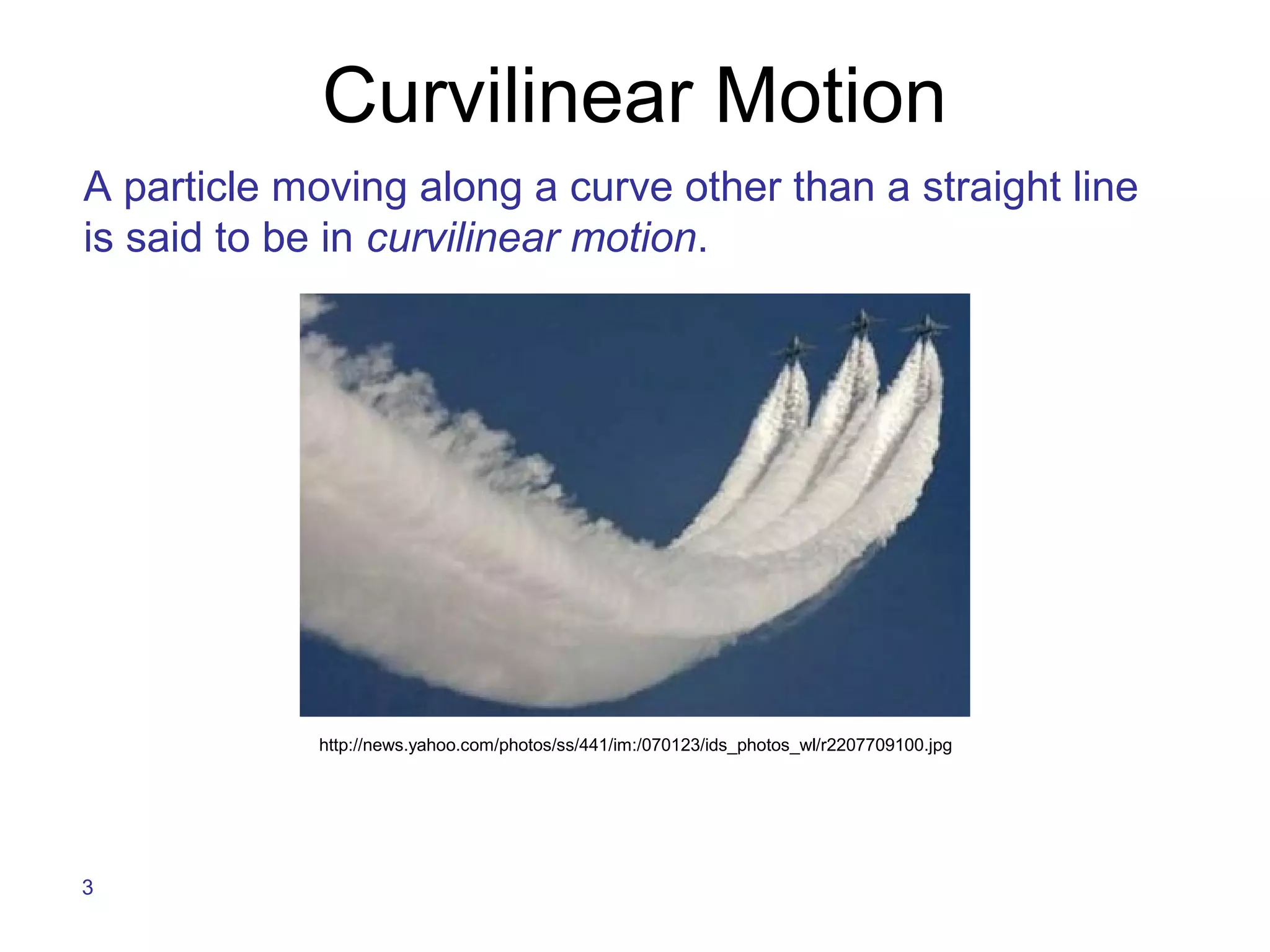
A particle moving along a curve other than a straight line
is said to be in curvilinear motion.


            http://news.yahoo.com/photos/ss/441/im:/070123/ids_photos_wl/r2207709100.jpg


3
Activity

age 228, Q. 1-8

age 196, Q. 1-3

ab: Walking Uniformly

ab: Acceleration due to Gravity
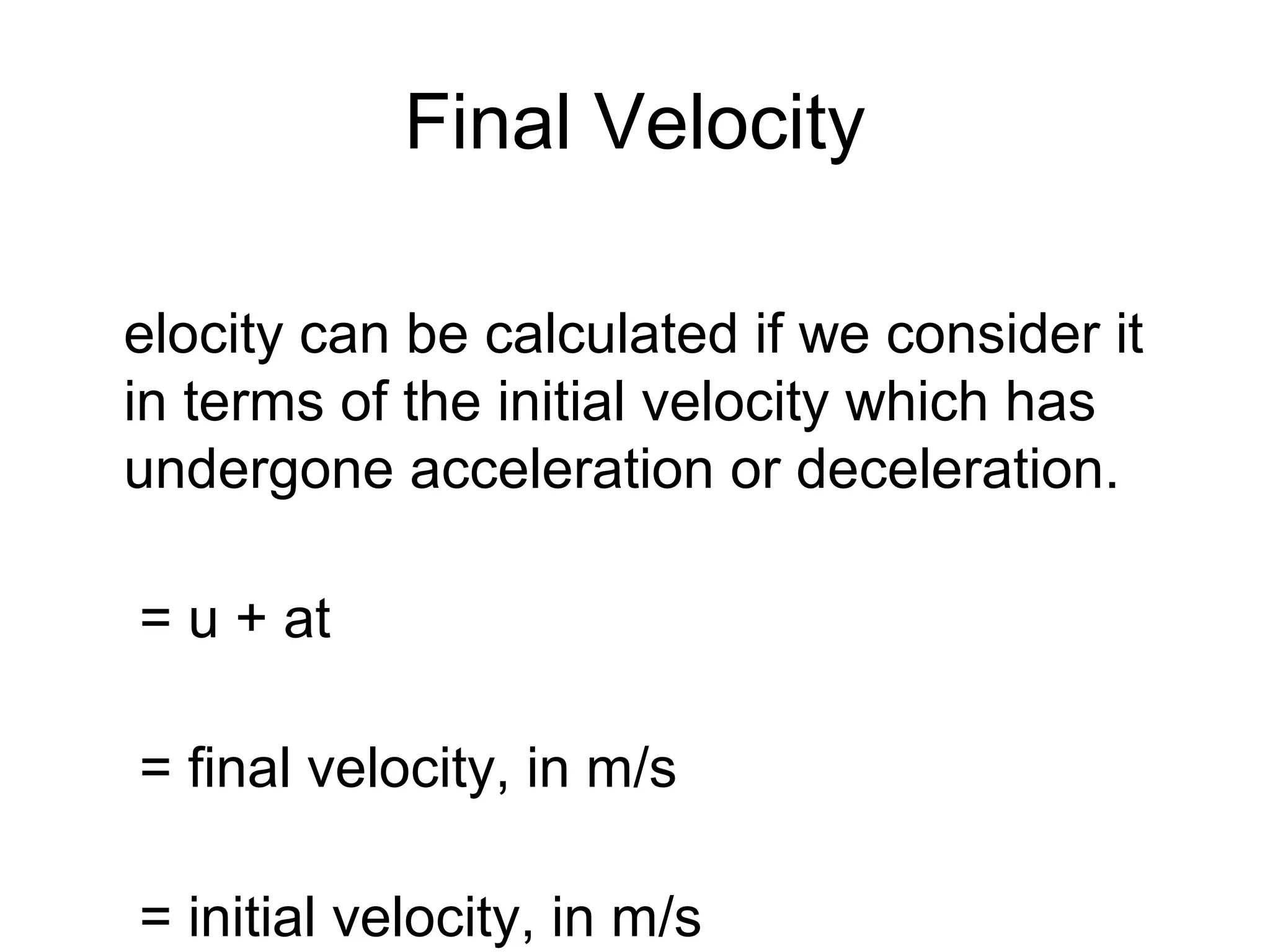
Final Velocity

elocity can be calculated if we consider it
in terms of the initial velocity which has
undergone acceleration or deceleration.

= u + at

= final velocity, in m/s

= initial velocity, in m/s
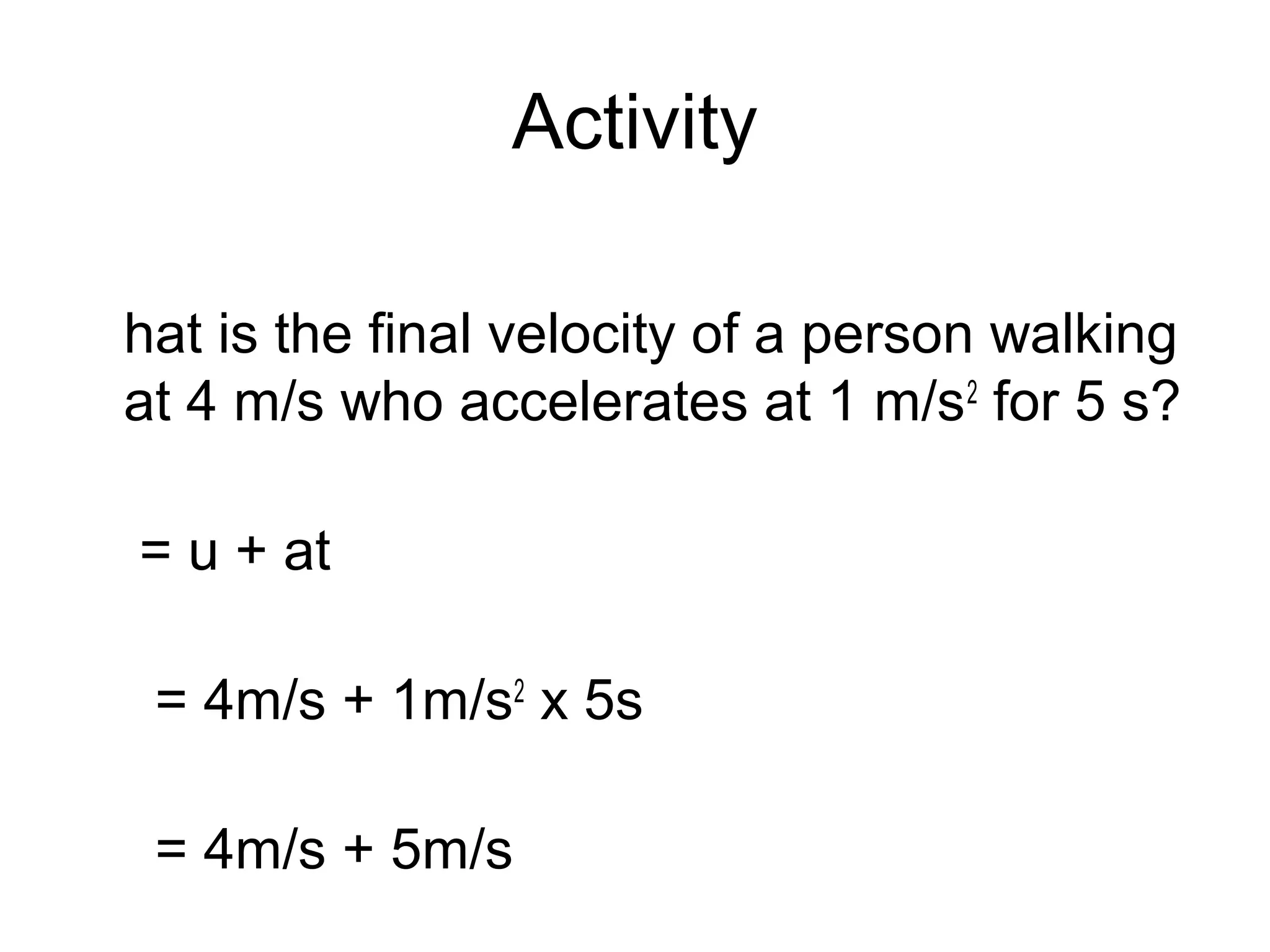
Activity

hat is the final velocity of a person walking
at 4 m/s who accelerates at 1 m/s 2 for 5 s?

= u + at

 = 4m/s + 1m/s2 x 5s

 = 4m/s + 5m/s
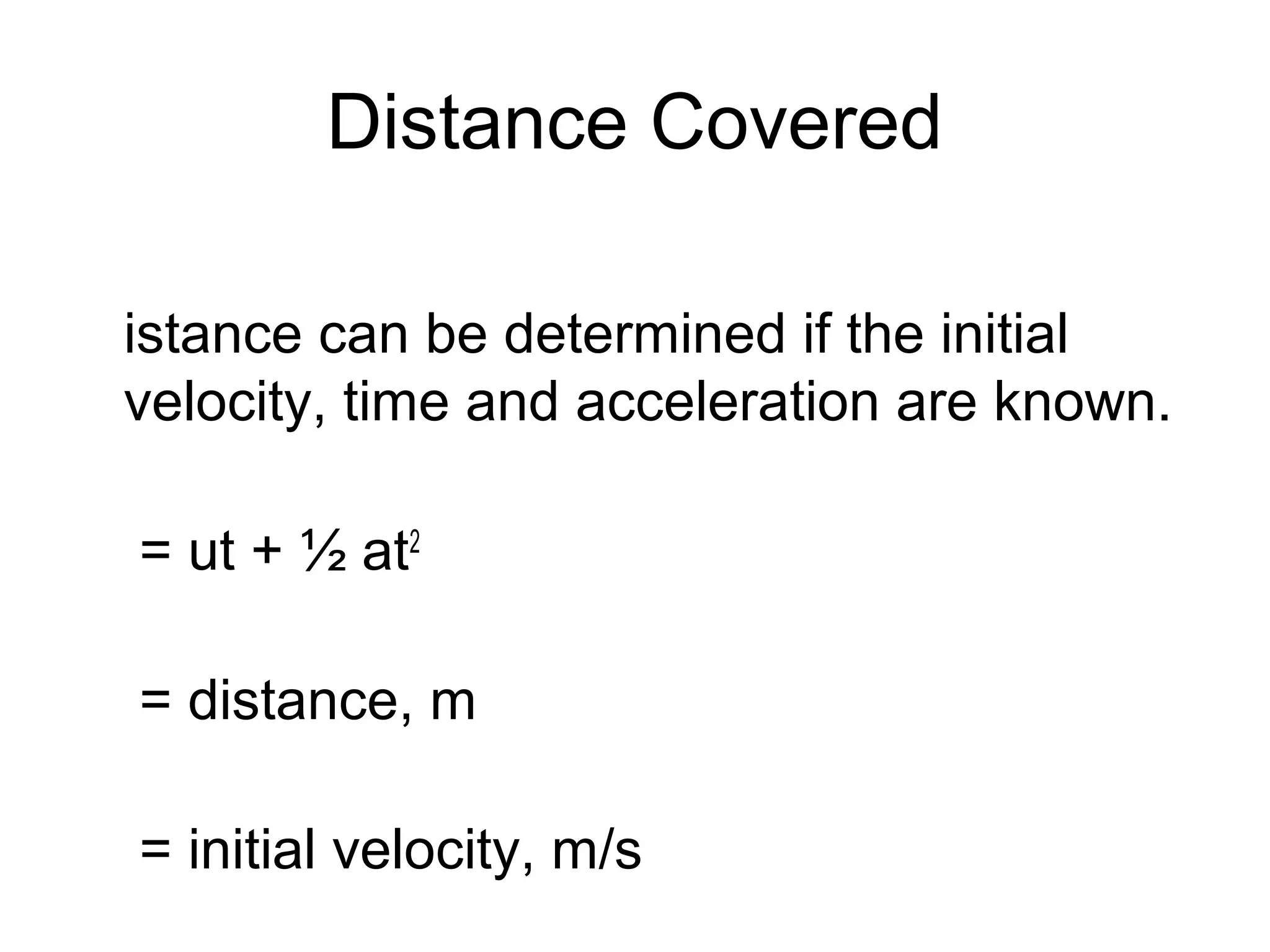
Distance Covered

istance can be determined if the initial
velocity, time and acceleration are known.

= ut + ½ at2

= distance, m

= initial velocity, m/s
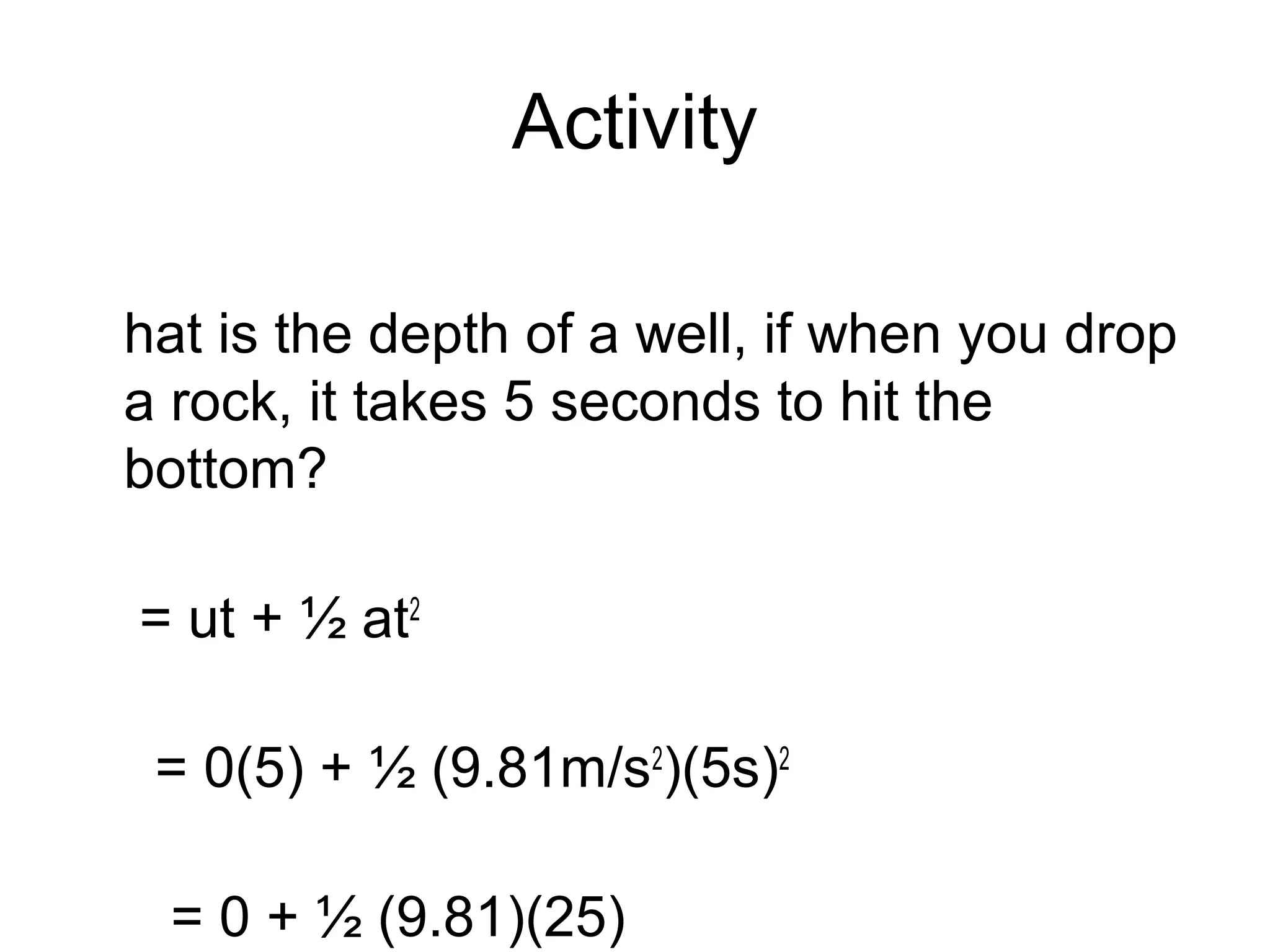
Activity

hat is the depth of a well, if when you drop
a rock, it takes 5 seconds to hit the
bottom?

= ut + ½ at2

 = 0(5) + ½ (9.81m/s2)(5s)2

 = 0 + ½ (9.81)(25)
Vertical Motion

NLY in situations where objects are
moving vertically through space, is the
acceleration - 9.81 m/s2.

n object dropped has an initial velocity of 0
m/s.

he acceleration due to gravity slows
objects moving upwards and speeds up
objects moving downwards.
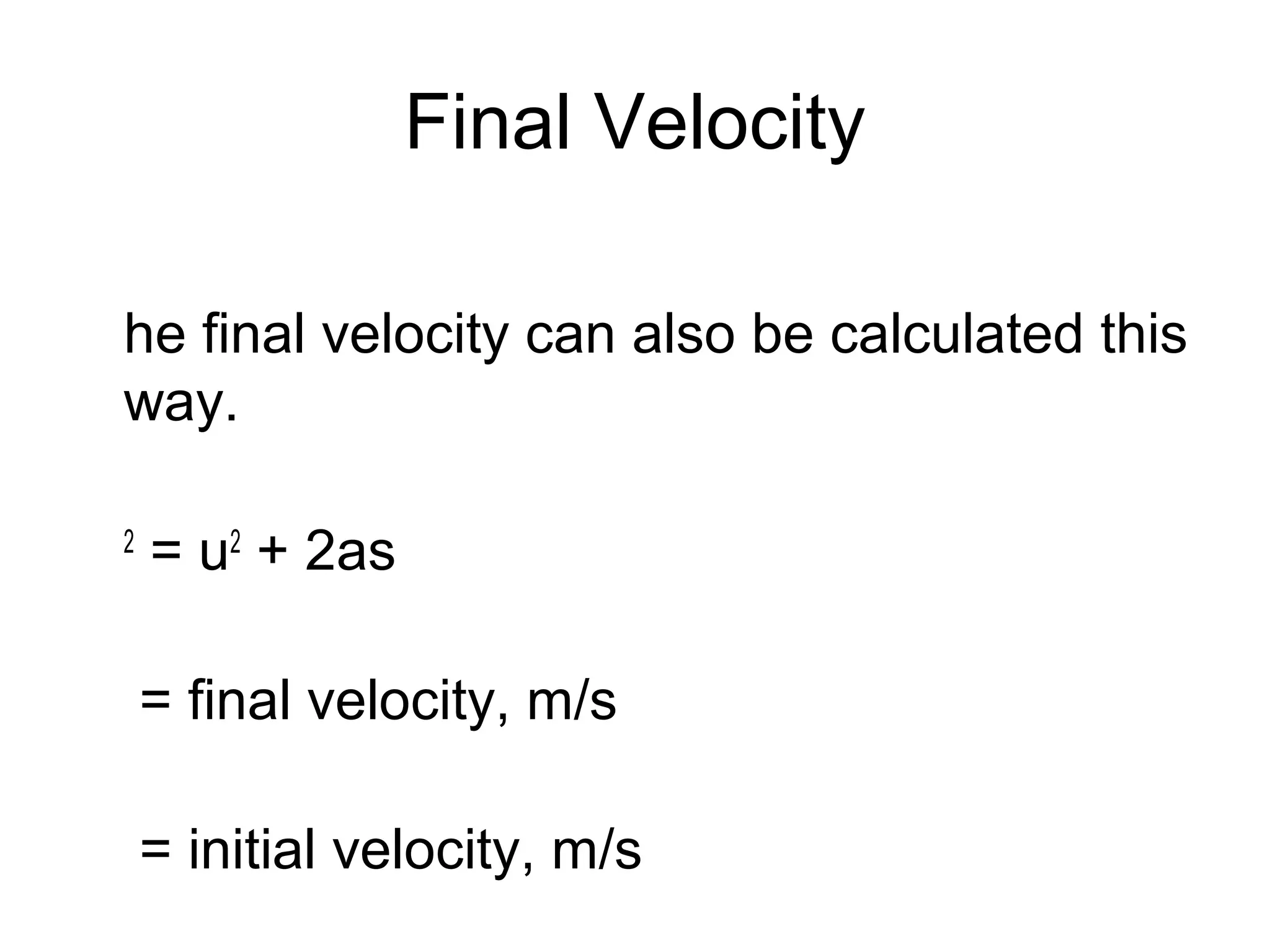
Final Velocity

he final velocity can also be calculated this
way.

2
    = u2 + 2as

    = final velocity, m/s

    = initial velocity, m/s
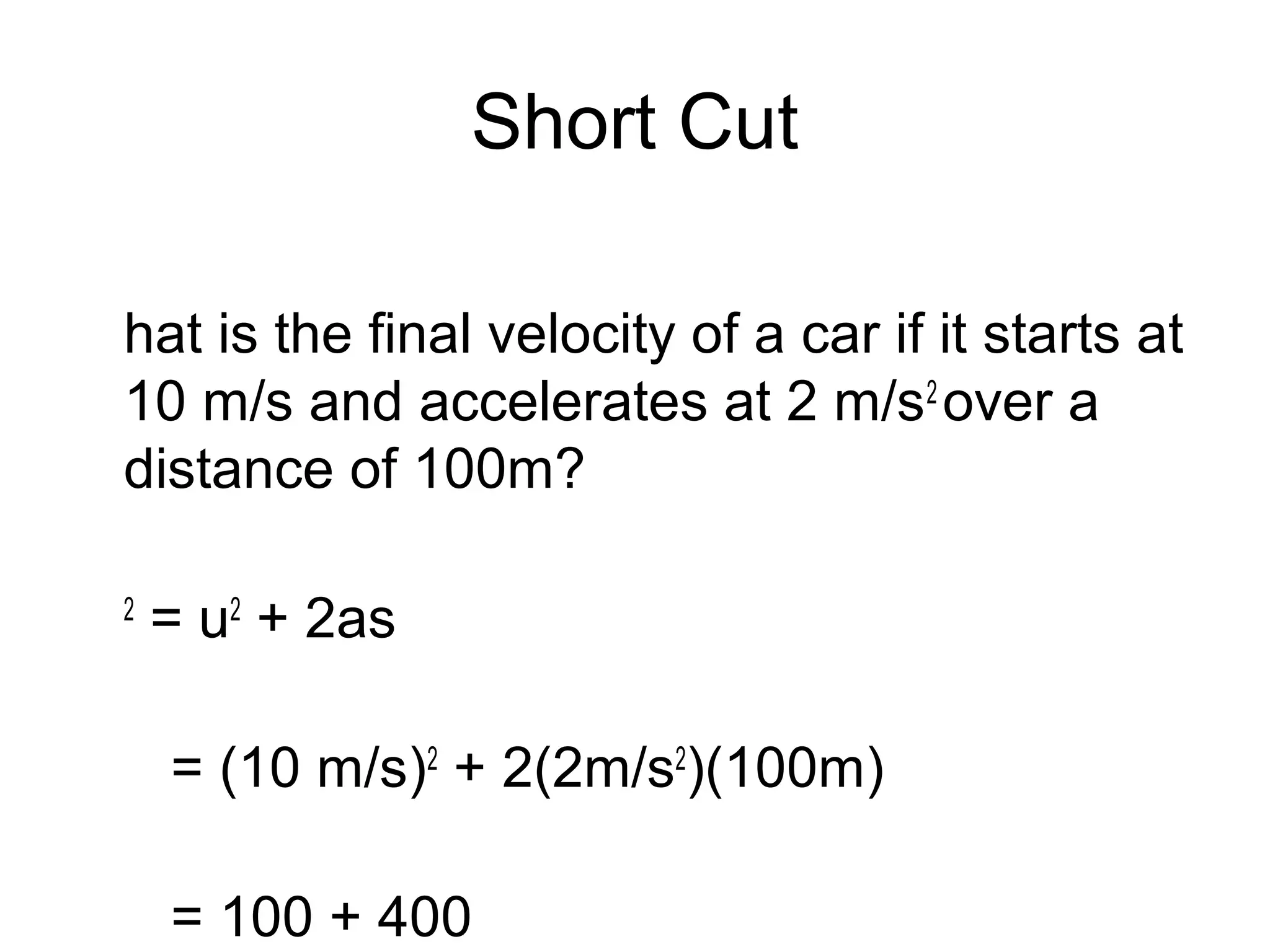
Short Cut

hat is the final velocity of a car if it starts at
10 m/s and accelerates at 2 m/s2 over a
distance of 100m?

2
    = u2 + 2as

    = (10 m/s)2 + 2(2m/s2)(100m)

    = 100 + 400
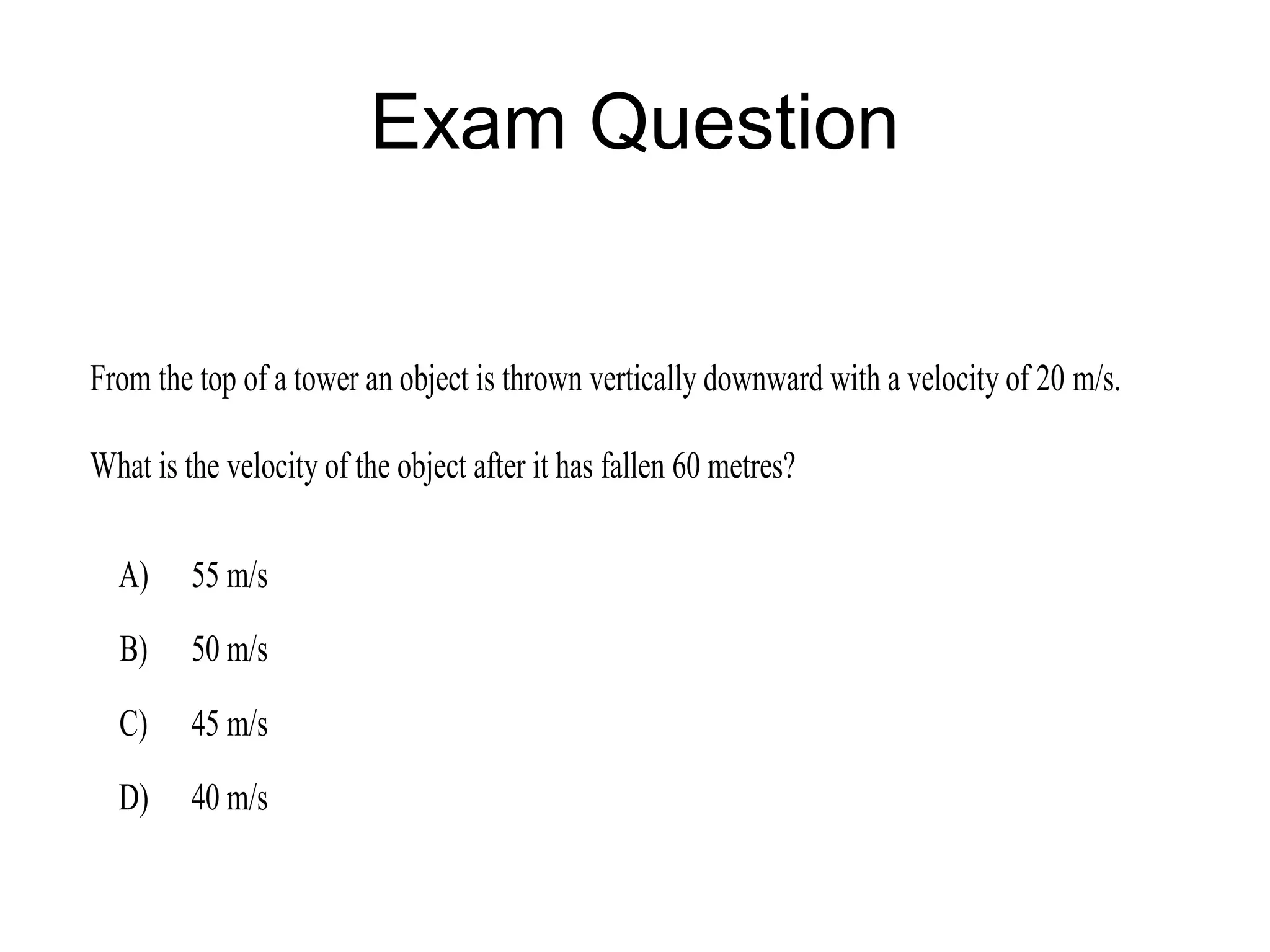
Exam Question


From the top of a tower an object is thrown vertically downward with a velocity of 20 m/s.

What is the velocity of the object after it has fallen 60 metres?

  A)     55 m/s
  B)     50 m/s
  C)     45 m/s
  D)     40 m/s
Exam Question

A motorcyclist, travelling at a speed of 30 m/s, sees an obstacle 100 metres in front of him and
puts on the brakes. He hits it 5.0 seconds later.

If the motorcycle slows down uniformly, how fast was it going at the instant of the collision?

  A)     10.0 m/s
  B)     8.0 m/s
  C)     6.0 m/s
  D)     4.0 m/s
Activity

age 234, Q 1-5

age 238, Q 1-6

andout
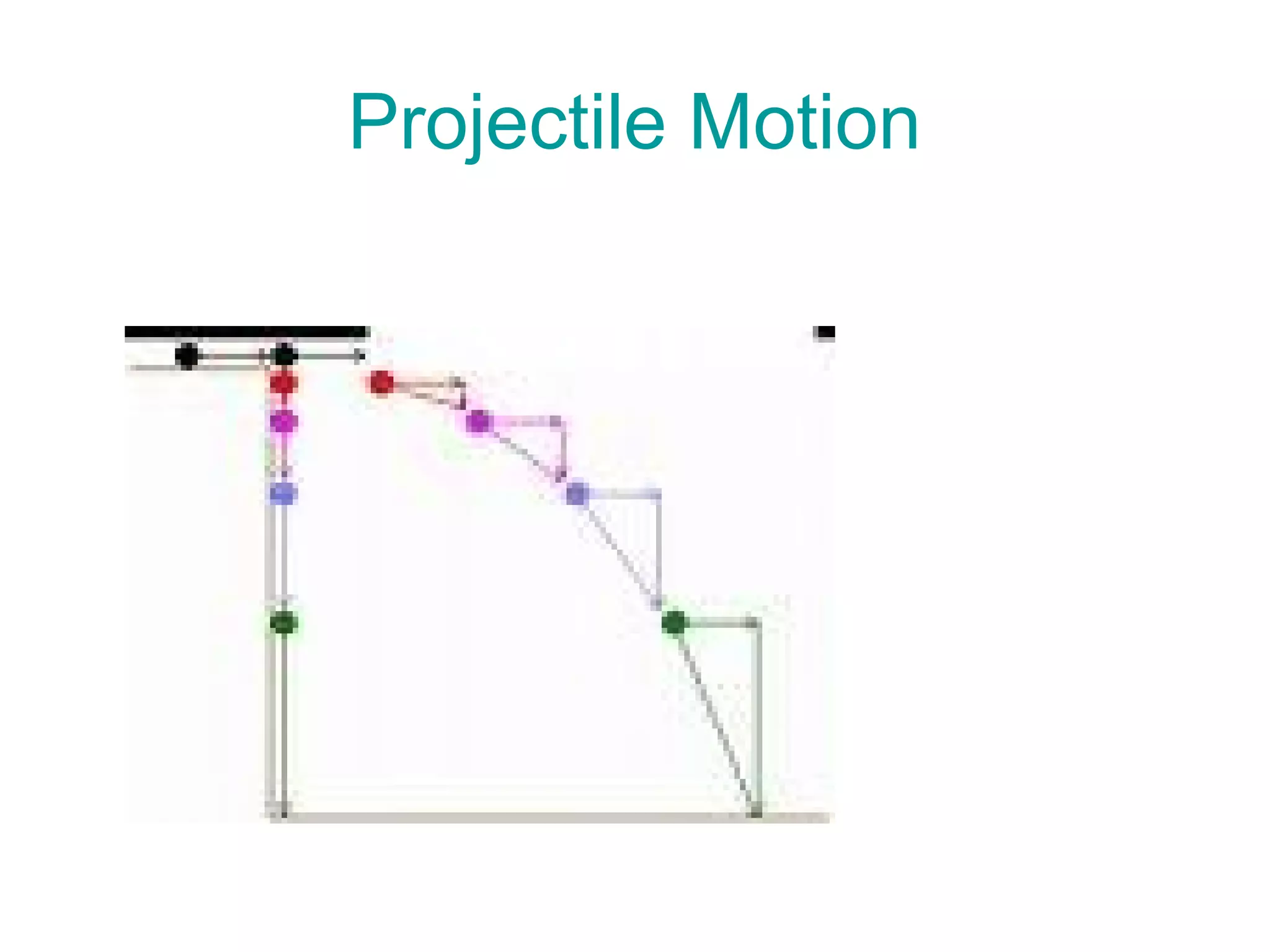
Projectile Motion
Sample Problem


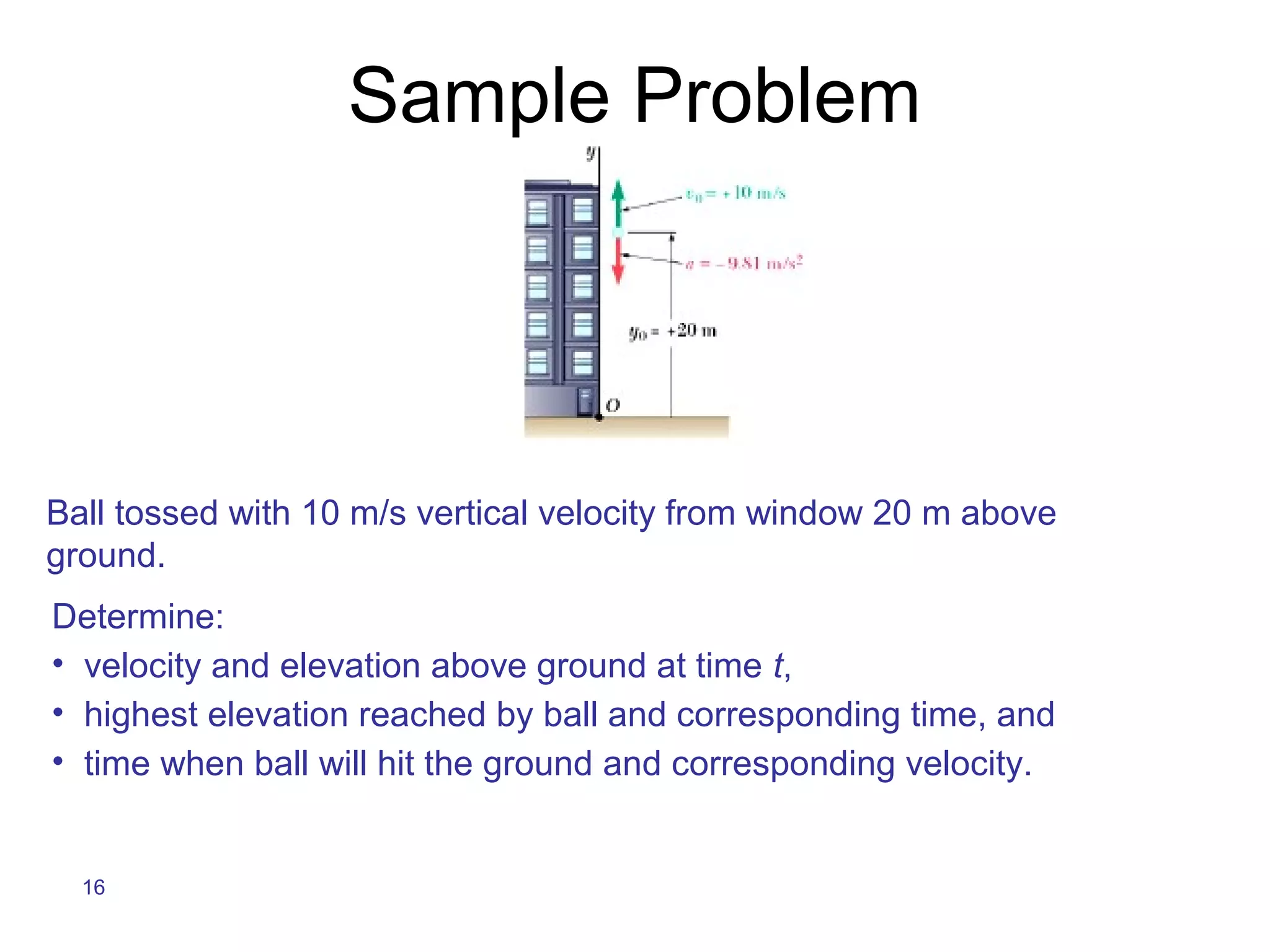
Ball tossed with 10 m/s vertical velocity from window 20 m above
ground.
Determine:
• velocity and elevation above ground at time t,
• highest elevation reached by ball and corresponding time, and
• time when ball will hit the ground and corresponding velocity.


  16
Example

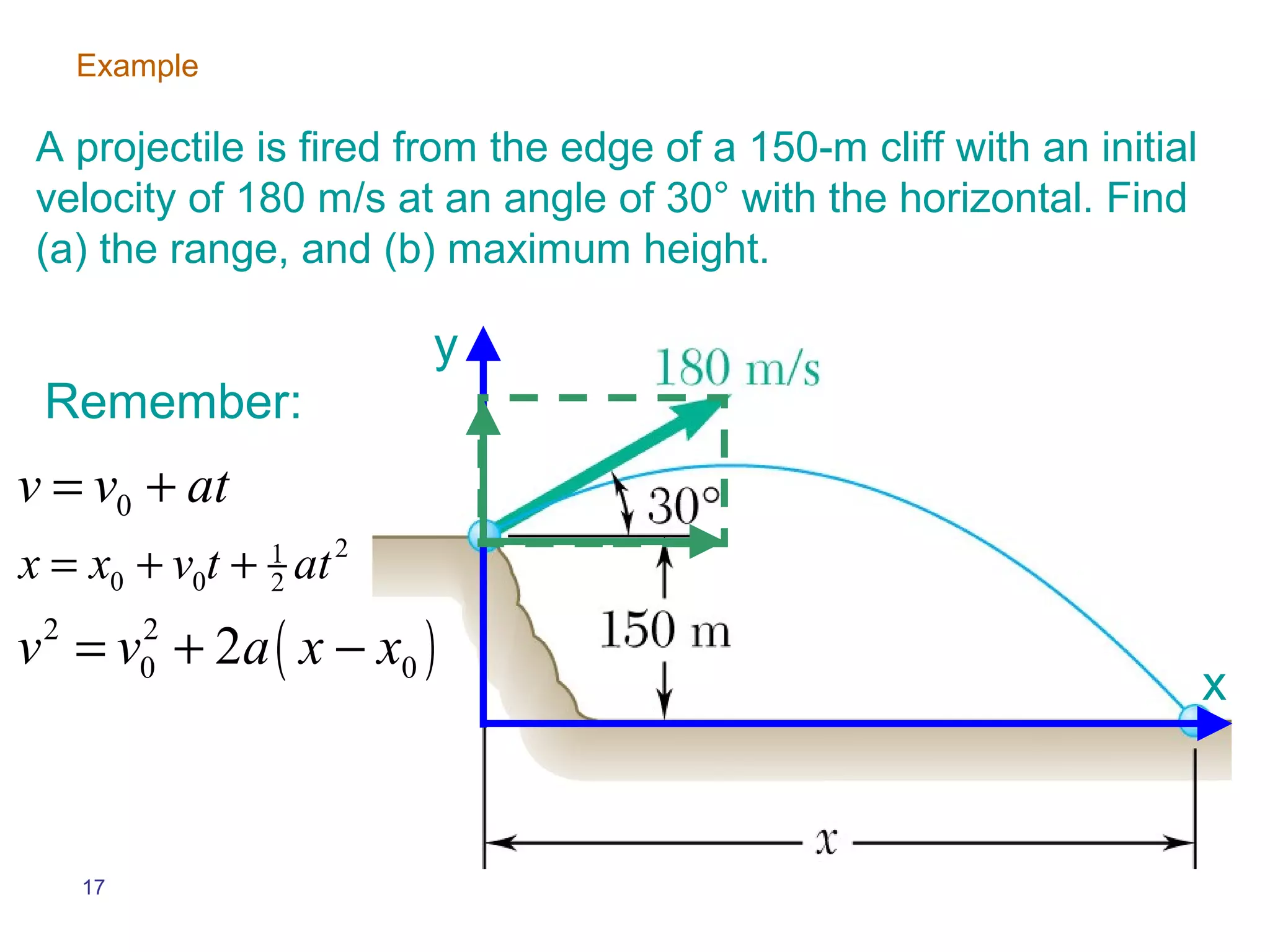
A projectile is fired from the edge of a 150-m cliff with an initial
velocity of 180 m/s at an angle of 30° with the horizontal. Find
(a) the range, and (b) maximum height.

                        y
 Remember:
v = v0 + at
x = x0 + v0t + at
               1
               2
                    2


v = v + 2a ( x − x0 )
 2        2
          0
                                                                       x


     17
Summary

hen air resistance is negligible, all freely
falling objects have the same downward
acceleration.

ball rolling down an incline has uniform
acceleration.

cceleration due to gravity has a value of
9.81 m/s2.
Summary
 negative slope on a straight line position-
time graph indicates motion in a negative
direction at constant velocity.

verage velocity = displacement/time interval

 which can be taken at any 2 times on a
position-time graph.

verage speed = total distance/time interval
Summary

elocity is a vector quantity which may be
found if the velocity is uniform, with
      velocity = displacement/time.

peed is a scalar quantity which may be
found, if the speed is uniform, with
      speed = distance/time.

he position-time graph for an object
moving with uniform motion is a straight
Summary

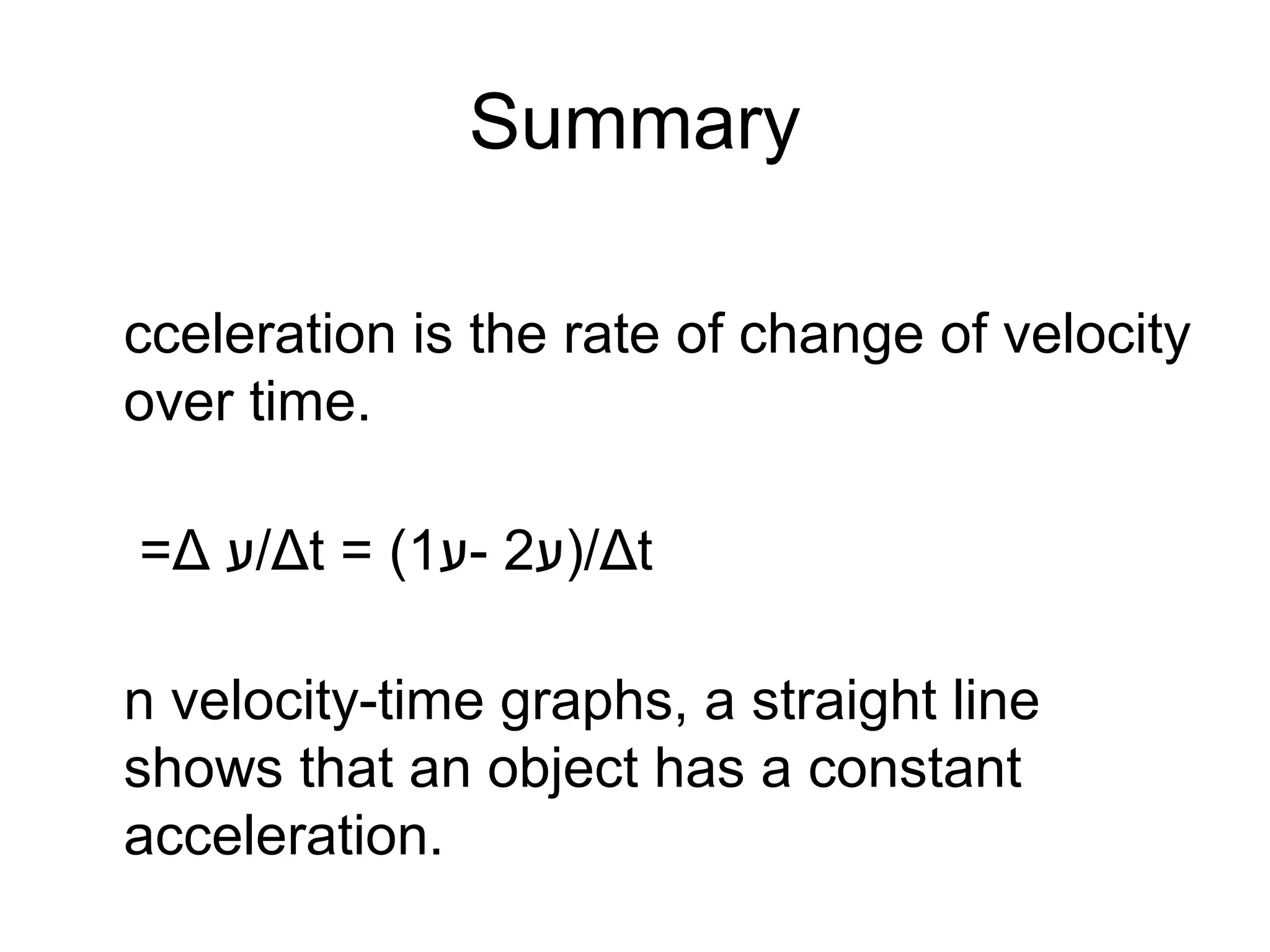
cceleration is the rate of change of velocity
over time.

=Δ ‫/ע‬Δt = (1‫/)ע2 -ע‬Δt

n velocity-time graphs, a straight line
shows that an object has a constant
acceleration.
Summary
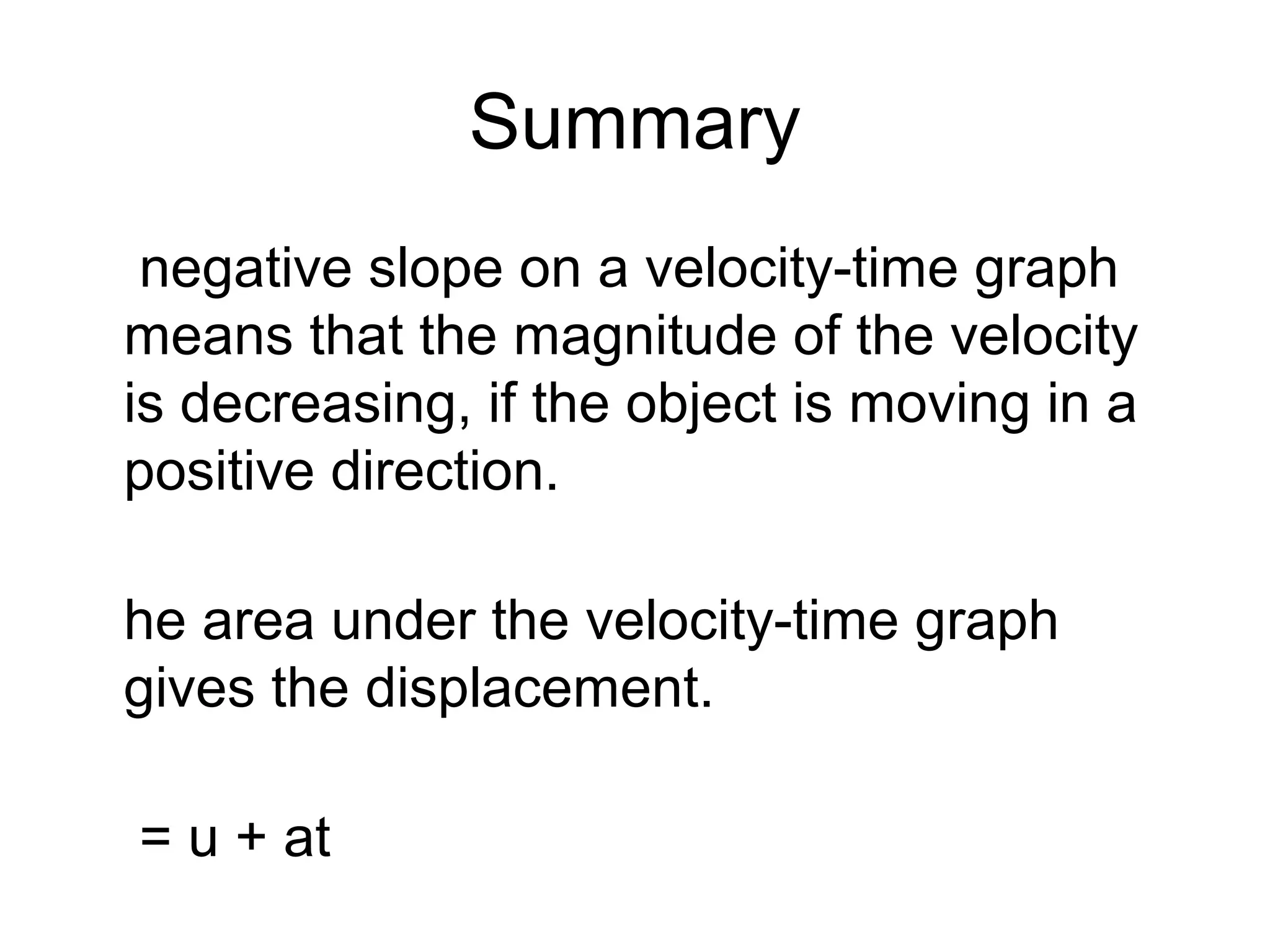
 negative slope on a velocity-time graph
means that the magnitude of the velocity
is decreasing, if the object is moving in a
positive direction.

he area under the velocity-time graph
gives the displacement.

= u + at
Summary

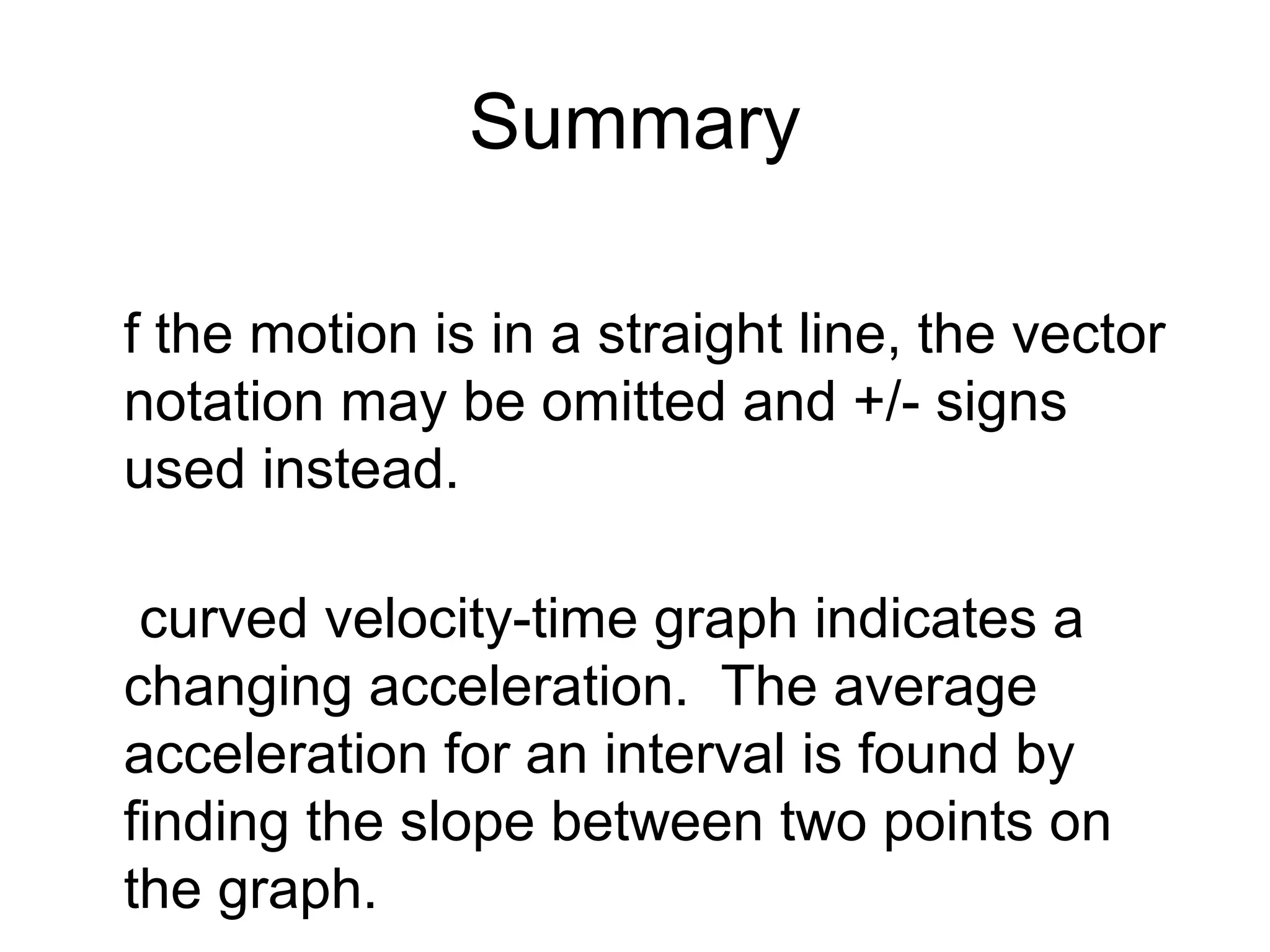
f the motion is in a straight line, the vector
notation may be omitted and +/- signs
used instead.

 curved velocity-time graph indicates a
changing acceleration. The average
acceleration for an interval is found by
finding the slope between two points on
the graph.
Summary

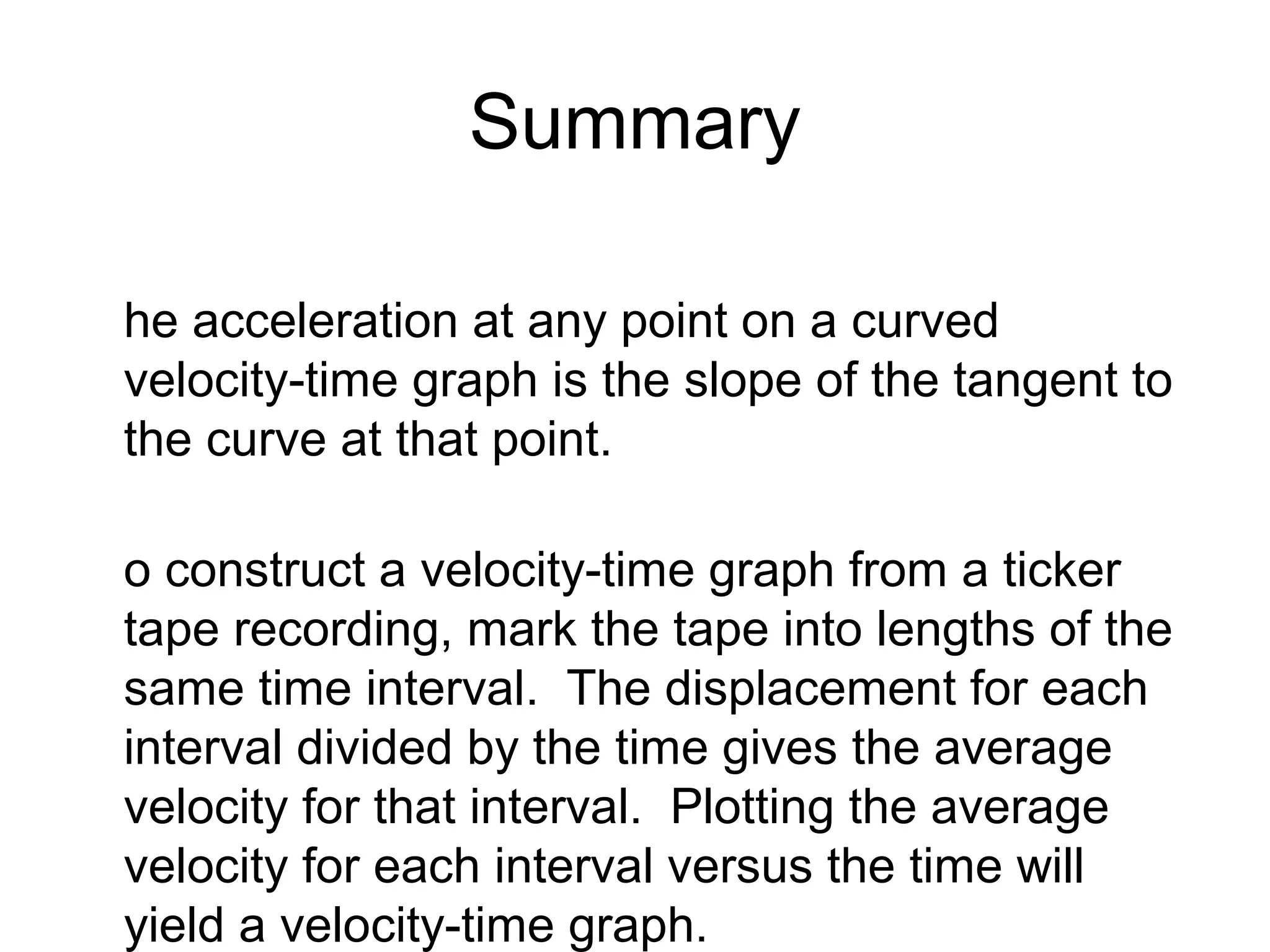
he acceleration at any point on a curved
velocity-time graph is the slope of the tangent to
the curve at that point.

o construct a velocity-time graph from a ticker
tape recording, mark the tape into lengths of the
same time interval. The displacement for each
interval divided by the time gives the average
velocity for that interval. Plotting the average
velocity for each interval versus the time will
yield a velocity-time graph.
Exam Question

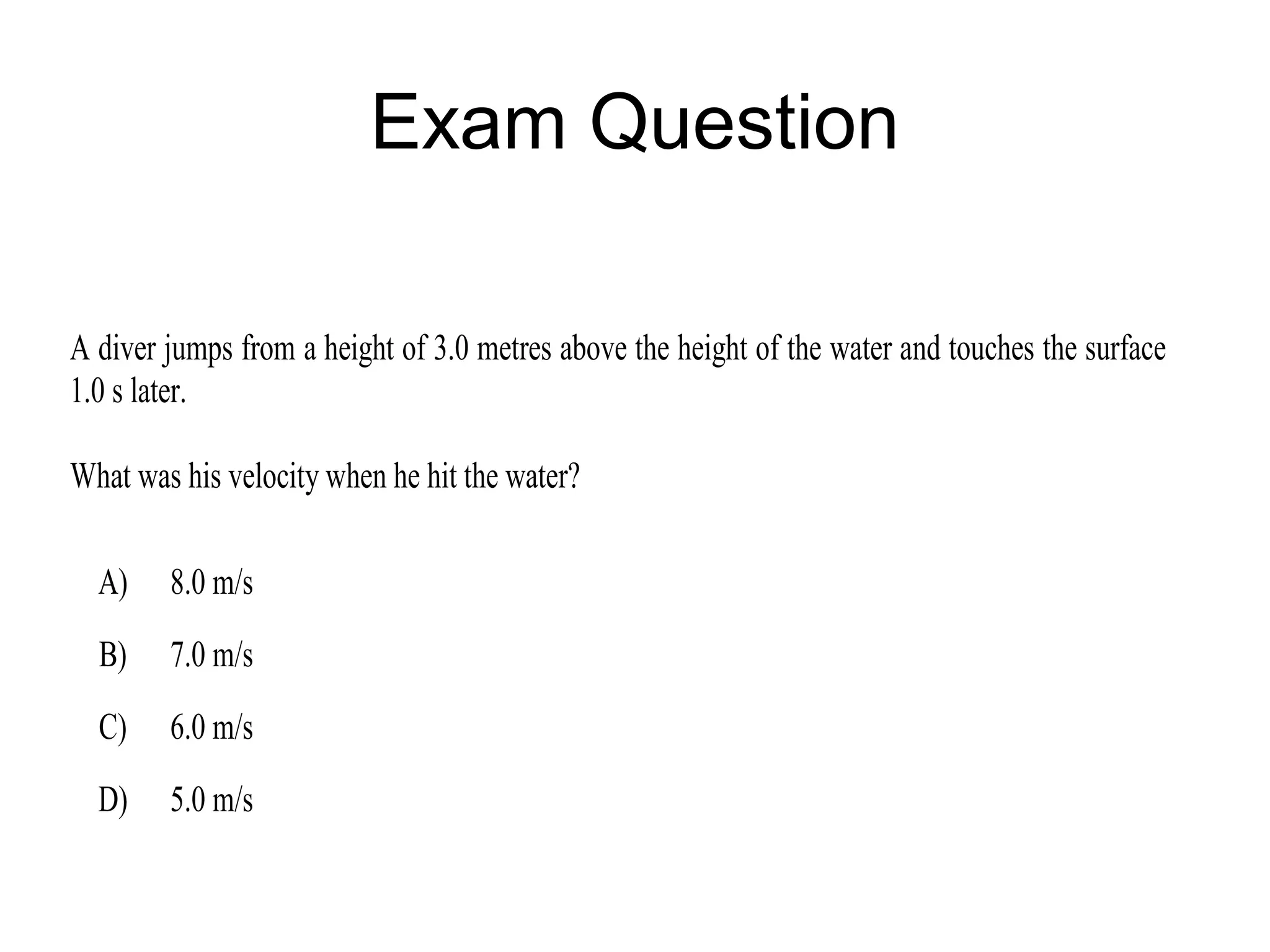
A diver jumps from a height of 3.0 metres above the height of the water and touches the surface
1.0 s later.

What was his velocity when he hit the water?

  A)    8.0 m/s
  B)    7.0 m/s
  C)    6.0 m/s
  D)    5.0 m/s
Activity

age 242, Q. 1-6

Physics 504 Chapter 10 Uniformly Accelerated Rectilinear Motion

  • 1.
  • 2.
    Introduction • Dynamics includes: - Kinematics: study of the motion (displacement, velocity, acceleration, & time) without reference to the cause of motion (i.e. regardless of forces). - Kinetics: study of the forces acting on a body, and the resulting motion caused by the given forces. • Rectilinear motion: position, velocity, and acceleration of a particle as it moves along a straight line. • Curvilinear motion: position, velocity, and acceleration of a particle as it moves along a curved line. 2
  • 3.
    Curvilinear Motion A particlemoving along a curve other than a straight line is said to be in curvilinear motion. http://news.yahoo.com/photos/ss/441/im:/070123/ids_photos_wl/r2207709100.jpg 3
  • 4.
    Activity age 228, Q.1-8 age 196, Q. 1-3 ab: Walking Uniformly ab: Acceleration due to Gravity
  • 5.
    Final Velocity elocity canbe calculated if we consider it in terms of the initial velocity which has undergone acceleration or deceleration. = u + at = final velocity, in m/s = initial velocity, in m/s
  • 6.
    Activity hat is thefinal velocity of a person walking at 4 m/s who accelerates at 1 m/s 2 for 5 s? = u + at = 4m/s + 1m/s2 x 5s = 4m/s + 5m/s
  • 7.
    Distance Covered istance canbe determined if the initial velocity, time and acceleration are known. = ut + ½ at2 = distance, m = initial velocity, m/s
  • 8.
    Activity hat is thedepth of a well, if when you drop a rock, it takes 5 seconds to hit the bottom? = ut + ½ at2 = 0(5) + ½ (9.81m/s2)(5s)2 = 0 + ½ (9.81)(25)
  • 9.
    Vertical Motion NLY insituations where objects are moving vertically through space, is the acceleration - 9.81 m/s2. n object dropped has an initial velocity of 0 m/s. he acceleration due to gravity slows objects moving upwards and speeds up objects moving downwards.
  • 10.
    Final Velocity he finalvelocity can also be calculated this way. 2 = u2 + 2as = final velocity, m/s = initial velocity, m/s
  • 11.
    Short Cut hat isthe final velocity of a car if it starts at 10 m/s and accelerates at 2 m/s2 over a distance of 100m? 2 = u2 + 2as = (10 m/s)2 + 2(2m/s2)(100m) = 100 + 400
  • 12.
    Exam Question From thetop of a tower an object is thrown vertically downward with a velocity of 20 m/s. What is the velocity of the object after it has fallen 60 metres? A) 55 m/s B) 50 m/s C) 45 m/s D) 40 m/s
  • 13.
    Exam Question A motorcyclist,travelling at a speed of 30 m/s, sees an obstacle 100 metres in front of him and puts on the brakes. He hits it 5.0 seconds later. If the motorcycle slows down uniformly, how fast was it going at the instant of the collision? A) 10.0 m/s B) 8.0 m/s C) 6.0 m/s D) 4.0 m/s
  • 14.
    Activity age 234, Q1-5 age 238, Q 1-6 andout
  • 15.
  • 16.
    Sample Problem Ball tossedwith 10 m/s vertical velocity from window 20 m above ground. Determine: • velocity and elevation above ground at time t, • highest elevation reached by ball and corresponding time, and • time when ball will hit the ground and corresponding velocity. 16
  • 17.
    Example A projectile isfired from the edge of a 150-m cliff with an initial velocity of 180 m/s at an angle of 30° with the horizontal. Find (a) the range, and (b) maximum height. y Remember: v = v0 + at x = x0 + v0t + at 1 2 2 v = v + 2a ( x − x0 ) 2 2 0 x 17
  • 18.
    Summary hen air resistanceis negligible, all freely falling objects have the same downward acceleration. ball rolling down an incline has uniform acceleration. cceleration due to gravity has a value of 9.81 m/s2.
  • 19.
    Summary negative slopeon a straight line position- time graph indicates motion in a negative direction at constant velocity. verage velocity = displacement/time interval which can be taken at any 2 times on a position-time graph. verage speed = total distance/time interval
  • 20.
    Summary elocity is avector quantity which may be found if the velocity is uniform, with velocity = displacement/time. peed is a scalar quantity which may be found, if the speed is uniform, with speed = distance/time. he position-time graph for an object moving with uniform motion is a straight
  • 21.
    Summary cceleration is therate of change of velocity over time. =Δ ‫/ע‬Δt = (1‫/)ע2 -ע‬Δt n velocity-time graphs, a straight line shows that an object has a constant acceleration.
  • 22.
    Summary negative slopeon a velocity-time graph means that the magnitude of the velocity is decreasing, if the object is moving in a positive direction. he area under the velocity-time graph gives the displacement. = u + at
  • 23.
    Summary f the motionis in a straight line, the vector notation may be omitted and +/- signs used instead. curved velocity-time graph indicates a changing acceleration. The average acceleration for an interval is found by finding the slope between two points on the graph.
  • 24.
    Summary he acceleration atany point on a curved velocity-time graph is the slope of the tangent to the curve at that point. o construct a velocity-time graph from a ticker tape recording, mark the tape into lengths of the same time interval. The displacement for each interval divided by the time gives the average velocity for that interval. Plotting the average velocity for each interval versus the time will yield a velocity-time graph.
  • 25.
    Exam Question A diverjumps from a height of 3.0 metres above the height of the water and touches the surface 1.0 s later. What was his velocity when he hit the water? A) 8.0 m/s B) 7.0 m/s C) 6.0 m/s D) 5.0 m/s
  • 26.