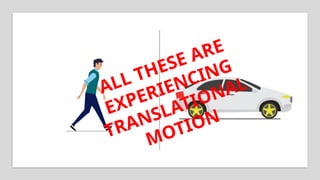
TRANSLATIONAL MOTION
• Translationalmotion is a type of motion
that occurs when an object moves along
a path in any of the three dimensions.
This means the object is moving in a
straight line from one point to another. In
this type of motion, all parts of the object
move the same distance, in the same
direction, and at the same time.
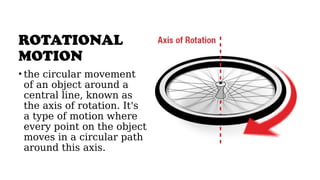
ROTATIONAL
MOTION
• the circularmovement
of an object around a
central line, known as
the axis of rotation. It's
a type of motion where
every point on the object
moves in a circular path
around this axis.
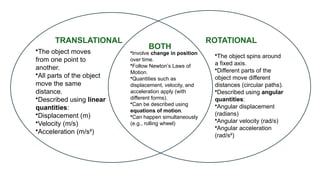
11.
•The object moves
fromone point to
another.
•All parts of the object
move the same
distance.
•Described using linear
quantities:
•Displacement (m)
•Velocity (m/s)
•Acceleration (m/s²)
TRANSLATIONAL ROTATIONAL
BOTH
•The object spins around
a fixed axis.
•Different parts of the
object move different
distances (circular paths).
•Described using angular
quantities:
•Angular displacement
(radians)
•Angular velocity (rad/s)
•Angular acceleration
(rad/s²)
•Involve change in position
over time.
•Follow Newton’s Laws of
Motion.
•Quantities such as
displacement, velocity, and
acceleration apply (with
different forms).
•Can be described using
equations of motion.
•Can happen simultaneously
(e.g., rolling wheel)
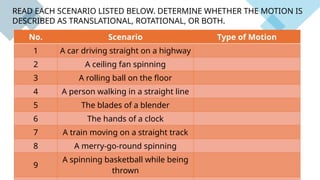
No. Scenario Typeof Motion
1 A car driving straight on a highway
2 A ceiling fan spinning
3 A rolling ball on the floor
4 A person walking in a straight line
5 The blades of a blender
6 The hands of a clock
7 A train moving on a straight track
8 A merry-go-round spinning
9
A spinning basketball while being
thrown
READ EACH SCENARIO LISTED BELOW. DETERMINE WHETHER THE MOTION IS
DESCRIBED AS TRANSLATIONAL, ROTATIONAL, OR BOTH.
14.
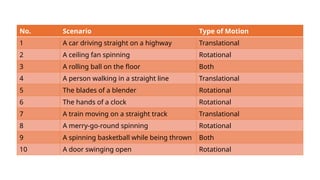
No. Scenario Typeof Motion
1 A car driving straight on a highway Translational
2 A ceiling fan spinning Rotational
3 A rolling ball on the floor Both
4 A person walking in a straight line Translational
5 The blades of a blender Rotational
6 The hands of a clock Rotational
7 A train moving on a straight track Translational
8 A merry-go-round spinning Rotational
9 A spinning basketball while being thrown Both
10 A door swinging open Rotational
Editor's Notes
#1 BUZZ Ask the group to stand up and to form a circle. Everyone takes turns saying a number starting with 1, 2, 3 and so on. Of course, there is a catch. At every number with a 2 in it or a multiple of 2, that person needs to say BUZZ AND WILL SIT instead of the number. The next person just continues the series as normal. Those who will lose the game will be the ones who answer my questions during my discussion, and those who will win will receive a reward from me. There will be only 1 winner for this game.
#2 This morning, we are going to discuss translational and rotational motion and their differences.
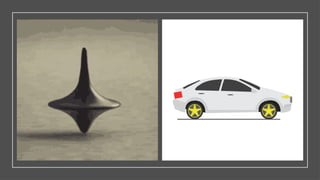
#6 WHAT HAVE OBSERVE IN THE TWO VIDEOS? CAN YOU DESCRIBE THEM?
#9 Tt's important to note that translational motion can be either uniform or non-uniform. Uniform translational motion means the object is moving at a constant speed, while non-uniform translational motion means the object's speed is changing.









![group_6_presentation[1].pptxhakskoajsjak](https://cdn.slidesharecdn.com/ss_thumbnails/group6presentation1-250506023058-e2c19c52-thumbnail.jpg?width=640&height=640&fit=bounds)


