MOTION
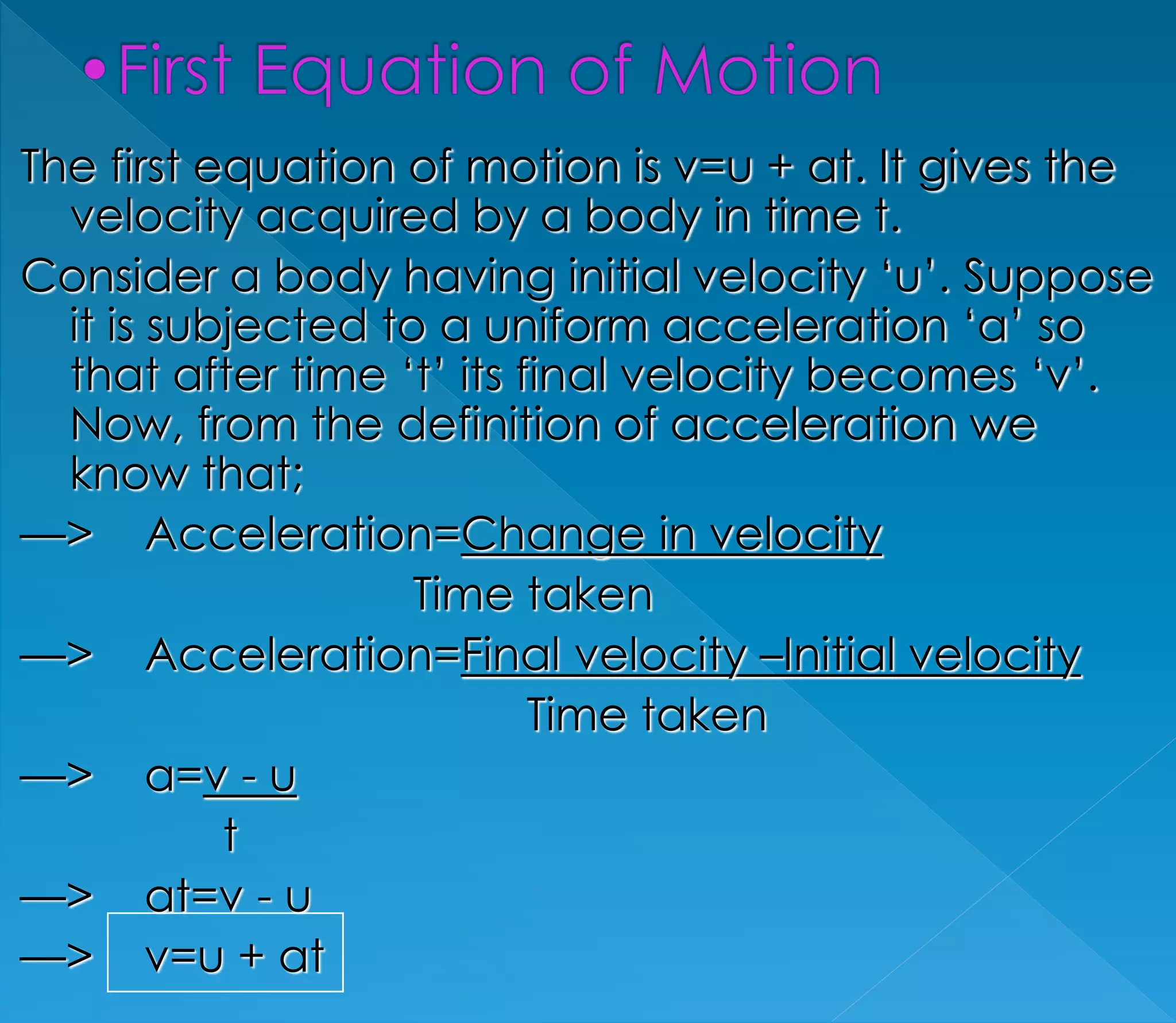
The first equation of motion is v=u + at. It gives the 
velocity acquired by a body in time t. 
Consider a body having initial velocity ‘u’. Suppose 
it is subjected to a uniform acceleration ‘a’ so 
that after time ‘t’ its final velocity becomes ‘v’. 
Now, from the definition of acceleration we 
know that; 
—> Acceleration=Change in velocity 
Time taken 
—> Acceleration=Final velocity –Initial velocity 
Time taken 
—> a=v - u 
t 
—> at=v - u 
—> v=u + at
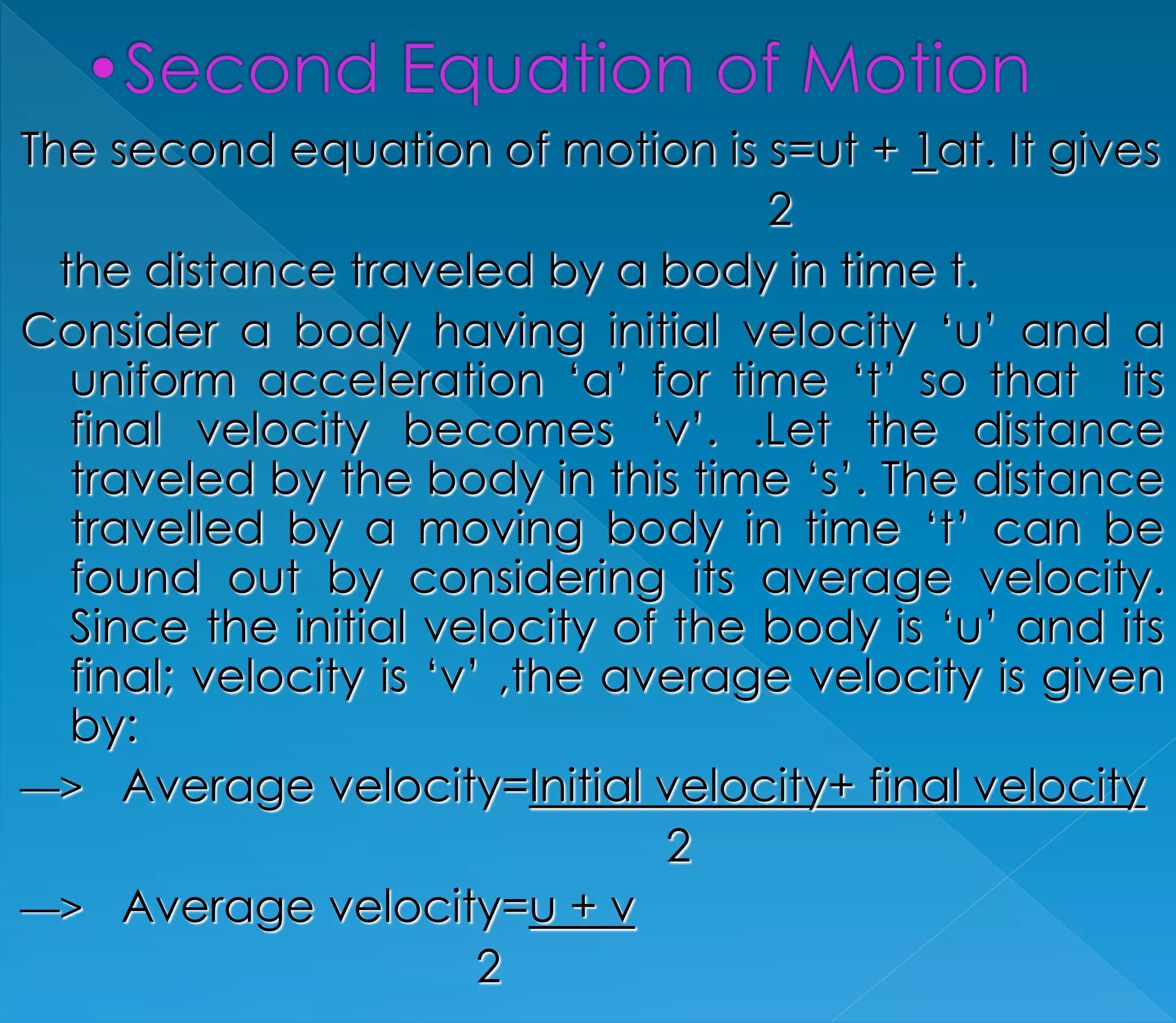
The second equation of motion is s=ut + 1at. It gives 
2 
the distance traveled by a body in time t. 
Consider a body having initial velocity ‘u’ and a 
uniform acceleration ‘a’ for time ‘t’ so that its 
final velocity becomes ‘v’. .Let the distance 
traveled by the body in this time ‘s’. The distance 
travelled by a moving body in time ‘t’ can be 
found out by considering its average velocity. 
Since the initial velocity of the body is ‘u’ and its 
final; velocity is ‘v’ ,the average velocity is given 
by: 
—> Average velocity=Initial velocity+ final velocity 
2 
—> Average velocity=u + v 
2
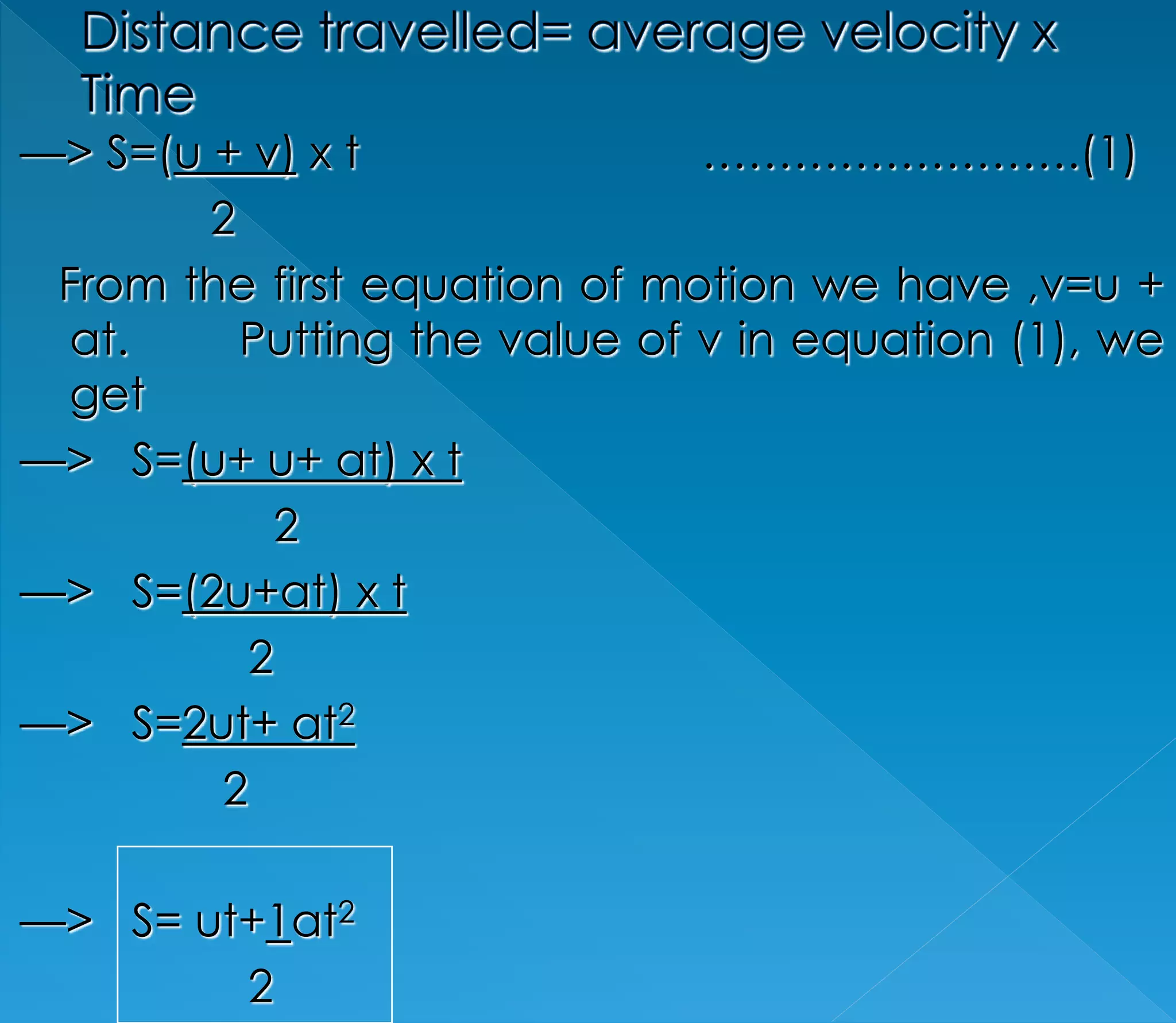
—> S=(u + v) x t …………………….(1) 
2 
From the first equation of motion we have ,v=u + 
at. Putting the value of v in equation (1), we 
get 
—> S=(u+ u+ at) x t 
2 
—> S=(2u+at) x t 
2 
—> S=2ut+ at2 
2 
—> S= ut+1at2 
2
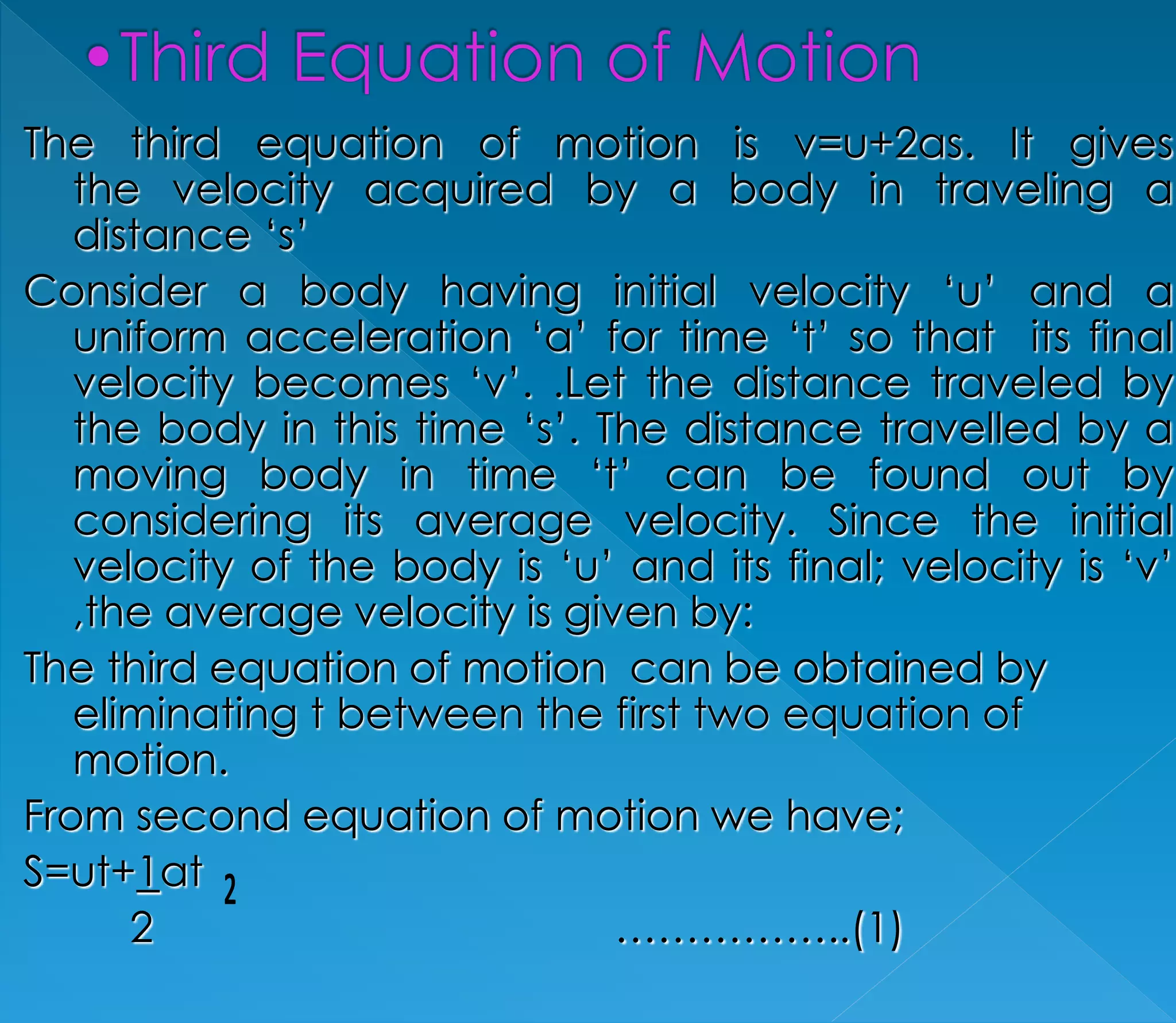
The third equation of motion is v=u+2as. It gives 
the velocity acquired by a body in traveling a 
distance ‘s’ 
Consider a body having initial velocity ‘u’ and a 
uniform acceleration ‘a’ for time ‘t’ so that its final 
velocity becomes ‘v’. .Let the distance traveled by 
the body in this time ‘s’. The distance travelled by a 
moving body in time ‘t’ can be found out by 
considering its average velocity. Since the initial 
velocity of the body is ‘u’ and its final; velocity is ‘v’ 
,the average velocity is given by: 
The third equation of motion can be obtained by 
eliminating t between the first two equation of 
motion. 
From second equation of motion we have; 
S=ut+1at 
2 ……………..(1)
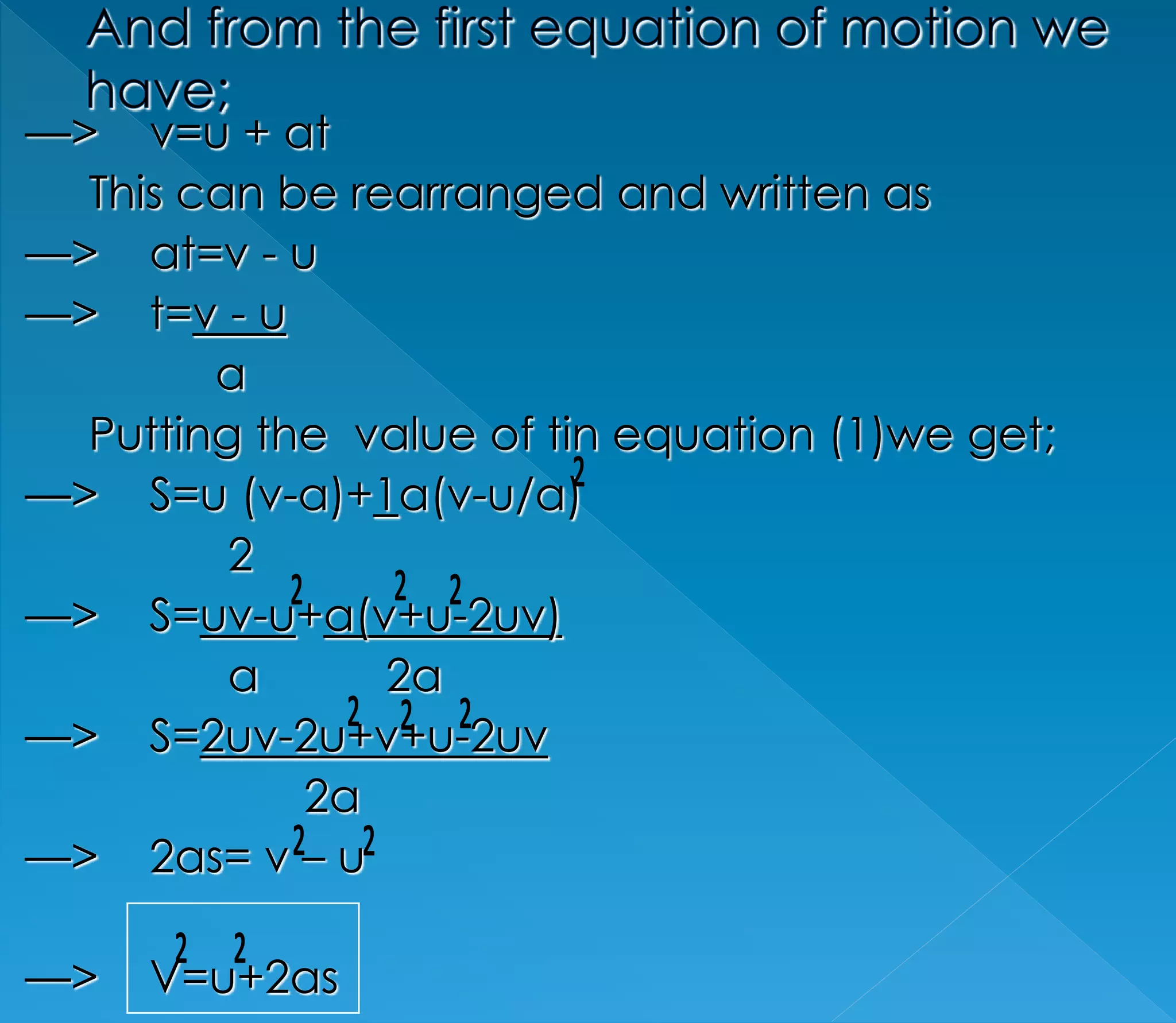
—> v=u + at 
This can be rearranged and written as 
—> at=v - u 
—> t=v - u 
a 
Putting the value of tin equation (1)we get; 
—> S=u (v-a)+1a(v-u/a) 
2 
—> S=uv-u+a(v+u-2uv) 
a 2a 
—> S=2uv-2u+v+u-2uv 
2a 
—> 2as= v – u 
—> V=u+2as
END

Physics equations of motion

  • 1.
  • 2.
    The first equationof motion is v=u + at. It gives the velocity acquired by a body in time t. Consider a body having initial velocity ‘u’. Suppose it is subjected to a uniform acceleration ‘a’ so that after time ‘t’ its final velocity becomes ‘v’. Now, from the definition of acceleration we know that; —> Acceleration=Change in velocity Time taken —> Acceleration=Final velocity –Initial velocity Time taken —> a=v - u t —> at=v - u —> v=u + at
  • 3.
    The second equationof motion is s=ut + 1at. It gives 2 the distance traveled by a body in time t. Consider a body having initial velocity ‘u’ and a uniform acceleration ‘a’ for time ‘t’ so that its final velocity becomes ‘v’. .Let the distance traveled by the body in this time ‘s’. The distance travelled by a moving body in time ‘t’ can be found out by considering its average velocity. Since the initial velocity of the body is ‘u’ and its final; velocity is ‘v’ ,the average velocity is given by: —> Average velocity=Initial velocity+ final velocity 2 —> Average velocity=u + v 2
  • 4.
    —> S=(u +v) x t …………………….(1) 2 From the first equation of motion we have ,v=u + at. Putting the value of v in equation (1), we get —> S=(u+ u+ at) x t 2 —> S=(2u+at) x t 2 —> S=2ut+ at2 2 —> S= ut+1at2 2
  • 5.
    The third equationof motion is v=u+2as. It gives the velocity acquired by a body in traveling a distance ‘s’ Consider a body having initial velocity ‘u’ and a uniform acceleration ‘a’ for time ‘t’ so that its final velocity becomes ‘v’. .Let the distance traveled by the body in this time ‘s’. The distance travelled by a moving body in time ‘t’ can be found out by considering its average velocity. Since the initial velocity of the body is ‘u’ and its final; velocity is ‘v’ ,the average velocity is given by: The third equation of motion can be obtained by eliminating t between the first two equation of motion. From second equation of motion we have; S=ut+1at 2 ……………..(1)
  • 6.
    —> v=u +at This can be rearranged and written as —> at=v - u —> t=v - u a Putting the value of tin equation (1)we get; —> S=u (v-a)+1a(v-u/a) 2 —> S=uv-u+a(v+u-2uv) a 2a —> S=2uv-2u+v+u-2uv 2a —> 2as= v – u —> V=u+2as
  • 7.